Ecuador vote shows contrasting roles of political parties and social movements / By W.T. Whitney, Jr.

An electoral official shows the ballot for a presidential election in Ayora, Ecuador, Sunday, Aug. 20, 2023. The election was called after President Guillermo Lasso dissolved the National Assembly by decree in May to avoid being impeached. | Dolores Ochoa / AP

Originally posted in People’s World on August 31, 2023


On Aug. 20 in Ecuador, 45-year-old lawyer Luisa González of the Citizen’s Revolution movement political party (RC) gained 33.6% of the votes in first-round balloting for eight presidential candidates. Second-place candidate Daniel Noboa of the National Democratic Action, a 35-year-old business man and political neophyte, took 23.4% of the vote. González and Noboa will be competing in second round voting on Oct. 15.

As for the elections to the National Assembly, the RC accounted for 39.4% of the votes, three other parties for 45% of those votes, and five smaller parties for the remaining ballots.

The voters also considered referendums, one on halting oil extraction from Ecuador’s huge Yasuní National Park and the other on prohibiting mining activities in a biosphere region northeast of Quito. The referendums were approved by 59% and 68% of the voters, respectively.

The circumstances were unusual. Two processes played out on parallel tracks and culminated together. These were political parties taking part in elections and social movements pursuing referendums. Contradictions emerged along with the promise of troubles ahead and signs of commitment and hope.

The new president will serve only the 18 months that remain in the term of Guillermo Lasso, elected in 2021 for a five-year term. When confronted with impeachment proceedings in May 2023 on corruption charges, Lasso dissolved the National Assembly and thereby, as provided by the Constitution, set in motion preparations for a new election and his own departure.

Nationwide Indigenous protests in 2022 accelerated the transition now taking place amidst violence attributed to narco-trafficking that took 4,671 lives during the past year. The election campaign itself provoked killings, those of presidential candidate Fernando Villavicencio, a legislator, journalist, and labor leader; the mayor of Manta, Agustín Intriago, and others.

The Citizen’s Revolution movement political party, represented by presidential candidate Luisa González, defends policies of social assistance and national development introduced under the leadership of former President Rafael Correa during his tenure from 2007 to 2017. The CR took shape in reaction to the neoliberal turn taken by the government of Lenin Moreno, Correa’s former vice president and successor.

Its predecessor party, under Correa’s democratic-socialist leadership, managed the national economy so as to preserve funds for social programs through reliance on petroleum exports and foreign credit. The RC led left-leaning forces in opposing the neoliberal government of Guillermo Lasso, in power since 2021.

With his second-place finish in the recent voting, candidate Daniel Noboa surpassed expectations, due in part to a stellar TV debate performance. He represents wealth and power. His father, a five-time presidential candidate, and his uncle preside over an agro-export and real estate conglomerate made up of 200 business entities. They owe the government $1 billion in back taxes.

Now campaigning for the second round of presidential elections, RC candidate González would seem to differ greatly from the prince of such an empire. “We are going to deal with the basic causes of violence and criminality which are hunger, poverty, lack of education, and the absence of opportunity,” she noted as she was accepting her party’s nomination.

But all is not as it appears. The positions taken by the various presidential candidates on the referendums were revealing. Only four of the eight candidates unambiguously supported the Yasuní referendum; three of them represented right-wing parties. Noboa justified leaving oil underground based on his conclusion that the financial yield is low and that over-reliance on oil exports impedes diversification of the economy.

The Correa-inspired RC movement and its candidate Gonzalez rejected the Yasuní referendum. Previous governments, governments headed by Correa in particular, took the position that income from oil exports is crucial to continued funding of social advances.

The contrast between approval at the polls shown for the candidates of political parties and for approval of the referendums was striking─33.6% and 23.4%, respectively, versus 68% and 59%, respectively. One set of the voting results testified to activists’ enthusiasm and commitment.

Approval of the two referendums reflects the advocacy and hard work of environmentalists, Indigenous activists, and supporters of women’s rights. According to NACLA.org: “The vote marks a triumph for the country’s grassroots anti-extractivist, ecological, and Indigenous movements, whose road to victory comes from a decade of social and political conflicts over extractive industry policies.”

Journalist Gabriela Barzallo surveys collective efforts toward restraining oil extraction. Highlighting the persistent participation of social movements, she quotes Ecuadorian sociologist Gregorio Páez:

“This upcoming referendum … serves as an inspiration for all Ecuadorians to have the agency to decide over our natural resources, and to empower people to see that grassroots activism really can have changes in policies.”

Páez sees activism in Ecuador as “inspiring social movements on a global scale.”

Analyst Santiago Kingman explores the impact of social movements on the elections:

“The triumph of the social movements is understood as a positive response from cities and areas far removed from the oil-producing world. At least 59% of Ecuador’s citizens…are alienated from the electoral system and political parties and say they have another way of doing politics. Those who voted for Noboa [who favored the referendum’s approval] are against politics, but they are not anti-capitalists. The social organizations behind the referendums are anti-capitalists and are anti-political parties.” 

Social movements have shaped political resistance throughout Latin America, in some countries more than others. They flourish, it seems, in situations of grief at the hands of international capitalism. Resonating there is contention over control of land and sub-soil resources, provision of energy, debt owed to foreign creditors, and prescriptions for domestic economies from abroad.

Capitalist-oriented political parties, often enablers of foreign predators, offer little resistance. Social movements active in Peru, Chile, Bolivia, Colombia, and now Ecuador have partially filled the void. Social movements operating in conjunction with anti-capitalist governments have different job descriptions.

Imaginings lead to speculation about an expanded role for social movements in the capitalist powerhouse nations. One recalls U.S. labor uprisings in the 1930s and the civil rights movement that peaked a few decades later.


We hope you appreciated this article. At People’s World, we believe news and information should be free and accessible to all, but we need your help. Our journalism is free of corporate influence and paywalls because we are totally reader-supported. Only you, our readers and supporters, make this possible. If you enjoy reading People’s World and the stories we bring you, please support our work by donating or becoming a monthly sustainer today. Thank you!

W. T. Whitney Jr.

W.T. Whitney Jr. is a political journalist whose focus is on Latin America, health care, and anti-racism. A Cuba solidarity activist, he formerly worked as a pediatrician, lives in rural Maine. W.T. Whitney Jr. es un periodista político cuyo enfoque está en América Latina, la atención médica y el antirracismo. Activista solidario con Cuba, anteriormente trabajó como pediatra, vive en la zona rural de Maine.
Anticommunism in Ukraine as Gift to U.S. Interventionists / by W.T. Whitney Jr.

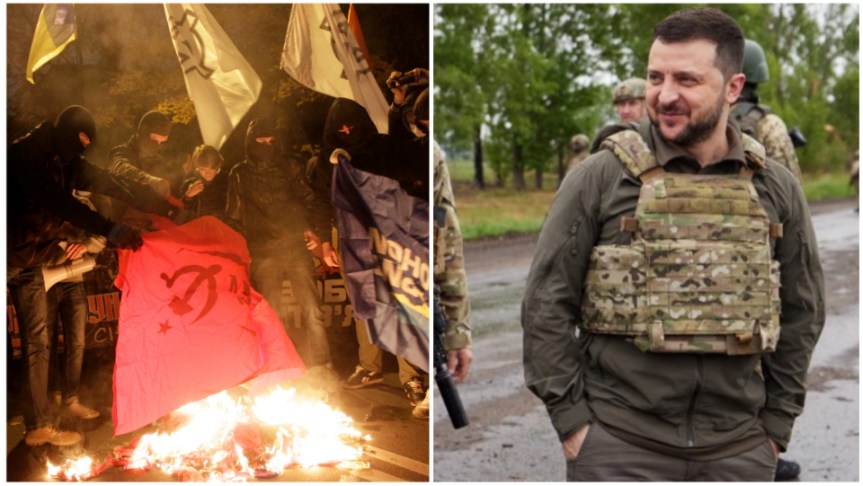
Left: Supporters of the neo-Nazi Svoboda (Freedom) Party burn the flags of the Communist Party of Ukraine and the Party of Regions of Ukraine. Right: Ukrainian President Vladimir Zelensky. | AP photos

South Paris, Maine. August 24, 2023


The arrest on August 16 of Georgi Buiko, a Communist leader, represents the latest and perhaps most significant action taken by Ukraine’s government to rid the country of the Communist Party of Ukraine (KPU). The charges, according to People’s Dispatch, referred to anti-Ukrainian activities and possession of pro-Russian and communist printed material.

Buiko, a key KPU leader, had been a youth leader within the Soviet Union’s Communist Party. Subsequently he was a Party and municipal leader in the Donbass area, secretary of the KPU’s Central Committee, member of the Ukrainian parliament, and a journalist.  Buiko heads the Anti-Fascist Committee of Ukraine.

The Communist Party of Spain condemned Buiko’s arrest and also other government attacks on the KPU. Its statement referred to the report in June from the UN’s High Commissioner for Human Rights which denounced violations of “international humanitarian law” in Ukraine along with arbitrary arrests, secret prisons, and torture.

Buiko’s arrest testifies to a definitive crackdown on Ukraine’s Communists. It began in tandem with an appeals court judgment on July 5, 2022 that confirmed a 2015 court decision declaring the KPU to be illegal. The appeals court ruling authorized the seizing of KPU properties and funds. That it quickly followed the onset of the Ukraine-Russia war on February 24, 2022 was probably not accidental.

The atmosphere turned toxic. Ukrainian President Zelensky on May 14, 2022 banned left-leaning political groups and parties and parties regarded as pro-Russian. The prohibitions did not apply to rightwing and neo-Nazi organizations.

In March of that year, the police in Kiev had already arrested the brothers Aleksander and Mikhail Kononovich on vague charges of pro-Russian attitudes. A court has been deliberating on their case intermittently ever since. The brothers have remained under house arrest for 17 months. They report having received death threats from the police.  

Mikhail Kononovich, addressing the General Assembly of the World Federation of Democratic Youth (WFDY) in Cyprus on December 3, 2019, identified and denounced a rightwing terror campaign against Communists and other opposition groups in Ukraine. Neo-Nazis had brutally attacked the Kononovich brothers a year earlier.

WFDY members have spearheaded demonstrations on their behalf in many countries, particularly in front of U.S. embassies. The Greek Communist Party has prominently defended the imprisoned brothers. 

The KPU’s impact had waned considerably even before wholesale persecution began.  Petro Symonenko, the Party’s former top leader and a prominent member of Ukraine’s Parliament, had been runner-up in presidential voting in 1999. Later, after the so-called Orange Revolution in 2004, the KPU lost most of its electoral appeal. Symonenko ended up supporting Russia in the burgeoning conflict between the two countries. In 2022, in the wake of police raids on his home, he left Ukraine for Russia.

Repression of the KPU manifested in the early stages of that conflict.  A stridently anti-Russian government took power in 2014, with U.S. assistance. Receiving U.S. material aid, Ukraine’s government initiated brutal military action against Russia-friendly separatist forces in southeastern Ukraine’s Donbass region.

Under those circumstances, KPU members experienced physical attacks and Party offices were ransacked. The government produced laws in 2015 requiring that symbols and reminders of Soviet-era Ukraine be removed and prohibiting communist advocacy. The teaching of history in schools would be altered and KGB archives would be newly accessible. 

The legislation promoted recognition of Ukrainian independence leaders extending back to World War II. The honored groups and individuals were predominately fascist in orientation, among them the nationalist leader Stephen Bandera.

Regulations announced in 2019 prohibited the KPU from participating in elections. A court that year banned the pro-communist Workers’ Newspaper (Rabochaya Gazeta), established in 1897.  The newspaper had offended by publishing articles with quotations from Marx and Lenin.

The confluence of vigorous anti-Communism showing up as Ukrainian state policy and U.S. participation in Ukraine’s war against Russia is no mere coincidence. Waging war against a powerful, well-resourced state, Ukraine needs U.S. assistance, and on that account would endeavor to please its essential ally. And the U.S. government sought to make use of Ukraine in order to cut Russia down to size for reasons presumably of global security. There was a meeting of the minds. 

It’s an arrangement that has Ukraine mounting a display of anti-communism for U.S. tastes and its ally relying on red-scare in order to shore up domestic support for its Ukrainian venture, as with past overseas interventions.

Surely Ukraine’s government was aware of its special gift on tap for the U.S. partner.  Anti-communism was the convenient pretext for the U.S. removal of Iran’s Mosaddegh government in 1953, for the CIA-staged coup in Guatemala in 1954, for discarding the Dominican Republic’s “constitutionalist” uprising in 1965, for removing Salvador Allende’s socialist government in Chile in 1973, and so on.

Foreign powerbrokers themselves have benefited from the anti-communist disposition of U.S. governments. The Cuban bourgeoisie and their heirs have relied on U.S. determination to relieve their island of a Communist revolution. Even a progressive Venezuelan government might appreciate the possible usefulness of its current assault on Venezuela’s Communist Party for persuading U.S. officials to ease their economic sanctions.


W.T. Whitney Jr. is a political journalist whose focus is on Latin America, health care, and anti-racism. A Cuba solidarity activist, he formerly worked as a pediatrician, lives in rural Maine. W.T. Whitney Jr. es un periodista político cuyo enfoque está en América Latina, la atención médica y el antirracismo. Activista solidario con Cuba, anteriormente trabajó como pediatra, vive en la zona rural de Maine.

‘Worse than the Special Period’: Cuba’s food situation more desperate by the day / By W.T. Whitney Jr.

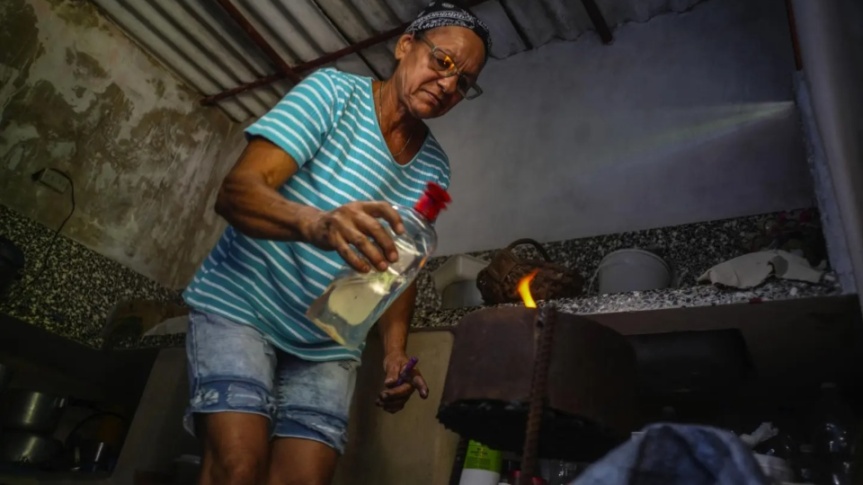
Mariel resident Rosa Lopez lights a charcoal stove to boil sweet potatoes and prepare scrambled eggs with tomatoes for her grandchildren on May 18, 2023. She had just returned from picking up her food rations from a government-run market. At the time, it had been more than a month since any cooking gas had been delivered to the city, so Lopez cooks using charcoal and a wood burning oven. Low agricultural yields, exploding inflation, a lack of gasoline for transportation, and the U.S. blockade have all contributed to soaring food prices. | Ramon Espinosa / AP

Originally posted in People’s World on August 16, 2023


Addressing a meeting of government ministers and the press in Havana on Aug. 11, Cuba’s Vice Prime Minister Jorge Luis Tapia Fonseca exploded when discussing the food crisis gripping the nation.

“It takes work to produce food. Everyone wants food deliveries, but we do nothing to produce it. We lack a culture of production … We don’t need all these papers, or words. When do we begin to plant? Who will do it?”

He was reporting on implementation of Cuba’s 2022 law on Food Sovereignty and Food and Nutritional Security. He noted that food self-sufficiency in local areas is disastrously lagging. Crop yields are low; plant diseases and the lack of inputs has hampered grain production.

The food situation in Cuba is growing more desperate by the day. Residents of the island individually consumed only 438 grams of animal protein per month in 2022, and in May 2023, only 347 grams; recommendations call for ingestion of 5 kg monthly. Not enough chickens were raised last year; poultry meat and eggs remain scarce.

Yields of corn, soy, sorghum and other crops have dropped, and animal feed is mostly unavailable. Therefore, pork production is also down, milk is unavailable to adults, and fewer cattle are being raised. Pasturage is poor, due to drought and no fertilizer.

Farm workers carry a tank of fresh milk to deliver it to a government-run food store in San Nicolas, Cuba, May 19, 2023. Milk is in short supply and reserved for children these days. | Ramon Espinosa / AP

Failures mount

Tapia pointed to the many failures exacerbating the situation. The output of state-controlled food producers is low. Producers, distributers, and institutional consumers don’t regularly contract with one another to facilitate food distribution. Producers aren’t being paid, because credit isn’t available. Cattle-stealing has reached new heights, 44,318 head so far this year.

The Ministry of Finances and Prices issued a report prior to the National Assembly session that recognized high inflation, widespread popular dissatisfaction, and the need for “concrete solutions.” Minister Vladimir Regueiro Ale indicated prices skyrocketed by 39% during 2022 and 18% more so far in 2023.

Inflation, he explained, varies from province to province and may manifest as abusive price-fixing, especially when agricultural supplies and products are in short supply.

Commenting on the report, National Assembly President Esteban Lazo, reminded delegates that diminished production and inflation were connected: “If there is no production and supply, we will not achieve effective control of prices.” He complained that “practically 100% of the food basket is being imported.”

The Assembly’s Food and Agricultural Commission analyzed organizational and management problems and reported that only 68% of expected diesel fuel has arrived so far in 2023, 14,700 tons less than in the similar period a year before; 28,900 tons of imported fertilizer were ordered, but only 168 tons arrived. Cuba’s fertilizer production has been nil this year in contrast to 9,600 tons produced in the same months in 2022.

Lazo communicated a message to Cuba’s Minister of Agriculture from the Assembly, whose recent session ended on July 22. The ministry, he said, would be “transforming and strengthening the country’s agricultural production,” to initiate “a political and participatory movement that would unleash a productive revolution in the agricultural sector.”

Nothing less than a revolution will do

A revolution appears to be exactly what’s needed. The recent National Assembly session dealt almost entirely with Cuba’s present food disaster. The lives of many Cubans are becoming more precarious due to unending food shortages, high prices, and low incomes.

Information emerging from the Assembly’s deliberations attests to the reality of crisis in Cuba, and it means that urgency is building for Cuba’s friends in the United States to resist U.S. policies in new ways, strongly and assertively. Their own government accounts for new suffering and destitution in Cuba.

President Miguel Díaz-Canel emphasized resistance when addressing the National Assembly. He dedicated his remarks to two revolutionary heroes who were present. Admiring how they kept “their foot in the stirrup of difficulties” and their “rifle pointed at mistakes,” he may have been thinking of hard work ahead.

He mentioned “problems of our difficult daily life, such as food production, electricity generation, water availability, crime, rising inflation, abusive prices.”

The president criticized behaviors “that reinforce the omnipresent blockade through inaction, apathy, insensitivity, incapacity, or simple tiredness and lack of faith.”

Díaz-Canel noted approvingly that delegates discussed “closer ties between deputies and the population,” “better management and allocation of the currency,” “greater direct participation of the non-state sector in national production,” “municipal autonomy,” and “downward pressure on prices.”

But it’s not enough. “Above all,” he said, “we must devote ourselves to creating wealth, first of all, by producing food.”

Trouble in the countryside

Cuba’s rural communities are troubled—and shrinking. Soon, “we won’t have any people left in the countryside,” one delegate said. Another called for improved “roadways, housing, and connectivity.”

No fuel means most people in rural areas are resorting to bicycles or horse carts to travel short distances. | Ramon Espinosa / AP

Regarding the low level of agricultural skills among the rural population, someone called for teaching in “agroecological techniques” and “good practices for the producing, processing, and commercialization of food.”

The idea has been circulating for a while now that greater local autonomy might help spur food production, but efforts at prompting that devolution of initiative have seen a slow uptake. As of April 2023, aspiring farmers had not yet taken possession of 258,388 hectares of idle land made available to them without cost under land-tenure reforms in 2008.

Frei Betto, Brazilian friend of revolutionary Cuba and adviser to Cuba’s Food Sovereignty and Nutritional Education Plan, visited Cuba in June. In his assessment, the “current shortages are more severe than in the Special Period (1990-95),” when Cuba’s economy nearly collapsed following the withdrawal of Soviet aid and the contraction of trade with the socialist bloc of nations.

He indicated that Cuba now imports 80% of the food it consumes, up from 70% five or so years ago, and that it costs $4 billion annually, up from $2 billion. For corn, soy, and rice alone, the outlay now is $1.5 billion annually.

He indicated, too, that a ton of imported chicken meat now costs $1.3 million, up from $900,000 a year ago, that “the wheat supply has worsened,” that milk production is down 38 million liters in one year, and that less oil from Venezuela, thanks to U.S. sanctions there, means further reduced food production in Cuba.

Blame the blockade, but not only

The origins of food shortages in Cuba and the mode of U.S. intervention are highly relevant in understanding the current situation, as every Cuban knows.

To be sure, the shortages plaguing the people are not solely due to U.S. policies. Drought, hurricane damage, marabou shrub infestation, soil erosion, high soil acidity, poor drainage, and lack of organic material soil have all contributed.

The still-prevailing bureaucratic and centralizing tendencies of the Cuban government’s economic management also play a role.

The U.S. economic blockade, however, remains central to understanding what’s happening. The creation of a food crisis was among the original proposals put forward by State Department official Lestor Mallory in 1960 for how to overthrow Cuba’s revolutionary government. The program: Use “hunger and desperation” to spark the “overthrow of government.”

Aid from and trade with the socialist world frustrated U.S. efforts and kept disaster at bay for decades, but eventually the Soviet Union and socialist Eastern Europe fell. The U.S. government seized the moment and passed legislation tightening the economic blockade in 1992 and 1996 and, later, designated Cuba a terrorist-sponsoring nation.

Beyond bans on products manufactured or sold by U.S. companies, proscribed categories soon included products manufactured by foreign companies associated with U.S. ones and products containing 10% or more components of U.S. origin. Now, foreign enterprises active in Cuba faced possible U.S. court action.

International loans and international transactions in dollars are usually off-limits. Payments abroad don’t reach destinations. Income from exports doesn’t arrive.

Think imports of seeds, fertilizers, herbicides, pesticides, breeding stock, veterinary supplies and drugs, new equipment, spare parts, exports of coffee, rum, and nickel. Think loans for purchasing food and more, loans for agricultural development. Think impediments to restoring rural infrastructure.

Farm workers wait in line to refuel their tractors on the highway to Pinar del Rio, Guanajay, Cuba, May 18, 2023. Cuba is in the midst of a major fuel shortage that has drivers and farmers waiting in line for days or even weeks to gas up their vehicles and tractors. | Ramon Espinosa / AP

The blockade, the U.S. tool of choice, has hit food production in Cuba hard. It is far along in achieving its ultimate purpose. Cuba needs a new order of support from friends in the United States─Marti’s “belly of the beast.”

Cuba needs friends more than ever

Many have so admired Cuba’s brand of socialism as to assume that Cuba’s social gains and exuberant international solidarity would fire up such enthusiasm that, along with considerations of fairness, legality, neighborliness, and revulsion against U.S. cruelty, would make U.S. policymakers think anew about Cuba. It never happened.

Now at a watershed moment in Cuba, a new direction is necessary, one all about persuading, organizing, and unifying left-leaning political groups and anti-war, anti-empire activists of all stripes. Leadership is needed.

Frei Betto says that, “It is time for all of us, in solidarity with the Cuban Revolution, to intensify the struggle against the U.S. blockade and mobilize international cooperation with the island that dared to conquer its independence and sovereignty against the most powerful and genocidal empire in the history of mankind.”


We hope you appreciated this article. At People’s World, we believe news and information should be free and accessible to all, but we need your help. Our journalism is free of corporate influence and paywalls because we are totally reader-supported. Only you, our readers and supporters, make this possible. If you enjoy reading People’s World and the stories we bring you, please support our work by donating or becoming a monthly sustainer today. Thank you!


W.T. Whitney Jr. is a political journalist whose focus is on Latin America, health care, and anti-racism. A Cuba solidarity activist, he formerly worked as a pediatrician, lives in rural Maine. W.T. Whitney Jr. es un periodista político cuyo enfoque está en América Latina, la atención médica y el antirracismo. Activista solidario con Cuba, anteriormente trabajó como pediatra, vive en la zona rural de Maine.

A Plea for Simón Trinidad / By W. T. Whitney Jr.

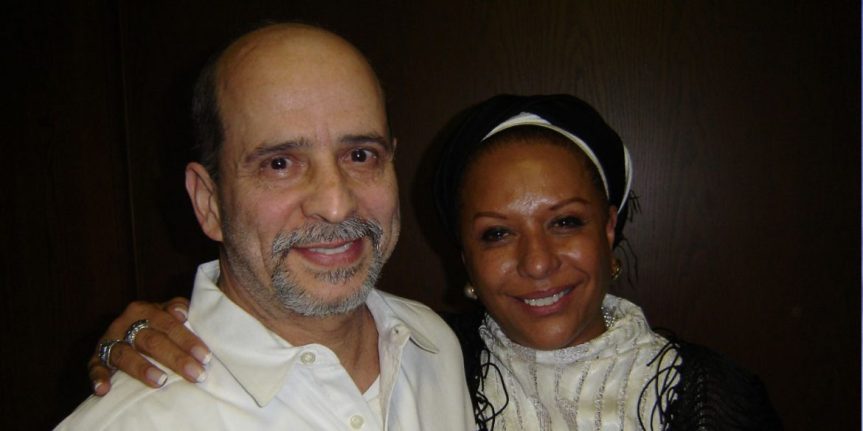
“Simon Trinidad” and Piedad Cordoba (Image: Piedad Cordoba)

South Paris, Maine


The title recalls the title of Henry David Thoreau’s essay “A Plea for Captain John Brown.” Trinidad, like John Brown, is remarkable for his implacable resolve and regard for justice.

Trinidad was 58 years of age when a U.S. court in 2008 sentenced him to 60 years in prison. His alleged crime was that of conspiracy to hold hostage three U.S. drug-war contractors operating in Colombia. In effect, he is serving a life sentence. He had nothing to do with the hostage-taking.

The contractors, captured in 2003, went free in 2008. U.S. drug war in Colombia has obscured the big U.S. role in Colombia’s war against leftist insurgents, primarily the Revolutionary Armed Forces of Colombia (FARC).

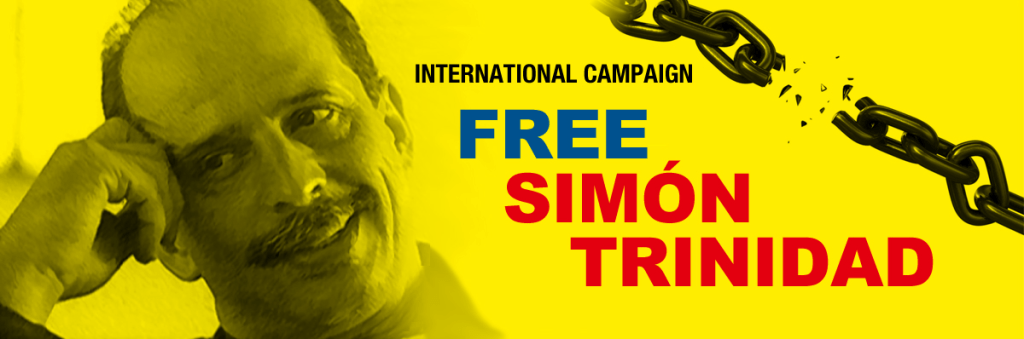
Simon Trinidad

Simón Trinidad was a FARC leader. The FARC and Colombia’s government signed a peace agreement in 2016 and Trinidad and other ex-combatants expected to be part of a peace process. Now he is a prisoner in a super-max prison in the United States and is confined to his cell for all but two hours per day, receives no mail, and is allowed very few visitors.

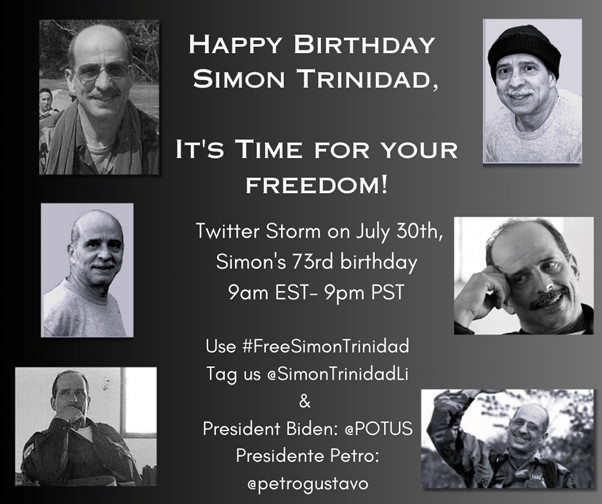
On July 27, Simón Trinidad unexpectedly was a featured item in the news in Colombia. An undated letter he had written to Colombian chancellor Álvaro Leyva requesting repatriation to Colombia had appeared on social media. News reports were reproducing it.

Observers associated Trinidad’s letter with the U.S. government’s announcement the day before that the bloodthirsty former paramilitary chieftain Salvatore Mancuso, also jailed in the United States, soon would be extradited to Colombia. President Gustavo Petro designated Mancuso as a “promotor of peace.”

Trinidad, not so favored as this, in his letter wrote of his determination to testify before the Special Jurisdiction for Peace, as other former FARC combatants have done, and Mancuso too, virtually. This court, established under the Peace Agreement of 2016, offers former combatants an opportunity to tell the truth about crimes they may have committed during the civil war and, having done so, to be pardoned or punished.

Trinidad apparently hopes not only that that Chancellor Leyva will inform the U.S. Secretary of State of his request to be repatriated but also that his message will be passed on to President Biden, who has the power to release him from prison.

Progressive Colombian Senator Iván Cepeda, “one of the people who speaks of peace on behalf of President Gustavo Petro,” welcomed “Simón Trinidad’s proposal [and] sent it directly to Chancellor Álvaro Leyva.”

Trinidad had joined the left-leaning Patriotic Union (UP) electoral coalition after it formed in 1985. A year later, paramilitaries began their massacre of UP adherents that, with impunity from Colombia’s government, lasted for years. In response, Trinidad in 1987 joined the FARC and, in the process, dropped his name Ricardo Palmera Pineda. For the FARC, Trinidad was responsible for political education and propaganda and was a negotiator.

The U.S. government in 2000 introduced its “Plan Colombia” through which Colombia’s military secured U.S. weapons and training assistance; U.S. troops and military contractors were deployed in Colombia. The appearance of Plan Colombia doomed peace negotiations between the FARC and Colombia’s government that were in progress at the time.

As a lead FARC negotiator in those talks, Simón Trinidad became known to international observers. His course with the FARC ended abruptly on January 2, 2004, when Colombian military personnel and the CIA seized him in Quito. Trinidad was there seeking UN assistance for a proposed prisoner exchange.

Colombia’s government extradited Trinidad to the United States on New Year’s Eve, 2004. According to his U.S. lawyer Mark Burton, Trinidad’s U.S. captors regarded him as a “trophy prisoner.”

Trinidad’s U.S. handlers had to stage four trials for them to finally gain a conviction. His capture and his multiple appearances in U.S. courtrooms from 2005 to 2008 served as real-time advertising that testified to U.S. commitment to anti-insurgency war and drug war in Colombia.

Trinidad’s misfortune was to have fallen into the clutches of a nation whose record on prisoners is horrific. After all, “The United States stands alone as the only nation that sentences people to life without parole for crimes committed before turning 18.” (No wonder: of 196 countries, only the United States has yet to ratify the UN’s Convention on the Rights of the Child.)

As a U.S. political prisoner, Simón Trinidad harks back to the Scottsboro Boys, who in Alabama faced death penalties in the 1930s; to Communist Party members jailed under the Smith Act; to Black Panther Party members caught up in the U.S. government’s COINTELPRO project. Simón Trinidad is also representative of prisoners gathered up in U.S. wars and other interventions abroad. They include: Ricardo Flores Magón, Mexican revolutionary who died in Leavenworth Federal Prison in 1922; the “Cuban Five” prisoners who resisted U.S. hostilities against Cuba; and the unfortunates ending up in the U.S. prison in Guantanamo during and after the Iraq War.

Despite the Peace Agreement, paramilitaries or other thugs have since killed almost 400 former FARC fighters; 300 FARC prisoners of war are still in prison almost seven years later.

Violence in the countryside persists. Colombia’s military is unable or unwilling to suppress a new breed of paramilitaries. One report highlights the paramilitaries’ “symbiotic relationship with Colombian state actors.” Declassified State Department and CIA documents from George Washington University’s National Security Archives say the same. The plot thickens: the tight relationship between the U.S. and Colombian militaries and the U.S. alliance with Colombia’s government together suggest U.S. complicity with a violence that Colombia’s Army and state are unable or unwilling to control.

The bad news for Simón Trinidad is that the U.S. government is betting not on peace in Colombia, but on continuing war. For that reason, Simón Trinidad confronts formidable barriers in satisfying his need to join Colombia’s peace process. Mark Burton’s words end this report: “Simón Trinidad is a man with a clear vision for a new Colombia, a Colombia in peace and with social justice. Colombia needs to listen to his voice, his vision, his proposals for peace. His continued imprisonment in the United States on false charges is an insult to Colombia, its history, and its people.”

Burton’s comments appear in a remarkable new eBook, accessible here. It contains commentary, in Spanish, from activists, writers, and intellectuals seeking Trinidad’s repatriation. The announcement of this book offers a video presentation, here, of reflections and documentary material.


W.T. Whitney Jr. is a political journalist whose focus is on Latin America, health care, and anti-racism. A Cuba solidarity activist, he formerly worked as a pediatrician, lives in rural Maine. W.T. Whitney Jr. es un periodista político cuyo enfoque está en América Latina, la atención médica y el antirracismo. Activista solidario con Cuba, anteriormente trabajó como pediatra, vive en la zona rural de Maine.