US Must Return Its Political Prisoner Simón Trinidad to Colombia – W.T. Whitney Jr.

In this Jan. 13, 2002 photo, Commander of the Revolutionary Armed Forces of Colombia, (FARC) Simón Trinidad reads a declaration during a press conference in Los Pozos, Colombia. | AP

Murderous violence and oligarchy were at the center of Colombian political life during the 20th century. Colombians by the millions were marginalized, impoverished, and/or displaced from small land holdings. Violence and the failings of liberal democracy turned Simón Trinidad into a revolutionary. Few in the United States and Europe know about him. Colombia’s allies in both places overlook the Colombian terror regime. 

Simón Trinidad matters; his time has come. This leader of the former Revolutionary Armed Forces of Colombia (FARC) faced bizarre and unfounded criminal charges in a U.S. court. He’s being held under the cruelest of conditions in a federal prison in Florence, Colorado. He will die there unless he is released. Simón Trinidad will be 70 years old on July 30. 

An international campaign is demanding that the U. S. government return Simón Trinidad to Colombia. What follows is an appeal on behalf of that campaign. Here are some facts: 

Trinidad’s birth name was Ricardo Palmera. His family included lawyers, politicians and landowners and was based in Valledupar, Cesar Department, Colombia. There, Palmera worked as a banker, taught economics in a regional university, and managed his family’s agricultural holdings. Affiliated with the Liberal Party, he favored agrarian reform. Then Palmera joined the left-leaning Patriotic Union, formed in 1985.   

That electoral coalition was immediately smothered in violence and murder. Palmera’s close comrades were being killed. Others departed for exile. On October 11, 1987, assassins killed Patriotic Union presidential candidate Jaime Pardo Leal, someone whom Palmera greatly admired. Discovering that he too was about to be killed, Palmera left Valledupar and joined the FARC. He took the name Simón Trinidad.

With that insurgency, Trinidad was responsible for propaganda and political education. He served as a peace negotiator. In December, 2003, Trinidad was in Ecuador preparing to meet with United Nations official James Lemoyne to discuss FARC plans to liberate hostages. On January 2, 2004, he was arrested there – with CIA help – and within two days had been delivered to Colombia. He remained in custody until December 31, 2004, when the Colombian government extradited him to the United States.

Simón Trinidad faced four jury trials between October, 2006 and April, 2008. The first trial ended in a deadlocked jury, the second one yielded a conviction, and the third and fourth trial each ended with juries deadlocked on a drug-trafficking charge. He was convicted of having conspired with other members of the FARC – terrorists in U. S. government eyes – to capture and hold hostage three U.S. drug-war contractors. 

Trinidad’s first trial judge was replaced after he had illegally interviewed jurors to secure information potentially useful to the prosecutors in his second trial. 

The new judge sentenced Simón Trinidad to 60 years in prison, 20 years for each of the three U.S. contractors being held hostage by the FARC. Trinidad was 57 years old.

He is serving his sentence at a U.S. “supermax” federal prison. Trinidad remained in solitary confinement from the time of his arrival in the United States until 2018. Now he may eat a midday meal in a dining hall. He is not allowed to receive letters, emails, or periodicals. Phone calls are limited.  Visitors are rare and very few, apart from his U.S. lawyers. 

Peace negotiations between the FARC and Colombian government took place in Havana from 2012 until 2016. The FARC delegation sought Simón Trinidad’s presence there as spokesperson and negotiator. Colombia’s government never requested authorities in Washington to release him for that purpose. There’s no indication that the latter would have done so. 

The eventual Peace Agreement provided for a “Special Jurisdiction for Peace.” There, former combatants on both sides of the conflict have the opportunity, if they choose, to speak the truth about crimes they may have committed and have the court decide upon pardon or punishment. Simón Trinidad chose to participate. To do so he needs to be in Colombia.

Making the case

As someone who sought justice for the oppressed and was faithful to his principles, Trinidad now is asking for justice for himself. Some solidarity activists may justify their support for him on the basis of only one or two aspects of his political life. Actually, there’s a full menu of good reasons for demanding that the U.S. government return Simón Trinidad to Colombia. 

1. The U.S. government must allow Simón Trinidad to appear before the Special Jurisdiction for Peace. It would thereby show respect for the Peace Agreement between the FARC and Colombian government.

2. The U.S. government has violated Trinidad’s basic legal and human rights. Trinidad was extradited as a drug-trafficker, which he was not. He was guilty of rebellion, which is a political crime. Extradition treaties and international human-rights law prohibit extradition for political crimes. The U.S. government subjected Trinidad to irregular court proceedings. His judge applied a wildly excessive sentence to a crime he didn’t commit. His prison conditions are inhumane. 

3. U.S. intervention in Colombia occasioned Simón Trinidad’s mistreatment at U.S. hands. His rescue would have anti-imperialist overtones. The U.S. government has long provided Colombia with military assistance, notably through its Plan Colombia, in effect after 2000. While ostensibly targeting drug-traffickers, Plan Colombia laid siege to the FARC. As a highly visible FARC peace negotiator in talks with the Colombian government in Caguán (1999-2001), Simón Trinidad became a trophy prisoner.  Plan Colombia set the stage, having already helped torpedo the peace talks. 

On display with Trinidad’s capture and extradition was the top-down nature of imperialist relations with client nations. Perhaps to please its boss, Colombia’s government almost immediately signaled its intention to extradite Trinidad to the United States, doing so even before a criminal charge had been announced. And Colombia’s political opposition regularly claims that national sovereignty is diminished every time prisoners like Simón Trinidad are referred to the United States for prosecution and punishment.

4. Solidarity activists in many countries have long admired those working and marginalized peoples in Colombia who have stood up to a ruling class intent upon plunder and oppression. They did so by joining indigenous and Afro-Colombian resistance movements, labor unions, leftist political parties, the FARC and other insurgencies. Simón Trinidad was in that fight. On that basis too he is worthy of support in his campaign to return to Colombia.   

5. Simón Trinidad was and is a revolutionary. The job description of progressives everywhere is to fight oppression and injustice. But now many of them are learning the truth about capitalism. They see climate change on the horizon and pandemic and economic collapse already here. Many of those who now embrace the revolutionary option have good reason to be at Simón Trinidad’s side. 

As a member of the FARC, Simón Trinidad saw violence against the Patriotic Union turn into massacre. Many of the estimated 5000 murder victims were former FARC members who were participating in electoral politics. Murderous violence and war between rich and poor are still at the center of Colombian politics. Following the signing of the Peace Agreement, assassins have killed more than 200 ex-FARC combatants and hundreds of community and political leaders, mainly in rural areas. The U.S. government, allied to the partisans of violence in Colombia, is complicit. 

That kind of violence helped to put Simón Trinidad on the revolutionary path. One good way to demonstrate abhorrence of U.S. promotion of violence in Colombia, we think, is to join the fight for Simón Trinidad’s return now to Colombia. 

For more information about the campaign to return Simón Trinidad to Colombia, go to https://www.libertadsimontrinidad.com/. Contact simontrinidadlibre@gmail.com. with questions or with your offer to join the campaign.  
Economic Collapse and Unemployment Councils – Then and Now – W.T. Whitney Jr.

By W. T. Whitney Jr. – June 10, 2020

Hunger, homelessness, and evictions were features of the Great Depression in the United States. Jobs disappeared and working conditions deteriorated. Some “250,000 teenagers  were on the road.” And how many others? By 1933 one third of farm families had lost their farms. Unemployment that year was 25 percent. The lives of working people were devastated. 

The federal government’s New Deal led to political and social reforms. Now the U.S. government once more has a big economic crisis on its hands, this one associated with the COVID 19 pandemic. It’s providing mostly financial relief, with a lot going to big economic players. 

During the Great Depression, people responded at the grassroots level too, particularly in urban neighborhoods. In the midst of another economic crisis, it makes sense that something similar happen again. This report is about a grassroots tool of 90 years ago and about its potential usefulness now. As will be seen, assaults on working people are harmful enough now to provide ample justification for possobly picking up that tool again.   

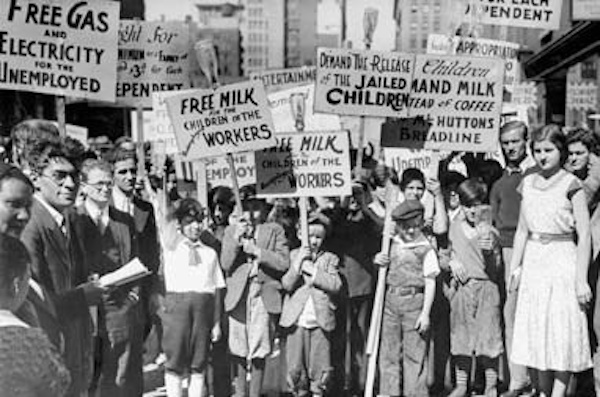
In fact, workers and their families created their own means of rescue as the Great Depression took hold. Demanding food, housing, and jobs, they organized, agitated, and prodded politicians to provide relief and reform. They did so through the Unemployed Councils. New in early 1930 and organized by the Communist Party USA, the Councils took root in many cities. 

They came into being step by step. In 1929 the Comintern decided that capitalist crisis manifesting as a worldwide economic depression required a “revolutionary offensive.” Responding, the CPUSA formed its Trade Union Unity League. That organization set up “Councils of Unemployed Workers.” According to a Party publication, “the tactical key to the present stage of class struggle is the fight against unemployment.”  

At once the Unemployment Councils organized unemployment protests that swept across the country. March 6, 1930 was designated as “International Unemployment Day,” a day when  one million demonstrators filled the streets of cities. 

Thousands of police violently attacked more than 100,000 workers filling New York’s Union Square. Demonstrations continued over several months in many cities, as did police harassment. New recruits flooded the Unemployment Councils. March 6 became an annual occasion for repeat nationwide demonstrations.

The Unemployment Councils, functioning autonomously in urban neighborhoods, pressured local relief officials to assist individuals and families. They badgered utility companies to restore gas or electricity to non-paying households. The Councils organized rent strikes beginning in 1931. They recruited crowds that, having overwhelmed the police and local officials, allowed evicted tenants to return to their dwellings. Council activists besieging city offices demanded reduced rents and no more evictions.

The Unemployment Councils reached out to Black workers, even in southern cities. Actions of the Unemployment Councils helped provide impetus for New Deal reforms like unemployment insurance, protection of labor rights, and security for elderly Americans and children.  

Hunger marches organized by the Unemployment Councils took place in various cities from 1931 on. The police killed five people marching in the “Ford Hunger March” in Dearborn, Michigan on March 7 1932; 60,000 people joined the funeral procession. At a national hunger march converging on Washington on December 7,1931, marchers demanded unemployment insurance and a “social insurance system to cover maternity care, illness, accidents, and old age.” 

A year later even more marchers, mainly Communist Party members, descended on Washington for a repeat national hunger march. They called forjobs, relief measures, taxation of the wealthy, and an end to racial discrimination. Members of Congress met with march leaders. The Roosevelt administration would soon direct states to expand relief efforts and promote job programs.   

           The CPUSA set up “The Unemployment Council  of the U.S.A.” in 1931 in part to deal with rapid turn-over of community activists affiliating with local Councils. The problem would remain. The national Council provided local Councils with guidance on national and international issues. Even so, individual Councils focused primarily on the hardships and needs of workers and their families, in their own neighborhoods. 

The national organization in 1932 published a 20-page pamphlet titled: “Fighting Methods and Organization Forms of the Unemployed Councils: A Manual for Hunger Fighters.” The introduction begins: 

The Unemployed Councils base their program on a recognition of the fact that those who own and control the wealth and government are willing to allow millions to suffer hunger and want in order that their great wealth shall not be drawn upon for relief. We know that the living standards of employed and unemployed alike will be progressively reduced unless we organize and conduct united and militant resistance. We know that the amount and extent of relief which the ruling class can be compelled to provide depends upon the extent to which the unemployed and employed workers together organize and fight….”  

The trajectory of the Councils changed. New Deal relief programs took effect, and the Communist Party, following the lead of the Comintern, turned to alliances with other progressive forces. This was the Popular Front. The Unemployment Councils gradually gave way to the Workers Alliance of America, formed by the CPUSA in 1936 and based in Washington. The Alliance welcomed Socialist Party unemployment groups and pacifist A.J. Muste’s Unemployment League. Its activities centered on lobbying for relief measures and worker protection.

Pandemic and sick economy

The Unemployment Councils were new and, within the context of that era, were extraordinary. They attended solely to the needs of workers. They were based in local communities. And they were a creature of the Communist Party. Their time may have come again.

One determining factor is the severity of the current economic collapse and its impact on the lives of working people. Indeed, this crisis looks like it’s going to hurt workers and their families as much as did the Great Depression. The assumption here is that the extraordinary nature of the present danger to working Americans must be appreciated in order to accept the idea that an extraordinary instrument of repair, the Unemployment Councils, is required once more.    

Unemployment – As of early June, 42.6 million U.S. workers had filed unemployment claims. The official unemployment rate was 14.7 percent in April, 13.3 percent in May. In May the official rate for Black people was 16.8 percent and for Latinos, 17.6 percent. However, “a quirk in BLS methodology” (Bureau of Labor Statistics) misclassified people absent from work due to COVID 19. The actual unemployment rate in April was 23.6 percent. According to economist David Ruccio, the total of the underemployed plus the officially unemployed represents 31 percent of the U.S. labor force. 

Significantly, ”39 percent of employed people in households making less than $40,000 lost their job or [had] been furloughed in March.” Official unemployment figures don’t include the chronically non-employed. The Brookings Institute reports that, in 2017, 15 percent of “American men between the ages of 25 and 54” were not working for a variety of reasons, imprisonment and others. 

Housing Loss – That many workers can’t pay rent sets the stage for evictions. Signs of tenant resistance have cropped up. For instance, Rent Strike 2020 is a “disaster relief organization owned and controlled by regular working people.” It demands that states “freeze rent, mortgage and utility bill collection for 2 months, or face a rent strike.” According to the website westriketogether.org, 33 percent of residential tenants didn’t pay rent in May and almost 350,000 tenants have signed a rent-strike pledge. 

Access to Health Care – Many of the newly unemployed have lost their employer-based healthcare insurance. They can’t pay for health care and soon will total 11 million working people. A crisis of access existed already. In 2018, no less than 30.1 million people under the age of 65 lacked health insurance. In 2019, 28 percent of adults with employer-based health insurance were underinsured.  

Food is short – The Brookings Institute recently declared that, “By the end of April, more than one in five households in the United States, and two in five households with mothers with children 12 and under, were food insecure “ In April, “21.9 percent of households with nonelderly adults were food insecure”. 

Dairy farmers are dumping milk. Hog and chicken farmers are killing their animals and growers are plowing crops into the ground. These are “scenes reminiscent of the Great Depression,” and, says the Guardian, “overproduction will sour the market.”  This is a crisis of capitalism.  

Racism – Non-white populations are vulnerable. They are generally sicker than white people from illnesses like diabetes, cardiovascular disease, asthma, HIV, morbid obesity, and kidney disease. That’s mostly because racial discrimination encourages low-quality health care, reduced access to care, and lack of preventative care. Racism forces a disproportionate number of non-white workers to live in places full of environmental toxins. The stress of living under racism may lead to or worsen  physical illnesses.

These points of vulnerability translate into high risk, plainly evident as African Americans and Latinos people confront the COVID 19 virus. One report has it that “COVID-19 mortality rate [in May] for Black Americans is 2.4 times as high as the rate for Whites and 2.2 times as high as the rate for Asians and Latinos.” Latinos, 18 percent of the U.S. population, in April accounted for 25 percent of COVID 19 deaths. Death rates for Blacks and Latinos living in cities range from two to four times higher than white people living in cities.

At issue here is suffering caused by economic crisis. Resilience helps economically-abused victims survive, and resilience may be in short supply for a class of people hit exceptionally hard by the COVID 19 virus. Besides, most of these victims are members of the working class, and they are more likely than higher-income employees to have been working “in public-facing occupations” and to experience  “inequitable distribution of scarce testing and hospital resources.” 

Women are victimsAccording to one report, the “hardest hit [during the pandemic] will be the world’s women and girls and populations already impacted by racism and discrimination …  Women are 70 percent of the global health workforce and the majority of social workers and caregivers.” Theydeliver 70 percent of global caregiving hours.” The report does not mention that these multitudes of women doing necessary work belong overwhelmingly to the working class, in the United States and elsewhere.

The broad conclusion here is that the impact of this economic downturn has been and will be disastrous for working people, extraordinarily so. The usual governmental remedies seeking to balance worker and business interests won’t adequately serve the working class. Too often what is done ends up pitting the needs of workers against the needs, real and imagined, of those who lack for nothing. And guess who losses out! 

The Unemployment Councils provided an extraordinary boost in their time to workers and their families. A return engagement is in order, in one form or another.  

A peripheral concern must be attended to. The argument may be advanced that this economic crisis will be brief and so why go to all the trouble? No, it will not be brief. 

U.S. delay in preventing spread of the virus allowed the pandemic to build. Lax social-distancing and irregular quarantine will ensure its prolongation. A comprehensive regimen of testing, tracing of contacts, and quarantine would have made all the difference, according to a medical expert. 

The virus has charge of the U.S. economy, said Federal Reserve Chair Jerome Powell: “We are now experiencing a whole new level of uncertainty, as questions only the virus can answer complicate the outlook.” (NY Times, May 21) 

Besides, an already flawed U.S. economy doesn’t rate a quick fix. It was already stumbling due to “stagflation” (inflationary tendencies co-existing with stagnant economic output), unpayable debt, and financialization. The latter signifies diminished productive capacity. 

Correlations

This report on the potential usefulness now of Unemployment Councils is of an introductory nature.  Even so, it does appear that the Councils have great potential to meet the needs of many working people in great trouble now in the United States – but not all of them.  

The Councils’ usefulness would rest on conditions under which they would be applied.  One would be that they deal with unemployment, lack of housing, and hunger. These are problems presenting both now and then in roughly similar fashion. Another would be that Councils of today pay heed to features characterizing their performances then. These included: attention to workers’ most pressing social and economic needs, rapid response, militancy, and long-term revolutionary goals. All were crucial to the Councils’ achievements. 

Other problems of today don’t fit with interventions of the kind offered years ago by Unemployment Councils.  These are: reduced access to healthcare, racial inequalities, and gender inequalities. They were as problematic then as they are now, but society and even worker organizations of that time either accepted the injustices they represented or weren’t prepared to engage with them.  

Those still unmet needs do demand attention now and any version of renewed Unemployment Councils would have to accommodate them. The difficulties in doing so represent a threshold that revived Unemployment Councils would have to overcome. How that would happen without major revamping is unclear.  

A full inquiry into the history and potential use of Unemployment Councils would require study of the feasibility of putting them into effect. However, doing so in the detail that is required and with any sort of comprehensiveness is beyond the scope of this introductory note. Suffice it to say – and in conclusion –that to revive effective and strong Councils today would be no easy task. The precondition for doing so may not yet exist. What’s required, as it seems, is the reality of support now, or the promise of support, emanating from ongoing popular mobilization with a working-class focus.

It was different earlier. Communist organizers in the 1930s drew upon enthusiasms left over from the socialist and workers’ movements that had peaked two decades previously. They also took new encouragement from socialist revolution in Russia in 1917. 

N. B. Historian Roy Rosenzweig’s chapter appearing in “Workers’ Struggles, Past and Present,” edited by James Green (1983) provided much of the information appearing here on Unemployment Councils. 

For Cuba and Venezuela, US Silence May Not Be Golden – W.T. Whitney – May 16th, 2020

The U. S. President and his Secretary of State frequently expound about the supposed failings of enemies abroad. Recently they’ve blasted China’s response to the pandemic, Venezuela’s dictatorship, Cuba’s “slave doctors” overseas, and even Iranian border guards beating up on Afghan migrants. But they’ve been mostly silent about two recent disruptions of the imperialist status quo.

Firing his AK-47 automatic rifle, an apparently mentally-ill Cuban émigré on April 30 caused serious damage to the Embassy building and the bronze stature of Cuban national hero Jose Marti. The only peep of official reaction came from the U.S. Embassy in Havana.  Charge daffaires Mara Tekach stated that, “the U.S. Embassy condemns the shooting” and “the United States takes its Vienna Convention responsibilities very seriously.”  

Her reference was to the multi-lateral United Nations agreement of 1961 that converted national customs into international norms for conducting diplomatic relations. The requirement emerged for host governments to protect the envoys of enemy countries and to respect “the inviolability of mission premises.” 

Assailant Alexander Alazo told investigators that if Ambassador José Ramón Cabañas had appeared at the door, he would have killed him. There were no injuries.  Washington authorities detained the shooter and charged him with assault with intent to kill and possession of an unregistered firearm. The incident was characterized as a hate crime. That it was: generations of U.S. politicians and Cuban – American political leaders have been railing against Cuba.  

Ambassador Cabañas declared that, “Neither State Department officials nor the Secretary of State Mike Pompeo has issued even one formal public condemnation of the attack.” Instead, “the Secretary inveighed against the Cuban medical brigades that today are offering assistance in dozens of countries in the world.” 

At a press conference May 13, Cuban Foreign Minister Bruno Rodríguez blamed the U.S. government for “complicit silence” in regard to “a grave terrorist attack” and for using “hate speech” that is a “permanent instigation to violence.”  

Rodríguez mentioned the accused shooter’s attendance at the Doral Jesus Worship Center in Florida. Frank López, the pastor there, is friendly toward “Senator Mark Rubio … and other known extremist figures.” Plus, the “U.S. Vice President … recently visited that church,” and in 2019 gave a speech there “openly hostile to Cuba.”  

Clearly, the U. S. blind eye toward Cuban-American paramilitary conspiracies, the U.S. turn to germ warfare, and a U.S. economic blockade directed at causing human misery are all manifestations of hatred. That’s so also with the impunity awarded arch-conspirators like Luis Posada and Orlando Bosch.

Cuba’s representatives serving abroad are no strangers to hatred manifesting as terrorism. A recent historical survey provided by Cuba’s security services cites: “83 attacks against Cuban embassies throughout the world and 29 attacks against Cuban diplomats with eight deaths as the result of terrorism encouraged, financed, or allowed by Washington.” 

Another mission of hate and terror emerged on May 3-4; a small invasion force of mainly Venezuelan Army deserters attempted to invade Venezuela from the sea. As with the Embassy affair, U.S. leaders said very little.

Venezuela’s Army and civilian militia quickly finished off the expedition, which had departed from northeastern Colombia. One of their number, a former U.S. Special Forces soldier, told his captors that the purpose of the force had been to seize President Nicolas Maduro and take him to the United States. Florida-based company Silvercorps USA had charge of the operation. 

The company’s owner is U.S. Special Forces veteran Jordan Goudreau.

Goudreau had recruited former Green Berets to supervise the training of the dissident Venezuelan troops. Two of them are now prisoners in Venezuela.  

Venezuelan opposition figures had contracted with Goudreau and Silvercorps USA to carry out the invasion. A contract worth $212.9 million was signed in an expensive condo in Miami. Venezuelan oil resources stolen by the U.S. government served as guarantee for the transaction.  

U.S. leaders said little about the assault. Secretary of State Pompeo indicated that, if necessary, “We will use every tool that we have” to retrieve the two captured U.S. mercenaries. President Trump remarked only that he “wouldn’t send a small, little group. No, no, no. It would be called an army. It would be called an invasion.”  

Trump might have remained totally silent in view of his personal connection with Silvercorps USA.  President Maduro on May 4 declared that two of the Silvercorps invaders were “members of the security team of the president of the United States.” Goudreau reportedly “worked as security at Trump rallies” – one in Charlotte, NC , for example – and “Silvercorp USA also apparently provided security for a Trump rally in Houston.” 

According to the company’s website, “We provide governments and corporations with realistic and timely solutions to irregular problems.” Jordan Goudreau has “planned and led international security teams for the president of the United States as well as the secretary of defense.” 

A mix of nefarious connections, hatred, and terrorism contributed to these irregular attacks on Cuba and Venezuela. Such material does not lend itself to official pronouncements. That nothing is said about the incentive for the two actions also makes sense.

Cuba and Venezuela put people and people’s basic needs first. They exemplify an alternative to U.S. purposes. Those in charge in Washington, imperialists to the core, seek to preserve the profiteering, market-based political and economic system that holds most of the world in its grip. Employing terrorism and military aggression, they stop at nothing.