
Brazilian Workers Lead in Offering Solidarity to Venezuelans under US Attack / By W.T. Whitney Jr.

The leader of Brazil’s Landless Rural Workers’ Movement (MST), João Pedro Stédile, declares solidarity with the Venezualan government and people as they are threantened by a U.S. military intervention | Photo credit: brasildefato.com

South Paris, Maine


Since August, U.S. warships, fighter planes, and troops have deployed in Caribbean waters off Venezuela and in Puerto Rico. Venezuela’s neighboring countries in Latin America and the Caribbean area are reacting variously. Many oppose U.S. aggression, but at a distance.  Others are either non-committal or accepting.

Colombia and Brazil are backing Venezuela – or soon will be –  in very different ways. Recent remarks of João Pedro Stédile, co-founder and a director of Brazil’s Landless Workers’ Movement (MST), warrant special attention.

U.S. attacks from the air have killed dozens of crew members of boats alleged to be carrying illicit drugs. U.S. accusations against Venezuelan President Nicolás Maduro that he is a top-level drug dealer, serve as pretext. The U.S. government now offers a $50 million reward for his capture. The allegation that he heads the drug-dealing Cartel de los Soles is false. The cartel doesn’t exist, according to a United Nations report. A U.S. coup plotter recently claimed the CIA created the cartel.

President Trump recently indicated the CIA would be operating inside Venezuela. It’s widely assumed that the U.S. government wants control of Venezuela’s oil and other resources and is contriving to remove a government heading towards socialism.

Venezuela’s government is training militia troops by the millions. Venezuelan defense minister Vladimir Padrino López announced on October 21 that Venezuela’s’ military will cooperate with Colombian counterparts to fight narcotrafficking. Relations between the two nations are quickly improving.

They had deteriorated after Colombia’s government backed accusations that Venezuela’s 2024 presidential elections were fraudulent. But on August 10, Colombian President Gustavo Petro stated on social media that, “Colombia and Venezuela are the same people, the same flag, the same history. Any military operation that does not have the approval of our sister countries is an act of aggression against Latin America and the Caribbean.” Petro recently announced the Colombian military will be sharing military intelligence with Venezuela.

U.S. vilification extends to Petro who, speaking at the United Nations General Assembly on September 23, condemned U.S. support of Israel’s war on Gaza and U.S. imperialism generally. He railed against the U.S. at a rally outside the UN Headquarters. In response, the U.S. government revoked his visa.  Petro had previously refused to accept Colombian deportees sent handcuffed from the United States in a military plane.

International solidarity

On October 18, Petro accused the United States of killing a Colombian fisherman and violating Colombian sovereignty. Responding, President Trump called Petro “an illegal drug dealer … [who] does nothing to stop” drug production. He imposed import tariffs and suspended subsidies granted Colombia for drug-war activities. Petro recalled Colombia’s ambassador in Washington.

Colombia may be on Venezuela’s side, but that’s not clear with other countries in the region. Colombia, president pro tempore of the CELAC group of nations, arranged for a virtual meeting of CELAC foreign ministers to reach a common position. In 2014, the Community of Latin American and Caribbean States – CELAC –had declared the entire region to be a “zone of peace.”  

At the meeting taking place on September 1, representatives of the 23 CELAC nations present (out of 33) considered a general statement that filed to mention the U.S. -Venezuela confrontation. It expressed support for “principles such as: the abolition of the threat or use of force, the peaceful resolution of disputes, the promotion of dialogue and multilateralism, and unrestricted respect for sovereignty and territorial integrity.”

Most of the countries voting approved, but Argentina, Ecuador, Paraguay, Perú, Costa Rica, El Salvador, Guyana, Jamaica, and Trinidad and Tobago did not.

Member nations of the Bolivarian Alliance for the Peoples of Our America–Peoples’ Trade Treaty (ALBA-TCP) did condemn US military action in the Caribbean. The CARICOM group of Caribbean nations, meeting in late October, expressed support “for the sovereignty and territorial integrity of countries in the region,” again without reference to  the United States and Venezuela. Trinidad and Tobago was an outlier: Prime Minister Kamla Persad-Bissessar insisted that, “I have no sympathy for traffickers; the US military should kill them all violently.”

Regional presidents spoke out against U.S. intervention, specifically: Mexican president Claudia Sheinbaum; Honduras’s president  Xiomara Castro, Daniel Ortega, co-president of Nicaragua, and Brazilian president Luiz Inácio Lula da Silva.

Brazilian workers, especially those associated with Brazil’s Landless Workers’ Movement (MST) are taking matters into their own hands. Their leader João Pedro Stédile was interviewed October 16 on Rádio Brasil de Fato. (The interview is accessible here.)  He points out that:

“The United States has been threatening Venezuela for quite some time. The process was accelerated by the Trump administration, a mixture of madness and fascism. He thinks that, with brute force, he can overthrow the Maduro government and hand it over to María Corina [Machado] on a silver platter. Part of this tactic was awarding her the Nobel Prize …The United States is making a tragic mistake because it is basing its actions solely on information from the far right….

“Never before has the Maduro government had so much popular support … It is time for Lula’s government to take more decisive action and show more active solidarity with Venezuela.

“If the United States is exerting all this military pressure to try to recover Venezuela’s oil, and … [if] María Corina … comes to power after the invasion, her first act will be to privatize PDVSA [Petróleos de Venezuela] and hand over other Venezuelan resources—I imagine iron, aluminum, gold, which they have a lot of—to American companies for exploitation. …

“At this event I attended in Venezuela, the World Congress in Defense of Mother Earth, … we agreed … to organize, as soon as possible, internationalist brigades of activists from each of our countries to go to Venezuela and place ourselves at the disposal of the Venezuelan government and people.

“We want to repeat that historic epic that the global left achieved during the Spanish Civil War of 1936, when thousands of militants from around the world went to Spain to defend the Republic and the Spanish people.”

The MST webpage testifies to the class consciousness and anti-imperialism inspiring MST solidarity with the Venezuelans:

“Brazil’s Landless Worker’s Movement was born from the concrete, isolated struggles for land that rural workers were developing in southern Brazil at the end of the 1970’s. … Brazilian capitalism was not able to alleviate the existing contradictions that blocked progress in the countryside … Little by little, the MST began to understand that winning land was important, but not enough. They also need access to credit, housing, technical assistance, schools, healthcare and other needs that a landless family must have met…. the MST discovered that the struggle was not just against the Brazilian latifundio (big landowners), but also against the neoliberal economic model.”

The MST “is the largest social movement in Latin America with an estimated 1.5 million landless members organized in 23 out 27 states.”

Stédile himself articulates a rationale for calling the U.S. government to account. In a recent New Year’s greeting, he noted that, The world and Brazil are experiencing serious crises, such as the structural crisis of capitalism, the environmental crisis and the crisis of the bankruptcy of states that are unable to solve the problems of the majority … A good 2024 to all Brazilian people!”

His recent interview with Monthly Review is revealing:

“The MST has drawn on two key concepts from the historical experience of the working class in general and campesinos in particular: mass struggle and solidarity.

“Our strength does not come from our arguments or ideas; it comes from the number of people we can mobilize … I believe there has been a process of integration and mutual learning among Venezuelans, Brazilians, and Latin Americans in general. … The MST … has promoted brigades in various countries … and a permanent brigade here in Venezuela.”


W.T. Whitney, Jr., is a political journalist whose focus is on Latin America, health care, and anti-racism. A Cuba solidarity activist, he formerly worked as a pediatrician and lives in rural Maine.
José Martí Exposes U.S. Designs on Cuba / Prepared by W.T. Whitney

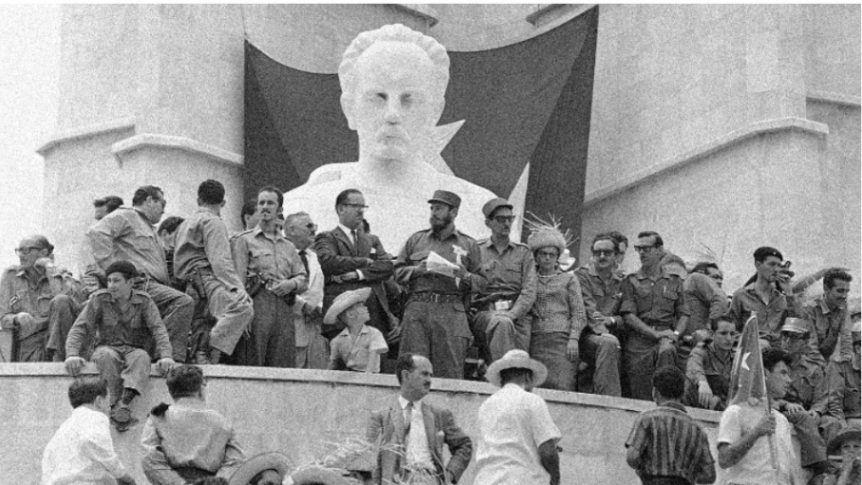
Photo: Fidel Castro, center, at the May Day 1960 parade in Havana at the Jose Marti Monument. | AP

South Paris, Maine


Introduction

While living in exile in the United States, José Martí dedicated the time between 1880 and 1895 to preparations for Cuba’s Second War for Independence from Spain, which ran from 1895 to 1898. Martí died as a martyr in Cuba on May 18, 1895. Our interest here is in Marti’s ideas on Cuba’s independence from the United States.

His writings are full of criticisms of the United States and U.S. pretentions for control of Cuba. Our object in presenting Martí’s ideas on the United States is to show that U.S. assault on Cuba, ongoing now for six decades as economic blockade, is hardly new. The U.S. has in fact sought domination over Cuba since the beginning of the 19 th century.

What follows is a sampling of Martí’s observation on the United States, written while he was living in New York between 1880 and early 1895. Martí, born in 1893, traveled frequently to Florida and even to Central America and the West Indies to educate, recruit, and raise funds for the coming independence struggle. In 1892, he founded the Cuban
Revolutionary Party and its newspaper Patria.

The Spanish colonial government arrested Martí for his writings in 1869 early in the course of Cuba’s First War for Independence (1868-1878). After one year in prison, Martí in 1871 left for exile in Spain where he remained for three years. Subsequently he was teaching and writing in Mexico and Guatemala until he returned to Cuba in 1878, only to be
exiled again to Spain. He moved on to New York, where, except for a six-month stay in Venezuela in 1881, he would remain until he left for Cuba in 1895.

Two themes dominate in his writings about the United States. He projected the idea of the idea of “our America,” which for him was all the territory lying between the Rio Bravo (Rio Grande) and Tierra del Fuego. That region had its own cultures, traditions, and history rather than those of North America and Europe. His essay “Our America” was published in
New York in 1991.

Warning about the U.S. threat to Cuban independence, Martí also mentioned the terms annexationism and annexationists to signify longings by U.S. Americans and by Cubans for U.S. possession of the island.

Excerpts of Martí’s writings follow:

José Martí’s letter to NY Evening Post, March 25, 1889 –

“It is probable that no self-respecting Cuban would like to see his country annexed to a nation where the leaders of opinion share towards him the prejudices excusable only to vulgar jingoism or rampant ignorance. There are some Cubans who … would like to see the island annexed to the United States. But those who have fought in war and learned in exile
… do not desire the annexation of Cuba to the United States. They do not need it; …they cannot honestly believe that excessive individualism, reverence for wealth, and the protracted exultation of a terrible victory are preparing the United States to be the typical nation of liberty.

José Martí’s letter to Gonzalo de Quesada on December 14, 1889 mentions this:

“On our land, Gonzalo, there is another [U.S.] plan even more sinister than what we have seen so far, and that is the wicked plan to force the island into war, to precipitate it, in order to have a pretext to intervene in it, and with the credit of mediator and guarantor, to take it over. There is nothing more cowardly in the annals of free peoples: nor any more cold- blooded evil.

The Washington Pan-American Congress — José Martí provided La Nación newspaper in Buenos Aires with a report (December 19-20, 1889) on the First International Conference of American States that took place in Washington from October,1889 to April,1890. Marti attended as consul for Uruguay. On the agenda were U.S. plans for bolstering commercial ties to the region and establishing a customs union.

“The parade of delegates is ending and the sessions of the Pan-American Congress are about to begin. Never in America, from its independence to the present, has there been a matter requiring more good judgment or more vigilance … than the invitation which the
powerful United States (glutted with unsaleable merchandise and determined to extend its dominions in America) is sending to the less powerful American nations (bound by free and useful commerce to the European nations) for purposes of arranging an alliance against Europe and cutting off transactions with the rest of the world. Spanish America
learned how to save itself from the tyranny of Spain; and now, after viewing with judicial eyes the antecedents, motives, and ingredients of the invitation, it is essential to say, for it is true, that the time has come for Spanish America to declare its second independence.”

The Inter-American Monetary Commission convened in Washington between January 7 and April 8, 1891. Its object was to fulfill instructions from the recent Pan-American International Conference to form an international monetary union and adopt a common silver currency. The Latin American delegates chose Martí, attending as Uruguay’s
representative, to present a report on their views.

“In every invitation among nations, one must look for hidden motives. No nation does anything against its interest; … Lesser nations, which are still in the throes of gestation, cannot safely join forces with those who seek a union with weaker nations as a solution for the excessive production of a compact and aggressive population, and a vent for their restless masses … They believe in the incontrovertible superiority of “the Anglo-Saxon
race over the Latin race”. They believe in the inferiority of the Black race, which they enslaved yesterday and continue to oppress today, and of the Indian race, which they are exterminating. They also believe that the peoples of Spanish America are composed principally of Indians and Blacks. … Does a political and economic alliance with the United States benefit Spanish America?

“Whoever says economic union, says political union. The nation that buys, rules. The nation that sells, serves.….

The Truth about the United States – Martí published this article in Patria, newspaper of the Cuban Revolutionary Party on March 23, 1894. “But it is certainly true that … in the United States, the reasons for unity are weakening, not solidifying; [that] the various localities are dividing and irritating national politics, not uniting with it; [that] democracy is
being corrupted and diminished, not strengthened and not saved from the hatred and wretchedness of monarchies … From the standpoint of justice and a legitimate social science it should be recognized that … the North American character has gone downhill since the winning of independence, and is today less human and virile; whereas the Spanish- American character today is in all ways superior, in spite of its confusion
and fatigue, to what it was when it began to emerge from the disorganized mass of grasping clergy, unskilled ideologists and ignorant or savage Indians.”

José Martí’s article “The Third Year of the Cuban Revolutionary Party” appeared in Patria on April 17, 1994. It contains this segment:
“Glory does not belong to those who look back, but to those who look forward. It is not merely two flower-covered islands (Cuba and Puerto Rico) … that we are going to bring forth, but we will save and serve them in such a way that the skills and vigor of their peoples, less isolated than those of the resentful and hungry European societies, ensures the independence of the happy archipelago that nature placed at the center of the world – despite the greed of a strong and unequal neighbor. … On the side of America are the Antilles, which, if enslaved, would be a mere pontoon in the war of an imperial republic against a jealous and superior world that is already preparing to deny it power—a mere fort of American Rome. If they were free … they would be the guarantee of balance between the continents, of independence for Spanish America, now under threat, and of honor for the great republic of the North.”

Martí’s article “Honduras and the Outsiders” appeared in Patria onDecember 15, 1894. There he explains that, “In America there are two peoples, and no more than two, with very
different souls due to their origins, backgrounds, and customs, and similar only in their fundamental human identity. On one side is our America, and all its peoples are of a similar or identical nature and background, and of an identical prevailing mix; on the other side is the America that is not ours, whose enmity it is neither sensible nor viable to foster, and with which it is not impossible, and indeed useful, to be friends, with firm decorum and shrewd independence. But we must live from our soul, cleansed of the evil church and the habits of mastery and undeserved luxury.”

José Martí’s letter to Manuel Mercado of May 18,1895
Mercado, living in Mexico, was Martí’s friend of many years. Martí, General Maximo Gomez and four others came ashore in eastern Cuba on April 11 1895. They had traveled from the Dominican Republic. Accompanied by rebel troops, they proceeded westward. Mari died in
battle on May 18, 1895, a day after writing this unfinished letter.

My dearest brother: Now I can write, now I can tell you how tenderly and gratefully and respectfully I love you and that home which I consider my pride and responsibility. I am in daily danger of giving my life for my country and duty. For I understand that duty and have the courage to carry it out – the duty of preventing the United States from spreading
through the Antilles as Cuba gains its independence and from overpowering our lands of America with that additional strength. All I have done so far, and all I will do, is for this purpose. … I have lived in the monster and I know its entrails; my sling is David’s. …

I am doing my duty here. The war in Cuba to prevent … the annexation of Cuba to the United States has come at the right time in America. It’s a reality greater than the vague and scattered desires of the annexationists among the Cubans and Spaniards, whose alliance with the Spanish government would only give them relative power.

Unless otherwise noted, Martí’s writings are taken from “Our America”, José Martí and Philip S. Foner, Monthly Review Press, 1977.


W.T. Whitney, Jr., is a political journalist whose focus is on Latin America, health care, and anti-racism. A Cuba solidarity activist, he formerly worked as a pediatrician and lives in rural Maine.