Colombia is afire with a National Strike mounted by working people young people, and the excluded. They are protesting neoliberal reforms that diminish lives and hopes. Tax-reform proposals from President Iván Duque’s rightwing government triggered large demonstrations that began on April 28 and are continuing. Brutal repression has inflamed the rebellion. The government quickly withdrew the tax proposals. The finance minister was dismissed.
A National Strike Committee coordinates the actions of “26 social sectors at the national level” plus regional, departmental, and municipal strike committees. The demonstrations, unprecedented in size and scope, follow the student uprising of 2011, the agrarian strike of 2013, marches in September 2020 against police abuses, and a large strike in November 2020 against pension and education reforms.
One stimulus for the uprising is the rise in poverty in Colombia from 37.5% of the population in 2019 to almost 50% in 2020; 15% live in extreme poverty. Another is widespread disapproval of the government’s handling of the Covid-19 pandemic. Young people are enraged. Their futures are blunted, claims commentator Germán Muñoz González. Often regarded as “expendable,” they are being killed, he asserts. Polling shows that 75% of Colombians support the National Strike.
Colombian Cecelia Zamudio paints a grim picture. Protesters “are constantly being attacked by the forces of state repression who shoot with high caliber rifles … use weapons of war … utilize paramilitaries for covert actions.” So far “more than 60 people have been killed … 600 people taken away and disappeared … thousands injured, thousands imprisoned.”
The proposed tax reforms represented the tip of the neoliberal iceberg. Healthcare privatization after 1993 led to healthcare inequalities because of reduced investment in personnel, training, and facilities. Over the course of three decades, most education at all levels has been privatized. For the “poorest sectors of the population, public education for children and adolescents has deteriorated.”
Flexible labor arrangements developing over three decades has centered on outsourcing. Self-employment, mostly work in the informal sector, now exceeds 60%; the unemployment rate is 18%. In the same neoliberal spirit, the government farmed out management of pension and disability funds to banks. Consequently, the equivalent of $83 billion of workers’ and employers’ money held by bankers is profitably invested and pension benefits are reduced.
The proposed tax-reform program was supposed to have supplied the government with the equivalent of $6.3 billion that would have enabled payment on debt that between 2016 and 2021 jumped from $79 billion to $157 billion, a figure representing 58% of Colombia’s GDP. Payment to foreign creditors consumes 38% of the government’s budgeted expenses.
The tax plan called for assessing a value added tax (VAT) on rent payments by those earning the equivalent of $470 per month or more. Some previously-exempt renters would have now been paying the tax. The plan also required that middle income private and public sector workers pay a 19% VAT on fees for energy use, water, and sewerage. People with big inheritances would have seen higher taxes. Well-to-do Colombians opposed the tax proposals along lower income people.
The National Strike Committee met May 15 with the government’s minister of labor and the high commissioner for peace. The Committee announced that no further negotiations would take place without guarantees assuring “no more violence and freedom to protest.” President Duque quickly responded: “In Colombia full guarantees exist for the exercise of protests.” He declared that the blocking highways represented criminal action “affecting the economy.”
The National Committee indicated that future negotiations must involve the departmental and municipal strike committees. As with earlier national strikes, people’s assemblies are underway – in Ibagué, for example.
The Colombian state looks to be on the verge of ungovernability. Taken together, longtime negative features of Colombia’s national existence now pose formidable obstacles. They are: divisions between rich and poor, urban and rural; state power in the hands of oligarchs; continuing destitution and precarious lives for the many; their exclusion from meaningful political participation; ruling-class resort to extreme violence; and governmental complicity with U.S. hegemonic ambitions. Integration of the national economy into the worldwide neoliberal system, with its own set of stern requirements, is relatively new.
The government has failed a three-part stress test. Colombians have suffered more from the Covid-19 pandemic than all but a few peoples of the world. The government’s implementation of the peace agreement between the FARC insurgents and the government was disastrous. There is the debt crisis.
Piedad Córdoba, once a left-leaning Liberal Party senator and always a target of reactionaries, portrays the strike as “only the most prominent symptom of a social order that’s now unsustainable. She calls for the “development of social struggle” and laments that, “in contrast to other countries of Our America, Colombia has not had a revolution of any type.”
She regards the high levels of poverty and debt as “big changes obliging us to look for [new] solutions.” Córdoba rejects neoliberalism and anticipates “a movement of new and developing leaders, and of generational change on the part of young people condemned to no future.”
Observer Fernando Rubio agrees: “The main protagonists of the present Strike are young people impacted by the breakdown of the neoliberal model.” These include “professionally trained people facing bankruptcy, the chronically unemployed, and those living precariously without a future.”
Hope is alive for some Colombian young people. That’s apparent in the faces of the 200 or so orchestra members performing in Medellin’s Park of Desires on May 5. Under the baton of Susana Boreal, 26 years old, and before 6000 singing onlookers, they played and sang “El pueblo unido jamás será vencido” (The people united will never be defeated), and other numbers.
The symbolism is clear. That song materialized in Chile prior to the overthrow of President Salvador Allende’s socialist government. It’s since been heard worldwide. The title, morphed into a slogan, became a staple of political demonstrations throughout the Western Hemisphere. Readers may go here or here to hear and see the performance.
The youth uprising in Colombia parallels the massive outpourings of young Chilean protesters from October 2019 on, the Occupy phenomenon in the United States in 2011, and the Indignados in Spain. Maybe, one surmises, a new way of doing politics is afoot.
Colombian youth in rebellion, acting spontaneously and mostly unaffiliated with political parties, are maybe attending to moral and community values as they defend their material interests. They are workers – or would-be workers – but presumably don’t carry the sectarianism and memories of failure burdening their left-leaning predecessors.
(May 5) According to the website of the Colombian Communist Party, “there is a massacre in progress in Colombia: 21 murders, 208 seriously wounded, 503 arbitrarily detained, dozens of disappeared, ten women raped by Esmad police, attacked human rights defenders and journalists.” A nation strike has been ongoing nationwide in Colombia since April 28.
Presently in Colombia a national strike is underway in rejection of President Iván Duque’s tax reform and a health reform bill that seeks to deepen the failed model of privatization established in the health system.
The tax reform would impose a 19 percent VAT on eggs, meat, fish, coffee and salt, and proposes to tax salaries over 2.4 million pesos per month and pensions over 7 million pesos, to freeze for five years the salaries of public employees and even a scandalous tax on burials. The protesters had to overcome two factors. First, the third peak of the pandemic. The Ministry of Health reported that day an accumulated death toll of 72,725, one of the highest in the world per million inhabitants, higher than that of India and the United States.
A second factor was the judicial prohibition of the protest, which was not heeded by either the organizers or the local authorities. Despite being rejected by the government and the mainstream media, the marches were massive taking place in at least 600 of the country’s 1,100 municipalities.
In a previous survey, 73 percent of the population expressed their support for the strike and 35 percent said they would be willing to take that position to the streets. Seven million people took part in the strike and marches, with mobilization in Bogotá, Medellín, Cali, Barranquilla, Bucaramanga, Manizales and Pereira standing out. Clashes with riot police were severe in Cali and Bogotá. Mirar al Sur reported that there were eight deaths due to police repression.
The crisis in Colombia is very deep, has been going on for a long time, but has deepened with the pandemic. Poverty has recently increased 6.8 percent and now affects 42.5 percent of Colombian which means that 21.2 million of them cannot meet their basic needs. Extreme poverty now impacts 7.4 million people. To make matters worse, the government is trying to take the country back to war and more and more people are opposing it. The assassinations of social activists and former FARC combatants who have joined the peace process continue unabated.
Since mid-March Venezuelan army units have been attacking and expelling Colombian operatives active in Apure state, in western Venezuela. Colombians have long used the border regions to prepare cocaine arriving from Colombia and ship it to the United States and Europe. Fighting has subsided; eight Venezuelan troops were killed. Seeking safety, 3,500 Venezuelans crossed the Meta River – an Orinoco tributary – to Arauca in Colombia.
Venezuela’s Defense Minister Vladimir Padrino Lopez addresses the media at Miraflores Palace, in Caracas, Venezuela April 5, 2021. REUTERS/Manaure Quintero
The bi-national border is porous and long enough, at 1367 miles, to encourage smuggling and the undocumented passage of cross-border travelers such as the narcotraffickers in Apure. These include paramilitaries, bands of former FARC-EP insurgents, and drug-trade workers – pilots, truckers, laboratory workers, and more. Also involved are Colombia’s Army; Mexican drug cartels; officials in Washington; and DEA functionaries in Colombia.
The paramilitaries in Apure represent Colombia’s largest drug cartel, “Los Rastrojos.” Colombia’s paramilitaries in general are the products of advice given Colombia’s government by U.S. Army consultants in the 1960s. They claimed paramilitaries were essential for defeating leftist guerrillas. The Colombian military controls the paramilitaries’ actions, as verified recently by the prototypic paramilitary leader Salvatore Mancuso. He was testifying before a Colombian judge virtually from a U.S. prison.
The former FARC-EP insurgents active in Apure are known by the name of their leader, Gentil Duarte. In 2016 they rejected the forthcoming peace agreement that the FARC-EP would be signing with the Colombian government. They’ve taken up narcotrafficking. Other dissenting ex-FARC fighters took up arms again in 2019. Calling themselves the “Second Marquetalia,” they are not present in Apure.
In March, the Colombian Army transferred 2000 troops to the Colombian side of the border. U.S. Secretary of State Anthony Blinken spoke with Colombian President Iván Duque by telephone on April 5; they discussed “their shared commitment to the restoration of democracy and rule of law in Venezuela.” U.S. Ambassador to Venezuela James Story, stationed in Bogota, held meetings from February 19 to 26 with Venezuelan opposition leaders Leopoldo López, Julio Borges, and Manuel Rosales. They style themselves the “Venezuelan Presidential Commission.”
The U.S. Air Force on March 30 and 31 flew four C-17 “Globemaster” troop and equipment-carrying planes to airports in Colombia. Colombia’s Semana newspaper anticipates that the U.S. Congress will soon authorize the sale to Colombia of fighter aircraft worth $4.5 billion. The report laments the “worrisome picture” of air force capabilities in comparison with those of Venezuela.
Colombian President Iván Duque in late February announced the creation of the “Special Command against Narcotrafficking and Transnational Threats.” This will be a 7000-person elite military force with air assault capabilities. Its “certain objective,” according to the Communist Party’s website, is war against Venezuela.
During the tenure of left-leaning Venezuelan President Hugo Chavez and that of his successor, President Nicolas Maduro, Colombian paramilitaries repeatedly crossed the border on destabilization missions. Organizers for a 2000 seaborne anti-Maduro assault called Operation Gedeon were based in Colombia, as were some of the plotters who mounted a drone attack against Maduro in 2018. The U.S. and Colombian governments in February 2019 failed in their attempt to deliver humanitarian aid across the border at Cucuta, Colombia. Their idea had been to divide Venezuela’s military.
The outcome of the fighting in Apure is unclear. The Colombian and U.S. governments undoubtedly would utilize any humanitarian crisis as an opening to further destabilize Venezuela’s government.
It’s certain that the U.S. government in the Biden era continues to seek the overthrow of Venezuela’s government. Without question the reactionary Colombian government is at the beck and call of the U.S. government. The U.S. capitalist hierarchy, of course, has its eye on Venezuela’s massive reserves of crude oil, in excess of 550 billion barrels.
What is underappreciated is the role of drug-trafficking in serving interventionist purposes, as in Apure. U.S. military aid under Plan Colombia, which began in 2000, was supposed to have reduced narcotrafficking. The same was to have happened after the FARC-EP insurgency gave up arms in 2016. Nevertheless, Colombia afterwards continued to produce 70 percent of the cocaine consumed in the world, according to a 2019 United Nations report. Production has increased since.
Some 70 percent of Colombia’s cocaine heads to the United States – the world’s leading consumer – via the Pacific Ocean route. But much of the remainder does pass through Venezuela, and Washington officials pay attention.
The Western Hemisphere Drug Policy Commission is “an independent, bipartisan entity” serving U.S. policymakers. Its December, 2020 report noted that: “Traffickers operate freely in large swaths of the country s territory [and] The US State Department is offering rewards of $15 million for information leading to [President] Maduro’s arrest and $10 million for information on four other top officials.”
The U.S. Fourth Naval monitors Venezuelan waters and air space for supposed Venezuelan drug-trafficking.
The assumption here is that Colombian narcotrafficking has great appeal to Washington deciders on Latin America. Nobody likes drug dependency. The United States suffered some 70,000 drug-overdose deaths in 2019. In short, to trumpet war on drugs has great public-relations value. It’s an easy sell to promise to stem the flow of drugs into the United States in return for free rein for harsh policies in Latin America.
Therefore, the United States uses the presence in Venezuela of Colombian narco-trafficking to serve regime-change purposes. Public support for U.S. Plan Colombia told a similar story. After 2000, U.S. taxpayer money readily flowed into what was billed as war on narcotics. The real purpose was assistance to the Colombian military as it attempted to defeat leftist FARC-EP guerrillas.
Jaime Caycedo, secretary general of the Colombian Communist Party, outlined these dynamics in writing about Plan Colombia in 2007:
“For the purposes of strategy, it’s essential to have it understood through continued propaganda that the guerrillas are associated with narcotrafficking and understood too that the war is being fought precisely because of that characteristic.” Drugs become a “demonic phenomenon [and] imperialist military intervention figures as something ‘natural.’” The imperialists offer “no tie to history or realities that might explain things,” with the result that, “violence in the form of daily manifestations of repression and super-exploitation of workers appears simple as a consequence of narco-trafficking.” (Colombia en la Hora Latinoamericana, Ediciones Izquierda Viva)
Capitalists taking a broad view accommodate drug-trafficking for another reason. Selling cocaine yields vast amounts of money; laundered, cocaine becomes a source of liquidity for their financial system.
Former director of the United Nations Office on Drugs and Crime Antonio Maria Costa, writing in 2009, claimed that, “In many instances, drug money is currently the only liquid investment capital.” According to the Samuel Robinson Institute, “the events in Apure show off Venezuela … as a threat, but only in what has to do with allowing the (narco)metabolism of the West to continue functioning.” He cited journalist Roberto Saviano who notes that, “Cocaine is a safe asset … an anticyclical asset…. Cocaine becomes a product like gold or oil, but more economically potent than gold or oil. [Without] access to mines or wells, it’s hard to break into the market. With cocaine, no.”
Haiti faces serious political crisis. The country has experienced great political difficulties ever since gaining independent nationhood in 1804. Impaired governance stems in large measure from U.S. meddling over many years. We examine the current crisis and the basis for U.S. zeal to curtail Haiti’s future.
Mass demonstrations have continued intermittently since mid-2018, when two million Haitians were in the streets. At various times, protesters have called for: (1) relief from high prices for oil and gas, the result of IMF austerity decrees; (2) relief from shortages of basic supplies; (3) punishment of government officials who embezzled billions in funds from Venezuela’s PetroCaribe program of low-cost oil for Caribbean peoples (President Jovenel Moïse stole $700,000); (4) Moïse’s resignation.
Demonstrators targeted Moïse aggressively after he closed down Haiti’s parliament in January 2020. He’s ruled since by decree. A general strike took place prior to February 7, 2021, which, according to lawyers and judges, marked the end of Moïse’s presidential term. He remains.
Moïse’s 2015 election victory was fraudulent. A transitional president served for one year. Moïse took office in early 2017 after winning a second election weeks earlier. Only 18 percent of Haitian adults voted.
Moïse recently appointed his own electoral council and his own committee for amending the constitution. He cemented ties with President Trump by supporting U.S. regime-change plans for Venezuela. His new National Intelligence Agency looks to one observer like “a new Gestapo-like force of armed spies.” Moïse has disregarded the suffering of Haitians, the most poverty-stricken population in the Americas.
Opposition elements recently named Supreme Court Justice Joseph Mécène as a transitional president replacing Moïse. Moïse responded by arresting 23 officials of whom three were Supreme Court justices. He replaced them.
Haiti’s opposition is divided between center-right political parties, headed loosely by lawyer André Michel, and protesters in the streets. Many of these belong to social movements and labor unions making up the new Patriotic Forum.
Violence is rampant. Some “150 criminal bands” have carried out murders and massacres. According to Argentinian Lautaro Rivara, active in Haiti, “Most of these groups have been organized and financed by senators, ministers, and presidents – when they are not directed fomented by the imperialist powers.” Some gangs have united under government auspices as the “G9 and family”.
These various problems reflect political norms from Haiti’s past. On display then and now have been: ineffectual, corrupt, undemocratic governance; governmental inattention to people’s basic needs; persistent, if unsuccessful, popular opposition; and politics mediated through violence. Submission to foreign masters has been less obvious recently than is usually the case. None of these failings operate against U.S. expectations for Haiti.
Setting the stage
The many foreign NGOs active in Haiti function autonomously, rarely collaborating with Haiti’s government. The “Core Group” of nations involving the United States, France, Canada, and others make strategic decisions for Haiti on their own.
The U.S government does likewise. Secretary of State Hillary Clinton inserted singer Michel Martelly into Haiti’s 2010 presidential elections. He won, and named banana tycoon Jovenal Moïse as his successor.
Haiti has long had to cope with burdensome foreign-debt obligations. Between 1825 and 1947, Haiti sent payments to France as compensation for Haiti’s slaves having liberated themselves. Said one observer recently, “the constant of financial needs forces all Haitian governments to take on even more debt with North American and European Banks.”
Bill Quigley, a close observer, notes that, “The US and the US dominated world financial institutions forced Haiti to open its markets [allowing] millions of tons of US subsidized rice and sugar into Haiti – undercutting their farmers and ruining Haitian agriculture.”
Holding Haiti in Check
The United States has long had its way with Haiti. It withheld recognition of Haiti’s national independence until 1862, and embargoed trade with Haiti until 1863. A U.S. naval squadron arriving at Môle Saint-Nicolas in 1889 sought to occupy the port permanently to block access to Haiti by ships of other nations. The effort failed, partly due to the intercession of U.S. ambassador Frederic Douglass, the famous abolitionist.
U. S. military units occupying Haiti between 1915 and 1934 encountered armed resistance. Some 15,000 Haitians were killed. U.S. officials wrote a new Haitian Constitution, collected taxes, controlled customs, administered sections of Haiti’s government, and forced payments on loans held by U.S. banks.
The plundering, murderous Duvalier dictatorship, father and son, ruled Haiti from 1957 until 1986. The U.S. government cited anti-communism as justification.
CIA personnel collaborated with Haitian military officers to plan the coup that in 1991 removed President Jean-Bertrand Aristide. That he returned to power in 1994 by means of a U.S. invasion typifies Haiti’s subservience to decisions made in Washington.
Paramilitaries trained and funded by the United States removed President Aristide in 2004. Canada and France helped out. A U.S. plane conveyed Aristide to the Central African Republic. The three nations arranged for United Nations troops to occupy Haiti. They would remain until 2019.
Particular reasons
“There was hell in Hayti (sic) in the red waning of the eighteenth century … while black men in sudden frenzy fought like devils for their freedom and won it … the shudder of Hayti was running through all the Americas.” (W. E. B. DuBois, John Brown, 1907)
Reports of the “tempest created by the black revolutionaries … spread rapidly and uncontrollably.” A maritime proletariat brought news to places like Charleston, South Carolina; “Afro-North Americans … derived inspiration from the example of Haitian freedom,” recalls historian Julius Scott. (Common Wind, 2018)
The U.S. slavocracy had much to protect. “Between 1775 and 1825 … a slave-labor large farming system [developed]. There was a close and indissoluble connection with the world’s cotton market.” (DuBois, Suppression of the African Slave Trade,1896) The labor of enslaved people generated wealth and enabled debt repayment. Slave ownership represented 20 percent of private U. S. wealth.
Fearful slaveowners had Haiti on their minds, more so when slaves were unruly. Slaves conspired, sometimes were discovered, and rebelled. That Denmark Vesey, leader of a failed slave rebellion in Charleston in 1822, had been enslaved in Haiti was hardly reassuring.
The enslavement of Black people in the United States eventually ended; racism did not. Haiti manifested a new orientation that would by no means mollify U. S. animosities against its people.
Historian C.L.R. James explains that, “Haiti had to find a national rallying point [and] discovered ‘negritude’ [involving] “substitution of Africa for France.” Until then, “Mulattos who were masters had their eyes fixed on Paris.” At work was the influence of pan-Africanists Marcus Garvey, George Padmore, and Martinican poet Aimé Césaire, regarding whom, says James, “it is Africa and African emancipation that he has in mind.” (Black Jacobins, 1989)
As a kind of African extension in the Western Hemisphere, Haiti solidified its place within the orbit of U.S racism. That showed in 1898 when U.S. troops intervened in Cuba’s war for independence from Spain. Later Cuba would become a U.S. protectorate of sorts. U.S. justification for both endeavors, according to statements, was to prevent “another Haiti,” a “second Haiti.”
Indeed, Cuba’s rebel army was full of Black soldiers. African-descended General Antonio Maceo led rebel troops. Maceo at the time was a favorite in the U.S. Black community.
Much later, U.S. imperialists were alert to real or imagined socialist stirrings in Guatemala (1954), Dominican Republic (1965), Indonesia, (1965-66), Chile (1973), Cuba perennially, and Haiti. There, anti-communism competed with racism as motivation.
Maybe with the advent of President Jean-Bertrand Aristide in Haiti, whispers were heard in U.S. government circles of “another Cuba” in the making. After all, Haitians are poor, they suffer, they die young, and they are heirs of a revolution.
Aristide was new. His 1991 election victory with a 67% plurality was Haiti’s “first successful democratic election ever,” according to the conservative National Republican Institute. Aristide gained reelection in 2000 with 91% of the vote.
An observer notes that, “In the period of governance by Fanmi Lavalas, the party founded by President Aristide, more schools were built than the total constructed between 1804 and 1994. Twenty percent of the country’s budget was mandated for education. Women’s groups and popular organizations helped coordinate a literacy campaign …The minimum wage was doubled. … Health clinics were established in the poorest communities. The government also launched an aggressive campaign to collect unpaid taxes owed by the wealthy elite.”
Haiti waits. Maybe Haitian President Moïse will be removed and maybe Haiti’s parliament will reopen. Maybe the new Biden administration will go along with a new array of officeholders. His representatives may pull strings selectively, or give a nudge to favorites. What the U.S. government does in the short term, however, won’t matter much to masses of Haitian people who are victims. What would matter for them is certainty of their independence, of being able to take charge of their own existence. Movement in that direction depends on change in the United States, forced by popular mobilization there, toward a politics that embraces the notion of human equality.
Belarusian lawyer and academician Alena Douhan, who in 2020 became the United Nations “Special Rapporteur on the negative impact of the unilateral coercive measures,” visited Venezuela on February 1-12. She was there “to assess the impact of unilateral [U. S.] sanctions on the enjoyment of human rights.” At her press conference on the last day, she read aloud a preliminary report. The full report will be presented to the United Nations Human Rights Council in September 2021.
Douhan, in her report, “reminds all parties of their obligation under the UN Charter to observe principles and norms of international law [and] that humanitarian concerns shall always prevail over political ones.”
She “underlines the inadmissibility of applying sanctions extraterritorially and urges the U.S. Government to end the national emergency regarding Venezuela.” The United States must “revise and lift sectoral sanctions against Venezuela’s public sector, review and lift secondary sanctions against third-state parties.” All states need to “review and lift targeted sanctions in accordance with principles of international law.”
The Rapporteur calls upon “the Governments of the United Kingdom, Portugal and the United States and corresponding banks to unfreeze assets of the Venezuela Central Bank.”
Douhan explains that U.S economic sanctions against Venezuela’s government began in 2005 and intensified after President Obama declared a “state of national emergency” in 2015. Held up as justification then were allegations of “violent repression of protests, persecution of political opponents, corruption, and curtailing of press freedom.”
She recalls that the U.S. government in 2019 imposed “a total economic embargo” that immobilized Venezuela’s state-owned oil company PDVSA and the Venezuelan Central Bank. The U.S. government transferred ownership of Venezuelan assets and properties in the United States to a façade government headed by opposition politician Juan Guaidó, whom the United States named as president. Britain, Portugal, Canada, and the United States went on to freeze billions of dollars owned by Venezuela and deposited in their banks.
The Special Rapporteur criticizes countries imposing sanctions at the behest of the United States, most of them belonging to the European Union and to the Lima Group of nations. These are members of the Organization of American States recruited by the U.S. government as an anti-Venezuelan bloc of nations.
Douhan clarifies that hyperinflation has aggravated Venezuela’s economic decline and that the fall of oil prices in 2014 accelerated it. Oil sales, she emphasizes, has long accounted for almost all the government’s income and has, consequently, paid for schools, health care, and social programs. Ultimately, she writes, revenues would “shrink by 99%.”
Now “Venezuela faces a lack of necessary machinery, spare parts, electricity, water, fuel, gas, food and medicine.” Remittances arriving from abroad have drastically fallen, due in part to impediments to bank transfers. Now, she notes, only 20% of normal electricity is available, almost 5 million Venezuelans have emigrated, and “2.5 million people” face severe food insecurity because of reduced food imports.
“Medical staff positions in public hospitals are 50–70% vacant,” she reports, adding that, mainly because of sanctions, “90 per cent of the population” lives in conditions of extreme poverty.
Douhan’s report documents violations of international law. Both the freezing of assets and the U.S. goal of removing Venezuela’s government “violate the sovereign rights” of the nation. The U.S. “state of national emergency” and the reign of sanctions are incompatible with the International Covenant on Civil and Political Rights, she asserts. U.S. extension of extraterrestrial jurisdiction to third countries “is not justified under international law.” Her reference is to countries whose citizens and companies deal with Venezuela
The United States abuses “the right to the highest attainable state of health.” She points to Venezuela’s “lack of doctors and nurses and of sufficient medicines, medical equipment, spare parts, relevant software updates, vaccines, tests, reagents and contraceptives” – all formerly supplied by the government. She decries violations of the right to water and the right to education.
The Special Rapporteur’s report differs in very significant ways from a United Nations survey and set of recommendations released in September, 2020. The UN Human Rights Council’s “Fact-Finding Mission on Venezuela” produced 409 pages and 65 recommendations. That document’s authors never traveled to Venezuela. Setting the tone, the first recommendation calls for “prompt, effective, thorough, independent, impartial and transparent investigations into the human rights violations and crimes described in the present report.”
Like the Special Rapporteur, the U.S. Government Accountability Office issued a report in February, one that joins in acknowledging a “deteriorating humanitarian situation” in Venezuela. The sole recommendation of the 50-page report was timidly to suggest that, “Treasury should ensure that [its] Office of Foreign Assets Control systematically tracks information on inquiries” about the suffering.
Mark Weisbrot of the Center for Economic and Policy Research praised the GAO report for providing “more evidence that these unilateral, illegal US sanctions are a form of collective punishment against the Venezuelan population and should be ended immediately.” Weisbrot and co-author Jeffrey Sachs in 2019 documented that sanctions had killed tens of thousands of Venezuelans.
Some opposition politicians in Venezuela now oppose U.S. sanctions. They include Timoteo Zambrano,President of the National Assembly’s Foreign Policy Commission, and Henri Falcón, former conservative presidential candidate.
In the United States, a group of 27 senators and representatives on February 11 urged President Biden to “”consider the humanitarian impacts of sanctions.” They did not name specific countries. According to nbcnews.com, President Biden doesn’t plan to negotiate with Venezuela’s government or give up on recognizing Juan Guaidó as Venezuela’s president.
It’s true. Too often, in too many circumstances, for too long, the lives of Black people in the United States don’t matter. Black people fill prisons; their children fill terrible schools; too many are poverty-stricken. But at issue here are the killings and the people left to die.
Post-Civil War arrangements by which the victorious North settled with the defeated slavocracy ensured that Black people would not matter and that many would die. A thousand or so were killed in the South in 1866, reports W.E. B Du Bois. Over 2000 more would be lynched during the Reconstruction years, as documented recently by the Equal Justice Initiative. (1) That organization had already documented and memorialized thousands of lynching deaths occurring between 1877 and 1950.
Epitomized by the suffocation death of George Floyd on May 25, police killings of Black people – a matter of lynching under state auspices – brought the Black Lives Matter movement into being. But Black people are dying quite unnecessarily in the United States in other ways.
Life expectancy is far shorter and infant mortality far greater for U.S. Blacks, for example, than for white people. And, as the Covid19 pandemic plays out, “The lives of disproportionately black and brown workers are being sacrificed to fuel the engine of a faltering economy.”
Journalist Adam Serwer, writing in the Atlantic, adds that, “workers at the front lines of the pandemic … have been deemed so worthless that legislators want to immunize their employers from liability.”
Significantly, even white people viewed as worthless may be in trouble. Texas Lt. Governor Dan Patrick, commenting on the Covid 19 pandemic, told a reporter that “there are more important things than living. And that’s saving this country.” Representative Hollingsworth of Indiana identified Coronavirus deaths as “the lesser of these two evils,” the other being economic collapse.
That white people die because they don’t matter is revealing. They too may be disposable – if they are unnecessary, in the way, or far off. The victims of Hiroshima, Nagasaki, and Dresden are remembered, as are indigenous peoples decimated by settlers and invaders, and civilians and combatants dying in U.S. wars. The political powers do not deal realistically with the near certainty that soon many millions will be dying due to climate change.
Dan Glazebrook, writing for Counterpunch is a witness. He asserts that, “one product has defined capitalism above all else: human waste.” Criticizing Britain’s management of the Covid 19 crisis, he notes that, “Superfluous people, not necessary for production, not able to participate in the market, and an ever-present threat to the stability of the system [are] the main output of the bourgeois epoch. … [S]urplus Europeans were exiled … to the colonies … to continue the process of exterminating surplus non-Europeans.
Glazebrook cites urban theoretician and historian Mike Davis’s observation that up to 3 billion informal workers constitute “the fastest-growing and most novel social class on the planet.” But this “is not a labor reserve army in the nineteenth-century sense: a backlog of strikebreakers. [It’s] a mass of humanity structurally and biologically redundant to global accumulation and the corporate matrix.”
Marxist scholar Andy Merrifield identifies some people as “residues.” “They’re minorities who are far and away a global majority. They’re people who feel the periphery inside them, who identify with the periphery, even if sometimes they’re located in the core. Residues are workers without regularity, workers without any real stake in the future of work … A lot of these residues know that now work is contingent [and] life itself is contingent.” George Floyd’s live was contingent. The lives of U.S. Black people who don’t matter are residues.
Under capitalism, human beings are valued for their use. Enslaved, Black workers were useful, even essential. Then their agrarian society merged with the larger one embarked upon industrial production and territorial expansion. They acquired a distant master that, like the old one, measured the worth of workers with an economic yardstick.
Black agricultural workers, bereft of education, their ancestors stolen from Africa, didn’t fit the capitalist mold. European immigrants ready to work in factories or to occupy land being opened up by the railroads amply fulfilled capitalist objectives. From Reconstruction on, Black people were marginalized in a country where social needs are neglected and public attention distracted. The violent thugs hovering over them have had free rein.
Du Bois in his Black Reconstruction in America (1935) offers an explanation for how the failure of Reconstruction led to limited political rights for Black people and exclusion from real participation in the larger society. Initially, “the reconstructed states were in the power of the rebels and … they were using their power to put the Negro back into slavery.” But the North “united its force with that of the workers to uproot the still vast economic power of the planters. It hoped …to induce the planter to surrender his economic power peacefully, in return for complete political amnesty.”
The northern business class was insecure: “the Republican party which represented it was a minority party.” But “united with abolition-democracy [with its] tremendous moral power and popularity,” the party hoped to “buttress the threatened fortress of the new industry.” Giving Blacks the vote “would save the day.” The Republicans sought to nullify apportionment based on non-voting slaves, as provided for in the Constitution. Southerners had relied on that device to inflate their representation in Washington.
But poor whites in the South regarded Blacks as wage competitors. Landowners proceeded to “draw the color line and convince the native-born white voter that his interests were with the planter class.” Poor whites “thought of emancipation as giving them a better chance to become rich planters, landowners, and employers of Negro labor.” They wanted “to check the demands of the Negroes by any means” and were willing “to do the dirty work of the revolution that was coming, with its blood and crass cruelties.”
In the North, “Abolitionists failed to see that … the nation did not want Negroes to have civil rights and that national industry could get its way easier by alliance with Southern landholders than by sustaining Southern workers.” And so, “labor control passed into the hands of white southerners, who combined with white labor to oust northern capitalists” and themselves manage a southern-style capitalist economy.
What resulted remained for decades. Wages for Black people, initially non-existent or very low, stayed depressed. Aspiring Black landowners met resistance, eventually at the hands even of New Deal officials. Because the methods of exploitation available to southern overlords, sharecropping and the convict-leasing system, were less profitable than those available to northern capitalists, the material value of southern Blacks was low.
Most Black people were barred from occupying a sustainable niche in the productive apparatus of the U.S. economy. They’ve verged on the irrelevant, remaining as a “residue,” at risk of being disposed of.
Nevertheless, the U.S. political system has been open enough to allow many Black people to find remunerative work, elevate their social-class status, and be safe. Even Black workers defied expectations: in 1950, 43% of Black men in Michigan were working in the auto industry. (2)
The argument here has centered on social-class difference. But racism, which operates as a means for imposing differentiation among humans, also had a part. The notion of racism elaborated by political scientist Adolph Reed Jr. is relevant. Reed explains that racism showed up historically as a tool devised by oppressors for dealing with social conflict. He claims that white settlers and other exploiters configured differences among humans – physical, cultural, and religious plus others fashioned out of upper-class snobbery – into an all-embracing concept of race. They thus gained the ability to weaponize inequalities within human society, the better to enforce oppression.
One example: southern elites, from Reconstruction on, arranged for Blacks and the white underclass to be at each other’s throats. Their northern counterparts did likewise, leaving it so that Blacks and whites don’t easily unite in common struggle.
Racism serves as an adjunct to classed-based oppression. Causing pain, racism works for maintaining social-class boundaries. The combination of the two has resulted in Black people being relegated to a generally precarious role within U.S. society and remaining vulnerable to lethal violence.
Some basic ideas, no less true for being platitudinous, may suffice to conclude this effort. One, an injury to one is an injury to all. Two, ruling class prerogatives and oppression travel in the same lane. Three, dedication to equality, radical or otherwise, does matter.
Anti-colonialist intellectual and activist Franz Fanon has the last word: “For my part, the deeper I enter into the cultures and the political circles the surer I am that the great danger that threatens Africa is the absence of ideology.” You need to replace “Africa” with “USA.”
Notes:
Reconstruction in America – Racial Violence After the Civil War, 1865 – 1876, Equal Justice Initiative, Montgomery, Alabama; pp 118; eji.org
Victor Perlo, People vs. Profits, (International Publishers, NY, 2003), p. 181.
The police killings of Black people prompted the formation of Black Lives Matter. But they die unnecessarily in others ways. Life expectancy is far shorter and infant mortality far greater for U.S. Blacks, for example, than for white people.
According to journalist Adam Serwer, writing in the Atlantic, “The lives of disproportionately black and brown workers are being sacrificed to fuel the engine of a faltering economy.” Specifically, “workers at the front lines of the [Covid 19] pandemic—such as meatpackers, transportation workers, and grocery clerks—have been deemed so worthless that legislators want to immunize their employers from liability.”
Epitomized by the suffocation death of George Floyd on May 25, police killings of Black people – a matter of lynching under state auspices – brought the Black Lives Matter movement into being. But Black people are dying quite unnecessarily in the United States in other ways.
Life expectancy is far shorter and infant mortality far greater for U.S. Blacks, for example, than for white people. And, as the Covid19 pandemic plays out, “The lives of disproportionately black and brown workers are being sacrificed to fuel the engine of a faltering economy.” Journalist Adam Serwer, writing in the Atlantic, adds that, “workers at the front lines of the pandemic … have been deemed so worthless that legislators want to immunize their employers from liability.”
That white people die because they don’t matter is revealing. They too may be disposable – if they are unnecessary, in the way, or far off. The victims of Hiroshima, Nagasaki, and Dresden are remembered, as are indigenous peoples decimated by settlers and invaders, and civilians and combatants dying in U.S. wars. The political powers seem to be at ease presently with the probability that millions will be dying soon due to climate change.
The political powers do not deal realistically with the near certainty that soon many millions will be dying due to climate change.
Black agricultural workers, bereft of education, their ancestors stolen from Africa, didn’t fit the capitalist mold. European immigrants ready to work in factories or to occupy land being opened up by the railroads amply fulfilled capitalist objectives. From Reconstruction on, Black people were marginalized in a country where social needs are neglected and public attention distracted. Violent thugs threatening them have had free rein.
Black agricultural workers, bereft of education, their ancestors stolen from Africa, didn’t fit the capitalist mold. European immigrants ready to work in factories or to occupy land being opened up by the railroads amply fulfilled capitalist objectives. From Reconstruction on, Black people were marginalized in a country where social needs are neglected and public attention distracted. The violent thugs hovering over them have had free rein.
Book Review: Don Fitz, Cuban Health Care, (Monthly Review Press, NY, 2020), ISBN paper: 978-158367-860-2, pp.303, monthlyreview.org.
If they are paying attention, progressives worldwide know that Cuba provides healthcare that saves lives and prevents disease more effectively than does the United States, its major capitalist enemy. They know that Cuban health workers have been caring for people throughout the global South and, during the Covid -19 pandemic, in Europe too. And the word is out that Cuba educates vast numbers of physicians for much of the world.
Many U.S. fans of Cuba’s Revolution know that, early on, care was extended to desperate rural areas of the island, that large number of new health workers were trained, that disease prevention was prioritized. They may know that healthcare planners pioneered in devising an exemplary primary medical care system. They had tried and abandoned versions of the so-called polyclinics, then arrived at the pathbreaking family doctor – nurse program.
The polyclinics featured general practitioners, pediatricians, gynecologists, dentists, pediatricians, and sometimes psychologists working in one setting. Once the family doctor-nurse teams took responsibility for primary care, in 1984, the polyclinics were assigned consulting and teaching duties. Essential to the family doctor-nurse program was the creation of a new medical discipline, comprehensive general medicine, for which a new post-graduate, multi-year training program was devised.
Cuban Health Care, written by Don Fitz’ and recently published by Monthly Review Press, explores these developments and more. Fitz explains how healthcare was integrated into the community and how the notion of health itself came to include social, psychological, economic, and nutritional wellbeing. His book surveys Cuba’s highly successful management of the HIV/AIDS epidemic; the role of Cuban doctors – and anti-apartheid troops – in southern Africa; disaster relief and general healthcare provided in countries throughout the world, and medical training for tens of thousands of young people from Latin America, Africa, and even Asia and the United States. Fitz explores the origins and mission of Cuba’s Latin American School of Medicine (ELAM) that between 2006 and 2019 provided training at no personal cost for 29,749 students from 115 nations.
Readers of this valuable book learn about difficulties confronted by Cuban leaders as they developed a new kind of health system. These included shortages of medical practitioners and teachers due to emigration in the early 1960s, competing revolutionary goals, frictions with Cuba’s Soviet ally, fallout from the collapse of the Soviet Bloc, harmful effects of the U.S. economic blockade, and false accusations of homophobia directed at those responsible for Cuba’s HIV/AIDS treatment program.
There would have no reformation of Cuba’s healthcare system, the author points out, without revolutionary change in the larger society. He praises Cuban healthcare as emblematic for what a revolution can achieve. His insertion of a chapter on the failings of U.S. healthcare – and a very coherent account it is – conveys the suggestion that Cuba’s model may be useful for healthcare reformers in the United States.
No specifics are offered – and certainly no call for political revolution in the United States. Fitz critiques U. S. healthcare in terms like “profit-based health care,” or the “sickness industry,” but without explicit reference to capitalism. He finds solutions in a “post-capitalist society” or through “the emergence and consolidation of a new consciousness,” but not through socialist change.
Cuban Health Care benefits from the author’s first-hand observations and from his interviews with providers, officials, and students – particularly students at ELAM – and interviews conducted by others that he cites. Many of the personal experiences and opinions expressed in interviews convey revolutionary purpose, enthusiasm for change, and hope for a better world. Several former Cuban soldiers who fought apartheid in southern Arica offer reflections that, intentionally or not on the author’s part, lay out the horrors of war.
Don Fitz’s book brings together information on Cuba’s Revolution and Cuba’s brand of healthcare; it communicates a vision of progressive social change. Clearly written and easily read, it deserves a wide audience.
One notes, however, that information, opinion, and data contained in some chapters had appeared in earlier ones. Articles the author had written for periodicals found new life as chapters in his book and those articles may have contained repetitions that made their way into the book. Plus, some data in the book is not current, due perhaps to data in the older articles not having been updated for the book.
This is a wide-ranging book, but significant aspects of Cuban healthcare escaped mention. For example, Cuban healthcare planners are pragmatic. Ready to abandon tradition or an initiative if it doesn’t work, they experiment – as illustrated by their moving from one kind of polyclinic to another, and ultimately to the family doctor-nurse program. And, as reported by Fitz, the prevailing mode of scientific medicine co-exists with community-based healing practices.
Secondly, healthcare renovation in Cuba made ample provision for complicated and/or unusual illnesses – to be expected of any health system, revolutionary or not, aiming at comprehensive care. Cuba has maintained an expanded corps of clinical specialists and scientists and has supported a variety of specialized care institutions.
The New England Journal of Medicine reported (December 8, 1983) that, “Cuba has engineered a national medical apparatus that is the envy of many developing nations. For some of these nations, it is not Boston, Massachusetts but Havana Cuba, that is the center of the medical world.” The report describes “National medical institutes [that] carry out highly specialized procedures, such as kidney transplantations and some heart operations … Children are sent to separate pediatric facilities, and almost all newborns (98.9 per cent) are delivered in maternity hospitals. Cuba has a wide range of hospitals offering other kinds of specialized care. [And] most of the drugs (83 percent) used in Cuba are manufactured by its own pharmaceutical industry.”
For a blockaded, impoverished, and tiny nation over the course of a few years to have prepared and mobilized skilled personnel and to have arranged for supplies, equipment, and appropriate physical structures was an extraordinary achievement.
Third, Cuban revolutionaries in power embarked upon a many-faceted bio-medical-pharmacological venture with research and production capabilities. Cuban-produced vaccines, drugs and other therapeutic and testing products have benefited Cubans themselves and peoples throughout the world. Export sales of these products have provided much-needed foreign currency.
In a recent report, analyst Charles Mckelvey states that, “In the period 1962 to 1973, fifty-three ‘units of science and technology’ were created, including research institutions in the natural sciences, medicine, technology, agricultural sciences, and social sciences. … On October 17, 1962, the “Victoria de Girón” Institute of Preclinical and Basic Sciences was inaugurated. Formed by a group of fifteen university professors of medicine and other teaching and laboratory personnel, its mission was to strengthen education in the medical sciences. However, it soon became evident that it was necessary to considerably expand the facilities for biomedical research.”
Fourth, a defining characteristic of Cuban-style healthcare is competence. Measuring competence in such an arena verges on the impossible, but there are indications. In her 1991 report on “the Road to a Family Medicine Nation”, Margaret Gilpin describes an elaborate process toward that end. Advice was sought from other countries and from international agencies. Multiple planning commissions were involved. The introductory phase was closely watched. Little was left to chance.
It must be noted, lastly, that the book devotes little attention to struggle between social classes as contributing to a progressive mode of healthcare. The author emphasizes instead the creativity and initiative of individuals, as with his final chapter entitled, “How Che Guevara Taught Cuba to Confront COVID 19.” Our idea is that Cuba’s brand of healthcare grew out of social stresses, and out of ideological ferment. The socialist roots of Cuban healthcare are not explored.
The book sporadically mentions adverse effects of the U.S. economic blockade against Cuba, which indeed is a manifestation of class conflict in the international sphere. The author missed the opportunity in his hands of systematically condemning the U.S. blockade as he was praising healthcare in Cuba.
Food availability was the top concern of 21 percent of Cubans responding to a recent opinion survey. The U.S. economic blockade has promoted food shortages. In 1960 the idea of a blockade was appealing to the U.S. State Department because it would cause deprivation and suffering. Those intentions resurfaced in 1992 with the so-called Cuban Democracy Act, which, still in force, restricts foreign partners of U.S. companies from exporting goods to Cuba. It covers exports of food and agricultural supplies.
Cuba’s food-supply system is presently unstable, due in part to a fragile Cuban economy. How it functions in the future will depend on the government’s management of agriculture and on the impact of the U.S. economic blockade. Economic fallout from the COVID-19 pandemic will play a role.
Some problems won’t be fixed soon. Sugarcane monoculture took a toll on soil fertility. The woody marabou plant, useful only for making charcoal and removable only with heavy machinery, has invaded 4.2 million acres of Cuban land – 18 % of the total. Cuba has recently experienced severe drought conditions interspersed with intense rains and flooding; 60 percent of the land is at risk of desertification. The agricultural sector accounts for 40 percent of hurricane-related financial losses.
According to one report, disempowerment of women in rural areas “impedes progress in the agricultural sector.” Many young people lack incentive to work in agriculture. The burden of feeding urban dwellers has increased. They accounted for 58 percent of the population in 1960, 77 percent in 2018.
Cuba’s food –supply problem manifests in the perennial need to import 60-80 % of food consumed on the island – at an annual cost of $2 billion.
Beginning in 2008, Cuba’s government instituted economic changes affecting the entire society, agriculture included. The government and Communist Party alike fashioned ambitious documents that outlined comprehensive reforms. The first was the Party’s 2011 “Guidelines for Economic and Social Policies.”
In 2008, private individuals and collectives gained long-term usage rights to small tracts of land. Now some 500,000 new, independent farmers work 4.9 million acres of agricultural land. Private farmers in general, new and old, occupy 5.93 million acres, which yield almost 80 percent of Cuba’s food.
The largest class of farmers, the UBPC cooperatives, heirs of the dismembered state farms, control 8.42 million acres of Cuba’s total of 15.56 million acres of arable land; 1.16 million acres remain idle and unfarmed.
The new private farmers ought to be producing “even more food,” says one observer. Supplies, equipment, spare parts, fertilizers, and seeds provided by state agencies are often unavailable, delayed, or of low quality. Access to credit and insurance may be limited.
Cuban farmers face gasoline and diesel fuel shortages, mainly because of drastically reduced shipments from Venezuelan oil producers, paralyzed by U.S. sanctions. The impact on food production in May 2019 led to increased food rationing.
Food distribution is inefficient. The National Union of [food] Collection, otherwise known as the “Acopio” (“collection” in English) is the Agriculture Ministry entity responsible for distributing food. Problems include delayed payments to producers, inadequate storage facilities, transportation delays, regional variations in service, and “cumbersome” criteria for defining food quality.
The Acopio operates 400 state agricultural markets and 1200 other food-selling facilities. Consumers experience long wait times, unavailability of desired food products, and variable quality. Vendors setting their own prices often reserve higher-quality food for consumers paying with the convertible currency used by foreign visitors. Cubans relying on rationed food may be left with lower quality food and smaller amounts – and forced to pay high prices for food they still lack.
Some government efforts at bolstering food supplies look like the ecologically-oriented initiatives for feeding urban populations that appeared during the Special Period, after the fall of the Soviet Bloc. They bear names like “Program for Municipal Self-supply;” “the Program of Urban, Suburban, and Family Agriculture” (focused on growing food in small spaces), and the “Program of Local Support for Agricultural Modernization,” for 37 municipalities.
Speaking in February, President Miguel Díaz-Canel called for local self-sufficiency and for the Acopio to collect farm products promptly and thoroughly. With more food arriving at markets, he suggested, the state could regain control over food sales and prices, and thereby push out speculators and black marketeers. Later Díaz-Canel spoke approvingly of producers bypassing the Acopio and selling at local markets. There’s discussion of “participation of other state and non-state actors” in the Acopio system.
Citing the examples of Vietnam and China – socialist countries that export food – reformers propose using remittances from Cubans living abroad for investing in food production, thus promoting farmer autonomy. Díaz-Canel recently advocated greater involvement of scientists and academicians in food production, just as with the coronavirus pandemic.
Overall, the official response to food-supply problems seems to lack focus and coherence. If so, maybe it’s because planners are stymied as they deal with a regimen of shortages cemented in place and intractable.
The imagination sees a specter-like U.S. presence as government officials deliberate and as farmers and consumers complain. It’s in the room as officials look abroad to transfer money, secure credit, import food, and seek investment in agriculture, or when they want to import farm machinery, tools, spare parts, premium seeds, fertilizers, pesticides, purebred livestock. and hydrocarbon fuels.
U.S. pressures on foreign financial institutions are unrelenting. Foreign suppliers face merciless penalties if they ship agricultural supplies to Cuba, especially if they have associations with U.S. companies or if their goods contain some tiny U.S. component.
When agricultural projects end up badly in Cuba or when food is short, surely recriminations crop up and perhaps animosities and anti-government ideas also. These would be exactly what the U.S. doctor ordered.
In this Jan. 13, 2002 photo, Commander of the Revolutionary Armed Forces of Colombia, (FARC) Simón Trinidad reads a declaration during a press conference in Los Pozos, Colombia. | AP
Murderous violence and oligarchy were at the center of Colombian political life during the 20th century. Colombians by the millions were marginalized, impoverished, and/or displaced from small land holdings. Violence and the failings of liberal democracy turned Simón Trinidad into a revolutionary. Few in the United States and Europe know about him. Colombia’s allies in both places overlook the Colombian terror regime.
Simón Trinidad matters; his time has come. This leader of the former Revolutionary Armed Forces of Colombia (FARC) faced bizarre and unfounded criminal charges in a U.S. court. He’s being held under the cruelest of conditions in a federal prison in Florence, Colorado. He will die there unless he is released. Simón Trinidad will be 70 years old on July 30.
An international campaign is demanding that the U. S. government return Simón Trinidad to Colombia. What follows is an appeal on behalf of that campaign. Here are some facts:
Trinidad’s birth name was Ricardo Palmera. His family included lawyers, politicians and landowners and was based in Valledupar, Cesar Department, Colombia. There, Palmera worked as a banker, taught economics in a regional university, and managed his family’s agricultural holdings. Affiliated with the Liberal Party, he favored agrarian reform. Then Palmera joined the left-leaning Patriotic Union, formed in 1985.
That electoral coalition was immediately smothered in violence and murder. Palmera’s close comrades were being killed. Others departed for exile. On October 11, 1987, assassins killed Patriotic Union presidential candidate Jaime Pardo Leal, someone whom Palmera greatly admired. Discovering that he too was about to be killed, Palmera left Valledupar and joined the FARC. He took the name Simón Trinidad.
With that insurgency, Trinidad was responsible for propaganda and political education. He served as a peace negotiator. In December, 2003, Trinidad was in Ecuador preparing to meet with United Nations official James Lemoyne to discuss FARC plans to liberate hostages. On January 2, 2004, he was arrested there – with CIA help – and within two days had been delivered to Colombia. He remained in custody until December 31, 2004, when the Colombian government extradited him to the United States.
Simón Trinidad faced four jury trials between October, 2006 and April, 2008. The first trial ended in a deadlocked jury, the second one yielded a conviction, and the third and fourth trial each ended with juries deadlocked on a drug-trafficking charge. He was convicted of having conspired with other members of the FARC – terrorists in U. S. government eyes – to capture and hold hostage three U.S. drug-war contractors.
Trinidad’s first trial judge was replaced after he had illegally interviewed jurors to secure information potentially useful to the prosecutors in his second trial.
The new judge sentenced Simón Trinidad to 60 years in prison, 20 years for each of the three U.S. contractors being held hostage by the FARC. Trinidad was 57 years old.
He is serving his sentence at a U.S. “supermax” federal prison. Trinidad remained in solitary confinement from the time of his arrival in the United States until 2018. Now he may eat a midday meal in a dining hall. He is not allowed to receive letters, emails, or periodicals. Phone calls are limited. Visitors are rare and very few, apart from his U.S. lawyers.
Peace negotiations between the FARC and Colombian government took place in Havana from 2012 until 2016. The FARC delegation sought Simón Trinidad’s presence there as spokesperson and negotiator. Colombia’s government never requested authorities in Washington to release him for that purpose. There’s no indication that the latter would have done so.
The eventual Peace Agreement provided for a “Special Jurisdiction for Peace.” There, former combatants on both sides of the conflict have the opportunity, if they choose, to speak the truth about crimes they may have committed and have the court decide upon pardon or punishment. Simón Trinidad chose to participate. To do so he needs to be in Colombia.
Making the case
As someone who sought justice for the oppressed and was faithful to his principles, Trinidad now is asking for justice for himself. Some solidarity activists may justify their support for him on the basis of only one or two aspects of his political life. Actually, there’s a full menu of good reasons for demanding that the U.S. government return Simón Trinidad to Colombia.
1. The U.S. government must allow Simón Trinidad to appear before the Special Jurisdiction for Peace. It would thereby show respect for the Peace Agreement between the FARC and Colombian government.
2. The U.S. government has violated Trinidad’s basic legal and human rights. Trinidad was extradited as a drug-trafficker, which he was not. He was guilty of rebellion, which is a political crime. Extradition treaties and international human-rights law prohibit extradition for political crimes. The U.S. government subjected Trinidad to irregular court proceedings. His judge applied a wildly excessive sentence to a crime he didn’t commit. His prison conditions are inhumane.
3. U.S. intervention in Colombia occasioned Simón Trinidad’s mistreatment at U.S. hands. His rescue would have anti-imperialist overtones. The U.S. government has long provided Colombia with military assistance, notably through its Plan Colombia, in effect after 2000. While ostensibly targeting drug-traffickers, Plan Colombia laid siege to the FARC. As a highly visible FARC peace negotiator in talks with the Colombian government in Caguán (1999-2001), Simón Trinidad became a trophy prisoner. Plan Colombia set the stage, having already helped torpedo the peace talks.
On display with Trinidad’s capture and extradition was the top-down nature of imperialist relations with client nations. Perhaps to please its boss, Colombia’s government almost immediately signaled its intention to extradite Trinidad to the United States, doing so even before a criminal charge had been announced. And Colombia’s political opposition regularly claims that national sovereignty is diminished every time prisoners like Simón Trinidad are referred to the United States for prosecution and punishment.
4. Solidarity activists in many countries have long admired those working and marginalized peoples in Colombia who have stood up to a ruling class intent upon plunder and oppression. They did so by joining indigenous and Afro-Colombian resistance movements, labor unions, leftist political parties, the FARC and other insurgencies. Simón Trinidad was in that fight. On that basis too he is worthy of support in his campaign to return to Colombia.
5. Simón Trinidad was and is a revolutionary. The job description of progressives everywhere is to fight oppression and injustice. But now many of them are learning the truth about capitalism. They see climate change on the horizon and pandemic and economic collapse already here. Many of those who now embrace the revolutionary option have good reason to be at Simón Trinidad’s side.
As a member of the FARC, Simón Trinidad saw violence against the Patriotic Union turn into massacre. Many of the estimated 5000 murder victims were former FARC members who were participating in electoral politics. Murderous violence and war between rich and poor are still at the center of Colombian politics. Following the signing of the Peace Agreement, assassins have killed more than 200 ex-FARC combatants and hundreds of community and political leaders, mainly in rural areas. The U.S. government, allied to the partisans of violence in Colombia, is complicit.
That kind of violence helped to put Simón Trinidad on the revolutionary path. One good way to demonstrate abhorrence of U.S. promotion of violence in Colombia, we think, is to join the fight for Simón Trinidad’s return now to Colombia.
Hunger, homelessness, and evictions were features of the Great Depression in the United States. Jobs disappeared and working conditions deteriorated. Some “250,000 teenagers were on the road.” And how many others? By 1933 one third of farm families had lost their farms. Unemployment that year was 25 percent. The lives of working people were devastated.
The federal government’s New Deal led to political and social reforms. Now the U.S. government once more has a big economic crisis on its hands, this one associated with the COVID 19 pandemic. It’s providing mostly financial relief, with a lot going to big economic players.
During the Great Depression, people responded at the grassroots level too, particularly in urban neighborhoods. In the midst of another economic crisis, it makes sense that something similar happen again. This report is about a grassroots tool of 90 years ago and about its potential usefulness now. As will be seen, assaults on working people are harmful enough now to provide ample justification for possobly picking up that tool again.
In fact, workers and their families created their own means of rescue as the Great Depression took hold. Demanding food, housing, and jobs, they organized, agitated, and prodded politicians to provide relief and reform. They did so through the Unemployed Councils. New in early 1930 and organized by the Communist Party USA, the Councils took root in many cities.
They came into being step by step. In 1929 the Comintern decided that capitalist crisis manifesting as a worldwide economic depression required a “revolutionary offensive.” Responding, the CPUSA formed its Trade Union Unity League. That organization set up “Councils of Unemployed Workers.” According to a Party publication, “the tactical key to the present stage of class struggle is the fight against unemployment.”
At once the Unemployment Councils organized unemployment protests that swept across the country. March 6, 1930 was designated as “International Unemployment Day,” a day when one million demonstrators filled the streets of cities.
Thousands of police violently attacked more than 100,000 workers filling New York’s Union Square. Demonstrations continued over several months in many cities, as did police harassment. New recruits flooded the Unemployment Councils. March 6 became an annual occasion for repeat nationwide demonstrations.
The Unemployment Councils, functioning autonomously in urban neighborhoods, pressured local relief officials to assist individuals and families. They badgered utility companies to restore gas or electricity to non-paying households. The Councils organized rent strikes beginning in 1931. They recruited crowds that, having overwhelmed the police and local officials, allowed evicted tenants to return to their dwellings. Council activists besieging city offices demanded reduced rents and no more evictions.
The Unemployment Councils reached out to Black workers, even in southern cities. Actions of the Unemployment Councils helped provide impetus for New Deal reforms like unemployment insurance, protection of labor rights, and security for elderly Americans and children.
Hunger marches organized by the Unemployment Councils took place in various cities from 1931 on. The police killed five people marching in the “Ford Hunger March” in Dearborn, Michigan on March 7 1932; 60,000 people joined the funeral procession. At a national hunger march converging on Washington on December 7,1931, marchers demanded unemployment insurance and a “social insurance system to cover maternity care, illness, accidents, and old age.”
A year later even more marchers, mainly Communist Party members, descended on Washington for a repeat national hunger march. They called forjobs, relief measures, taxation of the wealthy, and an end to racial discrimination. Members of Congress met with march leaders. The Roosevelt administration would soon direct states to expand relief efforts and promote job programs.
The CPUSA set up “The Unemployment Council of the U.S.A.” in 1931 in part to deal with rapid turn-over of community activists affiliating with local Councils. The problem would remain. The national Council provided local Councils with guidance on national and international issues. Even so, individual Councils focused primarily on the hardships and needs of workers and their families, in their own neighborhoods.
The national organization in 1932 published a 20-page pamphlet titled: “Fighting Methods and Organization Forms of the Unemployed Councils: A Manual for Hunger Fighters.” The introduction begins:
“The Unemployed Councils base their program on a recognition of the fact that those who own and control the wealth and government are willing to allow millions to suffer hunger and want in order that their great wealth shall not be drawn upon for relief. We know that the living standards of employed and unemployed alike will be progressively reduced unless we organize and conduct united and militant resistance. We know that the amount and extent of relief which the ruling class can be compelled to provide depends upon the extent to which the unemployed and employed workers together organize and fight….”
The trajectory of the Councils changed. New Deal relief programs took effect, and the Communist Party, following the lead of the Comintern, turned to alliances with other progressive forces. This was the Popular Front. The Unemployment Councils gradually gave way to the Workers Alliance of America, formed by the CPUSA in 1936 and based in Washington. The Alliance welcomed Socialist Party unemployment groups and pacifist A.J. Muste’s Unemployment League. Its activities centered on lobbying for relief measures and worker protection.
Pandemic and sick economy
The Unemployment Councils were new and, within the context of that era, were extraordinary. They attended solely to the needs of workers. They were based in local communities. And they were a creature of the Communist Party. Their time may have come again.
One determining factor is the severity of the current economic collapse and its impact on the lives of working people. Indeed, this crisis looks like it’s going to hurt workers and their families as much as did the Great Depression. The assumption here is that the extraordinary nature of the present danger to working Americans must be appreciated in order to accept the idea that an extraordinary instrument of repair, the Unemployment Councils, is required once more.
Unemployment – As of early June, 42.6 million U.S. workers had filed unemployment claims. The official unemployment rate was 14.7 percent in April, 13.3 percent in May. In May the official rate for Black people was 16.8 percent and for Latinos, 17.6 percent. However, “a quirk in BLS methodology” (Bureau of Labor Statistics) misclassified people absent from work due to COVID 19. The actual unemployment rate in April was 23.6 percent. According to economist David Ruccio, the total of the underemployed plus the officially unemployed represents 31 percent of the U.S. labor force.
Significantly, ”39 percent of employed people in households making less than $40,000 lost their job or [had] been furloughed in March.” Official unemployment figures don’t include the chronically non-employed. The Brookings Institute reports that, in 2017, 15 percent of “American men between the ages of 25 and 54” were not working for a variety of reasons, imprisonment and others.
HousingLoss – That many workers can’t pay rent sets the stage for evictions. Signs of tenant resistance have cropped up. For instance, Rent Strike 2020 is a “disaster relief organization owned and controlled by regular working people.” It demands that states “freeze rent, mortgage and utility bill collection for 2 months, or face a rent strike.” According to the website westriketogether.org, 33 percent of residential tenants didn’t pay rent in May and almost 350,000 tenants have signed a rent-strike pledge.
Access to Health Care – Many of the newly unemployed have lost their employer-based healthcare insurance. They can’t pay for health care and soon will total 11 million working people. A crisis of access existed already. In 2018, no less than 30.1 million people under the age of 65 lacked health insurance. In 2019, 28 percent of adults with employer-based health insurance were underinsured.
Food is short – The Brookings Institute recently declared that, “By the end of April, more than one in five households in the United States, and two in five households with mothers with children 12 and under, were food insecure “ In April, “21.9 percent of households with nonelderly adults were food insecure”.
Dairy farmers are dumping milk. Hog and chicken farmers are killing their animals and growers are plowing crops into the ground. These are “scenes reminiscent of the Great Depression,” and, says the Guardian, “overproduction will sour the market.” This is a crisis of capitalism.
Racism – Non-white populations are vulnerable. They are generally sicker than white people from illnesses like diabetes, cardiovascular disease, asthma, HIV, morbid obesity, and kidney disease. That’s mostly because racial discrimination encourages low-quality health care, reduced access to care, and lack of preventative care. Racism forces a disproportionate number of non-white workers to live in places full of environmental toxins. The stress of living under racism may lead to or worsen physical illnesses.
These points of vulnerability translate into high risk, plainly evident as African Americans and Latinos people confront the COVID 19 virus. One report has it that “COVID-19 mortality rate [in May] for Black Americans is 2.4 times as high as the rate for Whites and 2.2 times as high as the rate for Asians and Latinos.” Latinos, 18 percent of the U.S. population, in April accounted for 25 percent of COVID 19 deaths. Death rates for Blacks and Latinos living in cities range from two to four times higher than white people living in cities.
At issue here is suffering caused by economic crisis. Resilience helps economically-abused victims survive, and resilience may be in short supply for a class of people hit exceptionally hard by the COVID 19 virus. Besides, most of these victims are members of the working class, and they are more likely than higher-income employees to have been working “in public-facing occupations” and to experience “inequitable distribution of scarce testing and hospital resources.”
Women are victims– According to one report, the “hardest hit [during the pandemic] will be the world’s women and girls and populations already impacted by racism and discrimination … Women are 70 percent of the global health workforce and the majority of social workers and caregivers.” They “deliver 70 percent of global caregiving hours.” The report does not mention that these multitudes of women doing necessary work belong overwhelmingly to the working class, in the United States and elsewhere.
The broad conclusion here is that the impact of this economic downturn has been and will be disastrous for working people, extraordinarily so. The usual governmental remedies seeking to balance worker and business interests won’t adequately serve the working class. Too often what is done ends up pitting the needs of workers against the needs, real and imagined, of those who lack for nothing. And guess who losses out!
The Unemployment Councils provided an extraordinary boost in their time to workers and their families. A return engagement is in order, in one form or another.
A peripheral concern must be attended to. The argument may be advanced that this economic crisis will be brief and so why go to all the trouble? No, it will not be brief.
U.S. delay in preventing spread of the virus allowed the pandemic to build. Lax social-distancing and irregular quarantine will ensure its prolongation. A comprehensive regimen of testing, tracing of contacts, and quarantine would have made all the difference, according to a medical expert.
The virus has charge of the U.S. economy, said Federal Reserve Chair Jerome Powell: “We are now experiencing a whole new level of uncertainty, as questions only the virus can answer complicate the outlook.” (NY Times, May 21)
Besides, an already flawed U.S. economy doesn’t rate a quick fix. It was already stumbling due to “stagflation” (inflationary tendencies co-existing with stagnant economic output), unpayable debt, and financialization. The latter signifies diminished productive capacity.
Correlations
This report on the potential usefulness now of Unemployment Councils is of an introductory nature. Even so, it does appear that the Councils have great potential to meet the needs of many working people in great trouble now in the United States – but not all of them.
The Councils’ usefulness would rest on conditions under which they would be applied. One would be that they deal with unemployment, lack of housing, and hunger. These are problems presenting both now and then in roughly similar fashion. Another would be that Councils of today pay heed to features characterizing their performances then. These included: attention to workers’ most pressing social and economic needs, rapid response, militancy, and long-term revolutionary goals. All were crucial to the Councils’ achievements.
Other problems of today don’t fit with interventions of the kind offered years ago by Unemployment Councils. These are: reduced access to healthcare, racial inequalities, and gender inequalities. They were as problematic then as they are now, but society and even worker organizations of that time either accepted the injustices they represented or weren’t prepared to engage with them.
Those still unmet needs do demand attention now and any version of renewed Unemployment Councils would have to accommodate them. The difficulties in doing so represent a threshold that revived Unemployment Councils would have to overcome. How that would happen without major revamping is unclear.
A full inquiry into the history and potential use of Unemployment Councils would require study of the feasibility of putting them into effect. However, doing so in the detail that is required and with any sort of comprehensiveness is beyond the scope of this introductory note. Suffice it to say – and in conclusion –that to revive effective and strong Councils today would be no easy task. The precondition for doing so may not yet exist. What’s required, as it seems, is the reality of support now, or the promise of support, emanating from ongoing popular mobilization with a working-class focus.
It was different earlier. Communist organizers in the 1930s drew upon enthusiasms left over from the socialist and workers’ movements that had peaked two decades previously. They also took new encouragement from socialist revolution in Russia in 1917.
N. B. Historian Roy Rosenzweig’s chapter appearing in “Workers’ Struggles, Past and Present,” edited by James Green (1983) provided much of the information appearing here on Unemployment Councils.
The U. S. President and his Secretary of State frequently expound about the supposed failings of enemies abroad. Recently they’ve blasted China’s response to the pandemic, Venezuela’s dictatorship, Cuba’s “slave doctors” overseas, and even Iranian border guards beating up on Afghan migrants. But they’ve been mostly silent about two recent disruptions of the imperialist status quo.
Firing his AK-47 automatic rifle, an apparently mentally-ill Cuban émigré on April 30 caused serious damage to the Embassy building and the bronze stature of Cuban national hero Jose Marti. The only peep of official reaction came from the U.S. Embassy in Havana. Charge d‘affaires Mara Tekach stated that, “the U.S. Embassy condemns the shooting” and “the United States takes its Vienna Convention responsibilities very seriously.”
Her reference was to the multi-lateral United Nations agreement of 1961 that converted national customs into international norms for conducting diplomatic relations. The requirement emerged for host governments to protect the envoys of enemy countries and to respect “the inviolability of mission premises.”
Assailant Alexander Alazo told investigators that if Ambassador José Ramón Cabañas had appeared at the door, he would have killed him. There were no injuries. Washington authorities detained the shooter and charged him with assault with intent to kill and possession of an unregistered firearm. The incident was characterized as a hate crime. That it was: generations of U.S. politicians and Cuban – American political leaders have been railing against Cuba.
Ambassador Cabañas declared that, “Neither State Department officials nor the Secretary of State Mike Pompeo has issued even one formal public condemnation of the attack.” Instead, “the Secretary inveighed against the Cuban medical brigades that today are offering assistance in dozens of countries in the world.”
At a press conference May 13, Cuban Foreign Minister Bruno Rodríguez blamed the U.S. government for “complicit silence” in regard to “a grave terrorist attack” and for using “hate speech” that is a “permanent instigation to violence.”
Rodríguez mentioned the accused shooter’s attendance at the Doral Jesus Worship Center in Florida. Frank López, the pastor there, is friendly toward “Senator Mark Rubio … and other known extremist figures.” Plus, the “U.S. Vice President … recently visited that church,” and in 2019 gave a speech there “openly hostile to Cuba.”
Clearly, the U. S. blind eye toward Cuban-American paramilitary conspiracies, the U.S. turn to germ warfare, and a U.S. economic blockade directed at causing human misery are all manifestations of hatred. That’s so also with the impunity awarded arch-conspirators like Luis Posada and Orlando Bosch.
Cuba’s representatives serving abroad are no strangers to hatred manifesting as terrorism. A recent historical survey provided by Cuba’s security services cites: “83 attacks against Cuban embassies throughout the world and 29 attacks against Cuban diplomats with eight deaths as the result of terrorism encouraged, financed, or allowed by Washington.”
Another mission of hate and terror emerged on May 3-4; a small invasion force of mainly Venezuelan Army deserters attempted to invade Venezuela from the sea. As with the Embassy affair, U.S. leaders said very little.
Venezuela’s Army and civilian militia quickly finished off the expedition, which had departed from northeastern Colombia. One of their number, a former U.S. Special Forces soldier, told his captors that the purpose of the force had been to seize President Nicolas Maduro and take him to the United States. Florida-based company Silvercorps USA had charge of the operation.
The company’s owner is U.S. Special Forces veteran Jordan Goudreau.
Goudreau had recruited former Green Berets to supervise the training of the dissident Venezuelan troops. Two of them are now prisoners in Venezuela.
Venezuelan opposition figures had contracted with Goudreau and Silvercorps USA to carry out the invasion. A contract worth $212.9 million was signed in an expensive condo in Miami. Venezuelan oil resources stolen by the U.S. government served as guarantee for the transaction.
U.S. leaders said little about the assault. Secretary of State Pompeo indicated that, if necessary, “We will use every tool that we have” to retrieve the two captured U.S. mercenaries. President Trump remarked only that he “wouldn’t send a small, little group. No, no, no. It would be called an army. It would be called an invasion.”
Trump might have remained totally silent in view of his personal connection with Silvercorps USA. President Maduro on May 4 declared that two of the Silvercorps invaders were “members of the security team of the president of the United States.” Goudreau reportedly “worked as security at Trump rallies” – one in Charlotte, NC , for example – and “Silvercorp USA also apparently provided security for a Trump rally in Houston.”
According to the company’s website, “We provide governments and corporations with realistic and timely solutions to irregular problems.” Jordan Goudreau has “planned and led international security teams for the president of the United States as well as the secretary of defense.”
A mix of nefarious connections, hatred, and terrorism contributed to these irregular attacks on Cuba and Venezuela. Such material does not lend itself to official pronouncements. That nothing is said about the incentive for the two actions also makes sense.
Cuba and Venezuela put people and people’s basic needs first. They exemplify an alternative to U.S. purposes. Those in charge in Washington, imperialists to the core, seek to preserve the profiteering, market-based political and economic system that holds most of the world in its grip. Employing terrorism and military aggression, they stop at nothing.

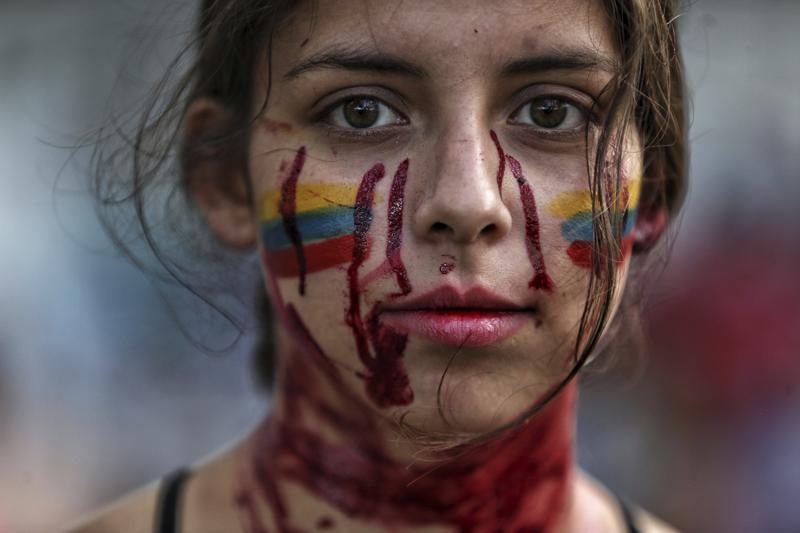
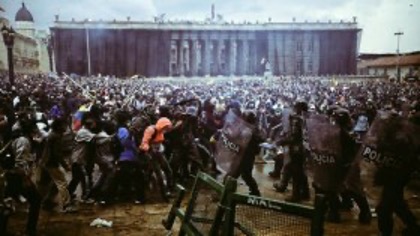
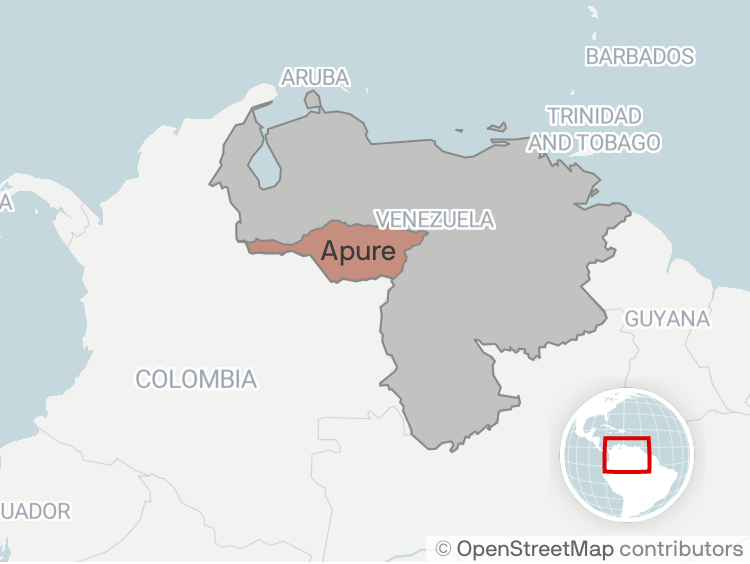
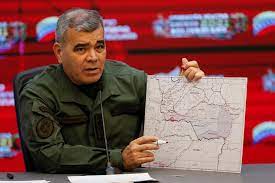
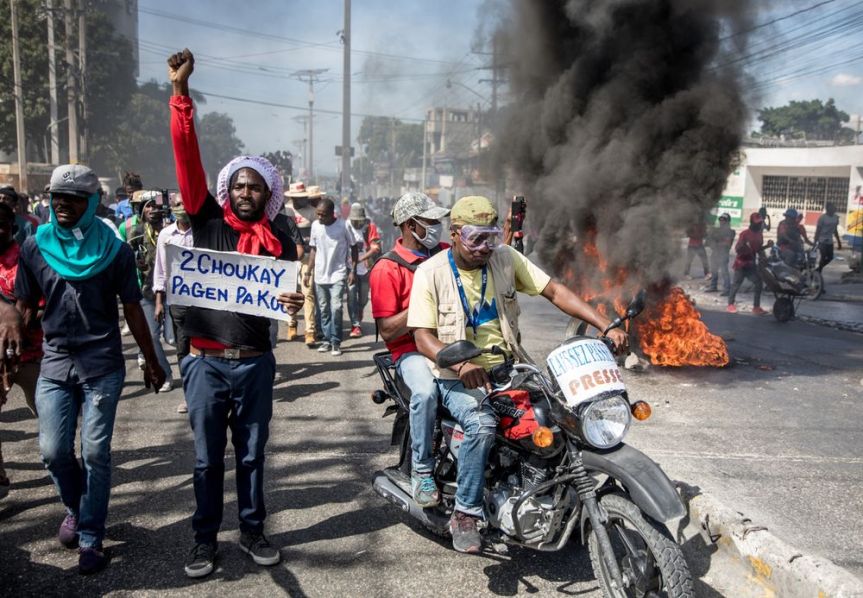
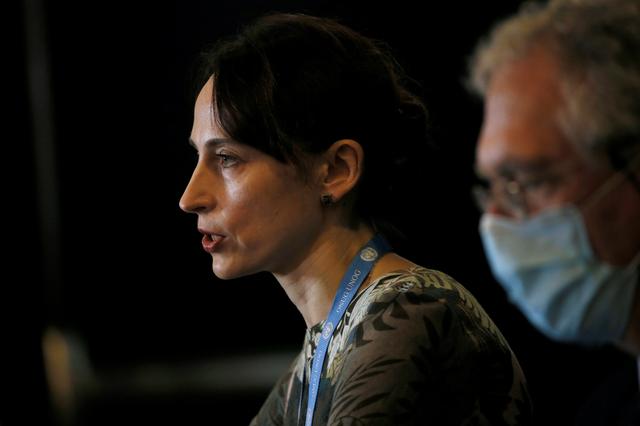
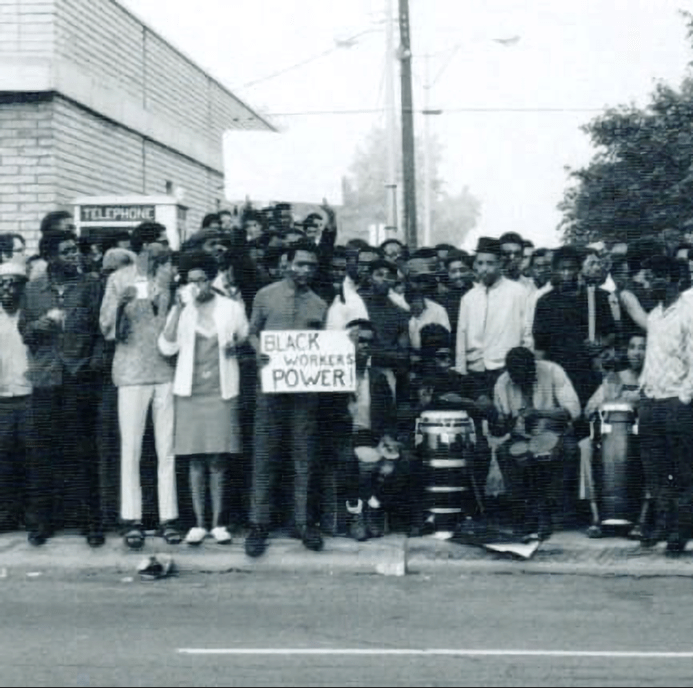


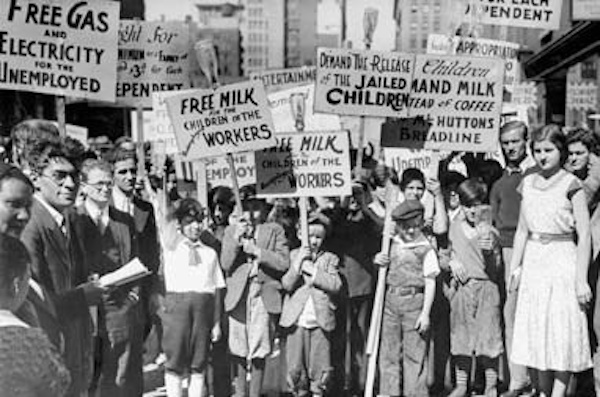
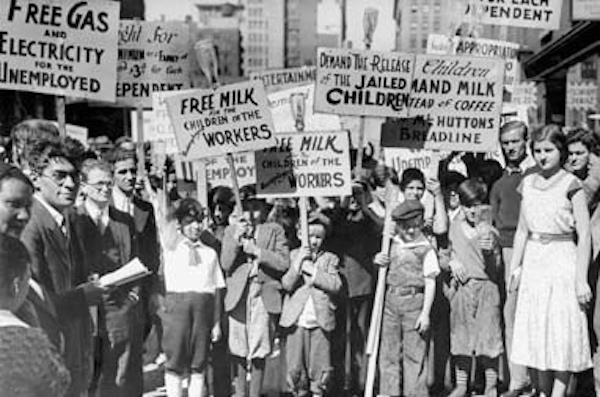


 COMMUNIST PARTY OF MAINE