
The Trump circus has a logic and it’s dangerous / By W.T. Whitney Jr

South Paris, Maine


As startling and far-reaching as they are, actions taken by the Trump administration are most impressive at first glance for their circus-like quality of no central purpose. Realization dawns, however, that measures hitting at the rule of law and democracy itself and promoting war and turmoil in the wider world are so politically disastrous that by no means would they have appeared accidentally.

The idea here is that present situation reflects the U.S. government’s last-ditch response to a crisis of capitalism. If so, any useful defense against unfolding catastrophe has to center, it seems here, on what needs to be done about capitalism.

The term signifies arrangements in effect since feudalism that give full rein to ruling classes everywhere to organize economic and political affairs to their advantage. Capitalism is an evolving process that, stumbling now and then, requires adjustments to its functioning. Presently, the masters of U.S. capitalism seem to be carrying out a major fix of old and new problems that impede profit-taking. The measures being employed are disruptive.

To get the job done, capitalist decision-makers recruited the MAGA crew as agents to take on the unpleasant job, among other, of removing protections against exploitation and abuse of U.S. working people. Lower-order capitalists having reservations will probably join the project, while holding their nose.

Some basic assumptions introduce the discussion here:

· To fix what’s wrong, you look for the cause.

· Focus on impaired personalities running the show does not fully explain the turmoil triggered by the Trump government’s recent actions.

· Preexisting political rules and arrangements for how to govern did nothing to prevent the present catastrophe.

· Wide sectors of the U.S. population are silent, stunned, and without hope. They are generally unconvinced that an alternative way of doing politics exists or is possible.

· The Trump administration regards political opposition as inconvenient, irrelevant, and disposable.

· Actions of his government result from rational decision-making. They are not the products of random impulses.

Beginnings

Capitalists cross established boundaries. Beginning centuries ago in Europe, they have been plundering distant parts of the world. Along the way, they added an exploitative factory system, great industrial monopolies, and, lastly, a world system of markets, cheap labor, and plunder of natural resources.

Overcoming challenges and contradictions, capitalists took charge of faraway peoples, fought wars against rival capitalist powers, confronted socialist governments and suppressed resistance movements at home and abroad. Periodically, they had to recover from economic crashes prompted by the impossibility of impoverished workers buying goods that were produced. The point here is that capitalists are used to dealing with challenges.

Capitalists after World War I were experiencing unprecedented difficulties, and fixing them was fraught with uncertainty. European and the U.S. economies were highly unstable even before the Great Depression arrived. Plus, the Soviet Union was attending to people’s social needs, was industrializing, and was little affected by the Great Depression. A socialist alternative to the capitalists’ faltering system had abruptly asserted itself.

Many capitalists in Germany and Italy reacted by tolerating or actively supporting the fascist political parties fighting for power in each of those countries. They claimed to offer protection for capitalist economies and fightback against the Soviet menace. Their restrained U.S. counterparts accepted palliative reforms mediated through New Deal social democracy.

U.S. capitalism took on new life after World War II when the United States took charge of inserting free trade and other neoliberal policies into the world economy, over which it presided. The system allowed rich nations and their capitalists to exploit low-wage workers abroad, take advantage of poor nations’ debt dependency, and profitably extract their underground resources.

New Troubles

The good times were not so good. Beginning in the 1970s, worldwide economic growth lagged and inflationary tendencies persisted. The U.S. economy was experiencing “long-term stagnation and deindustrialization.” Financial activities and financial assets now loom larger in the U.S. economy than do commodity production and trade.

Manipulation of debt instruments misfired in 2008 leading to serious economic crisis. These adverse, long-developing realities represent one impetus for capitalist leaders to move toward extraordinary corrective measures. The Trump administration is carrying them out.

The other big element marking the current disruption of national politics would be the expected unpredictability of the Trump administration’s conduct of foreign affairs. On the theory that the administration’s major task is to shore up capitalism, it will surely be acting so as to align U.S. overseas activities with capitalist norms.

Lenin and other authorities had a lot to say about these, mainly the notion that aggressive foreign interventions are crucial for capitalism to be able to function.

U.S. imperialism, a bipartisan project, expanded after post-World War II. U.S. imperialists have carried out interventions, wars, proxy wars, and devastating economic sanctions in country after country, mostly in the Global South. These activities will undoubtedly continue under the Trump administration in order to further capitalist purposes. Random remarks on Trump’s part suggestive of easing up on this or that foreign adversary contribute only to the current volatility of political affairs.

Anti-communism had long inspired U.S. overseas adventures, but U.S. warmaking continued even after the Soviet Bloc was no more. The U.S. government and its capitalist junior partners, for example, engineered devastating regime-change operations against Yugoslavia (1999), Iraq (2003), and Libya (2011) The cover of anti-communism was gone, and antiterrorism as justification barely sufficed. Subsequent U.S. foreign interventions have represented imperialism, pure and simple.

China and a few other underdeveloped nations are now major manufacturing centers. China continues to attract significant foreign investment and is investing, building infrastructure, and extracting subsoil resources throughout the Global South, in the process outstripping the United States. The BRICS+ nations, competitive with the Global North in banking, manufacturing and science, are seeking to replace the U.S. dollar as the main international currency.

What to do

U.S. capitalists, seemingly worried about uncertainties surrounding foreign interventions and about weaknesses of the faltering neoliberal free-trade system, are on the way to building something new. The suggestion here is that Trump circus riling U.S. politics is no accident and that a new kind of capitalism is on the horizon.

Under Trump the government is assertive, aggressively nationalistic, and insulated from progressive social and political currents from abroad. The U.S. has disconnected from international agreements and international organizations, notably the 2015 Paris Climate Accord and the World Health Organization. High import tariffs are landing on goods arriving from almost everywhere, with the highest ones reserved for Chinese products.

U.S. working people are, or soon will be, coping with price hikes stemming from high tariffs; assaults on labor organizing, healthcare, schools, and universities; selective food shortages; aggravated racism; and cruel and illegal deportation proceedings. New grief is compounding earlier unmet social and economic needs.

The changes are so far-reaching that progressive reforms introduced by President Franklin Roosevelt in the 1930s are at risk of disappearing. Breakdown of the New Deal consensus would be the crown jewel of the upcoming capitalist reformation.

Almost incidentally, war preparations are a major element of the new kind of capitalism. According to Monthly Review, “[R]earmament of U.S. allies, along with a massive increase in Pentagon spending and bellicose threats directed at designated enemies, could lead to the further proliferation of conflicts, heightening the chance of a Third World War.” A “Trump nationalist imperial policy” envisions a “New Cold War on China” involving a “limited nuclear war.”

Call in the specialists

A government embarking upon such far-reaching initiatives can expect troubles ahead. Vast numbers of U.S. Americans will be experiencing grief and abuse. They may rise up, prompting the need for their suppression and for maintenance of order. A major war would require the home front to be stabilized and controlled with vigor. A special brand of governance would come into play. Specialists are available for this kind of work.

They are MAGA crew, already on the job. Following a script, they hit at the rule of law, politicize the military, prepare for war, scapegoat immigrants and the racially oppressed as internal enemies, assault institutional centers of thought –universities, government research centers, and the independent press – and rip apart the fabric of democracy. Lying and disregard for the truth are nonstop.

You may have already made the association. Another bunch of fascists thugs almost a century ago in Germany and Italy did their reordering in ways similar to those adopted by the Trump administration in our era. Measures taken in both situations are similar, as are overall purposes.

The way out

Working-class resistance becomes important. Turning back the fascists – or protofascists, call them what you will – rests on alliances created between working people and other oppressed and marginalized sectors, especially in rural areas and among the lower ranks of the middle class, the so-called petit bourgeoisie. The MAGA movement’s electoral strength depends on support from both sectors and also, crucially, from elements of the working class.

The record shows that to defeat 20th century fascism, major elements of the Communist movement pursued the popular front strategy, the idea of worldwide alliance involving all democratic forces. That recipe fits today and, besides, no alternative political formation or remedy is waiting in the wings for rescue.

Communists are familiar through study and practice with the linkage between capitalism gone awry and the origins of fascism. Giving voice to that reality may be a first step in bringing unhappy, confused malcontents into political activism, and from there into mass mobilization, which is the essential tool for defeating fascism.

Communists and socialists will be educating and organizing, and asserting their places in public life. They would interact primarily, but not exclusively, with members of the working class. Their educational message would begin with the premise that capitalists unable to solve their big problems turn to fascism for rescue. They would highlight the connection between wars and imperialism.

Loose ends remain. First, U.S. capitalists’ reliance on the fascists is old hat for their kind. Business mogul Henry Ford and Charles Lindbergh of America First fame greatly admired the Nazis. Senator Harry S. Truman in 1941, commenting on war in Europe, stated that, “If we see that Germany is winning, we ought to help Russia, and if Russia is winning, we ought to help Germany, and that way let them kill as many as possible.” His message was that in the right circumstances Nazis are OK.

Secondly, U.S. capitalists, bent upon overcoming failures in how capitalism works, easily dismiss one of the greatest failures of worldwide capitalism, that of weak response to environmental crisis that threatens to destroy humankind and the natural world.


W.T. Whitney Jr. is a political journalist whose focus is on Latin America, health care, and anti-racism. A Cuba solidarity activist, he formerly worked as a pediatrician, and lives in rural Maine.

Ending the Gaza healthcare horror (and the US one) requires working class power / by W. T. Whitney

The infant intensive care unit of Kamal Adwan Hospital. Image: Abdulqader Sabbah/Anadolu via Getty Images

South Paris, Maine


U.S. laws require healthcare practitioners and anyone else to report to “the state” their suspicion of abuse of any child they’ve encountered. But the state abuses too.

The Lancet medical journal, published in Great Britain and read throughout the world, recently condemned the Israeli state and the “ongoing Israeli military assault on Gaza” for causing “an unprecedented rise in maternal deaths, miscarriages, and stillbirths.”  

Lancet asserts that the “violence is not just a consequence of the military assault—it is a deliberate outcome of policies that restrict access to health care.” And a “blockade, now in its second decade, and ever-tightened over the last few months, has compounded the suffering, with dire implications for future generations.”

Lancet’s report refers to “humanitarian catastrophe … the onset of famine … deterioration of maternal health services … [and the] near-total collapse of the health-care infrastructure.” It points to “a tragic surge in preventable maternal and neonatal deaths.” 

Lancet adds that:

“Prenatal care is virtually non-existent in Gaza. The rise in premature labor is staggering, often triggered by the chronic stress of displacement, malnutrition, and the trauma of witnessing air strikes. As hospitals struggle to keep up with mass casualties, maternity wards are becoming non-functional. In some cases, women have had to deliver babies outside, in unsanitary conditions, without the assistance of midwives or doctors.”

The “targeting of maternity hospitals and the blockade that limits essential medical supplies … from entering Gaza have turned pregnancy into a life-threatening condition for thousands of women.”

Women “are forced to carry pregnancies through conditions unfathomable to the human conscience.” The report cites malnutrition …  a profound moral failure of the international community … [and] violation of international law.”  “Humanitarian principles dictate that civilians, particularly children and pregnant women, must be protected,” the report states.  Moreover, “The world cannot remain silent any longer. The time for action is now—to restore access to health care, to protect women and children, and to uphold the sanctity of life.”

The enabling role of Israel’s partner in crime receives no mention.  The United States supplies the tools for killing – the bombs, guns, ammunition, and planes.

Citing mothers, nurses and physicians, Gaza journalist Taghreed Ali points out that expectant mothers are experiencing more miscarriages, premature deliveries, and stillborn births than before. He notes an increased incidence of newborns born with congenital abnormalities.

These include deformed or absent limbs; neurologic malformations, especially hydrocephalus; cardiac defects; and digestive problems. Possible causes, according to experts whom he consulted, include:

malnutrition of mothers; no pre-natal care; stress provoked by the bombings, shooting, and forced moves to new localities; gases produced by explosions; self-administration of inappropriate medicines necessitated by the absence of care; and inhalation of dust from explosions and collapsed buildings. Ali tells of expectant mothers buried in rubble for hours and later giving birth to babies who died or were malformed.

In this war and earlier Gaza wars, Israel’s military violates international humanitarian law by using artillery shells containing white prosperous. A pregnant woman exposed to this incendiary agent risks delivering a baby with congenital abnormalities, according to Lancet.

Aggravating the lack of care for sick or malformed babies has been the denial of access to specialty services outside of Gaza. Israel continues with its lockdown of Gaza’s borders.

The Israeli state’s trashing of healthcare in Gaza parallels the sorry state of healthcare fostered by governments in power in the United States. Israeli and U.S. political leaders share an easy tolerance of preventable dying.

In his recent comprehensive analysis, reporter Peter Dolack asserts that U.S. healthcare “is by far the world’s most expensive while providing the worst results among the world’s advanced capitalist countries.” The system is “designed to extract maximum profits rather than deliver health care.” U.S. residents “live the shortest lives and have the most avoidable deaths … More than 26,000 die in the United States yearly because of a lack of health insurance.”

Powerbrokers in both countries are dismissive, it seems, of healthcare for the poor, marginalized, and forgotten, and of their health. Such evident cruelty betokens an oppression that is widespread in both situations.  Meanwhile, both leadership classes shore up power and privileges. This is one area of struggle.

Another is the decades-long striving of Palestinians to restore land and liberty. Any headway with struggle along such lines promises to fire up oppressed peoples throughout the Middle East – and not so much minders of the region’s status quo. According to academician Jason Hickel, “A liberated Middle East means capitalism in the core really faces a crisis, and they will not let that happen, and they’re unleashing the full violence of their extraordinary power to ensure it doesn’t.”

Under these circumstances, Israeli and U.S. strategists are looking ahead and seeking to waylay progressive change, while tuning into their counter-revolutionary instincts. They apparently have latched onto a notion of power put forth earlier by one of their ideological enemies. According to Lenin (State and Revolution), “The state is a special organization of force; it is the organization of violence for the suppression of some class”.

It’s a frame of mind that, reasonably enough, would have the victims of oppression in both the Middle East and United States casting about for ways for their own class to achieve political power.

Meanwhile, the Communist Parties of Palestine and Israel, and their allies, meeting virtually on October 7, agreed that, “Only by establishing a sovereign Palestinian state will there be peace and stability in the region.”  Beyond self-determination, they also called for cessation of the siege on Gaza and the relief of suffering.


W.T. Whitney Jr. is a political journalist whose focus is on Latin America, health care, and anti-racism. A Cuba solidarity activist, he formerly worked as a pediatrician, lives in rural Maine. W.T. Whitney Jr. es un periodista político cuyo enfoque está en América Latina, la atención médica y el antirracismo. Activista solidario con Cuba, anteriormente trabajó como pediatra, vive en la zona rural de Maine.

U.S. Deaths Highlight Need for Far-Reaching Change / By W. T. Whitney Jr.

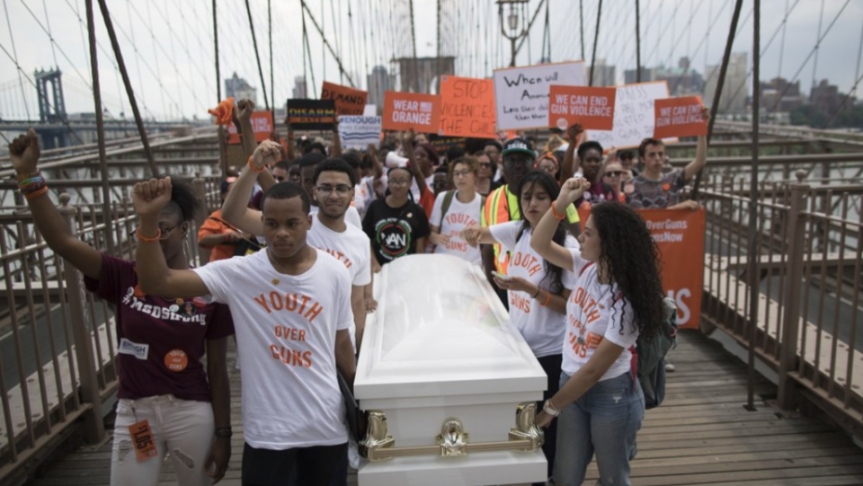
Demonstrators carry a coffin over Brooklyn Bridge during a march against gun violence, 06.02.18, in NY. | Mary Altaffer – AP

Under U.S. capitalism, industrial production and consumerism expand. Greenhouse gases increase, the climate changes, and people die. U.S. imperialism leads to wars and potentially nuclear war.

U.S. life expectancy has fallen. According to government statistics released in December, 2022, life expectancy at birth (LEB) for 2021 was 76.4 years. LEB was 77.0 years in 2020 and 78.8 years in 2019. Public health officials claimed this “was the biggest two-year decline in life expectancy since 1921-1923.”

Mothers fare badly. In 2020,19.1 mothers in general and 55.3 Black mothers died per 100,000 live births. They died from illnesses related to childbearing, most of them preventable. In the Netherlands that year, the maternal mortality rate was 1.2 mothers per 100,000 live births. In 2018, 55 nations showed a rate more favorable than that of the United States. 

Americans, mostly working-age adults, die from “diseases of despair” – substance abuse, accidental drug overdose, alcoholism, and suicide. They also died of Covid 19 infection, the U.S. rate of 332.81 Covid deaths per 100,000 population being the 16th highest in the world.

During most of the pandemic, Black people died at two or more times the rate of infected white people. Now the cumulative death rates of each group are similar, with 355 deaths of whites and 369 deaths of Blacks per 100,000 population. Cumulative Covid deaths for American indigenous peoples register at 478 deaths per 100,000 population. Vaccine skepticism may account for increased vulnerability of whites. 

The pandemic aside, Blacks and American Indians live far shorter lives than white people do. As of October 2022, LEB for Hispanics was 77.7 years; white people, 76.6 years; Blacks, 70.8 years; and American Indians, 65.2 years. In 2020, 65 nations showed longer LEB than did the United States.

Healthcare failings may have contributed to the high U.S death rates. Proposals for reform, especially for universal healthcare, center on its financing. The United States is the top healthcare spender among all nations.

Paying  $12,914 per capita for healthcare in 2021, the United States outspent second-place spender Germany whose outlay was $7383 per capita. Total spending on health that year amounted to $4.3 trillion –18.3% of the U.S. GDP. The United States accounted for 42% of healthcare spending in the world in 2018.

Healthcare in the United States is a profit center. The pricing of drugs, medical equipment, medical insurance, and services provided by hospitals and outpatient facilities in general is exorbitant.  Executives of medical supply and pharmaceutical companies, specialty physicians, and administrators of hospitals and healthcare networks receive enormous salaries.

Profitmaking hospital chains, health insurance companies, and pharmaceutical companies generate enough revenue to allow for stock buybacks and dividend payments. Over nine recent years 14 pharmaceutical companies spent $747 billion on stock buybacks. Payments to private insurance companies and private hospital networks are large enough to cover astronomically high administrative costs and profit-taking.

Some healthcare and health-promotion activities produce no revenue, or very little. They tend to receive relatively little support and skimpy funding.

  • The U.S. public health sector, charged with health education and illness prevention, is a low-priority item. Inadequate preparation and preventative measures largely accounted for the U.S. Covid-19 debacle. 
  • Insurance companies dedicate effort to denying coverage for particular diagnostic and therapeutic interventions.
  • Multi-hospital, multi-service conglomerates are cutting back on health services in rural and economical depressed areas because of decreased “productivity.” 
  • Many hospitals have recently dropped children’s hospital services as being less remunerative than care for hospitalized adults.
  • Small rural hospitals unable to pay bills have been closing down in droves throughout the nation, depriving area residents of care.
  • Specialty practitioners and hospitals often prioritize expensive medical procedures and high-technology diagnostic modes over care centering on provider – patient interaction and communication.
  • Many physicians during training opt for a specialty rather than a primary-care career, often because of income considerations. Primary care physicians now comprise only 20% of all U.S. physicians.
  • Diminished emphasis on a “medical home,” that hallmark of primary care, opens the door to inefficient, low-quality care.

Other capitalist countries have achieved long life expectancies.  The average life expectancy for 2021 in eight European countries plus Australia and Japan was 82.4 years. Their average per- capita health spending was $6,003. Japan spent $4,666 per capita on healthcare; LEB was 84.5 years.

Those countries protect healthcare as a public good, mainly because labor unions and social democratic or labor political parties apply pressure. Universal access to care is the norm. 

Universal care in the United States is but a dream. U.S. unions are weak and there is no working people’s political party. Some 25 million working age adults had no health insurance in 2021; insurance for 23% of them was inadequate. Too many have no care or fragmented care.

Reform efforts will continue in the United States, propelled perhaps by worsening life expectancy. But healthcare has its limitations. Steven Woolf, retired director of Virginia Commonwealth University’s Center on Society and Health, told an interviewer recently that better healthcare is “only a partial answer” to extending life expectancy, accounting “for about 10 to 20 percent of health outcomes.”

He explained: “Our health is really shaped by our living conditions, jobs, the wages we earn, our wealth accumulation, the education that enables us to get those jobs … The country that we live in is the richest in the world, but we have the highest level of income inequality. So, much of the resources that we need for a healthy population are not available to most of the population.”

Woolf is saying, in effect, that people die early because of inequalities, oppression, and organized greed. The United States appears as different from other rich capitalist counties. Social guarantees are fragile. The wealthy have few restraints on satisfying their wants. A besieged working class lacks voice and agency.

The prospect that reforms, alone, will restore justice and decent lives for working people is nil. They confront a voracious, extreme kind of capitalism.  Its rulers tolerate, promote, and seek out collaborators for actions and policies leading to die-offs. Think climate catastrophe, wars, and nuclear war.

In response to impending disaster, Americans desiring better and more secure lives for everyone would adjust their forward vision. Working for reforms, they would aim at something new, which is top-to-bottom social and political change. New motivation, determination and hope would be a shot in the arm.

Revolutionary change is a worldwide project, and not to be left to one people – except in special circumstances. One such was pre-1917 Czarist Russia and another would be that anomaly among capitalist nations which is the death-dealing U.S. nation.


W.T. Whitney Jr. is a political journalist whose focus is on Latin America, health care, and anti-racism. A Cuba solidarity activist, he formerly worked as a pediatrician, lives in rural Maine. W.T. Whitney Jr. es un periodista político cuyo enfoque está en América Latina, la atención médica y el antirracismo. Activista solidario con Cuba, anteriormente trabajó como pediatra, vive en la zona rural de Maine.

Cuba and China Exceed US in Life Expectancy, Send Message to the World – Socialism is the Difference / by W.T. Whitney Jr.


Children born in socialist Cuba and China can expect to live longer than children born in the capitalist United States. | AP photos

To extend a population’s life expectancy at birth (LEB) requires capabilities that are scarce in the United States. The U.S. LEB has fallen in the recent period, quite abruptly. Meanwhile, life expectancy in China and Cuba continues its long-term rise. To understand why we should explore nations’ varying capabilities to achieve social change and promote social gains.

Medical and sociological causes of death that relate to life expectancy and are specific to the United States will not be explored here. A subsequent report will cover that ground.

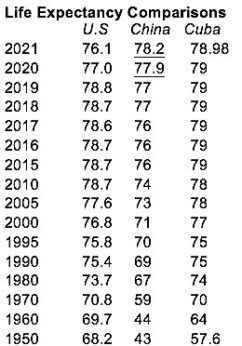
The U.S. National Center for Health Statistics on Aug. 31 set U.S. LEB for 2021 at 76.1 years, the same figure as in 1996. The decline from 77.0 years in 2020 and from 78.8 in 2019 was the greatest continuous U.S. fall in LEB in 100 years. Life expectancy for men in 2021, 73.2 years, represented an unprecedented male-female gap of almost six years (increased male mortality is routine).

Life expectancy for people in Cuba and for China now exceeds that for people born in the United States. Cuba’s LEB rose from 57.6 years in 1950 to 79 years in 2021—an advance of over 21 years. In those years, China’s LEB moved from 43 years to 78.2 years—a 35.2-year increase—and LEB for Americans rose by 7.9 years. The Cuban and Chinese achievements of drastically improving life expectancy in a few years and from very low levels are remarkable.

Policies put in place following the two countries’ socialist revolutions led to wide-ranging social initiatives that are protective of all people’s lives and, incidentally, crucial for long life expectancy. Capitalist governments, less oriented to social change, are prone to tolerating gaps in social development.

The two socialist countries pursued particular objectives to achieve social gains. Specifically, they have endeavored to establish working-class political power, promote decent and healthy lives for all working people, eradicate major economic inequalities, and build unity.

Some capitalist countries have also attempted to fulfill a few of these objectives when under left-wing governance, with mixed success. A look at how well they may have succeeded, and at some of the consequences when they have not, may shed light on the failings of capitalist states to support the lives of their people, particularly the U.S.’ failure to sustain a LEB that in 2020 was already lower than that of 53 other countries.

The subject of providing social support is, of course, vast. On that account, the discussion here pays more attention to health care and less to other areas. It draws on the insights of Vicente Navarro, professor of public health and public policy at universities in Baltimore and Barcelona.

As regards working-class political power, Navarro maintains that “countries with strong labor movements, with social democratic and socialist parties…have developed stronger redistribution policies and inequality-reducing measures…. These worker-friendly countries consequently have better health indicators [including LEB] than those countries where labor movements are very weak, as is the case in the United States.”

Navarro blames the lack of universal health care in the United States, unique among industrialized nations, on the lack there of a strong labor movement and/or a labor or socialist party. Political power exerted by the organized working class in industrialized nations may vary, but it almost always exceeds workers’ power in the United States, where statistical markers of health outcome are decidedly less favorable.

The political weakness of the organized workers’ movement in the United States is clear. “The working class,” Navarro writes in 2021, does not appear anywhere in the Cabinet nor the Senate, and only appears in the House with an extremely limited representation of 1.3 percent.” Most “members of these institutions belong to the corporate class, closely followed by upper-middle class.” He condemns the “privatization of the electoral process,” in which “there is no limit to how much money can go to the Democratic or Republican party or their candidates.”

Decent and healthy lives are far from routine in capitalist countries, where poor health is associated with low social-economic status. Navarro reports that, in the United States, the “blue-collar worker has a mortality rate from heart conditions double that of the professional class. Mortality differentials by social class are much larger in the United States than in Western Europe.”

He notes that “top level British civil servants live considerably longer than do lower level ones,” and that “members of the [Spanish] bourgeoisie…live an average of two years longer than the petit bourgeoisie…who live two years longer than the middle class, who live two years longer than the skilled working class, who live two years longer than members of the unskilled working class, who live two years longer than the unskilled [and unemployed] working class.”

Alienation under capitalism exacerbates health problems. According to Navarro, “the distance among social groups and individuals and the lack of social cohesion that this distance creates is bad for people’s health and quality of life.” The social isolation he describes adds to challenges faced by social support systems and detracts from the usefulness of interventions.

Attempts by capitalist countries to remove wealth inequalities, especially in the health care arena, show mixed success. As commercialization of healthcare advances, difficulties mount. As the result of profit-taking in that sector, society-wide inequalities are aggravated, and working people lose equal access to quality care.

And yet some form of public overview of, or support for, health care sectors is more or less routine in the various capitalist countries. In many, public authorities operate and pay for hospitals, nursing homes, staffing, drugs, equipment, and training. But the infiltration of market prerogatives and privatization in the health care systems of richer countries now threatens long established goals of accessible health care for all.

In Europe, austerity campaigns under neoliberal auspices have led to cutbacks in publicly provided care. Privatization inroads blunted the institutional response in Europe to the COVID-19 pandemic. Investor groups have been eyeing the hospital and nursing home sectors as profit-making opportunities. According to the Lancet medical journal, privatization within the British National Health Service contributed to an increase in preventable deaths from all causes between 2013 and 2020.

The United States is the poster child of war in defense of privilege. There are stories, from health care:

In 2020 salary and benefits for William J. Caron, Jr., CEO of MaineHealth, a major care provider in the author’s locality, were $1,992,044; for Richard W. Petersen, Maine Medical Center CEO, they were $1,822,185. A commentator notes that “Hospital CEOs are compensated primarily for the volume of patients that pass through their doors—so-called “heads in beds.” Average annual income for U.S. primary care physicians was $260,000 in 2021; for specialists, $368,000.

According to bain.com, “Medtech companies are among the most profitable in the healthcare industry, with margins averaging 22%…profit pools [will] grow to $72 billion in 2024.” And “HME (home medical equipment) retail companies average 45 percent gross profit margin (GPM).”

Researchers found that between 2000 and 2018, the “median annual gross profit margin” (gross profit is revenue minus costs) of 35 pharmaceutical companies was 39.1% higher than that of 357 non-pharmaceutical companies. The CEOs of three major pharmaceutical companies” increased their wealth by “a total of $90 million” in 2018. As for COVID-19 vaccine manufacturers: “Moderna’s and BioNTech’s 2021 net profit margins reached 66% and 54%, respectively.”

The matter of creating unity to establish socialism and arrange for the common good needs little comment. Unity within society is a near impossibility under capitalism, inasmuch as divisions there are inherent to a world of greed and individualism. Meanwhile, China, opting in favor of life, put on a magnificent display of socialist unity as its people grappled with the pandemic.

The government imposed strong preventative measures and accepted the inevitability of economic disruption and loss. China’s COVID-19 mortality rate is 1.07 deaths per 100,000 persons. Its U.S. counterpart never seemed to choose and, that way protected economic growth. The U.S. COVID-19 mortality rate is 319.59 deaths per 100,000 persons.

It is important, finally, to lay to rest any suggestion that the riches of the United States and other capitalist nations automatically enable them to offer long life expectancies. Individualized entitlement to wealth is basic to how they operate, and that’s a contradiction and an obstacle.

A society aiming to pursue social initiatives that are comprehensive and directed to all population groups equally is a society that has to redistribute wealth. Wealth redistribution is the necessary adjunct to the objectives already discussed. The message here is that capitalist-inspired measures don’t make the grade and that socialist programs, as in Cuba and China, do work and do offer the promise of decent and secure lives to entire populations.

As with all op-eds published by People’s World, this article reflects the opinions of its author.

W.T. Whitney Jr. is a political journalist whose focus is on Latin America, health care, and anti-racism. A Cuba solidarity activist, he formerly worked as a pediatrician, lives in rural Maine. W.T. Whitney Jr. es un periodista político cuyo enfoque está en América Latina, la atención médica y el antirracismo. Activista solidario con Cuba, anteriormente trabajó como pediatra, vive en la zona rural de Maine.

People’s World, September 21, 2022, https://www.peoplesworld.org/