

Photo : nicaraguasandino.com/vida-y-revolucion-my-name-is-daniel-kovalik/
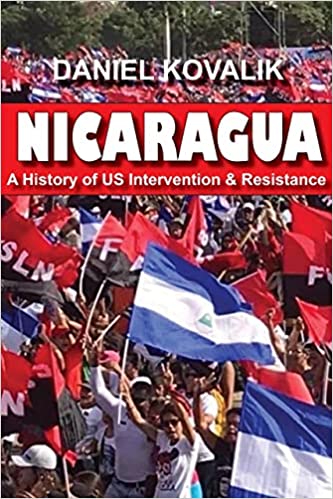
Daniel Kovalik, Nicaragua, a History of US Intervention & Resistance, (Clarity Press, Atlanta, 2023), ISBN; 978-1-949762-64-8, www.claritypress.com, 303 pages.
Prime minister of Saint Vincent and the Grenadines Ralph Gonsalves, speaking in Nicaragua in 2022, points out that the United States “is 350 million people [and is] the strongest military force in the world. Nicaragua is 6.2 million people, a country in Central America seeking to develop itself and its people.”
And so, “Why in God’s name, with a country so large, with so many resources, with such military strength, why would [the U.S.] want to pick on a small country like Nicaragua? I ask myself that question every day.”
9781949762600
Peace activist and Vietnam War veteran S. Brian Willson, speaking in South Paris, Maine, on September 13, 1998, had answered the question: “This neoliberal economics, the latest stage of capitalism, does not allow for alternative political or economic ideas or values. We already knew that any country that seriously threatened our model either had to assimilate or be eliminated.”
Willson had acted. On September 1, 1987 in Oakland, California, he put himself in front of a train to prevent a weapons delivery to U.S.- backed “Contra” mercenaries fighting revolutionaries in Nicaragua. The train did not stop and Willson lost two legs.
Daniel Kovalik’s valuable new book “Nicaragua, A History of US Intervention & Resistance” demonstrates the truth of Willson’s insight. Kovalik is a labor lawyer, human rights activist and teacher, and prolific author (his other books are here).
In that summer of 1987, college student Kovalik was part of a reforestation project in Nicaragua. The Contra war was in progress, and he heard machine gun fire “nearly every night.” The suffering was “simply shocking.” He writes that photos he took of children there “makes me want to cry.” The “Veterans Peace Convey” of humanitarian aid to Nicaragua, which he joined in 1988, was “possibly the most profound experience of my life.” Kovalik’s book is immensely appealing, not least because of personal experience that he relates.
He makes effective use of extended quotations from various reports, other histories, analyses from international agencies, and commentary from participants. Kovalik states that the object with his book was to present “the realities of U.S. intervention [in Nicaragua,] past and present,” highlight Nicaraguans’ abilities to overcome U.S. “assaults,” and promote solidarity with Nicaraguans in their struggle for self-determination.
The book’s first sections review Nicaragua’s history prior to the Sandinista National Liberation Front’s (FSLN) accession to power. It covers Tennessean William Walker’s attempt to set up his own slavocracy in 1855, U.S. Marines’ occupation of Nicaragua from 1912 to 1933, U.S. formation of Nicaragua’s oppressive National Guard, and U.S. support after 1936 for the brutal Somoza-family dictatorship.
Kovalik reports on Augusto Cesar Sandino’s guerrilla army that fought the Marines from 1927 until their departure. He writes about the struggle of the FSLN rural insurgency after 1960 to bring down the Somoza regime. Over 50,000 Nicaraguans died in the year preceding its collapse on July 17, 1979.
Most of the book is about the FSLN in power, their electoral defeat in 1990, the U.S.-led Contra counter-revolution in the 1980s, the “Dark Days” of neoliberal rule after 1990, and the Sandinistas in power again after 2007. There are these points:
· Until recently, the Sandinistas, originally an alliance of three factions, governed with allies including Catholic Church representatives, business leaders, capitalists, Marxists, and rural collectives.
· Women’s lives have improved in equality, political participation, and leadership opportunities.
· Sandinista approval ratings have remained high, even in stressful times, for example, 80% in 2018 prior to the protests of that year and up to 90% before the 2021 elections.
· Dissent within FSLN ranks and FSLN differences with its opposition have reflected divisions between city and countryside and between intellectual callings and manual work.
· The Catholic Church, now far removed from liberation theology, has consistently harassed the Sandinistas.
· Kovalik inveighs against U.S. leftists who have abandoned the Sandinistas. They “claim to know better about the nature of Daniel Ortega and the FSLN than the Nicaraguan people,” he points out.
· Sandinistas in power have accomplished much: nutritional gains, agrarian reform, food sovereignty, housing access, widespread electrification, increased literacy, more jobs, youth programs, universal access to schools and healthcare, infrastructure improvements, and lowered mortality rates.
Until 2020 or so, far fewer Nicaraguans were migrating north than were the peoples of other Central American countries. Their reduced numbers testify to the benefits of change in Nicaragua.
Kovalik finishes his book with a look at the interplay of recent anti-government protests, harsh penalties exacted by the government, and mounting criticism of the FSLN government by sectors of the U.S. and European left.
Anti-government protests with street actions and barricades prevailed in mid-2018. In his afterword that concludes Kovalik’s book, Orlando Zelaya Olivas indicates that 198 civilians and 22 police officers were murdered. Mainstream news reports uniformly blamed the police for killing peaceful demonstrators. The truth was otherwise.
Kovalik, citing sources, shows that the protesters had been paid and prepared, that many had criminal records, that snipers rather than the police did most of the killing, and that lethal violence continued even after the police were withdrawn. These were fake protests programmed toward destabilization and eventually a coup.
Kovalik shows the U.S. hand in creating turmoil. The U.S. government had funded opposition NGOs, youth groups, religious organizations, and dissidents who included former Sandinistas. U.S. agents and funding were behind the anti-government messaging on social media that played a prominent role.
Nicaragua’s government arrested and jailed many of those who in 2018 had violated laws against terrorist activities and against unauthorized service to a foreign government. In June 2019, the government amnestied hundreds of those caught up in the coup attempt. Dozens of jailed coup plotters were released on promising that they would no longer conspire against the government.
Criticism exploded again in 2021 after those who had promised to give up on plotting were imprisoned again on grounds that they were aiming to destabilize upcoming elections. Kovalik states that, “the first duty of a Revolution is to defend itself, for if it cannot meet this most essential goal, it obviously cannot serve and defend the people as they deserve.”
There was the added element of the imprisonments supposedly constituting interference in the elections of November 7, 2021 that gave Daniel Ortega a fourth consecutive presidential term.
Writing from Nicaragua, Stephen Sefton explains that the jailed opposition leaders were not opposition candidates. The political opposition in 2011 had split into regular political parties and “an extra-parliamentary opposition based in local NGOs.” The latter sector had “mounted the violent, US designed coup attempt” of 2018 and were arrested according to Nicaraguan Law. The opposition’s contending political parties had no part in planning a coup in 2021, according to Sefton
After Daniel Kovalik’s book was published, solidarity with the Sandinistas took a big hit. On February 9, 2023, the government released 222 prisoners, mostly those who had been arrested in 2021. It expelled all but a few to the United States. The government took away their citizenship and that of a 100 or so others, and confiscated their properties. Criticism has resounded, for example, from the Economist magazine, the United Nations, to the left-leaning Colombian government.
Taking away someone’s citizenship surely is an extraordinary step, certainly in the United States, and only slightly less so in the U.K. The grounds would be treason. A rationale for such a judgment emerges out of Kovalik’s book.
One imagines a favored few in Nicaragua who are oblivious to decades of U.S. military attacks, violence, pay-offs, trickery and manipulations. They spurned the government’s long efforts at collaboration and coalition building. One equally imagines the grief attending decades of popular resistance against the U.S.-backed dictatorship and, afterwards, the U.S.-backed opposition.
What’s left is desperation, especially what with population elements who reject the idea of justice and dignity for all Nicaraguans and who once more are shown to be dependent on the U.S. government. Meanwhile, U.S. economic sanctions are non-stop.
The book’s basic point is that rescue and recovery of oppressed, marginalized, and poor Nicaraguans have required a very long process. It’s no wonder that some counterparts today of Tom Paine’s “summer soldier and the sunshine patriot” have dropped out.
W.T. Whitney Jr. is a political journalist whose focus is on Latin America, health care, and anti-racism. A Cuba solidarity activist, he formerly worked as a pediatrician, lives in rural Maine. W.T. Whitney Jr. es un periodista político cuyo enfoque está en América Latina, la atención médica y el antirracismo. Activista solidario con Cuba, anteriormente trabajó como pediatra, vive en la zona rural de Maine.
 COMMUNIST PARTY OF MAINE