The United Arab Emirates Enables Human Catastrophe in Sudan, with the US in Tow / By W. T. Whitney, Jr.

Photo credit Z

South Paris, Maine


Beginning in April 2023, war between Sudan’s army and the paramilitary Rapid Support Forces (RSF) has caused humanitarian disaster of epic proportions. Some 150,000 people have died and 14 million Sudanese – Sudan’s population is 51 million – are displaced internally or in neighboring countries. Over 24 million suffer acute food insecurity. Famine is rampant in Darfur, the district in northwestern Sudan most afflicted by war and hunger.

We look at causes, foreign intervention in particular. The Sudanese people are victims of top-down oppression inflicted by big imperialists, lesser ones, and Sudan’s elite.  

The Bashir government in 2013 created the Rapid Support Forces from the Janjaweed formations and installed General Mohamed Hamdan Dagalo, known as “Hemedti,” as leader.

Protests by democratic forces beginning in December 2018 led to joint civilian-military rule. A coup in April 2019 removed Bashir from power. Subsequently, General Abdel Fattah al-Burhan, head of the armed forces and now the country’s president, and deputy military commander Hemedti became co-leaders of a transitional military council.

Turmoil continued, as did agitation for democratic change. In October, 2021, the two generals, having instigated another coup, established themselves as the country’s sole rulers. Al-Burhan and Hemedti subsequently disagreed on how to incorporate the RSF into Sudan’s army and on who would command the RSF. Reacting, Hemedti in April, 2023 provoked yet another coup. The RSF was soon occupying Khartoum, Sudan’s capitol city.

The Sudanese army recaptured a devastated Khartoum in March 2025. The RSF, having laid siege to El Fasher for 18 months and defeated the Sudanese army, took over that city of 700,000 inhabitants in October, 2025. Killings skyrocketed.

As of November 6, the Rapid Support Forces have agreed to a “humanitarian ceasefire” for three months proposed by the U.S., Egypt, the UAE and Saudi Arabia. The Sudanese army rejected the truce, demanding  that the RSF withdraw from civilian areas and surrender their weapons.

Origins

African nations emerging from colonialism endured varying degrees of continuing oppression and differing kinds of instability. Even so, humanitarian catastrophe in Sudan and the killings seem to be unprecedented.

The country’s vulnerability shows in a destitute, divided population, military rule, and societal collapse. It stems from a long history of autocratic rulers and recurring coups before independence and afterwards, division between an Arab-oriented North and non-Arab South (leading to an independent South Sudan in 2011), and susceptibility to manipulation by outside actors.

The United Arab Emirates (UAE) has interests in Sudan. Mohammad Khansa, writing for al-akhbar.commentions that, “Sudanese gold fuels the RSF, and the UAE.” Newly discovered gold deposits account for 60% of the country’s exports. The UAE imported $2.29 billion worth of Sudanese gold in 2022. Ninety percent of the gold Sudan produces goes to the UAE.

Sudan, the “leading agricultural producer in both Africa and the Middle East” is the “breadbasket of the Arab world.” The UAE imports 90% of its food. UAE investors have fostered land grabs in Sudan and industrialized Sudan’s agricultural production.

Other UAE interests are:  management of key Sudanese ports on the Red Sea, UAE control of many Sudanese banks and the UAE’s use of the RSF as its proxy in competing with Saudi Arabian influence in Africa.

UAE intrusion

Explaining the UAE’s relationship with Sudan and the RSF, Husam Mahjoub, writing in Spectre Journal, states that, “The UAE’s role in Sudan is … part of a coherent, well-financed, and regionally expansive project: a sub-imperialist agenda that combines economic extraction, authoritarian alliance-building, and counterrevolutionary politics.” The UAE “viewed the Arab Spring [of 2011] as an existential threat to both the authoritarian regimes in the region and its own model of governance. …[The] UAE became an active counterrevolutionary force.”

The Sudanese people’s uprising in December 2018, prior to Bashir’s removal, continued “even after the October 2021 coup.” It was “democratic, civilian-led, and explicitly antimilitary.” Demands were “freedom, peace, social justice, civilian governance, and accountability.” According to Mahjoub, this “grassroots resistance posed a threat to both Sudan’s own elites and regional powers like the UAE.”  

The RSF has helped the UAE in two ways: its “capacity for violence—that is, a force willing to suppress protests, fight wars, and eliminate rivals” and “economic access, especially to Sudan’s lucrative gold trade, which the RSF increasingly controlled.”

“[N]ow the regional leader in the defense sector,” according to the Simpson Center, the UAE imports weapons and makes its own. UAE support for the RSF shows in weapons transferred to the paramilitaries.  Gold from the RSF allows the UAE to buy weapons from many countries, with a portion of them ending up with the RSF.

The weapons enter Sudan by irregular means across several borders, and the gold arrives in the UAE the same way.

The UK’s Campaign against Arms Trade points out that, although the UAE allows the RSF to commit genocide by providing weapons, “there have been no efforts to pressure the UAE or hold it to account, and massive US and French arms supplies to the Gulf dictatorship continue unabated.”

Back in the US

The Biden administration in January 2025 accused the Rapid Support Forces of genocide. In March, New York Representative Gregory Meeks introduced legislation prohibiting arms sales to countries supplying arms to the RSF or the Sudanese Army. The bill has 27 co-sponsors.

Maryland Senator Chris Van Hollen and California Representative Sara Jacobs reintroduced legislation in March prohibiting U.S. arms sales to the UAE for as long as that country sends arms to the RSF. There are no co-sponsors.

The Trump administration in May announced a $1.4 billion sale of weapons and military equipment to the UAE. In 2024, the UAE received U.S. weapons worth $1.2 billion.

Husam Mahjoub explains that the UAE, as a “strategic partner of the West, … a buyer of arms, a major collaborator with Israel’s genocidal regime, a conduit for intelligence, and a financial hub, … is too useful to punish.”

Useful indeed! Reporter Dan Alexander claims the UAE “has become a hub for the Trump Organization’s international expansion. …[The] president and his family have entered into at least nine agreements with ties to the gulf nation. Together, the ventures … will provide an estimated $500 million in 2025—and about $50 million annually for years into the future …The president’s offspring are plotting novel ways to use crypto mania to squeeze more money from their real-estate assets.”

Alexander quotes Eric Trump: “The UAE is the developers’ greatest dream because they never say ‘no’ to anything, …. There’s no place that has been more fun to work in than the UAE. I mean, if you want to build it, if you can dream it up, they allow you to do it.” Alexander’s article is titled “This Gulf Nation Is Powering Trump’s Moneymaking Machine.”

The Sudanese Communist Party issued a statement on October 29. Speaking for the victims, it says in part:

“Our Party stands clearly and decisively against the horrifying massacres being committed against civilians in the cities of El Fasher and Bara … [We] always affirm that what is happening is not merely a military struggle for power; rather, it represents a complex scene of conflict between the parasitic wings of capitalism within the country over power and resources …  The war is, at the same time, a regional/international/imperialist scheme aimed at weakening the Sudanese state and creating conditions for disintegration and division to deplete the capabilities of the people, the wealth of the country, and violate national sovereignty.” 


W.T. Whitney, Jr., is a political journalist whose focus is on Latin America, health care, and anti-racism. A Cuba solidarity activist, he formerly worked as a pediatrician and lives in rural Maine.

Brazilian Workers Lead in Offering Solidarity to Venezuelans under US Attack / By W.T. Whitney Jr.

The leader of Brazil’s Landless Rural Workers’ Movement (MST), João Pedro Stédile, declares solidarity with the Venezualan government and people as they are threantened by a U.S. military intervention | Photo credit: brasildefato.com

South Paris, Maine


Since August, U.S. warships, fighter planes, and troops have deployed in Caribbean waters off Venezuela and in Puerto Rico. Venezuela’s neighboring countries in Latin America and the Caribbean area are reacting variously. Many oppose U.S. aggression, but at a distance.  Others are either non-committal or accepting.

Colombia and Brazil are backing Venezuela – or soon will be –  in very different ways. Recent remarks of João Pedro Stédile, co-founder and a director of Brazil’s Landless Workers’ Movement (MST), warrant special attention.

U.S. attacks from the air have killed dozens of crew members of boats alleged to be carrying illicit drugs. U.S. accusations against Venezuelan President Nicolás Maduro that he is a top-level drug dealer, serve as pretext. The U.S. government now offers a $50 million reward for his capture. The allegation that he heads the drug-dealing Cartel de los Soles is false. The cartel doesn’t exist, according to a United Nations report. A U.S. coup plotter recently claimed the CIA created the cartel.

President Trump recently indicated the CIA would be operating inside Venezuela. It’s widely assumed that the U.S. government wants control of Venezuela’s oil and other resources and is contriving to remove a government heading towards socialism.

Venezuela’s government is training militia troops by the millions. Venezuelan defense minister Vladimir Padrino López announced on October 21 that Venezuela’s’ military will cooperate with Colombian counterparts to fight narcotrafficking. Relations between the two nations are quickly improving.

They had deteriorated after Colombia’s government backed accusations that Venezuela’s 2024 presidential elections were fraudulent. But on August 10, Colombian President Gustavo Petro stated on social media that, “Colombia and Venezuela are the same people, the same flag, the same history. Any military operation that does not have the approval of our sister countries is an act of aggression against Latin America and the Caribbean.” Petro recently announced the Colombian military will be sharing military intelligence with Venezuela.

U.S. vilification extends to Petro who, speaking at the United Nations General Assembly on September 23, condemned U.S. support of Israel’s war on Gaza and U.S. imperialism generally. He railed against the U.S. at a rally outside the UN Headquarters. In response, the U.S. government revoked his visa.  Petro had previously refused to accept Colombian deportees sent handcuffed from the United States in a military plane.

International solidarity

On October 18, Petro accused the United States of killing a Colombian fisherman and violating Colombian sovereignty. Responding, President Trump called Petro “an illegal drug dealer … [who] does nothing to stop” drug production. He imposed import tariffs and suspended subsidies granted Colombia for drug-war activities. Petro recalled Colombia’s ambassador in Washington.

Colombia may be on Venezuela’s side, but that’s not clear with other countries in the region. Colombia, president pro tempore of the CELAC group of nations, arranged for a virtual meeting of CELAC foreign ministers to reach a common position. In 2014, the Community of Latin American and Caribbean States – CELAC –had declared the entire region to be a “zone of peace.”  

At the meeting taking place on September 1, representatives of the 23 CELAC nations present (out of 33) considered a general statement that filed to mention the U.S. -Venezuela confrontation. It expressed support for “principles such as: the abolition of the threat or use of force, the peaceful resolution of disputes, the promotion of dialogue and multilateralism, and unrestricted respect for sovereignty and territorial integrity.”

Most of the countries voting approved, but Argentina, Ecuador, Paraguay, Perú, Costa Rica, El Salvador, Guyana, Jamaica, and Trinidad and Tobago did not.

Member nations of the Bolivarian Alliance for the Peoples of Our America–Peoples’ Trade Treaty (ALBA-TCP) did condemn US military action in the Caribbean. The CARICOM group of Caribbean nations, meeting in late October, expressed support “for the sovereignty and territorial integrity of countries in the region,” again without reference to  the United States and Venezuela. Trinidad and Tobago was an outlier: Prime Minister Kamla Persad-Bissessar insisted that, “I have no sympathy for traffickers; the US military should kill them all violently.”

Regional presidents spoke out against U.S. intervention, specifically: Mexican president Claudia Sheinbaum; Honduras’s president  Xiomara Castro, Daniel Ortega, co-president of Nicaragua, and Brazilian president Luiz Inácio Lula da Silva.

Brazilian workers, especially those associated with Brazil’s Landless Workers’ Movement (MST) are taking matters into their own hands. Their leader João Pedro Stédile was interviewed October 16 on Rádio Brasil de Fato. (The interview is accessible here.)  He points out that:

“The United States has been threatening Venezuela for quite some time. The process was accelerated by the Trump administration, a mixture of madness and fascism. He thinks that, with brute force, he can overthrow the Maduro government and hand it over to María Corina [Machado] on a silver platter. Part of this tactic was awarding her the Nobel Prize …The United States is making a tragic mistake because it is basing its actions solely on information from the far right….

“Never before has the Maduro government had so much popular support … It is time for Lula’s government to take more decisive action and show more active solidarity with Venezuela.

“If the United States is exerting all this military pressure to try to recover Venezuela’s oil, and … [if] María Corina … comes to power after the invasion, her first act will be to privatize PDVSA [Petróleos de Venezuela] and hand over other Venezuelan resources—I imagine iron, aluminum, gold, which they have a lot of—to American companies for exploitation. …

“At this event I attended in Venezuela, the World Congress in Defense of Mother Earth, … we agreed … to organize, as soon as possible, internationalist brigades of activists from each of our countries to go to Venezuela and place ourselves at the disposal of the Venezuelan government and people.

“We want to repeat that historic epic that the global left achieved during the Spanish Civil War of 1936, when thousands of militants from around the world went to Spain to defend the Republic and the Spanish people.”

The MST webpage testifies to the class consciousness and anti-imperialism inspiring MST solidarity with the Venezuelans:

“Brazil’s Landless Worker’s Movement was born from the concrete, isolated struggles for land that rural workers were developing in southern Brazil at the end of the 1970’s. … Brazilian capitalism was not able to alleviate the existing contradictions that blocked progress in the countryside … Little by little, the MST began to understand that winning land was important, but not enough. They also need access to credit, housing, technical assistance, schools, healthcare and other needs that a landless family must have met…. the MST discovered that the struggle was not just against the Brazilian latifundio (big landowners), but also against the neoliberal economic model.”

The MST “is the largest social movement in Latin America with an estimated 1.5 million landless members organized in 23 out 27 states.”

Stédile himself articulates a rationale for calling the U.S. government to account. In a recent New Year’s greeting, he noted that, The world and Brazil are experiencing serious crises, such as the structural crisis of capitalism, the environmental crisis and the crisis of the bankruptcy of states that are unable to solve the problems of the majority … A good 2024 to all Brazilian people!”

His recent interview with Monthly Review is revealing:

“The MST has drawn on two key concepts from the historical experience of the working class in general and campesinos in particular: mass struggle and solidarity.

“Our strength does not come from our arguments or ideas; it comes from the number of people we can mobilize … I believe there has been a process of integration and mutual learning among Venezuelans, Brazilians, and Latin Americans in general. … The MST … has promoted brigades in various countries … and a permanent brigade here in Venezuela.”


W.T. Whitney, Jr., is a political journalist whose focus is on Latin America, health care, and anti-racism. A Cuba solidarity activist, he formerly worked as a pediatrician and lives in rural Maine.

José Martí Exposes U.S. Designs on Cuba / Prepared by W.T. Whitney

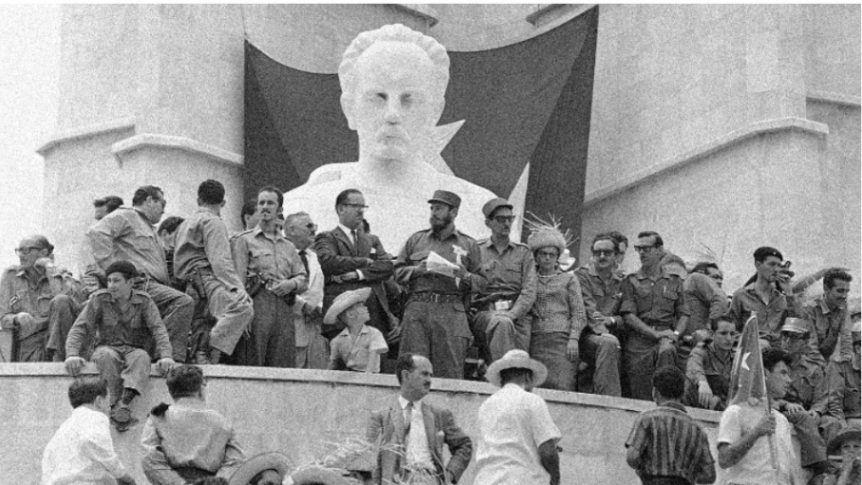
Photo: Fidel Castro, center, at the May Day 1960 parade in Havana at the Jose Marti Monument. | AP

South Paris, Maine


Introduction

While living in exile in the United States, José Martí dedicated the time between 1880 and 1895 to preparations for Cuba’s Second War for Independence from Spain, which ran from 1895 to 1898. Martí died as a martyr in Cuba on May 18, 1895. Our interest here is in Marti’s ideas on Cuba’s independence from the United States.

His writings are full of criticisms of the United States and U.S. pretentions for control of Cuba. Our object in presenting Martí’s ideas on the United States is to show that U.S. assault on Cuba, ongoing now for six decades as economic blockade, is hardly new. The U.S. has in fact sought domination over Cuba since the beginning of the 19 th century.

What follows is a sampling of Martí’s observation on the United States, written while he was living in New York between 1880 and early 1895. Martí, born in 1893, traveled frequently to Florida and even to Central America and the West Indies to educate, recruit, and raise funds for the coming independence struggle. In 1892, he founded the Cuban
Revolutionary Party and its newspaper Patria.

The Spanish colonial government arrested Martí for his writings in 1869 early in the course of Cuba’s First War for Independence (1868-1878). After one year in prison, Martí in 1871 left for exile in Spain where he remained for three years. Subsequently he was teaching and writing in Mexico and Guatemala until he returned to Cuba in 1878, only to be
exiled again to Spain. He moved on to New York, where, except for a six-month stay in Venezuela in 1881, he would remain until he left for Cuba in 1895.

Two themes dominate in his writings about the United States. He projected the idea of the idea of “our America,” which for him was all the territory lying between the Rio Bravo (Rio Grande) and Tierra del Fuego. That region had its own cultures, traditions, and history rather than those of North America and Europe. His essay “Our America” was published in
New York in 1991.

Warning about the U.S. threat to Cuban independence, Martí also mentioned the terms annexationism and annexationists to signify longings by U.S. Americans and by Cubans for U.S. possession of the island.

Excerpts of Martí’s writings follow:

José Martí’s letter to NY Evening Post, March 25, 1889 –

“It is probable that no self-respecting Cuban would like to see his country annexed to a nation where the leaders of opinion share towards him the prejudices excusable only to vulgar jingoism or rampant ignorance. There are some Cubans who … would like to see the island annexed to the United States. But those who have fought in war and learned in exile
… do not desire the annexation of Cuba to the United States. They do not need it; …they cannot honestly believe that excessive individualism, reverence for wealth, and the protracted exultation of a terrible victory are preparing the United States to be the typical nation of liberty.

José Martí’s letter to Gonzalo de Quesada on December 14, 1889 mentions this:

“On our land, Gonzalo, there is another [U.S.] plan even more sinister than what we have seen so far, and that is the wicked plan to force the island into war, to precipitate it, in order to have a pretext to intervene in it, and with the credit of mediator and guarantor, to take it over. There is nothing more cowardly in the annals of free peoples: nor any more cold- blooded evil.

The Washington Pan-American Congress — José Martí provided La Nación newspaper in Buenos Aires with a report (December 19-20, 1889) on the First International Conference of American States that took place in Washington from October,1889 to April,1890. Marti attended as consul for Uruguay. On the agenda were U.S. plans for bolstering commercial ties to the region and establishing a customs union.

“The parade of delegates is ending and the sessions of the Pan-American Congress are about to begin. Never in America, from its independence to the present, has there been a matter requiring more good judgment or more vigilance … than the invitation which the
powerful United States (glutted with unsaleable merchandise and determined to extend its dominions in America) is sending to the less powerful American nations (bound by free and useful commerce to the European nations) for purposes of arranging an alliance against Europe and cutting off transactions with the rest of the world. Spanish America
learned how to save itself from the tyranny of Spain; and now, after viewing with judicial eyes the antecedents, motives, and ingredients of the invitation, it is essential to say, for it is true, that the time has come for Spanish America to declare its second independence.”

The Inter-American Monetary Commission convened in Washington between January 7 and April 8, 1891. Its object was to fulfill instructions from the recent Pan-American International Conference to form an international monetary union and adopt a common silver currency. The Latin American delegates chose Martí, attending as Uruguay’s
representative, to present a report on their views.

“In every invitation among nations, one must look for hidden motives. No nation does anything against its interest; … Lesser nations, which are still in the throes of gestation, cannot safely join forces with those who seek a union with weaker nations as a solution for the excessive production of a compact and aggressive population, and a vent for their restless masses … They believe in the incontrovertible superiority of “the Anglo-Saxon
race over the Latin race”. They believe in the inferiority of the Black race, which they enslaved yesterday and continue to oppress today, and of the Indian race, which they are exterminating. They also believe that the peoples of Spanish America are composed principally of Indians and Blacks. … Does a political and economic alliance with the United States benefit Spanish America?

“Whoever says economic union, says political union. The nation that buys, rules. The nation that sells, serves.….

The Truth about the United States – Martí published this article in Patria, newspaper of the Cuban Revolutionary Party on March 23, 1894. “But it is certainly true that … in the United States, the reasons for unity are weakening, not solidifying; [that] the various localities are dividing and irritating national politics, not uniting with it; [that] democracy is
being corrupted and diminished, not strengthened and not saved from the hatred and wretchedness of monarchies … From the standpoint of justice and a legitimate social science it should be recognized that … the North American character has gone downhill since the winning of independence, and is today less human and virile; whereas the Spanish- American character today is in all ways superior, in spite of its confusion
and fatigue, to what it was when it began to emerge from the disorganized mass of grasping clergy, unskilled ideologists and ignorant or savage Indians.”

José Martí’s article “The Third Year of the Cuban Revolutionary Party” appeared in Patria on April 17, 1994. It contains this segment:
“Glory does not belong to those who look back, but to those who look forward. It is not merely two flower-covered islands (Cuba and Puerto Rico) … that we are going to bring forth, but we will save and serve them in such a way that the skills and vigor of their peoples, less isolated than those of the resentful and hungry European societies, ensures the independence of the happy archipelago that nature placed at the center of the world – despite the greed of a strong and unequal neighbor. … On the side of America are the Antilles, which, if enslaved, would be a mere pontoon in the war of an imperial republic against a jealous and superior world that is already preparing to deny it power—a mere fort of American Rome. If they were free … they would be the guarantee of balance between the continents, of independence for Spanish America, now under threat, and of honor for the great republic of the North.”

Martí’s article “Honduras and the Outsiders” appeared in Patria onDecember 15, 1894. There he explains that, “In America there are two peoples, and no more than two, with very
different souls due to their origins, backgrounds, and customs, and similar only in their fundamental human identity. On one side is our America, and all its peoples are of a similar or identical nature and background, and of an identical prevailing mix; on the other side is the America that is not ours, whose enmity it is neither sensible nor viable to foster, and with which it is not impossible, and indeed useful, to be friends, with firm decorum and shrewd independence. But we must live from our soul, cleansed of the evil church and the habits of mastery and undeserved luxury.”

José Martí’s letter to Manuel Mercado of May 18,1895
Mercado, living in Mexico, was Martí’s friend of many years. Martí, General Maximo Gomez and four others came ashore in eastern Cuba on April 11 1895. They had traveled from the Dominican Republic. Accompanied by rebel troops, they proceeded westward. Mari died in
battle on May 18, 1895, a day after writing this unfinished letter.

My dearest brother: Now I can write, now I can tell you how tenderly and gratefully and respectfully I love you and that home which I consider my pride and responsibility. I am in daily danger of giving my life for my country and duty. For I understand that duty and have the courage to carry it out – the duty of preventing the United States from spreading
through the Antilles as Cuba gains its independence and from overpowering our lands of America with that additional strength. All I have done so far, and all I will do, is for this purpose. … I have lived in the monster and I know its entrails; my sling is David’s. …

I am doing my duty here. The war in Cuba to prevent … the annexation of Cuba to the United States has come at the right time in America. It’s a reality greater than the vague and scattered desires of the annexationists among the Cubans and Spaniards, whose alliance with the Spanish government would only give them relative power.

Unless otherwise noted, Martí’s writings are taken from “Our America”, José Martí and Philip S. Foner, Monthly Review Press, 1977.


W.T. Whitney, Jr., is a political journalist whose focus is on Latin America, health care, and anti-racism. A Cuba solidarity activist, he formerly worked as a pediatrician and lives in rural Maine.


U.S. war on China, a long time coming / By W. T. Whitney Jr.

A still image from John Pilger’s documentary, “The Coming War on China”

South Paris, Maine


Movement toward war with China accelerates. The public, focused on troubles currently upending U.S. politics, does not pay much attention to a war on the way for decades. The watershed moment came in 1949 with the victory of China’s socialist revolution. Amid resurgent anticommunism in the United States, accusations flourished of “Who “lost” China.”

Loss in U.S. eyes was in China the dawning of national independence and promise of social change. In 1946, a year after the Japanese war ended, U.S. Marines, allied with Chinese Nationalist forces, the Kuomintang, were fighting the People’s Liberation Army in Northeast China.

The U.S. government that year was delaying the return home of troops who fought against Japan. Soldier Erwin Marquit, participant in “mutinies” opposing the delay, explained that the U.S. wanted to “keep open the option of intervention by U.S. troops … [to support] the determination of imperialist powers to hold on to their colonies and neocolonies,” China being one of these.

These modest intrusions previewed a long era of not-always muted hostility and, eventually, trade relations based on mutual advantage. The defeated Kuomintang and their leader, the opportunistic General Chiang Kai-shek, had decamped to Taiwan, an island China’s government views as a “breakaway province.”

Armed conflict in 1954 and 1958 over small Nationalist-held islands in the Taiwan Strait prompted U.S. military backing for the Nationalist government that in 1958 included the threat of nuclear weapons.

Preparations

U.S. allies in the Western Pacific – Japan and South Korea in the North, Australia and Indonesia in the South, and The Philippines and various islands in between – have long hosted U.S. military installations and/or troop deployments. Nuclear-capable planes and vessels are at the ready.  U.S. naval and air force units regularly carry out joint training exercises with the militaries of other nations.

The late journalist and documentarian John Pilger in 2016 commented on evolving U.S. strategies:

“When the United States, the world’s biggest military power, decided that China, the second largest economic power, was a threat to its imperial dominance, two-thirds of US naval forces were transferred to Asia and the Pacific. This was the ‘pivot to Asia’, announced by President Barack Obama in 2011. China, which in the space of a generation had risen from the chaos of Mao Zedong’s ‘Cultural Revolution’ to an economic prosperity that has seen more than 500 million people lifted out of poverty, was suddenly the United States’s new enemy…. [Presently] 400 American bases surround China with ships, missiles and troops.”

Analyst Ben Norton pointed out recently that, “the U.S. military is setting the stage for war on China. … The Pentagon is concentrating its resources in the Asia-Pacific region as it anticipates fighting China in an attempt to exert U.S. control over Taiwan.” Norton was reacting to a leaked Pentagon memo indicating, according to Washington Post, that “potential invasion of Taiwan” would be the “exclusive animating scenario” taking precedence over other potential threats elsewhere, including in Europe.  

New reality

Norton suggests that the aggressive trade war launched against China by the two Trump administrations, and backed by President Biden during his tenure in office, represents a major U.S. provocation. According to Jake Werner, director of the East Asia Program at the Quincy Institute, “Trump’s top military and economic advisers are almost without exception committed to confrontation with China.”

He adds that, “In a context of mounting economic pain on both sides, with surging nationalism in both countries becoming a binding force on leaders, both governments are likely to choose more destructive responses to what they regard as provocations from the other side. A single misstep around Taiwan or in the South China Sea could end in catastrophe.

Economic confrontation is only one sign of drift to a war situation. Spending on weapons accelerates. U.S. attitudes shift toward normalization of war. Ideological wanderings produce old and new takes on anticommunism.

Money for weapons

The annual report of the Stockholm International Peace Research Institute, released in April, says that in 2024 the world’s military spending increased by 9.4% in one year to a $2718 billion; it increased 37% between 2015 and 2024.

U.S. military spending in 2024 was $997 billion, up 5.9% in a year and 19% since 2015. For China, the comparable figures are $314 billion, 7.0%, and 59%, respectively; for Russia, $149 billion, 38%, and 100%; for Germany, $88.5 billion, 29% and 89%. The U.S. accounts for 37% of the world’s total military spending; China,12 %; Russia, 5.5%; and Germany, 3.3%. They are the world’s top spenders on arms.

In the United States,competition from new weapons manufacturers threatens the monopoly long enjoyed by five major defense contractors. These receive most of the $311 billion provided in the last U.S. defense budget for research, development, and production of weapons. That amount exceeds all the defense spending of all other countries in the world.

A new species of weapons manufacturer appears with origins in the high-tech industry. Important products are unmanned aircraft and surveillance equipment, each enabled by artificial intelligence.

Professor Michael Klare highlights one of them, California’s Anduril Industries, as providing the “advanced technologies … needed to overpower China and Russia in some future conflict.” Venture capital firms are investing massively.  The valuation of Anduril, formed in 2017, now approaches $4.5 billion.

Palmer Luckey, the Anduril head, claims the older defense contractors lack “the software expertise or business model to build the technology we need.” Multi-billionaire Peter Thiel, investor in Anduril and other companies, funded the political campaigns of Vice President J.D. Vance and other MAGA politicians. Klare implies that Theil and his kind exert sufficient influence over government decision-making as to ensure happy times for the new breed of weapon-producers.

Giving up

Waging war looks like a fixture within U.S. politics. Support for war and the military comes easily. Criticism that wars do harm is turned aside. Broadening tolerance of war is now a blight on prospects for meaningful resistance to war against China.    

Recent history is not encouraging. After the trauma of the Vietnam War subsided, anti-war resistance in the United States has been unsuccessful in curtailing wars in Yugoslavia, Iraq, Afghanistan, and Libya – and proxy wars in Ukraine and Gaza –despite massive destruction in all of them and more dead and wounded than can be accounted for.

Official language testifies to routinization of U.S. military aggression. Defense Secretary Hegseth, visiting at the Army War College in Pennsylvania, started with, “Well, good morning warriors. …We’re doing the work of the American people and the American warfighter. [And] the president said to me, I want you to restore the warrior ethos of our military.”

Hegseth traveled recently in the Pacific region, presumably with war against China on his mind. In the Philippines, he remarked, “I defer to Admiral Paparo and his war plans. Real war plans.” In Guam, he insists, “We are not here to debate or talk about climate change, we are here to prepare for war.” In Tokyo, he spoke of “reorganizing U.S. Forces Japan into a war-fighting headquarters.”

Ben Norton writes that, “In his 2020 book American Crusade: Our Fight to Stay Free, Hegseth vowed that, if Trump could return to the White House and Republicans could take power, “Communist China will fall—and lick its wounds for another two hundred years.”

Ideas as weapons

Proponents and publicists of off-beat ideas have long disturbed U.S. politics. Brandishing fantasies and myths, the Trump administrations have fashioned a new brand of resentment-inspired politics. Even so, familiar ideas continue as motivators, notably anticommunism.

Writing in Monthly Review, John Bellamy Foster recently explored ideology contributing to Donald Trump’s hold on to power. Much of it, he reports, derives from California’s Claremont Institute, its office in Washington, and Hillsdale College in Michigan. A leading feature is a kind of anticommunism that targets so-called cultural Marxism. But China and its Communist Party are not immune from condemnation.

Michael Anton is a “senior researcher” at the Claremont Institute and director of policy planning at the State Department. According to Foster, Anton suggested that “China was the primary enemy, while peace should be made with Russia [which] belonged to the same ‘civilizational sect’ as the United States and Europe, ‘in ways that China would never be.’”

Former Claremont Institute president Brian Kennedy, quoted by Foster, notes that, “We are at risk of losing a war today because too few of us know that we are engaged with an enemy, the Chinese Communist Party … that means to destroy us.”

The matter of no ideas comes to the fore. Recognized international law authority Richard Falk, writing on May 6, states that, “I am appalled that the Democratic establishment continues to adopt a posture of total silence with regard to US foreign policy.” Viewing the Democrats as “crudely reducing electoral politics to matters of raising money for electoral campaigns,” he adds that, I find this turn from ideas to money deeply distressing.”

The Democrats’ posture recalls a 1948 message from Michigan Senator Arthur Vandenburg, a Republican. During congressional debate on President Truman’s Marshall Plan, Vandenburg stated that, “Politics stops at the water’s edge.” This U.S. tradition lapses only occasionally.

Will resistance to war against China end up stronger and more effective than earlier anti-war mobilizations in the post-Vietnam War era?  A first step toward resisting would be to build awareness of the reality that war with China may come soon. General knowledge of relevant history would be broadened, with emphasis on how U.S. imperialism works and on its capitalist origins. Anyone standing up for peace and no war ought to be reaching out in solidarity with socialist China.  

John Pilger, moralist and exemplary documentarian and reporter, died on December 23, 2023. His 60th documentary film, The Coming War on China, first appeared in 2016. Pilger’s website states that, “the film investigates the manufacture of a ‘threat’ and the beckoning of a nuclear confrontation.” Please view the film on his website.


W.T. Whitney Jr. is a political journalist whose focus is on Latin America, health care, and anti-racism. A Cuba solidarity activist, he formerly worked as a pediatrician, and lives in rural Maine.
Unionized Maine Nurses reject reactionaries’ push for Medicaid cuts / By W. T. Whitney Jr.

Nicole Ogrysko / Maine Public

South Paris, Maine


U.S. healthcare, chronically afflicted with inequalities, has taken an acute turn for the worse. A proposal has emerged out of the U.S. government’s budget reconciliation process to reduce funding for healthcare and other national programs by $880 billion over the course of 10 years. Alleging fraud, proponents want to clear the way for “4.5 trillion in tax cuts through 2034.” Mostly the very wealthy would be benefitting.

Medicaid, the federal-state health insurance program established in 1965 to guarantee healthcare for low-come and/or disabled Americans, would take a big hit.

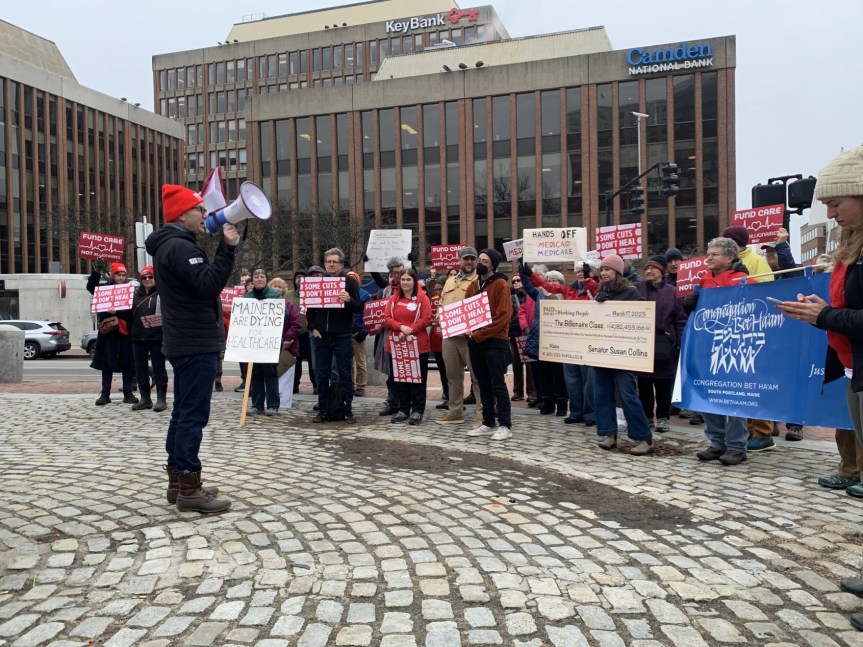
In Portland Maine on March 20, unionized nurses at Maine Medical Center, a big regional hub for sophisticated specialty care, staged a rally in defense of Medicaid outside Senator Susan Collins’s office. Their union, the Maine State Nurses Association/National Nurses Organizing Committee (MSNA/NNOC), made arrangements.

Emergency room nurse Kirsten Lane told the several dozen supporters on hand that, “People with chronic illnesses would not be getting the preventative care they need … We would see a lot of people showing up to the hospital sicker. We would see a lot of hospital crowding. We would see long wait times in the emergency room.”

Intensive care nurse Julianna Hansen remarked that, “The patients we see every day are some of the most vulnerable people in our state … “Our seniors, those with disabilities, and our young people are the ones who would most be hurt by cuts to MaineCare and CubCare … Union nurses stand against any cuts to our patients’ access to Medicaid.”  

(Medicaid in Maine is known as MaineCare; CubCare refers to children’s services provided under MaineCare.)

Some supporters of the nurses also spoke, including Dr. Julie Pease, longtime president of Maine AllCare, the Maine affiliate of Physicians for a National Health Program. The nurses then led the crowd in a march to Senator Collins’ office. They requested the senator’s surprised and grumpy staff to deliver their four-foot-long fake check to her.

According to pre-rally publicity, the check was “made out to the ‘Billionaire Class’ paid for by ‘Working People’ totaling $4,182,453,166 – the amount of Medicaid funding in Maine at risk if Sen. Collins votes to gut Medicaid to fund tax cuts for billionaires.”

The Maine Care program provides coverage for almost 400,000 Maine people─ 25% of the population ─ including two-thirds of Maine’s nursing home residents and half of Maine’s children. Nationally, 20% of all Americans and 40% of children receive healthcare through Medicaid. Medicaid covers 42 % of all births in the nation ─ almost 50% in Maine.

Maine has a Medicaid crisis of its own. The state government in early March was facing a $118 million shortfall in payments to providers for care covered under MaineCare. Many payments would be late in arriving. Spending on MaineCare consumed 32% of the state’s budget in 2023.

A supplemental budget aimed at meeting the shortfall did not survive Republican opposition in the legislature; a two thirds majority was required. The legislature then approved a two-year budget that provides for a one-year extension of MaineCare funding.

Apprehension exists that, if Medicaid funding is reduced, states will have to reduce expanded Medicaid services that were authorized under the Affordable Care Act, approved in 2014. Maine would have to remove 25,000 people enrolled in MaineCare, or else find $117 million more to replace lost federal funding.

According to the National Rural Health Association in February ─ Maine is a rural state ─“Medicaid funding is critical for sustaining rural healthcare systems, including hospitals, clinics, and community health centers.” The financial balances of almost half of rural hospitals are in the red.  Diminished flow of Medicaid funding threatens those hospitals’ existence. Their demise would lead to both preventable deaths in rural areas and significant job loss. All sorts of social and healthcare services of a preventative nature would disappear.

According to the KFF health policy news serviceMedicaid in 2023 covered 80% of children in poverty (and almost half of poverty-stricken adults). Medicaid also covers “nearly half of children with special health care needs.” Analyst Bruce Lesley reports that, “For millions of children with disabilities and chronic illnesses, Medicaid is the difference between survival and suffering.”

Studies of infant mortality in those states that chose expanded access to Medicaid under the Affordable Care Act show significantly reduced deaths of Black and Hispanic infants.  Mortality rates for them have been notoriously high in the United States for years.

Pressure on Senator Collins from the nurses’ union, MSNA/NNOC, reflects a wide vision. Indeed, the mission statement of National Nurses United starts out this way: “Through energetic advocacy we are organizing to: Win health care justice; accessible, quality health care for all, as a human right.”

Under the heading of sober reporting (we insist): the rally in Portland, Maine carried out by the unionized nurses represented something far beyond good news. Our collective prospects for the short and long terms took a sharp, upward turn.  


W.T. Whitney Jr. is a political journalist whose focus is on Latin America, health care, and anti-racism. A Cuba solidarity activist, he formerly worked as a pediatrician, and lives in rural Maine.

Readings (and films) on Cuba for the Comrades / Compiled by W.T. Whitney Jr.


Material following the “++” identification is of special importance


General aspects

++ Chronology and origins, US blockade. https://nsarchive.gwu.edu/briefing-
book/cuba/2022-02-02/cuba-embargoed-us-trade-sanctions-turn-sixty

Survey of US – Cuba relations — https://cri.fiu.edu/us-cuba-relations/chronology-of-us-cuba-relations/

++ Helen Jaffe — https://www.counterpunch.org/2023/03/31/the-state-of-cuba-us-relations-an-interview-with-dr-jose-ramon-cabanas/

Origins

US intervention and the Platt Amendment — chronology — https://leftlibrary.net/archives/2420

Historian Howard Zinn speaks in Maine on Cuba (2000) – film-
https://findingaids.library.nyu.edu/tamwag/tam_542/video/69p8d9k1/

Personalities

Julio Antonio Mella — https://jacobin.com/2024/12/julio-antonio-mella-cuba-communism

Che Guevara — https://revista.drclas.harvard.edu/the-legacy-of-che-guevara-his-
significance-in-the-americas/ —https://www.peoplesworld.org/article/che-guevara-and-
cubas-battle-of-ideas/

Fidel Castro — https://peoplesdispatch.org/2024/08/13/fidel-castro-a-life-of-revolution/

++ Jose Marti and Cuban Revolution — https://www.peoplesworld.org/article/jose-marti-soul-of-the-cuban-revolution/https://mronline.org/2018/01/29/the-soul-of-the-revolution/

US Blockade —Adverse effects

++ In Cuba’s report, U.S. blockade comes off as weapon of war — https://peoplesworld.org/article/in-cubas-report-u-s-blockade-comes-off-as-weapon-of-war/

The US Blockade and Its Effects on Cuban Medicine — https://magazine.scienceforthepeople.org/online/the-us-blockade-and-its-effects-on-cuban-medicine/

U.S. policy implicated in the economic crisis driving Cuban protests — https://cpmaine541537399.wordpress.com/wp-admin/post.php?post=30911&action=edit

Cuba’s problems multiply, but proposals for what to do are in short supply — https://peoplesworld.org/article/cubas-problems-multiply-but-proposals-for-what-to-do-are-in-short-supply/

Miscellaneous

++ Democracy in Cuba — https://cuba-solidarity.org.uk/cubasi/article/187/all-in-this-together-cubarsquos-participatory-democracy

Environment (Helen Jaffe)

People First: Cuba’s State Plan to Confront Climate Change –https://www.counterpunch.org/2023/06/02/people-first-cubas-state-plan-to-confront-climate-change/https://www.peoplesworld.org/article/cuba-has-a-plan-for-responding-to-climate-change/

Cuba has a plan for responding to climate change –https://www.peoplesworld.org/article/cuba-has-a-plan-for-responding-to-climate-change/

Cuba in Africa — https://jacobin.com/2022/05/cuba-castro-angola-namibia-us-soviet-union

Obama reforms — https://obamawhitehouse.archives.gov/the-press-office/2014/12/17/fact-sheet-charting-new-course-cuba

++ Cuba Defeats Covid-19 with Learning, Science, and Unity — https://www.counterpunch.org/2021/12/16/cuba-defeats-covid-19-with-
learning-science-and-unity/

++ Cuban Teachers and Students Make the Revolution –https://www.counterpunch.org/2023/01/06/cuban-teachers-and-students-make-the-revolution/

Cuban science — https://monthlyreview.org/press/how-the-knowledge-economy-and-science-bolster-cubas-socialist-revolution/

Healthcare

++ Vaccines — https://www.peoplesworld.org/article/cuba-develops-covid-19-vaccines-takes-socialist-approach/

Latin American School of Medicine — https://peoplesworld.org/article/cuba-s-wonder-of-the-modern-world-latin-american-school-of-medicine/

++ John Kirk — https://johnriddell.com/2020/04/08/cubas-unique-model-of-medical-
internationalism/

++ Helen Jaffe — https://www.counterpunch.org/2020/04/10/cuban-medical-science-in-the-service-of-humanity/

A few books

The History of Cuba Vol. 2, 1845-1895

Antonio Maceo: The “Bronze Titan” of Cuba’s Struggle for Independence

https://monthlyreview.org/product/spanish-cuban-
american_war_and_the_birth_of_american_imperialism_1895-1898_vol_1/

https://monthlyreview.org/product/our_america/ (Jose Marti, ed.by Philip Foner)

Films

Go to the Belly of the Beast media outlet to see films on Cuba, especially the three-part “War on Cuba” here: https://www.bellyofthebeastcuba.com/the-war-on-cuba

Or, Catherine Murphy’s (wonderful) film on literacy campaign, Maestra. at
https://vimeo.com/ondemand/maestra/160157747 51 minutes, cost $4.99


W. T. Whitney Jr.

W.T. Whitney Jr. is a political journalist whose focus is on Latin America, health care, and anti-racism. A Cuba solidarity activist, he formerly worked as a pediatrician, and lives in rural Maine.


Book Review – Truth-Telling about Nicaragua’s Long Revolution for Liberation and Democracy / By W. T. Whitney Jr.

Photo : nicaraguasandino.com/vida-y-revolucion-my-name-is-daniel-kovalik/


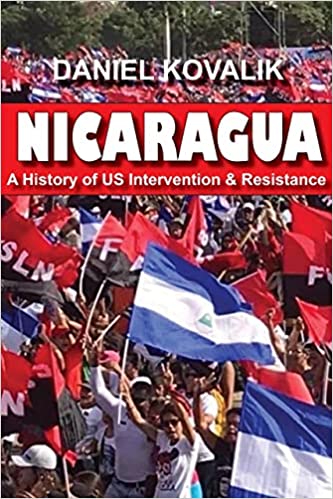
Daniel Kovalik, Nicaragua, a History of US Intervention & Resistance, (Clarity Press, Atlanta, 2023), ISBN; 978-1-949762-64-8, www.claritypress.com, 303 pages.


Prime minister of Saint Vincent and the Grenadines Ralph Gonsalves, speaking in Nicaragua in 2022, points out that the United States “is 350 million people [and is] the strongest military force in the world. Nicaragua is 6.2 million people, a country in Central America seeking to develop itself and its people.”

And so, “Why in God’s name, with a country so large, with so many resources, with such military strength, why would [the U.S.] want to pick on a small country like Nicaragua? I ask myself that question every day.”

Clarity Press, 2023
9781949762600

Peace activist and Vietnam War veteran S. Brian Willson, speaking in South Paris, Maine, on September 13, 1998, had answered the question: “This neoliberal economics, the latest stage of capitalism, does not allow for alternative political or economic ideas or values. We already knew that any country that seriously threatened our model either had to assimilate or be eliminated.”

Willson had acted. On September 1, 1987 in Oakland, California, he put himself in front of a train to prevent a weapons delivery to U.S.- backed “Contra” mercenaries fighting revolutionaries in Nicaragua. The train did not stop and Willson lost two legs.

Daniel Kovalik’s valuable new book “Nicaragua, A History of US Intervention & Resistance” demonstrates the truth of Willson’s insight. Kovalik is a labor lawyer, human rights activist and teacher, and prolific author (his other books are here).

In that summer of 1987, college student Kovalik was part of a reforestation project in Nicaragua. The Contra war was in progress, and he heard machine gun fire “nearly every night.” The suffering was “simply shocking.”  He writes that photos he took of children there “makes me want to cry.” The “Veterans Peace Convey” of humanitarian aid to Nicaragua, which he joined in 1988, was “possibly the most profound experience of my life.” Kovalik’s book is immensely appealing, not least because of personal experience that he relates.

He makes effective use of extended quotations from various reports, other histories, analyses from international agencies, and commentary from participants. Kovalik states that the object with his book was to present “the realities of U.S. intervention [in Nicaragua,] past and present,” highlight Nicaraguans’ abilities to overcome U.S. “assaults,” and promote solidarity with Nicaraguans in their struggle for self-determination.

The book’s first sections review Nicaragua’s history prior to the Sandinista National Liberation Front’s (FSLN) accession to power. It covers Tennessean William Walker’s attempt to set up his own slavocracy in 1855, U.S. Marines’ occupation of Nicaragua from 1912 to 1933, U.S. formation of Nicaragua’s oppressive National Guard, and U.S. support after 1936 for the brutal Somoza-family dictatorship. 

Kovalik reports on Augusto Cesar Sandino’s guerrilla army that fought the Marines from 1927 until their departure. He writes about the struggle of the FSLN rural insurgency after 1960 to bring down the Somoza regime. Over 50,000 Nicaraguans died in the year preceding its collapse on July 17, 1979.

Most of the book is about the FSLN in power, their electoral defeat in 1990, the U.S.-led Contra counter-revolution in the 1980s, the “Dark Days” of neoliberal rule after 1990, and the Sandinistas in power again after 2007. There are these points:

·        Until recently, the Sandinistas, originally an alliance of three factions, governed with allies including Catholic Church representatives, business leaders, capitalists, Marxists, and rural collectives.

·        Women’s lives have improved in equality, political participation, and leadership opportunities.

·        Sandinista approval ratings have remained high, even in stressful times, for example, 80% in 2018 prior to the protests of that year and up to 90% before the 2021 elections.

·        Dissent within FSLN ranks and FSLN differences with its opposition have reflected divisions between city and countryside and between intellectual callings and manual work.

·        The Catholic Church, now far removed from liberation theology, has consistently harassed the Sandinistas.

·        Kovalik inveighs against U.S. leftists who have abandoned the Sandinistas. They “claim to know better about the nature of Daniel Ortega and the FSLN than the Nicaraguan people,” he points out.

·        Sandinistas in power have accomplished much: nutritional gains, agrarian reform, food sovereignty, housing access, widespread electrification, increased literacy, more jobs, youth programs, universal access to schools and healthcare, infrastructure improvements, and lowered mortality rates.

Until 2020 or so, far fewer Nicaraguans were migrating north than were the peoples of other Central American countries. Their reduced numbers testify to the benefits of change in Nicaragua.

Kovalik finishes his book with a look at the interplay of recent anti-government protests, harsh penalties exacted by the government, and mounting criticism of the FSLN government by sectors of the U.S. and European left.

Anti-government protests with street actions and barricades prevailed in mid-2018. In his afterword that concludes Kovalik’s book, Orlando Zelaya Olivas indicates that 198 civilians and 22 police officers were murdered. Mainstream news reports uniformly blamed the police for killing peaceful demonstrators. The truth was otherwise.

Kovalik, citing sources, shows that the protesters had been paid and prepared, that many had criminal records, that snipers rather than the police did most of the killing, and that lethal violence continued even after the police were withdrawn. These were fake protests programmed toward destabilization and eventually a coup.

Kovalik shows the U.S. hand in creating turmoil. The U.S. government had funded opposition NGOs, youth groups, religious organizations, and dissidents who included former Sandinistas. U.S. agents and funding were behind the anti-government messaging on social media that played a prominent role. 

Nicaragua’s government arrested and jailed many of those who in 2018 had violated laws against terrorist activities and against unauthorized service to a foreign government. In June 2019, the government amnestied hundreds of those caught up in the coup attempt. Dozens of jailed coup plotters were released on promising that they would no longer conspire against the government.

Criticism exploded again in 2021 after those who had promised to give up on plotting were imprisoned again on grounds that they were aiming to destabilize upcoming elections. Kovalik states that, “the first duty of a Revolution is to defend itself, for if it cannot meet this most essential goal, it obviously cannot serve and defend the people as they deserve.”

There was the added element of the imprisonments supposedly constituting interference in the elections of November 7, 2021 that gave Daniel Ortega a fourth consecutive presidential term.

Writing from Nicaragua, Stephen Sefton explains that the jailed opposition leaders were not opposition candidates. The political opposition in 2011 had split into regular political parties and “an extra-parliamentary opposition based in local NGOs.” The latter sector had “mounted the violent, US designed coup attempt” of 2018 and were arrested according to Nicaraguan Law. The opposition’s contending political parties had no part in planning a coup in 2021, according to Sefton

After Daniel Kovalik’s book was published, solidarity with the Sandinistas took a big hit. On February 9, 2023, the government released 222 prisoners, mostly those who had been arrested in 2021. It expelled all but a few to the United States. The government took away their citizenship and that of a 100 or so others, and confiscated their properties. Criticism has resounded, for example, from the Economist magazine, the United Nations, to the left-leaning Colombian government.

Taking away someone’s citizenship surely is an extraordinary step, certainly in the United States, and only slightly less so in the U.K. The grounds would be treason. A rationale for such a judgment emerges out of Kovalik’s book.

One imagines a favored few in Nicaragua who are oblivious to decades of U.S. military attacks, violence, pay-offs, trickery and manipulations. They spurned the government’s long efforts at collaboration and coalition building. One equally imagines the grief attending decades of popular resistance against the U.S.-backed dictatorship and, afterwards, the U.S.-backed opposition.

What’s left is desperation, especially what with population elements who reject the idea of justice and dignity for all Nicaraguans and who once more are shown to be dependent on the U.S. government. Meanwhile, U.S. economic sanctions are non-stop.

The book’s basic point is that rescue and recovery of oppressed, marginalized, and poor Nicaraguans have required a very long process. It’s no wonder that some counterparts today of Tom Paine’s “summer soldier and the sunshine patriot” have dropped out.


W.T. Whitney Jr. is a political journalist whose focus is on Latin America, health care, and anti-racism. A Cuba solidarity activist, he formerly worked as a pediatrician, lives in rural Maine. W.T. Whitney Jr. es un periodista político cuyo enfoque está en América Latina, la atención médica y el antirracismo. Activista solidario con Cuba, anteriormente trabajó como pediatra, vive en la zona rural de Maine.

Review: Being Aware is First Step to Resisting US Militarization / by W.T. Whitney Jr.

Photograph Source: Jason Eppink – CC BY 2.0

The military draft in the United States has disappeared. There’s no major U.S. war and military affairs rate little attention in the media. The U.S. public embraces the pervasive influence of the military-industrial complex across U.S. society. The U.S. Congress seems never to hold back on wildly exorbitant military spending.

Travelers entering North Carolina on Interstate 95 almost immediately see a sign proclaiming “Nation’s most military friendly state” – a sign paid for, in part, by the N.C. Bankers Association.  In high schools, military recruiters “insinuate themselves into school life at every level.” Loudspeakers at sports events sound out tributes to veterans and active-duty troops. The latter may receive free tickets to performances, preferential parking, and discounts on merchandise.

Unveiling of the new “Welcome to North Carolina” sign for interstate highways in the state – Fayetteville Observer

Clarity Press, 2023
978-1949762587

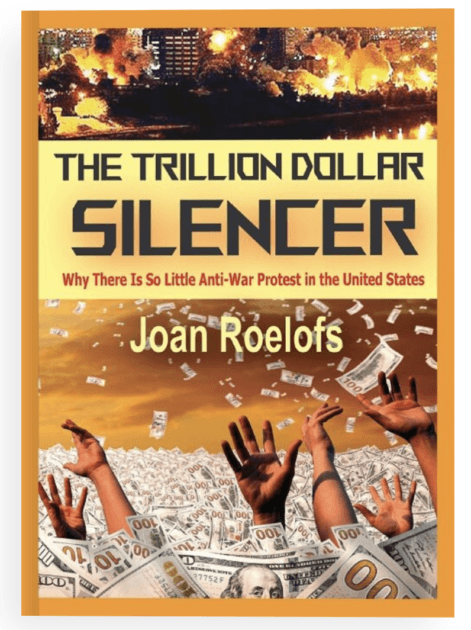
Author Joan Roelofs has written a new and much needed book that explains much about praise and support for the U.S. military. The Trillion Dollar Silencer, provides atravelogue of sorts through the U.S. military-industrial complex. It moves from the military establishment and big corporations to colleges, universities, NGOs, philanthropies, foundations research institutes, and other kinds of defense contractors.

Her thesis is that dependency on the part of civilian institutions involved with the military establishment has the effect of shielding the military from widespread popular outrage at war-making and big spending. She asks, “Why is there so much acceptance of and so little protest against our government’s illegal and immoral wars and other military opera­tions?”

The author shows her anti-war perspective in rejecting NATO and in criticizing U.S. military interventions, subversion, and covert military actions as violations of international law. She condemns U.S war-makers’ use of Cold War and anti-terrorism pretexts to have free rein to maim and destroy.

Roelofs, a retired professor of political science, is the author also of Foundations and Public Policy: The Mask of Pluralism (SUNY Press) and Greening Cities (Rowman and Littlefield).

She argues that the incentive for civilian institutions and private companies to support military funding and U.S. military purpose lies in their interests being satisfied. Propaganda, distractions, and fear of repression, she points out, are other persuaders. Her new book is about “the interests created by [the] military’s penetration into so many aspects of civilian life.”

Roelofs writes about large and small defense contractors and private, public, and non-profit ones. They are colleges, universities, research foundations, healthcare organizations, and groups working on political and legal issues and the environment.  They provide the military with supplies, logistics, weapons development, human services, defense against atypical threats.

She indicates that, “75% of the [Defense Department] budget is paid to contractors.” These had enough funds, she reports, to financially support dozens of think tanks and foundations. Money, we suggest, is basic to the “interests” cited by the author.

Other observers point out that U.S. companies in 2019 accounted for 57% of the arms sold by the world’s 100 top weapons manufactures. The world’s five biggest weapons manufacturers are U.S. corporations.

Lockheed Martin took in $58.2 billion in revenues in 2020 and showed profits of $9.1 billionin 2021. Raytheon Technologies reported arms sales of $36.8 billion in 2020 and profits of $5 billion in 2021. Boeing’s profits in 2021 were $5.19 billion. Northrop Grumman sold arms worth $30.4 billion in 2021 with $7.0 billion in net income. General Dynamics’s arms sales totaled $25.8 billion; its 2021 profits were $3.3 billion.  The average salary of the CEOs of these companies was $20,795,527, according to inequality.org.

According to the book, defense contracts provide economic rescue even for next-door operations.  In 2012 an $866,000 three-year contract for making cribs for childcare centers helped to revive a children’s furniture manufacturer in the author’s hometown Keene, New Hampshire. Granite Industries of Vermont was declining until it received a contract for making up to 4000 headstones a year for Arlington National Cemetery.

Surprises turn up as to who are the big defense contractors. The for-profit health insurance company Humana is the seventh largest of all of them, according to Roelofs. Massachusetts Institute of Technology ranks in 38th place.

Relationships are tight within the military industrial complex. Upper-level employees of universities, philanthropies, and non-government organizations and the top military brass and Defense Department officials oscillate between one sphere and the other. According to the author, Defense Department grants to philanthropies, foundations, and to environmental and civil rights groups are oriented to reforms and not so much to basic social change.

The single-issue orientation of most of the contracting philanthropies and NGOs fits with military and official preferences; their fear would be that different issues seen as connected might encourage critical thinking and even dissent. Roelofs looks at the role of state and local government entities in reaching out to youth to serve military needs such as ROTC units, recruitment, and encouragement of scientific and technical educational paths.

Roelofs’ purpose has been to make “the extent and implications of the military industrial complex more visible.” But, as she notes, “many look away, and the mountain is huge to move.” Additionally, “Our political system …  does not afford citizens much democratic control over policies, and hardly any over foreign policy.” The question is: “What can be done.”

Roelofs is alluding to the powerful forces attached to the economic and political status quo, among them the civilian enablers of the military establishment. She is saying, in essence, that the process of consciousness-raising that does lead to useful political action would be a long and arduous one.

Her book, which is written in a readable, accessible style, would have us start out at the beginning. The first item on the agenda is that of persuading ordinary people to say “No.” They would stand up, test the waters, be active in some way, and make a few gains.

She calls upon her readers to speak out, write to editors, contact elected officials, join and work with antiwar organizations. She advocates for a Green New Deal, a “national service program,” and “conversion to a civilian economy.” She is evidently hoping that masses of people will build a resistance movement, score some victories, gain confidence, and learn.

If Roelofs had presented all-encompassing themes like past U.S. military misadventures and the evils of a profit-driven political system, her call to action would have yielded almost nothing. Instead, more promisingly, she is lending support to a protest movement in its infancy. Now is exactly the right time for her highly recommended book.


W.T. Whitney Jr. is a retired pediatrician and political journalist living in Maine.

Counterpunch, November 18, 2022, https://www.counterpunch.org/

UN Condemns US Blockade as Crisis Builds in Cuba / by W. T. Whitney Jr

Cuba thanks universal support against the US blockade | Image: Prensa Latina

A long-running show played out in the United Nations General Assembly once more on November 3 as nations of the world for the thirtieth year voted overwhelming to approve a Cuban resolution calling for an end to the U.S. economic blockade of Cuba. The vote was 185 nations favoring the resolution, two nations opposing (The United States and Israel, as usual), and Ukraine and Brazil abstaining.

Cuba has withstood the blockade for 60 years, so long as to equal one fourth of the years of U.S. national existence.  In that time, Cuba has lacked the resources and powerful allies that might have forced the U.S. government to backtrack. 

Cuba instead has had to rely on ideals, high principles, and widespread consensus in its favor, epitomized by the yearly votes in the General Assembly The blockade is cruel, immoral, unfair, and illegal the under international law. Even so, an opportunistic and powerful U.S. ruling class has not budged. 

The U.S. blockade will not end soon inasmuch as U.S. law assigns that task to the Congress. Another way for the blockade to go is for outcomes  envisioned by U.S. State Department official Lester Mallory in April 1960 to have worked their way. The U.S. government, through the blockade, was seeking “economic dissatisfaction and hardship,” “hunger,” “desperation,” and “overthrow of government.”

Except for the last one, these policy goals are far advanced in being realized and a crisis may be at hand in Cuba.

Disruption

At a press conference on October 19, Cuban foreign minister Bruno Rodriguez explained how the workings of the blockade led to those results. He noted that Cuba had suffered the loss between August 2021 and February 2022 of $3.8 billion, which “is a historical record for such a short time.”  Losses over six decades amount to $154 billion. With inflation, that’s $1.391 trillion.

The U.S. government designates Cuba as a terrorist-sponsoring nation. That means foreign companies and financial institutions face severe U. S. penalties if they handle dollars in transactions with Cuba. Dollars are the principal currency used in international monetary transactions. As a result, Cuba’s income from exports is reduced and international loans are largely unavailable. 

Without much money to pay for imports, Cuba experiences shortages of food, spare parts, raw materials for drug manufacture, and all kinds of supplies and equipment. Rodriguez mentioned long lines and “anxiety among the population.” The blockade affects “every Cuban family” and the government cannot “guarantee medicines that an ill person requires.”

“Cuba can in no way … buy technologies, equipment, spare parts, digital technologies or software containing more than 10 per cent US components.” The blockade has aggravated difficulties caused by “international crises,” inflation, and lingering effects of the Covid-19 pandemic.

Blockade restrictions “gravely hinder our fuel purchases by making them … [up to] 50 percent more expensive.” Electrical power generation “is going through an extremely serious situation” because of unavailable replacement parts. Blackouts bedevil Cubans every day and restoration of electrical power in hurricane-damaged Pinar del Rio has been slow.

First hand report

Richard Grassl, friend and political colleague, visited Cuba recently with his wife, who is Cuban. He recalls conversations touching on shortages, distress, and uncertainty as to who is to blame. 

10/16      Talked to first cousin of wife …  He told me I will learn the real Cuba this time.  He says not to believe what the Cuban government says about the US blockade.  There are many lies.  My wife’s nephew says the economy is “nothing. Many Cubans think the blockade [itself] is secondary to issues of daily living like [shortages of] food, medicine, water and lack of opportunity because there is no money. 

10/17     I asked him from where most food for Cubans comes from and about food imports.  He said most food comes from Miami.  [President] Diaz-Canel gets some blame for the situation.

10/18    There is not much social distancing as the times are urgent.  Food, consumer goods, fuel, construction materials are very expensive.  Eggs are $8USD / dozen.  The exchange rate is 80 CUP / USD which is 4x higher than before Covid-19.   No one talks about the blockade.  The problem is scarcity of money. 

10/19     I talked with a friend.  He says the US has so much and we have so little.  He asks why cannot there be trade?  …  At several bodegas and public markets, many people, perhaps hundreds, waited all day for cooking oil, rice, beans, chicken etc. at prices subsidized by government. 

10/20     I talked to another cousin from Matanzas who said the economy is “on the floor”.  It is very hard with little money.  A round trip from Matanzas to Havana (500 km) was $500 CUP/person one way or $2000 round trip for both persons by bus.

Corruption and blockade

Former Cuban President Fidel Castro delivered wide-ranging speech on November 17, 2005 notable for his highlighting of corruption: “This country can self-destruct; this Revolution can destroy itself, but they can never destroy us; we can destroy ourselves, and it would be our fault.”

Similarly, President Miguel Díaz-Canel on October 26 convoked a meeting of Cuba’s Council of Ministers at which a plan was unveiled with “more than 40 directives aimed at confronting crime, corruption, and lack of social discipline.” The report appearing on the presidential website characterized the President’s remarks as “a forthright analysis of illegalities, stealing and price-gouging imposed on a population with no economic means.”

Both earlier and now, the toxic mixture of shortages of goods and money has led to stealing and lawlessness. The progression suggests that shortages of both are sufficient to exert a destabilizing effect on society. That evolution of blockade effects, which have reached crisis proportions, is consistent with how the blockade was supposed to operate.

President Díaz-Canel explained to the Council that, “neither the Party or the government can remain on the sidelines of what’s happening in society.” Therefore, “we must not allow those who neither work nor contribute, and are beyond the law, to acquire more and have more possibilities for life than do those who actually contribute. We have it backwards now and are breaking with the ideas of socialism.”

He pointed out that, “Many of these things are the result of us not attending to the powers and responsibilities assigned to our institutions.” [Corrupt activities] “take place in full view of the Party centers, the administrative institutions, and leadership bodies.”

The President asserted that anyone able to work who is not doing so is not so vulnerable as to require “welfare assistance.” In fact, “the building of socialism does not depend upon a welfare system. What we have to seek out, instead, is social transformation.” 

Díaz-Canel observed that, “We don’t do away with taxes here so that the rich get richer and poorer people have less. Here, we do have taxes so that those who have more give something up so that those who have less are better off.”  “That’s socialism,” he explained. 

While celebrating another Cuban victory in the UN General Assembly, supporters of revolutionary Cuba, we think, ought to recognize that

the survival of Cuba’s government is now at unprecedented risk, thanks to the U.S. blockade. U.S. supporters of Cuba’s revolutionary project would do well to elevate actions of resistance against their own government to a new level, with new intensity. That’s because realities in Cuba appear to have altered, ominously so. 

Already new mobilization may be underway. In the days prior to the General Assembly’s vote on November 3, dozens of rallies for ending the blockade took place in cities and towns throughout the United States (two of them in Maine, the author’s home state), with particularly big ones in Los Angeles, Portland Oregon; and New York. There, an impressive march took place between Times Square and the United Nations Plaza.    


W.T. Whitney Jr. is a political journalist whose focus is on Latin America, health care, and anti-racism. A Cuba solidarity activist, he formerly worked as a pediatrician, lives in rural Maine. W.T. Whitney Jr. es un periodista político cuyo enfoque está en América Latina, la atención médica y el antirracismo. Activista solidario con Cuba, anteriormente trabajó como pediatra, vive en la zona rural de Maine.

Press Coverage of Declining US Life Expectancy Evades the Truth / by W.T. Whitney Jr.

Photograph by Nathaniel St. Clair

Reporting by the U.S. news services frequently takes China to task for its strict preventative measures imposed to prevent Covid-19 infection. Reports point to economic instability and people’s distress supposedly generated by this uncompromising attitude. The slant of New York Times reporting, which skirts over Chinese lives saved, earned a sharp rebuke on September 9 from the fair.org website, a self-styled “national media watch group.”

Reporter Jim Naureckas imagines the lament of Times writers that, “China has had theenormous misfortune of avoiding mass death.” He is sarcastically contrasting lives saved in China with lives unnecessarily lost in the United States, where Covid-19 deaths now exceed one million. He reminds us that China now exceeds the United States in life expectancy.

U.S. reporting on the downhill turn of U.S. life expectancy is

fertile ground for the emergence of press bias that agrees with establishment leanings. 

The U.S. government recently released statistics indicating that U.S. life expectancy at birth is now 76.1 years That’s a return to the life expectancy level of 1996.  The 2021 figures, down from 77.0 years in 2020 and from 78.8 in 2019 represented the greatest multi-year life expectancy decline in 100 years. Life expectancy for men in 2021 was 73.2 years. That level signified an unprecedented male-female gap of almost six years.

U.S. press coverage of bad news on life expectancy barely mentions international comparisons and neglects the political and economic context of the drop in life expectancy.

Reports in the Washington Post, New York Times, and elsewhere have identified adverse biological or medical phenomena. They point to suicides, alcoholism and drug- overdose victims – “diseases of despair” – and spotty distribution of healthcare services. The reporting attributes the life-expectancy decline mostly to excess deaths from Covid-19 infection. 

In explaining deaths during the pandemic, The New York Times and Washington Post focus on disaster befalling indigenous peoples in the United States. The combined male-female life expectancy of indigenous peoples as of 2021 registers at 65.2 years. Indigenous deaths rates have recently exceeded those of white people by a factor of 10.  

These articles, and others throughout the period of the pandemic, have pointed to the particular risk Covid 19 infection poses for non-white populations. Press reports have cited Black and Hispanic mortality rates that are from two to four times higher than those for white people. Reports have leaned on public health data showing that “communities of color” had suffered from much chronic illness beforehand that compound difficulties in recovering from Covid-19 infection. 

Reporters have described medical care for these chronic diseases as poorly accessible or of low-quality. They imply that racism is the factor that largely accounts for the increased Covid-19 death rates among ethnic minorities. If so, getting rid of racial oppression would be the best way to reduce human loss from the pandemic and restore decent life-expectancy figures.

The reports also cast blame for Covid-19 deaths on unhealthy living habits, environmental pollution, and access to guns. Recent articles attribute now deceasing death rates from Covid-19 among Black people to protective actions taken by people themselves (not government action). The Times article, seemingly alone, does mention “a fragmented, profit-driven health care system.”

Otherwise, inquiry into the nature of U.S. healthcare is missing. Unsurprisingly, there are no calls for universal access to healthcare, improved preventative care, additional first-contact care providers, removal of financial barriers, and higher quality of care.  Lacking too is discussion of steps taken on behalf of education, housing, adequate nutrition, and safe retirement; all of these, taken together, promote good health.

Not much appears about the disjointed, inaccessible, unavailable care for illnesses, chronic or otherwise, that white people may experience together with Black people. The overall emphasis in the reporting is the special vulnerably of non-white people and, recently, the apparent role of racism in accounting for lowered life expectancy.

There is silence on social class. Seemingly alone among the major U.S. media, Newsweek highlighted the contrast between reduced U.S. life expectancy and Chinese and Cuban gains. The 2021 life expectancy of both countries, 78.2 years and 79 years, respectively, was higher that year than that of the United States

China and Cuba are socialist countries that redistributed wealth and opted for working-class political power. U.S. media and elected officials are reluctant to acknowledge successes of socialist countries, that by nature are oriented toward the good of working people.

Writing in 1991, Vicente Navarro, public policy and public health expert, notes that “class is rarely discussed in the scientific and mainstream media in the United States.” He adds that, “even if blacks and whites died at the same rates, most blacks would still have higher mortality rates.”

He elaborated in 2004:

“The United States is one of the very few countries that do not include class in its national health and vital statistics. It collects health and vital statistics by race and gender but not by class, even though, as I have shown, class mortality differentials are far larger than race or gender differentials. Class discrimination is the most frequent and least spoken of type of discrimination in the United States.”

Navarro’s remarks provide perspective to the biases in press coverage that are described here. Presumably press silence on developments in which working people have a stake does suit opinion-shapers for whom red-scare is a time-tested tool. Anti-Cuban sentiment and China bashing may play a role, but those postures too may stem from red-scare.  Navarro has the last word: “The capitalist class is extremely powerful.”

The heroic journalist John Pilger once explained that, “Journalists can help people by telling the truth, or by as much truth as they can find, and acting not as agents of governments, of power, but of people.” He asked recently: “do we live in a Media Society where brainwashing is insidious and relentless, and perception is filtered according to the needs and lies of state and corporate power?”


W.T. Whitney Jr. is a political journalist whose focus is on Latin America, health care, and anti-racism. A Cuba solidarity activist, he formerly worked as a pediatrician, lives in rural Maine. W.T. Whitney Jr. es un periodista político cuyo enfoque está en América Latina, la atención médica y el antirracismo. Activista solidario con Cuba, anteriormente trabajó como pediatra, vive en la zona rural de Maine.

Colombian Intelligence Operations, with US Backing, Are Bad for Peace / by W. T. Whitney Jr.

A Venezuelan couple use the Francisco De Paula Santander Bridge to cross between Urena, Venezuela, and Cucuta, Colombia, Aug. 6, 2022. | Matias Delacroix / AP

Colombia’s new president Gustavo Petro wants peace. Colombia’s military, the largest in Latin America, except for that of Brazil, stands in the way. It benefits from U.S. largesse while attending to U.S. needs. Its intelligence branch, discussed here, is not about peace and reconciliation.

The U.S. government, militarily involved in Colombia for decades is likewise an obstacle to peace. As explained recently by analyst Hernando Calvo Ospina, military cooperation has been central to the U.S.-Colombian alliance. He details how since World War II the United States has partnered with Colombia in dominating the entire region to maintain access to strategic resources, exclude Communism, and suppress left-wing movements. Calvo Ospina mentions Colombian-U.S. drug-war operations and the two countries’ addiction to military and ruling-class power. This is the setting for the intelligence operations described below.

Colombian intelligence operations serve U.S. imperialist objectives as they target Cuba and Venezuela. Colombian governing authorities appear to have forgotten the legacy of independence hero Simón Bolívar who, up against Spanish rule and U.S. pretentions, fought for Latin American unity. In 1829 he remarked that, “The United States appear to be destined by Providence to plague America with misery in the name of liberty.” He was denouncing unencumbered U.S. license to control Spanish America, as proclaimed in the Monroe Doctrine of 1823 and still in force. 

Trump-era national security advisor John Bolton recently boasted he had planned coups to unseat the Maduro government in Venezuela. Current White House advisor on Western Hemisphere affairs Juan González took a different tack while speaking in Colombia in August: “40 years ago the United States would have done everything possible to avoid the election of Gustavo Petro and, once elected would have done everything possible to sabotage his policies.”  Now, says González, the United States wants to collaborate and “navigate that change.” 

Meanwhile, Petro wants young people to choose social service and not do military service. His government will be negotiating peace with National Liberation Army (ELN) guerrillas. He rejects the U.S.-promoted drug war and has re-established diplomatic relations with Venezuela, the object of U.S. hybrid war. On August 12, Petro named new military chiefs and replaced 40 generals and admirals because of corruption and human rights violations.

This report turns to Colombian military intelligence. The Revista Raya website, directed by Edinson Bolaños, recently published three articles on Colombian intelligence operations that began in 2016 and continued for almost six years. (See the end note for possible translations in English of “raya.”)

Face-off against Cuba

The first article, titled “International Espionage: Operation Cuba,” appeared on the website on August 19.  One learns that, “Revista Raya had access to thousands of classified Colombian military intelligence documents where evidence appears of spying on Cuban diplomats and officials, left-leaning [Colombian] political leaders, journalists, and social leaders.” The folders contained “profiles of targeted personnel, photographs, videos of subjects being followed, maps, sketches and drawings.”

Agents posing as journalists or photographers mapped routes to facilities used by diplomats. They photographed the interiors of the Cuban embassy, consulates, and diplomats’ quarters, and also diplomats’ automobiles and license plates. They monitored diplomats’ encounters with Colombian activists and politicians. Operatives gained access to phones, computers and on-line communications.

They were able to alter the text of the Cubans’ email communications. Colombian intelligence operatives communicated their findings with U.S. counterparts. U.S. documents with responses and commentary show up in the files.

Operatives attended solidarity gatherings in Colombia and farther afield – at a Sao Paolo Forum of leftist political parties, for example. At these venues, they identified attendees, monitored conversations, gained access to email communications, and informed intelligence agencies in home countries of their citizens’ participation in leftist or pro-Cuba activities. They spied on solidarity gatherings at the Julio Antonio Mella International Camp near Havana.

People attending various events had their phone calls intercepted, among them: Cuban ambassador José Luis Ponce and Vice Consul Kendry Sosa, leftist senators Iván Cepeda and Gloria Flórez; Communist Party leaders Jaime Caycedo and Carlos Lozano Guillén; and FARC lawyer Diego Martínez. Among attendees monitored at the Sao Paolo Forum in 2019 were Communist Party member Gloria Inés Ramírez, now President Petro’s labor minister, and leftist senator Piedad Córdoba.

One purpose for the phone monitoring, according to Revista Raya, was to unearth or install material suggesting that Cuban operatives were promoting the protest demonstrations that rocked Colombia in 2019 and later, and contributed to the election of President Petro. The intelligence units also sought to connect Cuba’s government with leftist insurgents in Colombia, particularly the National Liberation Army (ELN).

According to documents in the report, agents “sewed” information in the computers of ELN guerrilla leaders suggesting the “complicity of Cuba’s government with the ELN in manufacturing the violence associated with the social protests.”  Nothing appeared in the files indicating that Cuba’s government actually did promote anti-government activities, according to Revista Raya.

Agents planted “evidence” of alleged terrorism undertaken by ELN guerrilla leader Andrés Vanegas Londoño, alias “Uriel,” and sent it to Colombian prosecutors and to Interpol. They communicated his location in Choco department. Uriel died in a bombardment of his camp 20 days later, on October 25, 1920.

Targeting Venezuela

Encouraged by its U.S. partner, Colombia’s government has long taken steps to destabilize Venezuelan society and government operations, and more so recently. Secret operations have taken place in Venezuela’s border region with Colombia. Colombian narco-traffickers are active there, and also Colombian paramilitaries. A small U.S.-Colombian force, Operation Gideon, carried out a maritime invasion of Venezuela in 2020.

Colombian military intelligence engaged with agencies and personnel of Venezuela’s government. On August 24, Revista Raya published “International Espionage: Objective Venezuela. The survey covers destabilization plans and monitoring of Colombian and Venezuelan politicians and Venezuelan diplomats.

Colombia’s intelligence service secreted 28 spies within various branches of Venezuela’s military. As part of so-called “Operation Vengeance,” operatives “tried to encourage the Venezuelan Army to carry out military operations against the ELN,” whose detachments were active in Venezuelan territory. They created hostile pamphlets and audio recordings and attributed them to the ELN.The spies “totally infiltrated” the communications of a Venezuelan press attaché in Bogota and monitored his contacts with prominent Colombian politicians of the left. Colombian officials later expelled him. 

Citing “another hundred documents,” Revista Raya shows that, during the presidency of President Iván Duque (2018 -2022), Colombian spies entered, photographed, and took material from the Venezuela’s consulate in Cartagena. The Colombian intelligence operatives attended primarily to consul Ayskel Torres.  

Under “Operation Sunset,” they “monitored her contacts with leftist social leaders in the region and her “sentimental relationship” with the “military attaché of a Caribbean country.” They were blackmailed and the latter provided a list of “cooperating” contacts.

Spying ceased after February 23, 2019, when The Maduro government broke relations with Colombia. The spies had monitored Venezuelan diplomats’ communications about the safety of money and sensitive documents lodged in an Embassy strong box. After the Venezuelans had departed, spies entered the building, took photographs, opened the strong box and stole documents and money. 

Responsibility

The last section of this three-part Revista Raya series is titled “International Espionage: Massive Profiling.” Documents were cited that contained “telephone numbers, homes addresses, political preferences, work places, email addresses, nationalities, and date of identification” for 450 persons. The article presents political profiles of eight individuals as examples of other profiles that were created. Dozens of images appear.

The targeted individuals included “political, social, and union leaders and also diplomats and officials of the Cuban and Venezuelan governments.” Intelligence agents descended on them when they attended “commemorations and political events relating to socialist countries,” or “peaceful mobilizations and … political events in Colombia.”

This last article in the series identifies the chief of Navy Intelligence as the individual primarily responsible for the illegal spying.

Rear Admiral Norman Iván Cabrera Martínez heads that agency now. He served as naval attaché at the Colombian Embassy in Washington and the U.S government awarded him a Meritorious Service Medal. Cabrera Martínez assumed his post on August 27, 2022. 

Colombian Communist Party secretary general Jaime Caycedo, the object of spying, commented to Revista Raya: “We … think this is a violation flagrant of our rights and constitutional liberties …[We] attach great importance to the journalistic work you are doing. You showed how we fell into their hands. You explained how public resources and public entities were used to maltreat citizens with this illegal profiling and to spy on diplomats of friendly countries with diplomatic relations.”

Note: The meaning in English of “raya,” as used in the website’s name, is mysterious here. We opt for “line-by-line review.” “Raya” may signify victim or despised person in that a “tienda de raya” in Mexico was a store operated by a company or hacienda relying on a laborer’s written line for a signature. A possibility from Colombia is “detective.”  Another commentator suggests “memorable happenings.”


W.T. Whitney Jr. is a political journalist whose focus is on Latin America, health care, and anti-racism. A Cuba solidarity activist, he formerly worked as a pediatrician, lives in rural Maine. W.T. Whitney Jr. es un periodista político cuyo enfoque está en América Latina, la atención médica y el antirracismo. Activista solidario con Cuba, anteriormente trabajó como pediatra, vive en la zona rural de Maine.

Birthday Celebration – “Fidel is a country, is this people.” / by W. T. Whitney Jr.

Credit: rebelión.org

Many people here in Maine have traveled to Cuba. Together with our Cuba solidarity group Let Cuba Live, some of them celebrate on August 13. That’s today; it’s the 96th anniversary of Fidel Castro’s birth. But we hear you saying: “isn’t a social revolution supposed be to something collective and not a cult of personality?”

True, we would reply, revolutions do need masses of people who, amid hardship and oppression, have visions of decent lives and can come together. But revolutions are not spontaneous. There is a place for leaders, someone like Fidel Castro. Just as with Jose Martí, Cuba’s great leader in an earlier era, Fidel Castro communicated goals and hope and offered strategic insight and plans. So it’s OK.

Some reflections on this anniversary date make the point. In her article appearing August 13 on cubadebate.orgDaily Sánchez Lemus claims that, “Fidel is a country, is this people, who see in him the architect of their highest dreams.” She asks, “How can we explain what it meant [for him] to be close to the humblest people, to feel them, interpret them and share the same fate?”.

She cites a long letter Fidel wrote on July 21, 1957 to Frank País, his martyred young comrade based in Santiago de Cuba in the early days of the Revolution. She states that Castro’s “concept of people” is displayed there. At that time Castro and his band of guerrilla insurgents, were fighting in the Sierra Maestro mountains. Castro writes:

“Now I do know what a people is: I see it in that invincible force that surrounds us everywhere. I see it in those caravans of thirty and forty men, with torches for light, going down muddy slopes, at two and three in the morning, with seventy pounds of weight on their shoulders, bringing supplies for us.

Where did they come from? Who organized them so marvelously? Where did they get so much skill, so much cunning, so much courage, so much self-sacrifice? Nobody knows! … They organize themselves, spontaneously! When the animals get tired and lie down on the ground, unable to keep on, men appear everywhere and bring the stuff along. [Deadly] force can’t do anything against them. They would have to kill them all, down to the last peasant, and that’s impossible. No tyranny can do that and the people realize it, and are more and more aware of their immense strength.”

From Spain’s Basque region, Paco Azanza Telletxikiwrote in 2008 about Fidel Castro’s decision then not to seek Cuba’s presidency. He cites Haydée Santamaría’s remarks spoken at the University of Havana in 1967. That hero of Cuba’s Revolution declared that, “for me, being a communist is not being a member of a party: for me, being a communist is having an attitude towards life. Fidel is a communist with an attitude; he is more than a Party member. Fidel is the unequivocable communist who is so scarce today and who is needed to bring to fruition the just causes of the whole world.

She adds that, “In the 80’s Fidel commented that if one day the USSR disappeared and Cuba was alone, Cuba would still be socialist. Then came 1991, and the Soviet Union collapsed. When that happened, many “friends” of Cuba disappeared. In this new and complicated situation, the color red was fading. The reds of some countries faded little by little; others, devoid of shame, did so quickly. …Fidel and his Revolution continued walking along the same ideological path as always, flying the same flag.”

Mumia Abu-Jamal, a political prisoner serving a life sentence in a Pennsylvania jail, in 2008 also weighed in on Fidel Castro’s withdrawal from political life.  In his commentsMumia Abu-Jamal points out that:

“Fidel’s nearly 50 years as Cuba’s head of state have had a far-reaching impact not only in Cuba, but in Latin America, and beyond. … Latin America, in large part due to Cuba’s strong and tenacious example, has distanced itself from the draconian governments of U.S.-supported generals and is opting for democratic governments and populist leftists.

“In the field of education, Cuba’s achievements have been exemplary. In Central and South America, the average literacy rate is 86.4 percent. Cuba’s average literacy rate is 98 percent …

“Under its socialist system, education in Cuba is free. Indeed, Cuba is the school of choice for thousands of students from all over the world, especially in higher education and medicine. …  In fact, in 1961 more than one million Cubans (mostly from rural areas of the nation) were illiterate. More than 100,000 children over the age of 10 voluntarily participated in “literacy brigades” and spread throughout the country to teach the poor and peasants to read and write …

“In foreign affairs, Cuba brought its considerable military power to the fore in the struggle against South Africa’s racist apartheid system. Cuba, supporting the Angolan armed forces, …caus[ed] such losses to the South African army that it ushered in a long road of negotiations, compromise, and [eventually] the dissolution of apartheid.”

Lastly, Patricio Montecinos offers reflections that appear today on rebelion.org

These days Cubans are paying special tributer to the historical leader of their Revolution, Fidel Castro. They speak of him with a mixture of admiration, respect, and longing, but for them, he is always present, even now when, physically, he is gone.

For millions of admirers on the island, Fidel – the Commander in Chief, as they always will always call him – lives on, inside all of them.  He is there in every part of the Island where he used to show up to plant ideas and hopes, and listen to his people.

Most Cubans have an anecdote they tell of their maximum leader and guide, and now on his 96th birthday celebration, this August 13, they are proud to have him with them in their various activities. Many say they still talk with Fidel, ask his advice and help with their personal decisions. Sometimes, one hears them saying this in tears, as if he were their closest and most beloved family member

He is the man the CIA tried to assassinate more that 600 times and that successive U.S. administrations tried to being down but couldn’t do so. He is present in every moment of happiness and victory for Cubans and there too in moments of adversity and sadness.

The leader of Cuba’s Revolution of January 1, 1959 is with his people always, and will be for generations, including people who never knew him.  For most young people and children, he is a guardian angel and the idol of the island that deserves the name “island of dignity.” 

Fidel is also remembered on every continent. He always extended hands of solidarity to the dispossessed peoples of this world, and never asked for anything in exchange. He taught his compatriots to continue on that path and always lend a hand to anyone who needs help.


W. T. Whitney Jr. is a political journalist whose focus is on Latin America, health care, and anti-racism. A Cuba solidarity activist, he formerly worked as a pediatrician, lives in rural Maine. W.T. Whitney Jr. es un periodista político cuyo enfoque está en América Latina, la atención médica y el antirracismo. Activista solidario con Cuba, anteriormente trabajó como pediatra, vive en la zona rural de Maine.