Arming Scientists and Society for the Climate Crisis / by W. T. Whitney Jr.

Photo by Jeff J. Mitchell | The Boston Globe via Getty Images

“[O]ur obligation as scientists [is] to make sure we fight the good fight and ensure the fruits of science are not monopolized by the powerful and the elite.” — Richard Levins

Three scientists associated with the United Nations Intergovernmental Panel on Climate Change (IPCC) are discouraged. New Zealanders  Bruce C. Glavovic and Timothy F. Smith and Australian Iain White criticize governments for not doing enough about climate change. They are calling upon fellow IPCC scientists to no longer conduct research on climate change. “More scientific reports, another set of charts,” Glavovic exclaims; “I mean, seriously, what difference is that going to make?”

Hundreds of IPCC scientists provide the United Nations periodically with reports on adverse impacts of climate change. The most recent report, issued in February, details rising seas, terrible droughts, atypical weather events, thawing permafrost, dying forests, and massive displacement of populations. 

Once atmospheric warming exceeds 1.5 degrees Celsius over 19th century levels, changes will be irreversible. The increase so far is 1.1 degrees Celsius. Surveyed, 60 percent of scientists working on an earlier IPCC report agreed that temperatures would rise almost three percent by the end of the present century.

Dr. Richard Levins (1930-2016) | Harvard T.H. Chan School of Public Health

The three scientists published a statement in Climate and Development in December, 2021They pointed out that“indicators of adverse global change rise year upon year. …[T]he time has come for scientists to agree to a moratorium on climate change research as a means to first expose, then renegotiate, the broken science-society contract.” 

Climate scientists have contributed to people’s general awareness of the issues. Lots of people understand that fossil fuels, when burned, generate gaseous emissions which, in excess, cause atmospheric warming. Many people are more or less aware that as consumption and industrial production increase, emissions rise too. In their appeal, the three protesting scientists are, in effect, be reaching out to the public and politicians, as if to spark a resistance movement within society.

There is a side story that hasn’t resonated yet. Capital requires new wealth to be created in order to survive. That only happens as long as production and consumption are increasing. Therefore, with capitalism in charge, rising emissions are a secondary matter. 

That’s why those three scientists seeking to renegotiate a science-society contract are spoiling for a fight that, in essence, is anti-capitalist.  Unsurprisingly, the prospect is slim of allies flocking to their cause from either the scientific community or the public sector. But of the two, the scientists may be more receptive. What follows here is a look at the potential for collaboration among scientists. 

Normally scientists don’t need a supporting cast. They often generate information that is applauded – for example, research findings that contribute to high technology consumer items. Even the science behind weapons manufacture gets a pass.

The public praises most scientific investigation involving natural and biologic processes, notably vaccine research, novel therapies for cancer or inherited illnesses, and the development of antibiotics. For instance, advances leading to antibiotic treatment of streptococcal infection led directly to the eradication of terrible afflictions of heart values, joints, and/or the brain. Everyone benefited.

But something went wrong in other healthcare situations. Scientific findings were not implemented, or only partially so. Population groups were excluded, as per decision-making at the highest levels of government and society. As regards the climate crisis, everyone is excluded.

Scientists found that ingested lead interferes with enzyme activities and thereby injures the brains of children, and causes other disastrous ailments.  In 2014, the majority Black population of Flint, Michigan learned that their drinking water contained high levels of lead. Eight years later, lead levels are down, but still potentially toxic. Epidemiologists say there is no safe level of lead in a child’s blood.
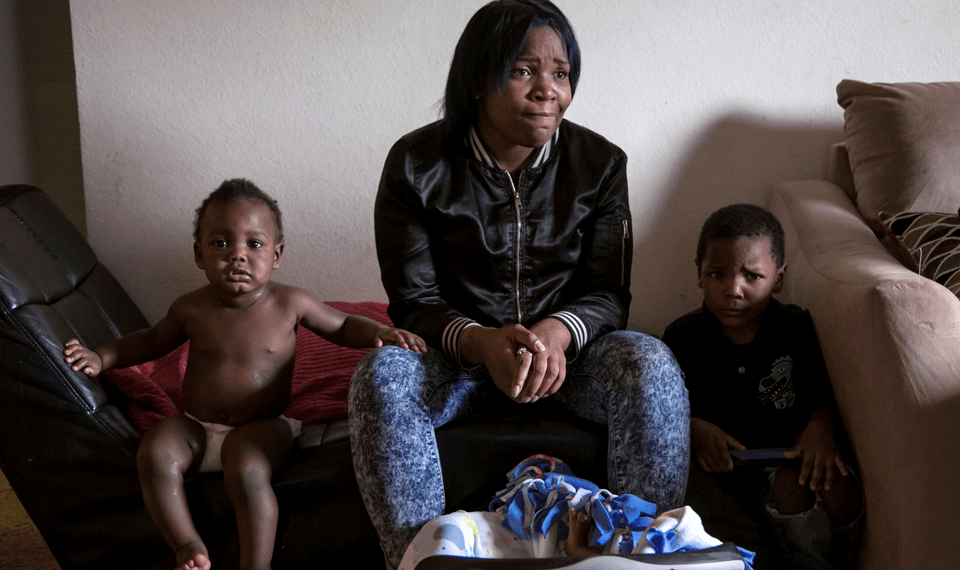
Ariana Hawk, with her sons Aiden Hawk, left, and Sincere Smith. Thousands of children required to eat additional nutritional foods to help limit the effects of lead exposure from Flint’s poisoned water | Ryan Garza – Detroit Free Press via AP

The high death rates of African-American infants are an abomination. Specialists of many disciplines long ago showed how babies stay healthy. Their mothers have to be healthy, well-educated and well-nourished.  Ready access to competent healthcare for mothers and babies is essential. But African American babies have long died at rates two to three times higher than those of white babies. 

Maybe scientists investigating natural and biologic processes – our climate scientists, for example – and scientists concerned with how society works can join forces. Both sets of scientists study realities involving either matter, natural and biological processes, or collective human aspirations and actions. They study the interaction of real things, and how things change.

Similarities in methodological approach are one basis for scientists to collaborate in developing joint projects, enabling the general population to understand the role of science in society, and firming up implementation of research findings.

“Sheehan’s book remains the single best secondary analysis of the debates over Marxist philosophy of science from its creation in the late nineteenth century … until the close of World War II.”– Marx & Philosophy

Scientists within the Marxist tradition look for linkages and commonalities. According to historian Helena Sheehan, “The history of marxism in relation to science is extraordinarily dense and dramatic. From the beginning, marxism took science extremely seriously, not only for its economic promise in building a socialist society, but for its revelatory power in understanding the world. Marxism has made the strongest claims of any intellectual tradition before or since about the socio-historical character of science.”

Karl Marx and Frederick Engels incorporated findings from the physical and biological sciences into their political analyses. Here is Marx:

Capitalist production, by collecting the population in great centers, and causing an ever-increasing preponderance of town population, on the one hand concentrates the historical motive power of society; on the other hand, it disturbs the circulation of matter between man and the soil, i.e., prevents the return to the soil of its elements consumed by man in the form of food and clothing; it therefore violates the conditions necessary to lasting fertility of the soil”.

Here Marx is discussing political power, changing modes of production, human migration from country to city, and the lack of organic waste material formerly produced by animals and people – which accounts for reduced soil fertility. His reference point is the enclosure movement in 19th century England. Wealthy bourgeoisie bought land, created large parcels, and surrounded them with walls to allow for grazing. Villagers and country people, now deprived of animals and land and unable to feed themselves, moved to cities and became factory workers.

This sequence of developments Marx characterized as a “metabolic rift.”  In developing his analysis, Marx gained an assist from scientist Justus von Liebig who studied agricultural chemistry and plant growth.
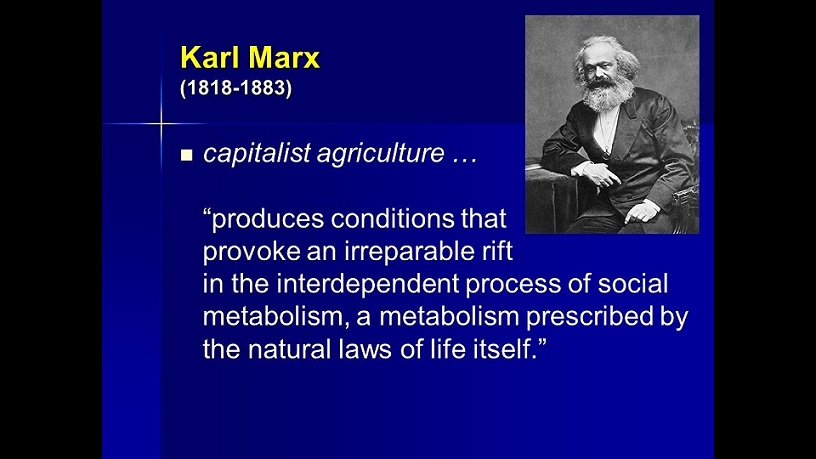
The Discovery and Rediscovery of Metabolic Rift | Climate & Capitalism

Marx declared that, “Humans live from nature, i.e.: nature is our body, and we must maintain a continuing dialogue with it if we are not to die. And “man’s physical and spiritual life is linked to nature … man is a part of nature.”

Frederick Engels was a kindred spirit. He asks:

What did the Spanish planters in Cuba, who burned down forests the slopes of the mountains and obtained from the ashes sufficient fertilizer for one generation of very highly profitable coffee trees, care that the tropical rainfall afterwards washed away the now unprotected upper stratum of the soil, leaving behind only bare rock? In relation to nature, as to society, the present mode of production is predominantly concerned only about the first, tangible success …Thus at every step we are reminded that … [we], belong to nature, and exist in its midst.”

We propose that scientists studying natural phenomena and processes are ripe for collaborative relations with social scientists, including Marxist investigators. As noted, they share similar methodologies and most of them a dedication to human well-being.  Growing numbers of scientists, both kinds, are very likely primed to accept that a linkage runs from wealth accumulation, to perennially increasing production, to rising emissions, to atmospheric warming.

Together with the public, scientists need to realize that capital is bound to make its peace with planetary warming, no matter the disaster ahead. Aware that their research impinges on human lives, a few scientists, maybe, will turn to political activism. 

Influenced by the worsening climate crisis, those social scientists receptive to Marxist analysis would increasingly familiarize themselves with issues involving the biologic and natural sciences. One envisions collaboration among the different kinds of scientists and even common struggle in the political arena. Anticipating the new society, revolutionaries within the ranks of scientists, acting together now, would gain a head start in building scientific institutions that serve the people.

Discussion here touching upon social transformation is incomplete without defining the political role of working people. They are the protagonists of the change to come and of rescue during the climate crisis.  The desperate situation now has an urgency and sweep extending far beyond burdens falling specifically upon the working class, like economic exploitation and plunder. Now, the world’s entire population may be heading to ruin.

Yet in times past, the working class has shown itself capable of carrying out social revolutions amid other circumstances of generalized disaster. This time the working class, organized and motivated, could take the lead in the climate crisis while brandishing, as before, some sort of an all-encompassing demand. In the Cuban and Chinese revolutions, the working class called for national liberation; in the Russian revolutions of 1917, for “peace, land, and bread.” 

W.T. Whitney Jr. is a political journalist whose focus is on Latin America, health care, and anti-racism. A Cuba solidarity activist, he formerly worked as a pediatrician, lives in rural Maine.
Puerto Rican union workers strike against austerity, point to U.S. responsibility / by W.T. Whitney Jr.

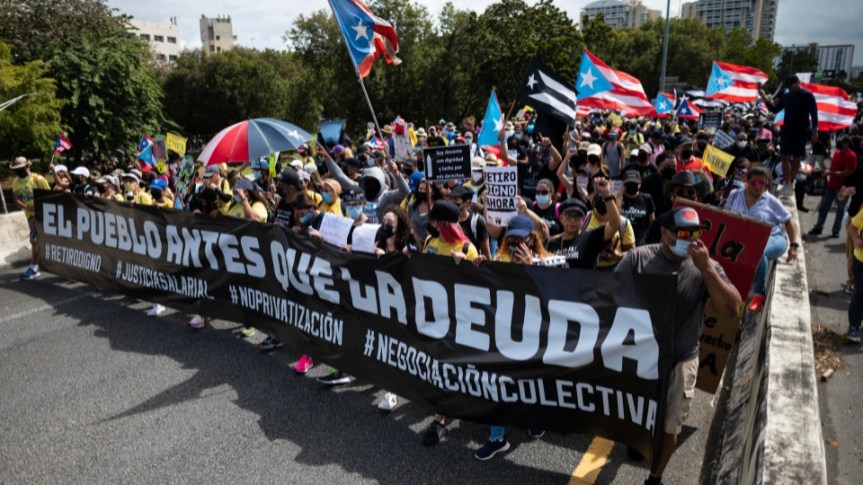
Public employees march to demand better salaries, adequate pensions, and better employment conditions, in San Juan, Puerto Rico, Feb. 18, 2022. | Carlos Giusti – AP

In Puerto Rico on Feb. 18, thousands of publicly-employed union workers, retired workers, and university students took part in a national strike and march that spread throughout the island. The largest contingent filled streets in San Juan. Demonstrators made noise and marched behind a long banner saying, “People before Debt – Salary Justice – Dignified Retirement – Collective Bargaining – No Privatization.”

Their demands grew out of actions of the U.S. government’s Fiscal Oversight and Management Board (FOMB), which was created under the authority of the U.S. Congress’s PROMESA Act of 2016. The island’s government was bankrupt at the time, and the FOMB was charged with negotiating with creditors and implementing austerity in Puerto Rico.

Labor unions participating in this most recent national strike included the Puerto Rican Workers’ Union, the Central Workers’ Federation, the United Auto Workers (for Treasury Department workers), the Electrical Workers’ Union, several teachers’ unions, the University Professors’ Union, and health workers’ unions. Unionized employees of the Highways and Transportation Authority also took part.

Students and teachers have sparked the recent protests. They’ve had no pay raises for 12 years. School closures have skyrocketed as the FOMB has denied funding to public schools while approving them for charter schools. Says one observer: “They are paying investors who are gaining profits from the country’s bankruptcy, and that is immoral.”

The FOMB recently approved public-employee salary hikes. But they were minimal and would only take effect in 2023. Beginning on Feb. 4, 70% of teachers stayed away from classes for six days, as thousands were demonstrating in San Juan and elsewhere on the island. Firefighters and police joined them. Those protests ended with Gov. Pedro Pierluisi promising the teachers an extra $1,000 per month, and firefighters a $500 raise. Funding sources are uncertain.

Puerto Ricans are in distress; 52% of them live below the poverty line, as do almost 60% of their children. Electricity and water bills are almost 60% higher than they are in the United States; food costs are 18% higher. The median family income is $20,500. The salary base for teachers—most are women—is $21,000 annually.

Privatization of the island’s electrical distribution system is emblematic of the FOMB’s brand of austerity. Since June 2021, Luma company has been in charge. It’s a subsidiary of the ATCO and Quanta Corporations, that together provide electrical services in more than 100 countries. Luma’s record is one of frequent blackouts and scant attention paid to damage left-over from Hurricane Maria in 2016 and earthquakes in 2020.

The workings of PROMESA and the FOMB had aroused Puerto Ricans to the point in July 2019 of forcing Gov. Ricardo Rosselló’s resignation, a process made easier through the corruption of some of his appointees. In recent weeks, protesting unionists called upon current Gov. Pedro Pierluisi to resign.

But the island’s government may lack tools for putting the people’s will into effect. Law professor and author José Nicolás Medina Fuentes, for example, regards the current prohibition on political parties forming electoral coalitions as undemocratic. He wants an “alternative to elites holding on to power through a two-party system that bypasses governance by a majority of the people.”

Medina Fuentes points out that in the elections of 2012, the Popular Democratic Party (supporting commonwealth status) and the New Progressive Party (supporting statehood) together gained 96% of the vote, leaving only 4% for the Puerto Rican Independence Party (PIP) and the Working People’s Party.

In 2020, the two major parties accounted for 64.5% of the vote, and the “emerging parties” now attracted 35.5% of the vote. These included the Citizens Victory Movement with 14.3%, the PIP with 13.7%, and Project Dignity with 6.9%. Effectively, he says, 67% of Puerto Ricans “do not govern.” He calls for either of the two major parties to be able to form coalitions with minor parties. A coalition with the PIP, for example, would give visibility to the independence vote.

A major sign of popular rejection of both government and major political parties is Puerto Rico’s increasingly high rate of voter abstention, really of electoral boycott. Voter turn-out for the general elections in 2020 was 50.02%.

Nevertheless, the island’s government by no means bears the main responsibility for difficulties confronting Puerto Ricans in the wake of PROMESA. The underlying, but not always explicit, theme of the recent protests is a call for the island’s association with the United States to be radically altered.

Reporter Monica Cruz cites Jocelyn Velazquez Rodriguez, who is an organizer of the ongoing campaign of demonstrations and strikes. Cruz refers to that campaign as “Jornada Se Acabaron Las Promesas,” which means “On this day we are done with promises!”

Velazquez Rodriguez emphasizes “the impact PROMESA has had on the political consciousness of the Puerto Rican people …[The]  PROMESA [law] has been a mechanism that has revealed the true face of US imperialism. It is a law created for a colony, to serve of the imperial interests of the United States. [And for] many Puerto Ricans there has never been a contract, nor an agreement, nor a convention on this.”

She sees “the popular demonstrations…[as] a sample of an awakening of a people that are tired of imperialism, the colonialism, the persecution and the suffering that it has caused us for so many years.”

The existence of colonial rule is not imaginary. The U.S Army invaded and occupied Puerto Rico in 1898. An “Organic Charter” two years later put the U.S. Congress in charge of the island. In 1950, Congress declared Puerto Rico to be a “Free Associated State,” authorized a constitution, and subjected the resulting document to U.S. laws and regulations. Also, there would be no protection from bankruptcy.

The U.S. Internal Revenue Service ruled in 1976 that U.S. companies operating in Puerto Rico would not pay taxes on income or capital gains. U.S. investors would pay no taxes on dividends paid by those companies. Nor were taxes due on U.S. investments deposited in Puerto Rican banks.

Previously, exploiters had counted on low-wage textile jobs and agricultural work for their profits. U.S. chemical and electronic manufacturers rushed to a Puerto Rico converted into a tax-free haven. A tax attorney quoted by The New York Times referred to the IRS tax leniency as “nothing but a welfare program for the Fortune 500.”

Meanwhile, Puerto Rico’s government had to rely on “multi-million” dollar loans to compensate for reduced tax collections. After 1990, U.S. authorities gradually restored taxation, and the manufacturers departed. To cover expenses, Puerto Rico’s government issued bonds held by U.S. banks, hedge funds, and corporations. Indebtedness mounted. Bankruptcy required rescue, of sorts—and thus came the PROMESA law of 2016.

W.T. Whitney Jr. is a political journalist whose focus is on Latin America, health care, and anti-racism. A Cuba solidarity activist, he formerly worked as a pediatrician, lives in rural Maine. 

People’s World, February 24, 2022, https://www.peoplesworld.org/article/puerto-rican-union-workers-strike-against-austerity-point-to-u-s-responsibility/

The Capitalist Roots of U.S. Racial Oppression  / by W. T. Whitney Jr.

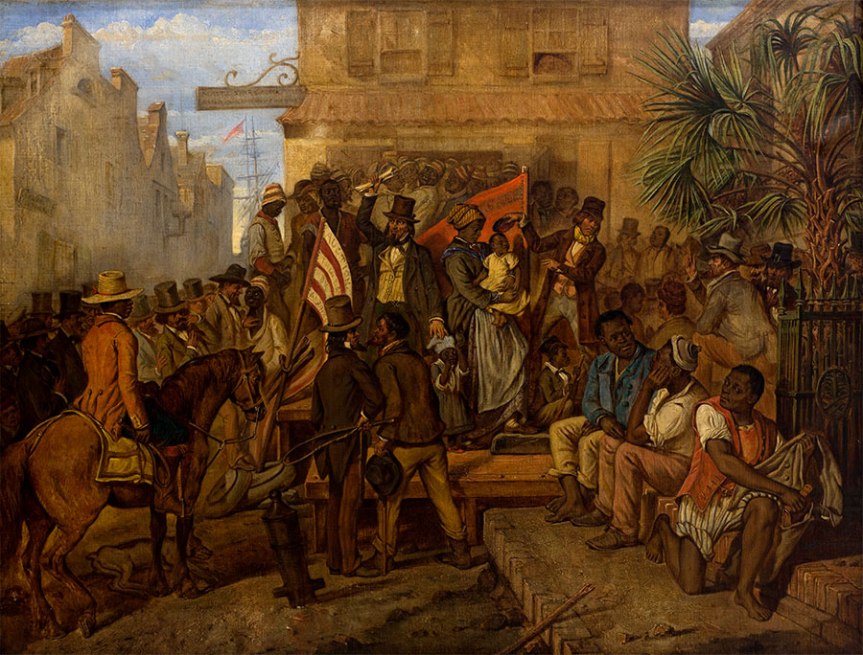
Painting by Eyre Crowe, A Slave Sale in Charleston, South Carolina, 1854

A recent BBC report attributes climate-change damage in Africa to “racialized capitalism.” That confusing term reflects a new understanding of U.S. slavery on the part of many historians. Here the term signifies the commanding role of capitalism in the oppression of Africans and of African-descended peoples in the United States. Racial hatred, by implication, takes on a secondary role as a tool useful for enforcing oppression.

What follows is an attempt to highlight the contribution of capitalism to racial oppression in the United States.

W.E.B. DuBois describes Europeans “scurrying down the hot, mysterious coasts of Africa to the Good Hope of Gain until for the first time a real commerce was born […] That sinister traffic, on which the British Empire and the American Republic were largely built cost black Africa no less than 100,000,000 souls, the wreckage of its political and social life, and left the continent in precisely that state of helplessness which invites aggression and exploitation.” (“The African Roots of War,” 1915).

Basic Books, 2021
9781541616592

In his recently published book The Ledger and the Chain, historian Joshua Rothman studies three wealthy U.S. slave traders. He points out that, “By 1860, four million enslaved people in the United States were a pillar of American prosperity, cumulatively worth more than the whole country had invested in manufacturing, railroads, and banks put together.” Slave traders “helped define the financial, political, legal, cultural, and demographic contours of a growing nation.”

Profit rules

Reflecting on Rothman’s observations, New York Times columnist Jamelle Bouie suggests that, “we should not think of the slave system or the slave trade as somehow about racism and hatred. It was about profit. That’s why — and how — it lasted so long.” He regards “chattel slavery … as part of a larger class system.” That characteristic, claims Bouie, accounts for “the ideas, ideologies and institutions” produced by slavery. 

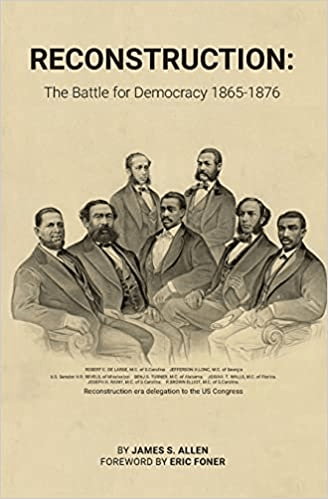
The northern side in the Civil War freed enslaved workers in the South. Reconstruction followed; it shocked the southern political establishment. Formerly enslaved people proved to be adept at organizing, articulating demands, and making politics work. Even the new National Labor Union briefly extended its organizing into the South. As described by Communist author James S. Allen in his 1937 book Reconstruction, “A strong tendency for solidarity with Negro workers and for alliance with the Negro people made itself felt early.”

International Publishers, 1937
978-0717801695

The old order took charge again after congressional shenanigans over the presidential elections of 1876 finished off Reconstruction. The freedmen were fodder for the profitable convict-leasing system. As tenant farmers, they provided a lifeline for the survival of plantations. Although some of them slowly and tenaciously gained land ownership, over time local oligarchs and lending agencies cut back on their acreage; the U.S. Department of Agriculture would be complicit.

Oppression continued through institutional means. That’s significant in that public institutions in the United States by and large reflect capitalist priorities.

Local and state governments and the courts sharply restricted voting rights and managed police, judicial, and prison affairs in oppressive ways. Local authorities provided low-quality and scanty education for the descendants of enslaved people. Poor schooling confined already marginalized workers to a future of diminished hopes and low wages.

The U.S. Supreme Court legitimized exclusionary legislation and administrative actions, especially in regard to higher education. African-Americans missed out on important benefits provided under the New Deal.  Until the mid-twentieth century, their military service was debasing and discriminatory. 

Variations

Oppression came from directions other than governmental action, or inaction. In the post-Civil War period, a trade-off arranged by higher-ups saw northerners tolerating continued abuse of African-descended workers in the South in return for the appearance of North-South harmony, viewed as essential for growing the nation’s capitalist economy.

Theirs was a bargain similar to the one struck by European workers in the early 20th century. As recounted by DuBois, “the laborer at home is demanding and beginning to receive a part of his share” on condition that the labor movement and other progressive forces go along with the imperialists’ plundering of “the darker nations of the world.” 

Racial oppression rested on the same social and political attitudes that allowed U.S. capitalism to flourish. Historian Frederick Jackson Turner, explains that the frontier experience itself instilled “anti-social” attitudes in the European settler, who manifested “antipathy to control.” Indeed, “democracy born of free land, strong in selfishness and individualism, intolerant of administrative experience and education, and pressing individual liberty beyond its proper bounds, has its dangers as well as benefits. Individualism in America has allowed a laxity in regard to governmental affairs.”

Since then, capitalist enforcers have taken advantage of the precariousness of workers’ lives. They’ve used poverty-stricken African-Americans as strike breakers to weaken labor unity. And very poor European-descended workers, mainly in the South and resentful of their own desperate economic conditions, have colluded in oppressing African-Americans. Intent upon preserving a modicum of status, they curry favor with the upper echelons

Some miscellaneous observations: first, the Thirteenth Amendment in 1965 abolished slavery, but it also legalized “involuntary servitude” as punishment for crime. It led to the convict leasing system that would continue for the next half century. It contributed to the profitable prison-industrial system of today.

Some miscellaneous observations: first, the Thirteenth Amendment in 1965 abolished slavery, but it also legalized “involuntary servitude” as punishment for crime. It led to the convict leasing system that would continue for the next half century. It contributed to the profitable prison-industrial system of today.

Secondly, the purpose of the Fourteenth Amendment of 1868 was to assure “due process of law [and] equal protection of the laws” for formerly enslaved people. Instead, according to historian Eric Foner, it became “a vehicle for protecting corporate rights rather than those of the former slaves.”

Thirdly, members of one’s own family in the U.S. South, no stranger to social-class distinctions, formerly employed that stock regional term “uppity.” They were referring to African-descended neighbors deemed to be rising above their “station in life.”

A clear message

In pursuing their own economic interests, the upper orders of society arranged for the enslavement of Africans in the United States and, later on, for the oppression of their descendants. That’s clear, as is the fact that race-based hatred persists because it’s useful as an enforcement mechanism and can be readily applied to victims identifiable through their physical appearance.

Hatred has many applications. Inciting fear, it theoretically inhibits open rebellion among the oppressed. Hatred in the form of organized terror – the lynchings, massacres, and police violence – maybe assures quiescence, or maybe not. Hatred frequently leads to divisions within racially-diverse political coalitions, and to their demise.

Protest mobilizations against hatred and its manifestations are necessary. But unless they are directed against the class-based origins of the oppression, they won’t do much to end it. Jamelle Bouie, the New Times columnist, agrees.

Citing the 1944 book Capitalism and Slavery, authored by Trinidadian historian and political leader Eric Williams, Bouie describes the settlers’ reliance first on Native Americans to provide forced labor and then on indentured white servants. The former did not survive long, and the latter were in short supply, independent-minded, and desirous of land once they were free.   Plantation owners turned to enslaved Africans.

Penguin Classics, 2022
3rd edition
9780241548165

Bouie quotes Williams: “The Negro, in a strange environment, conspicuous by his color and features, and ignorant of the white man’s language and ways, could be kept permanently divorced from the land.” Williams adds that, “Racial differences made it easier to justify and rationalize Negro slavery … to demand that resignation and that complete moral and intellectual subjection which alone make slave labor possible.

Moreover, “The features of the man, his hair, color and dentifrice, his ‘subhuman’ characteristics so widely pleaded, were only the later rationalizations to justify a simple economic fact that the colonies needed labor and resorted to Negro labor because it was cheapest and best.”

Bouie concludes: “One thing I’d like you to consider […] is the extent to which racial distinctions and racial divisions are rooted in relationships of class, labor and property, even when they take on a life and logic of their own. And if that’s true, I would like you to think about what that means for unraveling those divisions and distinctions, and consigning the ideology of ‘race’ to the ash heap of history.”

Author: W.T. Whitney Jr. is a political journalist whose focus is on Latin America, health care, and anti-racism. A Cuba solidarity activist, he formerly worked as a pediatrician, lives in rural Maine.
FEATURED ARTICLE: UN SCIENTISTS BLAME CLIMATE CHANGE ON CAPITALISM – IMPLICATIONS FOR MARXISTS / by W.T. WHITNEY, JR.

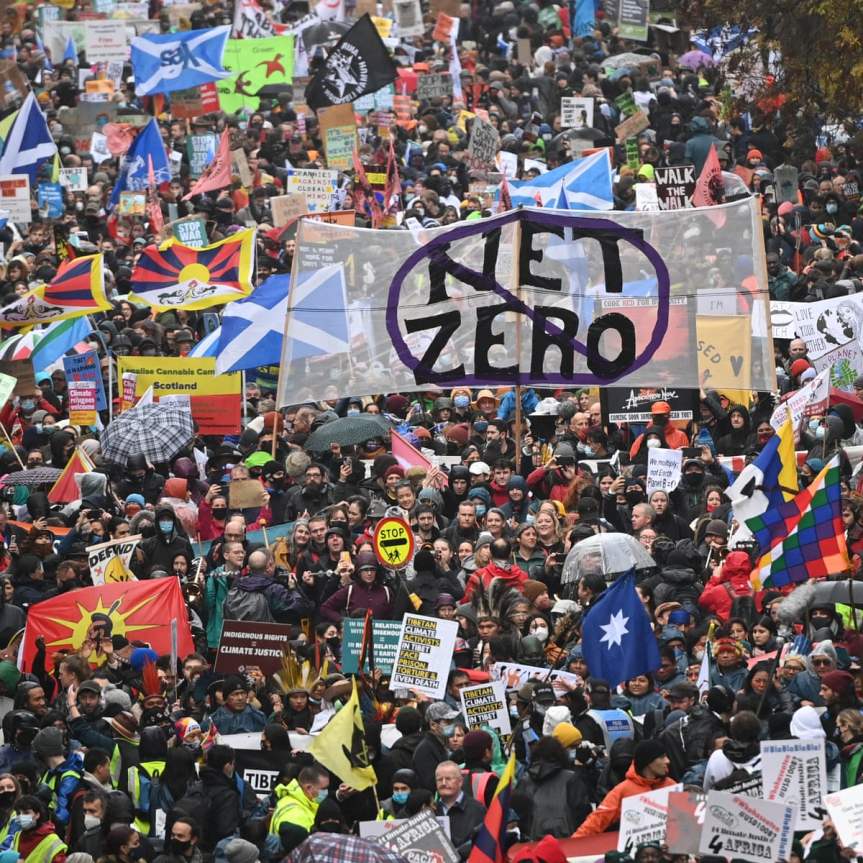
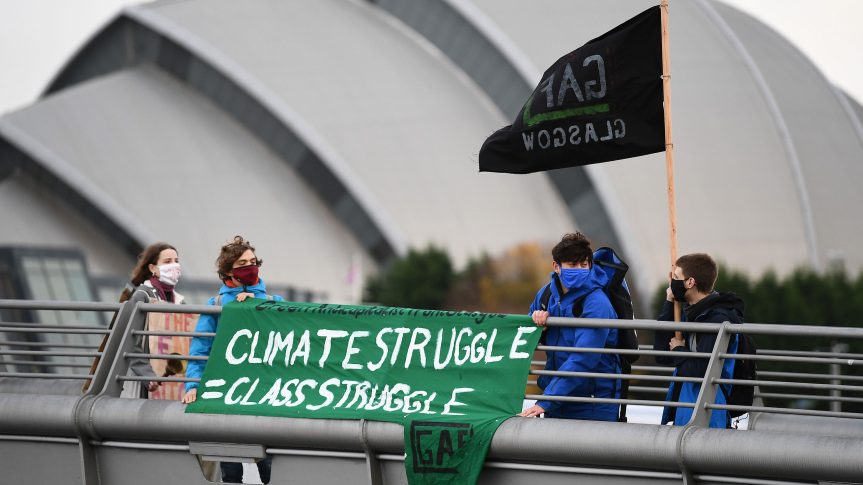
Protesters took to the streets of Glasgow near the COP26 conference to urge world leaders to take immediate action to combat the climate crisis. More than 100,000 marched in the city, organizers said. Credit: Kieran Dodds, The New York Times

Capitalism’s role in causing climate change now gains new visibility. Scientists advising world leaders present at the 26th Conference of the Parties (COP26) on November 1-12 in Glasgow affirmed the association. To slow down climate change and mitigate its effects, they want action taken to reduce capitalism’s impact on the climate.

The climate crisis is worsening.  For Monthly Review magazine, the COP26 gathering represents “a last-ditch effort to achieve a global solution on behalf of humanity as a whole.” The COP is the decision-making body of the 1995 UN Framework Convention on Climate Change.

The UN-sponsored Intergovernmental Panel on Climate Change (IPCC), made up of 230 climate scientists from 66 countries, monitors climate-change trends and effects. Their observations, analyses, and recommendations appear in the IPCC’s Assessment Reports, which are issued periodically. IPCC scientists, who “have spent the last 3 years reviewing over 14000 studies,” are in the process now of releasing their Sixth Assessment Report, with 4000 pages.

On August 9, 2021 they released the Report’s Part I on the “physical science basis of climate change.”  The IPCC will not release Part II, about impacts, and Part III, about mitigation, until early 2022, after all UN member states have reviewed the two sections. Key portions of the two have been leaked and, widely disseminated, they are the basis for this report.

Earlier Assessment Reports attributed climate change to human activity, unspecified.  What with IPCC scientists linking expanded industrial production and consumerism with rising greenhouse gas emissions, capitalism enters the picture.

As summarized by the Monthly Review editors, Part II asserts that “Life on Earth can recover from a drastic climate shift by evolving into new species and creating new ecosystems. Humans cannot… We need transformational change operating on processes and behaviors at all levels: individual, communities, business, institutions and governments. We must redefine our way of life and consumption.”

An important finding of Part III, according to the editors, is that, “technological improvements that allow for relative decarbonization are not enough. Rather, what is required … ‘is fundamental structural changes at the global level’ … in production and consumption systems. Accelerated climate-change transitions require a shift to entirely new systems of sustainable development. ‘Transformative change’ must replace incremental changes favored by the status quo.”

Monthly Review indicated also that “for the first time in the IPCC process,” Part III called for a “turn to demand-side strategies, exploring cutbacks in energy use and across all economic sectors, as well as aggressively pursuing conservation and low-energy paths.”

Part III, crucially, “indicates at one point, referring to the analysis of Malm and others that: ‘The character of social and economic development produced by the nature of capitalist society [is] …ultimately unsustainable.’”

UN Scientists Blame Climate Change on Capitalism; Implications for Marxists

This is not a new idea. Advocates for environmental sustainability – Marxists, academic socialists, eco-socialists, environmentalists – have long concerned themselves with capitalism’s impact on the environment. Visionary Marxist scholar Kenneth Neill Cameron called for action almost 30 years ago. Concluding his book Marxism, a Living Science (International Publishers, 1993), he discusses global warming.

“Most Marxists write as though … social advance will take place in a social bubble shut off from nature. The scientific evidence, however, points to an era of environmental stress. The evidence was already strong in 1984 when this book first went to press … [It’s] a perspective beyond anything Marx and Engels had to confront … Clearly then the struggle for socialism will take place in a world racked by natural disasters of social origin.”

Cameron explores the curbing of fossil-based fuel and reliance on alternative energy. He suggests that, “there is only one way known to slow down and then eliminate these disasters, namely by phasing out the gases that cause them.” He declares that:

“[T]o fully replace the fossil-fuel-based corporate structure is beyond the capacity of capitalism and requires a socialist planned economy … As this struggle progresses it will become apparent that human survival will depend not just on clean energy but on a socio-economic system run by the people in their own interest. In short, a new dimension has been added to the struggle for socialism, which no longer aims only at universal “social justice” but at assuring human survival.”

Marxists like Cameron, however, realize that words and theory are not enough. From Marx, they know that merely to interpret the world falls short; “The point … is tochange it.”

Marxists are able to frame climate-change action in a straightforward way. Inasmuch as their primary object is fighting capitalism, and capitalism causes climate change, and climate change endangers humanity, Marxists are duty-bound to involve themselves in the climate fight as learners, teachers and activists.

How would they do this, and what might the prospects be?

The opinions of the IPCC scientists, having circulated, constitute a kind of UN endorsement of fight-back against capitalism. To the extent that the UN position gains respect, capitalism becomes fair game for wider criticism within society as a whole. That’s helpful.

Marxists, self-described “scientific socialists” and prone to theorizing, analyzing problems, and strategizing, are prepared. As materialists, they embrace scientific inquiry and study of the natural world. The intersection of science and politics is familiar territory.

Marx himself modeled that approach. For example, he made the association between diminished productivity of soil in Britain and burgeoning industrialization. Having consulted with German scientists, he concluded that the movement of small farmers away from the land and into British factories, as industrial workers, had led to crops being under-fertilized. Because farmers had left the land, fertilizer in the form of animal and human excreta was in short supply.

Marxists are versatile. Having theorized, strategized, and acted in widely varying situations, they’ve shown that they probably would be able to confront the climate crisis. They’ve studied and defended waged labor laid low by the extraction of surplus value, small farmers displaced or oppressed by landlords, women (mostly) laboring in social reproduction for no pay, and those whose bodies, land, or subsoil resources have been plundered.

But capitalism won’t disappear quickly. After all, preparation for the way capitalism looked in the 1800s required a couple of centuries. As long as capitalism lasts, formation of a mass movement ready to defend environmental sustainability, and the climate, won’t happen soon, especially in the industrialized world.

For the sake of their jobs, wages and salaries, working people employed by entities dependent directly or indirectly on the market economy require economic stability and predictability. Under capitalism, that means an economy that produces and grows, always – one that, along the way, aggravates climate change. Working people, therefore, may find it more compelling to preserve the status quo than to pursue goals realizable only in the future, virtuous though they may be.

Relatedly, many wage workers, unemployed people, unionists, and seniors are leery of the environmental movement. They may resent the seemingly disproportionate involvement there of activists with comfortable life styles or object to the scarcity of black and brown people in such campaigns. It’s not yet clear how these twin projects, replacing capitalism and coping with climate change, are ultimately going to come together.

The possibility does emerge, however, that crisis-ridden capitalism, loaded with contradictions, will face some sort of a collapse.  Waiting in the wings are disasters like pandemics, wars, massive default on debt, underproduction due to climate-caused catastrophes, oil shortage, and more. In chaotic situations like these, the building of a mass response to the climate crisis, one that is collective, anti-capitalist, and necessary, might come about.

The stimulus would derive from fears and perplexity. These, of course, could also lead to the authoritarian solutions of fascists and their like. Such a potential outcome adds to the urgency of preparing for the great mobilization of a socialist nature that we need.

Meanwhile, socialists and Marxists have promoted programs directed at protecting the environment and climate. These are the multifaceted programs often referred to as Green New Deals, as outlined in Mark Brodine’s book Green Strategy, in John Molyneux’s article in Climate & Capitalism, and by Sean Sweeney writing in New Economic Forum.  As envisioned, they would accompany far-reaching proposals for progressive social and political change. Such undertakings are at risk of cooptation by corporations and other capitalist forces.

As the fight to ameliorate climate change proceeds, Marxists should take advantage of the teachability of their message. The idea that phenomena are connected – capitalism, expanding production, and rising emissions – is fact-based and logical. Lesser explanations blame the perversity of individuals. Exclusive focus on short-sightedness, disregard for the truth, ignorance, heartlessness, and/or immorality distracts from societal factors at work.

Class struggle will undoubtedly intensify in the years ahead. Faced with climate chaos, the upper classes, with their money, properties, and connections, will seek to wall themselves off from turmoil and victims, perhaps even hire enforcers to protect their remaining privileges.

Undone by climate change and its fallout – desertification, drought, floods, no homes, no livelihoods – people on the run worldwide become the rejects of resourced societies. Easily stigmatized, they serve as pawns for dividing and immobilizing the working class. And like nothing else, their plight calls for redistribution of wealth and resources, that is, if notions of the common good mean anything at all.

The object of this report has been to raise the consciousness of Marxists, socialists, and anyone else. Marxists ought to realize that they can contribute to and even lead collective efforts to head off climate change and to mitigate adverse effects. They have two major resources: the chain of causation from capitalism to climate change and anti-capitalism, which is their foundational tenet.

We are facing “the tragedy of our times;” and countries are “now so perilously close to the edge.” (Barbados prime minister Mia Mottley) Time is up; revolutionary socialists of all kinds need to set priorities. Let the discussion and work begin.

Author: W.T. Whitney Jr. is a political journalist whose focus is on Latin America, health care, and anti-racism. A Cuba solidarity activist, he formerly worked as a pediatrician, lives in rural Maine.

Source: Marxism-Leninism Today: The Electronic Journal of Marxist Leninist Thought, November 7, 2021, https://mltoday.com/un-scientists-blame-climate-change-on-capitalism-implications-for-marxists/

Report from Maine: End the US Blockade against Cuba Now!

By W. T. Whitney Jr

The two struggles have continued for decades, even centuries. Cubans fight to end slavery; gain independence from Spain and the United States; and, for 60 years, protect their socialist revolution. Ruling classes in the United States sought to annex Cuba, then to control Cuba’s economy, and for those 60 years have clamped down on the audacity of Cubans who struggle for independence and socialism.

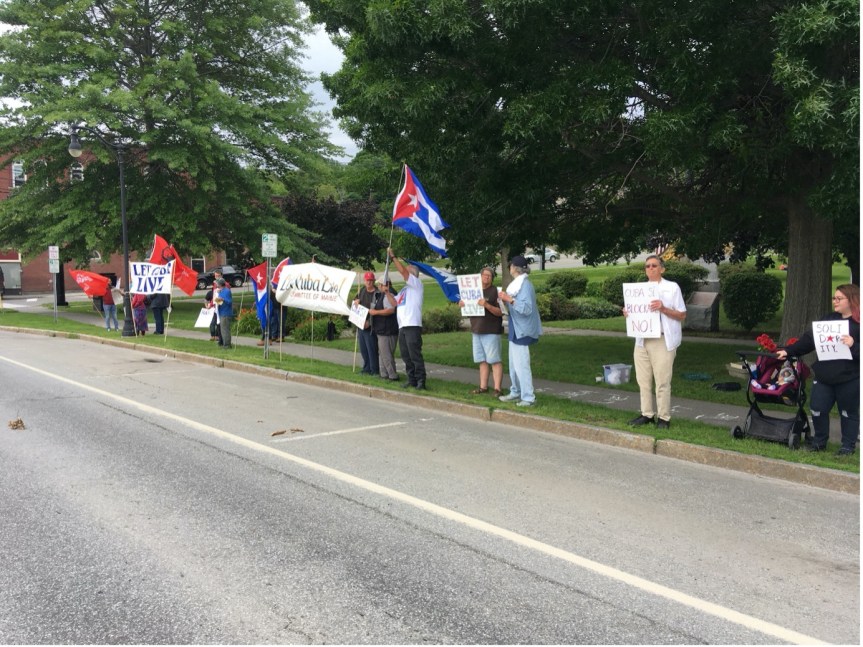
Justice-seeking peoples in the United States have joined in struggle to defend Cuban independence and/or Cuba’s revolution. This report from Maine takes note of two rainy day rallies on July 25, each of 25 or so people and each one held in protest of the U.S. blockade of Cuba. One was in Bangor, the other in Brunswick.

These protesters and other Maine people know that the blockade is purposed to overthrow of Cuba’s socialist government.  The author of a 1960 State Department memo – born in Houlton, Maine – made that perfectly clear.

These Mainers were joining in solidarity with demonstrations carried out on July 25 throughout the United States, for example, in Washington, Seattle, San Francisco, Fresno, Los Angeles, Phoenix, Albuquerque, Dallas, Milwaukee, and Pittsburgh. In Washington, Cuban-Americans calling for Puentes de Amor (Bridges of Love) gathered with supporters in Lafayette Park to protest the blockade. They had walked from Miami to Washington.

Lots of Maine people know that Cuba is at another watershed moment. Many recall the onset in the early 1990s of Cuba’s “Special Period,” which was resulted from the fall of the Soviet Bloc. The powers in Washington at that time sought to finish off Cuba’s revolution. The “Cuba Democracy Act” of 1992 was their big tool.

Similarly, the Biden presidency now takes advantage of three phenomena: economic and healthcare havoc wrought by the Covid 19 pandemic, the Trump administration’s intensified blockade restrictions, and mounting shortages in Cuba of money and goods essential for human survival.

Now Biden inveighs against supposed autocracy in Cuba. His administration remains silent when elected officials viciously threaten Cuban leaders. He and they follow a script fitted out for anti-government demonstrations like the ones playing out in Cuba on July 11. These surely reflected U.S. financial support provided over decades for internal subversion in Cuba. Accompanying them was a massive social-media assault against Cuba’s government orchestrated from abroad.

U.S. media have long cast a blind eye to the political movements in the United States mobilized on behalf of Cuban independence and Cuba’s revolution. Those rallying in Maine on July 25 were testifying to their relevance now.

In 1992, at the beginning of Cuba’s Special Period, veteran Maine activists traveled to the island. Sensing big troubles ahead for Cuba at the hands of the U.S. government, they formed the Let Cuba Live Committee of Maine. The new organization undertook to educate and activate fellow Mainers.

Let Cuba Live arranged for the Pastors for Peace leader Rev. Lucius Walker Jr, to speak before a large crowd in Monument Square, in Portland, Maine on July 21, 2001 – 20 years and four days prior to the protests reported here.

“In issue after issue, in area after area, Cuba lights the way,” Lucius Walker insisted; “Cuba has established the fact that it is the leader in the world community in the affirming of and guaranteeing the rights of the poor people of this world.”

That was not news for the ruling classes in the United States for whom revolutionary Cuba was a threat. Therefore, as pointed out by Lucius Walker: “if we really want to see the world continue to have hope and possibility for the creation of a new society, we must support Cuba.”

Let Cuba Live of Maine – see www.letcubelive.org – admits to gratification.  The slogan that is the group’s name now resonates widely. It’s the title of an appeal to President Biden that, endorsed by 400 prominent activists, may be viewed in a full-page advertisement appearing in the July 23 New York Times. To see the open letter to Biden, go to www.LetCubaLive.com.

The twin rallies putting forth the demand of no more blockade broke new ground in Maine.  They gained support from multiple statewide organizations that oppose U.S. imperialism and war-making and/or try to make good on socialist aspirations.

What follows are excerpts from remarks offered by some of the rally participants at talk-sessions that concluded the two affairs.  A listing appears below of the organizations claiming commentators and many participants as members.

Here’s Barbara West: “We are not gathered today simply to demand a reduction in the criminal measures the US has taken against Cuba for 61 years.  We are here to insist on respect for Cuba as a sovereign country … We insist that land in Guantanamo occupied in defiance of the Cuban people be vacated. … Our respect for Cuba as a sovereign nation, with its people fully able to chart their own path without any US interference, is really our agenda today.”

And Michael Mosely: “I do not believe that there is a difference between a Hispanic family in Maine and a Hispanic family in Cuba. Just like there is no difference between a Black family in Maine and a Black family in Africa. We are all under the same system fighting the same fight.”

And Daniel Carson: “In the over six decades that the United States has enforced such a cruel blockade, the Cuban government has reported that economic losses resulting directly from the blockade total $144.4 billion dollars. These figures are those of 2020. Excluded is an additional $5.4 billion in economic losses this year. When adjusted for dollar depreciation over the life of the blockade the number becomes $1.098 trillion … So when [U. S. leaders] proclaim Cuba to be a failed state or that the Cuban revolution has failed: this is a bold-faced lie. The truth lies in those numbers. That’s why we are here today to say, “End the blockade!”

And Bruce Gagnon: “The US has an MO (modus operandi), a way of repeating its regime change behavior as it desperately attempts to hang-on to its place as ‘king of the hill’. But due to $27 trillion in debt, more than 800 costly military bases around the world, and long-time disinvestment in our own nation, America’s ‘imperial project’ is destined to collapse. US efforts to force regime change in Cuba – like in Nicaragua, Venezuela, Bolivia and other nations – are destined to fail.”

And Ed Jurenas: “When the U.S. talks about democracy, it is hypocritical. It does not support the most basic democratic right to self-determination, but viciously opposes it. And in regard to the economic democracy championed by Cuba – free health care, free education, a right to housing, the just distribution of food – the U.S. is silent in its shame. Cuba ascribes to economic democracy, something the U.S. is incapable of practicing.”

Most of the participants in the Maine rallies belonged to one or more of these organizations: the Let Cuba Live Committee of Maine, The Global Network Against Weapons & Nuclear Power in Space, Maine Veterans for Peace, Maine Socialist Action, Maine Democratic Socialists of America, and the Maine Communist Party. The latter group had responsibility for organizing the rallies.

Lucius Walker has the last word (July 21, 2001): “We must name the powers. We must stand against the powers. And we must realize that in the course of doing so, we wrestle not just with flesh and blood, but with principalities and powers, against spiritual wickedness in high places. We cannot be deterred because they say evil things about us, because they revile us, because they put us in jail. We must continue to march, to work, to struggle, to be in solidarity no matter what obstacles they put in our way, because we are the future hope of the world! “

Report from Maine: End the US Blockade against Cuba Now!

By W. T. Whitney Jr

The two struggles have continued for decades, even centuries. Cubans fight to end slavery; gain independence from Spain and the United States; and, for 60 years, protect their socialist revolution. Ruling classes in the United States sought to annex Cuba, then to control Cuba’s economy, and for those 60 years have clamped down on the audacity of Cubans who struggle for independence and socialism.

Justice-seeking peoples in the United States have joined in struggle to defend Cuban independence and/or Cuba’s revolution. This report from Maine takes note of two rainy day rallies on July 25, each of 25 or so people and each one held in protest of the U.S. blockade of Cuba. One was in Bangor, the other in Brunswick.

These protesters and other Maine people know that the blockade is purposed to overthrow of Cuba’s socialist government.  The author of a 1960 State Department memo – born in Houlton, Maine – made that perfectly clear.

These Mainers were joining in solidarity with demonstrations carried out on July 25 throughout the United States, for example, in Washington, Seattle, San Francisco, Fresno, Los Angeles, Phoenix, Albuquerque, Dallas, Milwaukee, and Pittsburgh. In Washington, Cuban-Americans calling for Puentes de Amor (Bridges of Love) gathered with supporters in Lafayette Park to protest the blockade. They had walked from Miami to Washington.

Lots of Maine people know that Cuba is at another watershed moment. Many recall the onset in the early 1990s of Cuba’s “Special Period,” which was resulted from the fall of the Soviet Bloc. The powers in Washington at that time sought to finish off Cuba’s revolution. The “Cuba Democracy Act” of 1992 was their big tool.

Similarly, the Biden presidency now takes advantage of three phenomena: economic and healthcare havoc wrought by the Covid 19 pandemic, the Trump administration’s intensified blockade restrictions, and mounting shortages in Cuba of money and goods essential for human survival.

Now Biden inveighs against supposed autocracy in Cuba. His administration remains silent when elected officials viciously threaten Cuban leaders. He and they follow a script fitted out for anti-government demonstrations like the ones playing out in Cuba on July 11. These surely reflected U.S. financial support provided over decades for internal subversion in Cuba. Accompanying them was a massive social-media assault against Cuba’s government orchestrated from abroad.

U.S. media have long cast a blind eye to the political movements in the United States mobilized on behalf of Cuban independence and Cuba’s revolution. Those rallying in Maine on July 25 were testifying to their relevance now.

In 1992, at the beginning of Cuba’s Special Period, veteran Maine activists traveled to the island. Sensing big troubles ahead for Cuba at the hands of the U.S. government, they formed the Let Cuba Live Committee of Maine. The new organization undertook to educate and activate fellow Mainers.

Let Cuba Live arranged for the Pastors for Peace leader Rev. Lucius Walker Jr, to speak before a large crowd in Monument Square, in Portland, Maine on July 21, 2001 – 20 years and four days prior to the protests reported here.

“In issue after issue, in area after area, Cuba lights the way,” Lucius Walker insisted; “Cuba has established the fact that it is the leader in the world community in the affirming of and guaranteeing the rights of the poor people of this world.”

That was not news for the ruling classes in the United States for whom revolutionary Cuba was a threat. Therefore, as pointed out by Lucius Walker: “if we really want to see the world continue to have hope and possibility for the creation of a new society, we must support Cuba.”

Let Cuba Live of Maine – see www.letcubelive.org – admits to gratification.  The slogan that is the group’s name now resonates widely. It’s the title of an appeal to President Biden that, endorsed by 400 prominent activists, may be viewed in a full-page advertisement appearing in the July 23 New York Times. To see the open letter to Biden, go to www.LetCubaLive.com.

The twin rallies putting forth the demand of no more blockade broke new ground in Maine.  They gained support from multiple statewide organizations that oppose U.S. imperialism and war-making and/or try to make good on socialist aspirations.

What follows are excerpts from remarks offered by some of the rally participants at talk-sessions that concluded the two affairs.  A listing appears below of the organizations claiming commentators and many participants as members.

Here’s Barbara West: “We are not gathered today simply to demand a reduction in the criminal measures the US has taken against Cuba for 61 years.  We are here to insist on respect for Cuba as a sovereign country … We insist that land in Guantanamo occupied in defiance of the Cuban people be vacated. … Our respect for Cuba as a sovereign nation, with its people fully able to chart their own path without any US interference, is really our agenda today.”

And Michael Mosely: “I do not believe that there is a difference between a Hispanic family in Maine and a Hispanic family in Cuba. Just like there is no difference between a Black family in Maine and a Black family in Africa. We are all under the same system fighting the same fight.”

And Daniel Carson: “In the over six decades that the United States has enforced such a cruel blockade, the Cuban government has reported that economic losses resulting directly from the blockade total $144.4 billion dollars. These figures are those of 2020. Excluded is an additional $5.4 billion in economic losses this year. When adjusted for dollar depreciation over the life of the blockade the number becomes $1.098 trillion … So when [U. S. leaders] proclaim Cuba to be a failed state or that the Cuban revolution has failed: this is a bold-faced lie. The truth lies in those numbers. That’s why we are here today to say, “End the blockade!”

And Bruce Gagnon: “The US has an MO (modus operandi), a way of repeating its regime change behavior as it desperately attempts to hang-on to its place as ‘king of the hill’. But due to $27 trillion in debt, more than 800 costly military bases around the world, and long-time disinvestment in our own nation, America’s ‘imperial project’ is destined to collapse. US efforts to force regime change in Cuba – like in Nicaragua, Venezuela, Bolivia and other nations – are destined to fail.”

And Ed Jurenas: “When the U.S. talks about democracy, it is hypocritical. It does not support the most basic democratic right to self-determination, but viciously opposes it. And in regard to the economic democracy championed by Cuba – free health care, free education, a right to housing, the just distribution of food – the U.S. is silent in its shame. Cuba ascribes to economic democracy, something the U.S. is incapable of practicing.”

Most of the participants in the Maine rallies belonged to one or more of these organizations: the Let Cuba Live Committee of Maine, The Global Network Against Weapons & Nuclear Power in Space, Maine Veterans for Peace, Maine Socialist Action, Maine Democratic Socialists of America, and the Maine Communist Party. The latter group had responsibility for organizing the rallies.

Lucius Walker has the last word (July 21, 2001): “We must name the powers. We must stand against the powers. And we must realize that in the course of doing so, we wrestle not just with flesh and blood, but with principalities and powers, against spiritual wickedness in high places. We cannot be deterred because they say evil things about us, because they revile us, because they put us in jail. We must continue to march, to work, to struggle, to be in solidarity no matter what obstacles they put in our way, because we are the future hope of the world! “

U.S. Imperialists Deprive Cuba of Syringes That Are Needed Now, by Tom Whitney

Editorial note

US stubbornness in hanging on to its economic blockade against Cuba annoys us. Sixty years is enough, don’t you think? We are joining the Let Cuba Live Committee of Maine as it collaborates with IFCO/Pastors for Peace of New York in the project of that group heading to Cuba this Fall.

Pastors for Peace will be taking aid material to Cuba and visiting there, both against US rules for its blockade. We want some Maine people once more to be on this trip.

Every year, for 30 years, these two groups undertake civil disobedience in order to mobilize wider support for ending a policy that, by any definition, is cruel, immoral, and illegal.

Go to these websites to learn more: www.letcubalive.org and   https://ifconews.org/.

The article below reviews aspects of this grim situation and reports on a new horror. We also post the CPUSA’s recent condemnation of President Biden’s failure to remove Cuba from the US list of terrorist sponsoring nations. Your dog presents as much national threat as does Cuba.

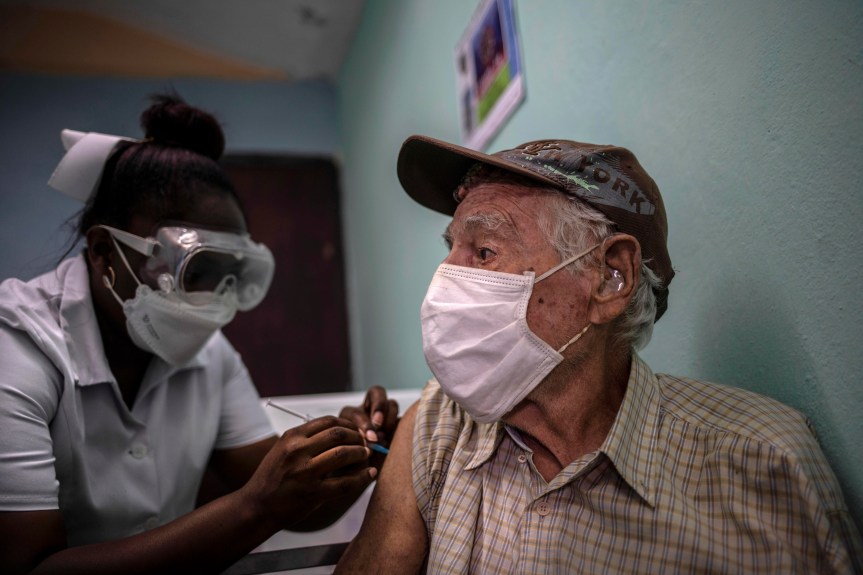
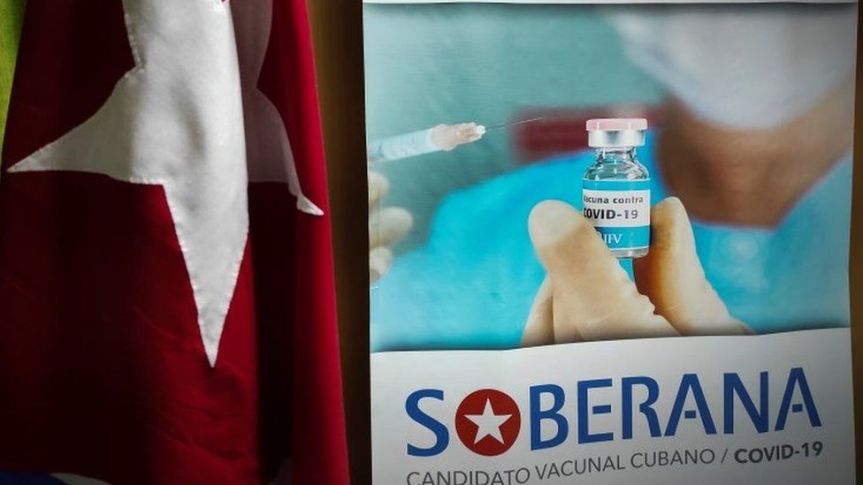
Cuba, the first Latin America country to develop its own COVID-19 vaccines, presently is short of syringes for immunizing its population against the virus. It’s not feasible for Cuba to make its own syringes. The U.S. blockade prevents Cuba from importing them from abroad.

Syringes are lacking all over. The New York Times estimates an overall need of between “eight billion and 10 billion syringes for Covid-19 vaccinations alone.” Manufacturing capabilities are increasing, but that’s of no use to Cuba. 

According to Global Health Partners,Cuba needs roughly 30 million syringes for their mass Covid vaccination campaign and they’re short 20 million.” Solidarity organizations are seeking donated funds to buy syringes and ship them to Cuba. (Readers may donate by contacting Global Health Partners or visiting here.) 

The shortage of syringes poses great hardship for the Cuban people. That’s not new. Calling for economic blockade in 1960, State Department official Lester Mallory was confident that making Cubans suffer would push them toward overthrowing their government.

The U.S. blockade causes shortages of basic materials. Buses lack fuel and spare parts; bus routes have been dropped. Food supplies are precarious. Cuban laboratories and production facilities have developed five kinds of COVID-19 vaccines despite short supplies of reagents and laboratory materials. 

Cuba can’t buy ventilators needed for critically ill COVID-19 patients. Two Swiss manufacturers stopped selling ventilators to Cuba after a U. S. company purchased them. But Cuban technicians devised their own ventilator model which is in production now.

The impact of the blockade is by no means haphazard. Institutionalized processes aimed at asserting U.S. domination involve laws, administrative decrees, regulations, officials’ interpretations of regulations, and caution on the part of third-country traders and financiers.

Authority for the ban on U.S. sales of goods to Cuba stems from legislation accumulating over many years. Then the Cuba Democracy Act of 1992 ensnared foreign companies into the blockade system. That law authorized the Treasury Department to license the foreign subsidiaries of U.S. corporations to export goods to Cuba. It actually created an opening for almost all applications for licensure to be denied.

Since then, the Treasury Department’s Office of Foreign Assets Control (OFAC), enforcer of the blockade, has found leeway to regulate the foreign corporations themselves. Foreign corporations contemplating sales to Cuba contend with U.S. sanctions if they have branches in the United States, partner with U.S. corporations, or handle U.S. dollars.

Most of the world’s syringes are manufactured by three U.S. companies and five companies elsewhere. Each of the latter has ties with a U.S. entity and is prohibited from exporting syringes to Cuba

For example, Germany’s B. Braun Melsungen Corporation partners with Concordance Healthcare Solutions, “one of the largest independent, healthcare distributors in the U.S.” Tokyo-based Terumo Corporation has a headquarters in New Jersey. Osaka-based Nipro Corporation recently “announce[d] the creation of a Vascular Division in the U.S.” “Healthcare heavyweight Cardinal Health” is headquartered in both Ireland and the United States.

Hindustan Syringes and Medical Devices, in India, came under OFAC purview  in January 2021 by virtue of associating with Envigo Global Products as its “digital marketing partner.” Envigo is headquartered in Indianapolis.

Officers of foreign companies presumably seek legal advice. One lawyers’ group maintains that, “OFAC has long held that if a non-U.S. company engages in business transactions in U.S. dollars, the foreign party is availing itself of the U.S. financial system and hence becomes subject to the U.S. sanctions laws.”

Another indicates sanctions are likely, if “the foreign party has a requisite level of contacts with the U.S., such as engaging [with] U.S. products, software or technology.” The National Law Review recommends that, “Foreign companies … need to be aware of board members, directors, or employees who hold U.S. citizenship or U.S. green cards.”

President Barack Obama eased many blockade regulations and re-established U. S. diplomatic relations with Cuba. He never pushed to end the blockade. The Biden Administration chooses not to prioritize improved relations with Cuba. Biden recently upheld the Trump Administration’s reassignment of Cuba to the U.S. list of terrorist-sponsoring nations.

The Helms-Burton Law of 1996 required, for the first time, that Congress determine the fate of the blockade. Except for legislation in 2000 allowing U.S. food products to be exported to Cuba, Congress has protected that policy. 

In February Oregon Senator Ron Wyden introduced his “United States-Cuba Trade Act of 2021,” which would end the blockade. The bill has four co-sponsors. SenatorsAmy Klobuchar of Minnesota, Jerry Moran of Kansas, and Patrick Leahy of Vermont on May 20 reintroduced the “Freedom to Export to Cuba Act.” That bill would facilitate U.S. exports to Cuba, especially agricultural products; allow some Cuban goods to enter the United States; and would retain sanctions imposed because of alleged human rights violations.

In March, 80 congresspersons sent a letter to President Biden urging him to use executive action to reverse restrictions imposed by President Trump.

The U.S. economic blockade of Cuba is calculated, systematic, all-encompassing, and savage. Opponents offer varying pleas. For some, the blockade is cruel and illegal. Others call for defending Cuba, because it’s a model both of human solidarity and of how to provide health care and education. Many insist on respect for Cuba’s sovereignty.

These arguments are disconnected, one from the other.  Blockade critics appear to lack a central focus on root causes. Having such would be essential, it seems, for fashioning a cohesive strategy. Were that in place, new possibilities might exist for recruitment and unity. Anti-racism struggle in the United States displays similar dynamics, and maybe offers lessons.

Reacting to various symptoms of oppression, defenders of racial equality have gone from pillar to post opposing police killings, an unjust criminal justice system, and Black people’s high poverty and death rates. Now, increasingly, analysts link manifestations of racial oppression with durable systems of repression involving capitalism. Writing about a notorious slave-trading firm, historian Joshua Rothman captures that association in the title of his new book, The Ledger and the Chain.

Similarly, if the campaign against the blockade paid more attention to the long history of U. S. ambition to dominate Cuba, it might gain strength by going to the heart of the matter. The premise would be that the European powers and the United States have long sought to draw Cuba and other dependent Latin American territories into their capitalist orbit.

The syringe story reflects U.S schemes in the 19th century to absorb Cuba, U.S. control of Cuba after Spain’s departure in 1902, and U.S. determination after 1959 to restore hegemony lost to the Revolution.

Chile’s Neoliberal nightmare, New Constitution, and Daniel Jadue, by Tom Whitney

Working and marginalized people in Chile can now see possibilities of relief from the political grief of decades.  A new constitution is in the works. And Daniel Jadue, author of an astonishingly progressive program as mayor of Rocoleta municipality, is a presidential candidate. The election is set for November 21, 2021.

Chileans will vote on May15-16 to select 155 members of a constitutional convention. They will also choose city council members, mayors and governors. The vote comes after months of political turbulence. Repeating anti-government demonstrations on a massive scale beginning in October 2019 persuaded the rightwing government of billionaire President Sabastian Pinero, and military leaders, that for the sake of peace in the streets they had better plan for a new Constitution.

After pandemic-related delay, the process started in October 2020 with a plebiscite for approving the convention. The next step, again delayed by the pandemic, is voting in May to select the convention delegates. 

The Communist Party’s electoral coalition, carrying the name Worthy, Green, and Sovereign Chile, Worthy Chile for short, has arranged with the center-left Broad Front coalition to jointly select the leftist candidate delegates to the convention. This will be Chile’s first constitutional convention with delegates being chosen by popular vote. Fifty percent of them will be women. 

Many leftists complain that the convention’s requirement for a two-thirds majority to approve constitutional provisions is a threshold so high as to stymy progressive change. Many are displeased that most delegates are tied to political parties, which are widely distrusted in Chile. They would have preferred more delegates representing social movements.

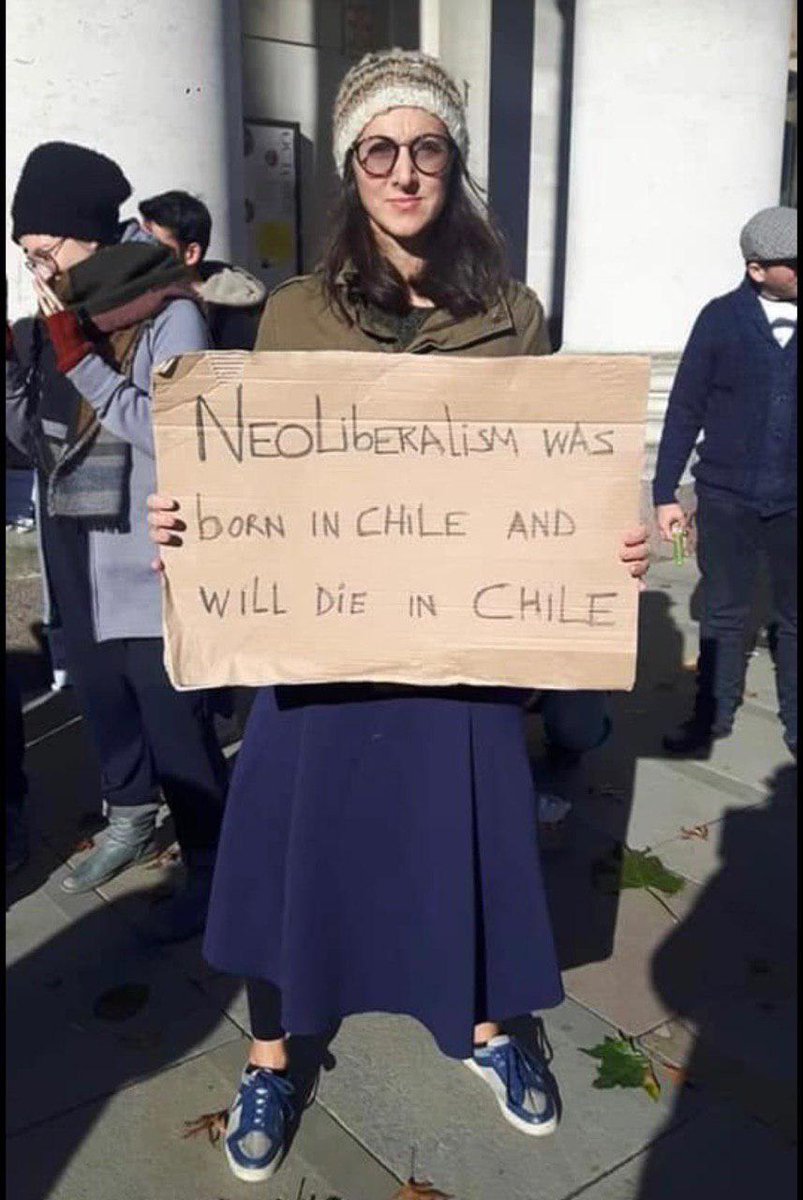
Working class Chileans have good reason to seek a new Constitution. The current one, instituted in 1980 by a military dictatorship to serve neoliberal purposes, lived on after dictator Pinochet departed in 1990. Subsequent governments, even socialist ones, have had to bend to its rules.

That Constitution instituted “radical neoliberalism,” according to the Council on Hemispheric Affairs. It “privatized fundamental aspects of the lives of Chileans, …  imbued principles of profit and capital investment in such key and sensitive sectors as education, healthcare, pensions, labor regulations, and other socially vital areas of the economy.”

According to the report, “Chile is now one of the most dramatic examples of social and economic inequality on the planet; … the richest 1% of Chileans hold 26% of the nation’s wealth … Chile ranks seventh among the most unequal countries on the planet.”

One observer notes that Chile “is the first country in the world to have privatized its sources and management of water.” Another claims that 4000 very wealthy families ultimately determine most of what happens in Chile, which necessarily would include actions of the notably cruel and corrupt militarized police known as carabineros.

Daniel Jadue represents a different Chile. The Communist Party’s Central Committee on April 24 announced that the Party would shortly be advancing Jadue as the most appealing candidate for left-leaning political parties in the upcoming presidential election.  Jadue “has aroused full, cross-the-board support from a large segment of our society,” remarked Communist Party President Guillermo Teillier.

Of Palestinian heritage, Jadue prepared in sociology, architecture, and urban planning; headed the Palestinian Youth Organization of Latin America until 1993; and that year joined Chile’s Communist Party. Born in Recoleta in 1967 and mayor since 2012, Jadue told an interviewer in 2019 that, “We are a very diverse and multicultural community [and] home to large portions of the Santiago’s informal sector.” Recoleta municipality or “commune,” population 162,000, is part of greater Santiago.

The interviewer praises Jadue as “one of the most important figures on the Latin American left.” He thinks “Jadue’s administration is building a laboratory for communism of today and of the future.” That seems to be Jadue’s intention: “In Recoleta, we want to form an open-door state, wherein all that matters are its citizens … We are nothing more than humble employees of the citizenry, those who truly constitute the state. Therefore, whenever our citizens come to us with a problem, we do everything in our power to solve it.”

Jadue describes what’s been done. About the “Open School,” for example, he reports that “some young men came to us, saying they wanted to get off the streets …So, we [are] keeping schools open until 10:00 PM daily, and over the weekend as well. This gave the whole community the opportunity to make use of the spaces as they saw fit …  Our plan is to create an open university that offers anyone in the community access to free university classes in every subject area. Almost 70 percent [of the activities] are self-directed, by both the older and younger people who attend.”

He turns to health care changes: “We had very few doctors in the community and just four medical offices …That’s one medical practice per every 40,000 inhabitants…. So, [we sought] to increase the number of doctors from eleven to forty. But we then ran into problems with overcrowding …We built two medical attention hubs for noninvasive primary care at each of Recoleta’s neighborhood councils. We were able to provide 75 percent of senior citizens with medical access within three blocks of their residence.”

About “the people’s pharmacy project,” Jadue recalls that, “Our residents told us scarcity and high prices were making medication the second biggest obstacle to proper care in Recoleta …Specialized medications were too expensive [and] Recoleta had only two pharmacies …Chilean law prohibits the state from engaging in any kind of commerce … [so we formed] a consumer’s cooperative, with the goal of driving down the cost of medication … Now, Communes of every stripe [throughout Chile] have people’s pharmacies.” 

Asked about the “optician program,” he states that, “we are selling 250 pairs [of glasses] a week now. And, “one last health-related service we offer is our people’s dentistry program. We have dentists who take mobile kits out into the community”

At “the people’s bookstore … all kinds of books are sold … all at an extremely low price. The municipality was able to cover all operational costs, paying for the location, salaries, and all the bills. We can then pass these savings on to the public, selling books at the same price we got them for from the publisher or distributor.”

The commune “invested in the promotion of reading. Our biggest resources are the ten public libraries in Recoleta, which make us the municipality with the most public libraries nationwide.” The municipality invests “about USD $500,000 a year in the public library system.”

To further accessible housing, Recoleta inaugurated its “Social Justice 1” condominium in June 2020. The structure, which cost $1.2 million USD to build, contains 38 rent-subsidized, three-bedroom apartments. “Today in the condominium, 95% of the beneficiaries of the project are women and, of them, 31 % were victims of family violence.” 

Reflecting on changes in Recoleta, Jadue maintains that, “A socialism that doesn’t govern any better than the Right has no future, nor any right to guide society’s destiny. If socialism wants an opportunity, it will have to be much more democratic, much more effective, and much more efficient.”

He points out that, “the Communist Party has been undergoing a resurgence. The accomplishments of local Communist governments have given citizens a renewed hope in the party.”  Overall, “The goal of our Communist administration is to fundamentally transform the state. As it currently exists, it functions purely as a vehicle for class domination. Its structures are completely impervious to the expectations and needs of its citizenry.

Presently Jadue is running second in presidential polling to the current favorite Pamela Jiles, a flamboyant journalist and legislator for the Humanist Party. She recently gained 21.7% approval in one tally and 18% in another, with Jadue scoring 10.3% and 11 %, respectively.

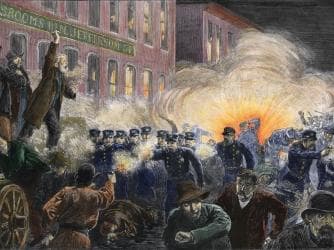
May Day and the Haymarket Martyrs, by Tom Whitney

(Source: Labor Standard, Vol1, No3, 1999)

(Image Credit: Stock Montage/Getty Images)

Jose Marti, author of “A Terrible Drama”, which is cited in the present article, lived in exile in the United States for 15 years until 1895. Having organized Cuban rebel forces fighting in Cuba’s Second War for Independence, Marti died in battle early in the war. In the United States he was a correspondent for Latin American newspapers.

On May 1, 1886, Albert Parsons, head of the Chicago Knights of Labor, led 80,000 people
through the city’s streets in support of the eight-hour day. In the next few days they were joined nationwide by 350,000 workers who went on strike at 1,200 factories, including 70,000 in Chicago.

On May 3, August Spies, editor of the Arbeiter-Zeitung (Workers Newspaper), spoke at a
meeting of 6,000 workers, and afterwards many of them moved down the street to harass scabs at the McCormick plant. The police arrived, opened fire, and killed four people, wounding many more.

On May 4, Spies, Parsons, and Samuel Fielden were speaking at a rally of 2,500 people held to protest the police massacre when 180 police officers arrived, led by the Chicago police chief. While he was calling for the meeting to disperse a bomb exploded, killing one policeman. The police retaliated, killing seven of their own in the crossfire, plus four others; almost two hundred were wounded. The identity of the bomb thrower remains unknown.

On June 21, 1886, eight labor leaders, including Spies, Fielden, and Parsons went on trial,
charged with responsibility for the bombing. The trial was rife with lies and contradictions, and the state prosecutor appealed to the jury: “convict these men, make an example of them, hang them, and you save our institutions.”

Even though only two were present at the time of the bombing (Parsons had gone to a nearby tavern), seven were sentenced to die, one to fifteen years imprisonment. The Chicago bar condemned the trial, and several years later Governor John P. Altgeld pardoned all eight, releasing the three survivors (two of them had had their sentences reduced from hanging to life imprisonment).

On November 11, 1886, four anarchist leaders were hanged; Louis Lingg had committed suicide hours before. Two hundred thousand people took part in the funeral procession, either lining the streets or marching behind the hearses.

Unfortunately, the events surrounding the execution of the Haymarket martyrs fueled the
stereotype of radical activists as alien and violent, thereby contributing to ongoing repression.

Over the years the remains of many deceased or martyred radicals, among them Emma
Goldman, Bill Hayward, and Joe Hill, were deposited at the Haymarket Monument in Chicago, where seven of the eight men on trial lie buried. Ever since that time, in almost every country except one (guess which?) May 1 has been honored as International Workers Day.

The internationalization (if not “globalization”) of the Haymarket legacy was apparent two days after the hangings when José Martí, leader of Cuba’s struggle for independence from Spain, who was then living in exile in New York, wrote a detailed, emotion-filled report of the events leading up to the executions. Full of analysis, his article entitled “A Terrible Drama” appeared on January 1, 1888, in the Argentine paper La Nación, published in Buenos Aires. Early on in his piece he notes:

“Frightened by the growing power of the plain people, by the sudden coming together of the working masses (previously held back by the rivalries of their leaders), by the demarcation of two classes within the population — the privileged and the discontented (the latter a thorn in the side of European high society) — the republic determined to defend itself with a tacit covenant, a complicity whereby criminal action is triggered by the authorities’ misdeeds as much as by the fanaticism of the accused, in order to use their example to terrify — not by means of pain directly visited upon the rabble, but by the fearsome revival of the hangman’s hood.”

At the end of his long article José Martí quoted from the Arbeiter-Zeitung issued on the day of the executions:

“We have lost a battle, unhappy friends, but we will see in the end an ordered world that
conforms to justice: we will be wise like the serpent and quiet like the dove.”
In our own time the Uruguayan writer Eduardo Galeano has commented on “A Terrible Drama” (in his Memories of Fire, vol. II):

“The scaffold awaited them. They were five, but Lingg got up early for death, exploding a
dynamite cap between his teeth. Fischer was seen unhurriedly humming the ‘Marseillaise.’
Parsons, the agitator who used the word like a whip or a knife, grasps the hands of his comrades before the guards tie his own behind his back. Engel, famous for his sharp wit, asks for port wine and then makes them all laugh with a joke. Spies, who so often wrote about anarchism as the entrance into life, prepares himself in silence to enter into death.

“The spectators in the orchestra of the theater fix their view on the scaffold — a sign, a noise, the trap door gives way, now they die, in a horrible dance, twisting in the air. [Here he quotes Martí.]

“José Martí wrote the story of the execution of the anarchists in Chicago. The working class of the world will bring them back to life every first of May. That was still unknown, but Martí always writes as if he is listening for the cry of a newborn where it is least expected.”

Cuba’s COVID-19 Vaccines Serve the People, Not Profits, by Tom Whitney

Cuba’s socialist approach to developing vaccines against COVID-19 differs strikingly from that of capitalist nations of the world. Cuba’s production of four vaccines is grounded in science and dedicated to saving the lives of all Cubans, and to international solidarity.

The New York Times’s running report on the world’s vaccine programs shows 67 vaccines having advanced to human trials; 20 of them are in the final phase of trials or have completed them. The United States, China, Canada, the United Kingdom, Germany, South Korea, and India have each produced many vaccines; most vaccine-manufacturing countries are offering one or two vaccines.

Cuba is the only vaccine manufacturer in Latin America; there are none in Africa. The only state-owned entities producing the leading vaccines are those of Cuba and Russia.

Cuba’s Finlay Vaccine Institute has produced two COVID-19 vaccines. Trials for one of them, called Sovereign I, focus on protecting people previously infected with COVID-19. The antibody levels of some of them turned out to be low, and the vaccine might provide a boost.

The other vaccine, Sovereign II, is about to enter final human trials. For verifying protection, these trials require tens of thousands of subjects, one half receiving the vaccine and the other half, a placebo vaccine. Cuba’s population is relatively small, 11 million people, too small to yield enough infected people in the short time required to test the vaccine’s protective effect. That’s why Sovereign II will be tested in Iran.

100 million doses of Sovereign II are being prepared, enough to immunize all 11 million Cubans, beginning in March or April. The 70 million remaining doses will go to Vietnam, Iran, Pakistan, India, Venezuela, Bolivia, and Nicaragua. Sovereign II “will be the vaccine of ALBA,” explained Venezuelan Vice President Delcy Rodríguez, referring to the solidarity alliance established in 2004 by Venezuelan President Hugo Chavez and Cuba’s Fidel Castro.   

Cuba’s strategy in commercializing the vaccine represents a combination of what’s good for humankind and the impact on world health. We are not a multinational where a financial objective comes first,” says Vicente Vérez Bencomo, director of Cuba’s Finlay Vaccine Institute. Income generated by vaccine sales abroad will pay for health care, education, and pensions in Cuba just as happens with exports of medical services and medicines.

Cuba’s Center for Genetic and Biotechnological Engineering is developing two other COVID-19 vaccines; One, named “Mambisa” (signifying a female combatant in wars of liberation from Spain), is administered via the nasal route, just as is Cuba’s hepatitis B vaccine.  The other vaccine, named “Abdala” (a character in a Jose Marti poem) is administered intramuscularly. The two vaccines are involved in early trials.

Cuba was ready

Cuban education emphasizes science and technology. In the 1990s, Cuba accounted for 11% of doctorate-level Latin American scientists. Cuban scientists work in the 50 or so biomedical research and production facilities which together make up Cuba’s state-owned BioCubaFarma Corporation, and which produces vaccines, drugs, medical tests, and medical equipment. It makes 60% of medicines used in Cuba, and 8 of 12 vaccines.

Cuba previously produced a pioneering vaccine that prevents life-threatening infection caused by type B meningococcus. Cuba developed a genetically-engineered hepatitis B vaccine and a vaccine offering palliative treatment for lung cancer. A Cuba-developed vaccine offers protection against infection, particularly childhood meningitis, caused by the Hemophilus Influenza type B bacterium.

In fashioning vaccines, Cuban scientists relied on familiar technology.

To provide an immunological extra, the antigen of Cuba’s Sovereign II vaccine is mixed with tetanus toxoid, as was done with Cuba’s Hemophilus influenza vaccine. As with other vaccines, scientists used a segment of the virus’s protein – here the COVID-19 virus – to form an antigen to stimulate protective antibodies. By contrast, the U. S. Pfizer and Moderna vaccines contain the whole viral protein, not a segment. That protein contains “genetic instructions” which enter human cells, causing them “to make spike proteins, which then get released into the body” where they trigger antibodies.

Observers suggest that this innovative U.S. technology may be less safe than the one used in Cuban vaccines.  Not requiring extremely cold storage, as do the U.S. vaccines, the Cuban vaccines are suited for areas without adequate refrigeration capabilities.

Cuba’s bio-medical production sector has also created drugs for treatingCovid-19 infection. Interferon, an antiviral agent developed in Cuba, produced in China, and used throughout the world, prevents many Covid – infected patients from becoming critically ill. The Cuban anti-inflammatory drug Jusvinza, used for treating auto-immune diseases, and Cuba’s monoclonal antibody Itolizumab, which moderates exaggerated immune responses, are both effective in reducing Covid-19 deaths.

The other way

The U. S. approach to producing and distributing COVID-19 vaccines is based on private enterprise, although the U. S. government did deliver billions of dollars to pharmaceutical companies to produce vaccines free of charge to recipients. The companies have contracted with purchasers abroad.

According to forbes.com in November, 2020,  ‘If Moderna’s [vaccine] can get FDA approval and can make enough doses, its top line could be nearly $35 billion higher … than … in the last 12 months.” Another report suggests that, “The companies (Pfizer and Moderna) stand to earn billions of dollars in profits from their COVID vaccines this year [and] there will be more profits in later years.” The companies “claim the rights to vast amounts of intellectual property.” 

With corporations in charge, distribution of COVID-19 vaccines is skewed. As of Jan. 27, “some 66.83 million doses have been sent out, of which 93 percent were supplied to only 15 countries.” In Latin America, only Brazil, Argentina, Mexico, and Chile have secured purchase contracts adequate for immunizing entire populations. The companies’ contracts with African nations allow for immunization of only 30 percent of Africans in 2021. Meaningful immunization has yet to begin there. 

The wealth divide determines distribution. Epidemiologists at Duke University report that, “While high-income countries represent only 16% of the world’s population, they currently hold 60% of the vaccines for COVID-19 that have been purchased so far.” Cuban journalist Randy Alonso reports that only “27 percent of the total population of low and middle income countries can be vaccinated this year.” 

The world is on the brink of a catastrophic moral failure – and the price of this failure will be paid with lives and livelihoods in the world’s poorest countries,” declared Dr. Tedros Adhanom Ghebreyesus, director of the World Health Organization, on January 18. He warned that, “some countries and companies continue to prioritize bilateral deals, going around COVAX, driving up prices and attempting to jump to the front of the queue.”

The WHO initiated the global vaccine collaboration COVAX to assure access by poor nations to COVID-19 vaccines. The 190 nations that are enrolled agreed to obtain vaccines through COVAX. Rich nations would supply COVAX with funds to enable 90 poor nations to receive no-charge vaccines. COVAX anticipates distributing two billion doses, enough to immunize only 25 % of the populations of poor nations during 2021.

Problems include: wealthy nations order vaccines independent of COVAX; they buy more vaccine than they need; manufacturers set prices; and prices are secret, variable, and very high.

Most other countries producing COVID-19 vaccines are at variance with Cuba through their profiteering and because they are complicit with the U.S. economic blockade of Cuba. Pursuing routine overseas commercial affairs, they all too easily adjust to U.S. regulations by means of which that cruel policy is enforced. More to the point, the U.S. blockade hinders Cuba’s vaccine efforts, and they are silent.

“We don’t have in Cuba all the raw materials and supplies we’ll need for the unprecedented scale of production that vaccinating our whole population requires,” Dagmar García-Rivera, Director of Research at Cuba’s Finlay Vaccine Institute, explained.  “They have to be purchased and for this, we need financing. This is made infinitely more difficult by the US embargo … Procuring the necessary reagents for research and the raw materials for production is a challenge we face daily.”

In confronting the pandemic, Cuba exhibits attention to detail suggestive of a level of caring and concern not readily matched elsewhere. For example, Cuba’s government-friendly cubadebate.cu website provides a daily, detailed update of the infection’s impact. Its report on Jan. 27 presents data relating to cities, provinces, the nation, and the world – and the nation’s intensive care units. Readers learn that of 43 patients in intensive care that day, 16 were in critical condition, stable or unstable, and 27 were in “grave” condition.

All 43 cases are reviewed, beginning with: “Cuban citizen, 75 years old, from Alquízar, in Artemisa, already suffering from arterial hypertension and ischemic cardiopathy who is afebrile, on mechanical ventilation, is hemodynamically stable… with acceptable blood gases (oxygen and CO2), is improving radiologically with inflammatory lesions in the right [lung] base – reported as critical but stable.” The cases of four Cubans who died that day are also presented.

Fighting a pandemic in Cuba, it’s understood, is no casual matter. Nor is the health of Cuba’s people. 

To Normalize US-Cuban Relations, Restore Working Embassies, by Tom Whitney

The new Biden administration may soon ease regulations enforcing the U.S. economic blockade against Cuba.  However, if Oregon Senator Ron Wyden’s new bill, the U.S.-Cuba Trade Act of 2021, becomes law, the blockade itself will disappear.

Meanwhile, the two countries’ embassies in Havana and Washington are dysfunctional. No normal relations will obtain until they are fully operative. A report recently issued by the Washington-based National Security Archive (NSA) explores circumstances through which the embassies are disabled.

The NSA is a truth-telling organization that monitors U.S. conduct of international affairs by reviewing declassified U.S. government documents obtained through the Freedom of Information Act.

In September 2017, the State Department reported that some U.S. diplomats stationed at U. S. embassy in Havana had for months, one by one, sought relief from incapacitating symptoms such as dizziness, hearing deficits, visual loss, mental confusion, painfully loud noises, insomnia, headaches, and balance problems. A few Canadian diplomats in Havana were similarly affected.

A“covert sonic device” was mentioned.  President Trump claimed that, “Cuba did some bad things.”  Citing health risks, the State Department recalled 60 percent of Embassy employees and, for the sake of reciprocity, expelled 15 Cuban diplomats from Washington. The Department warned U.S. travelers of health dangers in Cuba.

The Embassy quickly stopped processing entry visas for Cubans seeking to visit the United States.  These are only available now in U.S. embassies in third countries, and few Cubans can travel there to obtain them. Lack of embassy staffing in both countries hinders inquiries about travel, commercial affairs, and regulations. Cuba’s Washington Embassy can no longer provide consular serves to Cubans living in the United States.

The affected diplomats were evaluated at U. S. medical centers under State Department auspices. Specialists, unable to identify a cause for the symptoms, ruled out viral infection, toxins, hysteria, and chemical exposure.

CIA operatives in Havana were among the first to complain of symptoms.  A few U. S. diplomats in China and Tashkent also fell ill. Now for almost three years, no diplomats anywhere have been afflicted.

No visitors to Cuba have suffered in similar ways, nor have diplomatic personnel from countries other than the United States and Canada.

At stake is the future of U.S.  – Cuba relations. Vermont Senator Patrick Leahy claimed in 2017 that, “Whoever is doing this obviously is trying to disrupt the normalization process between the United States and Cuba. Someone or some government is trying to reverse that process.”

The NSA update, noted above, centered on a heavily-redacted report from the Accountability Review Board (ARB), which had been “mandated by Congress in 1986 to assist the State Department in addressing security challenges at U.S. Embassies abroad.”

Although Congress required ARB investigations to take place within 60 days of an incident, “the Trump administration delayed convening the ARB until early 2018.” The ARB submitted its classified report to the Secretary of State 18 months after the first diplomat reported strange symptoms.

The report noted, as regards afflicted diplomats, that, “we do not know how. We do not know what happened, when it happened, who did it, or why.” It confirmed that the CIA closed down its Havana station in September, 2017, just as the illnesses were first being reported.

The ARB report criticized “excessive secrecy that contributed to a delayed response.” It diagnosed “Systemic Disorganization” manifested by “serious deficiencies in the Department’s response in areas of accountability, interagency coordination, and communication, at all levels.” The result was “confusion [and] delayed effective, coordinated action.”

The report judged “the lack of a designated official at the Under-Secretary level to manage the response to be the single most significant deficiency.” It accused the State Department of not following procedural standards.

The ARB faulted the Department for not providing the Centers for Disease Control and Prevention with medical data for one year after it had requested a CDC investigation. The fact of a CDC investigation was unknown until a reference to it cropped up in a document reporting on another evaluation.  

That one, by the National Academy of Sciences, was sent to the State Department in August 2020. It too was unknown to the public, until it was leaked to the New York Times in December, 2020. According to the Times report,  the investigators concluded that, “The most probable cause [of the symptoms] was radiofrequency energy, a type of radiation that includes microwaves.” However, “they could not rule out other possible causes.”

The picture thus is of extreme disarray and secrecy. Nothing emerging from the studies or from U.S. government actions suggests lack of determination to resolve the embassy crisis. Easy tolerance of confusion and mystery is consistent with U.S. inclination to perpetuate initial allegations by officials against Cuba. Lack of closure apparently suited U.S. purposes.  

While the embassy stand-off persists, planning for normal relations by the new Biden administration is hobbled. Planners could, or should, take into consideration the NSA’s revelations suggesting that the impasse stems from cynical opportunism. They could, or should, pay respect to Cuba’s record of protecting foreign diplomats and of honoring international norms on conducting diplomacy.

Diplomatic relations between the two countries will continue. One looks in vain for extraordinary circumstances that would justify anything but normal arrangements. These necessitate a fully- functioning embassy and an ambassador. There’s been no U. S. ambassador to Cuba since diplomatic relations were re-established in July 2015.  

Besides, the U.S. image of concern for the safety of foreign diplomats needs burnishing. No word of sorrow or reassurance emanated from the U.S. government following a serious rifle attack against Cuba’s Embassy in Washington on April 30, 2020.    

Letter to End the US Embargo against Cuba, from Tom Whitney

Dear Comrades,

I write you on behalf of an ad hoc group of Maine people identifying themselves “Maine Citizens Opposed to the US Embargo against Cuba.”  We are asking you to add your name to the letter appearing below to the two Maine senators.

Now is a crucial time. There is a chance now – dare we say it? – to end the US economic blockade against Cuba. Sixty years is enough, right? The letter below explains.

And, just as important, please send out this communication to people you know, friends, family, anyone.

We are sending this communication also to people we know elsewhere in the US asking them to fashion a similar letter to their own representatives with a lot of names added.

In an email toatwhit@roadrunner.com, please say “Yes” to adding your name, and your town, to the letter to the senators. If you have questions or comments, please be in touch. Thank you.

In solidarity,

Tom Whitney, for the Let Cuba Live Committee of Maine, phone (207) 743-2183

Dear (name of Maine senator).

The U.S. trade embargo against Cuba has been in effect for almost 60 years. We, the undersigned, believe that’s long enough. Senator Ron Wyden of Oregon, Chair of the Senate Finance Committee, on February 4 introduced the U.S.-Cuba Trade Act of 2021. We presume that a similar bill will be introduced soon in the House of Representatives.

Senator Wyden’s proposed legislation appears to nullify regulations that enable the U.S. trade embargo against Cuba — in other words, would end that embargo. We realize that, as required by the Cuban Liberty and Democratic Solidarity (Libertad) Act of 1996, the power to end the embargo against Cuba rests exclusively with the U.S. Congress.

We understand too that public support for the U.S. embargo against Cuba has lessened. On the one hand, many citizens have long pointed to its cruelty and illegality. On the other, even supporters can appreciate that this U. S. policy has failed the test of so many years: it has not worked to bring down Cuba’s government.  Meanwhile, the Cuban people have experienced catastrophic damage at U.S. hands.

Cuba’s government, reporting to the United Nations General Assembly, indicated that between April 2019 and March 2020, U. S. economic sanctions deprived Cuba of $5.6 billion, also that Cuba’s total monetary loss over many decades has amounted to $144.4 billion, which, inflation being considered, is $1.098 trillion.

Therefore, we respectfully request that you, who represent us in the U.S. Senate, do everything in your power to end the U.S. embargo against Cuba. In that regard, we urge you to work toward passage in the Senate of Senator Wyden’s bill.

Any questions or comments relating to our request may be directed to Tom Whitney of Maine Citizens Opposed to the US Embargo against Cuba. His address is 102 Twitchell Road, South Paris, Maine, 04281; telephone (207) 743-2183.

Signed

 Name                                                                Town

1.

2.

3.