

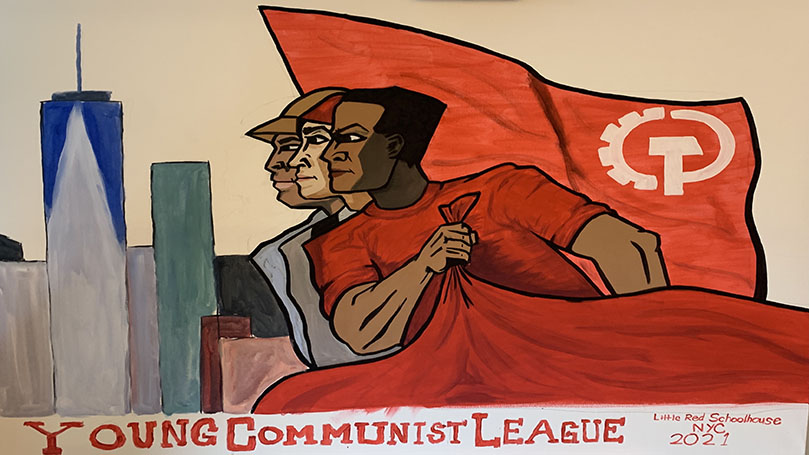
Marxist education is a very important part of our work, but it must be supplemented by self-study. Educating oneself about Marxism is a daunting task. Check out cpusa.org/education for our Party’s educational materials. We’ve also compiled some resources here for your perusal. Note that unless otherwise stated, these items are not affiliated with the Communist Party and we do not formally endorse any of these lists, websites, podcasts, etc.
What to Read and Where to Start
Looking at the available libraries of Marxist literature, choosing what to read is a daunting task. What counts as “Marxist” literature isn’t always easy to define either. Twitter communists might tell you that you need to read one book a week for a year before you’re allowed to have an opinion on anything, yet the self-claimed “most well read” Marxists will often fail to understand relatively simple works such as the CPUSA Party Program. Clearly, it is more important to take your time and really try to understand what you are reading than to plow through as many books as you can.
Ask ten communists to give a beginner reading list and you’ll get ten different answers. They may then vehemently insist that only their list is correct. We say that there’s no one correct answer. Depending on your background, good places to start might vary considerably. Perhaps you’re studying economics in college and you want to understand Marxist economics and how it’s different from the neo-classical economics you’ve been learning. In that case starting with Marx’s essays Value Price and Profit and Wage Labor and Capital might be best for you. If you’ve seen lots of people throwing around the term “Imperialism” lately and want to know what it really means, then you might want to read Lenin’s Imperialism the Highest Stage of Capitalism. Perhaps your boss has refused to give you a raise despite the soaring cost of living and you’ve realized you desperately need to unionize, then you might read William Z. Foster’s American Trade Unionism: Principles, Organization, Strategy, Tactics. The point here is that there’s no one correct or incorrect place to start. Different authors also have different writing styles that may affect your engagement with the text. And feel free to treat “difficultly levels” with a grain of salt, while it’s true that some works heavily cite other works and concepts, that does not mean that you can’t get anything out of a more “advanced” piece. Start by reading what interests you and if something seems too complex, you can always come back to it later. There is much to gain in reading the same text multiple times.
Where to get Marxist Literature
Sources of Marxist literature can generally be divided into two categories: Books, and Magazines/Journals.
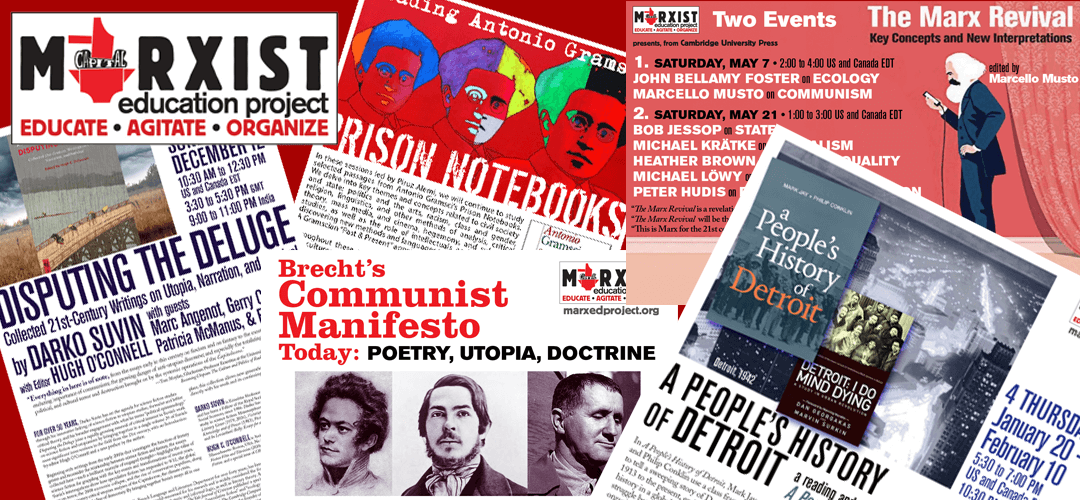
Starting with books, we have some publishers
- Canut is an independent publishing house of works from China, Vietnam, Cuba, and Korea.
- Haymarket Books is a radical, independent, nonprofit book publisher based in Chicago.
- International Publishers is the CPUSA affiliated publishing house.
- LeftWord Books is a New Delhi-based publishing house that seeks to reflect the views of the left in India and South Asia. We publish critical and analytical works on a range of subjects, and pay special attention to works on Marxist theory.
- Monthly Review Press has been a leading publisher of left scholarship since 1949.
- Verso Books is the largest independent, radical publishing house in the English-speaking world.
Some magazines and journals
Selected Podcasts
- Catalyst is a journal of theory and strategy, published by Jacobin Foundation.
- Jacobin is a leading voice of the American left, offering socialist perspectives on politics, economics, and culture.
- Monthly Review An American Marxist magazine, never aligned with any specific revolutionary movement or political organization.
- Peace Land and Bread is a peer-reviewed print journal of revolutionary theory, practice, and arts.
- Science & Society: A Journal of Marxist Thought and Analysis. Appearing quarterly since 1936, it is the longest, continuously published journal of Marxist scholarship, in any language, in the world.
For people who prefer listening over reading, we’ve compiled some Marxist podcasts. A word of caution however, podcasts tend to reflect the biases of their hosts, more so than books. Unlike books, sources are typically not cited within the podcast making it more difficult to verify any information presented.
- Anti-Capitalist Chronicles offers a dialectical analyses of the capitalist totality through a Marxist lens.
- Democracy at Work is a worker-led, small-donor-funded non-profit, making media that says we can do better than capitalism – an unjust economic system that is at odds with democracy.
- Economic Update aims to expose capitalism’s systemic problems and to show how democratizing our workplaces solves them.
- Pants on Fire is produced by the CPUSA International Department and aims to debunk ruling class lies, with most episodes focused on international politics.
- The Red Nation is an indigenous podcast focusing on Indigenous history, politics, and culture from a leftist perspective.









 COMMUNIST PARTY OF MAINE