
The United Arab Emirates Enables Human Catastrophe in Sudan, with the US in Tow / By W. T. Whitney, Jr.

Photo credit Z

South Paris, Maine


Beginning in April 2023, war between Sudan’s army and the paramilitary Rapid Support Forces (RSF) has caused humanitarian disaster of epic proportions. Some 150,000 people have died and 14 million Sudanese – Sudan’s population is 51 million – are displaced internally or in neighboring countries. Over 24 million suffer acute food insecurity. Famine is rampant in Darfur, the district in northwestern Sudan most afflicted by war and hunger.

We look at causes, foreign intervention in particular. The Sudanese people are victims of top-down oppression inflicted by big imperialists, lesser ones, and Sudan’s elite.  

The Bashir government in 2013 created the Rapid Support Forces from the Janjaweed formations and installed General Mohamed Hamdan Dagalo, known as “Hemedti,” as leader.

Protests by democratic forces beginning in December 2018 led to joint civilian-military rule. A coup in April 2019 removed Bashir from power. Subsequently, General Abdel Fattah al-Burhan, head of the armed forces and now the country’s president, and deputy military commander Hemedti became co-leaders of a transitional military council.

Turmoil continued, as did agitation for democratic change. In October, 2021, the two generals, having instigated another coup, established themselves as the country’s sole rulers. Al-Burhan and Hemedti subsequently disagreed on how to incorporate the RSF into Sudan’s army and on who would command the RSF. Reacting, Hemedti in April, 2023 provoked yet another coup. The RSF was soon occupying Khartoum, Sudan’s capitol city.

The Sudanese army recaptured a devastated Khartoum in March 2025. The RSF, having laid siege to El Fasher for 18 months and defeated the Sudanese army, took over that city of 700,000 inhabitants in October, 2025. Killings skyrocketed.

As of November 6, the Rapid Support Forces have agreed to a “humanitarian ceasefire” for three months proposed by the U.S., Egypt, the UAE and Saudi Arabia. The Sudanese army rejected the truce, demanding  that the RSF withdraw from civilian areas and surrender their weapons.

Origins

African nations emerging from colonialism endured varying degrees of continuing oppression and differing kinds of instability. Even so, humanitarian catastrophe in Sudan and the killings seem to be unprecedented.

The country’s vulnerability shows in a destitute, divided population, military rule, and societal collapse. It stems from a long history of autocratic rulers and recurring coups before independence and afterwards, division between an Arab-oriented North and non-Arab South (leading to an independent South Sudan in 2011), and susceptibility to manipulation by outside actors.

The United Arab Emirates (UAE) has interests in Sudan. Mohammad Khansa, writing for al-akhbar.commentions that, “Sudanese gold fuels the RSF, and the UAE.” Newly discovered gold deposits account for 60% of the country’s exports. The UAE imported $2.29 billion worth of Sudanese gold in 2022. Ninety percent of the gold Sudan produces goes to the UAE.

Sudan, the “leading agricultural producer in both Africa and the Middle East” is the “breadbasket of the Arab world.” The UAE imports 90% of its food. UAE investors have fostered land grabs in Sudan and industrialized Sudan’s agricultural production.

Other UAE interests are:  management of key Sudanese ports on the Red Sea, UAE control of many Sudanese banks and the UAE’s use of the RSF as its proxy in competing with Saudi Arabian influence in Africa.

UAE intrusion

Explaining the UAE’s relationship with Sudan and the RSF, Husam Mahjoub, writing in Spectre Journal, states that, “The UAE’s role in Sudan is … part of a coherent, well-financed, and regionally expansive project: a sub-imperialist agenda that combines economic extraction, authoritarian alliance-building, and counterrevolutionary politics.” The UAE “viewed the Arab Spring [of 2011] as an existential threat to both the authoritarian regimes in the region and its own model of governance. …[The] UAE became an active counterrevolutionary force.”

The Sudanese people’s uprising in December 2018, prior to Bashir’s removal, continued “even after the October 2021 coup.” It was “democratic, civilian-led, and explicitly antimilitary.” Demands were “freedom, peace, social justice, civilian governance, and accountability.” According to Mahjoub, this “grassroots resistance posed a threat to both Sudan’s own elites and regional powers like the UAE.”  

The RSF has helped the UAE in two ways: its “capacity for violence—that is, a force willing to suppress protests, fight wars, and eliminate rivals” and “economic access, especially to Sudan’s lucrative gold trade, which the RSF increasingly controlled.”

“[N]ow the regional leader in the defense sector,” according to the Simpson Center, the UAE imports weapons and makes its own. UAE support for the RSF shows in weapons transferred to the paramilitaries.  Gold from the RSF allows the UAE to buy weapons from many countries, with a portion of them ending up with the RSF.

The weapons enter Sudan by irregular means across several borders, and the gold arrives in the UAE the same way.

The UK’s Campaign against Arms Trade points out that, although the UAE allows the RSF to commit genocide by providing weapons, “there have been no efforts to pressure the UAE or hold it to account, and massive US and French arms supplies to the Gulf dictatorship continue unabated.”

Back in the US

The Biden administration in January 2025 accused the Rapid Support Forces of genocide. In March, New York Representative Gregory Meeks introduced legislation prohibiting arms sales to countries supplying arms to the RSF or the Sudanese Army. The bill has 27 co-sponsors.

Maryland Senator Chris Van Hollen and California Representative Sara Jacobs reintroduced legislation in March prohibiting U.S. arms sales to the UAE for as long as that country sends arms to the RSF. There are no co-sponsors.

The Trump administration in May announced a $1.4 billion sale of weapons and military equipment to the UAE. In 2024, the UAE received U.S. weapons worth $1.2 billion.

Husam Mahjoub explains that the UAE, as a “strategic partner of the West, … a buyer of arms, a major collaborator with Israel’s genocidal regime, a conduit for intelligence, and a financial hub, … is too useful to punish.”

Useful indeed! Reporter Dan Alexander claims the UAE “has become a hub for the Trump Organization’s international expansion. …[The] president and his family have entered into at least nine agreements with ties to the gulf nation. Together, the ventures … will provide an estimated $500 million in 2025—and about $50 million annually for years into the future …The president’s offspring are plotting novel ways to use crypto mania to squeeze more money from their real-estate assets.”

Alexander quotes Eric Trump: “The UAE is the developers’ greatest dream because they never say ‘no’ to anything, …. There’s no place that has been more fun to work in than the UAE. I mean, if you want to build it, if you can dream it up, they allow you to do it.” Alexander’s article is titled “This Gulf Nation Is Powering Trump’s Moneymaking Machine.”

The Sudanese Communist Party issued a statement on October 29. Speaking for the victims, it says in part:

“Our Party stands clearly and decisively against the horrifying massacres being committed against civilians in the cities of El Fasher and Bara … [We] always affirm that what is happening is not merely a military struggle for power; rather, it represents a complex scene of conflict between the parasitic wings of capitalism within the country over power and resources …  The war is, at the same time, a regional/international/imperialist scheme aimed at weakening the Sudanese state and creating conditions for disintegration and division to deplete the capabilities of the people, the wealth of the country, and violate national sovereignty.” 


W.T. Whitney, Jr., is a political journalist whose focus is on Latin America, health care, and anti-racism. A Cuba solidarity activist, he formerly worked as a pediatrician and lives in rural Maine.

Colombian paramilitaries encounter adverse US court decision and people’s resistance  / by W. T. Whitney

Paramilitary fighters hold their rifles during a ceremony to lay down their arms in Otu, northwest Colombia, on Dec. 12, 2005. Photo: Fernando Vergara/AP

South Paris, Maine


Away from industrialized countries, capitalism worked its way by means of enslavement, die-offs, wars, plunder, and thugs. Colombia specializes in thugs – since the 1970s. Paramilitaries, shock troops for Colombia’s rich and powerful, are an arm of Colombia’s military. A recent court decision in the United States provokes questions about the future of Colombia’s paramilitaries and about official U.S. reactions.

A trial jury in the U.S. District Court in West Palm Beach, Florida, determined June 10 that Chiquita Brands, formerly the United Fruit Corporation (UFC), was guilty of financially supporting the United Self-Defense Forces of Colombia (AUC). The paramilitary band has operated since the 1980s in Colombia’s northern banana-producing regions. The decision will be appealed.

Chiquita will pay $38.3 millionto 16 family members of eight individuals murdered by the AUC paramilitaries. Chiquita had supplied them with arms and ammunition. 

According to EarthRights, whose lawyers managed the case, “Chiquita knowingly financed the AUC, a designated terrorist organization, [as per the U.S. State Department], in pursuit of profit …These families, victimized by armed groups and corporations, asserted their power and prevailed in the judicial process.” No U.S. corporation has previously been punished for committing human rights abuses abroad

Testimony indicated AUC paramilitaries were active in suppressing labor activism, opposing leftist guerrillas, and enforcing company dictates against individual workers. With Chiquita support, “the paramilitaries successively extended their power in the region … by means of assassinations, disappearing people, and displacing thousands of them,” according to a report. 

The court’s ruling comes 17 years after Chiquita, in a 2007 plea-bargain agreement, acknowledged guilt in violating U.S. law prohibiting financial support for terrorist organizations. Acknowledging payments of $1.7 million to AUC paramilitaries for “security services” from 1997 to 2004,”Chiquita paid a $25 million fine. The company was spared having to reveal the identity of company executives approving the illegal payments.

Subsequently hundreds of claims against Chiquita descended on courts in Colombia. To secure relief for the victims’ families in U.S. courts, lawyers led by Terrence Collingwood, who represented 173 families, consolidated claims against Chiquita; they would pursue two “bellwether cases.” Favorable decisions would enable litigation to proceed on behalf of the other families. The second case opens on July 15.

Other companies have funded Colombian paramilitaries. A recent report indicates that Ecopetrol, Colombia’s largest oil company, paid paramilitaries up to 5% of the value of contracts it signed, that Bavaria brewery delivered to paramilitaries a portion of every dollar generated from sales along Colombia’s northern coast, and that distributers associated with Postobón, Colombia’s largest beverage company, gave paramilitaries boxes of bottled drinks to be sold for cash.

Only because the crimes occurred outside the United States did a U.S. court acquit Coca Cola companyon charges it contracted with paramilitaries to kill nine unionists in 1990-2002. Drummond coal-mining company, based in Alabama, beat back well-founded charges tried in a U.S. court that it paid paramilitaries to assassinate three labor leaders between 1996 and 2001. Del Monte and Dole food companies were charged in Colombian courts with “financing right-wing paramilitary groups,” according to a 2017 report.

With their own railroads, seaports, and ships, United Fruit Company and its offspring Chiquita have operated banana plantations in Panama, Colombia, Nicaragua, Costa Rica and Guatemala. Chiquita with a presence in 70 countries recently registered $7.59 billion in yearly revenue.

UFC, Chiquita’s parent and mentor, once claimed 42% of Nicaragua’s national territory. Agrarian reform impinging on UFC holdings there led to a CIA-mediated U.S. coup in 1954 that removed the left-leaning government of President Jacobo Árbenz.

In 1928 near Santa Marta on Colombia’s Caribbean coast, banana workers were on strike. UFC called upon an obliging Colombian government to send in troops. They machine-gunned strikers and their families. More than 1000 died. The pretext was Communist agitation.

In a poignant reminder almost a century later, on June 12, 2024, “5000 or so people undertaking a civic strike outside of Santa Marta blocked the Caribbean Trunk Route,” National Highway 90. According to the report, “The communities were asking the government for solutions for violence dispossession, displacement, and lockdown in their areas at the hands of paramilitary groups.” The strike lasted three days.

Nationwide mobilization organized by the Congress of the Peoples had begun on June 4. Activists representing “small farmers, African-descendants, Indigenous peoples, and urban representatives of the diversity of the Colombian people” blockaded four big highways. In Bogotá, they occupied the Interior Ministry and the Vatican Embassy.

Human rights leader Sonia Milena López, speaking at a press conference, declared that, “Paramilitarism has been and is a politics of the oligarchy enabled by the Colombian state.” She outlined measures for dismantling paramilitarism.

The government, she insisted, must recognize “that a national paramilitary strategy at the rural and urban level does exist and is oriented toward developing a genocidal process aimed against the people’s movement.” It must abandon “any pretension of political recognition of paramilitary elements” or of negotiating with them.  

She called for ‘investigating those who finance and direct [the paramilitaries], both state and private,” and for “removing …military officers when there are … accusations or evidence of connivance or lack of effective action against the paramilitaries.” 

In an interview, Esteban Romero, spokesperson for the Congress of the Peoples, reported that paramilitaries are absorbing territory, displacing populations, and threatening and harassing social leaders.  He suggested progressive president Gustavo Petro lacks the power needed to undo “a Colombian political regime that is a paramilitarized regime, one that created private armies to contain social changes.”

Paramilitaries are dangerous, as recalled by analyst Luis Mangrane: “Between 1985 and 2018, the paramilitary groups were the principal agents responsible for the killings associated with armed conflict [between the FARC and the Colombian government], having accounted for 45% of the total of 205.028victims. Through the ‘para-politics’ in the 2002 elections, they managed to coopt a third of the Congress.”

The paramilitaries’ base of support is strong, not least in the United States. There will be no new U.S. response to their actions, it seems, unless it is mediated through Colombia’s military. What with close ties between paramilitaries and the military, however, that possibility seems unlikely

The association shows in a memo from the U.S. Department of Justice in 2001: “Colombia has five divisions in its army, but paramilitaries are so fully integrated into the army’s battle strategy, coordinated with its soldiers in the field, and linked to government units … that they effectively constitute a sixth division of the army.”

Colombia’s labor minister, Communist Party member Gloria Inés Ramírez reflects on the staying power of the paramilitaries. “[P]aramilitaries came to the fore within the framework of the development of contemporary capitalism … Colombian capitalism turns out to be a complex socio-economic synthesis between a traditionalist and pre-modern tendency around land concentration, on the one hand, and a modernizing tendency in capital accumulation, on the other. This synthesis favored the authoritarianism of the political regime, the increasing militarization of politics and the growing role of paramilitary organizations.”


W.T. Whitney Jr. is a political journalist whose focus is on Latin America, health care, and anti-racism. A Cuba solidarity activist, he formerly worked as a pediatrician, lives in rural Maine. W.T. Whitney Jr. es un periodista político cuyo enfoque está en América Latina, la atención médica y el antirracismo. Activista solidario con Cuba, anteriormente trabajó como pediatra, vive en la zona rural de Maine.

War and Plunder in Eastern Congo and a US Hand / By W. T. Whitney

Congo’s borderlands with Rwanda have become one of the continent’s deadliest conflict zones | Credit: Guardian (UK)

South Paris, Maine


The United States Institute of Peace on February 27 awarded its “Women Building Peace” award to Pétronille Vaweka. She responded: “I weep because at this moment, in … Goma women and children are dying … [and] thousands of families are forced from their villages.”  Goma, population two million, is the capital of North Kivu province in eastern Democratic Republic of Congo (DRC).

For Guardian reporter Owen Jones, the DRC “is the site of the deadliest war since the fall of Adolf Hitler, and yet I doubt most people in the west are even aware of it.” Diminished U.S. and European press coverage of the region’s humanitarian crisis contributed to massive human suffering as, unwatched, lethal violence enabled the wholesale stealing of natural resources.

One million refugees entered eastern DRC from neighboring Ruanda during and after that country’s genocide in 1994. By early 2023 one million newly displaced people had arrived in the Goma region. Within months there would be half a million more. Of the 7.1 million displaced persons in the region now, 97% were displaced due to violent attacks by non-state military forces. The 1.1 million children and 605,000 women who are malnourished exemplify the suffering there.

The UN Refugee Agency describes “targeted attacks against civilians” with “killings, kidnappings, and the burning of homes.” The International Organization for Migration reports that “violence and brutal attacks …  loss of life, mass displacement, and increasing instability” are devastating and that “[a]cross the country, over 26 million people need humanitarian aid.”

War in the eastern DRC has killed six million people over 30 years, according to reporter James Rupert. He indicates that, “More than 250 local and 14 foreign armed groups are fighting for territory, mines or other resources in the DRC’s five easternmost provinces.” Troops fromUganda, Rwanda and Burundi are present. A United Nations peacekeeping contingent will be leaving soon.

The March 23 Movement (M23), formerly troops of the DRC army, figures prominently in the turmoil. This irregular military force, allegedly controlled by Ruanda, occupied Goma in late 2012 and was soon ejected by DRC and UN forces. Having broadened their operations after 2022, M23 detachments regularly execute civilians and force boys and men into their ranks. U.S. press coverage of this brutal war remains skimpy, and the U.S. public is largely uninformed.

The media also steers clear of humanitarian crises associated with war in Sudan and displacement of the Rohingya people from Myanma, in both instances perhaps because U.S. vital interests are not at risk. The U.S. approach toward Sudan apparently is one of watchful waiting, despite reports of growing Russian and Chinese influence and of combatants allying with extremists.

Israel’s war against Palestinians and humanitarian catastrophe in Gaza are different. The U.S. government and weapons manufacturers are unreservedly involved and the media and public pay close attention. Maybe there’s a correlation. As long as war, social catastrophe, and U.S. self-interest play out together, the U.S. public is informed. Drop the U.S. involvement, and they are not.

If that’s a rule, troubles in eastern DRC are an exception. U.S. powerbrokers are strongly attracted to the region, but even so, the U.S. public remains oblivious to the situation. James Rupert explains:

“The DRC is a treasury of minerals …, including an estimated 70 percent of the world’s known cobalt, a vital component of lithium-ion batteries for electric vehicles and other green energy products. …Since 2020, the U.S. Energy and Interior Departments have maintained a list of minerals, currently 50 of them, that they judge vital to America’s economy, energy grid or national defense. Many are difficult to access through reliable supply chains and many, including cobalt, copper, lithium, tantalum, tin and titanium, are mined in the DRC, often from illegal mines controlled by armed groups and smugglers, or in industrial mining that is significantly dominated by China.”

Rupert describes U.S. initiatives aimed at promoting mining in Africa, for example, securing investments for “building a $2.3 billion railroad to carry copper and cobalt from Congo and Zambia to Angola’s seaport of Lobito.”

He blames the multitude of “industrial and artisanal mines” in the DRC for human suffering. Paramilitary groups provide security and “hundreds of thousands … who are effectively enslaved” do the work. Importantly, “more than 250 local and 14 foreign armed groups are fighting for territory, mines or other resources in the DRC’s five easternmost provinces.”

With its cheery message of March 14, 2024, the International Trade Administration of the U.S. Department of Commerce wins points for salesmanship:

“The DRC offers opportunities large and small.  The DRC’s vast mining wealth attracts top mining companies from around the world … [and] is home to globally significant deposits of hard-rock lithium … Energy is another sector with huge potential for renewable energy, including hydropower and solar. The country has the potential to generate over 100,000 MW of hydropower, which is more than half of Africa’s total hydropower potential.”  

Continuing: “Oil and gas discoveries in the east of the country give the DRC the second largest crude oil reserves in Central and Southern Africa … The DRC has the highest agricultural potential in Africa … [and] the potential to feed over 2 billion people with appropriate investment …There are many infrastructure construction opportunities for U.S. companies, with most projects structured as public-private partnerships.” 

This U.S. presentation of opportunities for extraction and expropriation of resources does not explain how to pursue them.  A promotion piece, it is far removed from Pétronille Vaweka’s portrayal of, as she sees it, a system “based on brutal, illegal mining of these minerals from our soils and by people working in conditions of slavery.”

Wide dissemination of this grim news would likely shed light on the dark side of capitalism. Capitalism’s much-vaunted magic of the market and its autonomous mode of operating would turn out to be proxies for a kind of anarchy that, built on greed, assures that anything goes. This is a kind of insight that, for those in charge, is best avoided.    

To limit the flow of news on human suffering is offensive on other grounds.  Doing so violates “the commons,” items such as water, oxygen in the atmosphere, and knowledge that, essential to human living, must be accessible to everyone. The restriction also hits at the revolutionary notion of human solidarity, the idea that someone else’s pain is ours too.


W.T. Whitney is a political journalist whose focus is on Latin America, health care, and anti-racism. A Cuba solidarity activist, he formerly worked as a pediatrician, lives in rural Maine. W.T. Whitney Jr. es un periodista político cuyo enfoque está en América Latina, la atención médica y el antirracismo. Activista solidario con Cuba, anteriormente trabajó como pediatra, vive en la zona rural de Maine.

In Distress, Niger Expels US Military, Resurrects Hope / By W. T. Whitney

Supporters of Niger’s governing military council, gather for a protest called to fight for the country’s freedom and push back against foreign interference, in Niamey, Niger, Aug. 3, 2023. A top Pentagon official says that the U.S. has not yet received a formal request from Niger’s rulers to depart the country. | Sam Mednick / AP

Reposted from the People’s World


On March 16, Amadou Abdramane, spokesperson for Niger’s governing military council, announced that Niger was dropping its 12-year-old military-cooperation agreement with the United States. Niger’s military council had assumed power following the coup in July, 2023 that removed Mohamed Bazoum, the elected president.

U.S. military intervention in Niger is now a poor fit with grim realities in the western Sahel region of Africa and with the Nigerien people’s needs and aspirations.

The U.S. military presence there co-exists with danger posed by Islamic extremist military groups. These expanded after 2011 when NATO destroyed the Libyan government, a stabilizing force in the region. Niger faces a humanitarian crisis worsened by environmental disaster. The military council is seeking alternative arrangements for security cooperation and looking to China for help with societal development.

Abdramane denounced “the attitude of the [recently visiting] U.S. delegation in denying the sovereign right of Niger’s people to choose partners and allies capable of really helping them fight terrorism.” General Michael Langley, delegation member and head of the U.S. Africa Command (AFRICOM), “expressed concerns” that Niger was pursuing close ties with Russia and Iran.

AFRICOM, headquartered in Stuttgart, Germany, operates 20 bases in Africa. The two largest are air bases in Djibouti, in East Africa, and Agadez, in central Niger. Niger hosts two other U.S. bases, an airbase nearNiamey, the capital city, and a CIA base in the northeast.

According to a report, the Agadez base cost $110 million to build and costs $30 million annually to maintain. It is “the largest Air Force-led construction project in history.” By means of these two large bases, the United States conducts air war, with drones, over a significant portion of the earth’s surface.

In moving to end U.S. military involvement, the coup government had backing “from the trade unions and the protest movement against French presence.”  The new government had already pressured France, Niger’s colonizer, to remove its military units from the country; the last of them departed in January, 2024. Coup governments in Mali and Burkina Faso expelled French troops in February 2022 and February 2023, respectively.

Also in January 2024, the three countries abandoned the Economic Community of West African States (ECOWAS). France had led in forming this trade bloc in 1975; it would include 15 African nations. Critics cited by the BBC claim that France, through ECOWAS, was able to “meddle … in the politics and economics of its former territories after independence.”

The French government failed in an attempt to mobilize an ECOWAS military force to punish Niger for leaving the trade bloc. Mali, Burkina Faso, and Niger reacted by forming their Alliance of Sahel States. They “are exploring alternative security relations, including with Russia.” Niger also looks to Iran for security assistance.  

Investigator Nick Turse points to U.S. failures to explain why Niger is looking elsewhere for military assistance. He documents the vast number of deaths in the western Sahel region at the hands of extremist Islamist groups over the course of 20 years. The killings skyrocketed despite the U.S. military presence in Niger.

Niger may have given up on the United States also on considering that U.S. and NATO military action in Libya in 2011 contributed to worsening living conditions in the region now. A commentator notes that, “The toppling of Gaddafi created a power vacuum that fostered civil war and terrorist infiltration, with disastrous regional ramifications.”

Additionally, in a Niger unable on its own to adequately fulfill human needs, U.S. focus on military advantage without attention to human suffering would have been disheartening. The scale of suffering is the Sahel region is immense, as evidenced by diminished food production and migration, with climate-change contributing to both.

The International Rescue Committee reports that, “The Central Sahel region of Africa, which includes Burkina FasoMali and Niger, is facing an unprecedented humanitarian crisis. Over 16 million people need assistance and protection, marking a 172 percent increase from 2016.”

China responded and Washington officials are perturbed. A report from Mali indicates that, “In Niger, the main areas of [Chinese] investment are energy ($5.12 million); mining ($620 million) and real estate ($140 million), other aspects of cooperation include: the construction of stadiums and schools, medical missions, military cooperation, infrastructure (roads, bridges, rolling stock, thermal power plants).”

A “Nigerien security analyst” told investigator Nick Turse that “the trappings of paternalism and neocolonialism” have marred Niger’s military-cooperation agreement with the United States. 

Expanding upon these polite words while commenting on Niger’s current situation, Casablanca academician Alex Anfruns observes that, “international capitalism has destroyed the hopes of entire generations of Africans while inflicting its policies like a thug with white gloves. Actors like the International Monetary Fund and World Bank are complicit as key functionaries of the neocolonial system.”

U.S. policy-makers, enablers of world capitalism, look longingly at Africa. Africa claims “98% of the world’s chromium, 90% of its cobalt, 90% of its platinum, 70% of its coltan, 70% of its tantalite, 64% of its manganese, 50% of its gold, and 33% of its uranium.” Even more: “The continent holds 30% of all mineral reserves, 12% of known oil reserves, 8% of known natural gas, and 65% of the world’s arable land.”

Alex Anfruns sees hope: the leaders of Niger, Mali, and Burkina Faso,  with their Alliance of Sahel States, “have sent a powerful message of solidarity to millions of Africans who share a vision and an emancipatory project, that of pan-African unity.” Indeed, “From now on neither the United States or France under the flag of NATO can destroy an isolated African country, as happened in Libya in 2011.” 

Burkina Faso president Thomas Sankara expressed a far-ranging kind of hope in 1984, at the United Nations: “We refuse simple survival. We want to ease the pressures, to free our countryside from medieval stagnation or regression. We want to democratize our society, to open up our minds to a universe of collective responsibility.”


We hope you appreciated this article. At People’s World, we believe news and information should be free and accessible to all, but we need your help. Our journalism is free of corporate influence and paywalls because we are totally reader-supported. Only you, our readers and supporters, make this possible. If you enjoy reading People’s World and the stories we bring you, please support our work by donating or becoming a monthly sustainer today. Thank you!


W.T. Whitney Jr. is a political journalist whose focus is on Latin America, health care, and anti-racism. A Cuba solidarity activist, he formerly worked as a pediatrician, lives in rural Maine. W.T. Whitney Jr. es un periodista político cuyo enfoque está en América Latina, la atención médica y el antirracismo. Activista solidario con Cuba, anteriormente trabajó como pediatra, vive en la zona rural de Maine.

Prospects Ahead for the Fighting Communist Party of Swaziland / by W. T. Whitney Jr.

CPS

Life expectancy in Swaziland, in southern Africa, is the world’s 7th lowest; its HIV/AIDS prevalence is the world’s highest at 26%. Unemployment is 41%, and wages for 80% of workers are less than $2 dollars per day. Swaziland is an autocracy ruled by a king.

A Communist party has existed in Swaziland since 2011. Political parties are illegal there. Many activists, Communists, live abroad, mainly in South Africa. What follows is information about the Communist Party of Swaziland (CPS), its activities and goals, aspects of Swazi history, and current realities. The CPS needs international solidarity.

Its recent story begins in early May 2021 with the mysterious death, presumably at police hands, of law student Thabani Nkomonye. The police violently disrupted his memorial services.

The National Union of Students mobilized masses of young people and the police retaliated repeatedly with tear gas and bullets. The CPS called for legalization of political parties, overthrow of the “tinkhundla system” [of control by chiefs in rural areas] and removal of the king.

During May and into June, the National Union of Students organized additional marches; 3,000 students advancing on a police station met with tear gas and arrests. Anti-government protesters prevented 30,000 textile workers from entering their factories. The government banned demonstrations.

The CPS called for a National Democracy Conference at which “a common minimum program could be achieved for transform[ing] the state from a monarchy into a republic.” There was no conference. Writing a year later, analyst Joseph Mullen explains:

In this moment … the anti-monarchy forces were themselves deeply divided. While the CPS represented the radical force pushing for the abolition of the monarchy and the prosecution of the King, some opposition forces expressed willingness to settle for a constitutional monarchy with an elected government … They afforded too much power to bourgeois forces, who sought simply to reform the monarchy.

Nationwide anti-government protests, continuing for weeks, climaxed on June 29, 2021. Swazi police and soldiers initiated violent repression. Within days, 70 people were dead and hundreds wounded.

Nationwide agitation returned almost a year later as opposition groups prepared for the one-year anniversary of the massacre. The CPS, playing a leading role, was targeted early. The police captured and tortured member Bongi Nkumbula on March 23. On July 13 they were surrounding and approaching his house. He escaped.

CPS cadres organized weekly “sunset rallies.” They urged communities to form “security councils” to protect against police incursions and organized “welfare councils” to deal with unmet housing, food, education, and healthcare needs.

In cooperation with the People’s United Democratic Movement (PUDEMO) and the Multi-Stakeholder Forum, “a platform of political parties, trade unions, civil society and other groups,” the CPS carried out vigils, set barricades and called for schools and businesses to be closed on June 29, the anniversary day.

Police attacks continued. Security “forces shot live bullets at CPS members and activists” on June 26. Descending on sections of Mastapha municipality on June 28, they raided two houses CPS members were using as organizing centers.

The anniversary passed without killings, as was the case with an earlier period of turmoil connected to the Party’s experience. In 2011, days of anti-government agitation by students, unions, and democracy organizations anticipated the fateful day of April 12. That was the day in 1973 when King Sobhuza II, father of the present king, banned political parties and repealed the Constitution the British colonial power had granted in 1968. He ruled thereafter by decree. The CPS chose April 11, 2011 as the day for announcing its presence in Swaziland.

King Sobhuza II ruled from 1921 until he died in 1982. His reign is the longest in human history. On becoming king in 1986, his son Mswati III reinstated parliament. His government devised a constitution that went into effect in 2006 and continues. It enables the king power to appoint the prime minister, cabinet, all judges, two thirds of the upper-house members, and 12% of lower-house members. The remaining legislators require approval from tribal chiefs, appointed by the King. A harsh Suppression of Terrorism Act took effect in 2008.
A writer in 2011 summarizes: The Swazi monarchy “crushed the ambitions of all Swazis, [except for] a small parasitic elite based within the monarchy. The ambitions of the middle classes were curtailed by banning political parties and those of the working classes by suppressing the labor movement. The monarchy also enhanced its power grip … by controlling mineral royalties, business, and land administration.”
According to MRonline.org, “the royal family receives a 25% cut of all the mining deals … and as of 2016 has a budget of $69.8 million. The King, Mswati, has a net worth of $200 million and he controls a trust worth $10 billion.”

The Swaziland monarchy has enjoyed absolute power for centuries, even during the period of European colonial domination during the late 19th century. A British commissioner governed Swaziland from 1902 until Swazi independence in 1968. Even so, the monarchy exercised complete control over 33% of Swaziland known as the “native reserve.” On April 19, 2018, the 50th anniversary of Swazi independence,
King Mswati III renamed Swaziland. Now, officially, it’s “the Kingdom of Eswatini”.

The People’s United Democratic Movement (PUDEMO), formed in 1983 and a member of the Socialist International, plays a major role in Swazi opposition politics. Others are: the Political Parties Assembly, the Ngwane National Liberatory Congress, the Economic Freedom Fighters of Swaziland, and the Swaziland Liberation Movement.

United States, Taiwan, and a few other nations provide the monarchy with military supplies. Two Taiwan-supplied and U.S.- built helicopters were used for firing upon protesters in June, 2021. The United States annually hosts 15 Swazi police officers at its International Law Enforcement Academy in Botswana, and trains security personnel in the United States. The U.S.-based World Bank and Taiwan have provided Swaziland with generous loans. Swaziland is the only African country that recognizes Taiwan diplomatically.

South Africa’s government loaned 355 million euros to the cash-strapped monarchy in 2011 and maintains supportive relations. Swaziland looks to South Africa for 85% of its imports and 60% of its exports. The Congress of South African Trade Unions and the South African Communist Party have expressed support for democracy efforts in Swaziland, without taking strenuous action.

CPS goals and strategies are evident in the statement the Party issued on its first appearance in Swaziland in 2011. These sections are revealing:

We join Swaziland’s mass democratic movement for change and pledge our full support to building that movement, led by PUDEMO, to bring about a National Democratic Revolution in Swaziland … [But] We do not want see the monarchic autocracy reformed or dressed in democratic trappings to appease the liberal sensibilities of any interest group or the imperialist international community.

The CPS calls for the “ending of the monarchic autocracy and the transfer of much of its wealth to the immediate tasks of fighting disease and the worst aspects of poverty (such as access to water and sanitation) [and] the confiscation of all crown property.”

Also: the “demand for democracy [as] a first step in an ongoing struggle to set our country on a totally different development path towards meeting all the needs of our people and creating a socialist system.”

In a statement appearing on Solidnet.org on July 6, 2021, the CPS
urges Communist Parties of the world to pay attention to “news of what is happening in our country, to pressure the authorities in your respective countries to condemn the Mswati regime, … to lobby South Africa … to take more decisive positions against the lack of democracy and human rights in Swaziland.”

Our concluding emphasis is on Swaziland’s youth. They are many. Of 1.18 million Swazi people, 36.6% are less than 15 years of age. Young people have loomed large in opposing the regime, especially activist youth organizations like the National Union of Students and the Swaziland Youth Congress, PUDEMO’s youth group.

A report appearing on the CPS website highlights the plight of young people. Students had refused to take university exams. They claimed inability to study due to economic hardship. University authorities postponed the exams, but backtracked. Students protested, the police attacked, and the students sat for the exams on July 4. Afterwards student Sphelele returned to his room and killed himself. The report notes that eight Swazi university students had recently committed suicide.

The CPS reporter cites the “Condition of the Working Class in England” (1845) written by “Comrade Frederick Engel.” He quotes: “[O]nce a system has placed the working class under conditions in which they can neither retain health nor live long, and thus gradually undermine the vital force of the working class, little by little, and so hurry them to the grave before their time, such is nothing but social murder.”


W. T. Whitney Jr. is a political journalist whose focus is on Latin America, health care, and anti-racism. A Cuba solidarity activist, he formerly worked as a pediatrician, lives in rural Maine. W.T. Whitney Jr. es un periodista político cuyo enfoque está en América Latina, la atención médica y el antirracismo. Activista solidario con Cuba, anteriormente trabajó como pediatra, vive en la zona rural de Maine.

People’s World, July 27, 2022, https://www.peoplesworld.org/

Book Review: The Struggles and Travail of Anti-Colonialist W. Alphaeus Hunton / by W. T. Whitney Jr.

Alphaeus Hunton, second from left in the foreground, along with Petitioners Julian Mayfield, Alice Windom, W.A. Jeanpierre, and Maya Angelou Make, deliver a petition to the U.S. Embassy in Accra, Ghana, in 1963. | New York Public Library

Tony Pecinovsky, Edited by and Introduction by; The Cancer of Colonialism – “W. Alphaeus Hunton, Black Liberation, and the Daily Worker, 1944-1946;” (International Publishers, New York, 2021); https://www.intpubnyc.com; ISBN- 9780717808816, pp 355, $19.99

Political movements and activists seeking to serve the people move toward unity of purpose and action. Separate struggles come together. Beginning in the mid-1930s, W. Alphaeus Hunton was constantly widening the scope of his work and teaching. From a grounding in labor activism and fight for racial and economic equality, he embraced national liberation in Africa and peace and cooperation among nations.

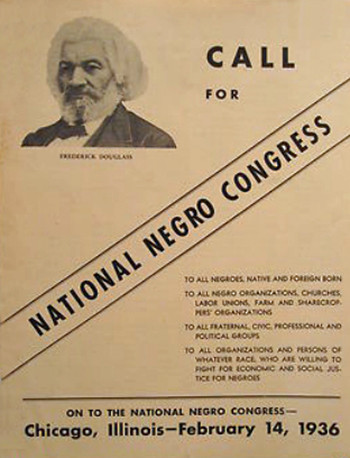
Hunton grew up in Brooklyn, his family’s refuge from racist violence in Atlanta. As professor of English literature at Howard University, he organized a faculty labor union. Anticipating the National Negro Congress (NNC), Hunton arranged for a large meeting at Howard. Anti-communists attacked him. That was in 1935.

Alphaeus Hunton addressing four thousand people at Abyssinian Baptist Church to open the famine relief campaign. Josh Lawrence, Paul Robeson, Rev. Shelton Bishop, and Adam C. Powell Sr. are seated behind the cans and bags of food. | Photographs and Prints Division, Schomburg Center for Research in Black Culture, The New York Public Library, Astor, Lenox and Tilden Foundations.

Hunton joined the U.S. Communist Party (CPUSA) in 1936. That year he organized the first national conference of the NNC, an offshoot of the Party. As suggested by historian and labor educator Tony Pecinovsky, “The CPUSA was the only organization on the left to make Africa -American equality a centerpiece of its work.” 

The central theme of Pecinovsky’s new book is Hunton’s contribution, now mostly forgotten, to ongoing resistance against economic and political oppression of Africans and African Americans alike. His internationalist perspective was exemplary.  The book, The Cancer of Colonialism, is clearly written, well-organized, and full of information. Detailed footnotes are a side-benefit. 

The book’s first section, modestly labeled “Introduction,” is a stand-alone resource. It covers intersecting historical features of the inter-war, wartime, and post-World War II periods. Figuring prominently are national liberation struggles playing out in Africa, and also in Vietnam, Indonesia, the Philippines, and Korea. The author traces the twists and turns of U.S. Communists in dealing with racism at home and independence struggles abroad.

The reader learns how the Communist International, and later the Soviet Union, stimulated, prodded, facilitated, and provided material support for national liberation struggles. The author cites the complicity of U.S. imperialism with mass murders, take-downs of newly independent governments, harassment of liberation movements, and anti-communist provocations. He touches upon the prolonged debate within the CPUSA as to whether African Americans constitute an oppressed nation.

Spreading the word  

The second section of Pecinovsky’s book tells about Hunton’s political life. From 1936 on, he organized national conventions for the NNC, edited its publications, and planned education programs. Hunton gained recognition nationwide and in Washington as a leader in opposing racial discrimination and police violence against Black people. 

With chapters in 26 cities, the NNC established the Southern Negro Youth Congress that would set up chapters in 11 southern states and recruit more than 10,000 members. Both organizations were typical of “popular front” groups promoted by the CPUSA. Joining were Communists and, according to the author, “anyone willing to fight for workers’ rights and African American equality.”  The Communist International had launched its popular-front strategy in 1935 in order to fight fascism.

Under fire from anti-communists, Hunton in 1941 was forced to testify before the House Un-American Activities (“Dies”) Committee. He resigned his professorship at Howard in 1943. The NNC merged with the CPUSA-backed Civil Rights Congress (CRC) in 1947, and disappeared. 

Alphaeus Hunton was “the administrative and intellectual mainstay” of the Council on African Affairs (CAA) between 1942, when it began, until its demise in 1955. Paul Robeson was the organization’s co-founder and chairperson and W.E.B DuBois, its vice-chairperson. According to Pecinovsky, The CAA “brought together African Americans fighting for equality with Black liberation movements in Africa while both sought allies within ascendent socialism.” Historian Gerald Horne regards the CAA as “the vanguard organization in the U.S. campaigning against colonialism.” 

Hunton was the CAA’s education director. He edited and wrote for its publications, organized events, mentored young activists, arranged for humanitarian aid deliveries to Africa, and, with Paul Robeson, was a “fixture” at the United Nations. Time and again, he returned to South Africa’s freedom movement. 

International Publishers, 2021

Anti-communist harassment was a constant. Having refused to provide federal investigators the names of donors to the CRC bail fund, Hunton went to prison for six months in 1951. Rather than turn over CAA correspondence to the government in 1955, Hunton dissolved the organization. 

Hunton in 1957 published his book Decision in Africa. He traveled to Ghana, to the Soviet Union, and to Guinea, where he taught and wrote. He moved to Ghana in 1962 to work on DuBois’s Encyclopedia Africana. A CIA-assisted coup forced Hunton to leave Ghana in 1966 for Zambia. He died there in 1970 at the age of 67.

Daily Worker

“The Cancer of Colonialism” concludes with a collection of columns Hunton wrote for the Daily Worker from July 20,1944 to January 19, 1946. A present-day reader of the columns becomes his or her own historian in tracing a transition from optimism to frustration.   

Vice President Henry Wallace is quoted as anticipating “freedom everywhere … under just and democratic principles.” Hunton applies the example of the Soviet Union to the problem of colonies. What Britain failed to do in 100 years, he notes, the USSR did in 25 years. 

Hunton expects that the United States, Britain and Soviet Union would collaborate in shaping a new world and the new United Nations. The worldwide labor movement in the works would help out.

He praises Churchill and Roosevelt’s Atlantic Charter agreement (1941) and the outcome of the Teheran and Yalta conferences in 1943 and 1945, when Stalin joined the other two.  He assumes that agreements on the right of all nations to self-government and on collaboration in securing world peace would last.

Hunton lauds conferences in 1944 at Dunbarton Oaks and Bretton Woods where new trade and financial arrangements were fashioned that, as he expected, would assure the development even of small nations. 

International Publishers, ©1965

He reports on the 1945 San Francisco conference and the agreement there on a United Nations Charter. He offers several columns on South Africa, where the job remained of “liquidating fascism.”

Now Hunton is uncertain. He sees colonialism returning to Korea, Indonesia, Malaya, and Indochina (think Vietnam). He critiques U.S. aggressiveness in demanding to exercise UN-sanctioned trusteeship over Japanese islands and the Pacific islands that had hosted allied bases. Signs crop up of U.S. anti-Soviet hostility. The Cold War is beginning.

Finally, Hunton comments on a Daily Worker article on “Leninism” by William Z. Foster. Having returned to head the CPUSA, Foster, as quoted by Hunton, mentions “dangerous illusions as to exaggerated possibilities” associated with “New Dealism” (Hunton’s term). Hunton cites “reformist illusions [that] act as, [in Foster’s words], a ‘barrier to the movement to socialism.’” 

Hunton’s world had shifted. CPUSA leaders had shared his optimism, so much so that they had taken the CPUSA out of commission – which Foster’s return had remedied. And Hunton’s expectation of continuing amity between the capitalist powers and the Soviet Union was splintering. 

Ultimately, Pecinovsky’s narrative testifies to the commanding role of anti-communism in Hunton’s political life. Pecinovsky borrows from analyst Michael Parenti to say that anti-communism is “the most powerful political force in the world.”

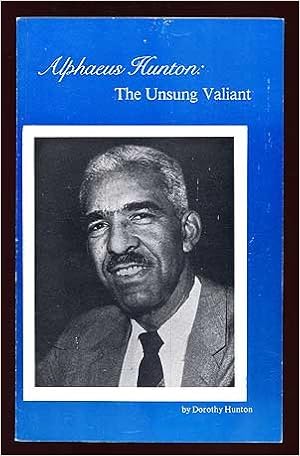
Concluding, we recognize the contribution of International Publishers for not only having presented The Cancer of Colonialism, but also for having republished Alphaeus Hunton’s 1957 book Decision in Africa and Alphaeus Hunton: The Unsung Valiant, Dorothy Hunton’s 1986 biography of her husband.

W.T. Whitney Jr. is a political journalist whose focus is on Latin America, health care, and anti-racism. A Cuba solidarity activist, he formerly worked as a pediatrician, lives in rural Maine.