The Trump circus has a logic and it’s dangerous / By W.T. Whitney Jr

South Paris, Maine


As startling and far-reaching as they are, actions taken by the Trump administration are most impressive at first glance for their circus-like quality of no central purpose. Realization dawns, however, that measures hitting at the rule of law and democracy itself and promoting war and turmoil in the wider world are so politically disastrous that by no means would they have appeared accidentally.

The idea here is that present situation reflects the U.S. government’s last-ditch response to a crisis of capitalism. If so, any useful defense against unfolding catastrophe has to center, it seems here, on what needs to be done about capitalism.

The term signifies arrangements in effect since feudalism that give full rein to ruling classes everywhere to organize economic and political affairs to their advantage. Capitalism is an evolving process that, stumbling now and then, requires adjustments to its functioning. Presently, the masters of U.S. capitalism seem to be carrying out a major fix of old and new problems that impede profit-taking. The measures being employed are disruptive.

To get the job done, capitalist decision-makers recruited the MAGA crew as agents to take on the unpleasant job, among other, of removing protections against exploitation and abuse of U.S. working people. Lower-order capitalists having reservations will probably join the project, while holding their nose.

Some basic assumptions introduce the discussion here:

· To fix what’s wrong, you look for the cause.

· Focus on impaired personalities running the show does not fully explain the turmoil triggered by the Trump government’s recent actions.

· Preexisting political rules and arrangements for how to govern did nothing to prevent the present catastrophe.

· Wide sectors of the U.S. population are silent, stunned, and without hope. They are generally unconvinced that an alternative way of doing politics exists or is possible.

· The Trump administration regards political opposition as inconvenient, irrelevant, and disposable.

· Actions of his government result from rational decision-making. They are not the products of random impulses.

Beginnings

Capitalists cross established boundaries. Beginning centuries ago in Europe, they have been plundering distant parts of the world. Along the way, they added an exploitative factory system, great industrial monopolies, and, lastly, a world system of markets, cheap labor, and plunder of natural resources.

Overcoming challenges and contradictions, capitalists took charge of faraway peoples, fought wars against rival capitalist powers, confronted socialist governments and suppressed resistance movements at home and abroad. Periodically, they had to recover from economic crashes prompted by the impossibility of impoverished workers buying goods that were produced. The point here is that capitalists are used to dealing with challenges.

Capitalists after World War I were experiencing unprecedented difficulties, and fixing them was fraught with uncertainty. European and the U.S. economies were highly unstable even before the Great Depression arrived. Plus, the Soviet Union was attending to people’s social needs, was industrializing, and was little affected by the Great Depression. A socialist alternative to the capitalists’ faltering system had abruptly asserted itself.

Many capitalists in Germany and Italy reacted by tolerating or actively supporting the fascist political parties fighting for power in each of those countries. They claimed to offer protection for capitalist economies and fightback against the Soviet menace. Their restrained U.S. counterparts accepted palliative reforms mediated through New Deal social democracy.

U.S. capitalism took on new life after World War II when the United States took charge of inserting free trade and other neoliberal policies into the world economy, over which it presided. The system allowed rich nations and their capitalists to exploit low-wage workers abroad, take advantage of poor nations’ debt dependency, and profitably extract their underground resources.

New Troubles

The good times were not so good. Beginning in the 1970s, worldwide economic growth lagged and inflationary tendencies persisted. The U.S. economy was experiencing “long-term stagnation and deindustrialization.” Financial activities and financial assets now loom larger in the U.S. economy than do commodity production and trade.

Manipulation of debt instruments misfired in 2008 leading to serious economic crisis. These adverse, long-developing realities represent one impetus for capitalist leaders to move toward extraordinary corrective measures. The Trump administration is carrying them out.

The other big element marking the current disruption of national politics would be the expected unpredictability of the Trump administration’s conduct of foreign affairs. On the theory that the administration’s major task is to shore up capitalism, it will surely be acting so as to align U.S. overseas activities with capitalist norms.

Lenin and other authorities had a lot to say about these, mainly the notion that aggressive foreign interventions are crucial for capitalism to be able to function.

U.S. imperialism, a bipartisan project, expanded after post-World War II. U.S. imperialists have carried out interventions, wars, proxy wars, and devastating economic sanctions in country after country, mostly in the Global South. These activities will undoubtedly continue under the Trump administration in order to further capitalist purposes. Random remarks on Trump’s part suggestive of easing up on this or that foreign adversary contribute only to the current volatility of political affairs.

Anti-communism had long inspired U.S. overseas adventures, but U.S. warmaking continued even after the Soviet Bloc was no more. The U.S. government and its capitalist junior partners, for example, engineered devastating regime-change operations against Yugoslavia (1999), Iraq (2003), and Libya (2011) The cover of anti-communism was gone, and antiterrorism as justification barely sufficed. Subsequent U.S. foreign interventions have represented imperialism, pure and simple.

China and a few other underdeveloped nations are now major manufacturing centers. China continues to attract significant foreign investment and is investing, building infrastructure, and extracting subsoil resources throughout the Global South, in the process outstripping the United States. The BRICS+ nations, competitive with the Global North in banking, manufacturing and science, are seeking to replace the U.S. dollar as the main international currency.

What to do

U.S. capitalists, seemingly worried about uncertainties surrounding foreign interventions and about weaknesses of the faltering neoliberal free-trade system, are on the way to building something new. The suggestion here is that Trump circus riling U.S. politics is no accident and that a new kind of capitalism is on the horizon.

Under Trump the government is assertive, aggressively nationalistic, and insulated from progressive social and political currents from abroad. The U.S. has disconnected from international agreements and international organizations, notably the 2015 Paris Climate Accord and the World Health Organization. High import tariffs are landing on goods arriving from almost everywhere, with the highest ones reserved for Chinese products.

U.S. working people are, or soon will be, coping with price hikes stemming from high tariffs; assaults on labor organizing, healthcare, schools, and universities; selective food shortages; aggravated racism; and cruel and illegal deportation proceedings. New grief is compounding earlier unmet social and economic needs.

The changes are so far-reaching that progressive reforms introduced by President Franklin Roosevelt in the 1930s are at risk of disappearing. Breakdown of the New Deal consensus would be the crown jewel of the upcoming capitalist reformation.

Almost incidentally, war preparations are a major element of the new kind of capitalism. According to Monthly Review, “[R]earmament of U.S. allies, along with a massive increase in Pentagon spending and bellicose threats directed at designated enemies, could lead to the further proliferation of conflicts, heightening the chance of a Third World War.” A “Trump nationalist imperial policy” envisions a “New Cold War on China” involving a “limited nuclear war.”

Call in the specialists

A government embarking upon such far-reaching initiatives can expect troubles ahead. Vast numbers of U.S. Americans will be experiencing grief and abuse. They may rise up, prompting the need for their suppression and for maintenance of order. A major war would require the home front to be stabilized and controlled with vigor. A special brand of governance would come into play. Specialists are available for this kind of work.

They are MAGA crew, already on the job. Following a script, they hit at the rule of law, politicize the military, prepare for war, scapegoat immigrants and the racially oppressed as internal enemies, assault institutional centers of thought –universities, government research centers, and the independent press – and rip apart the fabric of democracy. Lying and disregard for the truth are nonstop.

You may have already made the association. Another bunch of fascists thugs almost a century ago in Germany and Italy did their reordering in ways similar to those adopted by the Trump administration in our era. Measures taken in both situations are similar, as are overall purposes.

The way out

Working-class resistance becomes important. Turning back the fascists – or protofascists, call them what you will – rests on alliances created between working people and other oppressed and marginalized sectors, especially in rural areas and among the lower ranks of the middle class, the so-called petit bourgeoisie. The MAGA movement’s electoral strength depends on support from both sectors and also, crucially, from elements of the working class.

The record shows that to defeat 20th century fascism, major elements of the Communist movement pursued the popular front strategy, the idea of worldwide alliance involving all democratic forces. That recipe fits today and, besides, no alternative political formation or remedy is waiting in the wings for rescue.

Communists are familiar through study and practice with the linkage between capitalism gone awry and the origins of fascism. Giving voice to that reality may be a first step in bringing unhappy, confused malcontents into political activism, and from there into mass mobilization, which is the essential tool for defeating fascism.

Communists and socialists will be educating and organizing, and asserting their places in public life. They would interact primarily, but not exclusively, with members of the working class. Their educational message would begin with the premise that capitalists unable to solve their big problems turn to fascism for rescue. They would highlight the connection between wars and imperialism.

Loose ends remain. First, U.S. capitalists’ reliance on the fascists is old hat for their kind. Business mogul Henry Ford and Charles Lindbergh of America First fame greatly admired the Nazis. Senator Harry S. Truman in 1941, commenting on war in Europe, stated that, “If we see that Germany is winning, we ought to help Russia, and if Russia is winning, we ought to help Germany, and that way let them kill as many as possible.” His message was that in the right circumstances Nazis are OK.

Secondly, U.S. capitalists, bent upon overcoming failures in how capitalism works, easily dismiss one of the greatest failures of worldwide capitalism, that of weak response to environmental crisis that threatens to destroy humankind and the natural world.


W.T. Whitney Jr. is a political journalist whose focus is on Latin America, health care, and anti-racism. A Cuba solidarity activist, he formerly worked as a pediatrician, and lives in rural Maine.

Vietnam Is Precedent as US Prepares for War with China / By W. T. Whitney

Near Da Nang, South Vietnam, Marines move through ankle-deep mud carry their poncho-covered comrade towards higher ground were, when the weather permits, he will be air-lifted to the rear areas, Jan. 16, 1968. (AP Photo/John T. Wheeler)

South Paris, Maine


Popular struggle for national independence under socialism has regularly provoked U.S. war or hostile interventions, as with Cuba, North Korea, China, Vietnam and other nations. We explore both the extreme danger of possible U.S. war with China and also the changing U.S rationale for fighting wars. This shows in the difference between why the U.S. war in Vietnam was fought and why U.S. war with China may be on the way.   

Vietnam recently commemorated agreements reached 70 years ago in Geneva that on July 21, 1954 ended war between Vietnamese revolutionary forces and the French military, defeated two months earlier at Dien Bien Phu. According to official media, the object of a “scientific conference” held on July 19 was “to emphasize the historical importance of the agreements for the struggle for national liberation of the Vietnamese people and the peoples of the world.”

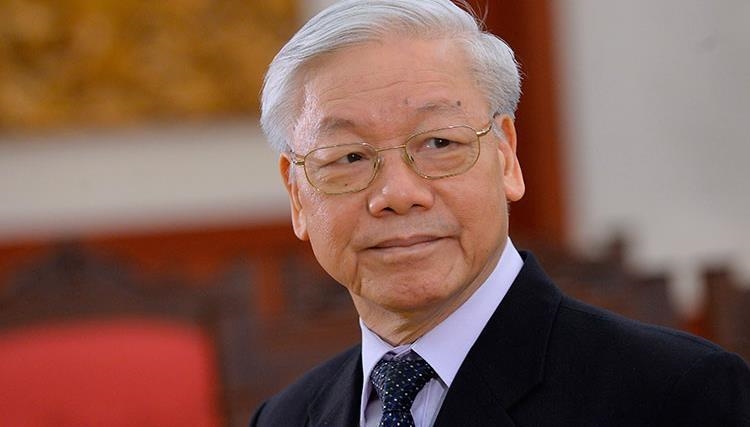
Nguyen Phu Trong | Photo: Anadolu Ajnsi

Also on July 19, Nguyen Phu Trong died. Once chairperson of the National Assembly and president of Vietnam, this paramount leader, a student and teacher of Marxist theory, had long served as general secretary of the Communist Party of Vietnam. His death is a reminder, if such is needed, that for Vietnam revolutionary socialism and national liberation were kindred struggles.

To prevent the unification of Vietnam as a socialist nation, the U.S. government went the last mile, first diplomatically and then militarily – from the 1954 Geneva agreements that established Vietnam’s national independence to the departure of defeated U.S. troops on April 30, 1975. The U.S. leadership class, involved in spreading U.S. power and influence across the globe, created and then defended South Vietnam, while attempting to defeat Vietnam’s Revolution, all at enormous human and material cost.

The enclave remaining after a U.S. victory might have ended up as a beachhead for counter-revolution and U.S. control in Southeast Asia. In their various situations, that’s the role performed by South Korea, Taiwan, and even Ukraine in relation to Russia, and Israel vis-a-vis the rest of the Middle East.

U.S. planners, in thinking about what to do about Vietnam, were not entirely devoid of reason. For U.S. imperialists, to beat back Vietnamese Communists – think “domino theory” – and heat up the Cold War against the Soviet Union had a certain logic, according to their own lights.

After the Vietnam disaster, official U.S. planning for war has built upon a variety of ostensible reasons for fighting. Having emerged from World War II well-resourced and strong, the U.S. government consistently demonstrated limited tolerance for the risings of oppressed, colonialized peoples. However, once newly formed independent states showed signs of strength, regional prominence, or even strategic rivalry, U.S. strategists turned to action.

War materialized as the ultimate U.S. fix, no matter the circumstances and under a variety of pretexts, as shown with U.S. war-making in Libya, Afghanistan, and Iraq. The rationales for fighting were more diffuse. The threat of U.S. war now looms over Iran and, more ominously, over China. Each is under the gun because they are strong, assertive states.  

Anti-communism was a safer kind of rationale. Vietnam won its “American War,” and the U.S. government backed off. That’s the story. Incidentally, the Vietnamese people scored a clear win. They live according to plans and socialist purpose in a free and independent nation.  

Vietnam has established diplomatic relations with 190 countries. A Vietnamese writer cites “important achievements with infrastructure gradually meeting the needs of industrialization and modernization.”  Since reforms in the 1980s, an economy resting mainly on foreign direct investment in manufacturing and tourism has expanded. Economic growth ranged between 9.5 and 5.5 percent between 1993 and 2022, save for sharp drops in 2020 and 2021. GDP rose 5.05 percent in 2023. By 2022, the poverty rate was down to 4.3%.

Vietnam’s government since 2008 has spent 20 percent of its budget on education. The same report mentions “high primary school completion rates, strong gender parity, low student/teacher ratios,” and school attendance rates that are high.  The British medical journal Lancet indicates that, “Along with the economic growth, the health of the Vietnamese people has significantly improved between 1990 and 2020, whereby the life expectancy grew from 69 to 75 years, and the under-five child mortality rate decreased from 30 to 21 per 1000 live births.” 

Socialist China restored dignity to the vast majority of its citizens, has afforded them decent lives, and created a well-functioning state that responds effectively to the climate crisis and other challenges. It too warrants a pass from the U.S. government.

That’s not happening: the U.S. government, in the hands of a divided leadership class, deals only haphazardly with major problems afflicting U.S. society. It satisfies the material wants of the upper echelons, and presides over war preparations as part of what is, in effect, a new Cold War.

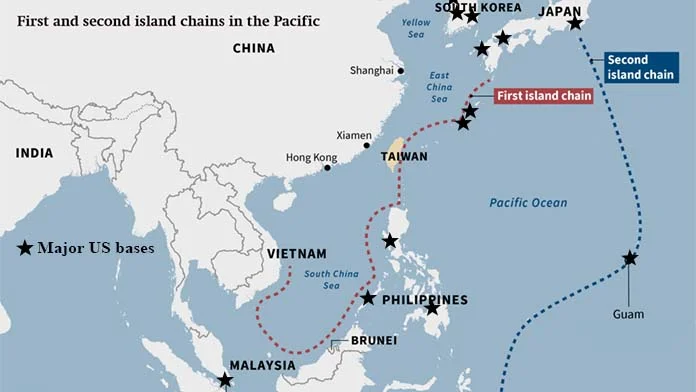
Indeed, the USA has accumulated over 750 bases in 80 countries and posted 173,000 troops in 159 counties. The U.S. share of global arms exports in 2019-23 was 42 percent, up from 34 percent during the previous four-year period, according to sipri.org.

The US has two island chains around the coast of China. The stars indicate major US bases | via solidarity.net.au

In the Pacific waters surrounding China, the United States has expanded the capabilities of its bases; it operates nuclear-equipped naval vessels, arranges for multi-national naval exercises, has vessels engaging in provocative “freedom of navigation exercises,” and will be introducing nuclear-powered submarines.

The idea of multiple and varied reasons for fighting wars, presented above, folds neatly into the overarching notion of a new Cold War, something that by nature is ambitious, far-reaching, and long term.  Where is the justification for that?

Here is a guess: The United States decades ago turned to a great variety of activities related to military preparation, financing, and recovery. These now intrude massively in the U.S.  economy and in society itself, so much so that, in theory, something has to happen to explain and justify such a state of affairs. War provides meaning, without which the whole apparatus might disappear. What then of the economy and of the collective experience of a U.S population variously oriented to the military?

The Costs of War Project of the Watson Institute of Brown University weighs in. Author Heidi Peltier points out that:

Federal spending on the military and on veterans makes up more than half of the federal discretionary budget. Employment in the federal government is dominated by civilian defense workers and uniformed military personnel. Because the majority of taxpayer dollars and federal resources are devoted to the military and military industries, and most government jobs are in the defense sector, the political power of this sector has become more deeply entrenched and other alternatives have become harder to pursue. Instead of having a federal government that addresses various national priorities … the U.S. has a government that is largely devoted to war and militarism.

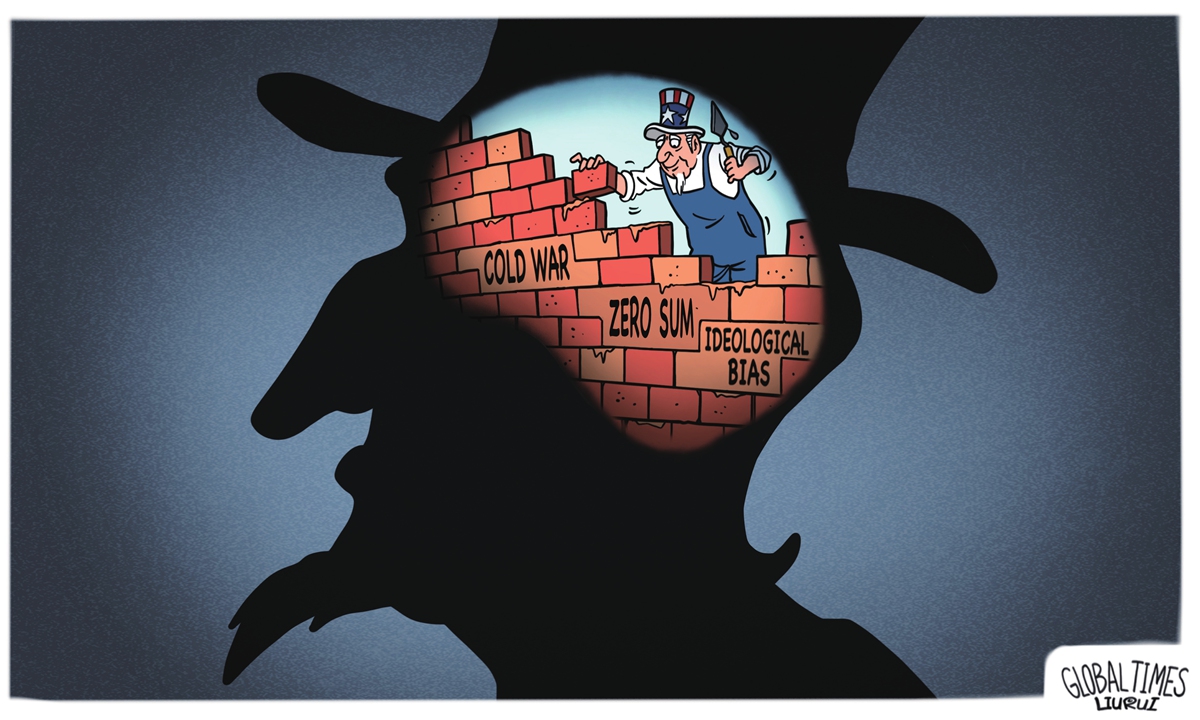
Illustration: Liu Rui/GT

Unfortunately, protecting both the U.S. economy and habituation to the military has its downside, specifically extreme danger to humanity itself. Writing in the most recent issue of Monthly Review magazine, John Bellamy Foster and Brett Clark explain, pointing to China. Discussing “Imperialism in the Indo-Pacific,” they state that:

“Most U.S. strategies for winning the New Cold War directed at China are aimed at a strategic-geopolitical defeat of the latter that would bring down Chinese President Xi Jinping and destroy the enormous prestige of the Communist Party of China, leading to regime change from within and the subordination of China to the U.S. imperium from without … (It) is the United States, which sees China’s rise as a threat to its own global preeminence, with the Indo-Pacific super-region increasingly being viewed as the pivotal site in the New Cold War, that is propelling all of humanity toward a Third World War.”


W.T. Whitney Jr. is a political journalist whose focus is on Latin America, health care, and anti-racism. A Cuba solidarity activist, he formerly worked as a pediatrician, lives in rural Maine. W.T. Whitney Jr. es un periodista político cuyo enfoque está en América Latina, la atención médica y el antirracismo. Activista solidario con Cuba, anteriormente trabajó como pediatra, vive en la zona rural de Maine.

Anticommunism in Ukraine as Gift to U.S. Interventionists / by W.T. Whitney Jr.

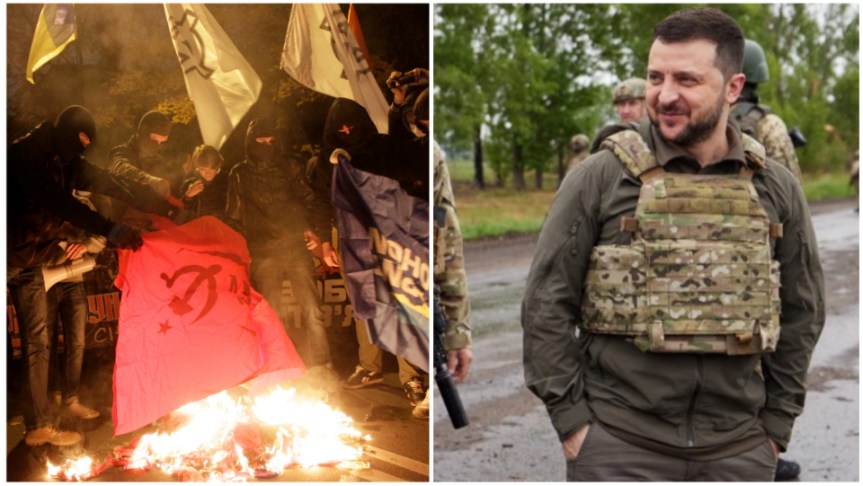
Left: Supporters of the neo-Nazi Svoboda (Freedom) Party burn the flags of the Communist Party of Ukraine and the Party of Regions of Ukraine. Right: Ukrainian President Vladimir Zelensky. | AP photos

South Paris, Maine. August 24, 2023


The arrest on August 16 of Georgi Buiko, a Communist leader, represents the latest and perhaps most significant action taken by Ukraine’s government to rid the country of the Communist Party of Ukraine (KPU). The charges, according to People’s Dispatch, referred to anti-Ukrainian activities and possession of pro-Russian and communist printed material.

Buiko, a key KPU leader, had been a youth leader within the Soviet Union’s Communist Party. Subsequently he was a Party and municipal leader in the Donbass area, secretary of the KPU’s Central Committee, member of the Ukrainian parliament, and a journalist.  Buiko heads the Anti-Fascist Committee of Ukraine.

The Communist Party of Spain condemned Buiko’s arrest and also other government attacks on the KPU. Its statement referred to the report in June from the UN’s High Commissioner for Human Rights which denounced violations of “international humanitarian law” in Ukraine along with arbitrary arrests, secret prisons, and torture.

Buiko’s arrest testifies to a definitive crackdown on Ukraine’s Communists. It began in tandem with an appeals court judgment on July 5, 2022 that confirmed a 2015 court decision declaring the KPU to be illegal. The appeals court ruling authorized the seizing of KPU properties and funds. That it quickly followed the onset of the Ukraine-Russia war on February 24, 2022 was probably not accidental.

The atmosphere turned toxic. Ukrainian President Zelensky on May 14, 2022 banned left-leaning political groups and parties and parties regarded as pro-Russian. The prohibitions did not apply to rightwing and neo-Nazi organizations.

In March of that year, the police in Kiev had already arrested the brothers Aleksander and Mikhail Kononovich on vague charges of pro-Russian attitudes. A court has been deliberating on their case intermittently ever since. The brothers have remained under house arrest for 17 months. They report having received death threats from the police.  

Mikhail Kononovich, addressing the General Assembly of the World Federation of Democratic Youth (WFDY) in Cyprus on December 3, 2019, identified and denounced a rightwing terror campaign against Communists and other opposition groups in Ukraine. Neo-Nazis had brutally attacked the Kononovich brothers a year earlier.

WFDY members have spearheaded demonstrations on their behalf in many countries, particularly in front of U.S. embassies. The Greek Communist Party has prominently defended the imprisoned brothers. 

The KPU’s impact had waned considerably even before wholesale persecution began.  Petro Symonenko, the Party’s former top leader and a prominent member of Ukraine’s Parliament, had been runner-up in presidential voting in 1999. Later, after the so-called Orange Revolution in 2004, the KPU lost most of its electoral appeal. Symonenko ended up supporting Russia in the burgeoning conflict between the two countries. In 2022, in the wake of police raids on his home, he left Ukraine for Russia.

Repression of the KPU manifested in the early stages of that conflict.  A stridently anti-Russian government took power in 2014, with U.S. assistance. Receiving U.S. material aid, Ukraine’s government initiated brutal military action against Russia-friendly separatist forces in southeastern Ukraine’s Donbass region.

Under those circumstances, KPU members experienced physical attacks and Party offices were ransacked. The government produced laws in 2015 requiring that symbols and reminders of Soviet-era Ukraine be removed and prohibiting communist advocacy. The teaching of history in schools would be altered and KGB archives would be newly accessible. 

The legislation promoted recognition of Ukrainian independence leaders extending back to World War II. The honored groups and individuals were predominately fascist in orientation, among them the nationalist leader Stephen Bandera.

Regulations announced in 2019 prohibited the KPU from participating in elections. A court that year banned the pro-communist Workers’ Newspaper (Rabochaya Gazeta), established in 1897.  The newspaper had offended by publishing articles with quotations from Marx and Lenin.

The confluence of vigorous anti-Communism showing up as Ukrainian state policy and U.S. participation in Ukraine’s war against Russia is no mere coincidence. Waging war against a powerful, well-resourced state, Ukraine needs U.S. assistance, and on that account would endeavor to please its essential ally. And the U.S. government sought to make use of Ukraine in order to cut Russia down to size for reasons presumably of global security. There was a meeting of the minds. 

It’s an arrangement that has Ukraine mounting a display of anti-communism for U.S. tastes and its ally relying on red-scare in order to shore up domestic support for its Ukrainian venture, as with past overseas interventions.

Surely Ukraine’s government was aware of its special gift on tap for the U.S. partner.  Anti-communism was the convenient pretext for the U.S. removal of Iran’s Mosaddegh government in 1953, for the CIA-staged coup in Guatemala in 1954, for discarding the Dominican Republic’s “constitutionalist” uprising in 1965, for removing Salvador Allende’s socialist government in Chile in 1973, and so on.

Foreign powerbrokers themselves have benefited from the anti-communist disposition of U.S. governments. The Cuban bourgeoisie and their heirs have relied on U.S. determination to relieve their island of a Communist revolution. Even a progressive Venezuelan government might appreciate the possible usefulness of its current assault on Venezuela’s Communist Party for persuading U.S. officials to ease their economic sanctions.


W.T. Whitney Jr. is a political journalist whose focus is on Latin America, health care, and anti-racism. A Cuba solidarity activist, he formerly worked as a pediatrician, lives in rural Maine. W.T. Whitney Jr. es un periodista político cuyo enfoque está en América Latina, la atención médica y el antirracismo. Activista solidario con Cuba, anteriormente trabajó como pediatra, vive en la zona rural de Maine.