
US General Hypes China as Threat in Latin America / By W.T. Whitney Jr.


The U.S. government has long intervened in Latin America and the Caribbean (LAC). Now the U.S. military is paying attention to China’s economic activities there. 

General Laura Richardson on March 8 reported to the Armed Services Committee of the U.S. House of Representatives on actions and needs of the Southern Command, which she heads. She has charge of all U.S. military operations in the region. 

Citing the 2022 National Security Strategy, Richardson declared that “no region impacts the United States more directly than the Western Hemisphere …. [There] autocrats are working overtime to undermine democracy.” And security there “is critical to homeland defense.”

Richardson stated that “the PRC (People’s Republic of China) has both the capability and intent to eschew international norms, advance its brand of authoritarianism, and amass power and influence at the expense of the existing and emerging democracies in our hemisphere.” The Southern Command’s “main priority … is to expose and mitigate PRC malign activity.”

She sees a “myriad of ways in which the PRC is spreading its malign influence, wielding its economic might, and conducting gray zone activities to expand its military and political access and influence.” A “grey zone,” according to the NATO-friendly Atlantic Council, is a “set of activities … [like] nefarious economic activities, influence operations, … cyberattacks, mercenary operations, assassinations, and disinformation campaigns.”

Richardson highlighted China’s trade with LAC that is heading toward “$700 billion [annually] by 2035.” The United States, in her view, will be facing intense competition and presently “its comparative trade advantage is eroding.”

She added that, “The PRC’s efforts to extract South America’s natural resources to support its own population … are conducted at the expense of our partner nations and their citizens.” And opportunities for “quality private sector investment” are disappearing.

Competition extends to space: “11 PRC-linked space facilities across five countries in this region [enable] space tracking and surveillance capabilities.” Richardson complained of “24 countries [that] have existing Chinese telecommunication infrastructure (3G/4G), increasing their potential to transition to Chinese 5G.” 

She expressed concern both about surveillance networks supplied by China that represent a “potential counterintelligence threat” and about Latin Americans going to China “to receive training on cybersecurity and military doctrine.” Richardson denounced China’s role in facilitating environmental crimes and pointed to “potential dual use for malign commercial and military activities.”

“Relationships absolutely matter,” she insisted, “and our partner democracies are desperate for assistance from the United States.” Plus, “if we’re not there in time, they … take what’s available, creating opportunities for the PRC.”

Moving beyond China, Richardson indicated that “many partner nations …  see TCOs (transnational criminal organizations) as their primary security challenge.” That’s because drug-cartel violence leads to deaths and poverty and “illicit funds exacerbate regionalcorruption, insecurity, and instability.”

Her report avoids mention of particular countries other than offering brief references to Haiti, Cuba, Nicaragua, and Venezuela. She criticized Russia for “military engagements with Venezuela and Nicaragua” and for spreading “false narratives.” Richardson praised Colombia for providing military training in other countries. 

The Southern Command gains “exponential return” on supplying various countries with U.S. weapons and supplies. It conducts joint military exercises, and “provides professional military education to personnel from 28 countries.”

Richardson reported at length on processes she sees as fostering useful relationships between her command and the various governments and military services. The tone of urgency characterizing her discussion on China was entirely lacking. 

Economic intervention

General Richardson’s view that China has greatly expanded its economic involvement with the LAC nations is on target.

Since 2005, China’s state-owned banks have arranged for 117 loans in the region worth, in all, more than $140 billion. They averaged over $10 billion annually. Since 2020, China has made fewer loans.

Chinese trade with Latin America grew from $12 billion in 2000 to $448 billion in 2021. China’s imports of “ores (42%), soybeans (16%), mineral fuels and oils (10%), meat (6%), and copper (5%)” totaled $221 billion in 2021. The value of exported manufactured goods that year was $227 billion. By 2022, China had become the biggest trading partner in four Latin American countries and the second-largest in many others.  

China’s foreign direct investment (FDI) has long represented China’s strongest economic tie to the region. FDI signifies funding of projects abroad directed at long-term impact. China’s FDI from 2005 to mid-2022 was $143 billion. Energy projects and “metals/mining” accounted for 59% and 24% of the total, respectively. Of that total, Brazil and Peru received 45% and 17%, respectively. 

The FDI flow since 2016 has averaged $4.5 billion annually; worldwide, China’s FDI has contracted.

Chinese banks and corporations have invested heavily in lithium production in Argentina, Bolivia, and Chile, which, together, account for 56% of the world’s lithium deposits. China is the largest investor in Peru’s mining sector, controlling seven large mines and owning two of Peru’s biggest copper mines. Brazil is the world’s largest recipient of Chinese investments.  

China’s government has linked FDI to its Belt and Road Initiative (BRI) that began in 2013. As of May 2022, 21 Latin American and Caribbean countries were cooperating with the BRI and 11 of them had formally joined.

On the ground

U.S. military intervention in LAC is far from new. Analyst Sergio Rodríguez Gelfenstein complements Richardson’s report with a three-part survey, accessible herehere, and here, of recent U.S. military activities in the region.

He indicates the United States now has “12 military bases in Panamá, 12 in Puerto Rico, 9 in Colombia, 8 in Perú, 3 in Honduras, 2 in Paraguay, as well as similar installations in Aruba, Costa Rica, El Salvador, Cuba (Guantánamo), and in other countries.”

Rodríguez maintains that, “levels of aggressive interference by Washington in the region have increased dramatically” and that U.S. embassies there are supplied with more military, Cuba, Nicaragua, and CIA personnel than ever before.

Rodríguez notes features of the LAC region that attract U.S. attention, among them: closeness to strategically-important Antarctica; reserves of fresh water and biodiversity in Amazonian regions; the Guarani Aquifer near the triple frontier of Brazil, Paraguay, and Argentina, the largest in the world; and huge reserves of valuable natural resources.

Among ongoing or recent U.S. military interventions are these:

·        The U.S. Army Corps of Engineers is implementing a “master plan” for navigability of the Paraguay River and Plata River Basin. The nearby Triple Frontier area supposedly harbors international terrorism and drug-trafficking.

·        The U.S. military facility in Neuquén, Argentina is turning from its alleged humanitarian mission to activities in line with local preparations for oil extraction.            

·        U.S. officials on October 13, 2022 announced that 95 military vehicles were being donated to Guatemala for drug-war activities.   

·        In Brazil in September 2022, General Richardson indicated that U.S. forces would join Brazilian counterparts to fight fires in the Amazon..

·        The Southern Command’s fostering of good relations with Peru’s military has borne fruit. Under consideration in Peru’s Congress is a proposal to authorize the entry of foreign military forces. To what nation would they belong? Hint: former CIA operative and U.S. Ambassador Lisa Kenna met with Peru’s Defense Minister the day before President Pedro Castillo was removed in a parliamentary coup on December 7, 2022.

·        In March 2023, two U.S. congresspersons proposed that U.S. troops enter Mexico to carry out drug-war operations.

·        Presently the United States is making great efforts to establish a naval base on Gorgona island off Colombia’s Pacific coast. It would be the ninth U.S. base in Colombia, a NATO “global partner.”

·        In Colombia, U.S. troops acting on behalf of NATO, are active in that country’s Amazon region supposedly to protect the environment and combat drug-trafficking.

·        The U.S. National Defense Authorization Act of December 2022 awarded the Southern Command $858 million for military operations in Ecuador.

·        In a second visit, the US Coast Guard Cutter Stone was plying Uruguayan waters in February ostensibly to train with local counterparts for search and rescue operations. The ship was also monitoring the nearby Chinese fishing fleet.

Rodríguez does not comment on U.S. interventions in Cuba, Nicaragua, and Venezuela. That’s because they’ve persisted for “more than 60, 40, and 20 years, respectively” and each requires a “special report.”

John Quincy Adams returns

Proclaiming the Monroe Doctrine 200 years ago, Secretary of State Adams informed European powers that the United States regarded “any attempt on their part to extend their system to any portion of this hemisphere as dangerous to our peace and safety.”

General Richardson would apply the warning of that era to the PRC. Yet signs of hegemonic aspirations from that quarter are absent.

Commenting recently, Argentinian economist and academician Claudio Katz notes that, “China concentrates its forces in the economic arena while avoiding confrontations at the political or military level … Investments are not accompanied by troops and bases, useful for guaranteeing return on investments.”

Besides, China “does business with all governments, without regard to their internal politics.” That tendency, Katz writes, stems from the PRC having “arisen from a socialist experience, having hybrid characteristics, and not completing a passage to capitalism.” He maintains that China, with its economic involvement, contributes nothing to advancing socialism in the region.   


W.T. Whitney Jr. is a political journalist whose focus is on Latin America, health care, and anti-racism. A Cuba solidarity activist, he formerly worked as a pediatrician, lives in rural Maine. W.T. Whitney Jr. es un periodista político cuyo enfoque está en América Latina, la atención médica y el antirracismo. Activista solidario con Cuba, anteriormente trabajó como pediatra, vive en la zona rural de Maine.
CELAC Summit Offers Proposals, amid Divisions and Dissent / By W. T. Whitney Jr.

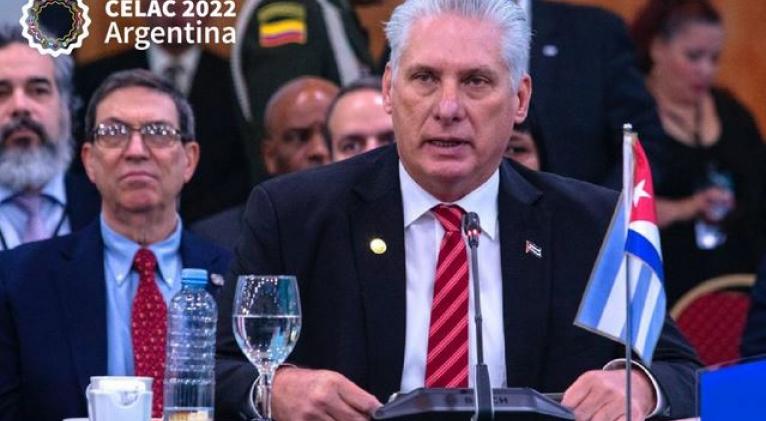
Cuban president denounces US interference at Celac Summit | Prensa Latina, 01.24.23

The 7th Summit Meeting of the Community of Latin and America States (CELAC) took place in Buenos Aires, Argentina on January 23. In their Declaration, representatives of 33 member nations, including 14 presidents, paid  homage to integration, unity, and  “political economic, social, and cultural diversity among member states.” They agreed “by consensus” to an all-embracing set of proposals and statements, 100 in all, and to 11 “special statements” on the situations of particular countries.

As is usual, host-country president Alberto Fernández made arrangements and set the agenda. The one-day meeting included closed- door discussions and brief presentations by representatives of the various country.

Participants at CELAC’s founding meeting in Caracas in 2013 declared  the region to be a “zone of peace.”  CELAC, it was hoped, would be promoting regional cooperation on social and economic development, agreement on common political goals, and progress toward integration and unity.

Preparations had begun in 2010 after U.S. interventions in Venezuela, Bolivia, Ecuador, Cuba, and other countries had intensified. CELAC would differ from Organization of American States (OAS), the regional organization serving U.S. interests since 1948. The United States and Canada are not members of CELAC. 

A gap separated the fifth CELAC Summit in 2017, in the Dominican Republic, from the sixth one, on September 16-18, 2021 in Mexico City. Instability in Venezuela, Bolivia, and Brazil was a likely factor.  Mexican President Andres Manuel Lopez Obrador (AMLO), presiding over CELAC VI, spoke of CELAC as the regional equivalent of the European Union. There was speculation about CELAC replacing the OAS. 

Brazilian President Luiz Inácio “Lula” Da Silva’s arrival at CELAC VII generated excitement. Brazil had rejoined CELEC after being removed by Former President Jair Bolsonaro in 2020. Lula supports closer ties of both CELAC and the Mercosur economic organization with the European Union.

In Buenos Aires, rightwing demonstrators from Argentina and elsewhere were noisily protesting against CELAC. They objected to the presence of leftist countries like Venezuela, Cuba, and Nicaragua. To avoid confrontation, Venezuelan President Nicolas Maduro and President Daniel Ortega of Nicaragua stayed away. AMLO also did not attend, claiming he was busy.

Crisis in Peru provoked divisions.  The Declaration was silent on the coup there and on repression of popular resistance. Colombian president Gustavo Petro, President Xiomara Castro of Honduras, and AMLO, in a video presentation, called for deposed President Pedro Castillo’s release from prison. Presidents Fernández of Argentina and Boric of Chile said nothing on that score. 

CELAC did not respond to Prime Minister Ariel Henry’s requests for  member states to “participate in a specialized multinational force requested by Haiti” to deal with gang warfare.

President Fernández, surprisingly, had invited U.S. President Biden, who sent former Senator Chris Dodd in his stead. Dodd spoke at the plenary session, as did European Council President Charles Michel.  President Droupadi Murmu of India participated virtually. Chinese President Xi Jinping sent a message of solidarity.

The Summit Declaration says little about implementing proposals and realization of earlier plans.  It refers to expected actions by United Nations agencies and by regional organizations with special experience and expertise.

The only CELAC actions mentioned are recent meetings of ministers of CELAC countries with international agencies dealing with healthcare and food-supply issues. The only CELAC initiatives underway soon are meetings of CELAC representatives with officials of the European Union, China, the African Union, and the ASEAN nations.

The website celacinternational.org mentions far-reaching plans as of 2013 for transportation, healthcare, and hunger-alleviation projects. A subsequent lack of follow-up information and references to other projects suggests flawed implementation.

Speaking at the Summit, Colombian President Gustavo Petro called for “building integration through concrete projects” and for action on the climate crisis, revitalizing the Amazonian forests particularly. He denounced “U.S. deficiencies in moving toward a carbon-free economy.” 

President Miguel Díaz-Canel of Cuba reminded his listeners of U.S. “efforts to divide us, stigmatize us and subordinate us to its interests.” The United States is isolated, he suggested, in its “strategy of hegemony and domination.”  And Cuba’s inclusion on the U.S. list of states that sponsor terrorism greatly impedes “our aspirations for development.

On video, President Maduro of Venezuela called upon CELAC to demand that the United States no longer intervene in the affairs of “free and sovereign nations” and “No more coup-plotting, no more sanctions against sovereign nations.” 

Uruguayan President Luis Lacalle, dissenting, charged that, “there are clearly countries here … that do not respect institutions, democracy or human rights.” He has drawn criticism for his push for a regional free trade zone and a Uruguayan -Chinese trade agreement. 

Speaking for El Salvador, Vice President Félix Ulloa urged CELAC to take on an executive secretary to preserve the alliance’s “institutional memory.” 

A CELAC “social summit” took place in Buenos Aires on the day prior to CELAC VII. Present were Argentinian trade unionists and leftist political parties and political leaders and activists from many countries. Former Bolivian President Evo Morales headed a panel of speakers.

Participants demonstrated outside the actual Summit against the rightwing protesters and “in support of our anti-imperialist presidents.”  Returning later, they demanded support for Peruvians’ resistance and called for non-recognition of the coup government. 

U.S. imperialism remained the perennial CELAC theme. Asked about U.S. designs on the region’s natural resources, Bolivian President Luis Arce was forthright: “[T]hese are our natural resources … We are not going to accept any imposition by anybody nor let anyone regard our natural resources as if it were theirs.”   

General Laura Richardson’s remarks before the Atlantic Council on January 19 had prompted the question. She is head of the U.S. Southern Command.

The next CELAC summit meeting will occur in Saint Vincent and the Grenadines, population 104,000 and the first Anglophone site for a CELAC meeting. Prime Minister Ralph Gon­salves will be presiding.


W.T. Whitney Jr. is a political journalist whose focus is on Latin America, health care, and anti-racism. A Cuba solidarity activist, he formerly worked as a pediatrician, lives in rural Maine. W.T. Whitney Jr. es un periodista político cuyo enfoque está en América Latina, la atención médica y el antirracismo. Activista solidario con Cuba, anteriormente trabajó como pediatra, vive en la zona rural de Maine.

Peru Sees Possible Transformative Change, and US Intervention / By W.T. Whitney Jr.

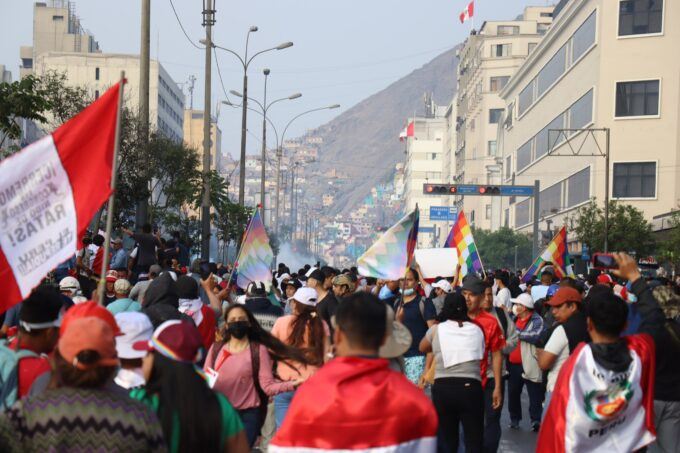
Photograph Source: Mayimbú – CC BY-SA 4.0


Critics of U.S. interference in Latin America and the Caribbean may soon realize, is such is not the case now, that Peru has a compelling claim on their attention. The massive popular resistance emerging now amid political crisis looks to be sustainable into the future. Meanwhile, a reactionary political class obstinately defends its privileges, and the U.S. government is aroused.

This new mobilization of Peru’s long-oppressed majority population manifested initially as the force behind left-leaning presidential candidate Pedro Castillo’s surprise second-round election victory on June 6, 2021. It exploded again following the coup that removed Castillo on December 7, 2022.

The politically inexperienced Castillo, a primary school teacher and teachers’ union leader in rural northern Peru, espoused a program of resisting both Peru’s corrupt and oligarchical elite and foreign exploiters.  Castillo had begun his 2020 presidential campaign prior to aligning with a political party.  His affiliation eventually would the Marxist-oriented Peru Libre (Free Peru) Party, which abandoned him during his presidency.  

Castillo was the first leftist to be elected president of Peru. The candidate he defeated was Keiko Fijimoro, standard-bearer of Peru’s oligarchs and militarists and daughter of dictator and former president Alberto Fujimori.

Castillo’s forced removal from office prompted massive popular resistance.  Since then, small farmers, indigenous communities, social organizations, students, and labor unions have sustained a national strike. Concentrated in Peru’s southern provinces at first, and later spreading throughout northern regions, strikers have been blocking highways, city streets, and access to government offices and airports. 

In their “March from the Four Corners” of Peru, protesters on January 19 occupied Lima massively in what they called the “Taking of Lima.” They have filled streets and plazas, marched, and impeded access to government offices. They say they will stay. Lima residents and social movements have stocked food for them and, with the help of schools and universities, provided shelter.

Anthropologist Elmer Torrejón Pizarro, from Amazonian Peru, was marching on January 19. He writes: “I saw no criminals next to me, much less terrorists. I observed young university students and mostly peasants, women and men from the south. I saw their faces, furrowed by the pain of life and death. They were next to me, their faces hard and burned by blows from life, from Peru. They were faces expressing generational hibernation of a country that, as a state, has failed.”

The protesters are demanding: resignation of de-facto president Dina Boluarte, liberation of the imprisoned Pedro Castillo, and dismissal of a Congress dominated by rightwing and centrist political operatives. They want new elections in 2023 and a popular referendum on instituting a Constituent Assembly. They, like Castillo, want a new Constitution.

Left-oriented news sources haven’t reported reactions to the strike from Peru’s leftist political parties. The few websites of those parties that are accessible add little.  The Communist Party of Peru Patria Roja, an exception, on January 16 condemned the coup government as a dictatorship, called for a transitional government, and expressed support for the demands outlined above.   

Popular resistance is one aspect of this crisis situation. The other is political repression. For weeks, the police and the military have been assaulting protesters throughout the country with lethal force. They have killed over 60 of them, wounded hundreds and jailed hundreds more.

In Lima on January 21, almost 12,000 police were in the streets blocking demonstrations and harassing residents and students; 14,000 more were otherwise engaged. The police that day violated a university autonomy law and entered San Marcos University where they arrested strikers sheltering there and students, over 200 in all.

The security forces and their handlers are heirs to repressors who, from Spanish colonization on, have repeatedly victimized masses of impoverished, mostly indigenous Peruvians.  Peru experienced three prolonged military dictatorships during the 20th century.

In dealing with Castillo and the threat he represented, forces of reaction turned to softer methods. These centered on congressional maneuvering aimed at harassing Castillo’s ministers and blocking his government’s program.

Finally, the Congress demanded that Castillo resign, and immediately soldiers seized the president. He was charged with “rebellion and conspiracy” and will remain in prison for at least 18 months.  He is held incommunicado.

Interviewed, Wilfredo Robles Rivera, the deposed president’s lawyer, spoke of a “parliamentary coup, a slow coup, a prolonged one organized on several fronts.” He explains that, “It was a strategy that began even before President Castillo took office. The rightwing … was pressuring election officials to recognize electoral fraud. An electoral coup, therefore. The true parliamentary coup began when Castillo became president.”

An earlier article by the present author elaborates on this terminal phase of Castillo’s downfall. Robles Rivera’s perspective appears in one of the addenda below.

Lastly, there is that aspect of Peru’s mounting crisis that relates to North Americans: U.S. intervention is possible. 

General Laura Richardson, head of the U.S. Southern Command, spoke to the establishment-oriented Atlantic Council on January 19. In regard to Latin America, she mentioned “rare earth elements,” “the lithium triangle – Argentina, Bolivia, Chile,” the “largest oil reserves [and] light, sweet crude discovered off Guyana,” Venezuela’s “oil, copper, gold” and “31% of the world’s fresh water in this region.”  She concludes, crucially: “This region matters. It has a lot to do with national security. And we need to step up our game.”

On January 18, de facto President  Dina Boluarte and her Council of Ministers informed Peru’s Congress that they were submitting for approval a draft legislative resolution saying, in effect, that Congress would be “authorizing the entry of naval units and foreign military personnel with weapons of war” into Peru.

Who but U.S. troops and military machinery would be first in line? The U.S. military is already familiar with deploying in Peru.  And the day prior to Castillo’s removal from office. U.S. ambassador Lisa Kenna, a CIA veteran, was in the office of Peru’s defense minister, conferring.  

She is persistent. On January 18 Kenna conferred with Peru’s minister of energy and mining and his associates. Journalist Ben Norton attests to that minister tweeting about “a high-level institutional dialogue that day between Peru and the United States.” The minister expressed pleasure at “support from the North American government in mining-energy issues” and mentioned his government’s prioritization of the natural gas and energy sectors.

Presently all liquified natural gas produced in Peru goes to Europe. Energy supplies there are precarious due to U.S. anti-Russian sanctions. We imagine U.S. applause.

The author did the translating above and below.


Addenda:

Lawyer Wilfredo Robles Rivera describes some of the congressional maneuvering that led to President Pedro Castillo’s removal.

“Obstructionists in the Congress prevented that body from discussing hundreds of the [Castillo] government’s legislative proposals …They followed with demands for dismissing the president through the vacancy procedure. …Their request for vacancy came in response to the President’s speech of December 7 in which he called for dissolution of Congress. They did not have the necessary votes to present the request … [and so] there was an accelerated process backed by other institutions, especially the military and police. At this point, the military-police coup comes into play.”

We add that Peru’s Constitution, in force since 1993 and a product of the Fujimori dictatorship, does allow a president to dismiss the Congress under specified circumstances and the Congress to “request a vacancy” in order to remove a president. Twice before, the Congress failed in that attempt.

Héctor Béjar offers reflections. His interview with  Prensa Latina reporter Manuel Robles Sosa appeared on January 18.   [WW1]  

Béjar served for three weeks as minister of foreign affairs in ex-President Castillo’s new government. He resigned in response to unfounded charges from the military conveyed through Parliament. Béjar has taught and written extensively on revolutionary change in Peru. He and others founded the National Liberation Army in 1962 for which he was imprisoned.

Prensa Latina: How do you evaluate the protest movement forming in the South of Peru?

Héctor Béjar: It’s a many-faceted movement composed of the quechua and aimaras communities, especially the aimaras, of women vendors in the popular markets, of transport workers in the South, traders in general, small business owners in the booming city of Juliaca, students from universities and high schools, and people in general. Added to them are the “rondas campesinas” (autonomous peasant patrols in rural areas) active in Cajamarca, Amazonian communities, and within many other popular networks.

PL: The social organizations that are protesting are putting forth a platform of political demands … without being ready to back off in exchange for development projects. What are the implications of this characteristic of the current protests for the people’s movement?

HB: It’s a qualitative shift. It’s the first time in Peruvian history that a movement surging up from the people themselves is setting forth a clearly political agenda that takes precedence over immediate, isolated demands limited to local problems. 

PL: What about ex-President Pedro Castillo? 

HB: The protesters identify with him as a person, as a teacher and rural resident, quite apart from his questionable performance in governing. … I have to say also that the movement has already largely transcended the idea of simply rescuing Castillo.

PL:  Most political analysts assert that the failure of Castillo has been harmful for the left and its future. Do the social protests and participation of left forces call this idea into question?

HB: The big movement we are speaking about must not be defined as of the left. If we look at reality, it’s a people’s movement, from the base, much broader than left politics. It’s also certain that most militants of the different left movements existing in Peru are fully invested in supporting this movement.

PL: Opinion polls show that the demand for a constituent assembly is shared by a majority of the population. That has to have an impact on the protests. (NB: Opinion polling in mid-January indicated that 71 % of Peruvians reject the government; 19% approve; 88% of them object to the Congress. )

HB: Evidently so. We are already in the process of getting rid of the old system and the constituent is part of a new one. The most probable outcome is that as the days and weeks pass, and if this movement persists and grows, the demand of a constituent assembly and a new constitution will continue growing until it takes over.

PL: What is the future and what are the options that might open up after this struggle?

HB: If this struggle continues and is not betrayed … we would have the possibility of a true democracy open to all of the country’s cultures and nationalities – a social state and an economy open to investments by the people and closed to every kind of corruption ….

Lautaro Rivara’s interview with Héctor Béjar for the alai.info website appeared on January 3. Excerpts from  Béjar’s comments follow:

On Peru’s 1993 Constitution: It’s the bad result of a disastrous coup d’état and of entangled negotiations of de facto President Fujimori with the OAS and the international community. This resulted in a text full of legal patchwork…It also contains a famous economic chapter that shields foreign investment, making it invulnerable and paying no taxes in Peru. … What is happening is that this Constitution, already makeshift in 1993, has been patched up repeatedly since then. And it was the present Congress … that has made more than thirty modifications that Peruvians do not even know about. Some of these modifications repealed existing rights, such as the right to referendum.

In regard to a coup: The Army and Police know that they cannot carry out a coup d’état directly; there is no environment either in Latin America or the world that favors that. But as everybody knows, the patterns of coups now vary … Some military chief leaked information to the effect that the left will never govern the country while armed forces remain in Peru. The problem is no longer communism, which is what they used to say, but now it’s the entire left that these people are rejecting.

How does Peru’s government work? Today in Peru we have a media party, very active as a concentrated monopoly; a prosecution party, and the judiciary’s party. These three parties, and the Congress, are the four great actors that govern Peru, with support from big capitalists, both local and foreign … Closing the Congress is a national demand. Everyone wants that, apart from the congresspersons themselves. …. The same goes for the judiciary, which is highly corrupt. In my opinion, it should be reorganized, but also totally dismantled.

About Peru’s social movements: They have grown a lot. In Peru there is a political left, which is part of the political apparatus, the political system, and there is a co-called “social left”, which is not left in terms of strict political consciousness, but which includes many social activists who feel they are part of the left. They are very articulate in expressing political ideas … and have highly articulated political ideas. There are thousands of them in Peru now. However, corruption permeates everything in this country, including sectors of the social movement.


W.T. Whitney Jr. is a political journalist whose focus is on Latin America, health care, and anti-racism. A Cuba solidarity activist, he formerly worked as a pediatrician, lives in rural Maine. W.T. Whitney Jr. es un periodista político cuyo enfoque está en América Latina, la atención médica y el antirracismo. Activista solidario con Cuba, anteriormente trabajó como pediatra, vive en la zona rural de Maine.