US Intervenes as Indigenous Guatemalans Back President-elect Arévalo / By W. T. Whitney Jr.

Image: Los Angeles Times

South Paris, Maine


Bernardo Arévalo’s victory in first round of presidential voting on June 25 surprised Guatemalans, as did the emergence of his Seed (Semilla) political party. Roadblocks engineered by established political forces threatened his candidacy in the second round of voting, on August 20, and now may keep him from taking office, on January 14, 2024.  

Arévalo and the Seed Party seek to remove corruption from Guatemalan politics. They and others oppose “the Pact of the Corrupt,” individuals with criminal associations that for decades, they say, have occupied all levels of government, national and local. They are, “former military people …sophisticated businessmen, judicial functionaries, legislators, mayors, communications people, bankers, and liberal professionals, the facilitators of business deals worth millions.”

From shortly after Arévalo’s first-round victory until now, their operatives in the government of outgoing President Alejandro Giamattei have alleged voter fraud. The attorney general, a couple of prosecutors, and a few judges of the Supreme Court of Justice and Constitutional Court have forced the Supreme Electoral Tribunal to take measures that would prevent Arévalo from becoming president.

It decreed that ballot boxes be seized and the Seed Party no longer qualify as a political party. It voided the election of congressional deputies.  President Giamattei has rejected widespread demands that Attorney General Consuelo Porras, the offending prosecutors, and a couple of judges be dismissed.

Another surprise was on the way. A national strike of indigenous peoples erupted on October 2. For one commentator, this represented “the discovery of a forgotten and marginalized country, that didn’t exist in the national imagination … [and].came from the provinces, where the Seed Party, with its basically urban and middle-class origins, did not exist.”

Sit-ins and blockades of highways spread nationwide, peaking at 130 or more. Up to 60% of Guatemala’s commerce halted. Schools, colleges, and some local government offices closed. The demands were: no more corruption, remove Attorney General Porras, and Arévalo will become president on January 14.

Indigenous leaders referred to as the “48 Cantons of Totonicapán” had called the strike. They and indigenous officials nationwide were in charge.  Guatemala’s European-descended leadership class had bestowed administrative authority on the “48 Cantons” in the 19th century. Now, somehow, they seem to set the course for indigenous authorities in municipalities nationwide. 

News reports cite the “Ancestral Indigenous Authorities” as representing indigenous participation in Guatemalan politics. The Accord on the Identity and Rights of Indigenous Peoples, formulated in 1995, had enabled such.  It was part of the Peace Agreement that ended decades of armed conflict during which some 200,000 people died, most of them indigenous.

Partisans of the current strike staged a rally in Guatemala City on October 20 to mark the 79th anniversary of Guatemala’s “October Revolution.” On that day in 1944, a three-person “revolutionary junta” replaced the long dictatorship of Jorge Ubico.  Voters in 1945 elected Juan José Arévalo, father of Bernardo, as president and Guatemala experienced its so-called “Democratic Spring,” which ended in 1954 thanks to a CIA-instigated coup.

Bernardo Arévalo spoke at the rally on October 20:

“The ancestral authorities have opened the way to students, community leaders, professionals, unions, … business leaders. … Look around. We are located in the center of citizens’ life in the country. The legacy of the October Revolution of 1944 is before our eyes. The Guatemalan Institute of Social Security is an instrument of solidarity… and source of tranquility for many families … [and the] Bank of Guatemala guarantees economic stability and supports … an economy whose benefits extend to everyone.”

In Guatemala, however, the poverty rate was 59% in 2020, 80% in rural areas; half of the population have limited access to food. That the average adult income in 2022 was $13,412 testifies to a well-resourced sector of the population. Indeed, 10% of Guatemalans owned 61.7% of the nation’s wealth in 2021.

Journalist Víctor Ferrigno points out the limited ambitions of the national strike: its indigenous leaders claim not to represent a political party but merely to be defending democracy and opposing corruption. Analyst  Ollantay Itzamná adds that Guatemala’s government will emerge unscathed and will “certainly continue being racist and lethal for indigenous peoples.”

He argues elsewhere that the Seed Party, attentive mostly to the urban middle class, is responding to concerns that the government, a big source of employment, might disintegrate because of corruption, racist though it may be.

The U.S. government backs Arévalo, the Seed Party, and the campaign against political corruption. Itzamná points out that USAID finances projects of the 48 Cantons and of NGOs siding with the Seed Party.  Indigenous leadership groups in Guatemala have gained U.S. trust, he indicates, by not “questioning the racist nature of the state or disputing the power of the rich.”

The U.S. government, he explains, is willing to “try out a progressive government in Guatemala as long as it is obedient to U.S. interests.” That government now gains U.S. favor by accepting an indigenous mobilization that serves to “hide the emergence of the pluri-national, anti-neoliberal, or anti-imperialist social subjects that do exist in Guatemala.” Radical indigenous movements, such as the ones active in Peru and especially Bolivia, are to be squelched.  

One would be Committee of Campesino Development (CODECA), formed in 1992 as a “class-based organization” defending farm workers. CODECA announced its own national strike to begin on September 19. Demands were those of the current strike with the addition of a “people’s and pluri-national constituent assembly.”

Calling for a constituent assembly and basic change, Thelma Cabrera, presidential candidate of CODECA’s political party,The Movement for Liberation of the Peoples, won 456,114 votes, or fourth place, in the 2019 elections.   She was ranking in fourth place in 2023, according to opinion polls, when the Supreme Electoral Tribunal rejected her candidacy.

In an interview on February 19, 2023, Mauro Vay Gonón, the CODECA founder, recalled that “state terrorism, mainly at the hands of Guatemala’s military, had cost the lives of 25 CODECA activists.”  Tereso Cárcamo, killed on December 5, 2022, had taken part “in different peasant struggles such as the Popular and Pluri-national Constituent Assembly process.”

Vay Gonón, a guerrilla insurgent during the armed conflict, lamented that, “The entire Peace Agreement” [of 1996] is for nothing. They are walking all over it. This is a sad truth for the Guatemalans, because we sincerely don’t want to go back to a war.”


W.T. Whitney Jr. is a political journalist whose focus is on Latin America, health care, and anti-racism. A Cuba solidarity activist, he formerly worked as a pediatrician, lives in rural Maine. W.T. Whitney Jr. es un periodista político cuyo enfoque está en América Latina, la atención médica y el antirracismo. Activista solidario con Cuba, anteriormente trabajó como pediatra, vive en la zona rural de Maine.
US Has a Favorite in Tumultuous Elections in Guatemala / By W. T. Whitney Jr.

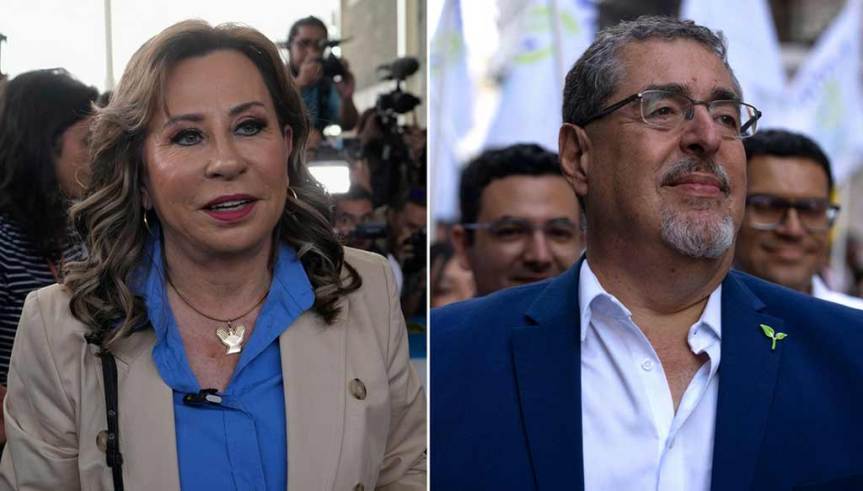
Sandra Torres of the center-right National Unity of Hope (UNE) party and Bernardo Arévalo of the center-left Semilla Movement party will face off in the second round of presidential elections in Guatemala on August 20. (Photo: Prensa Latina)

South Paris, Maine


Bernardo Arévalo scored a big surprise in first-round presidential voting in Guatemala on June 25. Prior to the vote, Arévalo, candidate of the Seed Movement political party had been lagging badly in opinion polls. But he went on to secure 11.8% of the vote, second place behind the 15.8% tally for Sandra Torres of the National Unity for Hope Party (UNE). Second-round voting takes place on August 20, possibly.

The Seed Party quadrupled its congressional delegation to become the third largest with 23 delegates. That party formed in 2015 with a mission of fighting corruption. Critics refer to political forces associated with Guatemala’s last three presidents, including incumbent President Alejandro Giammattei, as the “Pact of the Corrupt.”

Conservative politicians “together with the evangelical churches” campaigned vigorously against Arévalo, “presenting him as a leftist extremist.” Unnerved by his unexpected success, those forces took vigorous action.

The UNE and eight other political parties complained. On July 8 Guatemala’s Constitutional Court (CC), backed by the Supreme Judicial Court, ordered the country’s Supreme Electoral Tribunal (TSE) to suspend certification of the results pending a recount.

When it was completed on July 12, the CC authorized the TSE to certify. But Fredy Orellana, a judge with the so-called Seventh Instance Court, then authorized the Special Prosecutor against Corruption to invalidate the “judicial personhood” of the Seed Party, the effect being to prevent the Party from competing for votes.

Looking for evidence of alleged voter fraud, agents of various agencies carried out intrusive searches at the Seed Party headquarters and TSE offices.

The TSE on July 21 announced it was seeking CC protection from the “imminent threat” against democracy and the electoral process posed by various government ministries and particularly the Public Ministry, in charge of criminal investigations and prosecution.

Almost simultaneously, the CC reiterated that the Seed Party was provisionally protected and that the TSE must allow it to compete in the elections on August 20. Even so, “harassing, intimidating, pressuring and blocking of the electoral process” continued.

Condemning the shenanigans were the Catholic Church, social movements and even business sectors. Electoral observers from the European Union weighed in as did the Organization of American States and its Inter-American Commission on Human Rights. The OAS generally aligns with U.S. purposes. Indeed, Brian Nichols of the U.S. State Department twittered that we “look forward to the Aug 20 vote on the announced top two presidential candidates.”

Congresspersons Raúl Grijalva, Norma Torres, James McGovern and Eleonor Holmes Norton often oppose State Department positions on Latin America, but on July 21 they wrote to Secretary of State Blinken, urging him to pressure Guatemala’s government to allow second-round voting to proceed.

By implicitly supporting Bernardo Arévalo, the U.S. government seems to have reversed course to the extent that it was now speaking up for progressive political leadership ─ far from its usual practice as regards Latin America. Given its long immersion in Guatemalan affairs, however, U.S. actions there probably are coherent, if not always just or legal. The United States has recently applied economics sanctions to Guatemalans accused of political corruption. The Defense Department now and then supplies Guatemala’s security forces with military equipment. In October, 2022 military vehicles worth $4.4 million were donated, supposedly for use against drug-trafficking and for control of migrants. Over many years, the U.S. and Guatemalan militaries have carried out joint exercises.

Really, U.S. intervention is part of Guatemala’s DNA. Cuban investigator Hedelberto López Blanch states that: Before World War II, “Guatemala was in the hands of a few big landowners and U.S. companies… Workers were reduced to conditions of semi-slavery … The government of Jacobo Arbenz tried to change this political, economic and social system, but in June 1954 he was overthrown by the intervention of the CIA and large U.S. landowning companies.”

For 34 years ending in 1996, the U.S. government ─ the CIA in particular ─ was a constant presence. This was a time of rural insurgency, war against indigenous peoples, and 200,000 deaths. Analyst Marc Weisbrot explained in 1999: “[O]ur government had extensive and up-to-date knowledge of massacres and other atrocities, while they maintained a close working relationship with the Guatemalan military at all levels. The United States supplied weapons, training, and other aid to the military …  Through some of the worst periods of killings, our government provided crucial political support.”

Seed Party candidate Bernardo Arévalo has coexisted with U.S. interference for a lifetime. He was abroad during his youth after his father, President Juan José Arévalo, went into exile due to the U.S.- assisted 1954 coup. He served Guatemala’s government as a diplomat and mainstay in the Ministry of Foreign Affairs in the closing years of the civil war. He later taught in the United States and worked at the federally-funded United States Institute of Peace.

That the Seed Movement represents a new kind of rightwing politics for Guatemala, as suggested by commentator Félix Alvarado, may appeal to the U.S. government. In power, Arévalo supposedly would embrace business competition, be less corrupt, and not be beholden to rabid anti- communists and evangelicals.

In a recent interview Arévalo spoke about governing: to deal with corruption, one needs “a process of convergence of social forces” and “recuperation of institutions.” As regards poverty: “The government can’t help everyone but we can begin to create policies for the medium and long term.” As regards “backwardness, discrimination, and racism … we are setting the foundation for the beginning of a process in which institutions begin to function and serve the common good.”

For the U.S. government, Arévalo’s evident deliberation, caution, and limited expectations identify him as an entirely safe would-be Guatemalan president. But a time of testing, a social explosion, is at hand. Maybe for U.S. purposes, Arévalo would be the right president to ward it off, or deal with it.

Numbers speak: 260, number of millionaires; $95 billion GDP, highest in Central America; 47%, rate of undernutrition among under-age-five children (6th highest in the world); 61.6 %, rate of persons living in multidimensional poverty. Also, 2.5% of farms use 65% of the agricultural land, 45% of Guatemalans are indigenous, 79% of the indigenous live in poverty, 80% of rural people are indigenous and Guatemala’s human development index ranks 127th out of 189 counties.

In the recent first-round voting, 17% of the ballots were left blank, and 40% of eligible voters abstained. Non-participation surely points to social and political exclusion ─ of Guatemala’s indigenous people in particular. They don’t figure into current media reports on election difficulties, but they are the fuse for a potential social explosion.

The reflections of Silvel Elías appearing March 1, 2023 on debatesindigenas.org make this point: “The colonialist obsession of the Guatemalan State is evident in …setbacks in human rights and indigenous rights, denial of indigenous demands; violent repression … the granting of extractive licenses on ancestral territories, and practices of structural racism and social and political exclusion.

“Inequality continues to deepen … There are no laws, public policies or targeted programs that serve indigenous peoples. “Although indigenous Guatemalans represent 45 percent of the population, their representation in the Congress has never exceeded 10 percent. Indigenous people there don’t represent indigenous interests, but rather those of the traditional political parties that nominate them.”

U.S. government probably takes the region’s history into consideration as it deals with elections in Guatemala. The mix of extreme poverty, indigenous uprising and rebellion in Bolivia and Peru is a warning.


W.T. Whitney Jr. is a political journalist whose focus is on Latin America, health care, and anti-racism. A Cuba solidarity activist, he formerly worked as a pediatrician, lives in rural Maine. W.T. Whitney Jr. es un periodista político cuyo enfoque está en América Latina, la atención médica y el antirracismo. Activista solidario con Cuba, anteriormente trabajó como pediatra, vive en la zona rural de Maine.