
Enlightened Working People Expect a Lot from Their Political Party: Reply to Brooks / by W.T. Whitney Jr.

Photo via CPUSA

South Paris, Maine


White working-class voters who recently switched to the Republicans have not yet returned to the Democratic Party. They should do that, New York Times columnist David Brooks points out. After all, the Biden administration has “pursued an ambitious agenda to support the working class … [and] economic results have been fantastic.”

He outlines a divide between Republican voters, who mostly lack college degrees and may live in rural areas and small towns, and Democrats, whom he reports as being urban-based, college-educated, and snobby. He mentions a “seismic political realignment,” which “is more about culture and identity than it is about economics.”

Brooks suggests that, if the Biden administration matched the commitment shown by the New Deal, a Democratic Party legacy, many former Democrats voting Republican would return home. Those less attentive to working-class interests and more susceptible to demagoguery and myth-making would presumably remain where they are.

Brooks doesn’t explain why cultural phenomena and the political use of people’s identity led to voters moving to another party. These played out in a way that encouraged a kind of politics that overwhelmed political undertakings crucial to various sectors of the working class.

The object here is to examine some of these political projects and thereby identify certain causes that are off limits to working people who vote Republican. Whether they are compelling enough to persuade errant Democrats to return to the fold is uncertain. So too is the Biden Administration’s dedication to pursuing such struggles.

In any case aspirations inspiring the kinds of activism described below are not far removed from urgings toward a coherent and consistent working-people’s political movement or political party.

Culture and its variations

Brooks’s use of the term “culture” seemingly embraces religious beliefs, persisting racial prejudice, views on abortion and gender nonconformity, rural distrust of city life, and support for gun ownership.

Working-class history is about another kind of culture. The French and American Revolutions of the late 18th century left behind a culture of democracy. It involved popular elections, expanded legislative power, and guarantees of political rights. Royalty and feudal remnants mostly disappeared. Political newspapers and public debate flourished.    

Some of the founders thought George Washington ought to be king. Fearful of democracy, they provided for indirect presidential and Senate elections, gave big and little states equal representation in the Senate and Electoral College, counted enslaved people as three-fifths of a person, and denied women the vote.

Democratic malaise manifests now as: disappearing consensus that elections decide who becomes president, gerrymandered congressional districts, elections given over to money-power, and the Electoral College’s disregard of the idea of one person-one vote.

But democratic forces return. Even as the Constitution took effect, struggling farmers and backwoodsmen rebelled against wealthy politicians in charge of new state governments. Agitation for democracy would resurface in fights for women’s suffrage, voting for the racially excluded and propertyless, economic justice for small farmers (in the progressive era), better wages and working conditions, and civil rights – and fights also to abolish corporate monopolies, slavery, child labor, and police violence.

Working people, socialists included, have long defended democracy. Socialists have realized that the democratic rights achieved by early revolutionists enabled struggles later on for social and economic change.

Presently, working-class voters allied to the Democratic Party most certainly prioritize renewed struggle for democratic guarantees aimed at shoring up a U.S. democracy in trouble.

Hazards of identity politics

Brooks doesn’t explore exactly how misuse of people’s identity disturbs U.S. politics. He implies that working people are somehow hurt.

The identity of being a woman often leads to trouble. Their political struggles have provoked anti-women biases and stereotypes. The origins and evolution of these are so nebulous as to not provide a basis for criticism that would actually end them. They recur, as with current fight over abortion. No end is in sight.

There is another way. Many women struggle now to overcome remnants of the dependency and obligation visited upon them at the beginning of industrialization. It’s an unfinished battle.

Men, and even women and children, were working in the new factories as independent contractors. The state and employers were oblivious to their domestic circumstances. Families were on their own to raise children, find and prepare food, and seek protection. Women were the ones who were responsible.

Factory owners and other capitalists even now regard women’s work at home as a “free gift.” Although less onerous, women’s state of dependency verging on oppression remains.

The manufacturing and service industries today cannot do without women’s work; it has long served them well in quality and quantity. That factor, and women’s struggle too, have induced power-brokers reluctantly to attend to women’s collective demands for fairness and basic equality. Women’s fight continues, but on the basis of realities in their lives, not on their identity.

As women and their families gain access to the social and economic resources needed for preparing new generations, women work toward a new independence freeing them from governmental intrusions in their private affairs, notably their freedom to choose an abortion.

Racial identity

The idea of affirmative action was to open up access to higher education and jobs for previously excluded persons. Racial and gender identity has been the marker of such exclusion. That’s what admissions officers and employers pay attention to. 

The process of expanding admissions to colleges and universities is unfair. Large numbers of U.S. young people eligible for affirmative action through their racial identity can’t aspire towards higher education. Their families are poor and vulnerable to social catastrophe. Their schools likely are inadequate. 

The families of most students benefiting from affirmative action have economic resources. Those students usually have originated from the middle and upper strata of the various minority groupings.  Most have attended good schools. They thrived from encouragement and high expectations at home.

A fix is at hand in the form of economic security for all, better schools, and universal availability of decent jobs. Capable young people of the working class would understand that they are due high-quality education from start to finish. It would be a kind of affirmative action that leads to hope and overcomes division.

David Brooks credits the Biden administration for creating new jobs, including jobs for workers without a college degree. Wondering why working-class people don’t return to the Democrats, he could have produced a more direct answer than one based on speculation about effects of culture and identity. 

Working people’s needs other than jobs go unrecognized. Brooks might have mentioned good schools, healthcare for all, housing for all, and guaranteed income. He would then have been entering territory of the unspeakable, which is redistribution of wealth.


W.T. Whitney Jr. is a political journalist whose focus is on Latin America, health care, and anti-racism. A Cuba solidarity activist, he formerly worked as a pediatrician, lives in rural Maine. W.T. Whitney Jr. es un periodista político cuyo enfoque está en América Latina, la atención médica y el antirracismo. Activista solidario con Cuba, anteriormente trabajó como pediatra, vive en la zona rural de Maine.

The Implications of New US Troop Arrivals in Peru / By W. T. Whitney Jr.

Starting from June 1, the United States will deploy its regular military units in Peru | Photo:gestion.pe. / https://orinocotribune.com/


Beginning in June, detachments of U.S. troops will be arriving in Peru and staying until December 31, 2023. Peru’s Congress, supported by only 6% of Peruvians, on May 26 approved a resolution introduced in January that “authorized the entry of naval units and foreign military personnel with weapons of war.”

U.S. military personnel are heading for Peru on a training and advisory mission.  U.S. Army, Navy and Air Force troops will be active throughout that country. Most of them apparently will stay for less than the allotted seven months. They are bringing weapons and equipment. The U.S. Southern Command appointed a Peruvian general as “deputy commanding general-interoperability.”

They arrive following massive popular protests that erupted in reaction to Peru’s rightwing Congress on December 7, 2022 having ordered the arrest of the democratically-elected President Pedro Castillo. His politics were progressive. The protests provoked violent military and police repression; over 70 Peruvians were killed. Demonstrations peaked in February, but will revive in July, according to reports.

Castillo remains in prison, and his replacement, former Vice-President President Dina Boluarte, is widely reviled. The Inter-American Commission on Human Rights recently issued a report documenting “serious violations by the police and military” that took place shortly after she became president.  Peru’s Public Ministry, investigating “the presumed crime of genocide,” required that Boluarte testify on June 6.   

The U.S. troops will be arriving amid an upsurge of Peru’s underclass. Peru’s mostly rural, poor, and indigenous majority did elect the inexperienced Castillo as president in July 2021. They are now calling for Boluarte’s removal, new presidential elections, and a Constituent Assembly. Six of ten Peruvians regard the current political crisis as stemming from “racism and anti-indigenous discrimination,” according to a recent poll.

Resumen Latinoamericano reports that the U.S. forces heading to Peru will include 25 Special Forces troops arriving with weapons and equipment and 42 other Special Forces troops charged with preparing Peru’s intelligence command for “joint special operations;” 160 additional U.S. troops will be utilizing nine U.S. airplanes.

Eventually, 970 U.S. Air Force and Special Forces personnel will have taken part in the U.S. Southern Command’s so-called “Resolute Sentinel 23.” Previous U.S. military interventions in Latin America have been similarly named. The phrasing of this intervention’s official purpose is odd: “to “integrate combat interoperability and disaster response training in addition to medical exchanges, training and aid and construction projects.”

The coup government, under whose auspices the U.S. troops will be operating, is a creature of conservative political parties and the business establishment. In April it announced plans to privatize lithium mining, thus reversing President Castillo’s efforts to nationalize the processing of lithium. The government is easing the authorization procedures that enable foreign corporations to extract copper. Lawyer and former Castillo advisor Raúl Noblecilla cites control over Peru’s mineral wealth as to why U.S. troops are in Peru; their presence there indicates “how lackey and sell-out governments function.”   

Academician Jorge Lora Cam states that “the usurper government” seeks to “deepen extractive plunder with blood and fire … unify the right with left-leaning elements infected by neoliberalism … and prepare for permanent political power.”  He adds that under the auspices of “political criminals,” the country’s economy is newly “at risk because Peru’s foreign debt now amounts to $100 billion dollars.”

The imminent arrival of U.S. military forces provoked other criticism. Former foreign Minister Héctor Béjar insisted that, “the spurious government was using the presence of these troops to intimidate the Peruvian people who have announced new protests for July.” 

A spokesperson for the Communist Party of Peru – “Patria Roja” explained that, “the entry of U.S. troops in Peru is an affront to our sovereignty and represents explicit backing by the U.S. government of the nefarious Boluarte regime, which is responsible for repression against the Peruvian people.” 

The U.S. military, of course, has long interacted with its Peruvian counterpart. Instances include: military exercises in 2017, “Regional Emergency Operations Centers” in 2018, a “naval mission in 1920,” U.S. Army involvement “from 1946 to 1969,” and U.S. training of thousands of Peruvian military personnel from the 1940s on.  TeleSur in 2015 reported that, “Hundreds of Peruvians protested Wednesday … against the [anticipated] arrival of 3,200 [U.S.]soldiers with ships, airplanes, and various kinds of weapons.”

Peruvians are hardly alone as a targeted people.  Some 800 U.S. bases are distributed throughout the world, and “173,000 troops [were] deployed in 159 countries as of 2020.” The setting is of military intrusion extending over decades in Peru and now across the world.  What’s the cost and how are payments arranged for?

The projected U.S. military budget for FY 2024 exceeds $1.5 trillion, according to a recent analysis. There are two sets of military activities and each requires its own funding approach. The U.S. government has to pay for potential war against enemies like China and Russia and for military operations elsewhere.

To portray China and Russia as threats to the U.S. status quo garners so much attention as to spark fellow-feeling for the military- industrial complex, and the funding flows.  Rationales for the other kinds of involvement may lack crowd appeal. They are: shoring up the worldwide capitalist economy, serving corporate interests, and countering leftist insurgencies. 

We conclude that congressional and tax-payer generosity in response to exaggerated threats to the U.S. status quo and to the worldwide capitalist system may translate into so much funding that enough is left over to pay for U.S. meddling in the other countries.

Panama may be one of them: The Biden administration may be on the verge of sending U.S. troops to the Darién region of Panama “to counter illicit drug trafficking, human trafficking, and irregular immigration.”  


W.T. Whitney Jr. is a political journalist whose focus is on Latin America, health care, and anti-racism. A Cuba solidarity activist, he formerly worked as a pediatrician, lives in rural Maine. W.T. Whitney Jr. es un periodista político cuyo enfoque está en América Latina, la atención médica y el antirracismo. Activista solidario con Cuba, anteriormente trabajó como pediatra, vive en la zona rural de Maine.

New Haven Declares an Emphatic No to US Blockade of Cuba / by W. T. Whitney Jr.

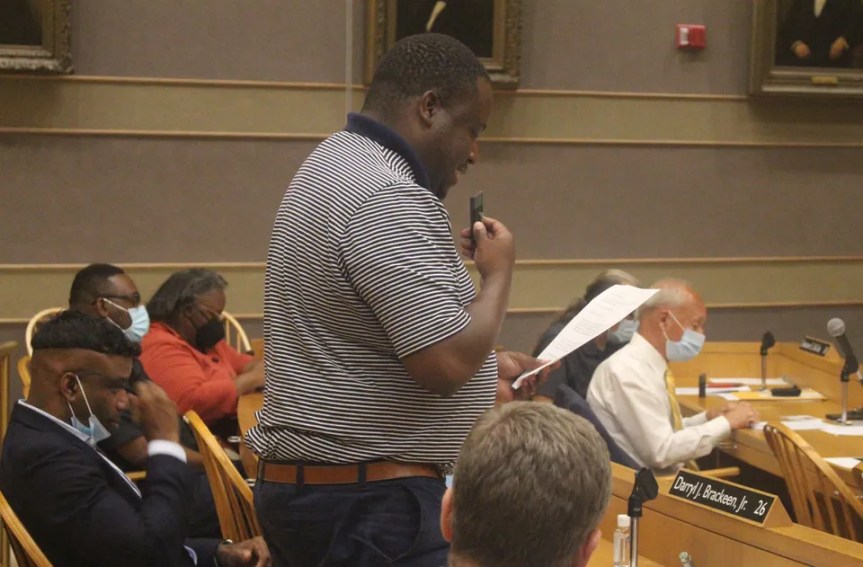
This resolution ​“speaks for itself,” Health and Human Services Committee Chair and Westville Alder Darryl Brackeen, Jr. said in support of the item as the New Haven Board of Alders Vote To End Cuba Embargo | Photo credit: New Haven Independent

A spirited and persistent campaign joined by peace activists in New Haven struck gold on July 6 as the Board of Alders of that large Connecticut city approved a resolution calling upon Biden administration to “to build a new cooperative relationship between the United States and Cuba and to immediately end all aspects of the United States economic, commercial and financial embargo against Cuba.”

The action this week followed testimony community members led by the New Haven Peace Coalition before the Board’s Health and Human Services Committee on June 24. That committee went on to recommend “without dissent” that the Board approve the anti-blockade resolution.

In written testimony read at the session, acting Peace Coalition head and veteran U.S. Communist Party activist Joelle Fishman, pointed out that. “As a city heavily invested in medicine, New Haven would gain from humanitarian exchanges about the most up-to-date treatments and medicines under development. Cuba is also pioneering in local sustainable food production.”

Cuba has gained enviable reputation internationally for its healthcare achievements, biomedical research, and ecologically sound agriculture.

The process toward the New Haven municipal authorities’ unanimous approval of their resolution had begun in September 2021 when the New Haven Peace Council and other groups first presented a proposed version of an anti-blockade resolution to the Board of Alders.

For many years, the Peace Council, affiliated with the New Haven-based U.S. Peace Council, and the New Haven Peace Coalition have jointly engaged in community-wide education and advocacy efforts on a wide range of human rights issues. The coalition enjoys the status of an official city commission.

In calling for an end to the U.S. economic blockade of Cuba, New Haven joins a bevy of other U.S. cities, and even states, in a grassroots campaign to get rid of this 60-year-old cruel, illegal, and immoral U.S. policy. The list now is long.

The most recent additions are Massachusetts cities Brookline on June 10 – a second time for that city – and Boston on May 16. The Bostonians defiantly called for “full restoration of trade and travel between the two countries.”

The Chicago city council’s unanimous passage of an anti- blockade resolution in February 2021 represented a major addition.  Chicago is the nation’s third largest city.

Other cities passing such resolutions are: Pittsburg, St. Paul Minneapolis, Cleveland, Detroit, Sacramento, and Hartford. The list includes Helena, MT; Cambridge, MA and Oakland, Berkeley, and Richmond – all in California.  States whose legislative bodies have passed resolutions are Alabama, Michigan, California and Minnesota.

Henry Lowendorf, president of the Greater New Haven Peace Council, outlined how actions taken against the U.S. blockade of Cuba contribute to peace. Commenting on the Human Service Committee’s approval on June 24 of the proposed resolution, Lowendorf declared that. “Despite the blockade no Cuban families, unlike in New Haven, are homeless. Despite the blockade all Cubans, unlike New Haveners, enjoy fully covered first-class healthcare.”

He added: “We have much to learn from how Cuba manages to guarantee its citizens these rights despite the US noose around its neck. That noose is intended not only to reverse these rights in Cuba but to prevent us from visiting Cuba, seeing for ourselves and demanding the same rights for ourselves from our own government.”


W. T. Whitney Jr. is a political journalist whose focus is on Latin America, health care, and anti-racism. A Cuba solidarity activist, he formerly worked as a pediatrician, lives in rural Maine. W.T. Whitney Jr. es un periodista político cuyo enfoque está en América Latina, la atención médica y el antirracismo. Activista solidario con Cuba, anteriormente trabajó como pediatra, vive en la zona rural de Maine.