Ignacio Ramonet, academician and former editor of Le Monde diplomatique, has written an open letter to President Joe Biden. It offers nations, organizations, and individuals a golden moment for getting rid of a critical piece of the U.S. system of economic blockade of Cuba. Ramonet argues in the strongest possible terms that the U.S. President must end the U.S. designation of Cuba as a state sponsor of terrorism (SSOT) and do it now.
Ramonet, originally from Spain, has long lived and worked in Paris, where he prepared. He teaches at Paris Diderot University and formally at the Sorbonne. In 2006, Ramonet praised Fidel Castro’s legacy in a series of articles in Foreign Policy journal. His book My Life: A Spoken Autobiography, written with Fidel Castro, appeared in the same year. It’s based on more than 100 hours of interviews with Castro.
The Casa de las Americas in Havana has sent out to the world an invitation for any and all to endorse Ramonet’s letter. Casa says:
“Our dear friend Ignacio Ramonet sent us this open letter to the President of the United States. Casa de las Americas supports this noble initiative and invites writers, artists, cultural promoters, academics, activists and social fighters, members of non-governmental organizations, and people sensitive to the daily suffering of the Cuban people to support it with their signatures.”
“Cuba’s income per person is probably 1/3 or 1/4 of what it would be without the bloqueo,” writes economist Jeffrey Sachs. The SSOT designation does its bit toward assuring that grim outcome. It provides for penalties against international financial institutions that handle Cuba’s borrowing and commercial transactions overseas, ones that involve dollars, which is usually the case.
Now is a crucial time. The SSOT designation is the one part of the far-reaching U.S. system of sanctions and commercial blockade that does not require action by the U.S. Congress to end or modify it. The U.S. president has sole responsibility for either authorizing or withdrawing the SSOT designation.
President Donald Trump reinstated the designation on January 12, 2021, within days of leaving office. President Obama had removed it in 2015. Right now, Biden could remove Cuba from that list of supposedly terrorist-sponsoring nations before a new president is installed, and without pain. The inevitable howls of outrage from defenders of U.S. domination of Cuba will bother neither him–who will be gone–nor the new administration–that was not there.
The point is that now is the time for a major campaign to persuade many individuals and organizations to sign on to Ignacio Ramonet’s open letter. The project would be part of a major push to get the job done.
After all, the U.S. State Department did remove Cuba from its list of countries “not cooperating fully” in U.S. anti-terrorism efforts in May 2024.
Here is what you do to sign on:
First, read Ramonet’s letter. It’s accessible at this link.
Second, access the Casa de las Americas invitation to endorse it. Do that by going to the same link.
Third, go to page three of the same communication to indicate who you are and the name of your group.
A job well done.
W.T. Whitney Jr. is a political journalist whose focus is on Latin America, health care, and anti-racism. A Cuba solidarity activist, he formerly worked as a pediatrician, lives in rural Maine. W.T. Whitney Jr. es un periodista político cuyo enfoque está en América Latina, la atención médica y el antirracismo. Activista solidario con Cuba, anteriormente trabajó como pediatra, vive en la zona rural de Maine.
Taking note of International Workers’ Day, several Latin American news sources this year cited JoséMartí’s 1886 essay “A Terrible Drama;” two of them republished it, here and here. There Martí reports on events in Chicago in 1886 and the fate of the so-called Haymarket Martyrs – seven labor journalists and agitators railroaded to prison and given death sentences. Another received a 15-year prison term.
Martí, who would become Cuba’s national hero, was living in exile in the United States.He relates how strikes for the eight-hour day were underway on May 1, 1886 in Chicago and nationwide, how the Chicago police killed one striker and wounded others on May 3, and how a mass protest against police violence took place the next day in the Haymarket area. There, a bomb exploded, seven policemen and four workers were killed, and dozens were wounded.
The court lacked evidence that the defendants, anarchist by inclination, were involved in the violence of May 4. Martí describes the execution of four of them and the suicide of another. An appeals court judge commuted the sentences of two defendants to life in prison. In 1893, Illinois Governor John Altgeld pardoned those two and the remaining prisoner.
The Socialist International in 1889 declared May Day to be an annual celebration of labor militancy.
José Martí’s account, “A Terrible Drama,” is a foundational contribution to the history of the U.S. labor movement.Martí defended working people – U.S. workers in his writings, and Cuban workers in words and deeds, from 1886 on. The combination of author and story points to a connection between U.S. labor activism and workers’ struggles in Cuba. Its time has come.
The U.S. economic blockade of Cuba, lasting decades, has led to shortages, misery, and despair. Nations of the world voting annually in the United Nations General Assembly overwhelmingly condemn the blockade. It violates international law.
Domestic opposition to U.S. policies on Cuba, while persistent, vigorous at times, principled, on-target, and diverse, has fallen short. U.S. government measures aimed at destabilization remain in force. Upping power of the people with labor combativeness would make a difference.
Unions and labor activists know how to organize and how to confront recalcitrant political and economic leaders. They will be active on Cuba’s side, once they realize that working people’s struggles in the two countries are linked, or so our theory goes. In addition:
· Labor unionists involved in struggle count on unity, the power of numbers, and sometimes solidarity from counterparts, often from abroad.
· The current Cuban Revolution is the product of a revolutionary tradition. U.S. workers confronting their own government on Cuba would be expressing solidarity with a revolution whose progenitor, Jose Martí, defended U.S. workers fighting for the eight-hour day. They would be paying back.
· Social revolution and ordinary labor struggles are battles of ideas. The writings of Martí, maximum leader of Cuba’s early revolution, speak to Cuban and U.S. workers alike. In that way they are connected.
Martí wrote about working people and their lives. He contributed greatly to the ideas and substance of revolutionary struggle in Cuba and also defended African-descended and poverty-stricken Cubans with a seemingly unqualified egalitarianism. For example:
· “And let us place around the star of our new flag this formula of love triumphant: ‘With all, and for the good of all.’”
· “A nation having a few wealthy men is not rich, only the one where each of its inhabitants shares a little of the common wealth. In political economy and in good government, distribution is the key to prosperity.”
Responding to the Haymarket affair in his “A Terrible Drama,” Martí reflects upon the situation of U.S. working people:
“The nation is terrified by the increased organization among the lower classes … Therefore the Republic decided … to use a crime born of its own transgressions as much as the fanaticism of the criminal in order to strike terror by holding them up as an example …. Because of its unconscionable cult of wealth, and lacking any of the shackles of tradition, this Republic has fallen into monarchical inequality, injustice, and violence …
“In the recently emerging West … where the same astounding rapidity of growth, accumulating mansions and factories on the one hand, and wretched masses of people on the other, clearly reveals the evil of a system that punishes the most industrious with hunger, the most generous with persecution, the useful father with the misery of his children – there the unhappy working man has been making his voice heard.”
Martí’s “A Terrible Drama” appeared in La Nación newspaper in Buenos Aires in January 1888, some 19 months after the Haymarket events. The delay may have stemmed from Martí’s ambivalence about the anarchist leanings of the accused. Previously published segments of his report do appear under the title “The First of May, 1886” in historian Philip Foner’s anthology of Martí’s writings published in 1977. Excerpts follow:
“Enormous events took place in Chicago, but rebellion exists throughout the nation. In the United States … a firm and active struggle has been in preparation for years … …[T]hings are not right when an honest and intelligent man who has worked tenaciously and humbly all his life does not have at the end of it a loaf of bread … or a dollar put away, or the right to take a tranquil stroll in the sunlight… Things are not right when the one who in the cities … lives a contemplative life of leisure so exasperating to the miner, the stevedore, the switchman, the mechanic, and to every wretched person who must be content with seventy-five cents day, in raw winter weather …Things are not right if shabby women and their pallid children must live in tenement cubicles in foul-smelling neighborhoods. …The reasons are the same. The rapid and evident concentration of public wealth, lands, communication lines, enterprises in the hands of the well-to-do caste that rules and governs has given rise to a rapid concentration of workers. Merely by being gathered together in a formidable community which can, at one stroke, extinguish the fires in the boiler and let the grass grow under the wheels of the machinery, the workers are able successfully to defend their own rights against the arrogance and indifference with which they are regarded by those who derive all their wealth from the products of the labor they abuse.”
Deeds and words
Martí acted on behalf of working people. He organized Cuba’s independence struggle that culminated in war with Spain in early 1895. Under his leadership, the process became a social revolution.
From exile in New York, Martí outlined goals, strategies, and methods. Traveling widely, he arranged for Cuban exiles in the United States, Central America, and the Caribbean – many of them workers, many African-descended – to select the revolution’s leadership, provide funding and supplies, and approve goals and proposals. Martí persuaded the military heads to accept civilian leadership. He created and edited the independence movement’s newspaper Patria.
Aware of U.S. aspirations to dominate Cuba and the entire region, Martí led in confronting U.S. imperialism – never good for workers. In 1891 he wrote “Our America,” an essay demonstrating commonalities among diverse peoples inhabiting all the land extending from the Rio Bravo (the Rio Grande) south to Patagonia. Martí highlighted their shared cultural and political orientations that set them apart from U.S. and European societies.
In a letter to a friend shortly before he was killed in battle on May 19, 1895, Martí insisted that: “It is my duty … to prevent, by the independence of Cuba, the United States from spreading over the West Indies and falling, with that added weight, upon the other lands of Our America.”
Attacking military installations of the Batista regime on July 26, 1953, revolutionaries led by Fidel Castro were honoring José Martí, born 100 years earlier. For Castro, Martí was “the Apostle of Independence … whose ideas inspired the Centennial Generation and today inspire and will continue to inspire all of our people more and more.”
For the sake of justice and in view of connections with Cuban workers, U.S. working people would do well to press upon their government the necessity to end the blockade of Cuba. Labor unions, the principal means for expression of workers’ sentiment and power, have prime responsibility in this regard.
They would be acting as did West Coast dockworkers who blocked arms shipments to Chile under the Pinochet dictatorship, cargo arriving from apartheid-ridden South Africa, and, recently, arms shipments bound for Israel. U.S. unionists actively opposed their government’s support for authoritarian El Salvador in the 1980s and supported Iraqi workers after the U.S. invasion there. They collaborated with Mexican miners and other workers over many years. Recently U.S. unions issued statements and approved resolutions calling for a ceasefire in Gaza.
W.T. Whitney is a political journalist whose focus is on Latin America, health care, and anti-racism. A Cuba solidarity activist, he formerly worked as a pediatrician, lives in rural Maine. W.T. Whitney Jr. es un periodista político cuyo enfoque está en América Latina, la atención médica y el antirracismo. Activista solidario con Cuba, anteriormente trabajó como pediatra, vive en la zona rural de Maine.
Some of the weapons seized from a Florida-based terrorist captured on Cuban soil after he snuck onto the island via jet ski. | Photo courtesy of Granma
When the U.S. government launched its so-called “Global War on Terror” after the al Qaeda attacks of Sept. 11, 2001, U.S.-led terror attacks against Cuba had already been ongoing for over 40 years.
They included: military invasion (1961), CIA-sponsored counter-revolutionary paramilitaries in the countryside (1960s), a fully loaded Cuban airliner brought down by U.S. agents (1976), attacks on coastal towns and fishing boats, biowarfare, hundreds of killings in Cuba and abroad, sabotage, and bombings of hotels and tourist facilities (1997).
With the new century, however, violence and terror seemed to be on vacation. The Cuban media and sympathetic international media were reporting little or nothing about U.S.-based terror attacks that had been their stock in trade.
On Dec. 17, 2023, Cuban Chancellor Bruno Rodríguez released a statement harking back to the violent past. He insisted that the “U.S. government is very aware of the official, public, and repeated denunciations by the Cuban government of the assistance, protection, and tolerance that promotors and perpetrators of terrorist acts against Cuba enjoy in the United States.”
He added that, “Recently Cuba’s Interior Ministry has reported on the dismantling of destabilization plans developed in the United States by terrorists of Cuban origin in a security operation that led to the detention of several persons tied to this conspiracy.”
Rodríguez’s statement followed a report appearing on the Communist Party’s Granma newspaper on Dec. 9, 2023. A Florida resident, traveling on a jet ski, came ashore near Matanzas on Cuba’s northern coast in late 2023; no date was specified. Carrying pistols, ammunition, and loading clips, the individual headed for Cienfuegos, his province of origin, and was arrested.
The unnamed man “contacted several people in order to recruit them.” He allegedly had ties in South Florida with “terrorists who publicly promote violent actions against Cuba … [and who] have received military training with weapons, have the physical equipment … and other resources to carry out their plans.”
Granma stated that, “the terrorists, with their plans for actions aimed at undermining internal order, go beyond a virtual setting; they concentrated on promoting violence so as to cause pain, suffering, and death at the year’s end.”
These “instigators of hate and death … appear on [Cuba’s] National List … [Cuban security officials] have investigated actions they’ve taken in the national territory or in other countries.”
A report on Jan. 4 from Mexican journalist Beto Rodríguez discusses the Interior Ministry’s “National List of persons and entities … associated with terrorism against Cuba.” Since 1999, they “have planned, carried out, and plotted acts of extreme violence in Cuban territory.’’
The List first appeared on Dec. 7 in Cuba’s Official Gazette as Resolution 19/2023. It names 61 individuals and 19 terrorist organizations, all based in the United States, presumably most of them in South Florida. One of the names on the List belongs to the jet skier, but which one is unspecified.
According to Beto Rodríguez, criminal investigations in Cuba revealed that some of the listed persons targeted “governmental and tourist installations and carrying out sabotage, illegal incursions, human trafficking, and preparations for war.” They “made plans for assassinating leaders of the revolution.”
He also reported that the arrested jet skier “intended to recruit Cubans for burning sugarcane plantations, provoke disturbances, disturb tourist centers, and hand out propaganda.” “[C]itizen denunciation” led to his arrest.
Appearing on the List is Alexander Alazo Baró, who shot at Cuba’s embassy in Washington with a semiautomatic weapon on April 30, 2020. He is still “under investigation.” Two Molotov cocktails exploded at the embassy on Sept. 24, 2023. The perpetrator is unknown.
Beto Rodríguez notes that on Nov. 24, 2023, the U.S. State Department, warning prospective travelers to Cuba of “potential terrorist actions … against the United States,” advised them to avoid “sites commonly used for demonstrations.”
A day earlier, a large pro-Palestinian march headed by Cuban President Miguel Díaz-Canel passed by the U.S. embassy in Havana. Journalist Rodríguez surmises that, “Washington already knew beforehand that anti-Cuban groups were planning to enter onto the island to commit acts of terrorism.”
Hernando Calvo Ospina, veteran analyst of U.S. terror against Cuba, reported on Jan. 10 that Cuba’s government referred the National List to the International Criminal Police Organization (Interpol), which deals with crime extending across borders.
Describing activities of the listed persons, Calvo Ospina highlights their new use of social media to communicate propaganda and to “incite internal violence, the assassination of State personalities, the destruction of common goods and all kinds of sabotage.”
Ospina states that, “the objectives now being pursued are similar to those of the so-called ‘historical exile group.’ Only the method has changed. Both have one thing in common: they use terrorist methods.” Some of those whose names appear were carrying out terrorist activities in the 1990s.
He indicates that, “Many received direct funding from the U.S. State Department, and also from the CIA, which uses various entities and NGOs to deliver it.”
According to the Congressional Research Service, the government’s so-called “democracy and human rights funding” for Cuba, a reference to support provided for interventionist programming, amounted to $20 million annually from 2014 to 2022. In July 2023, Rep. Mario Diaz-Balart, R-Fla., chairman of the House Appropriations Subcommittee, sought “to boost funding by 50% for democracy promotion efforts in Cuba.”
What looks like a revival of the U.S. government’s former anti-Cuba terror campaign may point to one or more of several possibilities:
Terror attacks had actually continued during the past two decades, but Cuba’s government, for unknown reasons, opted not to publicize them.
Terror attacks did continue, but at a low ebb, and now the Cuban government, at a difficult time, seeks to inform world opinion of illegal and dangerous U.S. actions, the object being to promote multi-national mobilization against prolonged U.S. all-but-war against Cuba.
The U.S. government, taking advantage of Cubans’ discouragement aggravated by a terrible economic crisis, has successfully recruited dissidents and once more is capable of mounting terror attacks.
The U.S. government, true to its ideologic core, to its imperialist self, stops at nothing while dominating or beating up on lesser peoples of the world.
We hope you appreciated this article. At People’s World, we believe news and information should be free and accessible to all, but we need your help. Our journalism is free of corporate influence and paywalls because we are totally reader-supported. Only you, our readers and supporters, make this possible. If you enjoy reading People’s World and the stories we bring you, please support our work by donating or becoming a monthly sustainer today. Thank you!
W.T. Whitney Jr. is a political journalist whose focus is on Latin America, health care, and anti-racism. A Cuba solidarity activist, he formerly worked as a pediatrician, lives in rural Maine. W.T. Whitney Jr. es un periodista político cuyo enfoque está en América Latina, la atención médica y el antirracismo. Activista solidario con Cuba, anteriormente trabajó como pediatra, vive en la zona rural de Maine.
People look at food prices at a private business in Havana on December 20, 2023. Cuba’s economy will shrink by up to 2 percent this year, Finance Minister Alejandro Gil estimated on Wednesday, after acknowledging that the country will not be able to achieve the projected economic growth of 3 percent by 2023 | Yamil Lage / AFP / Getty
“Our joy is immense … We don’t deceive ourselves thinking that everything ahead will be easy, when perhaps everything is going to be more difficult.” That was Fidel Castro, hours after the victory of Cuba’s Revolution.
Difficulties were center stage 65 years later, at a plenary session of the Central Committee of Cuba’s Communist Party on December 15 and 16 and at the National Assembly of People’s Power, meeting on December 20-22.
The views of Cuban leaders on problems now enveloping Cuba shed light on realities of a nation under siege and a revolution in trouble. The information is pertinent to the solidarity efforts of Cuba’s friends abroad. Addressing the Central Committee’s plenary session, Cuban President Miguel Díaz-Canel noted that, “We have discussed efforts that have not yielded solutions, measures that did not prosper, and goals that were not fulfilled …The scenario is that of a war economy … [We] are all here to reverse the present situation … with consensus as to decisions and with collective work, with passion and energy.”
Díaz-Canel called for “creative resistance” and “confidence in victory,” while insisting that dissatisfaction “is a motor that moves revolutionary energies. It provokes embarrassment that ends up activating people’s full participation, without which socialism is impossible.”
“We would be surrendering beforehand, if we see this war as an insuperable calamity. We must see it … as the opportunity to grow and to overcome our own selves, while the adversary is nakedly evil before the world … On the eve of the 65th anniversary of the Cuban Revolution … we are called to act together for a common objective: Save the homeland, the Revolution, socialism, and overcome.”
The Assembly meets
Speaking to the National Assembly were: Alejandro Gil Fernández, minister of the economy and planning; Prime Minister Manuel Marrero Cruz; and President Miguel Díaz-Canel. Gil Fernández regards the U.S. economic, commercial and financial blockade of Cuba as the principal obstacle Cuba faces in restoring its economy.
He indicated that in 2023 Cuba’s GDP will have fallen almost two percent. Exports were $770,000 million below predictions. Food production was less than that of 2022. Tourism income increased by $400 million in 2023 but represented only 69% of the yield in 2019. Overall production was down due mainly to state enterprises held back by shortages of supplies and fuels. Currency shortages and loss of workers to migration hampered the healthcare and education sectors. Electricity generation was up 32% in 2023, according to Gil Fernández. Cuba’s 30% inflation rate for 2023 was lower than the 77.3% rate in 2021.
State business entities showed “gradual recuperation.” They employ 1.3 million workers while accounting for 92% of goods and services produced in Cuba and 75% of exported products. He attributed price inflation to international price hikes, the government’s release of money to finance its budget deficit, fewer goods being produced, and an agriculture sector burdened by labor shortage, high costs, and low yields.
“What isn’t being produced cannot be imported,” Gil Fernández lamented. His message is that importing goods is almost impossible what with “the effect of high prices on the international market.” But, paradoxically, “a lack of production resources” forces Cuba to import over 70% of the food that is being consumed.
He proposed measures for increasing food production, including:
+ Creation of a financial mechanism for bolstering production based on farmers using Cuban currency derived from agricultural sales to buy supplies they need. + Build a farm labor force through moonlighting, employing students, and having young people do agricultural work as part of their military service. + Use food produced in Cuba, not imported food, to fill the “normal family food basket.”
Prime Minister Manuel Marrero Cruz critiqued the government’s lack of control over production and distribution which “adversely affects production by state entities and lets currency exchanges on the illegal market determine the pricing of products from the non-state sector.” e reported that social inequalities are growing, and that the tendency exists while state subsidies continue to nourish less distressed sectors of the economy. Equally worrisome: “The former state monopoly in production is now consolidating in the private sector.”
He was referring to the recent appearance of 9000 or so mostly private small-and-medium-sized businesses and to independent farmers and cooperatives that took over land from the state under long-term usage arrangements. They now control 80% of Cuba’s agricultural land. Marrero Cruz called for “stimulation of government-operated small-and- medium-size business entities.”
Both private businesses and the farming sector sell products at highly inflated prices with prices being set by black market operatives. The prime minister condemned the state subsidies such entities receive in the form of low prices assigned to the fuel, water, transportation and electricity they buy from the state. Similarly, the government pays high prices to farmers for food that, under the rationing system, is sold inexpensively to the population.
Henceforth, according to Marrero Cruz, the government will be subsidizing people, not products. According to one report, “The Ministry of Work and Social Security will be charged with undertaking a survey of ‘vulnerable’ social sectors.” “Nobody will be abandoned,” Marrero Cruz insisted.
The government, he indicated, will increase sales taxes on final products such as water, gas, electricity, transport and reduce import tariffs by 50% on the “intermediate products” used in food production and manufacturing. More tourist dollars will be harvested. Municipal assemblies will present budgets and in the case of deficits will generate more income and reduce administrative expenses.
For the prime minister, “food production needs to be prioritized and by all sectors. Many countries are saying to us: ‘We’ll put up the money, you provide the land and then pay back the money with production.’” He pointed out that, despite the non-availability of imported fertilizer and pesticides, “there are many instances of countries producing food; an agricultural country must produce its food.”
Marrero Cruz sees “speculative prices … and intermediaries earning a lot more than producers” and non-state entities now controlling imports rather than the government, the result being “abusive and speculative pricing.” He called for paying for imports with income from exports: “[W]e prefer importing supplies and products essential to the economy and paying for them by offering other countries certain products and/or services.”
Responding to inflation, the government, collaborating with the Central Bank of Cuba, will change the official exchange rate for the peso. According to Marrero Cruz, the government will be restricting prices for goods and services with a system of “maximum prices.”
President Miguel Díaz-Canel, addressing the National Assembly on December 22, focused on Cuba’s “war economy … [It’s] a political scenario of maximum asphyxia, designed and applied against a small country by the most powerful empire in history.” He also attributed economic problems to “the crisis in international economic relations and our own errors.”
Economic war takes the form of economic blockade aimed at “reduced supplies of goods used by the population, inflated prices, and low purchasing power for most Cubans.” “Together with constant acts of subversion and disinformation against Cuba, the goal is to break the country, provoke social decomposition, and make for ungovernability.”
Díaz-Canel spoke of errors as “part of the complexity of making decisions in a context of extreme tension … [and of] commitment to preserving social conquests.” He mentioned mistakes, particularly in the “design and implementation of currency unification” and in “approving new economic actors without performance norms having been established.”
The effectiveness of new measures will “depend on generating more wealth, more work incentives, and more distribution of resources.” The president promised there will be no “neoliberal package … no crusade against small businesses, no elimination of the basic food allocation.” The president highlighted: “food production, localities taking care of more of their needs, the revival of tourism, rescue of the sugar industry, state control of currency and the exchange market, redesign of the financial system, and guarantees for self-financing, and managing currency so as to serve those whose production generates income.”
Díaz-Canel took note of Cubans’ high regard for healthcare workers and teachers, promising that “they will be the first to benefit from additional pay, which the prime minister announced in his intervention.” Testifying earlier before the Economics Commission of the National Assembly, Díaz-Canel emphasized “taking advantage of the facilities of the municipalities and articulating strategies of local development.” Recalling that the “[f]oundation of government is the municipal assembly of people’s power,” he insisted on “mapping out actors in the municipalities and integrating them with state and private businesses.”
In the end
The information and opinions provided by Cuban leaders and reviewed here clarify difficult realities, among them: adverse effects of diminished tourism, inflation, and emigration; social inequalities based on varying access to resources; production stymied by shortages of resources; inadequate food production; lack of buying-power for most Cubans, and for importing necessary goods; and the near impossibility of securing foreign investment.
Cuba is fashioning responses. They are: decentralization of political and economic administration; cut backs on expenditure of central government funds, reduced subsidies for the purchase of water, fuel, transport, and electricity by business entities; adjustment of import tariffs to favor the availability of resources for production, capturing more tourist dollars, protecting state-operated production entities, fixing prices, and producing more food.
These will be palliative remedies unless basic causes are dealt with. A prime goal of U.S. policy has been to deprive Cuba of money, and that has come to pass. Revolutionary Cuba’s very survival depends on U.S. citizen activists forcing their government to shed its blockade of Cuba. There, the great need now is for Cuba to be removed from the U.S. list of terrorist-sponsoring nations. That designation causes most international financial institutions to refuse handle dollars on Cuba’s behalf.
There is a larger context. The U.S. use of economic sanctions everywhere rests on planet-wide dollar dependency. That emerged out of the Bretton Woods Conference of 1944 and has coincided since with unrelenting U.S. assertion of worldwide power. That’s the basis for a global constituency on Cuba’s behalf. How it will be set in motion is the big question.
W.T. Whitney Jr. is a political journalist whose focus is on Latin America, health care, and anti-racism. A Cuba solidarity activist, he formerly worked as a pediatrician, lives in rural Maine. W.T. Whitney Jr. es un periodista político cuyo enfoque está en América Latina, la atención médica y el antirracismo. Activista solidario con Cuba, anteriormente trabajó como pediatra, vive en la zona rural de Maine.
A portrait of Argentine born Cuban revolutionary hero Ernesto ‘Che’ Guevara hangs on a shelf at a food store in Havana with some of the few products for sale. | Ramon Espinosa / AP
The civilian victims of U.S. war-making in Gaza—the U.S. government supplies the big weapons—are on full display right now, broadcast on television screens and Twitter feeds around the world.
There’s another group on the receiving end of U.S. imperialism whose plight is not being publicized very much at the moment, though, and that’s the resistance of the long-suffering people of Cuba against an unrelenting economic war.
Differences in scale and immediacy of course distinguish the assault they face due from the U.S. blockade and the bombardment and constant death being visited upon the Palestinians by Washington’s Israeli ally, but for the island nation to our south, the supply of food and other necessities is becoming ever more precarious by the day.
And despite the differences in the war against Palestinians and the economic war against Cubans, there is a common principle that governs in both instances: Subjecting non-combatant populations to potentially lethal danger, under conditions of war, is criminal. That’s reason enough to force an end to the U.S. economic blockade of Cuba.
The blockade promotes food shortages and is putting more and more lives at risk. The U.S. public needs to know about, understand, and reject this blockade, its operation, and its impact. Letting people in the U.S. know the full details of what’s being done in their name is, of course, no small task. The blockade proceeds automatically and quietly; the human suffering it causes is largely hidden.
Economic embargos are a form of war and the people whose government is dishing out such a strategy is often unaware of what’s happening, writes commentator Nicholas Mulder: “Voters in the sanction-imposing country are unlikely to observe or understand the full costs of sanctions on ordinary people abroad.”
Not by accident
The blockade promotes food shortages, and that’s its intention. New Jersey Congressman Robert Torricelli introduced the Cuban Democracy Act in 1992 in the wake of the Soviet Bloc’s collapse. Cuba had just lost 80% of its trade and was vulnerable, which provided what the U.S. government saw as a chance to finish off Cuba’s Revolution.
The law prohibits those exporters abroad who are affiliated with U.S. companies from shipping food and other goods to Cuba under threat of penalties and fines. Torricelli explained the rationale, saying you mus “keep your foot on the snake, don’t let up.”
Companies around the globe had previously been exporting almost $500 million worth of food to Cuba annually, but Torricelli’s law put a stop to that. The legislation, which is still in effect, prohibits ships from entering U.S. harbors for six months after they visit a Cuban port.
The effect has been to raise shipping prices for Cuba and severely limit the number of international companies willing to risk their access to the giant U.S. market in order to sell to a much smaller customer like Cuba.
U.S legislation in 2000, provided some small relief, authorizing exports of U.S. farm products to Cuba. Payments are in cash only—no loans. Shipping costs remain high, though, because the food products must be carried in U.S. ships, and they return empty. Cuba has to pay for a two-way trip to get only one boatload of goods. U.S. food exports to Cuba peaked in 2008 and have fallen since.
The U.S. blockade also restricts financial services provided by international banks and lenders. Under U.S. pressure, they don’t lend money to Cuba and can’t handle U.S. dollars in transactions involving Cuba. The legislation that authorized U.S. presidents to designate other nations as sponsors of terrorism incorporated these prohibitions, along with penalties.
Cuba, as an alleged—falsely so—terrorist-sponsoring nation, lacks the credit and often the cash to pay for food imports and to develop the island’s own domestic agricultural potential. Cuba must spend $4 billion annually to import 80% of the food it consumes.
The U.S. blockade causes other shortages that also hobble food production. Fuel shortages impede the transport of goods and the operation of machinery. Fertilizer, herbicides, pesticides, seeds, spare parts, new equipment, veterinary supplies, irrigation equipment, new breeding stock, and grains used to make animal feed are all constantly in short supply. U.S. limitations on the remittances Cuban-Americans send to their families in Cuba further interfere with food purchases and spending on agricultural projects.
A comparison of agricultural production in Cuba and in the Dominican Republic suggests food shortages are due mostly to the U.S. blockade. The two are neighbors with essentially identical climates. The total of food produced in the unblockaded DR in 2021 exceeded Cuba’s “best historical average” yield by 35.7%, even though agricultural acreage in the Dominican Republic is only 25% of Cuba’s total.
Some difficulties affecting agricultural production result from non-blockade causes, to be sure: mounting inflation, domestic corruption, theft, currency speculation, and shortages of foreign currency due to reduced tourism during the COVID-19 pandemic and subsequently. Higher food prices generally around the globe recently and climate-change effects are also phenomena bearing on food availability in Cuba.
Policy failures also factor into the equation, as Cuba’s government has fallen short in converting the island’s many idle fields into productive farm land. And relatively few Cuban young people are attracted to farming; only 15% of Cubans live in the countryside.
Empty shelves
Agricultural minister Ydael Jesús Pérez Brito, interviewed recently, noted that the agriculture sector has secured only 40% of the diesel fuel it needs, 4% of required fertilizers, and 20% of feed needed for livestock.
He reported that pork production fell from almost 200,000 tons in 2017 to 16,500 tons in 2022, due in part to only 14% of necessary fuel being available. Rice farmers are producing 10% of recently achieved levels of production. Current production of beans and corn amounts to 9% and 30%, respectively, of yields in 2016.
Manuel Sobrino Martínez, the food industry minister, indicated last month that food processing generally and milk processing in particular is down over three years to 50% of capacity. He described a 46% drop over one year of milk received for processing to powdered milk, and reported that a ton of milk costs $4,508 now, up from $3,150 in 2019.
The availability of cooking oil is down 44% in a year; its cost is up from $880 per ton in 2019 to $1,606 now. Wheat processing is at half capacity. Fishing activity has fallen by 23% since 2022; 60 boats are not operating because motors are expensive and suppliers refuse to sell, or demand hard currency up-front. The minister said he must choose between “powdered milk, or wheat, or motors.”
The essence, according to an observer, is that, “owing to low agricultural yields, total food production in 2022 fell to 26% [of food produced] in 2019.”
Cuban President Miguel Díaz-Canel told a reporter recently that, “They have put us in a situation of maximum pressure, of economic asphyxiation to provoke the collapse of the Revolution, to fracture the unity between the leadership and the people, to obliterate the work of the Revolution.”
Production is low, he pointed out, and “the country’s fundamental problem is low availability of foreign currency.” Díaz-Canel said the government would “take advantage of the possibilities we have as a socialist state to plan and distribute available resources to prioritize the production that … could give us more possibilities, and also to protect people who may be in a situation of social disadvantage.”
Grim reality, of which food insufficiency is one aspect, demonstrates that now is the time for action and messaging strong enough to finally end the U.S. blockade. Suffering and distress at U.S. hands should provoke revulsion, just as does U.S. complicity with attacks on hospitals in Gaza, and killings of non-combatants.
A key element of Cubans’ distress is lack of currency and credit. President Joe Biden has only to remove Cuba from the U.S. list of terrorist-sponsoring nations to provide immediate humanitarian relief and restore Cuba’s government some room to maneuver the food crisis. An easing of current living conditions would surely result in fewer Cuban migrants heading to the United States, too.
For the U.S. government to be at peace with Cuba would hardly violate baseline presumptions for war-making, which would indeed be the case if the United States opposed Israel’s war in Gaza. Doing so would disturb respect for ally Israel’s historical memory, profiteering by U.S. weapons manufacturers, and backing for Israel as U.S. beachhead for regional control.
In dropping the blockade, U.S. power-brokers would lose little more than gratification and political reward for fighting communism and opposing Cuba’s efforts to rearrange their U.S. Latin American and Caribbean backyard.
We hope you appreciated this article. At People’s World, we believe news and information should be free and accessible to all, but we need your help. Our journalism is free of corporate influence and paywalls because we are totally reader-supported. Only you, our readers and supporters, make this possible. If you enjoy reading People’s World and the stories we bring you, please support our work by donating or becoming a monthly sustainer today. Thank you!
W.T. Whitney Jr. is a political journalist whose focus is on Latin America, health care, and anti-racism. A Cuba solidarity activist, he formerly worked as a pediatrician, lives in rural Maine. W.T. Whitney Jr. es un periodista político cuyo enfoque está en América Latina, la atención médica y el antirracismo. Activista solidario con Cuba, anteriormente trabajó como pediatra, vive en la zona rural de Maine.
Mariel resident Rosa Lopez lights a charcoal stove to boil sweet potatoes and prepare scrambled eggs with tomatoes for her grandchildren on May 18, 2023. She had just returned from picking up her food rations from a government-run market. At the time, it had been more than a month since any cooking gas had been delivered to the city, so Lopez cooks using charcoal and a wood burning oven. Low agricultural yields, exploding inflation, a lack of gasoline for transportation, and the U.S. blockade have all contributed to soaring food prices. | Ramon Espinosa / AP
Addressing a meeting of government ministers and the press in Havana on Aug. 11, Cuba’s Vice Prime Minister Jorge Luis Tapia Fonseca exploded when discussing the food crisis gripping the nation.
“It takes work to produce food. Everyone wants food deliveries, but we do nothing to produce it. We lack a culture of production … We don’t need all these papers, or words. When do we begin to plant? Who will do it?”
He was reporting on implementation of Cuba’s 2022 law on Food Sovereignty and Food and Nutritional Security. He noted that food self-sufficiency in local areas is disastrously lagging. Crop yields are low; plant diseases and the lack of inputs has hampered grain production.
The food situation in Cuba is growing more desperate by the day. Residents of the island individually consumed only 438 grams of animal protein per month in 2022, and in May 2023, only 347 grams; recommendations call for ingestion of 5 kg monthly. Not enough chickens were raised last year; poultry meat and eggs remain scarce.
Yields of corn, soy, sorghum and other crops have dropped, and animal feed is mostly unavailable. Therefore, pork production is also down, milk is unavailable to adults, and fewer cattle are being raised. Pasturage is poor, due to drought and no fertilizer.
Farm workers carry a tank of fresh milk to deliver it to a government-run food store in San Nicolas, Cuba, May 19, 2023. Milk is in short supply and reserved for children these days. | Ramon Espinosa / AP
Failures mount
Tapia pointed to the many failures exacerbating the situation. The output of state-controlled food producers is low. Producers, distributers, and institutional consumers don’t regularly contract with one another to facilitate food distribution. Producers aren’t being paid, because credit isn’t available. Cattle-stealing has reached new heights, 44,318 head so far this year.
The Ministry of Finances and Prices issued a report prior to the National Assembly session that recognized high inflation, widespread popular dissatisfaction, and the need for “concrete solutions.” Minister Vladimir Regueiro Ale indicated prices skyrocketed by 39% during 2022 and 18% more so far in 2023.
Inflation, he explained, varies from province to province and may manifest as abusive price-fixing, especially when agricultural supplies and products are in short supply.
Commenting on the report, National Assembly President Esteban Lazo, reminded delegates that diminished production and inflation were connected: “If there is no production and supply, we will not achieve effective control of prices.” He complained that “practically 100% of the food basket is being imported.”
The Assembly’s Food and Agricultural Commission analyzed organizational and management problems and reported that only 68% of expected diesel fuel has arrived so far in 2023, 14,700 tons less than in the similar period a year before; 28,900 tons of imported fertilizer were ordered, but only 168 tons arrived. Cuba’s fertilizer production has been nil this year in contrast to 9,600 tons produced in the same months in 2022.
Lazo communicated a message to Cuba’s Minister of Agriculture from the Assembly, whose recent session ended on July 22. The ministry, he said, would be “transforming and strengthening the country’s agricultural production,” to initiate “a political and participatory movement that would unleash a productive revolution in the agricultural sector.”
Nothing less than a revolution will do
A revolution appears to be exactly what’s needed. The recent National Assembly session dealt almost entirely with Cuba’s present food disaster. The lives of many Cubans are becoming more precarious due to unending food shortages, high prices, and low incomes.
Information emerging from the Assembly’s deliberations attests to the reality of crisis in Cuba, and it means that urgency is building for Cuba’s friends in the United States to resist U.S. policies in new ways, strongly and assertively. Their own government accounts for new suffering and destitution in Cuba.
President Miguel Díaz-Canel emphasized resistance when addressing the National Assembly. He dedicated his remarks to two revolutionary heroes who were present. Admiring how they kept “their foot in the stirrup of difficulties” and their “rifle pointed at mistakes,” he may have been thinking of hard work ahead.
He mentioned “problems of our difficult daily life, such as food production, electricity generation, water availability, crime, rising inflation, abusive prices.”
The president criticized behaviors “that reinforce the omnipresent blockade through inaction, apathy, insensitivity, incapacity, or simple tiredness and lack of faith.”
Díaz-Canel noted approvingly that delegates discussed “closer ties between deputies and the population,” “better management and allocation of the currency,” “greater direct participation of the non-state sector in national production,” “municipal autonomy,” and “downward pressure on prices.”
But it’s not enough. “Above all,” he said, “we must devote ourselves to creating wealth, first of all, by producing food.”
Trouble in the countryside
Cuba’s rural communities are troubled—and shrinking. Soon, “we won’t have any people left in the countryside,” one delegate said. Another called for improved “roadways, housing, and connectivity.”
No fuel means most people in rural areas are resorting to bicycles or horse carts to travel short distances. | Ramon Espinosa / AP
Regarding the low level of agricultural skills among the rural population, someone called for teaching in “agroecological techniques” and “good practices for the producing, processing, and commercialization of food.”
The idea has been circulating for a while now that greater local autonomy might help spur food production, but efforts at prompting that devolution of initiative have seen a slow uptake. As of April 2023, aspiring farmers had not yet taken possession of 258,388 hectares of idle land made available to them without cost under land-tenure reforms in 2008.
Frei Betto, Brazilian friend of revolutionary Cuba and adviser to Cuba’s Food Sovereignty and Nutritional Education Plan, visited Cuba in June. In his assessment, the “current shortages are more severe than in the Special Period (1990-95),” when Cuba’s economy nearly collapsed following the withdrawal of Soviet aid and the contraction of trade with the socialist bloc of nations.
He indicated that Cuba now imports 80% of the food it consumes, up from 70% five or so years ago, and that it costs $4 billion annually, up from $2 billion. For corn, soy, and rice alone, the outlay now is $1.5 billion annually.
He indicated, too, that a ton of imported chicken meat now costs $1.3 million, up from $900,000 a year ago, that “the wheat supply has worsened,” that milk production is down 38 million liters in one year, and that less oil from Venezuela, thanks to U.S. sanctions there, means further reduced food production in Cuba.
Blame the blockade, but not only
The origins of food shortages in Cuba and the mode of U.S. intervention are highly relevant in understanding the current situation, as every Cuban knows.
To be sure, the shortages plaguing the people are not solely due to U.S. policies. Drought, hurricane damage, marabou shrub infestation, soil erosion, high soil acidity, poor drainage, and lack of organic material soil have all contributed.
The still-prevailing bureaucratic and centralizing tendencies of the Cuban government’s economic management also play a role.
The U.S. economic blockade, however, remains central to understanding what’s happening. The creation of a food crisis was among the original proposals put forward by State Department official Lestor Mallory in 1960 for how to overthrow Cuba’s revolutionary government. The program: Use “hunger and desperation” to spark the “overthrow of government.”
Aid from and trade with the socialist world frustrated U.S. efforts and kept disaster at bay for decades, but eventually the Soviet Union and socialist Eastern Europe fell. The U.S. government seized the moment and passed legislation tightening the economic blockade in 1992 and 1996 and, later, designated Cuba a terrorist-sponsoring nation.
Beyond bans on products manufactured or sold by U.S. companies, proscribed categories soon included products manufactured by foreign companies associated with U.S. ones and products containing 10% or more components of U.S. origin. Now, foreign enterprises active in Cuba faced possible U.S. court action.
International loans and international transactions in dollars are usually off-limits. Payments abroad don’t reach destinations. Income from exports doesn’t arrive.
Think imports of seeds, fertilizers, herbicides, pesticides, breeding stock, veterinary supplies and drugs, new equipment, spare parts, exports of coffee, rum, and nickel. Think loans for purchasing food and more, loans for agricultural development. Think impediments to restoring rural infrastructure.
Farm workers wait in line to refuel their tractors on the highway to Pinar del Rio, Guanajay, Cuba, May 18, 2023. Cuba is in the midst of a major fuel shortage that has drivers and farmers waiting in line for days or even weeks to gas up their vehicles and tractors. | Ramon Espinosa / AP
The blockade, the U.S. tool of choice, has hit food production in Cuba hard. It is far along in achieving its ultimate purpose. Cuba needs a new order of support from friends in the United States─Marti’s “belly of the beast.”
Cuba needs friends more than ever
Many have so admired Cuba’s brand of socialism as to assume that Cuba’s social gains and exuberant international solidarity would fire up such enthusiasm that, along with considerations of fairness, legality, neighborliness, and revulsion against U.S. cruelty, would make U.S. policymakers think anew about Cuba. It never happened.
Now at a watershed moment in Cuba, a new direction is necessary, one all about persuading, organizing, and unifying left-leaning political groups and anti-war, anti-empire activists of all stripes. Leadership is needed.
Frei Betto says that, “It is time for all of us, in solidarity with the Cuban Revolution, to intensify the struggle against the U.S. blockade and mobilize international cooperation with the island that dared to conquer its independence and sovereignty against the most powerful and genocidal empire in the history of mankind.”
We hope you appreciated this article. At People’s World, we believe news and information should be free and accessible to all, but we need your help. Our journalism is free of corporate influence and paywalls because we are totally reader-supported. Only you, our readers and supporters, make this possible. If you enjoy reading People’s World and the stories we bring you, please support our work by donating or becoming a monthly sustainer today.Thank you!
W.T. Whitney Jr. is a political journalist whose focus is on Latin America, health care, and anti-racism. A Cuba solidarity activist, he formerly worked as a pediatrician, lives in rural Maine. W.T. Whitney Jr. es un periodista político cuyo enfoque está en América Latina, la atención médica y el antirracismo. Activista solidario con Cuba, anteriormente trabajó como pediatra, vive en la zona rural de Maine.
The fascist and anti-communist VOX Party of Spain is leading the effort to sink EU-Cuba relations in the European Parliament. Here, VOX leader Santiago Abascal makes a speech in Madrid, March 19, 2022. Repeating typical right-wing falsehoods, party banners at the rally allege the media and the government are controlled by communists. | Paul White / AP
Originally published in the People’s World on July 20, 2023
The Cuban musical duo Buena Fe (Good Faith) toured Spain in May. Thugs disrupted their concerts, forcing the cancelation of a few. A month later in Paris, protests orchestrated by a Cuban émigré university professor forced a prestigious poetry festival to take away the honorary presidency it had bestowed upon Cuban poet Nancy Morejón.
On July 12, Cuba’s relations with European governments went from unstable to possibly disastrous. The European Parliament (EP) approved a “Resolution on the State of the EU-Cuba PDCA.” The vote was 359 in favor, 226 against, and 50 abstentions—signaling trouble ahead for Cuba.
The PDCA is the Political Dialogue and Cooperation Agreement that, signed in 2016, committed individual European countries to rely upon consensus and “constructive engagement” in their dealings with Cuba. It replaced the EU’s “Common Position” that, from 1998 on, promoted “interventionist, selective, and discriminatory” relations with Cuba.
Josep Borrell, the top EU diplomatic representative, visited Cuba in May. He was advocating for the PDCA as a means of “support for the increasingly important Cuban private sector” and for “the expanding economic reform taking place” in Cuba.
With its 60 items, the resolution’s scope was vast. False allegations of human rights violations appeared throughout. The resolution “condemn[ed] the Cuban regime’s support for the Russian war of aggression against Ukraine and its defense of Russia and Belarus.” It called for sanctions by the European Council “against those responsible for the persistent human rights violations in Cuba, starting by sanctioning [President] Miguel Díaz-Canel.”
If the resolution is any indication, EU-Cuba relations are going to be stormy. That was the whole point, surely, for those parliamentarians linked up, says one observer, “with CIA officers and diplomats stationed at the U.S. embassy in Brussels and Luxembourg.”
Spanish EP delegate and Communist Party member Manuel Pineda claimed that the EP “has become a loudspeaker for the most reactionary and extreme right-wing positions, contaminating and clouding what should be the house of Europe’s sovereignty.”
The resolution had been the project of the “Euroskeptic and anti-federalist” European Conservatives and Reformists Group (ECR) within the EP. ECR member Herman Tertsch, belonging to Spain’s fascist-leaning Vox Party, explained that, “The resolution is a further step towards ending the EU’s intolerable complicity with the Cuban dictatorship and that of its High Representative, Josep Borrell.”
He denounced Cuba’s Communists, “communists all over the world,” and “their accomplices in the democracies of America and Europe.”
Meanwhile, the European Union is Cuba’s biggest trading partner and EU countries account for most foreign investment in Cuba and one-third of all tourists visiting there. The EU has donated most of the developmental assistance received by Cuba over many years ─ €100 million as of 2021.
The timing was significant. The vote missed by one day the two-year anniversary of large anti-government protests occurring in Cuba on July 11, 2021. U.S. Secretary of State Blinken used that anniversary to insist that “the United States stands in solidarity with those in Cuba who continue to desire a free democracy.”
Additionally, a heads-of-state summit meeting between the EU and the Community of Latin American and Caribbean States (CELAC) took place soon after the vote, on July 17-18 in Brussels. CELAC includes all Western Hemisphere nations except the United States and Canada,
Preceding this summit were EU meetings with pre-CELAC regional alliances and CELAC-EU summit meetings in 2013 and 2015. The recent hiatus resulted from EU displeasure with “popularly elected governments and leaders” in Latin America. Now the object is to foster “respectful interchange” and to “acknowledge mutual interests.”
Chinese competition with Europe in Latin America and the Caribbean over trade, access to natural resources, and investment opportunities may have provided encouragement.
Reflecting official Cuban sentiment ahead of the summit, journalist Claudia Fonseca Sosa stated, “For Cuba, it’s important that … dialogue in Brussels be serious, participative, and diverse.” However, the EP’s resolution was aimed directly at aspirations of “consensus and bridge-building.”
The Foreign Relations Commission of Cuba’s National Assembly charged that “The EP Resolution represents harassment of European businesses investing in Cuba or seeking to do so. It also expresses the will of extreme right-wing political forces to deprive the EU of its own independent policy toward Cuba.”
As new grief falls on Cuba, the role of a newly evolving version of counterrevolution, fully evident elsewhere in the world, is hitting at the island. For Cuban political analyst Iramís Rosique Cárdenas, that kind of conservative politics with “known liberal discourse of private property, market fundamentals, a minimum state…and with social democratic cooperation” is disappearing.
He describes “a series of movements and organizations of the right and extreme right” with ideas of national chauvinism, reliance on strong states, economic protectionism, provincialism instead of multi-culturalism, xenophobia, “centrality of the traditional family,” exclusion of minorities, nationalism, and religious fundamentalism.
He adds, “The right-wing extremism active in the West displays virulent hostility against Latin American progressivism, especially the Bolivarian process, and against movements and states…like China and Cuba, [that resist] European and North American centers of power.
We hope you appreciated this article. At People’s World, we believe news and information should be free and accessible to all, but we need your help. Our journalism is free of corporate influence and paywalls because we are totally reader-supported. Only you, our readers and supporters, make this possible. If you enjoy reading People’s World and the stories we bring you, please support our work by donating or becoming a monthly sustainer today. Thank you!
W.T. Whitney Jr. is a political journalist whose focus is on Latin America, health care, and anti-racism. A Cuba solidarity activist, he formerly worked as a pediatrician, lives in rural Maine. W.T. Whitney Jr. es un periodista político cuyo enfoque está en América Latina, la atención médica y el antirracismo. Activista solidario con Cuba, anteriormente trabajó como pediatra, vive en la zona rural de Maine.
President of the Republic of Cuba, Miguel Díaz-Canel Bermúdez | Photo: Estudios Revolución
Addressing Cuba’s recently-convened National Assembly on April 19, President Miguel Díaz-Canel expressed confidence that the Cuban People would overcome warlike measures imposed by the United States.
“Congratulations to everyone on the Day of Victory!” he proclaimed. “On April 19 in 1961 on the sands of PlayaGirón (Girón Beach) Cuba won the right to celebrate this day in providing for the first great defeat of imperialism in America. It was the triumph of the just against the unjust, of little David against the giant Goliath, of a socialist Revolution under the nose of the empire.”
“Thanks to this victory we today, on the tenth such occasion, install the People’s Assembly.” He declared that each of the 470 deputies “defends the interests of the majority,” that none of them won their seat through money or from the backing of an electoral party.
Referring to the Cuban Revolutionary Party founded by José Martí, he extolled “the single party that is the guarantee of unity” and through which,“the forces of a little nation do not disintegrate or fight each other.”
Díaz-Canel catalogued manifestations of U.S. all-but-war:invaders “working out of their caves on social networks,” and the “perennial cruelty of a blockade reinforced during the pandemic,” and “millions of dollars offered to those preparing to subvert Cuba’s internal order,” and “inclusion of Cuba on a list of supposed sponsors of terrorism that blocks access to financing.”
He stated that, “someday, earlier than later, the politics of hegemony will have to cease; multilateralism will take its place, and Cuba will be able to show how far a noble creative and talented people can go if they are united around clear objectives and if they are freed from pressures and blockades.”
Offering praise, Díaz-Canel maintained that “elections to the National Assembly are aimed at choosing the best people. That’s difficult … [because] there are many more good Cubans than there are seats in parliament.”
He expressed “certainty that no simulation of artificial intelligence could match the Cuban people’s achievements in recent years and their creative resistance. Their resilience exceeds the limits of any simulation or prediction. There is no algorithm capable of reflecting what we have lived through.”
Díaz-Canel highlighted the transparency of recent election campaigns, noting that voter participation was ample enough to waylay “hate-inspired” foreign-media expectations of low voter turnout indicative of a failed Cuban state. The recent elections included the Family Code referendum on September 25, 2022, elections for delegates to municipal assemblies on November 27, 2022, and voting for National Assembly deputies on March 27.
The Cuban president noted that the 75.8% of Cubans who voted on the last occasion was “above average for the other models of democracy in the world and [represented] “a show ofcitizenship, … patriotism, and above all, of political consciousness.”
The recently elected National Assembly overwhelmingly approved new terms for the Council of Ministers, the Council of State, and for Díaz-Canel, who will be serving his second and last five-year presidential term, as prescribed by recent constitutional changes.
Díaz-Canel outlined difficulties and unfinished tasks, observing that:
The world economy, uncertain and unstable in all latitudes, poses the first and greatest challenge for the new Council of Ministers … Leadership should focus on food production, the use of idle productive capacities, increased reliance on foreign-currency income, transformations required by the socialist state enterprise, enhanced efficiency of the investment process, and synergy of our economic actions and foreign investment. We do all this to increase the supply of goods and services and control inflation, which is the main priority in the economic battle.
Even as he acknowledged “obstacles external to our economy that present profound difficulties,” the President “condemned bureaucratism, indifference, and corruption” in Cuba. He expressed confidence in the deputies’ “commitment and dedication,” while insisting that, “we will overcome the blockade without waiting for them to lift it.”
Díaz-Canel extolled Cuban youth “as the best revolutionaries because, dealing with every-day difficulties, they confront, try to fix, and achieve much. Despite adversity, they keep on smiling, loving, and believing in the possibility of a better country.” In fact, “socialism is closest to youth because it too is unfinished work.”
A persisting undertone of Díaz-Canel’s presentation was that of values, particularly those of solidarity and revolutionary service. Coinciding with the April 20 presentation of Díaz-Canel’s speechon resumenlatinoamericano.orgwere two news reports that exhibited diverseCuban and U.S. purposes as regards Ukraine and expressed values.
A report from Argentina announced a public television showing on April 23 of the Cuban film “Sacha, a child of Chernobyl,” first viewed in 2021. Living in Ukraine, Sacha was one year old and living in Ukraine on April 28, 1986 when the Chernobyl nuclear power installation exploded and radioactivity and radiation-caused diseases spread far and wide.
Sacha, un niño de Chernobyl, película completa
He was one of 26,000 children in Ukraine, Belarus, and Russia who received sophisticated medical care and rehabilitation in Cuba for their illnesses between 1990 and 2011, at no cost to families or governments. In the 1990s, Cuba was suffering the economic disaster of its “Special Period.” The film may be viewed here; Spanish language subtitles are provided.
Also on that day, a report appeared indicating that “The United States announced … the sending of another package of military aid worth $325 million for the fight against Russian forces. The U.S. Defense Department highlighted through a communique that this aid ‘will allow Ukraine to continue bravely defending itself in a brutal war against Russia, unprovoked and unjustified.’”
During another April, 200 years ago, an early warning sign cropped of a reality that would from then on plague Cuba, provoke revolution and bolster counter-revolution. In his speech, Díaz-Canel recalled that John Quincy Adams, as secretaryof state,statedon April 28,1823 that, “if an apple severed by the tempest from its native tree cannot choose but to fall to the ground, Cuba, forcibly disjoined from its own unnatural connection with Spain, and incapable of self-support, can gravitate only to the North American Union.”
W.T. Whitney Jr. is a political journalist whose focus is on Latin America, health care, and anti-racism. A Cuba solidarity activist, he formerly worked as a pediatrician, lives in rural Maine. W.T. Whitney Jr. es un periodista político cuyo enfoque está en América Latina, la atención médica y el antirracismo. Activista solidario con Cuba, anteriormente trabajó como pediatra, vive en la zona rural de Maine.
Rep. Maria Elvira Salazar, R-Fla., speaks during a news conference to highlight ‘Cuban Independence Day’ outside the Capitol on Thursday, May 20, 2021. Rep. Mario Diaz-Balart, R-Fla., left, and House Minority Leader Kevin McCarthy, R-Calif., also appear. | Tom Williams / CQ Roll Call via AP
Originally published in the People’s World on April 6, 2023
Although Cuba’s Revolution survived military invasion, guerrilla actions, terrorist attacks, and bacteriologic warfare, enough was not enough. Now, there are pay-offs to dissidents, manipulation of worldwide media coverage, and weaponization of social media capabilities. And of course, the U.S. economic and financial blockade persists, after 60 years, with no sign of stopping any time soon.
That’s mostly because power to end the blockade switched from the executive branch to Congress, courtesy of the Helms-Burton Law of 1996. Now, the House of Representatives will be considering a bill that, similarly, would have Congress and no longer the president decide on removing Cuba from the U.S. list of terrorism-sponsoring nations.
Miami’s Republican Rep. María Elvira Salazar introduced H.R. 314, the so-called FORCE Act, on Jan. 12, 2023. Its aim is to “prohibit the removal of Cuba from the list of state sponsors of terrorism until Cuba satisfies certain conditions, and for other purposes.”
GOP Sen. Marco Rubio introduced a companion bill in the U.S. Senate on March 16. The House bill has 24 co-sponsors; five are Floridians. The House Foreign Affairs Committee sent the bill to the House floor on March 28.
Meanwhile, a revived campaign is pressuring President Joe Biden to end the designation of Cuba as a state sponsor of terrorism. That campaign takes on urgency now, inasmuch as Congress may soon co-opt Biden’s power to do so.
The designation represents a false account of Cuba’s facilitation of peace talks between Colombia’s government and leftist guerrillas. It traces back to old accusations that Cuba was harboring fugitives from the United States.
The designation persisted from the 1980s until 2015, when President Barack Obama removed it, only to be reinstated by White House occupant Donald Trump in 2021. The effect is to broaden economic war and bring new grief to the people of Cuba.
U.S. dollars are weaponized; they are still the de facto currency in all international financial dealings, anywhere, by anyone. A convenient choke point exists, as pointed out recently by Cuban diplomat José Ramón Cabañas: “The issue is the clearing system based in New York. 90% of [Cuba’s] international transactions with U.S. dollars go through that system … [and are] automatically frozen.”
U.S. regulations, introduced through executive action, long ago prohibited state sponsors of terrorism from using U.S. dollars in international transactions. Consequently, payments that Cuban exporters expect from foreign buyers may not arrive, and Cuban importers have difficulties paying foreign suppliers. International loan payments are blocked, and grants from international agencies go astray.
The U.S. Treasury Department may impose heavy fines on those international banks and foreign corporations that do handle dollars in transactions with Cuba. Non-offenders avoid Cuba, out of caution. The connection between the terrorism-sponsoring designation and prohibition on the use of U.S. currency has led to shortages and economic distress in Cuba.
Massachusetts Peace Action has spearheaded the necessary campaign against H.R 314. A recent communication provides information and shows how to contact members of the House of Representatives.
The extended Cuban exile community provides the main political support for the anti-Cuba legislative proposals in the House and Senate. The Cuba part of U.S. foreign policy is regularly farmed out to the population sector with the most to lose or gain. That approach is dysfunctional, irrational, and unfair.
The text of the proposed bill assigns Cuba goals, fulfillment of which would signal that the country is no longer to be designated as a sponsor of terrorism. These are the very goals that, as specified in the Helms-Burton Law, need to be achieved so that the blockade may be ended.
The goals are:
Release all political prisoners and allow for investigations of Cuban prisons by appropriate international human rights organizations.
Transition away from the “Castro regime” to a system that guarantees the rights of the Cuban people to express themselves freely.
Commit to holding free and fair elections.
Perspective reveals contradictions in all of this. The subject of political prisoners demands consideration of the fate of U.S. prisoners held at the U.S. military base in Guantánamo Bay.
It’s worthwhile also to recall that neither Fidel nor Raul Castro now plays a part in Cuba’s government. As for Fidel, he’s dead. And when it comes to the retired Raul, his influence may persist, just as does that of former presidents in the United States, but he occupies no leadership role. His thinking is sought from time to time in Cuba when, for instance, organized discussion among wide sectors of the population precedes the introduction of important initiatives. The last such occasion was the discussion period in 2022 prior to the vote on the Constitutional Amendment for a Family Code.
And, lastly, Cuba’s conduct of elections is exemplary. In voting on March 26 for Cuba’s National Assembly, 75% of the voting population took part. The portion of those who vote in U.S. national elections is far smaller. Plus, the make-up of delegates to the Assembly actually reflects the demographics of Cuba’s population, unlike the U.S. Congress.
The National Assembly then chooses from among its members to be Cuba’s leaders. That’s the standard process followed in the parliamentary systems of many countries.
W.T. Whitney Jr. is a political journalist whose focus is on Latin America, health care, and anti-racism. A Cuba solidarity activist, he formerly worked as a pediatrician, lives in rural Maine. W.T. Whitney Jr. es un periodista político cuyo enfoque está en América Latina, la atención médica y el antirracismo. Activista solidario con Cuba, anteriormente trabajó como pediatra, vive en la zona rural de Maine.
On the occasion of Cuban President Miguel Díaz-Canel’s visit recently to Mexico, Mexican President Andrés Manuel López Obrador (AMLO) raised the possibility of many nations cooperating to oppose the U.S blockade of Cuba. AMLO has become Cuba’s champion in the international arena, and perhaps not accidentally: the governments of the two nations each originated from social and political revolutions.
The two leaders have built a tight relationship. Diaz-Canal visited to Mexico in September, 2021. AMLO was in Cuba in May, 2022. And AMLO refused to attend a U.S – organized Summit of the Americas in Los Angeles in June 2022 because Cuba had been excluded.
Accompanied by Cuban government officials, Díaz-Canel on February 11 joined AMLO in the Mexican state of Campeche. That Cuban medical teams are working there now may have helped determine the meeting’s location.
In remarks at a medical center, AMLO lauded Cuba’s medical solidarity and described his own people’s unmet social needs. He called upon the U.S. government to end its blockade of Cuba:
[Cuba] has our respect, our gratitude, our support, and we are going to continue demanding the removal, the elimination of the blockade against Cuba, which is inhumane. And there’s more than voting in the United Nations where the anti-blockade resolution is always approved overwhelmingly, and then it’s back to the way it was.
I promise President Miguel Díaz-Canel that Mexico will be leading a more active movement so that all countries come together and defend the independence and sovereignty of Cuba. No longer will there be anything about treating Cuba as a terrorist country or putting Cuba on the black list of supposed terrorists.
Cuba has been able to count on support from Mexico. As the Bay of Pigs invasion was unfolding in 1961, former Mexican President Lázaro Cárdenasspoke in defense of Cuba before 80,000 people in Mexico City’s Zocalo. Soon afterwards, Mexico’s government backed Cuba in the United Nations. Later Mexico rejected calls by the U.S. – dominated Organization of American States for member states to impose economic sanctions against Cuba and break off diplomatic ties.
AMLO visited Cuba in May, 2022. Speaking before Cuban leaders, he recalled “times when the United States wanted to own the continent …. They were annexing, deciding on independence wherever; creating new countries, freely associated states, protectorates, military bases; and … invading.” The U.S. government, he declared, needs to know “that a new relationship among the peoples of America … is possible.”
While in Cuba he signed agreements for Mexican young people to study medicine in Cuba, for Cuba to provide Mexico with anti-Covid vaccines, and for hundreds of Cuban physicians to work in Mexico in underserved areas.
Months before, in September 2021, Díaz-Canel was the honored guest at celebrations in Mexico City of the 200th anniversary of Mexico’s national independence. Welcoming his guest, AMLO praised Cuba’s steadfastness in defending its revolution. Calling upon U.S. political leaders to lift the blockade on Cuba, he appealed to their good sense and rationality, saying nothing about nations uniting in opposition to the blockade.
Photo credit: People’s Dispatch
[The U.S. government] must lift its blockade against Cuba, because no state has a right to subjugate another people, or another country … [And] It looks very bad that the U.S. government uses the blockade to hurt the people of Cuba in order to force them by necessity to confront their own government … President Biden, who shows political sensitivity, [must] take a wider view and put a permanent end to the politics of grievances against Cuba.
The emphasis was different, however, when the two leaders met recently, on February 11 in Campeche. AMLO unveiled an evolved and more forceful approach to ending the blockade. He bestowed upon Díaz-Canel Mexico’s highest recognition extended to foreign notables, the Aztec Eagle, and then praised Cuba as a special case for its strenuous resistance to U.S. enforcement of the Monroe Doctrine. He continued:
I also maintain that it is time for a new coexistence among all the countries of America, because that model imposed more than two centuries ago is completely exhausted, it is anachronistic, it has no future. There is no way out, it no longer benefits anyone, we must put aside the trade-off imposed on us either to go along with the United States or be in opposition, courageously and defensively.
It is time to express and explore another option, that of dialoguing with the leaders of all the countries and especially with U.S. leaders, and convince and persuade them that a new relationship between the countries of our continent, of all America, is possible. I believe that conditions are perfect now for achieving this goal of mutual respect.
In an interview later on, Mexican foreign minister Marcelo Ebrard offered some specifics:
President Lopez Obrador wants to bring the presidents of the progressive states of Latin America together to address food security, well-being and other issues that are important for our community of nations. This is something we have to discuss with other foreign ministers and move forward in the coming months.
The progressive governments AMLO has in mind, according to Ebrard, are Mexico, Argentina, Brazil. Colombia, Cuba, Venezuela, Bolivia, Chile, and Honduras. They include “the three largest economies in Latin America.” The implication may be that these countries, collaborating on various issues, political ones included, have sufficient economic clout to pressure the United States on Cuba.
President Díaz-Canel himself has been building other bridges. In recent weeks he visited Belize, Saint Vincent and the Grenadines, and Barbados, for the 7th CARICOM (Caribbean Community) – Cuba Summit meeting.
AMLO’s focus on progressive nations is crucial. He has worked toward reviving the Community of Latin American and Caribbean States (CELAC) as a vehicle for collective action, despite participation there by conservatively-governed nations. Yet he did not attend the CELAC summit taking place in January and so may be discouraged as to prospects for CELAC serving his purposes.
AMLO’s power to orchestrate regional support is limited. Only 18 months remain of his six-year term as president of a country dependent economically on the United States and divided geographically, ethnically, and by social class. Nevertheless, Cuba, whose external resources for ending the U.S. economic blockade are hardly infinite, badly needs international partnering that offers persuasive power. Lifelines thrown by AMLO are a start in that direction.
W.T. Whitney Jr. is a political journalist whose focus is on Latin America, health care, and anti-racism. A Cuba solidarity activist, he formerly worked as a pediatrician, lives in rural Maine. W.T. Whitney Jr. es un periodista político cuyo enfoque está en América Latina, la atención médica y el antirracismo. Activista solidario con Cuba, anteriormente trabajó como pediatra, vive en la zona rural de Maine.
Teacher Graciela Lage gives an English lesson at the Cuban School of Foreign Languages in Havana. | Desmond Boylan / AP
Cuban education has long been ground zero for ending inequalities.
Schools on the island are places where doors opened up for all Cuban young people to learn and for students, even of oppressed classes, to prepare for one or another kind of work that would contribute to Cuba’s development as an independent nation.
Cuban literacy teachers, 123 of them, arrived in Honduras on Dec. 20. With Honduran colleagues, they will be utilizing Cuba’s special method, “Yo sí puedo” (Yes I can), to teach literacy. It’s a technique that has found worldwide application.
Dec. 22 in Cuba is Teacher’s Day. On that date in 1961—Cuba’s “Year of Education”—Fidel Castro, speaking before a large crowd in Havana, announced the end of Cuba’s literacy campaign of that year. He declared Cuba to be a “territory free of illiteracy.”
On hand were 100,000 young people who had volunteered to teach the rudiments of reading and writing to illiterate adults living in rural areas. These young people, mostly from Cuba’s cities, lived with families they were teaching and did farm work.
Joining them in the island-wide literacy campaign were tens of thousands of volunteer teachers, unionists, and other working people. In the end, 271,000 literacy volunteers enabled 707,000 Cubans (out of a population of 7,291,200) to learn how to read.
The figure of José Martí, Cuba’s national hero, epitomizes for Cubans the affinity of education and revolution. Introducing Martí’s book On Education (Monthly Review Press, 1978), editor Philip Foner observes that, “Basic to the foundation of liberty, in the eyes of José Martí, was the education of the people. Nothing guaranteed that a government was anxious to serve its citizens as much as the haste it displayed in educating its people.”
Fidel Castro waves at literacy teachers and students in Havana after declaring Cuba free of illiteracy, Dec. 22, 1961. | Cuba Debate
In comments in September 1961 about the literacy campaign, Castro updated Martí’s idea: “One does not conceive of a revolution without also a great revolution in the educational arena … revolution and education are almost two synonymous ideas … [The] Revolution will advance and be successful the more it works in the field of education, the more competent technicians there are, the more competent administrators, teachers, revolutionary cadre it has.”
Foner notes that in 1959, 23% of Cubans were illiterate, the “average school education was below third grade,” and “only a few thousand” children were attending secondary schools. By December 1961, according to Castro, the revolutionary government had created 15,000 schools while converting military installations into schools and building schools for handicapped children.
By 1973, literacy was all but universal. Some 1,898,000 children were attending primary school, and 470,000 were enrolled in secondary schools, according to Foner. By that time, a “second educational revolution” was in progress with the training of 20,000 additional teachers to handle waves of students now attending secondary and pre-university schools.
A third educational “revolution” was underway from 2000 on. Associated with what the Cuban state referred to as the “Battle of Ideas,” it called for teaching that emphasized social justice and equality and was accompanied by moral and social support for students. Education in the arts expanded, and there were new social-work schools. Visual, audio, and computer-based methods were newly available to teachers.
University enrollment increased as authorities extended instruction to students’ own localities while relying on computer-based and televised teaching aids. By 2015, 80% of university students were studying close to home.
Some problems emerged, however. Teaching programs in science and technology lost students to courses in the humanities and social sciences. University teaching was contributing less than before to the country’s economic development. Fewer students were preparing to be teachers, and 20,000 teachers had left their posts for the sake of better-paying jobs.
Reversing course, the government cut back on university teaching at the local level, made entrance exams more competitive, re-emphasized scientific and technical training, and shortened the university course of study. As of 2019, 241,000 students, or one in three Cubans between 18 and 24 years of age, were studying in 50 university centers. Almost 50% of them were taking medical-sciences courses; 8,542 were art students.
All along, the U.S. economic blockade was causing shortages and adding difficulties. A report presented by Cuba’s Education Ministry in early 2022 explains:
Under blockade rules, Cuba lacks access to the credit needed for buying goods abroad.
Importing is difficult due in part to price hikes resulting from high freight costs for importing goods from places other than the United States.
The inflated costs of goods purchased abroad from third-party intermediaries discourage imports.
Under blockade regulations, specific items manufactured anywhere with even tiny U.S. components are prohibited.
The list of necessary and often missing items is long: paper, books, notebooks, computers, audio-visual devices, laboratory supplies, laboratory equipment, writing materials, art supplies, sports equipment, special devices used by handicapped students, musical instruments, recording devices, English language texts and books, broadband internet connections, and replacement parts for equipment.
Nevertheless, as the result of sustained efforts over decades, students have been prepared to take on varied tasks aimed at developing Cuba’s economy and building socialism.
Between 1960 and 2017, Cuban universities graduated 1.2 million “professionals,” including 80,000 physicians. Women accounted for 64% of university graduates in 2010, up from 3% in 1959. University graduates in 2019 made up 2.2% of Cuban workers.
Spending on education in Cuba in 2012 represented 9% of the GDP. The comparable figure in the United States currently is 4.96% of GDP. Cuba in 2018 dedicated 13% of its national budget to education.
In Cuba in 1995, a Cuban woman hitched a ride on a small bus carrying Maine visitors, myself included, from Havana to Trinidad. “We Cubans want producers, not consumers,” we heard her say. Fidel Castro spoke similarly on that first Teachers Day in 1961.
He dismissed fellow University of Havana law students as “all those people with nothing to do but to study to be a lawyer.” At that time, “the ruling class was not teaching the children of workers.” That “half the population, the rural population, had no secondary school” he regarded as a “serious problem for any revolution in an underdeveloped country like ours. What few technical workers there are come from upper-income sectors … from the economically and politically dominant class, which, logically, is opposed to revolutionary change.”
Leftists in the United States and elsewhere often regard reform and revolution as separate projects. Cuba’s experience of preparing young citizens to work at what would become socialism may be relevant.
Small though they may be, certain reforms happening now within U.S. schools, rife with inequalities, could end up serving the revolution on the way, and in that way be revolutionary. Such reforms: the fostering of equality among students, the inculcation of real knowledge about societal problems, and students’ work projects that are oriented to the common good.
W.T. Whitney Jr. is a political journalist whose focus is on Latin America, health care, and anti-racism. A Cuba solidarity activist, he formerly worked as a pediatrician, lives in rural Maine. W.T. Whitney Jr. es un periodista político cuyo enfoque está en América Latina, la atención médica y el antirracismo. Activista solidario con Cuba, anteriormente trabajó como pediatra, vive en la zona rural de Maine.
Food availability was the top concern of 21 percent of Cubans responding to a recent opinion survey. The U.S. economic blockade has promoted food shortages. In 1960 the idea of a blockade was appealing to the U.S. State Department because it would cause deprivation and suffering. Those intentions resurfaced in 1992 with the so-called Cuban Democracy Act, which, still in force, restricts foreign partners of U.S. companies from exporting goods to Cuba. It covers exports of food and agricultural supplies.
Cuba’s food-supply system is presently unstable, due in part to a fragile Cuban economy. How it functions in the future will depend on the government’s management of agriculture and on the impact of the U.S. economic blockade. Economic fallout from the COVID-19 pandemic will play a role.
Some problems won’t be fixed soon. Sugarcane monoculture took a toll on soil fertility. The woody marabou plant, useful only for making charcoal and removable only with heavy machinery, has invaded 4.2 million acres of Cuban land – 18 % of the total. Cuba has recently experienced severe drought conditions interspersed with intense rains and flooding; 60 percent of the land is at risk of desertification. The agricultural sector accounts for 40 percent of hurricane-related financial losses.
According to one report, disempowerment of women in rural areas “impedes progress in the agricultural sector.” Many young people lack incentive to work in agriculture. The burden of feeding urban dwellers has increased. They accounted for 58 percent of the population in 1960, 77 percent in 2018.
Cuba’s food –supply problem manifests in the perennial need to import 60-80 % of food consumed on the island – at an annual cost of $2 billion.
Beginning in 2008, Cuba’s government instituted economic changes affecting the entire society, agriculture included. The government and Communist Party alike fashioned ambitious documents that outlined comprehensive reforms. The first was the Party’s 2011 “Guidelines for Economic and Social Policies.”
In 2008, private individuals and collectives gained long-term usage rights to small tracts of land. Now some 500,000 new, independent farmers work 4.9 million acres of agricultural land. Private farmers in general, new and old, occupy 5.93 million acres, which yield almost 80 percent of Cuba’s food.
The largest class of farmers, the UBPC cooperatives, heirs of the dismembered state farms, control 8.42 million acres of Cuba’s total of 15.56 million acres of arable land; 1.16 million acres remain idle and unfarmed.
The new private farmers ought to be producing “even more food,” says one observer. Supplies, equipment, spare parts, fertilizers, and seeds provided by state agencies are often unavailable, delayed, or of low quality. Access to credit and insurance may be limited.
Cuban farmers face gasoline and diesel fuel shortages, mainly because of drastically reduced shipments from Venezuelan oil producers, paralyzed by U.S. sanctions. The impact on food production in May 2019 led to increased food rationing.
Food distribution is inefficient. The National Union of [food] Collection, otherwise known as the “Acopio” (“collection” in English) is the Agriculture Ministry entity responsible for distributing food. Problems include delayed payments to producers, inadequate storage facilities, transportation delays, regional variations in service, and “cumbersome” criteria for defining food quality.
The Acopio operates 400 state agricultural markets and 1200 other food-selling facilities. Consumers experience long wait times, unavailability of desired food products, and variable quality. Vendors setting their own prices often reserve higher-quality food for consumers paying with the convertible currency used by foreign visitors. Cubans relying on rationed food may be left with lower quality food and smaller amounts – and forced to pay high prices for food they still lack.
Some government efforts at bolstering food supplies look like the ecologically-oriented initiatives for feeding urban populations that appeared during the Special Period, after the fall of the Soviet Bloc. They bear names like “Program for Municipal Self-supply;” “the Program of Urban, Suburban, and Family Agriculture” (focused on growing food in small spaces), and the “Program of Local Support for Agricultural Modernization,” for 37 municipalities.
Speaking in February, President Miguel Díaz-Canel called for local self-sufficiency and for the Acopio to collect farm products promptly and thoroughly. With more food arriving at markets, he suggested, the state could regain control over food sales and prices, and thereby push out speculators and black marketeers. Later Díaz-Canel spoke approvingly of producers bypassing the Acopio and selling at local markets. There’s discussion of “participation of other state and non-state actors” in the Acopio system.
Citing the examples of Vietnam and China – socialist countries that export food – reformers propose using remittances from Cubans living abroad for investing in food production, thus promoting farmer autonomy. Díaz-Canel recently advocated greater involvement of scientists and academicians in food production, just as with the coronavirus pandemic.
Overall, the official response to food-supply problems seems to lack focus and coherence. If so, maybe it’s because planners are stymied as they deal with a regimen of shortages cemented in place and intractable.
The imagination sees a specter-like U.S. presence as government officials deliberate and as farmers and consumers complain. It’s in the room as officials look abroad to transfer money, secure credit, import food, and seek investment in agriculture, or when they want to import farm machinery, tools, spare parts, premium seeds, fertilizers, pesticides, purebred livestock. and hydrocarbon fuels.
U.S. pressures on foreign financial institutions are unrelenting. Foreign suppliers face merciless penalties if they ship agricultural supplies to Cuba, especially if they have associations with U.S. companies or if their goods contain some tiny U.S. component.
When agricultural projects end up badly in Cuba or when food is short, surely recriminations crop up and perhaps animosities and anti-government ideas also. These would be exactly what the U.S. doctor ordered.

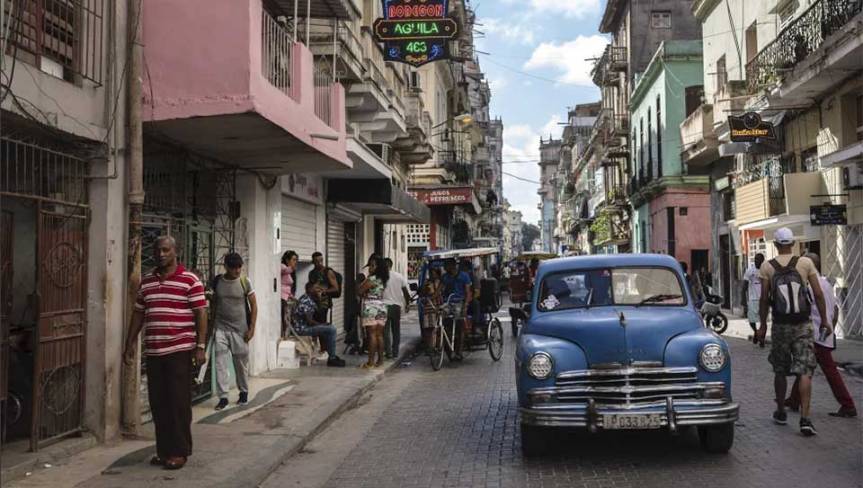
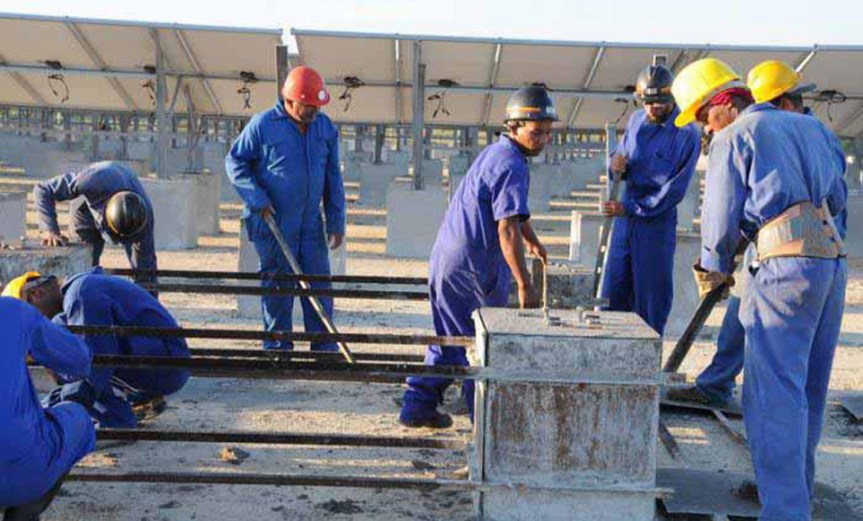


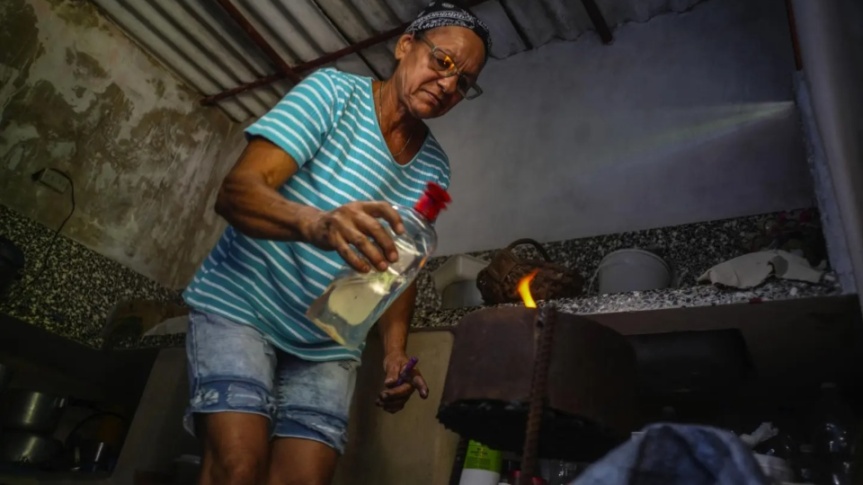


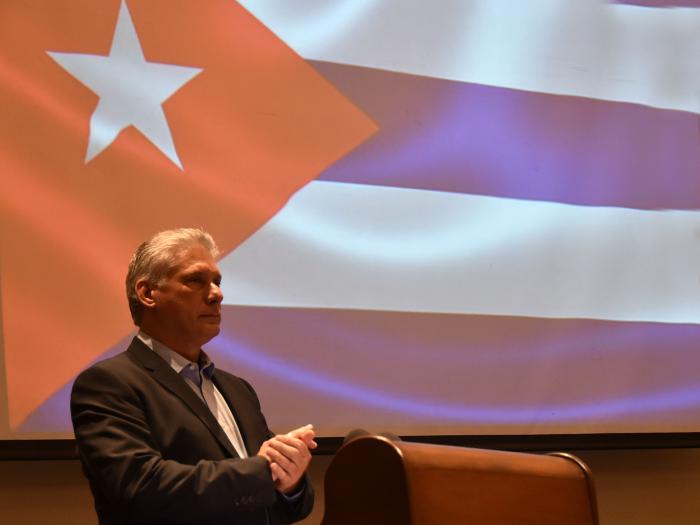
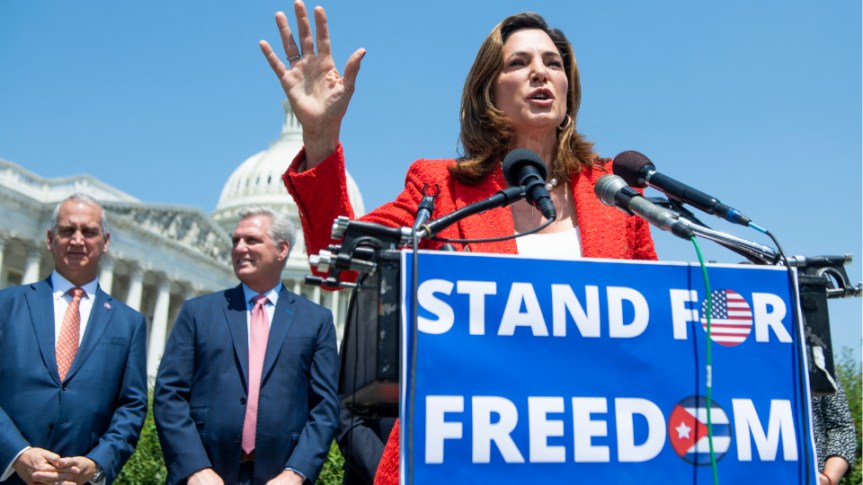
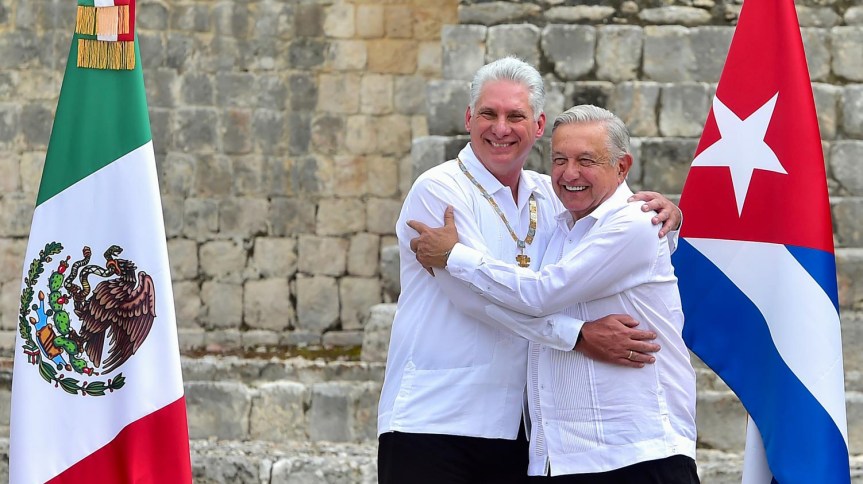


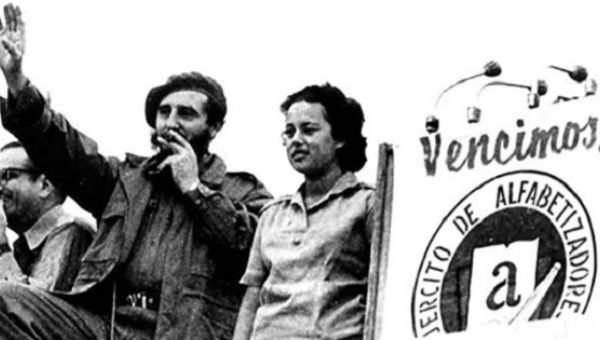


 COMMUNIST PARTY OF MAINE