
US Labor Must Weigh in on Cuba / By W.T. Whitney

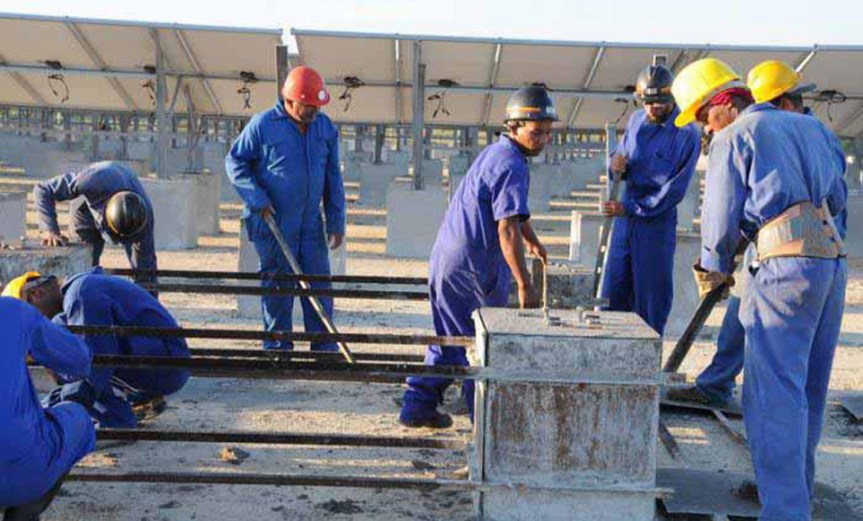
Photo credit: Juan Carlos Dorado

South Paris, Maine


Taking note of International Workers’ Day, several Latin American news sources this year cited José Martí’s 1886 essay “A Terrible Drama;” two of them republished it, here and here.  There Martí reports on events in Chicago in 1886 and the fate of the so-called Haymarket Martyrs – seven labor journalists and agitators railroaded to prison and given death sentences.  Another received a 15-year prison term.

Martí, who would become Cuba’s national hero, was living in exile in the United States. He relates how strikes for the eight-hour day were underway on May 1, 1886 in Chicago and nationwide, how the Chicago police killed one striker and wounded others on May 3, and how a mass protest against police violence took place the next day in the Haymarket area. There, a bomb exploded, seven policemen and four workers were killed, and dozens were wounded. 

The court lacked evidence that the defendants, anarchist by inclination, were involved in the violence of May 4. Martí describes the execution of four of them and the suicide of another. An appeals court judge commuted the sentences of two defendants to life in prison. In 1893, Illinois Governor John Altgeld pardoned those two and the remaining prisoner.

The Socialist International in 1889 declared May Day to be an annual celebration of labor militancy.

José Martí’account, “A Terrible Drama,” is a foundational contribution to the history of the U.S. labor movement. Martí defended working people – U.S. workers in his writings, and Cuban workers in words and deeds, from 1886 on. The combination of author and story points to a connection between U.S. labor activism and workers’ struggles in Cuba. Its time has come.

The U.S. economic blockade of Cuba, lasting decades, has led to shortages, misery, and despair. Nations of the world voting annually in the United Nations General Assembly overwhelmingly condemn the blockade. It violates international law.

Domestic opposition to U.S. policies on Cuba, while persistent, vigorous at times, principled, on-target, and diverse, has fallen short. U.S. government measures aimed at destabilization remain in force.  Upping power of the people with labor combativeness would make a difference.

Unions and labor activists know how to organize and how to confront recalcitrant political and economic leaders. They will be active on Cuba’s side, once they realize that working people’s struggles in the two countries are linked, or so our theory goes. In addition:

·        Labor unionists involved in struggle count on unity, the power of numbers, and sometimes solidarity from counterparts, often from abroad.

·        The current Cuban Revolution is the product of a revolutionary tradition. U.S. workers confronting their own government on Cuba would be expressing solidarity with a revolution whose progenitor, Jose Martí, defended U.S. workers fighting for the eight-hour day.  They would be paying back. 

·        Social revolution and ordinary labor struggles are battles of ideas. The writings of Martí, maximum leader of Cuba’s early revolution, speak to Cuban and U.S. workers alike. In that way they are connected.

Martí wrote about working people and their lives.  He contributed greatly to the ideas and substance of revolutionary struggle in Cuba and also defended African-descended and poverty-stricken Cubans with a seemingly unqualified egalitarianism. For example:

·        “And let us place around the star of our new flag this formula of love triumphant: ‘With all, and for the good of all.’”

·        “A nation having a few wealthy men is not rich, only the one where each of its inhabitants shares a little of the common wealth. In political economy and in good government, distribution is the key to prosperity.”

·        “In Cuba there is no fear whatever of racial conflict. A man is more than white, black, or mulatto. A Cuban is more than mulatto, black, or white … True men, black or white, will treat each other with loyalty and tenderness for the sake of merit alone.”

Workers are oppressed

Responding to the Haymarket affair in his “A Terrible Drama,” Martí reflects upon the situation of U.S. working people:

“The nation is terrified by the increased organization among the lower classes … Therefore the Republic decided … to use a crime born of its own transgressions as much as the fanaticism of the criminal in order to strike terror by holding them up as an example …. Because of its unconscionable cult of wealth, and lacking any of the shackles of tradition, this Republic has fallen into monarchical inequality, injustice, and violence …

“In the recently emerging West … where the same astounding rapidity of growth, accumulating mansions and factories on the one hand, and wretched masses of people on the other, clearly reveals the evil of a system that punishes the most industrious with hunger, the most generous with persecution, the useful father with the misery of his children – there the unhappy working man has been making his voice heard.”

Martí’s “A Terrible Drama” appeared in La Nación newspaper in Buenos Aires in January 1888, some 19 months after the Haymarket events. The delay may have stemmed from Martí’s ambivalence about the anarchist leanings of the accused. Previously published segments of his report do appear under the title “The First of May, 1886” in historian Philip Foner’s anthology of Martí’s writings published in 1977. Excerpts follow:

“Enormous events took place in Chicago, but rebellion exists throughout the nation. In the United States … a firm and active struggle has been in preparation for years … …[T]hings are not right when an honest and intelligent man who has worked tenaciously and humbly all his life does not have at the end of it a loaf of bread … or a dollar put away, or the right to take a tranquil stroll in the sunlight… Things are not right when the one who in the cities … lives a contemplative life of leisure so exasperating to the miner, the stevedore, the switchman, the mechanic, and to every wretched person who must be content with seventy-five cents day, in raw winter weather …Things are not right if shabby women and their pallid children must live in tenement cubicles in foul-smelling neighborhoods. …The reasons are the same. The rapid and evident concentration of public wealth, lands, communication lines, enterprises in the hands of the well-to-do caste that rules and governs has given rise to a rapid concentration of workers. Merely by being gathered together in a formidable community which can, at one stroke, extinguish the fires in the boiler and let the grass grow under the wheels of the machinery, the workers are able successfully to defend their own rights against the arrogance and indifference with which they are regarded by those who derive all their wealth from the products of the labor they abuse.”

Deeds and words

Martí acted on behalf of working people. He organized Cuba’s independence struggle that culminated in war with Spain in early 1895. Under his leadership, the process became a social revolution.

From exile in New York, Martí outlined goals, strategies, and methods. Traveling widely, he arranged for Cuban exiles in the United States, Central America, and the Caribbean – many of them workers, many African-descended – to select the revolution’s leadership, provide funding and supplies, and approve goals and proposals. Martí persuaded the military heads to accept civilian leadership. He created and edited the independence movement’s newspaper Patria.

Aware of U.S. aspirations to dominate Cuba and the entire region, Martí led in confronting U.S. imperialism – never good for workers. In 1891 he wrote “Our America,” an essay demonstrating commonalities among diverse peoples inhabiting all the land extending from the Rio Bravo (the Rio Grande) south to Patagonia. Martí highlighted their shared cultural and political orientations that set them apart from U.S. and European societies.

In a letter to a friend shortly before he was killed in battle on May 19, 1895, Martí insisted that: “It is my duty … to prevent, by the independence of Cuba, the United States from spreading over the West Indies and falling, with that added weight, upon the other lands of Our America.”

Attacking military installations of the Batista regime on July 26, 1953, revolutionaries led by Fidel Castro were honoring José Martí, born 100 years earlier. For Castro, Martí was “the Apostle of Independence … whose ideas inspired the Centennial Generation and today inspire and will continue to inspire all of our people more and more.”

For the sake of justice and in view of connections with Cuban workers, U.S. working people would do well to press upon their government the necessity to end the blockade of Cuba. Labor unions, the principal means for expression of workers’ sentiment and power, have prime responsibility in this regard.

They would be acting as did West Coast dockworkers who blocked arms shipments to Chile under the Pinochet dictatorship, cargo arriving from apartheid-ridden South Africa, and, recently, arms shipments bound for Israel. U.S. unionists actively opposed their government’s support for authoritarian El Salvador in the 1980s and supported Iraqi workers after the U.S. invasion there. They collaborated with Mexican miners and other workers over many years. Recently U.S. unions issued statements and approved resolutions calling for a ceasefire in Gaza.  


W.T. Whitney is a political journalist whose focus is on Latin America, health care, and anti-racism. A Cuba solidarity activist, he formerly worked as a pediatrician, lives in rural Maine. W.T. Whitney Jr. es un periodista político cuyo enfoque está en América Latina, la atención médica y el antirracismo. Activista solidario con Cuba, anteriormente trabajó como pediatra, vive en la zona rural de Maine.

How to Ease the Migration Crisis: End US Economic Sanctions / by W.T. Whitney Jr.

Migrants wait to be processed by US Border Patrol after crossing the US-Mexico border in Yuma, Arizona, July 2022. (Allison Dinner / AFP via Getty Images)

South Paris, Maine


Top officials of 11 Latin American and Caribbean governments met October 22 in Chiapas, Mexico to deal with the flood of migrants heading to the United States. There was agreement that U. S. interventions in their region fuel migration.  A report from Chicago, released two days earlier and discussed here, concluded similarly.  

The goal of the meeting called by Mexican president Andrés Manuel López Obrador was to form a regional block tasked with finding solutions. Presidents on hand, besides AMLO, were Xiomara Castro of Honduras, Miguel Díaz-Canel of Cuba, Gustavo Petro of Colombia, and Nicolás Maduro of Venezuela.

The joint statement emerging from the meeting outlined baseline assumptions: 

  • “The main structural causes of migration have political, economic, and social origins, to which the negative effects of climate change are added.” 
  • “Unilateral, coercive policies from the outside are by nature indiscriminate; they affect entire populations adversely.”

The statement concluded with an agreement covering 14 points, among them: further development of an action plan, mutual cooperation, attention to commercial relationships, demands put on destination countries, respect for human rights, protection of vulnerable populations, the special case of Haiti, and a plea that the Cuban and U.S. governments “comprehensively discuss their bilateral relations.”  

AMLO declared that “unilateral measures and sanctions imposed against countries in the region, particularly Venezuela and Cuba, contribute to instigating migration,” also that the U.S. government has to “dialogue with us.”  

The Great Cities Institute, a research center at the University of Illinois at Chicago, on Oct 20 released a report prepared by journalist Juan González. It analyzes recently-imposed economic sanctions and U.S. assaults over many years against regional governments.

The report concludes that “U.S. foreign policy toward Latin America …[and] sanctions directed at Venezuela, Cuba and Nicaragua, have played a major role in crippling theeconomies of those three nations, thus fueling for the past two years an unprecedented wave of migrants and asylum seekers from those countries that have appeared at our borders.”

Undocumented Mexican immigrants are shown to have represented 70% of all undocumented immigrants in 2008 but only 46 % in 2021. It appears that, later on, most unauthorized migrants entering the United States came from Honduras, Guatemala, and El Salvador.

Then Venezuelans “apprehended at the border” increased from 4,500 in 2020 to “more than 265,000 in the first 11 months FY 2023.” There were 3,164 undocumented Nicaraguans crossing the border in 2020 and 131,831 two years later. 14,000 Cubans crossed in 2020; 184,00 did so in 2023. In fact, “more Cubans have sought to enter the U.S. during the past two years than at any time in U.S. history.”

The report indicates that the three countries supplying these migrants “have been targeted by Washington for regime change through economic sanctions, a form of financial warfare that has only made life worse for their citizens.”

Note is taken of Venezuela’s GDP falling 74% over eight years and of $31 billion in oil revenues lost between 2017 and 2020. Venezuela must import most of the pharmaceuticals, medical supplies, and food it needs, according to the report. Funds for importing goods and for maintaining oil production derives from oil exports, which are blocked by U.S. sanctions. Shortages mounted, people suffered, and even died. Venezuelans reacted by leaving.

The Obama administration instituted sanctions in 2015 and President Trump added more afterwards. The sanctions block access to international credit, punish owners of foreign ships entering Venezuelan ports, and prevent income generated in the United States by Venezuela’s Citgo oil company from being repatriated.

The U.S government, according to the report, “is virtually alone in the world” in having unilaterally pursued such a lengthy economic blockade against Cuba. The U.S government punishes “an entire population for a political purpose.”  

The report notes that, “Cubans have garnered far less nationwide attention [than Venezuelan migrants] because they tend to settle in just one part of the country.” The real reason is that the Cuban Adjustment Act of 1966 provides undocumented Cubans with permanent residence a year after their arrival, and until then with work permits. The legislation, magnet-like, draws Cubans to the United States.

Cuban President Miguel Diaz-Canel, speaking at the Chiapas meeting denounced U.S. “coercive measures aimed, by definition, at depressing the standard of living of the Cuban population, reducing their real income and making them suffer hunger and misery.”

One learns that in Nicaragua after 2006, when the socialist-oriented Sandinistas returned to power, poverty diminished and food supplies increased.  Migration to the United States remained very low. Then, in 2018, protests erupted, with violence and deaths.

The report points out that “investigative journalists” viewed the uprising as “an attempted violent coup organized by U.S.- funded dissident groups.” But the U.S. government saw the Sandinista government as violating human rights and instituted sanctions, strengthening them in 2021.  International loans were now off limits and countries assisting Nicaragua would be punished. Emigration skyrocketed.

Juan González, who prepared the report, recalls having “documented in a previous study, [that] the largest migrations from Latin America over the past sixty years have come precisely from those countries the U.S. has repeatedly occupied and most controlled.”

The report catalogues U.S. interventions, among them: Guatemala, 1954; Cuba, Bay of Pigs, 1961; Dominican Republic, 1965; Chile, coup, 1973; Nicaragua, Contra war, 1980s; Panama, 1989; Venezuela, failed coup, 2002; Honduras, rightwing coup, 2009.

The report offers recommendations for easing the migration crisis. One is to end “economic warfare against Venezuela, Cuba and Nicaragua.” Another is to provide “expedited work permits” to recently arrived migrants and to long-term undocumented immigrants. The report asks that, “our government listen to the rest of the world community and end its destructive embargo against Cuba.”

The United Nations General Assembly will soon vote on a Cuban resolution calling for no more blockade. It has approved the resolution annually for 30 years, overwhelmingly so in recent years. The U.S. government does not listen.

Discussing his report on Democracy Now, Juan González provided a rationale for ending the various economic blockades that, based on cost-benefit analysis, ought to resonant with capitalists in charge of our national affairs.

He pointed to U.S. government spending of $333 billion between 2003 and 2021 “for immigration enforcement and for ICE and Border Patrol and fences.” It makes sense: ending U.S. economic sanctions would result in far fewer migrants at the southern border and, potentially, a big cost saving. 


W.T. Whitney Jr. is a political journalist whose focus is on Latin America, health care, and anti-racism. A Cuba solidarity activist, he formerly worked as a pediatrician, lives in rural Maine. W.T. Whitney Jr. es un periodista político cuyo enfoque está en América Latina, la atención médica y el antirracismo. Activista solidario con Cuba, anteriormente trabajó como pediatra, vive en la zona rural de Maine.

China, Brazil Lead in Chipping Away at U.S. Economic Power Abroad / By W. T. Whitney Jr.

United States hegemony in Latin America is in question | credit Prensa Latina


The United States proclaimed the Monroe Doctrine 200 years ago and ever since has arranged Latin American and Caribbean affairs to its advantage. Nevertheless, struggles for national and regional independence did continue and the poor and marginalized classes did resist. Eventually there would be indigenous movements, labor mobilizations, and progressive and socialist-inclined governments. Cuba’s revolutionary government has endured for 63 years.

The U.S. political hold may have weakened, but U.S. control over the region’s economies remains strong; after World War II it extended worldwide.  Now cracks are showing up. In particular, the U.S. dollar’s role as the world economy’s dominant currency may have run its course. 

In 1944, 44 allied nations determined that the value of their various currencies would correlate with the value of the U.S. dollar instead of the value of gold. The nations since then have relied on the U.S. dollar for their reserve currencies, for foreign trade and in banking transactions.

There seemed to be good reason. The United States was supreme in producing and marketing goods and so, presumably, the dollar’s value would remain stable and predictable. The dollar would be readily accessible to bankers and traders and its valuation would be unambiguous. Nations could also build their currency reserves through the dollars they accumulated in the form of bonds sold by an increasingly indebted United States.  

The United States has benefited. In currency exchanges involving the dollar, U.S. companies and individuals experience only minor add-on costs. U.S. importers know that the more the dollar strengthens in value, the less expensive will be products they buy abroad. U.S. borrowing costs overseas are relatively low because U.S. bonds, and the investments they represent in dollars, are appealing abroad, for a variety of reasons.

Dollar dominance has caused pain abroad. Exporters to the United States take a hit when the exchange value of the dollar weakens. Importers of U.S. goods are hurt when the dollar strengthens.

Most importantly, the U.S. government gains an opening to punish enemy countries through their use of dollars in international transactions. It imposes economic sanctions requiring that dollars not be used in a targeted country’s overseas transactions. The U.S. Treasury Department penalizes foreign banks and companies that disobey. Sanctioned nations have included Cuba, Iran, North Korea, Syria, Venezuela, Nicaragua, and more recently, China and Russia.

The U.S. government’s frequent resort to economic sanctions has greatly contributed to new stirrings on behalf of a new international currency system. Confiscation of currency reserves deposited in U.S. and European banks that belong to Iran, Venezuela, and Afghanistan have likewise encouraged calls for change.

On March 29 China and Brazil announced they would use their own currencies in trading with each other. China is Brazil’s biggest trade partner.  China’s renminbi currency presently constitutes a major share of Brazil’s currency reserves.

Earlier in 2023, Brazil and Argentina proposed cooperation toward creating a common currency for themselves.  At the January meeting of the Community of Latin American and Caribbean States (CELAC), Brazilian President Lula da Silva opined that, “If it were up to me, I would promote a single currency for the region.” He would call it the “SUR” (South).  The ALBA regional alliance in 2009 proposed an electronic currency called the “Sucre” aimed at reducing dollar dependency.

Former Brazilian President Dilma Rousseff is the recently named head of the New Development Bank which, headquartered in Shanghai, serves the BRICS nations (Brazil, Russia, India, China, and South Africa). The bank represents an alternative to the U.S. -dominated International Monetary Fund and the World Bank.

The shift away from dollar dependency is evident elsewhere. At a Russian-Indian “Strategic Partnership …Forum” recently, a Russian official announced that the BRICS states would be creating a new currency and that the formal announcement would be made at the BRICS summit meeting in Durban South Africa in August.

The BRICS countries account for “40% of the global population and one-fourth of the global GDP.” According to People’s Dispatch, Iran and Saudi Arabia, having recently signed a peace accord, will soon be joining BRICS.  Egypt, Algeria, the UAE, Mexico, Argentina, and Nigeria apparently are giving consideration.  The values of new currencies will rest not on another currency but on the value of “products, rare-earth minerals, or soil.”  

Iran and Russia in January agreed on methods useful for bypassing the SWIFT banking system, the U.S. tool for servicing its dollar dominance.  To evade U.S. sanctions, the two countries reply on their own currencies for most transactions.

At their summit in March, Russian and Chinese leaders reiterated their intention to expand bilateral trade and utilize their own currencies. China increasingly is using its own currency in transactions with Asian, African, and Latin American countries. The yuan “has become the world’s fifth-largest payment currency, third-largest currency in trade settlement and fifth-largest reserve currency,” according to Global Times.

Saudi Arabia is on the verge of selling oil and natural gas in currencies other than the dollar, and China occasionally pays Arabian Gulf nations in yuan for those products.   

The finance ministers and governors of the central banks of the member states of the Association of Southeast Asian Nations (ASEAN) met in Indonesia on March 28. At the top of their agenda were “discussions to reduce dependence on the US Dollar, Euro, Yen, and British Pound from financial transactions and move to settlements in local currencies”. The ASEAN nations, an alliance of 10 southeast Asian nations, are developing a digital payment system for member states’ transactions.

Dollar dominance may be losing its appeal closer to home.  Former Goldman Sachs chief economist Jim O’Neill claims that, The U. S. dollar plays a far too dominant role in global finance … Whenever the Federal Reserve Board has embarked on periods of monetary tightening, or the opposite, loosening, the consequences on the value of the dollar and the knock-on effects have been dramatic.”

Gillian Tell, chair of the Financial Times’ editorial board notes that, “concerns are afoot that this month’s US banking turmoil, inflation and looming debt ceiling battle is making dollar-based assets less attractive.” Plus, “a multipolar pattern could come as a shock to American policymakers, given how much external financing the US needs.”

There are wider implications. Argentinian economist Julio Gambina bemoans “disorder in the world economy …[and] this attitude of unilateralism represented by the US sanctions.” Interviewed on March 29, Gambina points out that “wealth has a father and a mother: labor and nature.”

He adds that, “Latin America and the Caribbean … where inequality is growing the most …  have a highly skilled working class, willing to carry forward the production of wealth. We have the resource of assets held in common for sovereign development through which the interests of our peoples and the reproduction of nature, life and society are defended.”


W.T. Whitney Jr. is a political journalist whose focus is on Latin America, health care, and anti-racism. A Cuba solidarity activist, he formerly worked as a pediatrician, lives in rural Maine. W.T. Whitney Jr. es un periodista político cuyo enfoque está en América Latina, la atención médica y el antirracismo. Activista solidario con Cuba, anteriormente trabajó como pediatra, vive en la zona rural de Maine.

US General Hypes China as Threat in Latin America / By W.T. Whitney Jr.


The U.S. government has long intervened in Latin America and the Caribbean (LAC). Now the U.S. military is paying attention to China’s economic activities there. 

General Laura Richardson on March 8 reported to the Armed Services Committee of the U.S. House of Representatives on actions and needs of the Southern Command, which she heads. She has charge of all U.S. military operations in the region. 

Citing the 2022 National Security Strategy, Richardson declared that “no region impacts the United States more directly than the Western Hemisphere …. [There] autocrats are working overtime to undermine democracy.” And security there “is critical to homeland defense.”

Richardson stated that “the PRC (People’s Republic of China) has both the capability and intent to eschew international norms, advance its brand of authoritarianism, and amass power and influence at the expense of the existing and emerging democracies in our hemisphere.” The Southern Command’s “main priority … is to expose and mitigate PRC malign activity.”

She sees a “myriad of ways in which the PRC is spreading its malign influence, wielding its economic might, and conducting gray zone activities to expand its military and political access and influence.” A “grey zone,” according to the NATO-friendly Atlantic Council, is a “set of activities … [like] nefarious economic activities, influence operations, … cyberattacks, mercenary operations, assassinations, and disinformation campaigns.”

Richardson highlighted China’s trade with LAC that is heading toward “$700 billion [annually] by 2035.” The United States, in her view, will be facing intense competition and presently “its comparative trade advantage is eroding.”

She added that, “The PRC’s efforts to extract South America’s natural resources to support its own population … are conducted at the expense of our partner nations and their citizens.” And opportunities for “quality private sector investment” are disappearing.

Competition extends to space: “11 PRC-linked space facilities across five countries in this region [enable] space tracking and surveillance capabilities.” Richardson complained of “24 countries [that] have existing Chinese telecommunication infrastructure (3G/4G), increasing their potential to transition to Chinese 5G.” 

She expressed concern both about surveillance networks supplied by China that represent a “potential counterintelligence threat” and about Latin Americans going to China “to receive training on cybersecurity and military doctrine.” Richardson denounced China’s role in facilitating environmental crimes and pointed to “potential dual use for malign commercial and military activities.”

“Relationships absolutely matter,” she insisted, “and our partner democracies are desperate for assistance from the United States.” Plus, “if we’re not there in time, they … take what’s available, creating opportunities for the PRC.”

Moving beyond China, Richardson indicated that “many partner nations …  see TCOs (transnational criminal organizations) as their primary security challenge.” That’s because drug-cartel violence leads to deaths and poverty and “illicit funds exacerbate regionalcorruption, insecurity, and instability.”

Her report avoids mention of particular countries other than offering brief references to Haiti, Cuba, Nicaragua, and Venezuela. She criticized Russia for “military engagements with Venezuela and Nicaragua” and for spreading “false narratives.” Richardson praised Colombia for providing military training in other countries. 

The Southern Command gains “exponential return” on supplying various countries with U.S. weapons and supplies. It conducts joint military exercises, and “provides professional military education to personnel from 28 countries.”

Richardson reported at length on processes she sees as fostering useful relationships between her command and the various governments and military services. The tone of urgency characterizing her discussion on China was entirely lacking. 

Economic intervention

General Richardson’s view that China has greatly expanded its economic involvement with the LAC nations is on target.

Since 2005, China’s state-owned banks have arranged for 117 loans in the region worth, in all, more than $140 billion. They averaged over $10 billion annually. Since 2020, China has made fewer loans.

Chinese trade with Latin America grew from $12 billion in 2000 to $448 billion in 2021. China’s imports of “ores (42%), soybeans (16%), mineral fuels and oils (10%), meat (6%), and copper (5%)” totaled $221 billion in 2021. The value of exported manufactured goods that year was $227 billion. By 2022, China had become the biggest trading partner in four Latin American countries and the second-largest in many others.  

China’s foreign direct investment (FDI) has long represented China’s strongest economic tie to the region. FDI signifies funding of projects abroad directed at long-term impact. China’s FDI from 2005 to mid-2022 was $143 billion. Energy projects and “metals/mining” accounted for 59% and 24% of the total, respectively. Of that total, Brazil and Peru received 45% and 17%, respectively. 

The FDI flow since 2016 has averaged $4.5 billion annually; worldwide, China’s FDI has contracted.

Chinese banks and corporations have invested heavily in lithium production in Argentina, Bolivia, and Chile, which, together, account for 56% of the world’s lithium deposits. China is the largest investor in Peru’s mining sector, controlling seven large mines and owning two of Peru’s biggest copper mines. Brazil is the world’s largest recipient of Chinese investments.  

China’s government has linked FDI to its Belt and Road Initiative (BRI) that began in 2013. As of May 2022, 21 Latin American and Caribbean countries were cooperating with the BRI and 11 of them had formally joined.

On the ground

U.S. military intervention in LAC is far from new. Analyst Sergio Rodríguez Gelfenstein complements Richardson’s report with a three-part survey, accessible herehere, and here, of recent U.S. military activities in the region.

He indicates the United States now has “12 military bases in Panamá, 12 in Puerto Rico, 9 in Colombia, 8 in Perú, 3 in Honduras, 2 in Paraguay, as well as similar installations in Aruba, Costa Rica, El Salvador, Cuba (Guantánamo), and in other countries.”

Rodríguez maintains that, “levels of aggressive interference by Washington in the region have increased dramatically” and that U.S. embassies there are supplied with more military, Cuba, Nicaragua, and CIA personnel than ever before.

Rodríguez notes features of the LAC region that attract U.S. attention, among them: closeness to strategically-important Antarctica; reserves of fresh water and biodiversity in Amazonian regions; the Guarani Aquifer near the triple frontier of Brazil, Paraguay, and Argentina, the largest in the world; and huge reserves of valuable natural resources.

Among ongoing or recent U.S. military interventions are these:

·        The U.S. Army Corps of Engineers is implementing a “master plan” for navigability of the Paraguay River and Plata River Basin. The nearby Triple Frontier area supposedly harbors international terrorism and drug-trafficking.

·        The U.S. military facility in Neuquén, Argentina is turning from its alleged humanitarian mission to activities in line with local preparations for oil extraction.            

·        U.S. officials on October 13, 2022 announced that 95 military vehicles were being donated to Guatemala for drug-war activities.   

·        In Brazil in September 2022, General Richardson indicated that U.S. forces would join Brazilian counterparts to fight fires in the Amazon..

·        The Southern Command’s fostering of good relations with Peru’s military has borne fruit. Under consideration in Peru’s Congress is a proposal to authorize the entry of foreign military forces. To what nation would they belong? Hint: former CIA operative and U.S. Ambassador Lisa Kenna met with Peru’s Defense Minister the day before President Pedro Castillo was removed in a parliamentary coup on December 7, 2022.

·        In March 2023, two U.S. congresspersons proposed that U.S. troops enter Mexico to carry out drug-war operations.

·        Presently the United States is making great efforts to establish a naval base on Gorgona island off Colombia’s Pacific coast. It would be the ninth U.S. base in Colombia, a NATO “global partner.”

·        In Colombia, U.S. troops acting on behalf of NATO, are active in that country’s Amazon region supposedly to protect the environment and combat drug-trafficking.

·        The U.S. National Defense Authorization Act of December 2022 awarded the Southern Command $858 million for military operations in Ecuador.

·        In a second visit, the US Coast Guard Cutter Stone was plying Uruguayan waters in February ostensibly to train with local counterparts for search and rescue operations. The ship was also monitoring the nearby Chinese fishing fleet.

Rodríguez does not comment on U.S. interventions in Cuba, Nicaragua, and Venezuela. That’s because they’ve persisted for “more than 60, 40, and 20 years, respectively” and each requires a “special report.”

John Quincy Adams returns

Proclaiming the Monroe Doctrine 200 years ago, Secretary of State Adams informed European powers that the United States regarded “any attempt on their part to extend their system to any portion of this hemisphere as dangerous to our peace and safety.”

General Richardson would apply the warning of that era to the PRC. Yet signs of hegemonic aspirations from that quarter are absent.

Commenting recently, Argentinian economist and academician Claudio Katz notes that, “China concentrates its forces in the economic arena while avoiding confrontations at the political or military level … Investments are not accompanied by troops and bases, useful for guaranteeing return on investments.”

Besides, China “does business with all governments, without regard to their internal politics.” That tendency, Katz writes, stems from the PRC having “arisen from a socialist experience, having hybrid characteristics, and not completing a passage to capitalism.” He maintains that China, with its economic involvement, contributes nothing to advancing socialism in the region.   


W.T. Whitney Jr. is a political journalist whose focus is on Latin America, health care, and anti-racism. A Cuba solidarity activist, he formerly worked as a pediatrician, lives in rural Maine. W.T. Whitney Jr. es un periodista político cuyo enfoque está en América Latina, la atención médica y el antirracismo. Activista solidario con Cuba, anteriormente trabajó como pediatra, vive en la zona rural de Maine.

Migration as Sign of Climate-Change Impact in the Global South / by W. T. Whitney Jr.

Source: The African Union Mission in Somalia

U.S. government programs for migrants who crossed the U.S. southern border are punitive and disjointed. Left-leaning political groupings may criticize, but they too have fallen short in conceptualizing lives of dignity for migrants in the United States. Nor do they adequately take into account adverse circumstances weighing on migrants’ lives in their home countries.

First among forces pushing masses of people northward is the environmental crisis. The role of climate change in reducing soil productivity and food availability and in predisposing already beleaguered people to migrate is of great concern.  

One assumption here is that capitalist systems of production and consumption have been central to causing the climate to change for the worse. Another is the need for war on capitalism so as to stave off more climate change and cope with its fallout. That hasn’t happened in the industrialized northern countries.

Southern regions may be different. The excesses of capitalist globalization have hurt masses of people there. They were never afforded the relief northern peoples gained from welfare-state remedies. They may be ready to take up the climate-change fight.

Northern climate-change warriors who are anti-capitalist ought to be establishing linkages of support with their southern counterparts. One precedent for them is Spain.  Anti-fascists in 1936 joined the International Brigades to defend the Spanish Republic.  Now, in one way or another, northerners would be joining a faraway fight, this time against climate change.  One locality is Guatemala. 

Storytelling

Author Ilka Oliva Corado describes herself as an “indigenous, undocumented immigrant in the United States.” An English-language version of her story, which is situated in Guatemala and titled “The Plum,” appears here. Excepts follow: 

Guillermina leaves the grocery bags on the table and hurriedly takes out a plum, washes it and takes a bite … She is grateful for the hands that cared for it from the time the seed of the tree was planted. Ever since she was a child, her peasant grandparents taught her to be thankful for the labor of those who work on the land.

She was from Parramos, Chimaltenango, in Guatemala. When she arrived in the United States, she was speaking only her mother tongue, Cakchiquel. … She spent 20 years working as a domestic worker in New York. … Guillermina left Guatemala with her brother Jacobo to help her parents raise her younger siblings … She was on the eve of her fifteenth birthday when she left her indigenous clothing behind and packed two pairs of pants and two T-shirts in her backpack …

(Oliva Corado writes that the traffickers sexually abused Guillermina and her brother as they traveled in Mexico, from Chiapas to Tijuana.) “She doesn’t know what happened to her memory. But she managed to block all recall of the journey after they arrived in Tapachula [in Chiapas].” (The author writes that Jacobo was similarly abused. He remembers, has nightmares, and sleeps fitfully at night.)  

He works three jobs. Every Friday they collect their money so that Guillermina can send off the remittance. Neither of the two will allow their younger siblings to emigrate. At home … they work the land of their grandparents, but Miguel, the youngest, didn’t listen to them and emigrated with another group of friends. He wanted to leave to help his older siblings deal with the economic burden of the house. Now he’s been missing for three years. 

Guillermina bites into the plum that takes her back to remembering the bean fields, shade from the avocado and orange trees, and furrows in the cornfields.  It was there she saw her younger siblings beginning to walk while her parents were working.

Plum juice drips from the corner of her lips. … But tasting the fruit that Miguel loved so much sets off the pain that for three years has been knotted in her throat and she begins to cry inconsolably.

It was in the supermarket that she received the call from Jacobo. There is news of Miguel. A forensic team did tests and they have confirmed his identity. A humanitarian rescue team searching months ago for a missing migrant woman found his bones in a dry river in Sonora. Her parents will be able to bury their young son in the town cemetery, finally.

Context

The family’s land may not have been producing enough food to satisfy nutritional needs, nor enough to sell and provide cash. International agencies concerned about food shortages use a scale that registers severity. It consists of phase 1 – no significant problem; phase 2 – stress; phase 3 – crisis; phase 4 – emergency; and phase 5 – widespread acute malnutrition.

The 2022 Global Report on Food Crises, assembled by United Nations agencies, reported on trends in Guatemala, population 16.9 million. In November, 2018, 2.12 million Guatemalans were classified as experiencing food “crisis.” The corresponding figures in August, 2000 and in May, 2021 were 3.24 million and 3.29, respectively.  As of those dates, there were 4.67 million, 7.21 million, and 7.78 million people, respectively, who endured food stress. A recent report indicates that, as of September 2021, 4.6 million Guatemalans were facing food crisis (phase 3) or food emergency (phase 4).

The World Meteorological Organization, reporting in July on the impact of climate change in Latin America and the Caribbean, points out that, “Droughts, heat waves, periods of cold, more tropical storms and floods have led to loss of life, serious damage to agricultural production and infrastructure, and displaced populations.” 

The authors of another detailed report on the region’s “Climate Change Emergency” state that, “the present bimodal pattern of precipitation in Central America may be distorted in the coming decades … Extreme phenomena like droughts, hurricanes, and the Niño Southern Oscillation will be recurring … and their intensity will increase with climate change .. These phenomena magnify social-economic vulnerability in the region.” 

A survey of the impact of changing climate in Guatemala claims that drought “mostly afflicts the semi-arid region of the country known as the “dry corridor,” and that “in the coming years, that area is expected to extend to higher elevations.” Recently rain has been uncharacteristically scarce or absent during heat waves.

Rural families in Guatemala grow or produce food from their own land. Family members may also work seasonally on big farms to be able to purchase additional food, or they fish or hunt. High poverty rates underscore the vulnerability of their lives – 70% in Guillermina’s Chimaltenango department and nearly 80 percent among Guatemala’s indigenous population. Now the impact on food supplies of droughts, storms, and floods – which are more severe now because of climate-change – adds to their plight.

Many Guatemalans and others in the Global South have to move. They go to big cities or they cross national borders to begin new lives, and/or earn money to support families at home. Plenty of other reasons to migrate do exist such as land grabs, governmental chaos, and violence from criminals, gangs, paramilitaries, and soldiers. 

But migration undertaken in response to climate-change effects is highly significant, so much so that victims are everywhere, and in the millions. On that account, the prospect emerges of mass political mobilization and of growing awareness along the way of capitalism as enemy.

Capitalist-inspired intrusions already fill the landscape with mines and oil-extraction facilities, dams and flooded rivers, pollution, mega land-holdings and mono-culture farming operations. U.S. political interference, debt owed foreign banks, privatizations, and cuts in social spending have provoked opposition movements.  Growing appreciation of linkage between these manifestations of global capitalism and capitalism’s contribution to climate change may serve to stimulate anti-capitalist resistance movements that are ready to take on the environmental crisis.

This possible scenario in the Global South ought to resonate with anti-capitalist activists in the North. The great need is for international solidarity. Author, editor, and eco-socialist John Bellamy Foster offers perspective in his recently published article titled “Ecology and the Future of History.” Excerpts follow:

“The agent of revolution is increasingly a class that is not to be conceived in its usual sense as a purely economic force but as an environmental (and cultural) force: an environmental proletariat …[and] Most of the major class struggles and revolutionary movements over the centuries of capitalist expansion have been animated in part by what could be called ecological imperatives – such as struggles over land, food and environmental conditions.”

He adds: “In general, Third World liberation movements have been aimed at both the environment and economy and have been struggles in which peasants and Indigenous peoples have played central roles, together with nascent proletarian and petty bourgeois forces …[and] All material struggles are now environmental-class as well as economic-class struggles, with the separation between the two fading.”

Finally, “The objective consequence of the changing social and ecological environment, the product of uncontrolled capitalist globalization and accumulation, arising from forces at the center of the system, is inevitably to create a more globally interconnected revolutionary struggle: a new eco-revolutionary wave emanating primarily from the Global South.”


W. T. Whitney Jr. is a political journalist whose focus is on Latin America, health care, and anti-racism. A Cuba solidarity activist, he formerly worked as a pediatrician, lives in rural Maine. W.T. Whitney Jr. es un periodista político cuyo enfoque está en América Latina, la atención médica y el antirracismo. Activista solidario con Cuba, anteriormente trabajó como pediatra, vive en la zona rural de Maine.