Brazilian Workers Lead in Offering Solidarity to Venezuelans under US Attack / By W.T. Whitney Jr.

The leader of Brazil’s Landless Rural Workers’ Movement (MST), João Pedro Stédile, declares solidarity with the Venezualan government and people as they are threantened by a U.S. military intervention | Photo credit: brasildefato.com

South Paris, Maine


Since August, U.S. warships, fighter planes, and troops have deployed in Caribbean waters off Venezuela and in Puerto Rico. Venezuela’s neighboring countries in Latin America and the Caribbean area are reacting variously. Many oppose U.S. aggression, but at a distance.  Others are either non-committal or accepting.

Colombia and Brazil are backing Venezuela – or soon will be –  in very different ways. Recent remarks of João Pedro Stédile, co-founder and a director of Brazil’s Landless Workers’ Movement (MST), warrant special attention.

U.S. attacks from the air have killed dozens of crew members of boats alleged to be carrying illicit drugs. U.S. accusations against Venezuelan President Nicolás Maduro that he is a top-level drug dealer, serve as pretext. The U.S. government now offers a $50 million reward for his capture. The allegation that he heads the drug-dealing Cartel de los Soles is false. The cartel doesn’t exist, according to a United Nations report. A U.S. coup plotter recently claimed the CIA created the cartel.

President Trump recently indicated the CIA would be operating inside Venezuela. It’s widely assumed that the U.S. government wants control of Venezuela’s oil and other resources and is contriving to remove a government heading towards socialism.

Venezuela’s government is training militia troops by the millions. Venezuelan defense minister Vladimir Padrino López announced on October 21 that Venezuela’s’ military will cooperate with Colombian counterparts to fight narcotrafficking. Relations between the two nations are quickly improving.

They had deteriorated after Colombia’s government backed accusations that Venezuela’s 2024 presidential elections were fraudulent. But on August 10, Colombian President Gustavo Petro stated on social media that, “Colombia and Venezuela are the same people, the same flag, the same history. Any military operation that does not have the approval of our sister countries is an act of aggression against Latin America and the Caribbean.” Petro recently announced the Colombian military will be sharing military intelligence with Venezuela.

U.S. vilification extends to Petro who, speaking at the United Nations General Assembly on September 23, condemned U.S. support of Israel’s war on Gaza and U.S. imperialism generally. He railed against the U.S. at a rally outside the UN Headquarters. In response, the U.S. government revoked his visa.  Petro had previously refused to accept Colombian deportees sent handcuffed from the United States in a military plane.

International solidarity

On October 18, Petro accused the United States of killing a Colombian fisherman and violating Colombian sovereignty. Responding, President Trump called Petro “an illegal drug dealer … [who] does nothing to stop” drug production. He imposed import tariffs and suspended subsidies granted Colombia for drug-war activities. Petro recalled Colombia’s ambassador in Washington.

Colombia may be on Venezuela’s side, but that’s not clear with other countries in the region. Colombia, president pro tempore of the CELAC group of nations, arranged for a virtual meeting of CELAC foreign ministers to reach a common position. In 2014, the Community of Latin American and Caribbean States – CELAC –had declared the entire region to be a “zone of peace.”  

At the meeting taking place on September 1, representatives of the 23 CELAC nations present (out of 33) considered a general statement that filed to mention the U.S. -Venezuela confrontation. It expressed support for “principles such as: the abolition of the threat or use of force, the peaceful resolution of disputes, the promotion of dialogue and multilateralism, and unrestricted respect for sovereignty and territorial integrity.”

Most of the countries voting approved, but Argentina, Ecuador, Paraguay, Perú, Costa Rica, El Salvador, Guyana, Jamaica, and Trinidad and Tobago did not.

Member nations of the Bolivarian Alliance for the Peoples of Our America–Peoples’ Trade Treaty (ALBA-TCP) did condemn US military action in the Caribbean. The CARICOM group of Caribbean nations, meeting in late October, expressed support “for the sovereignty and territorial integrity of countries in the region,” again without reference to  the United States and Venezuela. Trinidad and Tobago was an outlier: Prime Minister Kamla Persad-Bissessar insisted that, “I have no sympathy for traffickers; the US military should kill them all violently.”

Regional presidents spoke out against U.S. intervention, specifically: Mexican president Claudia Sheinbaum; Honduras’s president  Xiomara Castro, Daniel Ortega, co-president of Nicaragua, and Brazilian president Luiz Inácio Lula da Silva.

Brazilian workers, especially those associated with Brazil’s Landless Workers’ Movement (MST) are taking matters into their own hands. Their leader João Pedro Stédile was interviewed October 16 on Rádio Brasil de Fato. (The interview is accessible here.)  He points out that:

“The United States has been threatening Venezuela for quite some time. The process was accelerated by the Trump administration, a mixture of madness and fascism. He thinks that, with brute force, he can overthrow the Maduro government and hand it over to María Corina [Machado] on a silver platter. Part of this tactic was awarding her the Nobel Prize …The United States is making a tragic mistake because it is basing its actions solely on information from the far right….

“Never before has the Maduro government had so much popular support … It is time for Lula’s government to take more decisive action and show more active solidarity with Venezuela.

“If the United States is exerting all this military pressure to try to recover Venezuela’s oil, and … [if] María Corina … comes to power after the invasion, her first act will be to privatize PDVSA [Petróleos de Venezuela] and hand over other Venezuelan resources—I imagine iron, aluminum, gold, which they have a lot of—to American companies for exploitation. …

“At this event I attended in Venezuela, the World Congress in Defense of Mother Earth, … we agreed … to organize, as soon as possible, internationalist brigades of activists from each of our countries to go to Venezuela and place ourselves at the disposal of the Venezuelan government and people.

“We want to repeat that historic epic that the global left achieved during the Spanish Civil War of 1936, when thousands of militants from around the world went to Spain to defend the Republic and the Spanish people.”

The MST webpage testifies to the class consciousness and anti-imperialism inspiring MST solidarity with the Venezuelans:

“Brazil’s Landless Worker’s Movement was born from the concrete, isolated struggles for land that rural workers were developing in southern Brazil at the end of the 1970’s. … Brazilian capitalism was not able to alleviate the existing contradictions that blocked progress in the countryside … Little by little, the MST began to understand that winning land was important, but not enough. They also need access to credit, housing, technical assistance, schools, healthcare and other needs that a landless family must have met…. the MST discovered that the struggle was not just against the Brazilian latifundio (big landowners), but also against the neoliberal economic model.”

The MST “is the largest social movement in Latin America with an estimated 1.5 million landless members organized in 23 out 27 states.”

Stédile himself articulates a rationale for calling the U.S. government to account. In a recent New Year’s greeting, he noted that, The world and Brazil are experiencing serious crises, such as the structural crisis of capitalism, the environmental crisis and the crisis of the bankruptcy of states that are unable to solve the problems of the majority … A good 2024 to all Brazilian people!”

His recent interview with Monthly Review is revealing:

“The MST has drawn on two key concepts from the historical experience of the working class in general and campesinos in particular: mass struggle and solidarity.

“Our strength does not come from our arguments or ideas; it comes from the number of people we can mobilize … I believe there has been a process of integration and mutual learning among Venezuelans, Brazilians, and Latin Americans in general. … The MST … has promoted brigades in various countries … and a permanent brigade here in Venezuela.”


W.T. Whitney, Jr., is a political journalist whose focus is on Latin America, health care, and anti-racism. A Cuba solidarity activist, he formerly worked as a pediatrician and lives in rural Maine.

President Biden, release Simón Trinidad from prison now! Let him return to Colombia! / By W. T. Whitney

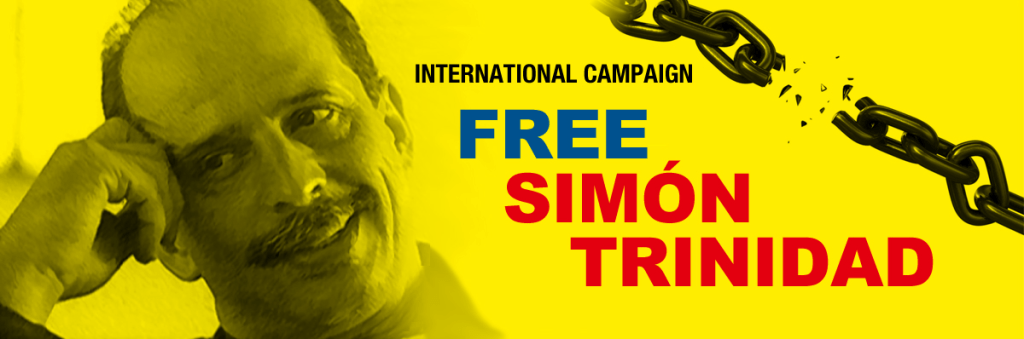
Simón Trinidad, leader of the former guerrilla organization Revolutionary Armed Forces of Colombia. File photo / via Orinoco Tribune

South Paris, Maine


President Biden recently pardoned his son Hunter Biden and commuted the sentences of 1499 drug offenders. Analyst Charles Pierce insists Biden should pardon Simón Trinidad also. Here we join this plea on behalf of the Colombian Ricardo Palmera, whose nom de guerre is Simón Trinidad. Biden indeed must release Trinidad and let him return to Colombia.

Trinidad, a former leader of the Revolutionary Armed Forces of Colombia (FARC), has been imprisoned since 2008. U.S. agents arranged for his capture in Ecuador in 2003. Charged with drug-trafficking, Trinidad was extradited from Colombia to the United States in late 2004. Juries in two of his four trials there failed to convict him of narco-trafficking. Two trials were required to convict Trinidad of terrorist conspiracy to hold hostage three U.S. military contractors operating in Colombia.

The Peace Agreement of 2016 between Colombia’s government and the FARC offered a process for combatants to leave war behind. The Agreement produced the Special Jurisdiction for Peace (JEP), a device whereby Trinidad, once he arrives in Colombia, would be able to tell the truth about participating in civil war and possibly gain immunity from further punishment.

Trinidad’s defenders claim that his earlier experience as a negotiator on behalf of the FARC amply qualify him to help with overcoming difficulties still damaging prospects for peace in Colombia.

Trinidad is presently serving a 60-year sentence – 20 years for each of the captured North Americans.  Early release from prison for Trinidad would make partial amends for an excessively long sentence and relieve him of the cruelty marking his prison experience.

President Gustavo Petro’s Colombia’s government is now finally pressuring the Biden administration to return Trinidad to Colombia. A note sent from the Colombian Embassy on November 12 proposes that “in a humanitarian spirit and for the purpose of [Trinidad] contributing to Colombia’s peace agenda, we present a request for a presidential pardon.”

In a request first made in early 2023, Colombia still seeks “necessary technical facilities” provided for Trinidad so that he might participate in “virtual sessions” of the Special Jurisdiction for Peace.  Once repatriated, he could then participate fully in “the search for total peace in Colombia.”

The U.S. government, ironically enough, has expressed support for the peace process in Colombia, both during four years of negotiation and subsequently after the Agreement was signed in 2016.

Simón Trinidad came from a wealthy, politically powerful, and landowning family in Cesar Department in northern Colombia. He prepared as an economist. Before he joined the FARC in 1987, he was managing an agricultural bank and his family’s estates, and teaching at a local university.

In reaction to accentuation of class-based bloody conflict in Colombia’s rural areas, ongoing for decades, his politics changed. Joining with others, he opposed the Colombian government’s tolerance of paramilitary killings of office-holders and adherents of the Patriotic Union electoral coalition, from 1985 on. They were Communist Party members, former FARC guerrillas, and other progressives. Well over 5000 of them would be massacred.

Within the FARC, Trinidad attended to political education, propaganda, and negotiations with foreign agencies and political leaders. He served as a lead negotiator and spokesperson during the failed FARC-Colombian government peace negotiations taking place in San Vicente del Caguen in 1998-2002.

Here are good reasons for Trinidad’s U.S. imprisonment to end, and for him to return to Colombia now:  

·        The federal prison in Florence, Colorado where Trinidad is held “is one of the strictest maximum-security prisons in the world.” He remained in solitary confinement for 12 years. Authorities restrict his outside communication to infrequent contacts with a very few family members. Visits are few and far between.

·        The conspiracy charge against him amounts to no more than membership in the FARC. That insurgency sought revolutionary social change. International law recognizes both the right of revolution, and rights for prisoners of war.

·        FARC guerrillas in 2003 shot down the plane carrying the three U.S. military contractors and took them hostage. They were “three retired military officers who provided intelligence services through private companies.” The FARC regarded them as enemy combatants. They went free in 2008. Simón Trinidad was far-removed geographically and command-wise from the decision to bring down their plane. In view of such circumstances, Trinidad’s 60-year jail sentence is wildly disproportionate.

·        Mind-reading has its hazards, but appearances may be suggestive. Pains taken to prosecute and persecute Simón Trinidad speak to his status as “trophy” prisoner for his U.S. captors – as indicated by Trinidad’s U.S. attorney Mark Burton. Under the pretext of drug war, the U.S. government in 2000 had introduced its “Plan Colombia” program of military assistance directed at ridding Colombia of leftist insurgents – to the tune eventually of $10 billion. Simón Trinidad’s prominent role in the recently failed Caguen peace talks showed off Plan Colombia as meeting expectations; an exalted prisoner like Trinidad was now in U.S. hands.

There would be the possibility too that Trinidad had earned the special ire of the entitled classes in both Colombia and the United States. Born with a silver spoon, he was indeed a traitor to his class. 

SimónTrinidad as a special case is clear on comparing his fate with that of major paramilitary boss Salvatore Mancuso, reliably accused of killing 1500 Colombians. Each faced trials in the United States after extradition on narco-trafficking charges. Mancuso served his 15-year sentence and in February 2024 was allowed to return to Colombia. President Gustavo Petro honored him through an appointment as “peace manager as part of’ [his] ‘Total Peace’ initiative.” Mancuso, but not Simón Trinidad, has testified before the JEP.

Attorney Mark Burton regards Trinidad as a friend: “To know him is to admire him, because he is an intelligent, human man, and also very firm in his political and social ideas. There are not many people like him in life. He is a person that in the worst prison in the United States they have not been able to break him. He is a person with firmness, ideas, and character. That alone is worth admiration.”


W.T. Whitney Jr. is a political journalist whose focus is on Latin America, health care, and anti-racism. A Cuba solidarity activist, he formerly worked as a pediatrician, and lives in rural Maine.

Colombian paramilitaries encounter adverse US court decision and people’s resistance  / by W. T. Whitney

Paramilitary fighters hold their rifles during a ceremony to lay down their arms in Otu, northwest Colombia, on Dec. 12, 2005. Photo: Fernando Vergara/AP

South Paris, Maine


Away from industrialized countries, capitalism worked its way by means of enslavement, die-offs, wars, plunder, and thugs. Colombia specializes in thugs – since the 1970s. Paramilitaries, shock troops for Colombia’s rich and powerful, are an arm of Colombia’s military. A recent court decision in the United States provokes questions about the future of Colombia’s paramilitaries and about official U.S. reactions.

A trial jury in the U.S. District Court in West Palm Beach, Florida, determined June 10 that Chiquita Brands, formerly the United Fruit Corporation (UFC), was guilty of financially supporting the United Self-Defense Forces of Colombia (AUC). The paramilitary band has operated since the 1980s in Colombia’s northern banana-producing regions. The decision will be appealed.

Chiquita will pay $38.3 millionto 16 family members of eight individuals murdered by the AUC paramilitaries. Chiquita had supplied them with arms and ammunition. 

According to EarthRights, whose lawyers managed the case, “Chiquita knowingly financed the AUC, a designated terrorist organization, [as per the U.S. State Department], in pursuit of profit …These families, victimized by armed groups and corporations, asserted their power and prevailed in the judicial process.” No U.S. corporation has previously been punished for committing human rights abuses abroad

Testimony indicated AUC paramilitaries were active in suppressing labor activism, opposing leftist guerrillas, and enforcing company dictates against individual workers. With Chiquita support, “the paramilitaries successively extended their power in the region … by means of assassinations, disappearing people, and displacing thousands of them,” according to a report. 

The court’s ruling comes 17 years after Chiquita, in a 2007 plea-bargain agreement, acknowledged guilt in violating U.S. law prohibiting financial support for terrorist organizations. Acknowledging payments of $1.7 million to AUC paramilitaries for “security services” from 1997 to 2004,”Chiquita paid a $25 million fine. The company was spared having to reveal the identity of company executives approving the illegal payments.

Subsequently hundreds of claims against Chiquita descended on courts in Colombia. To secure relief for the victims’ families in U.S. courts, lawyers led by Terrence Collingwood, who represented 173 families, consolidated claims against Chiquita; they would pursue two “bellwether cases.” Favorable decisions would enable litigation to proceed on behalf of the other families. The second case opens on July 15.

Other companies have funded Colombian paramilitaries. A recent report indicates that Ecopetrol, Colombia’s largest oil company, paid paramilitaries up to 5% of the value of contracts it signed, that Bavaria brewery delivered to paramilitaries a portion of every dollar generated from sales along Colombia’s northern coast, and that distributers associated with Postobón, Colombia’s largest beverage company, gave paramilitaries boxes of bottled drinks to be sold for cash.

Only because the crimes occurred outside the United States did a U.S. court acquit Coca Cola companyon charges it contracted with paramilitaries to kill nine unionists in 1990-2002. Drummond coal-mining company, based in Alabama, beat back well-founded charges tried in a U.S. court that it paid paramilitaries to assassinate three labor leaders between 1996 and 2001. Del Monte and Dole food companies were charged in Colombian courts with “financing right-wing paramilitary groups,” according to a 2017 report.

With their own railroads, seaports, and ships, United Fruit Company and its offspring Chiquita have operated banana plantations in Panama, Colombia, Nicaragua, Costa Rica and Guatemala. Chiquita with a presence in 70 countries recently registered $7.59 billion in yearly revenue.

UFC, Chiquita’s parent and mentor, once claimed 42% of Nicaragua’s national territory. Agrarian reform impinging on UFC holdings there led to a CIA-mediated U.S. coup in 1954 that removed the left-leaning government of President Jacobo Árbenz.

In 1928 near Santa Marta on Colombia’s Caribbean coast, banana workers were on strike. UFC called upon an obliging Colombian government to send in troops. They machine-gunned strikers and their families. More than 1000 died. The pretext was Communist agitation.

In a poignant reminder almost a century later, on June 12, 2024, “5000 or so people undertaking a civic strike outside of Santa Marta blocked the Caribbean Trunk Route,” National Highway 90. According to the report, “The communities were asking the government for solutions for violence dispossession, displacement, and lockdown in their areas at the hands of paramilitary groups.” The strike lasted three days.

Nationwide mobilization organized by the Congress of the Peoples had begun on June 4. Activists representing “small farmers, African-descendants, Indigenous peoples, and urban representatives of the diversity of the Colombian people” blockaded four big highways. In Bogotá, they occupied the Interior Ministry and the Vatican Embassy.

Human rights leader Sonia Milena López, speaking at a press conference, declared that, “Paramilitarism has been and is a politics of the oligarchy enabled by the Colombian state.” She outlined measures for dismantling paramilitarism.

The government, she insisted, must recognize “that a national paramilitary strategy at the rural and urban level does exist and is oriented toward developing a genocidal process aimed against the people’s movement.” It must abandon “any pretension of political recognition of paramilitary elements” or of negotiating with them.  

She called for ‘investigating those who finance and direct [the paramilitaries], both state and private,” and for “removing …military officers when there are … accusations or evidence of connivance or lack of effective action against the paramilitaries.” 

In an interview, Esteban Romero, spokesperson for the Congress of the Peoples, reported that paramilitaries are absorbing territory, displacing populations, and threatening and harassing social leaders.  He suggested progressive president Gustavo Petro lacks the power needed to undo “a Colombian political regime that is a paramilitarized regime, one that created private armies to contain social changes.”

Paramilitaries are dangerous, as recalled by analyst Luis Mangrane: “Between 1985 and 2018, the paramilitary groups were the principal agents responsible for the killings associated with armed conflict [between the FARC and the Colombian government], having accounted for 45% of the total of 205.028victims. Through the ‘para-politics’ in the 2002 elections, they managed to coopt a third of the Congress.”

The paramilitaries’ base of support is strong, not least in the United States. There will be no new U.S. response to their actions, it seems, unless it is mediated through Colombia’s military. What with close ties between paramilitaries and the military, however, that possibility seems unlikely

The association shows in a memo from the U.S. Department of Justice in 2001: “Colombia has five divisions in its army, but paramilitaries are so fully integrated into the army’s battle strategy, coordinated with its soldiers in the field, and linked to government units … that they effectively constitute a sixth division of the army.”

Colombia’s labor minister, Communist Party member Gloria Inés Ramírez reflects on the staying power of the paramilitaries. “[P]aramilitaries came to the fore within the framework of the development of contemporary capitalism … Colombian capitalism turns out to be a complex socio-economic synthesis between a traditionalist and pre-modern tendency around land concentration, on the one hand, and a modernizing tendency in capital accumulation, on the other. This synthesis favored the authoritarianism of the political regime, the increasing militarization of politics and the growing role of paramilitary organizations.”


W.T. Whitney Jr. is a political journalist whose focus is on Latin America, health care, and anti-racism. A Cuba solidarity activist, he formerly worked as a pediatrician, lives in rural Maine. W.T. Whitney Jr. es un periodista político cuyo enfoque está en América Latina, la atención médica y el antirracismo. Activista solidario con Cuba, anteriormente trabajó como pediatra, vive en la zona rural de Maine.

Anti-Petro Coup Imperils Historic Pact Government in Colombia / by W.T. Whitney Jr.

Colombians protest outside the Attorney General’s Office in Bogota, Feb. 8, 2024. | Photo: X/ @hugomilenio

South Paris, Maine


President Gustavo Petro, head of the left-leaning Historic Pact coalition, took office on August 8, 2022. He is Colombia’s most progressive president ever. Now he faces a coup. The fate of Petro’s government connects with prospects for peace in Colombia

On social media Petro indicated that, “Unions have been raided and witnesses have been tortured and otherwise pressured so as to accuse the president (himself)  …  Narcotrafficking sectors, perpetrators of crimes against humanity, corrupt politicians and sections of the attorney general’s office are desperately looking to remove him from … office.”  

The lead coup-plotters have been former Attorney General Francisco Barbosa and Vice-Attorney General Martha Mancera, hold-overs from previous administrations.  Peculiarities of Colombian governmental arrangements have officials installed in the top levels of government whom the president did not select and does not control.  

Barbosa is the public face of the opposition. He ended his four-year term of office on February 12. The Supreme Court of Justice, charged with replacing him, failed to choose one of the three candidates Petro offered for the post. The Court named Mancera as temporary attorney general.

According to one commentator, Mancera has long had actual charge of the attorney general’s office; Francisco Barbosa was “a façade.” She is accused of protecting corrupt officials and drug traffickers.

Provocateur

Barbosa charged the Colombian Federation of Educators with illegally providing Petro’s presidential campaign with funds amounting to the equivalent of $128,000. Searching for evidence on January 22, his agents trashed the union’s headquarters.

Barbosa announced December 1, 2023 he would detain young people whom Petro had released from prison, praising their dedication to peace.  The release would occur long after they had been jailed originally following participation in protest rallies in mid-2021.

Barbosa in January visited the Justice Department in Washington. He reported on “his stewardship [as attorney general] and sought U.S. support for Martha Mancera to become Colombia’s new attorney-general.”

Inspector general Margarita Cabello on February 2 ordered a three-month suspension of Chancellor Álvaro Leyva Duran. His ministry, she charged, had illegally contracted the preparation of passports to a new company. A defender claimed he was breaking a monopoly in passport preparation held by an “old Bogota family.”

In street demonstrations taking place throughout Colombia on February 8, unionists, students, and teachers demanded that the Supreme Court name a Petro nominee as Colombia’s new attorney general.

Military intelligence reports revealed plans for expanded use of social media to broadcast news of destabilizing activities. Reserve and retired army officers, a powerful sector, have held anti-government protests.

Commentators liken Colombia’s evolving coup to the other “soft coups,” or exercise of “lawfare,” that removed Paraguayan President Fernando Lugo (2012), Brazilian President Dilma Rousseff (2016), Bolivian President Evo Morales (2019), and Peruvian President Pedro Castillo (2023).

Distant dream

For the Petro government to disappear would deliver a major blow to Colombians who for decades have sought and struggled for peace in their country. Petro had campaigned for “total peace.” It was a signature cause for him.

The signing of a Peace Agreement between the Revolutionary Armed Forces of Colombia (FARC) and the Colombian government in 2014 came close to satisfying the longings of peace advocates. From then on, however, it was downhill. In that very year, rightwing political forces engineered a watered-down version of the Agreement reached months earlier. Subsequently, the governments of Presidents Juan Manuel Santos and Iván Duque, Petro’s predecessor as president, failed to implement crucial parts of the Agreement.  

Beginning in 2015, 419 former FARC combatants and 1596 social and community leaders have been assassinated – 188 of them in 2023, while Petro was president.  Continuing armed conflict has led to 154 instances of “massive forced displacement” affecting 56,665 persons.

Dissident FARC groups, the National Army of Liberation, and paramilitaries – often in the service of narco-traffickers – account for most of the killings and turmoil.  The current government is negotiating with the remaining insurgencies.

Information from the historical record, recent and remote, suggests that causative factors accounting for violent conflict and the incipient coup are identical.

September 26, 2016 saw a revealing moment. The Peace Agreement was being signed in Cartegena, Colombia. “Timochenko,” the FARC leader, was speaking to notables assembled from several continents. At precisely that point, fighter planes of the Colombian Air Force zoomed by overhead. As noted by an observer: “The face of ‘Timo’ gave the impression of being under a bombardment.” 

Colombia’s U.S.-supported military was weighing in. The nation’s military forces have long been at the disposal of the established sectors of Colombian society. A well-to-do landowning, religious, and commercial elite has charge of Colombia, now and ever since the Europeans’ arrival. That sector is not happy with either Petro or with peace in the countryside.

Analyst Carlos Rangel Cárdenas sees Petro’s “total peace” as “constructing peace by involving civil society in binding dialogues.” He points out that violence in the countryside increased so much during the presidency of Iván Duque as to approach the excesses of earlier eras.  Dialogues do not thrive in conditions of war, presumably. The coup plotters and their soulmates who tolerate war in the countryside are linked.

An urban-based oligarchy, with cooperation from big landowners, controls the financial, commercial, business and media entities in Colombia that shepherd economic development in rural areas. The heavy hitters there, economically, are industrial-scale agriculture, mining operations, energy production, and narcotrafficking. These activities attract investment and enable wealth accumulation.

Colombia’s majority population is different. They are marginalized urban inhabitants, often refugees from an inhospitable countryside.  They are rural people, overwhelmingly poverty-stricken and poorly-educated, who, most of them, have limited access to social services and to land that would allow for subsistence farming.

Defenders of the Historic Pact government confront a set of rulers equipped with money power, a big army, ample police, and ready access to U.S. military resources. They have been on the losing side of struggle between one social class and another. They are quite unable to project the appearance or reality of the kind of political power that matters.

Social movements have more of a hold on Colombians, especially in rural areas, than do political parties. Writer Sidney Tarrow concludes that parties “seek to gain or retain power” while “Movements are more ideological.” The latter, he implies, are weaker. 

In a 2021 interview, Petro suggested that, “The necessities of Colombian society are not based on building socialism, but on building democracy and peace, period.” He is pondering the matter, evidently. On February 9, he indicated that, “We believe and desire that the means of production are in the hands of the people and not the state.”

In any event, an opinion survey shows young Colombians turning increasingly to “rightwing ideological views,” from “7% in May, 2021 to 37% in October, 2023.” 


W.T. Whitney Jr. is a political journalist whose focus is on Latin America, health care, and anti-racism. A Cuba solidarity activist, he formerly worked as a pediatrician, lives in rural Maine. W.T. Whitney Jr. es un periodista político cuyo enfoque está en América Latina, la atención médica y el antirracismo. Activista solidario con Cuba, anteriormente trabajó como pediatra, vive en la zona rural de Maine.

Colombia Opts for Peace in Rural areas, No More Drug-trafficking / by William T. Whitney Jr.

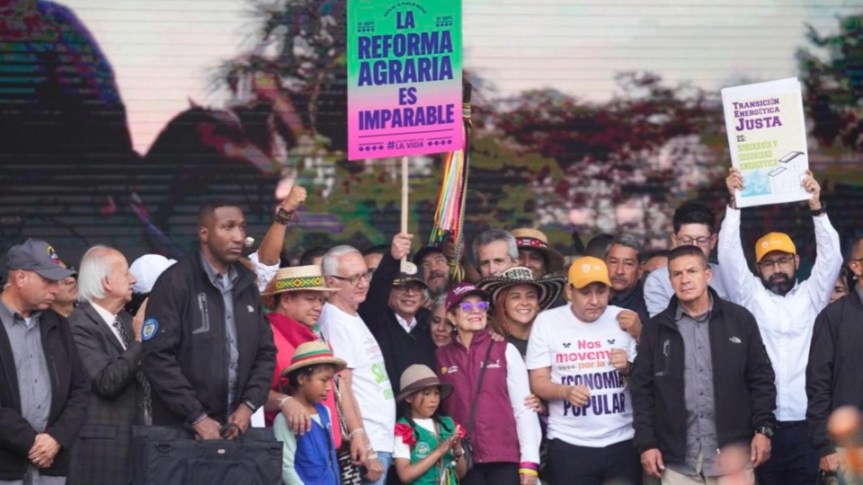
Surrounded by supporters, Colombia’s President Gustavo Petro, center, holds a sign that reads in Spanish, ‘The Agrarian Reform is Unstoppable,’ during a rally to show support for his proposed reforms, in Bogota, Colombia, Sept. 27, 2023. | Fernando Vergara / AP

South Paris, Maine


Colombian president Gustavo Petro on October 3 attended a big meeting of mostly small farmers in El Tambo, in Cauca, where “the coca economy is the main way of life for thousands of peasants.” Colombia’s first progressive president ever was presenting his government’s National Drug Policy for 2023. Petro had insisted earlier that “war on drugs has failed.” He recently expressed support for “phased decriminalization.”

His government is evidently prioritizing the present initiative, which is part of its far-reaching program for social and political reforms, now stumbling due to strong right-wing political opposition. The drug plan attends to main features of Colombian’s longstanding social disaster. They include:  dispossession leading to consolidation of large land holdings, agricultural underdevelopment, migrations leading to precarious lives often in cities, widespread lethal violence; and great wealth accumulated by top-level distributers and their financial backers.

The government’s new plan promises much, especially to working people both in Colombia and abroad. Freed of the monopolization of illegal drug production and commercialization, rural areas might shift to diversified agricultural production and expanded support systems. Prospects for community-development programs might improve and those rural Colombians forced into cities might return.  

By reducing that fraction of the domestic and international economy represented by drug production and marketing, the government would, in effect, be redistributing wealth, to a degree. And any success the new plan achieves in cutting back on drug commercialization might translate into reduced visibility abroad and, consequently, into lessened appeal to U.S. interventionists who have often justified military intrusions on that basis.

The plan calls for 27 “territorial spaces” in 16 departments and in Bogota, along with 51 “inter-institutional or bilateral technical working-groups.” Each one would hold three conferences with strategic allies, five with sectors drawn from the Joint Committee on Coordination and Follow-up. Other gatherings would involve women, young people, and prevention specialists.

Government spokespersons focused on the program’s two pillars. One of them, called “oxygenation,” supports those “territories, communities, people and ecosystems” adversely affected by drug-trafficking. It would support the transition to legal economies and reduce “vulnerabilities of regions and populations.” Measures would be taken that advance “environmental management and climate action toward … restoring regions” adversely affected by the narco-economy. The personal use of “psychoactive substances” will be dealt with on the basis of public health and human rights.

The other pillar, called “asphyxiation,” targets “the strategic nodes of the criminal system that generates violence” and “profits most from this illegal economy.”  The object would be to interfere with the “capacities and income” of the strongest drug-trafficking organizations and to do so so “systematically” and with consideration “of their complexity and relation with other economies both legal and illegal.”  Persons involved in production and trafficking would benefit from destigmatization and social justice.

The new plan has a slogan: “sewing life and burying narco-trafficking.” The aim is to remove 222,400 acres from coca and marihuana cultivation, reduce cocaine production by 43%, and block at least $55 billion in illegal financial gains. The plan would interfere with irregular banking and financial maneuvers and reduce both deforestation and greenhouse gas emissions.

Colombia’s illegal drug industry remains well entrenched, despite the drug war waged from 2000 on under the auspices of US Plan Colombia, a venture that absorbed billions of U.S. taxpayer dollars. A United Nations report cites a 13% one-year increase in land given over to illegal crops, as of 2022. It takes note of a recent “summit meeting [in Bogota] of narcotrafficking capos from Albania, Poland, Spain and Colombia.” 

The relentlessness of cocaine and marihuana production in Colombia may have led the U.S. government to recently stop monitoring the acreage of illegal crop cultivation. Indeed, after four decades of involvement, the U.S. government has abandoned its war against narco-trafficking in Colombia, according to analyst Aram Aharonian. Still, he reports, “weapons manufacturers” are benefiting, along with workers whose livelihood depends on narco-trafficking.

Petro’s new drug policy is significant mostly because it pursues objectives of the 2016 Peace Agreement which ended armed conflict between Colombia’s government and the FARC insurgency. Important parts of the new drug plan coincide with major provisions of that Agreement that were never implemented.

Agrarian reform matches with improving rural life generally. Solving the illicit drug problem was a goal of the Peace Agreement and now is the essence of Petro’s plan. The guarantee under the Peace Agreement of safety for former combatants never took root. The attacks against them are largely related to drug-trafficking, and now that will be dealt with.

Violence has been, and remains, pervasive. During just 13 months of the Petro government, assassins took the lives of 198 community and human-rights leaders and 43 former combatants.

A comprehensive report on the Petro government’s shepherding of  the peace process highlights the association of continuing violence with narco-trafficking. Indeed, “broad regions of the country” see persisting collusion of the police and military with paramilitaries and with “smaller narco-trafficking gangs and narco-trafficking structures.”  

Affirmation of the Petro government’s new campaign against drug trafficking comes from the report in June of the United Nations Mission to Verify the Peace Agreement. It emphasizes “the importance of peace initiatives and of efforts being made to expand the presence of the state so that vulnerable communities may be protected, especially in rural areas.”

Much is at stake as a government undertakes to control and end the production and marketing of illegal drugs. According to the UN’s Economic Commission for Latin America, “Problems associated with the production, trafficking, and consumption of drugs in Latin America affect the population’s quality of life, contribute to forms of social exclusion and institutional weakness, generate much insecurity and violence, and corrode governance in some countries.”  


W.T. Whitney Jr. is a political journalist whose focus is on Latin America, health care, and anti-racism. A Cuba solidarity activist, he formerly worked as a pediatrician, lives in rural Maine. W.T. Whitney Jr. es un periodista político cuyo enfoque está en América Latina, la atención médica y el antirracismo. Activista solidario con Cuba, anteriormente trabajó como pediatra, vive en la zona rural de Maine.

A Plea for Simón Trinidad / By W. T. Whitney Jr.

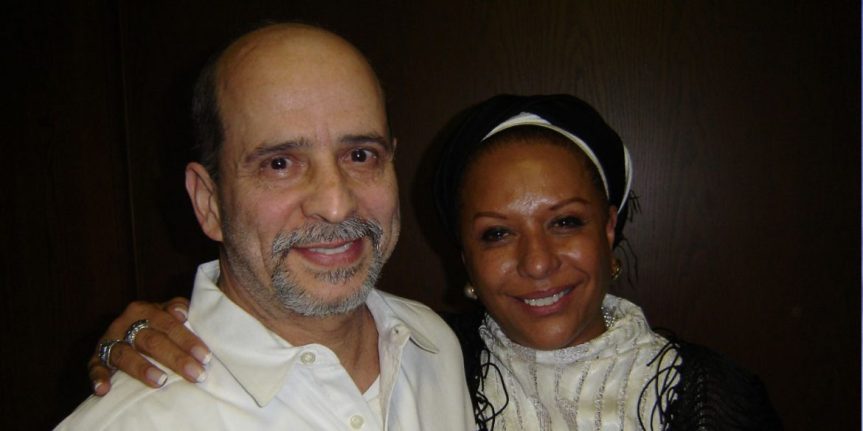
“Simon Trinidad” and Piedad Cordoba (Image: Piedad Cordoba)

South Paris, Maine


The title recalls the title of Henry David Thoreau’s essay “A Plea for Captain John Brown.” Trinidad, like John Brown, is remarkable for his implacable resolve and regard for justice.

Trinidad was 58 years of age when a U.S. court in 2008 sentenced him to 60 years in prison. His alleged crime was that of conspiracy to hold hostage three U.S. drug-war contractors operating in Colombia. In effect, he is serving a life sentence. He had nothing to do with the hostage-taking.

The contractors, captured in 2003, went free in 2008. U.S. drug war in Colombia has obscured the big U.S. role in Colombia’s war against leftist insurgents, primarily the Revolutionary Armed Forces of Colombia (FARC).

Simon Trinidad

Simón Trinidad was a FARC leader. The FARC and Colombia’s government signed a peace agreement in 2016 and Trinidad and other ex-combatants expected to be part of a peace process. Now he is a prisoner in a super-max prison in the United States and is confined to his cell for all but two hours per day, receives no mail, and is allowed very few visitors.

On July 27, Simón Trinidad unexpectedly was a featured item in the news in Colombia. An undated letter he had written to Colombian chancellor Álvaro Leyva requesting repatriation to Colombia had appeared on social media. News reports were reproducing it.

Observers associated Trinidad’s letter with the U.S. government’s announcement the day before that the bloodthirsty former paramilitary chieftain Salvatore Mancuso, also jailed in the United States, soon would be extradited to Colombia. President Gustavo Petro designated Mancuso as a “promotor of peace.”

Trinidad, not so favored as this, in his letter wrote of his determination to testify before the Special Jurisdiction for Peace, as other former FARC combatants have done, and Mancuso too, virtually. This court, established under the Peace Agreement of 2016, offers former combatants an opportunity to tell the truth about crimes they may have committed during the civil war and, having done so, to be pardoned or punished.

Trinidad apparently hopes not only that that Chancellor Leyva will inform the U.S. Secretary of State of his request to be repatriated but also that his message will be passed on to President Biden, who has the power to release him from prison.

Progressive Colombian Senator Iván Cepeda, “one of the people who speaks of peace on behalf of President Gustavo Petro,” welcomed “Simón Trinidad’s proposal [and] sent it directly to Chancellor Álvaro Leyva.”

Trinidad had joined the left-leaning Patriotic Union (UP) electoral coalition after it formed in 1985. A year later, paramilitaries began their massacre of UP adherents that, with impunity from Colombia’s government, lasted for years. In response, Trinidad in 1987 joined the FARC and, in the process, dropped his name Ricardo Palmera Pineda. For the FARC, Trinidad was responsible for political education and propaganda and was a negotiator.

The U.S. government in 2000 introduced its “Plan Colombia” through which Colombia’s military secured U.S. weapons and training assistance; U.S. troops and military contractors were deployed in Colombia. The appearance of Plan Colombia doomed peace negotiations between the FARC and Colombia’s government that were in progress at the time.

As a lead FARC negotiator in those talks, Simón Trinidad became known to international observers. His course with the FARC ended abruptly on January 2, 2004, when Colombian military personnel and the CIA seized him in Quito. Trinidad was there seeking UN assistance for a proposed prisoner exchange.

Colombia’s government extradited Trinidad to the United States on New Year’s Eve, 2004. According to his U.S. lawyer Mark Burton, Trinidad’s U.S. captors regarded him as a “trophy prisoner.”

Trinidad’s U.S. handlers had to stage four trials for them to finally gain a conviction. His capture and his multiple appearances in U.S. courtrooms from 2005 to 2008 served as real-time advertising that testified to U.S. commitment to anti-insurgency war and drug war in Colombia.

Trinidad’s misfortune was to have fallen into the clutches of a nation whose record on prisoners is horrific. After all, “The United States stands alone as the only nation that sentences people to life without parole for crimes committed before turning 18.” (No wonder: of 196 countries, only the United States has yet to ratify the UN’s Convention on the Rights of the Child.)

As a U.S. political prisoner, Simón Trinidad harks back to the Scottsboro Boys, who in Alabama faced death penalties in the 1930s; to Communist Party members jailed under the Smith Act; to Black Panther Party members caught up in the U.S. government’s COINTELPRO project. Simón Trinidad is also representative of prisoners gathered up in U.S. wars and other interventions abroad. They include: Ricardo Flores Magón, Mexican revolutionary who died in Leavenworth Federal Prison in 1922; the “Cuban Five” prisoners who resisted U.S. hostilities against Cuba; and the unfortunates ending up in the U.S. prison in Guantanamo during and after the Iraq War.

Despite the Peace Agreement, paramilitaries or other thugs have since killed almost 400 former FARC fighters; 300 FARC prisoners of war are still in prison almost seven years later.

Violence in the countryside persists. Colombia’s military is unable or unwilling to suppress a new breed of paramilitaries. One report highlights the paramilitaries’ “symbiotic relationship with Colombian state actors.” Declassified State Department and CIA documents from George Washington University’s National Security Archives say the same. The plot thickens: the tight relationship between the U.S. and Colombian militaries and the U.S. alliance with Colombia’s government together suggest U.S. complicity with a violence that Colombia’s Army and state are unable or unwilling to control.

The bad news for Simón Trinidad is that the U.S. government is betting not on peace in Colombia, but on continuing war. For that reason, Simón Trinidad confronts formidable barriers in satisfying his need to join Colombia’s peace process. Mark Burton’s words end this report: “Simón Trinidad is a man with a clear vision for a new Colombia, a Colombia in peace and with social justice. Colombia needs to listen to his voice, his vision, his proposals for peace. His continued imprisonment in the United States on false charges is an insult to Colombia, its history, and its people.”

Burton’s comments appear in a remarkable new eBook, accessible here. It contains commentary, in Spanish, from activists, writers, and intellectuals seeking Trinidad’s repatriation. The announcement of this book offers a video presentation, here, of reflections and documentary material.


W.T. Whitney Jr. is a political journalist whose focus is on Latin America, health care, and anti-racism. A Cuba solidarity activist, he formerly worked as a pediatrician, lives in rural Maine. W.T. Whitney Jr. es un periodista político cuyo enfoque está en América Latina, la atención médica y el antirracismo. Activista solidario con Cuba, anteriormente trabajó como pediatra, vive en la zona rural de Maine.

US General Hypes China as Threat in Latin America / By W.T. Whitney Jr.


The U.S. government has long intervened in Latin America and the Caribbean (LAC). Now the U.S. military is paying attention to China’s economic activities there. 

General Laura Richardson on March 8 reported to the Armed Services Committee of the U.S. House of Representatives on actions and needs of the Southern Command, which she heads. She has charge of all U.S. military operations in the region. 

Citing the 2022 National Security Strategy, Richardson declared that “no region impacts the United States more directly than the Western Hemisphere …. [There] autocrats are working overtime to undermine democracy.” And security there “is critical to homeland defense.”

Richardson stated that “the PRC (People’s Republic of China) has both the capability and intent to eschew international norms, advance its brand of authoritarianism, and amass power and influence at the expense of the existing and emerging democracies in our hemisphere.” The Southern Command’s “main priority … is to expose and mitigate PRC malign activity.”

She sees a “myriad of ways in which the PRC is spreading its malign influence, wielding its economic might, and conducting gray zone activities to expand its military and political access and influence.” A “grey zone,” according to the NATO-friendly Atlantic Council, is a “set of activities … [like] nefarious economic activities, influence operations, … cyberattacks, mercenary operations, assassinations, and disinformation campaigns.”

Richardson highlighted China’s trade with LAC that is heading toward “$700 billion [annually] by 2035.” The United States, in her view, will be facing intense competition and presently “its comparative trade advantage is eroding.”

She added that, “The PRC’s efforts to extract South America’s natural resources to support its own population … are conducted at the expense of our partner nations and their citizens.” And opportunities for “quality private sector investment” are disappearing.

Competition extends to space: “11 PRC-linked space facilities across five countries in this region [enable] space tracking and surveillance capabilities.” Richardson complained of “24 countries [that] have existing Chinese telecommunication infrastructure (3G/4G), increasing their potential to transition to Chinese 5G.” 

She expressed concern both about surveillance networks supplied by China that represent a “potential counterintelligence threat” and about Latin Americans going to China “to receive training on cybersecurity and military doctrine.” Richardson denounced China’s role in facilitating environmental crimes and pointed to “potential dual use for malign commercial and military activities.”

“Relationships absolutely matter,” she insisted, “and our partner democracies are desperate for assistance from the United States.” Plus, “if we’re not there in time, they … take what’s available, creating opportunities for the PRC.”

Moving beyond China, Richardson indicated that “many partner nations …  see TCOs (transnational criminal organizations) as their primary security challenge.” That’s because drug-cartel violence leads to deaths and poverty and “illicit funds exacerbate regionalcorruption, insecurity, and instability.”

Her report avoids mention of particular countries other than offering brief references to Haiti, Cuba, Nicaragua, and Venezuela. She criticized Russia for “military engagements with Venezuela and Nicaragua” and for spreading “false narratives.” Richardson praised Colombia for providing military training in other countries. 

The Southern Command gains “exponential return” on supplying various countries with U.S. weapons and supplies. It conducts joint military exercises, and “provides professional military education to personnel from 28 countries.”

Richardson reported at length on processes she sees as fostering useful relationships between her command and the various governments and military services. The tone of urgency characterizing her discussion on China was entirely lacking. 

Economic intervention

General Richardson’s view that China has greatly expanded its economic involvement with the LAC nations is on target.

Since 2005, China’s state-owned banks have arranged for 117 loans in the region worth, in all, more than $140 billion. They averaged over $10 billion annually. Since 2020, China has made fewer loans.

Chinese trade with Latin America grew from $12 billion in 2000 to $448 billion in 2021. China’s imports of “ores (42%), soybeans (16%), mineral fuels and oils (10%), meat (6%), and copper (5%)” totaled $221 billion in 2021. The value of exported manufactured goods that year was $227 billion. By 2022, China had become the biggest trading partner in four Latin American countries and the second-largest in many others.  

China’s foreign direct investment (FDI) has long represented China’s strongest economic tie to the region. FDI signifies funding of projects abroad directed at long-term impact. China’s FDI from 2005 to mid-2022 was $143 billion. Energy projects and “metals/mining” accounted for 59% and 24% of the total, respectively. Of that total, Brazil and Peru received 45% and 17%, respectively. 

The FDI flow since 2016 has averaged $4.5 billion annually; worldwide, China’s FDI has contracted.

Chinese banks and corporations have invested heavily in lithium production in Argentina, Bolivia, and Chile, which, together, account for 56% of the world’s lithium deposits. China is the largest investor in Peru’s mining sector, controlling seven large mines and owning two of Peru’s biggest copper mines. Brazil is the world’s largest recipient of Chinese investments.  

China’s government has linked FDI to its Belt and Road Initiative (BRI) that began in 2013. As of May 2022, 21 Latin American and Caribbean countries were cooperating with the BRI and 11 of them had formally joined.

On the ground

U.S. military intervention in LAC is far from new. Analyst Sergio Rodríguez Gelfenstein complements Richardson’s report with a three-part survey, accessible herehere, and here, of recent U.S. military activities in the region.

He indicates the United States now has “12 military bases in Panamá, 12 in Puerto Rico, 9 in Colombia, 8 in Perú, 3 in Honduras, 2 in Paraguay, as well as similar installations in Aruba, Costa Rica, El Salvador, Cuba (Guantánamo), and in other countries.”

Rodríguez maintains that, “levels of aggressive interference by Washington in the region have increased dramatically” and that U.S. embassies there are supplied with more military, Cuba, Nicaragua, and CIA personnel than ever before.

Rodríguez notes features of the LAC region that attract U.S. attention, among them: closeness to strategically-important Antarctica; reserves of fresh water and biodiversity in Amazonian regions; the Guarani Aquifer near the triple frontier of Brazil, Paraguay, and Argentina, the largest in the world; and huge reserves of valuable natural resources.

Among ongoing or recent U.S. military interventions are these:

·        The U.S. Army Corps of Engineers is implementing a “master plan” for navigability of the Paraguay River and Plata River Basin. The nearby Triple Frontier area supposedly harbors international terrorism and drug-trafficking.

·        The U.S. military facility in Neuquén, Argentina is turning from its alleged humanitarian mission to activities in line with local preparations for oil extraction.            

·        U.S. officials on October 13, 2022 announced that 95 military vehicles were being donated to Guatemala for drug-war activities.   

·        In Brazil in September 2022, General Richardson indicated that U.S. forces would join Brazilian counterparts to fight fires in the Amazon..

·        The Southern Command’s fostering of good relations with Peru’s military has borne fruit. Under consideration in Peru’s Congress is a proposal to authorize the entry of foreign military forces. To what nation would they belong? Hint: former CIA operative and U.S. Ambassador Lisa Kenna met with Peru’s Defense Minister the day before President Pedro Castillo was removed in a parliamentary coup on December 7, 2022.

·        In March 2023, two U.S. congresspersons proposed that U.S. troops enter Mexico to carry out drug-war operations.

·        Presently the United States is making great efforts to establish a naval base on Gorgona island off Colombia’s Pacific coast. It would be the ninth U.S. base in Colombia, a NATO “global partner.”

·        In Colombia, U.S. troops acting on behalf of NATO, are active in that country’s Amazon region supposedly to protect the environment and combat drug-trafficking.

·        The U.S. National Defense Authorization Act of December 2022 awarded the Southern Command $858 million for military operations in Ecuador.

·        In a second visit, the US Coast Guard Cutter Stone was plying Uruguayan waters in February ostensibly to train with local counterparts for search and rescue operations. The ship was also monitoring the nearby Chinese fishing fleet.

Rodríguez does not comment on U.S. interventions in Cuba, Nicaragua, and Venezuela. That’s because they’ve persisted for “more than 60, 40, and 20 years, respectively” and each requires a “special report.”

John Quincy Adams returns

Proclaiming the Monroe Doctrine 200 years ago, Secretary of State Adams informed European powers that the United States regarded “any attempt on their part to extend their system to any portion of this hemisphere as dangerous to our peace and safety.”

General Richardson would apply the warning of that era to the PRC. Yet signs of hegemonic aspirations from that quarter are absent.

Commenting recently, Argentinian economist and academician Claudio Katz notes that, “China concentrates its forces in the economic arena while avoiding confrontations at the political or military level … Investments are not accompanied by troops and bases, useful for guaranteeing return on investments.”

Besides, China “does business with all governments, without regard to their internal politics.” That tendency, Katz writes, stems from the PRC having “arisen from a socialist experience, having hybrid characteristics, and not completing a passage to capitalism.” He maintains that China, with its economic involvement, contributes nothing to advancing socialism in the region.   


W.T. Whitney Jr. is a political journalist whose focus is on Latin America, health care, and anti-racism. A Cuba solidarity activist, he formerly worked as a pediatrician, lives in rural Maine. W.T. Whitney Jr. es un periodista político cuyo enfoque está en América Latina, la atención médica y el antirracismo. Activista solidario con Cuba, anteriormente trabajó como pediatra, vive en la zona rural de Maine.

Court Says Colombian State Responsible for Patriotic Union “Extermination” – No Mention of US Role / By W.T. Whitney Jr.

The survivors and family members of the victims of the genocide against the Patriotic Union party celebrated the IACHR Court’s ruling, which declared the Colombian State responsible for the extermination of UP militants and members in the mid-1980s. Photo: Corporación Reiniciar/Twitter

Rubí Andrea Forero, 52 years old, talked to Prensa Latina about the recent court ruling in the Patriotic Union’s case against Colombia’s government. She felt relief. She has coped with her father’s murder on February 27, 1989 and her awareness of “impunity and continuing crimes”. She recalls “silent longings and frustrated dreams from the war” and the “fears, absences, and frustrations” of families and friends. 

Teofilo Forero, Rubí’s father, was a union president, a deputy in the Cundinamarca legislature, and Bogota City councilor. Nationally, he was a leader of the CTC Labor Federation and organization secretary of Colombia’s Communist Party. That party, the interviewer explains, was the “vertebral column of the Patriotic Union (UP in Spanish-language initials).” The UP dates from 1985.

On January 30, the Inter-American Court of Human Rights (IACHR Court) announced its long-anticipated ruling in the UP case. The Court named the Colombian state as responsible “for violations of human rights committed against more than 6000 members of the Patriotic Union political party during a period that began in 1984 and lasted for more than 20 years.”

(The Special Jurisdiction for Peace, established under the 2016 Peace Agreement between the FARC and Colombian government, indicated in 2022 that “5,733 persons were assassinated or disappeared in attacks directed against the UP.”)  

The Court ruling cites a “plan of systematic extermination … relying on participation by state agents and acquiescence by authorities.” It cites “forced disappearances, massacres, extrajudicial executions, assassinations … [and] impunity.”

The peace agreement between the Revolutionary Armed Forces of Colombia (FARC) and Colombia’s government in 1984 enabled demobilized FARC insurgents, Communist Party activists, and others to create the UP. The organization undertook to “promote the social, economic, and political transformations necessary for building a peace with social justice,” according to the Reiniciar Corporation, stalwart defender of the UP since 1992.

As 1985 closed, the UP had established “2,229 grassroots organizations” in more than 200 municipalities and rural districts. In early 1986, 15 UP candidates were elected to Colombia’s Congress, 18 to departmental legislatures, and 335 to city councils; there were 23 UP mayors. In elections a few weeks later, UP candidate Jaime Pardo Leal proved to be the third most popular presidential candidate. The UP was a powerful political force.

Then came catastrophe. Assassins killed “nine congresspersons, 70 city council members, and dozens of deputies, mayors, and grassroots leaders,” and also “labor leaders, students, artists, activists, and sympathizers” from all sectors. Two presidential candidates would be murdered. 

The IACHR Court ordered reparations. The state must pursue investigations of “gross violations of human rights and [that way] determine penal responsibilities.”  In addition, disappeared victims must be located, victims cared for, and the Court’s decision publicized. The Court called for protecting UP activists now, a national educational campaign, recompense for “material and immaterial damages” and a national day of commemorating UP victims.

The Reiniciar Corporation in 1993 led in submitting the UP case to the Inter-American Commission on Human Rights (IACHR). That agency collected evidence and collaborated  with the Colombian government to reach a settlement, but to no avail. The case moved to the IACHR Court in 2017.

No longer able to field electoral candidates, the UP in 2002 lost its “judicial personhood” and state recognition of its status as a political party. Reacting to IACHR verification of persecution, election officials in 2013 restored the UP’s former status.

UP participation in elections was evident recently in the party having joined the victorious Historic Pact coalition of President Gustavo Petro. Former UP activist Germán Umaña serves as minister of commerce in the Petro government. He had abandoned political life after the assassination in 1998 of his brother Eduardo Umaña, law professor and defender of human rights.

Revival of the UP and its distancing from a violent past go along with Colombia’s tentative turn to peace. In that regard, the government on January 1 announced a ceasefire among combatant groups; among them the Colombian Army, National Liberation Army guerrillas, two groups of narco-trafficking paramilitaries, and two dissident insurgencies formerly part of the now defunct FARC.  

However, the UP story is about U.S. military intervention as well as peace in Colombia.

Journalist Nelson Lombana Silva sees the IACHR Court decision as “not solely applying to the Colombia state, but also to Colombia’s liberal-conservative, criminal oligarchy that decided to remove this political movement,” and did so “with U.S. participation.”

Historian Ivan David Ortiz, investigating the failure of the 1984 peace agreement, notes the FARC’s explanation at the time, that “hegemonic political and economic sectors continued the warlike policies of the United States.” He cites the FARC’s claim that, “the anti-peace offensive in Colombia came from the Pentagon.” (1)

An Amnesty International report of 2005 covers the same ground:

Efforts by the government of President Belisario Betancur (1982-1986) to initiate peace talks with guerrilla groups in the mid-1980s heightened concern that any peace agreement would have entailed land and other socio-economic reforms. This dynamic strengthened the alliance between the traditional economic elites and the armed forces and spurred on the development of paramilitary structures under the coordination of the armed forces.

Accessory information points to U.S. involvement within this context. Paramilitaries bore most of the direct responsibly for massacring the Patriotic Union. Paramilitaries coordinate their operations with Colombia’s military, which has a supervisory role, as documented here and here. The impetus for the paramilitary phenomenon derived from recommendations of a U.S. “Special Warfare” consulting team in 1962. 

Secondly, Colombia’s military, the paramilitaries’ senior partner, thrives due in part to the U.S. government’s generous support and financing. The flow of billions of dollars to Colombia’s military is notable.  It began in 2000 under U.S. Plan Colombia and continued for more than ten years. Drug war, the usual justification for U.S. partnering with Colombia’s military, has been useful as a cover for war against leftist guerrillas and against left-leaning political groups and social movements.

Ultimately, it seems, there was a big element of U.S. proxy war in the deadly suppression of the UP. U.S. would-be masters of global affairs have long manifested instant readiness to blot out popular risings viewed as threatening to their accustomed ways. Viewed like this, perpetrators of the anti-UP violence were kin to Bay of Pigs assailants in Cuba, Contra warriors in Nicaragua and Ukraine’s military fighting against Russians now.

Note: (1) Iván David Ortiz Palacios, “El Genocidio Político contra la Unión Patriótica,” (Universidad Nacional de Colombia, Bogotá, 2007), p. 17


W.T. Whitney Jr. is a political journalist whose focus is on Latin America, health care, and anti-racism. A Cuba solidarity activist, he formerly worked as a pediatrician, lives in rural Maine. W.T. Whitney Jr. es un periodista político cuyo enfoque está en América Latina, la atención médica y el antirracismo. Activista solidario con Cuba, anteriormente trabajó como pediatra, vive en la zona rural de Maine.

Prisoner Simón Trinidad Is Victim of Toxic US – Colombia Alliance / by W. T. Whitney Jr

In this Jan. 13, 2002 photo, the Commander of the Revolutionary Armed Forces of Colombia (FARC), Simón Trinidad, reads a declaration during a press conference in Los Pozos, Colombia. | AP

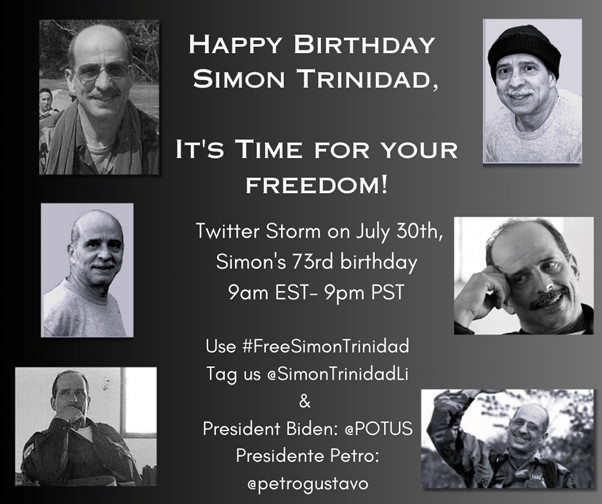
Simón Trinidad’s 72nd birthday is July 30. Don’t think about sending him a card. U.S. prison authorities have blocked his mail since 2004. Extradited from Colombia, he would remain in solitary confinement until 2018. He is lodged in a maximum-security federal prison in Colorado.

As a leader of the Revolutionary Armed Forces of Colombia (FARC), Trinidad was in charge of political education and propaganda. He was captured in Ecuador in 2003, with CIA assistance. He had been conferring there with a United Nations official about the release of FARC-held prisoners.

Transferred to Colombia, Trinidad was a high-profile prisoner.  He had family connections with upper elements of Colombian society and had been a lead FARC negotiator in peace talks with Colombia’s government from 1998 to 2002. The Colombian government and its U.S. ally might have detected a propaganda advantage in a public trial and severe punishment. Putting him away, out of sight, as a prisoner of war in Colombia would have offered little gain.

Ideas may also have cropped up that Trinidad extradited would be an object lesson for Colombia’s political dissidents, display damage done to the FARC, and advertise the newly strengthened U.S. – Colombian alliance. Colombian officials asked the U.S. government to request his extradition.

U.S. Plan Colombia took effect in the early 2000s. At the cost eventually of more than $10 billion, the U.S government provided military equipment, intelligence services, and funding for Colombia’s military, police, and prisons. The purpose, claims the U.S. Global Leadership Coalition was “to provide security and economic development assistance to help combat the spread of narcotics … and promote economic growth.”

Narco-trafficking was a secondary matter. Plan Colombia was mainly about fighting leftist insurgents, primarily the FARC. A stiffened alliance was background to the targeting of Trinidad and to enhanced political oppression in Colombia.

Interviewed recently, Colombian historian Renán Vega Cantor mentions “80 years, during which Colombia became the main US ally in the region.” He cites seven U.S. military bases, “a U.S. presence in 50 [other] places …[and] 25 secret U.S. agencies” operating in Colombia.  Crucially, the paramilitaries, long notorious as agents of deadly violence, are “Colombian Army proxies sponsored, financed, trained, and supported by the United States, which have carried out all kinds of atrocities that the Armed Forces, openly, cannot legally carry out.”  

Says Vega Cantor, “Plan Colombia militarized [Colombian] society in an impressive way, propelling the growth of the Colombian Armed Forces to unthinkable levels.” Colombia presently fields 500,000 troops; its army is one of the world’s largest. Some 50,000 Colombian military and police officers received training at the U.S. Army’s School of the Americas in Georgia, referred to by some as the “school of assassins.”

The U.S. government has readily accepted the cruelty marking its partner’s civil war. Cruelty was on display recently. The Truth Commission, set up via the 2016 Peace agreement between the FARC and Colombian government released its ten-volume Final Report on June 28, 2022. Cruelty portrayed there is vast enough to have infected the criminal justice system of its ally, or so it seems.    

Analyst Camilo Rengifo Marín, referring to the Report, takes note of “an armed conflict of more than 60 years that goes on still and led to more than 10 million victims of whom 80 percent were civilians.” He writes that, “50.770 were kidnapped, 121.768 disappeared, 450.664 murdered and 7.7 million forcibly disappeared.” Another observer indicates that, “The report is critical of the role played by various U.S. administrations in developing security policies, in militarizing society, and in hiding relations between paramilitary groups and the Colombian Army.”

The Final Report itself states that, “During many years, the victims got little attention and often were defended only by human rights organizations or by churches. From torture victims and kidnappings by guerrillas … to victims belonging to political movements like the Patriot Union and other opposition groups, those victims were invisible to most Colombians over the course of decades.” 

Simón Trinidad has been all but invisible in the United States. U.S. authorities sought his extradition solely because of alleged narco-trafficking. After all, international law does forbid extradition on political grounds, like rebellion. The indictment greeting Trinidad on arrival in Washington charged him with providing material support to terrorists, taking hostages, and dealing in illicit drugs.

It took four trials between 2006 and 2008 to exonerate him on the charges of narco-trafficking and providing material support for terrorists, and to convict him of conspiring to capture three U.S. drug-war contractors.  FARC gunfire had brought down their plane. The idea of conspiracy derived exclusively from Trinidad’s status as a FARC member. 

In 2008, 57-year-old Trinidad received a 60 -year sentence. Since 2018, he’s been allowed to eat a midday meal in a dining hall. Phone calls are rare. Emails and periodicals are prohibited, along with letters. Trinidad’s only visitors are his lawyers and rarely his brother and Colombians conferring about Peace-Agreement arrangements.

Trinidad faces charges in Colombia relating to possible crimes committed during the Civil War. The Peace Agreement provided for a “Special Jurisdiction for Peace” (JEP in Spanish) whose role is to decide on punishment or pardon for former combatants on both sides charged with crimes. To be pardoned they must tell the truth.

Simón Trinidad is eligible to appear before the JEP. Trinidad’s U.S. lawyer Mark Burton indicated via email that a first step towards his virtual appearance there is for Colombia’s Foreign Ministry to ask the U.S. Justice Department to approve of Trinidad’s appearance before the JEP.

Burton is hopeful. The new foreign minister of the incoming Gustavo Petro government may be receptive; Álvaro Leyva Duran “worked on the negotiating team of the FARC in Havana” during the peace talks, Burton recalls. The JEP could pardon Trinidad or require court appearances in Colombia. Either way, pressure would mount for the U.S. government to commute his sentence to allow for deportation.

President-elect Gustavo Petro, campaigning, protested the ongoing killings of community leaders and former FARC combatants. A central demand of his Historical Pact coalition has been full implementation of the 2016 peace agreement. Ultimately, relief for Trinidad rests on realizing peace in Colombia.

Any affinity of the U.S. government with the goals of the new Historical Pact government would be good news for Trinidad. For the United States to back away, even a little, from intervening in Colombia would also be good news.  Secretary of State Blinken, speaking with Petro, “underscored our countries’ shared democratic values and pledged to further strengthen the 200-year U.S.-Colombia friendship,” according to an announcement on June 20. The mouthing of hypocrisy is bad news.

Peace in Colombia, and Trinidad’s fate, depends on the U.S. relaxing its cop-on-the-beat posture for an entire region, that of monitoring any and all stirrings of fundamental political and social change. A new kind of U.S. openness, however, doesn’t jibe with U.S. determination to protect the interests of corporations and the moneyed classes at home and abroad.

Until a new anti-imperialist consciousness has inspired a meaningful and potentially effective, all-points opposition, collective effort is in order now towards organizing and fighting for Simón Trinidad’s return to Colombia. Even so, that struggle would have to fit within a larger context of anti-imperialism, peace now in Colombia, and support for the new government there.


W. T. Whitney Jr. is a political journalist whose focus is on Latin America, health care, and anti-racism. A Cuba solidarity activist, he formerly worked as a pediatrician, lives in rural Maine. W.T. Whitney Jr. es un periodista político cuyo enfoque está en América Latina, la atención médica y el antirracismo. Activista solidario con Cuba, anteriormente trabajó como pediatra, vive en la zona rural de Maine.

People’s World, July 18, 2022, https://peoplesworld.org/

Petro wins first-round victory against right wing in Colombian presidential vote / by William T. Whitney, Jr.

Presidential candidate Gustavo Petro, left, and his running mate Francia Marquez, with the Historical Pact coalition, stand before supporters on election night in Bogota, Colombia, Sunday, May 29, 2022. Their ticket will advance to a runoff contest in June after none of the six candidates in Sunday’s first round got half the vote. | Fernando Vergara / AP

During 212 years of Colombia’s national independence, the propertied and wealthy classes, with military backing, have held the reins of power. Gustavo Petro and Francia Marquez, presidential and vice-presidential candidates of the Historical Pact coalition, scored a first-round victory in elections held on May 29. They are forerunners of a new kind of government for Colombia.

If they prevail in second-round voting on June 19, they will head Colombia’s first ever people-centered government. Petro’s opponent will be the May 29 runner-up Rodolfo Hernández.

The tallies were: Petro, 40.3 percent (8.333.338 votes); Hernández, 28.1 percent (5.815.377 votes); Federico Gutiérrez, 23.9 percent (4.939.579 votes). Other candidates shared the remaining votes. The voter participation rate was 54 percent, standard for Colombia.

Petro’s rightwing electoral opponents represented varying degrees of attachment to the extremist ex-President Alvaro Uribe (2002-2010) and his protegee, current President Ivan Duque, who was not a candidate.

Oscar Zuluaga, the early standard-bearer for the Uribe cause ended his non-prospering campaign in March in favor of Federico Gutiérrez and his “Team for Colombia” party. Opinion polls showed Gutiérrez losing ground while, coincidentally, the candidacy of the conservative Hernández was gaining support. 

Petro, 62 years old, was a leader of the radical April 19 Movement, mayor of Bogota, twice a presidential candidate, and has been a senator. As such, he led in calling to account ex- President Uribe for political corruption and ties with paramilitaries.  He defines his politics as “not based on building socialism, but on building democracy and peace, period.”

Vice-presidential candidate Francia Márquez projects what looks, from this vantage point, to be star-power. She is a 40-year-old African-descended lawyer and award-winning environmentalist who, from her rural base, organized against plunder of natural resources. As a presidential candidate in the primary elections in March, she gained 780,000 votes from Historical Pact electors – third place within that coalition. Her candidacy reflects a merger of sorts between social-movement and political-party kinds of activism.

Candidate Rodolfo Hernández is a special case. Analyst Horacio Duque claims that, “The Gringos’ Embassy and the [Colombian] ultraright are moving to catapult” this former mayor of Bucaramanga “onto a platform for existential salvation … by forcing a way toward a second round.”  The wealthy real estate profiteer and mega landlord for low-income renters faces bribery charges relating to a “brokerage contract” and trash disposal. With a slogan of “no lying, no stealing, and no treason,” Hernández is a self-described enemy of the “traditional clans.” He is a devotee of social media.

The Historical Pact campaign benefited from circumstances. The failings of 2016 Peace Agreement with the FARC insurgency are clear, namely: persisting violence, no agrarian reform, and continuing drug war in the countryside. Blame falls upon Uribe’s machinations and the Duque government.

The campaign follows two years of demonstrations that, led by young people, were violently repressed by the police. Protesters called for full access to healthcare and education, pension reforms and new labor legislation. They set an agenda for change.

Death threats greeting Petro and Francia Márquez on the campaign trail forced them to cancel some events and deliver speeches from behind protective shields. Earlier popular mobilizations had also triggered ugly reactions.   

Rodolfo Hernandez, presidential candidate of the right. | Mauricio Pinzon / AP

Commentators recalled the assassinations of four leftist or liberal presidential candidates between 1987 and 1990 and the murder of prospective presidential candidate Jorge Eliécer Gaitán on April 9, 1948. Petro and Gaitan are the only progressively-oriented political figures in Colombia’s history to have had realistic hopes for becoming president.

For a few days in early May the “Clan del Golfo” paramilitary group reacted to its leader’s extradition to the United States on drug-trafficking charges; paramilitaries “stole, threatened, killed, and burned trucks and taxis” throughout northern Colombia. They coordinated their mayhem with the police and soldiers, and “the Duque government didn’t move a finger to contain them.” Reasserting their role as enforcers and destabilizers, the paramilitaries disrupted the Historical Pact’s campaign.

Petro and Márquez promised much. They would to improve food security, education, healthcare, pensions and reverse the privatization of human services. Petro would rein in extractive industries, cut back on fossil-fuel use, and renegotiate free trade agreements. He called for land for small farmers, peace with insurgent National Liberation Army, and for restraining the paramilitaries. He promised to respect Venezuela’s sovereignty.

Colombia’s military is displeased about a prospective Petro government. In April, Petro criticized military commanders’ close ties with paramilitary bosses. In a revealing response that violated constitutional norms, General Eduardo Zapateiro accused Petro of harassing the military for political reasons and of having taken illegal campaign funds.

An interventionist U.S. government is uneasy about a change-oriented government in Colombia. U.S. General Laura Richardson, head of the U.S. Southern Command, met with Colombian General Luis Navarro in March. She sought assurance that a Petro victory would not lead to the dismantling of seven U.S. Air Force bases in Colombia. Navarro indicated military leaders and most congresspersons would oppose such a step. The Southern Command issued a press release confirming that “Colombia is a staunch security partner.”  

U.S. Ambassador Phillip Goldberg’s comment on electoral fraud, delivered to an interviewer in mid-May, had destabilizing potential. He mentioned the “real risk posed by the eventual interference in the elections by the Russians, Venezuelans, or Cubans.” Goldberg’s excessive zeal for U.S. interests had been on display in Bolivia. As ambassador there in 2008, he immersed himself in an unsuccessful coup attempt against President Evo Morales – and was expelled.  

 The U.S. impulse to determine who governs in Colombia was on display on May 13 with a debate involving Colombian vice-presidential candidates. It was staged in Washington, not in Colombia. The congressionally-funded U.S. Institute of Peace session hosted the session. The appearance was that of a junior partner auditioning, as in seeking approval from a boss.

Commenting on his victory, Petro remarked that “forces allied to Duque have been defeated … The message to the world is that an era is finished.” Reaching out to “fearful businesspersons,” he proposed that “social justice and economic stability are good for productivity.”

The Historical Pact faces an uphill battle as it approaches the voting on June 19. According to an observer, opposition candidate Rodolfo Hernández will inherit the institutional and personnel resources the Duque government dedicated to the Federico Gutiérrez campaign. First – round voters for the several rightwing candidates will now turn to Hernández. The Historical Pact will have to engage with Colombians who did not vote on May 29.


W.T. Whitney Jr. is a political journalist whose focus is on Latin America, health care, and anti-racism. A Cuba solidarity activist, he formerly worked as a pediatrician, lives in rural Maine. W.T. Whitney Jr. es un periodista político cuyo enfoque está en América Latina, la atención médica y el antirracismo. Activista solidario con Cuba, anteriormente trabajó como pediatra, vive en la zona rural de Maine.

People’s World, May 31, 2022, https://www.peoplesworld.org/

Progressive Coalition Campaigning in Colombia Promises Real Change / by W. T. Whitney Jr.

Historic Pact confirms Gustavo Petro and Francia Márquez presidential ticket in Colombia | Peoples Dispatch

In Colombia Gustavo Petro and Francia Márquez on March 24 registered as presidential and vice-presidential candidates, respectively, for elections taking place on May 29. On behalf of the Historic Pact coalition, Petro stated that, “today is the first day of a campaign that promises to actually change the history of Colombia.”

He was, in effect, proposing that someday killings, disappearances and dispossessions would be gone. And no longer would elections be the exclusive province of oligarchs.  Real democracy would replace the hollow version of Colombian democracy regularly proclaimed by U.S. officials.

The Historic Pact campaign scored well in primary elections held on March 13. Of 5.6 million Colombians voting in the coalition’s primary, 4.5 million of them chose Petro as presidential candidate. Significantly, 783,160 of them opted for Francia Márquez for the same office. Later, of course, Petro selected her as his vice-presidential running mate.

Other primary results were: of the 4.0 million people voting for the rightwing Team Colombia coalition, 2.2 million (54.2%) selected Federico Gutierrez as that coalition’s presidential candidate. Colombians loyal to the centrist Center of Hope coalition, 2.2 million in all, picked Sergio Fajardo as presidential candidate with 723,084 votes (33.5%).  Results were reported also on many other presidential candidates running either as individuals or as candidates of other coalitions.

Voters also cast ballots on March 13 to fill 108 seats in the Senate and 187 in the House of Representatives. In Senate voting, the Historic Pact led with 2.7 million votes and 21 seats.  The Conservative Party followed with 2.2 million votes and 15 seats. The Liberal Party with 2.1 million votes and 15 seats was in third place. Voting for delegates to the House of Representatives gave 33 seats to Liberal Party candidates, 29 to the Historic Pact, and 27 to Conservative Party candidates.

Because most legislators joining the new Congress represent many political groupings.  For the Historic Pact legislators to do their work, they will have to form alliances.  

Petro, a former M-19 urban guerrilla and mayor of Bogota, served in Colombia’s Senate. There he established himself as an implacable foe of two-term former president Alvaro Uribe, who personifies and has led the extreme right-wing sector of Colombian politics.  In 2018, Iván Duque, an Uribe protegee and now the outgoing president, defeated Petro in second-round voting, gaining 10.3 million votes to the latter’s 8.0 million votes. Petro’s first presidential campaign was the first outing for the brand-new Historic Pact, whose formation Petro had engineered.

For progressives, the Historic Pact this year has star-power. Francia Márquez herself gathered more votes for a presidential run than did Sergio Fajardo, the candidate of the third largest electoral coalition. Márquez is a 39-year-old African-descended lawyer and environmentalist, whose activism has centered on the environment harm caused by mining activities in Cauca Department – from where she was forced to leave because of threats.

Márquez won the National Prize for the Defense of Human Rights in 2015 and the prestigious Goldman Environmental Prize in 2018. The BBC named her as one the 100 most influential women in the world.

On announcing Márquez’s vice-presidential candidacy, Petro asserted that Márquez would represent “three pillars [of] the first people’s government of Colombia,” specifically “the women of Colombia, the excluded territories, and peoples excluded by the color of their skin.”

Márquez responded, dedicating her words to Colombia’s youth: “Our job will be to close gaps arising from inequity and inequality in those regions where people are excluded and silenced.” Reports suggest that in a Petro government she would serve as environmental minister and fill a newly created Ministry of Equality.

Troubles emerged after the March 13 elections. At issue were voting irregularities marking the elections for the Senate and House of Representatives. The Election Observation Mission on March 18 reported that not one of more than 28,000 polling booths produced a ballot showing a vote for a candidate supported by the Historic Pact or by other left-leaning groups.

Former President Uribe reacted: “These elections leave mistrust everywhere. To these inconsistences must be added the overwhelming vote for Petro in the narco-trafficking regions. This result cannot be accepted.” His Democratic Center Party called for a total recount, insisting that otherwise “the new Congress would be illegitimate.”

Petro on March 20 called upon “all political parties to reject [Uribe’s] invitation to a coup d’état. It’s time for everyone to defend democracy.”  In a recount, almost 400,00 additional votes were discovered. The Historic Pact gained three more Senate seats at the expense of three other parties.

Obstacles remain. According to  an observer, “Voting for the Historic Pact took shape in spite of and against massive buying of votes by the Mafias of the traditional parties and the new parties of the oligarchy …[and] against the multimillion dollar machinery of the establishment’s electoral businesses.”   

Two recent opinion polls have Gustavo Petro winning the first round of elections on May 29. One points to 37% of likely voters favoring Petro. Next in line, Federico Gutiérrez, candidate of the Team Colombia coalition, polled at 19%. Another poll gives Petro a 32% favorability rating, with Gutiérrez at 23%.

Analysts say that the Historic Pact must win a first-round victory, that a “second-round election would be very dangerous.” Coalition strategists envision a broad-front approach aimed at opening up “political space beyond the Historic Pact.”

Youth activism and popular resistance beyond the orbit of left-leaning political parties did fuel the growth of the Historic Pact – as exemplified by the vice-presidential candidacy of Francia Márquez.  As part of the political uprisings of 2021 in Colombia, these sectors recalled the upsurge of social movements in Chile that helped to install the new progressive government there headed by President Gabriel Boric

Alexander Escobar is a senator whose political party, the Democratic Pole, is part of the Historic Pact; he was a presidential candidate within that coalition. His advice for Petro now is for the Historic Pact to be cautious in assimilating social movements into the campaign.

Escobar insists that electoral success must precede efforts at fostering mobilizations outside regular politics. While admiring activists who “have big dreams, that are so strong and have so many roots,” he relies on “real organizing and decision-making spaces.”

W.T. Whitney Jr. is a political journalist whose focus is on Latin America, health care, and anti-racism. A Cuba solidarity activist, he formerly worked as a pediatrician, lives in rural Maine. W.T. Whitney Jr. es un periodista político cuyo enfoque está en América Latina, la atención médica y el antirracismo. Activista solidario con Cuba, anteriormente trabajó como pediatra, vive en la zona rural de Maine.

US Must Return Its Political Prisoner Simón Trinidad to Colombia – W.T. Whitney Jr.

In this Jan. 13, 2002 photo, Commander of the Revolutionary Armed Forces of Colombia, (FARC) Simón Trinidad reads a declaration during a press conference in Los Pozos, Colombia. | AP

Murderous violence and oligarchy were at the center of Colombian political life during the 20th century. Colombians by the millions were marginalized, impoverished, and/or displaced from small land holdings. Violence and the failings of liberal democracy turned Simón Trinidad into a revolutionary. Few in the United States and Europe know about him. Colombia’s allies in both places overlook the Colombian terror regime. 

Simón Trinidad matters; his time has come. This leader of the former Revolutionary Armed Forces of Colombia (FARC) faced bizarre and unfounded criminal charges in a U.S. court. He’s being held under the cruelest of conditions in a federal prison in Florence, Colorado. He will die there unless he is released. Simón Trinidad will be 70 years old on July 30. 

An international campaign is demanding that the U. S. government return Simón Trinidad to Colombia. What follows is an appeal on behalf of that campaign. Here are some facts: 

Trinidad’s birth name was Ricardo Palmera. His family included lawyers, politicians and landowners and was based in Valledupar, Cesar Department, Colombia. There, Palmera worked as a banker, taught economics in a regional university, and managed his family’s agricultural holdings. Affiliated with the Liberal Party, he favored agrarian reform. Then Palmera joined the left-leaning Patriotic Union, formed in 1985.   

That electoral coalition was immediately smothered in violence and murder. Palmera’s close comrades were being killed. Others departed for exile. On October 11, 1987, assassins killed Patriotic Union presidential candidate Jaime Pardo Leal, someone whom Palmera greatly admired. Discovering that he too was about to be killed, Palmera left Valledupar and joined the FARC. He took the name Simón Trinidad.

With that insurgency, Trinidad was responsible for propaganda and political education. He served as a peace negotiator. In December, 2003, Trinidad was in Ecuador preparing to meet with United Nations official James Lemoyne to discuss FARC plans to liberate hostages. On January 2, 2004, he was arrested there – with CIA help – and within two days had been delivered to Colombia. He remained in custody until December 31, 2004, when the Colombian government extradited him to the United States.

Simón Trinidad faced four jury trials between October, 2006 and April, 2008. The first trial ended in a deadlocked jury, the second one yielded a conviction, and the third and fourth trial each ended with juries deadlocked on a drug-trafficking charge. He was convicted of having conspired with other members of the FARC – terrorists in U. S. government eyes – to capture and hold hostage three U.S. drug-war contractors. 

Trinidad’s first trial judge was replaced after he had illegally interviewed jurors to secure information potentially useful to the prosecutors in his second trial. 

The new judge sentenced Simón Trinidad to 60 years in prison, 20 years for each of the three U.S. contractors being held hostage by the FARC. Trinidad was 57 years old.

He is serving his sentence at a U.S. “supermax” federal prison. Trinidad remained in solitary confinement from the time of his arrival in the United States until 2018. Now he may eat a midday meal in a dining hall. He is not allowed to receive letters, emails, or periodicals. Phone calls are limited.  Visitors are rare and very few, apart from his U.S. lawyers. 

Peace negotiations between the FARC and Colombian government took place in Havana from 2012 until 2016. The FARC delegation sought Simón Trinidad’s presence there as spokesperson and negotiator. Colombia’s government never requested authorities in Washington to release him for that purpose. There’s no indication that the latter would have done so. 

The eventual Peace Agreement provided for a “Special Jurisdiction for Peace.” There, former combatants on both sides of the conflict have the opportunity, if they choose, to speak the truth about crimes they may have committed and have the court decide upon pardon or punishment. Simón Trinidad chose to participate. To do so he needs to be in Colombia.

Making the case

As someone who sought justice for the oppressed and was faithful to his principles, Trinidad now is asking for justice for himself. Some solidarity activists may justify their support for him on the basis of only one or two aspects of his political life. Actually, there’s a full menu of good reasons for demanding that the U.S. government return Simón Trinidad to Colombia. 

1. The U.S. government must allow Simón Trinidad to appear before the Special Jurisdiction for Peace. It would thereby show respect for the Peace Agreement between the FARC and Colombian government.

2. The U.S. government has violated Trinidad’s basic legal and human rights. Trinidad was extradited as a drug-trafficker, which he was not. He was guilty of rebellion, which is a political crime. Extradition treaties and international human-rights law prohibit extradition for political crimes. The U.S. government subjected Trinidad to irregular court proceedings. His judge applied a wildly excessive sentence to a crime he didn’t commit. His prison conditions are inhumane. 

3. U.S. intervention in Colombia occasioned Simón Trinidad’s mistreatment at U.S. hands. His rescue would have anti-imperialist overtones. The U.S. government has long provided Colombia with military assistance, notably through its Plan Colombia, in effect after 2000. While ostensibly targeting drug-traffickers, Plan Colombia laid siege to the FARC. As a highly visible FARC peace negotiator in talks with the Colombian government in Caguán (1999-2001), Simón Trinidad became a trophy prisoner.  Plan Colombia set the stage, having already helped torpedo the peace talks. 

On display with Trinidad’s capture and extradition was the top-down nature of imperialist relations with client nations. Perhaps to please its boss, Colombia’s government almost immediately signaled its intention to extradite Trinidad to the United States, doing so even before a criminal charge had been announced. And Colombia’s political opposition regularly claims that national sovereignty is diminished every time prisoners like Simón Trinidad are referred to the United States for prosecution and punishment.

4. Solidarity activists in many countries have long admired those working and marginalized peoples in Colombia who have stood up to a ruling class intent upon plunder and oppression. They did so by joining indigenous and Afro-Colombian resistance movements, labor unions, leftist political parties, the FARC and other insurgencies. Simón Trinidad was in that fight. On that basis too he is worthy of support in his campaign to return to Colombia.   

5. Simón Trinidad was and is a revolutionary. The job description of progressives everywhere is to fight oppression and injustice. But now many of them are learning the truth about capitalism. They see climate change on the horizon and pandemic and economic collapse already here. Many of those who now embrace the revolutionary option have good reason to be at Simón Trinidad’s side. 

As a member of the FARC, Simón Trinidad saw violence against the Patriotic Union turn into massacre. Many of the estimated 5000 murder victims were former FARC members who were participating in electoral politics. Murderous violence and war between rich and poor are still at the center of Colombian politics. Following the signing of the Peace Agreement, assassins have killed more than 200 ex-FARC combatants and hundreds of community and political leaders, mainly in rural areas. The U.S. government, allied to the partisans of violence in Colombia, is complicit. 

That kind of violence helped to put Simón Trinidad on the revolutionary path. One good way to demonstrate abhorrence of U.S. promotion of violence in Colombia, we think, is to join the fight for Simón Trinidad’s return now to Colombia. 

For more information about the campaign to return Simón Trinidad to Colombia, go to https://www.libertadsimontrinidad.com/. Contact simontrinidadlibre@gmail.com. with questions or with your offer to join the campaign.