
U.S. Deaths Highlight Need for Far-Reaching Change / By W. T. Whitney Jr.

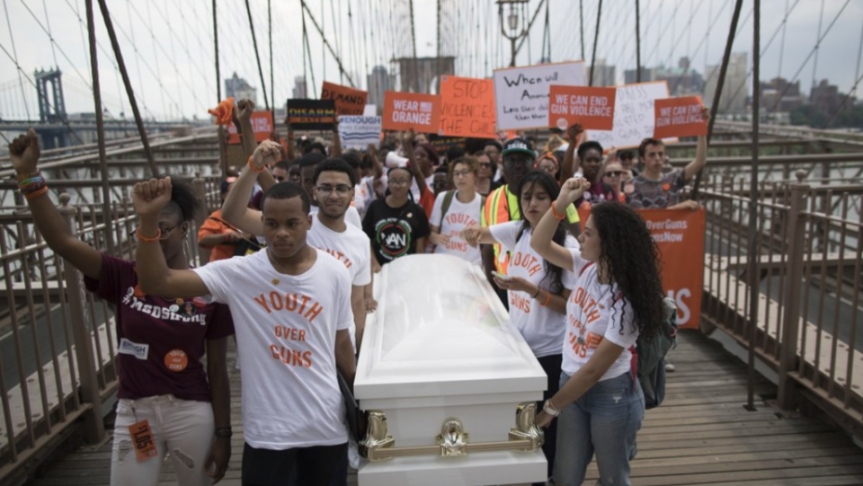
Demonstrators carry a coffin over Brooklyn Bridge during a march against gun violence, 06.02.18, in NY. | Mary Altaffer – AP

Under U.S. capitalism, industrial production and consumerism expand. Greenhouse gases increase, the climate changes, and people die. U.S. imperialism leads to wars and potentially nuclear war.

U.S. life expectancy has fallen. According to government statistics released in December, 2022, life expectancy at birth (LEB) for 2021 was 76.4 years. LEB was 77.0 years in 2020 and 78.8 years in 2019. Public health officials claimed this “was the biggest two-year decline in life expectancy since 1921-1923.”

Mothers fare badly. In 2020,19.1 mothers in general and 55.3 Black mothers died per 100,000 live births. They died from illnesses related to childbearing, most of them preventable. In the Netherlands that year, the maternal mortality rate was 1.2 mothers per 100,000 live births. In 2018, 55 nations showed a rate more favorable than that of the United States. 

Americans, mostly working-age adults, die from “diseases of despair” – substance abuse, accidental drug overdose, alcoholism, and suicide. They also died of Covid 19 infection, the U.S. rate of 332.81 Covid deaths per 100,000 population being the 16th highest in the world.

During most of the pandemic, Black people died at two or more times the rate of infected white people. Now the cumulative death rates of each group are similar, with 355 deaths of whites and 369 deaths of Blacks per 100,000 population. Cumulative Covid deaths for American indigenous peoples register at 478 deaths per 100,000 population. Vaccine skepticism may account for increased vulnerability of whites. 

The pandemic aside, Blacks and American Indians live far shorter lives than white people do. As of October 2022, LEB for Hispanics was 77.7 years; white people, 76.6 years; Blacks, 70.8 years; and American Indians, 65.2 years. In 2020, 65 nations showed longer LEB than did the United States.

Healthcare failings may have contributed to the high U.S death rates. Proposals for reform, especially for universal healthcare, center on its financing. The United States is the top healthcare spender among all nations.

Paying  $12,914 per capita for healthcare in 2021, the United States outspent second-place spender Germany whose outlay was $7383 per capita. Total spending on health that year amounted to $4.3 trillion –18.3% of the U.S. GDP. The United States accounted for 42% of healthcare spending in the world in 2018.

Healthcare in the United States is a profit center. The pricing of drugs, medical equipment, medical insurance, and services provided by hospitals and outpatient facilities in general is exorbitant.  Executives of medical supply and pharmaceutical companies, specialty physicians, and administrators of hospitals and healthcare networks receive enormous salaries.

Profitmaking hospital chains, health insurance companies, and pharmaceutical companies generate enough revenue to allow for stock buybacks and dividend payments. Over nine recent years 14 pharmaceutical companies spent $747 billion on stock buybacks. Payments to private insurance companies and private hospital networks are large enough to cover astronomically high administrative costs and profit-taking.

Some healthcare and health-promotion activities produce no revenue, or very little. They tend to receive relatively little support and skimpy funding.

  • The U.S. public health sector, charged with health education and illness prevention, is a low-priority item. Inadequate preparation and preventative measures largely accounted for the U.S. Covid-19 debacle. 
  • Insurance companies dedicate effort to denying coverage for particular diagnostic and therapeutic interventions.
  • Multi-hospital, multi-service conglomerates are cutting back on health services in rural and economical depressed areas because of decreased “productivity.” 
  • Many hospitals have recently dropped children’s hospital services as being less remunerative than care for hospitalized adults.
  • Small rural hospitals unable to pay bills have been closing down in droves throughout the nation, depriving area residents of care.
  • Specialty practitioners and hospitals often prioritize expensive medical procedures and high-technology diagnostic modes over care centering on provider – patient interaction and communication.
  • Many physicians during training opt for a specialty rather than a primary-care career, often because of income considerations. Primary care physicians now comprise only 20% of all U.S. physicians.
  • Diminished emphasis on a “medical home,” that hallmark of primary care, opens the door to inefficient, low-quality care.

Other capitalist countries have achieved long life expectancies.  The average life expectancy for 2021 in eight European countries plus Australia and Japan was 82.4 years. Their average per- capita health spending was $6,003. Japan spent $4,666 per capita on healthcare; LEB was 84.5 years.

Those countries protect healthcare as a public good, mainly because labor unions and social democratic or labor political parties apply pressure. Universal access to care is the norm. 

Universal care in the United States is but a dream. U.S. unions are weak and there is no working people’s political party. Some 25 million working age adults had no health insurance in 2021; insurance for 23% of them was inadequate. Too many have no care or fragmented care.

Reform efforts will continue in the United States, propelled perhaps by worsening life expectancy. But healthcare has its limitations. Steven Woolf, retired director of Virginia Commonwealth University’s Center on Society and Health, told an interviewer recently that better healthcare is “only a partial answer” to extending life expectancy, accounting “for about 10 to 20 percent of health outcomes.”

He explained: “Our health is really shaped by our living conditions, jobs, the wages we earn, our wealth accumulation, the education that enables us to get those jobs … The country that we live in is the richest in the world, but we have the highest level of income inequality. So, much of the resources that we need for a healthy population are not available to most of the population.”

Woolf is saying, in effect, that people die early because of inequalities, oppression, and organized greed. The United States appears as different from other rich capitalist counties. Social guarantees are fragile. The wealthy have few restraints on satisfying their wants. A besieged working class lacks voice and agency.

The prospect that reforms, alone, will restore justice and decent lives for working people is nil. They confront a voracious, extreme kind of capitalism.  Its rulers tolerate, promote, and seek out collaborators for actions and policies leading to die-offs. Think climate catastrophe, wars, and nuclear war.

In response to impending disaster, Americans desiring better and more secure lives for everyone would adjust their forward vision. Working for reforms, they would aim at something new, which is top-to-bottom social and political change. New motivation, determination and hope would be a shot in the arm.

Revolutionary change is a worldwide project, and not to be left to one people – except in special circumstances. One such was pre-1917 Czarist Russia and another would be that anomaly among capitalist nations which is the death-dealing U.S. nation.


W.T. Whitney Jr. is a political journalist whose focus is on Latin America, health care, and anti-racism. A Cuba solidarity activist, he formerly worked as a pediatrician, lives in rural Maine. W.T. Whitney Jr. es un periodista político cuyo enfoque está en América Latina, la atención médica y el antirracismo. Activista solidario con Cuba, anteriormente trabajó como pediatra, vive en la zona rural de Maine.


In a world of great disorder and extravagant lies, we look for compassion / by Vijay Prashad

Francisca Lita Sáez (Spain), An Unequal Fight, 2020.

Greetings from the desk of Tricontinental: Institute for Social Research.

These are deeply upsetting times. The COVID-19 global pandemic had the potential to bring people together, to strengthen global institutions such as the World Health Organisation (WHO), and to galvanise new faith in public action. Our vast social wealth could have been pledged to improve public health systems, including both the surveillance of outbreaks of illness and the development of medical systems to treat people during these outbreaks. Not so.

Studies by the WHO have shown us that health care spending by governments in poorer nations has been relatively flat during the pandemic, while out-of-pocket private expenditure on health care continues to rise. Since the pandemic was declared in March 2020, many governments have responded with exceptional budget allocations; however, across the board from richer to the poorer nations, the health sector received only ‘a fairly small portion’ while the bulk of the spending was used to bail out multinational corporations and banks and provide social relief for the population.

In 2020, the pandemic cost the global gross domestic product an estimated $4 trillion. Meanwhile, according to the WHO, the ‘needed funding … to ensure epidemic preparedness is estimated to be approximately U.S.$150 billion per year’. In other words, an annual expenditure of $150 billion could likely prevent the next pandemic along with its multi-trillion-dollar economic bill and incalculable suffering. But this kind of social investment is simply not in the cards these days. That’s part of what makes our times so upsetting.

S. H. Raza (India), Monsoon in Bombay, 1947–49.

On 5 May, the WHO released its findings on the excess deaths caused by the COVID-19 pandemic. Over the 24-month period of 2020 and 2021, the WHO estimated the pandemic’s death toll to be 14.9 million. A third of these deaths (4.7 million) are said to have been in India; this is ten times the official figure released by the Government of Prime Minister Narendra Modi, which has disputed the WHO’s figures. One would have thought that these staggering numbers–nearly 15 million dead globally in the two-year period–would be sufficient to strengthen the will to rebuild depleted public health systems. Not so.

According to a study on global health financing, development assistance for health (DAH) increased by 35.7 percent between 2019 and 2020. This amounts to $13.7 billion in DAH, far short of the projected $33 billion to $62 billion required to address the pandemic. In line with the global pattern, while DAH funding during the pandemic went towards COVID-19 projects, various key health sectors saw their funds decrease (malaria by 2.2 percent, HIV/AIDS by 3.4 percent, tuberculosis by 5.5 percent, reproductive and maternal health by 6.8 percent). The expenditure on COVID-19 also had some striking geographical disparities, with the Caribbean and Latin America receiving only 5.2 percent of DAH funding despite experiencing 28.7 percent of reported global COVID-19 deaths.

Sajitha R. Shankar (India), Alterbody, 2008.

While the Indian government is preoccupied with disputing the COVID-19 death toll with the WHO, the government of Kerala–led by the Left Democratic Front–has focused on using any and every means to enhance the public health sector. Kerala, with a population of almost 35 million, regularly leads in the country’s health indicators among India’s twenty-eight states. Kerala’s Left Democratic Front government has been able to handle the pandemic because of its robust public investment in health care facilities, the public action led by vibrant social movements that are connected to the government, and its policies of social inclusion that have minimised the hierarchies of caste and patriarchy that otherwise isolate social minorities from public institutions.

In 2016, when the Left Democratic Front took over state leadership, it began to enhance the depleted public health system. Mission Aardram (‘Compassion’), started in 2017, was intended to improve public health care, including emergency departments and trauma units, and draw more people away from the expensive private health sector to public systems. The government rooted Mission Aardram in the structures of local self-government so that the entire health care system could be decentralised and more closely attuned to the needs of communities. For example, the mission developed a close relationship with the various cooperatives, such as Kudumbashree, a 4.5-million-member women’s anti-poverty programme. Due to the revitalised public health care system, Kerala’s population has begun to turn away from the private sector in favour of these government facilities, whose use increased from 28 percent in the 1980s to 70 percent in 2021 as a result.

As part of Mission Aardram, the Left Democratic Front government in Kerala created Family Health Centres across the state. The government has now established Post-COVID Clinics at these centres to diagnose and treat people who are suffering from long-term COVID-19-related health problems. These clinics have been created despite little support from the central government in New Delhi. A number of Kerala’s public health and research institutes have provided breakthroughs in our understanding of communicable diseases and helped develop new medicines to treat them, including the Institute for Advanced Virology, the International Ayurveda Research Institute, and the research centres in biotechnology and pharmaceutical medicines at the Bio360 Life Sciences Park. All of this is precisely the agenda of compassion that gives us hope in the possibilities of a world that is not rooted in private profit but in social good.

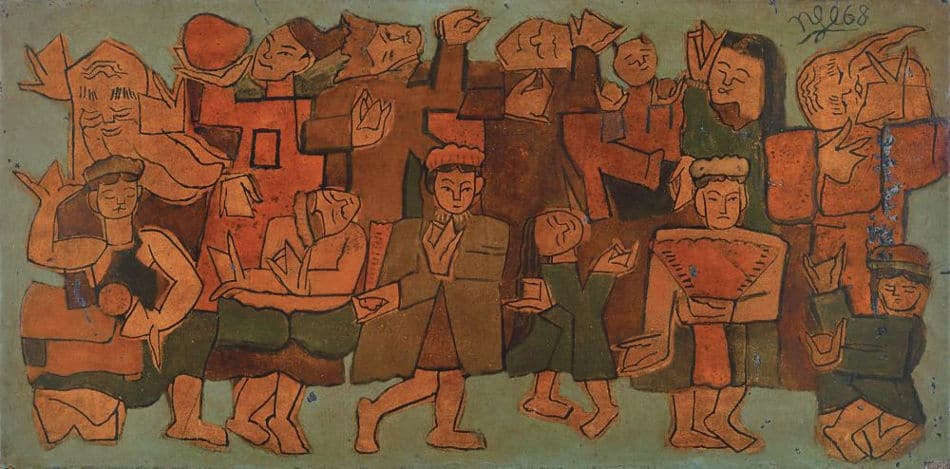
Nguyễn tư Nghiêm (Vietnam), The Dance, 1968.

In November 2021, Tricontinental: Institute for Social Research worked alongside twenty-six research institutes to develop A Plan to Save the Planet. The plan has many sections, each of which emerged out of deep study and analysis. One of the key sections is on health, with thirteen clear policy proposals:

If even half of these policy proposals were to be enacted, the world would be less dangerous and more compassionate. Take point no. 6 as a reference. During the early months of the pandemic, it became normal to talk about the need to support ‘essential workers’, including health care workers (our dossier from June 2020, Health Is a Political Choice, made the case for these workers). All those banged pots went silent soon thereafter and health care workers found themselves with low pay and poor working conditions. When these health care workers went on strike–from the United States to Kenya–that support simply did not materialise. If health care workers had a say in their own workplaces and in the formation of health policy, our societies would be less prone to repeated healthcare calamities.

1. Advance the cause of a people’s vaccine for COVID-19 and for future diseases.
2. Remove patent controls on essential medicines and facilitate the transfer of both medical science and technology to developing countries.
3. De-commodify, develop, and increase investment in robust public health systems.
4. Develop the public sector’s pharmaceutical production, particularly in developing countries.
5. Form a United Nations Intergovernmental Panel on Health Threats.
6. Support and strengthen the role health workers’ unions play at the workplace and in the economy.
7. Ensure that people from underprivileged backgrounds and rural areas are trained as doctors.
8. Broaden medical solidarity, including through the World Health Organisation and health platforms associated with regional bodies.
9. Mobilise campaigns and actions that protect and expand reproductive and sexual rights.
10. Levy a health tax on large corporations that produce beverages and foods that are widely recognised by international health organisations to be harmful to children and to public health in general (such as those that lead to obesity or other chronic diseases).
11. Curb the promotional activities and advertising expenditures of pharmaceutical corporations.
12. Build a network of accessible, publicly funded diagnostic centres and strictly regulate the prescription and prices of diagnostic tests.
13. Provide psychological therapy as part of public health systems.

Roque Dalton

There’s an old Roque Dalton poem from 1968 about headaches and socialism that gives us a taste of what it will take to save the planet:

It is beautiful to be a communist,
even if it gives you many headaches.

The communists’ headache
is presumed to be historical; that is to say,
that it does not yield to painkillers,
but only to the realisation of paradise on earth.
That’s the way it is.

Under capitalism, we get a headache
and our heads are torn off.
In the revolution’s struggle, the head is a time-bomb.

In socialist construction,
we plan for the headache
which does not make it scarce, but quite the contrary.
Communism will be, among other things,
an aspirin the size of the sun.

Originally published: Tricontinental: Institute for Social Research on May 12, 2022

Vijay Prashad is an Indian historian, editor and journalist. He is a writing fellow and chief correspondent at Globetrotter, a project of the Independent Media Institute. He is the chief editor of LeftWord Books and the director of Tricontinental: Institute for Social Research. He has written more than twenty books, including The Darker Nations: A People’s History of the Third World (The New Press, 2007), The Poorer Nations: A Possible History of the Global South (Verso, 2013), The Death of the Nation and the Future of the Arab Revolution (University of California Press, 2016) and Red Star Over the Third World (LeftWord, 2017). He writes regularly for Frontline, the Hindu, Newsclick, AlterNet and BirGün.

MR Online, May 13, 2022, https://mronline.org/