US Pirate Attacks in the Caribbean Will Aggravate Emergency in Cuba / By W. T. Whitney Jr.

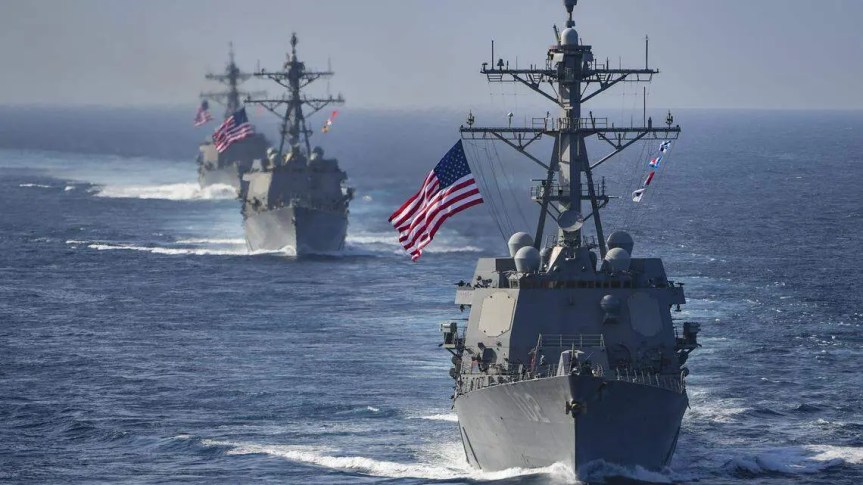
At least eight US warships have been deployed to the Caribbean Sea | Source: venezuelanalysis.com

South Paris, Maine


Hitting two birds with one stone, the U.S. government, top-level disturber of the peace now brandishing a Caribbean armada, strikes out against Venezuela – and Cuba too, indirectly. The U.S. military on December 10 seized a large oil tanker in the Caribbean bound for China. The ship carrying Venezuelan oil had previously offloaded 50,000 barrels of oil to a smaller ship for delivery to Cuba.

Cuba depends on oil supplied by Venezuela. High U.S. officials want to cut off Cuba’s access to oil from Venezuela and thereby deliver a decisive blow against Cuba’s government. Presently six other tankers sanctioned by the U.S. government and carrying Venezuelan oil are at high risk of being seized.

Cuba’s Foreign Relations Ministry issued a statement saying in part that, This act of piracy and maritime terrorism … represents U.S. escalation against Venezuela’s legitimate right freely to use and to trade its natural resources with other nations, including hydrocarbon supplies to Cuba …[Such] actions have a negative impact on Cuba and intensify the United States’ policy of maximum pressure and economic suffocation, with a direct impact on the national energy system and, consequently, on the daily lives  our people.”

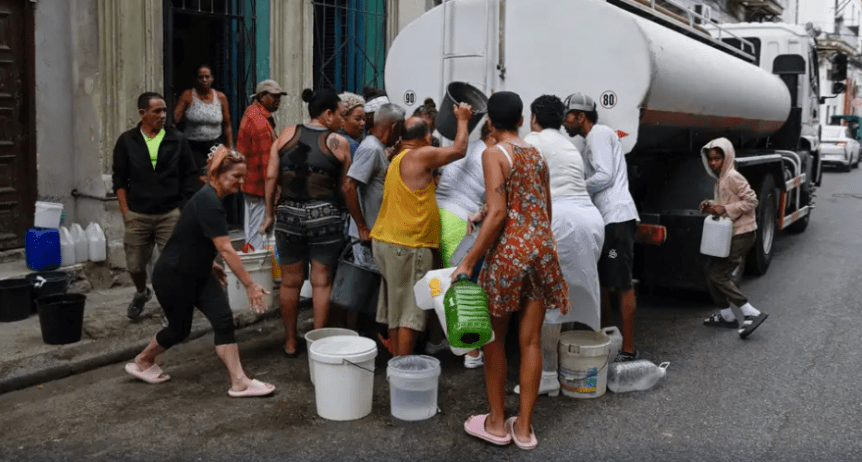
This reference to a “policy of maximum pressure” invites a look at ominous developments unfolding in Cuba as the maritime drama plays out.  Cuba’s government has recently resorted to measures that are extraordinary enough as to indicate worsening crisis in Cuba. The U.S economic blockade has led to shortages of supplies, food, and income. The impact over the course of decades has been wearing and cumulative. Now death rates are up and newer generations are decimated by migration.

Recent measures taken by Cuba’s government, explored below, strongly suggest Cubans face an emergency. U.S. activists responding to their government’s warlike preparations in the Caribbean – another emergency – have good reason to urgently build their solidarity not only with Venezuela but with Cuba too.  What follows here is a report on extreme measures recently taken by Cuba’s government. The object is to portray these measures as so unusual as to confirm the existence of Cuba’s last-ditch situation and, that way, motivate Cuba’s U.S. supporters toward action.

Dollarization

Cuba’s government recently introduced monetary regulations allowing citizens to buy and sell some goods and services using the U.S. dollar.  A report published by a government-oriented news service refers to a “pragmatic recognition of today’s reality” and to “a partial and controlled dollarization of [Cuba’s] economy.” The government will be “allowing certain economic actors to trade in foreign currencies under specific circumstances.”

The new regulations apply to transactions with foreign manufacturers, investors, traders, shippers, financial institutions – and to families abroad sending remittances. The immediate goal is “to directly incentivize the generation of foreign exchange earnings, allowing those who contribute to this generation to keep a significant portion of their earnings in hard currency.” 

The broader purpose is “to increase national production, improve the availability of goods and services, and create conditions for a future return to the strengthened Cuban peso.” Policy-makers want to stimulate exports, augment the supply of goods available in Cuba, and increase both national production and foreign investment. Another goal, referred to as “[r]eduction of distortions,” is elimination of informal or illegal foreign currency markets.

The new regulations allow “authorized commercial establishments … [and those] domestic suppliers supporting export or import substitution activities to use dollars and other foreign currencies in international transactions.” Parties permitted to use dollars are authorized self-employed workers, privately owned businesses, cooperatives, and state enterprises.

These parties have permission to deposit dollars in Cuban banks – dollars accumulated from exports of goods and services, from on-line sales and from sales realized through the Mariel Special Development Zone. Banks will accept dollars purchased from foreign currency traders and dollars sent as remittances from families abroad.

The government’s new authorization of the U.S. dollar as a national currency may well be unsettling to Cubans perceiving implications of a dependency relationship with the northern neighbor. The necessity to have done so reflects the urgency of Cuba’s current situation.     

Pressing needs

Overtones of a new situation entered into the decision of the Cuban Communist Party’s Central Committee at its meeting on December 13 to postpone the 9th Party Congress set for April 2026. Party Congresses have taken place every five years.

Making the announcement, Leader of the Revolution Raul Castro emphasized the need to “dedicate all the country’s resources, as well as the effort and energy of the Party, Government, and State cadres, to resolving current problems, and to dedicate 2026 to recovering as much as possible.” 

Likewise, Cuba’s Council of State announced on December 10 that the upcoming session of the National Assembly of People’s Power set to begin on December 18 would be meeting for that day only, by video conference. In 2024, Assembly delegates met in person for two sessions for a total of  24 days.

A spokesperson explaining the shift stated that, as is “known by all, the electricity situation and the current state of the economy, and also difficulties with the [multi-virus] pandemic and the health situation … create a complex situation for carrying out the Assembly. There is the problem too of the rational use of resources.” 

The 11th plenum of the Communist Party’s Central Committee taking place on December 13 was also a one-day session; video conferencing provided access for members living outside Havana. Concluding the meeting, First Secretary Miguel Díaz-Canel, president of Cuba, mentioned particularly that:

At the end of the third quarter, GDP has fallen by more than 4%, inflation is skyrocketing, the economy is partially paralyzed, thermal power generation is critical, prices remain high, deliveries of rationed food are not being met, and agricultural and food industry production is not meeting the needs of the population. There are also the costly losses caused by the devastating passage of Hurricane Melissa …

Donald Trump has just launched his pirates onto a Venezuelan oil tanker, shamelessly seizing the cargo like a common thief. This was the latest episode in an alarming series of attacks on small boats and extrajudicial executions of more than eighty people, based on unproven accusations and amid an unprecedented and threatening military deployment in a declared Zone of Peace …

[However,] we are the children of a people who carried out a revolution 90 miles from the greatest imperial power on the planet and who have successfully defended it for more than six decades … Only a heroic people who defend a Revolution, who have the example of the history of that Revolution, are capable of enduring what we have been living through all these years.”

Henry Lowendorf of the U.S. Peace Council, queried for this article, highlights the central role of the U.S. government. He states via email that, “The U.S. has been trying to crush the Cuban revolution for over 60 years. So far it has failed. But with new intensity and the newly accelerated war on Venezuela, the U.S. is desperately working to cut off all life support to Cuba.”

A dark setting brightens a bit with good news out of California, as reported in the Cuban press. The Los Angeles Hands off Cuba Committee led in organizing a shipment from Los Angeles to Cuba by way of Jacksonville, Florida of a 40-foot container with medical supplies worth $1 million.  Participating were members of the International Longshore and Warehouse Union and International Association of Machinists, along with Global Health Partners and the PanAmerican Medical Association.


W.T. Whitney Jr. is a retired pediatrician and political journalist living in Maine.

Electoral Coup Surfaces in Honduras amid Signs of US Intervention / By W.T. Whitney Jr.

Photo: Xiomara Castro de Zelaya/X

South Paris, Maine


Elections taking place November 30 in Honduras will decide the country’s next president and make-up of the national assembly. Current President Xiomara Castro of the democratic socialist Party of Liberty and Refoundation (Libre), in office since 2022, is limited to one term. Libre Party presidential candidate Rixi Moncada was finance minister and then defense minister in Castro’s government.

The mantra circulates that ten families rule in Honduras and hold most of its wealth. Their influence is such that left-leaning opposition forces can count on the most forceful kind of pushback.

Businessman Manuel Zelaya turned progressive politician was Honduras’ president from 2006 until June 2009, when a military coup deposed him, with U.S. help. He had called for a minimum wage, mild agrarian reform and a constituent assembly. Zelaya is now general coordinator of the Libre Party, founded in 2011 in reaction to the coup. He is President Xiomara Castro’s husband.

Xiomara Castro’s unsuccessful candidacies for president in 2013 and 2017 encountered electoral fraud and violent attacks orchestrated by the well-ensconced National and Liberal Parties. Her overwhelming electoral victory in 2021 resulted from the association of incumbent president Juan Orlando Hernández and his National Party with corruption and narcotrafficking. Hernández and his brother, convicted on narcotics and weapons charges, are serving long prison terms in the United States.Hernández’s second term was constitutionally illegal.

Current polls give the Libre Party candidate Rixi Moncada an even chance for victory, or a small majority. A plot emerged a month ahead of the voting.

On October 29, Attorney General Johel Zelaya reported he had transferred leaked audio recordings, with transcriptions, to the Public Minister for investigation. Libre Party’s Marlon Ochoa, one of three members of Honduras’ National Electoral Council, discovered them. Each councilor represents a political party. Voices on the recordings allegedly are those of Councilor Cossette López of the National Party; Tomas Zambrano, head of the National Party’s congressional bench; and an unnamed military officer.

According to Johel Zelaya, the conversations told of plans for hiring transportation companies and personnel to transfer voting results on election day, inserting agents among election observers, interrupting data transmission, prematurely announcing rightwing Liberal Party candidate Salvador Nasralla as the winner, sowing suspicion in the media about voting processes, and announcing favorable partial results as a potential “alibi for impugning and suspending the process.”

According to an observer, “The recordings revealed … a plan to pressure external actors, notably the US Embassy in Tegucigalpa, not to recognize any victories by Libre. This would turn an internal dispute into an international recognition crisis.” The report has councilor Cossette López-Osorio exclaiming, “We’ll use the tools that the people at the Embassy gave us.”

One Honduran observer says Salvador Nasralla is the “choice of the most reactionary spheres in Washington,” another that he has promised to “implement a security plan” similar to that of dictatorial Salvadoran president Nayib Bukele. Nasralla spent one third of the pre-election period traveling in the United States and Spain, presumably seeking support.

The Libre party on October 13 announced a “permanent mobilization … [against] the bipartisan plan to manipulate the coming elections.” The Party’s general coordinator Manuel Zelaya declared, “We must prepare ourselves to defeat the electoral coup … They know that we already reversed the coup in 2009 and that we will never go back!”

Rixi Moncada, speaking at a rally on November 9, reviewed gains achieved during Castro’s presidency, described her own program for governing, and highlighted a new twist in the coup saga. The National Election Council that day had carried out a nationwide simulation of election day processes. Only 1556 of 4362 voting locations actually transmitted voting records to a central location. Only 23.7% of biometric devices functioned. The results mirror the scenario presented by the recordings.  

Moncada outlined plans; 12 Libre Party activists from each of Honduras’s 18 departments would remain in Tegucigalpa until election day. They would constitute a “commission … our battlefront in defense of victory.” Party activists on that day would transfer voting records to the various Party headquarters where votes would be counted.

Context is important.  The U.S. government has long maintained hundreds of troops and several military units at Honduras’ Soto Cano airfield. They constitute the largest U.S. base in Central America, which facilitates U.S. interventions in regional affairs, as when the U.S. government in the 1980s sent supplies to Contra paramilitaries fighting in Nicaragua.

U.S. economic interests center on the mining, tourism, and agricultural export sectors. Honduras, regional center for narcotics transfer to the United States, qualifies as a target of U.S. drug war activities, but also as staging area for military interventions, for which drug war is a frequent pretext.  

President Castro has irritated U.S. officials. She cut ties with Taiwan in favor of the People’s Republic of China and supported Venezuelan President Maduro against U.S. accusations that his 2024 election victory was fraudulent.  Accusing the U.S. ambassador of meddling with Honduras’ military forces in August 2024, she mentioned cancelation of the binational extradition treaty.  Reacting to U.S. plans for massive deportation of migrants from Central America, Castro in January 2025 threatened to expel U.S. troops.

Her Libre Party government scored successes:  new highways, new hospitals, reforestation, subsidized electrical power, electricity for rural households, educational scholarships, loans for thousands of farmers, seeds and fertilizers for 450,000 of them, community orchards, 5000 refurbished education centers, and land redistribution.

Honduras’ murder rate per 100,000 inhabitants dropped from an average of 41.7 during President Hernández last term to 27.2 under Castro. Families living in poverty dropped from 73.6% to 62.9%. The previous government had promoted so-called “zones for employment and economic development.” Castro ended the scheme that gave control of municipalities to foreign investors and deprived residents of self-government and legal rights.

Candidate Rixi Moncada, 60 years old, came from a working-class family, taught in rural and city schools, studied law and became a practitioner and teacher of criminal law. She served the government of President Manuel Zelaya (2006-2009) as secretary of labor and social security. She managed the government-owned electric company.

Moncada indicated that, as president, she will “defend workers and state sovereignty and democratize the economic system.” She would “transform the justice system, combat impunity, reform the public ministry and strengthen the courts … [and revive] “strategic state enterprises.” She would support public healthcare and education – “without privatization.”

On November 12, Deputy Secretary of State Christopher Landau indicated  the U.S. government “will respond rapidly and firmly to any attack on the integrity of the electoral process in Honduras.” At once the U.S. Embassy broadly disseminated Landau’s message.

Interviewed on television that day, Salvador Nasralla asked “What would happen if these people (from the Libre Party) tried to steal votes?” His response: “Those ships that are soon going to take over Venezuela are going to come and target Honduras.”

U.S. interference in Honduras’ electoral processes is nothing new,” says veteran reporter Giorgio Trucchi. Quoting activist Luis Méndez, he adds that, “We are facing the old traditional politics, allied with US interference, large corporations, and business sectors attached to the neoliberal agenda with its project of dispossession and dismantling of the public sector …For Libre to continue governing is a setback for the geostrategic goals of U.S. domination in Latin America. We will somehow see this reflected in the elections.”


W.T. Whitney, Jr., is a political journalist whose focus is on Latin America, health care, and anti-racism. A Cuba solidarity activist, he formerly worked as a pediatrician and lives in rural Maine.

José Martí Exposes U.S. Designs on Cuba / Prepared by W.T. Whitney

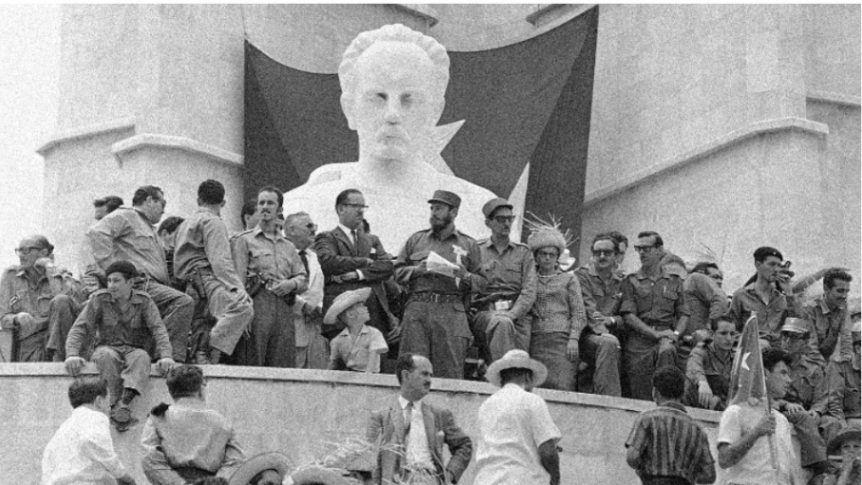
Photo: Fidel Castro, center, at the May Day 1960 parade in Havana at the Jose Marti Monument. | AP

South Paris, Maine


Introduction

While living in exile in the United States, José Martí dedicated the time between 1880 and 1895 to preparations for Cuba’s Second War for Independence from Spain, which ran from 1895 to 1898. Martí died as a martyr in Cuba on May 18, 1895. Our interest here is in Marti’s ideas on Cuba’s independence from the United States.

His writings are full of criticisms of the United States and U.S. pretentions for control of Cuba. Our object in presenting Martí’s ideas on the United States is to show that U.S. assault on Cuba, ongoing now for six decades as economic blockade, is hardly new. The U.S. has in fact sought domination over Cuba since the beginning of the 19 th century.

What follows is a sampling of Martí’s observation on the United States, written while he was living in New York between 1880 and early 1895. Martí, born in 1893, traveled frequently to Florida and even to Central America and the West Indies to educate, recruit, and raise funds for the coming independence struggle. In 1892, he founded the Cuban
Revolutionary Party and its newspaper Patria.

The Spanish colonial government arrested Martí for his writings in 1869 early in the course of Cuba’s First War for Independence (1868-1878). After one year in prison, Martí in 1871 left for exile in Spain where he remained for three years. Subsequently he was teaching and writing in Mexico and Guatemala until he returned to Cuba in 1878, only to be
exiled again to Spain. He moved on to New York, where, except for a six-month stay in Venezuela in 1881, he would remain until he left for Cuba in 1895.

Two themes dominate in his writings about the United States. He projected the idea of the idea of “our America,” which for him was all the territory lying between the Rio Bravo (Rio Grande) and Tierra del Fuego. That region had its own cultures, traditions, and history rather than those of North America and Europe. His essay “Our America” was published in
New York in 1991.

Warning about the U.S. threat to Cuban independence, Martí also mentioned the terms annexationism and annexationists to signify longings by U.S. Americans and by Cubans for U.S. possession of the island.

Excerpts of Martí’s writings follow:

José Martí’s letter to NY Evening Post, March 25, 1889 –

“It is probable that no self-respecting Cuban would like to see his country annexed to a nation where the leaders of opinion share towards him the prejudices excusable only to vulgar jingoism or rampant ignorance. There are some Cubans who … would like to see the island annexed to the United States. But those who have fought in war and learned in exile
… do not desire the annexation of Cuba to the United States. They do not need it; …they cannot honestly believe that excessive individualism, reverence for wealth, and the protracted exultation of a terrible victory are preparing the United States to be the typical nation of liberty.

José Martí’s letter to Gonzalo de Quesada on December 14, 1889 mentions this:

“On our land, Gonzalo, there is another [U.S.] plan even more sinister than what we have seen so far, and that is the wicked plan to force the island into war, to precipitate it, in order to have a pretext to intervene in it, and with the credit of mediator and guarantor, to take it over. There is nothing more cowardly in the annals of free peoples: nor any more cold- blooded evil.

The Washington Pan-American Congress — José Martí provided La Nación newspaper in Buenos Aires with a report (December 19-20, 1889) on the First International Conference of American States that took place in Washington from October,1889 to April,1890. Marti attended as consul for Uruguay. On the agenda were U.S. plans for bolstering commercial ties to the region and establishing a customs union.

“The parade of delegates is ending and the sessions of the Pan-American Congress are about to begin. Never in America, from its independence to the present, has there been a matter requiring more good judgment or more vigilance … than the invitation which the
powerful United States (glutted with unsaleable merchandise and determined to extend its dominions in America) is sending to the less powerful American nations (bound by free and useful commerce to the European nations) for purposes of arranging an alliance against Europe and cutting off transactions with the rest of the world. Spanish America
learned how to save itself from the tyranny of Spain; and now, after viewing with judicial eyes the antecedents, motives, and ingredients of the invitation, it is essential to say, for it is true, that the time has come for Spanish America to declare its second independence.”

The Inter-American Monetary Commission convened in Washington between January 7 and April 8, 1891. Its object was to fulfill instructions from the recent Pan-American International Conference to form an international monetary union and adopt a common silver currency. The Latin American delegates chose Martí, attending as Uruguay’s
representative, to present a report on their views.

“In every invitation among nations, one must look for hidden motives. No nation does anything against its interest; … Lesser nations, which are still in the throes of gestation, cannot safely join forces with those who seek a union with weaker nations as a solution for the excessive production of a compact and aggressive population, and a vent for their restless masses … They believe in the incontrovertible superiority of “the Anglo-Saxon
race over the Latin race”. They believe in the inferiority of the Black race, which they enslaved yesterday and continue to oppress today, and of the Indian race, which they are exterminating. They also believe that the peoples of Spanish America are composed principally of Indians and Blacks. … Does a political and economic alliance with the United States benefit Spanish America?

“Whoever says economic union, says political union. The nation that buys, rules. The nation that sells, serves.….

The Truth about the United States – Martí published this article in Patria, newspaper of the Cuban Revolutionary Party on March 23, 1894. “But it is certainly true that … in the United States, the reasons for unity are weakening, not solidifying; [that] the various localities are dividing and irritating national politics, not uniting with it; [that] democracy is
being corrupted and diminished, not strengthened and not saved from the hatred and wretchedness of monarchies … From the standpoint of justice and a legitimate social science it should be recognized that … the North American character has gone downhill since the winning of independence, and is today less human and virile; whereas the Spanish- American character today is in all ways superior, in spite of its confusion
and fatigue, to what it was when it began to emerge from the disorganized mass of grasping clergy, unskilled ideologists and ignorant or savage Indians.”

José Martí’s article “The Third Year of the Cuban Revolutionary Party” appeared in Patria on April 17, 1994. It contains this segment:
“Glory does not belong to those who look back, but to those who look forward. It is not merely two flower-covered islands (Cuba and Puerto Rico) … that we are going to bring forth, but we will save and serve them in such a way that the skills and vigor of their peoples, less isolated than those of the resentful and hungry European societies, ensures the independence of the happy archipelago that nature placed at the center of the world – despite the greed of a strong and unequal neighbor. … On the side of America are the Antilles, which, if enslaved, would be a mere pontoon in the war of an imperial republic against a jealous and superior world that is already preparing to deny it power—a mere fort of American Rome. If they were free … they would be the guarantee of balance between the continents, of independence for Spanish America, now under threat, and of honor for the great republic of the North.”

Martí’s article “Honduras and the Outsiders” appeared in Patria onDecember 15, 1894. There he explains that, “In America there are two peoples, and no more than two, with very
different souls due to their origins, backgrounds, and customs, and similar only in their fundamental human identity. On one side is our America, and all its peoples are of a similar or identical nature and background, and of an identical prevailing mix; on the other side is the America that is not ours, whose enmity it is neither sensible nor viable to foster, and with which it is not impossible, and indeed useful, to be friends, with firm decorum and shrewd independence. But we must live from our soul, cleansed of the evil church and the habits of mastery and undeserved luxury.”

José Martí’s letter to Manuel Mercado of May 18,1895
Mercado, living in Mexico, was Martí’s friend of many years. Martí, General Maximo Gomez and four others came ashore in eastern Cuba on April 11 1895. They had traveled from the Dominican Republic. Accompanied by rebel troops, they proceeded westward. Mari died in
battle on May 18, 1895, a day after writing this unfinished letter.

My dearest brother: Now I can write, now I can tell you how tenderly and gratefully and respectfully I love you and that home which I consider my pride and responsibility. I am in daily danger of giving my life for my country and duty. For I understand that duty and have the courage to carry it out – the duty of preventing the United States from spreading
through the Antilles as Cuba gains its independence and from overpowering our lands of America with that additional strength. All I have done so far, and all I will do, is for this purpose. … I have lived in the monster and I know its entrails; my sling is David’s. …

I am doing my duty here. The war in Cuba to prevent … the annexation of Cuba to the United States has come at the right time in America. It’s a reality greater than the vague and scattered desires of the annexationists among the Cubans and Spaniards, whose alliance with the Spanish government would only give them relative power.

Unless otherwise noted, Martí’s writings are taken from “Our America”, José Martí and Philip S. Foner, Monthly Review Press, 1977.


W.T. Whitney, Jr., is a political journalist whose focus is on Latin America, health care, and anti-racism. A Cuba solidarity activist, he formerly worked as a pediatrician and lives in rural Maine.


New Cuban Report Confirms US Blockade is War / By W.T. Whitney Jr.

South Paris, Maine


Cuba’s foreign ministry on September 17 released the nation’s annual report on adverse effects of the lengthy U.S. economic blockade of Cuba. It does so ahead of the yearly vote in the United Nations General Assembly on a Cuban resolution stating the “necessity of ending the economic, commercial and financial embargo imposed by the United States against Cuba.” Voting takes place on October 28-29.

For 32 years, member states have overwhelmingly approved Cuba’s resolution. At times recently, the U.S. and Israel have been alone inrejecting it.

The 55-page Report – accessible here – is remarkable for its detailed and far-ranging description of disarray and distress caused by the blockade. It exposes the cruelty and lawlessness of U.S. intrusion in the lives of a sovereign people.

This year’s version of the Report is convincing as to the urgency of opposing this U.S. policy. Showing that the blockade kills people, it casts the blockade as war. Struggle against the blockade might gain new strength with a new focus on the issue of peace over war.

The idea of the U.S. as war-maker is not new. Beginning with the Monroe Doctrine of 1823, the U.S. government has relied on military power as well as economic and political pressure to work its way in Latin America and the Caribbean area. Even now the U.S. wages war on Venezuela, Cuba’s close ally and fellow victim of U.S. economic sanctions.

A recent study adds precision to the notion of U.S. war against Cuba. The Lancet medical journal in August 2025 reported that economic sanctions imposed in 152 countries between 1971 and 2021 caused so many deaths annually as to exceed battle-related deaths and, often, to equal the annual toll of battlefield deaths plus civilian casualties.
This information removes any lingering surprise that the blockade might be lethal.

Awareness of that reality would be a big step toward recognition of the blockade as war against Cuba. The agenda here is to show the Report as backing these claims. The inquiry offers perspective as to Cuba’s place in the world system of wealth accumulation, conflict,
and oppression.

Big picture

The Report records damage affecting various sectors of Cuban society between March 2024 and February 2025. It surveys financial losses, shortages, and consequences. It shows that adverse effects themselves lead to far-ranging difficulties for individual Cubans and Cuban commercial and production entities.

Troubles stacked one upon another undermine strenuous efforts by Cuba’s government and people to encourage production and create living conditions that are sustaining and fulfilling. The Report is a story of institutions, production units, private enterprises, schools, healthcare entities, government agencies, and service organizations having to cope with frustrations and failed improvisations. A section appears on solidarity activities on Cuba’s behalf taking place in the United States and in the world.

The Report outlines two general categories of requirements under the blockade. Measures relating to Cuba’s finances make for low salaries, diminished flow of emittances, obstacles to investments from abroad, and inability to re-finance accumulated debt. Other measures block access to materials and commercial products. These include: food, hospital supplies, medicines, raw materials, new machinery, miscellaneous devices and tools, construction materials, replacement parts, fuel, chemicals, fertilizers, and more.

The categories overlap. According to the Report, “Dozens of banks suspended their operations with Cuba, including transfers for the purchase of food, medicines, fuel, materials, spare parts for the national power system, and other essential goods.”

The Report identifies the U.S. instruments that created regulations governing Cuba’s access to money and goods, among them:

  • Designation of Cuba as a state sponsor of terrorism, whereby Cuba
    loses access to international loans and payments due from abroad.
  • Lawsuits filed in US courts under Title III of the Helms-Burton Act.
    These seek damages from those foreign businesses making use of
    nationalized properties. The effect is to discourage future investments.
  • Hundreds of U.S. measures devised for weakening Cuba’s tourism
    industry, that until recently was the country’s leading source of income.
  • New sanctions aimed at foreign officials who enable Cuban doctors to
    work in their countries. They block income that formerly supported
    Cuba’s own healthcare system.
    +Threats and sanctions mounted against “shipping companies, carriers,
    insurers or reinsurers involved in supplying fuel to Cuba.”
  • The 1992 U.S. “Torricelli Law” that requires third-country enterprises
    affiliated with U.S. corporations to never sell goods to Cuba containing
    more than 10% U.S. components.
  • The legacy of 1996 Helms-Burton Act stipulating that the blockade
    would be altered or ended only by Congress and not by the U.S.
    president.

Money talks

The Report records monetary data relating to shortages. The term “damages” that crops up. It signifies a combination of costs, loss of income due to the blockade, and potential gains stymied by theblockade. Damages recorded for various sectors are:

Biotechnology – $129.3 million
Energy and mining – $496.1 million
Information and communication – $78 million
Industry (goods and services) – $5.1 billion
Construction – $161.9 million
Transportation – $353.0 million
Tourism – $2.5 billion
Education – $89.9 million
Sports – $4.1 million
Culture – $195.1 million
Healthcare – $288.8 million
Food supply and processing – $932.3 million
Agricultural production – $51.9million

Total damages during the period under study were $7.6 billion. That amount exceeds damages by 49%. The total since the blockade’s onset is $170.7 billion. With inflation, “quantifiable damages” over the years become $2.1 trillion. There are these additional realities:

* Cuba’s GDP was down 1.1% in 2024. “The economy …has recorded an 11 per cent downfall since 2018.”

* Exports of goods and services achieved 92.5% and 101.6%, respectively, of anticipated goals. Export income was $770 million less than expected. Domestic revenues were down $900 million from 2023.

* Food production was so reduced during the year that 100% of the food provided under the rationing system was imported food.

* The term “geographic relocation of trade” refers to trade displaced because of the blockade. That necessity leads to elevated transportation costs and inflated prices. Added costs are $1.2 billion.

* The year’s inflation rate of 24.9% stems from shortages of supplies, diminished access to hard currency, and state spending to finance its budget deficit.

* Overall spending on tourism was $2.5 billion in 2024; tourism was down 9.6%.

Sanctions as war

Presenting the Report to the press on September 17, Cuban chancellor Bruno Rodríguez observed that, “It is impossible to quantify the emotional damage, anguish, suffering, and deprivation that the blockade causes Cuban families. This has been the case for several generations, with more than 80% of Cubans on the island born after the blockade began.”
According to the Report, “The unprecedented tightening of the blockade in recent years has had a particular impact on the public health sector.

The tense situation created in our economy, the financial persecution of Cuba and the denial of access to the US market … have hampered the ability of our health system to obtain … supplies when needed and provide quality service to the population. This has, in turn, led to the deterioration of several health indicators, including those related to
mortality.”

Indeed, the “blockade imposed by the US government against Cuba is an act of genocide.”
Hospitals and doctors have trouble finding, or may not find, “first line medicines,” cancer drugs, specialized drugs, key surgical supplies, respiratory therapy equipment, imaging equipment, diagnostic agents and test kits, dialysis machines, anesthesia gear, endoscopy equipment, insulin pumps, pacemakers, defibrillators, and pediatric ventilators.

According to the Report, 94,729 people are on surgery waiting lists, including 4507 cancer patients and 9913 children. A benign treatment device for aortic stenosis is available elsewhere but not in Cuba for 158,800 unstable patients. Survival rates for childhood cancer have fallen.

In a recent interview, Paul Jonas, a physician associated with the University of Leiden and admirer of Cuban healthcare, stated that, “In recent years, the Cuban healthcare system has deteriorated significantly…. This leads to untreated illnesses, unnecessary suffering,
and sometimes even death … [T]he quality of nutrition in Cuba is currently very poor … there are also shortages of medicines and other medical supplies.”

Cuba’s infant mortality rate (IMR), the number of babies dying in their first year of life per 1,000 births, was 4.2 in 2014 and presently is 8.2. Cuban economist and demographer Juan Carlos Albizu-Campos, writing in 2023, notes that Cubans’ life expectancy registered a “decrease of 5.39 years” from 2012, also that the “decline … would not only have
continued, but would also have accelerated even if the [Covid-19] pandemic had not occurred.”

Food scarcity, mentioned in 2024 by Granma, the Cuban Communist Party’s newspaper, contributes to excess deaths. Blockade effects extend to food production. New machinery, livestock feed, credit, fuel, spare parts, fertilizer, veterinary supplies, and means of transportation are often lacking War characteristically disrupts societies and kills troops and/or civilians. Doing both, the U.S. blockade of Cuba is a weapon of war and manifestation of war.

What accounts for U.S. warmaking against Cuba? The U.S. has littlechoice. As chief honcho of the world capitalist order, the U.S. government must stick with capitalist rules. A big one requires that production always increase and expand. For that to happen, poorer and under-developed nations must cooperate and be subservient. Their job is to provide cheap labor and access to natural resources – and allow their wealth to be transferred to the centers. An outlier like Cuba is surely due for punishment.


W.T. Whitney, Jr., is a political journalist whose focus is on Latin America, health care, and anti-racism. A Cuba solidarity activist, he formerly worked as a pediatrician and lives in rural Maine.

Trump’s Cuba Memorandum provokes strong criticism amid new US aggressiveness abroad / By W. T. Whitney Jr.

Photo via Resumen Latinoamericano 

South Paris, Maine


The Trump administration on June 30 released its “National Security Presidential Memorandum 5” on U.S. plans for Cuba. Criticism from Cuba’s government and international commentators welled up, as if entirely new forms of anti-Cuba aggression were in the works. That may or may not be so. Actually, the recent Memorandum was a re-issue of the document put forth by the first Trump administration on June 16, 2017.

The eruption of an unusually forceful reaction to a Memorandum that says nothing new seems odd. It’s not. For one thing, the Memorandum creates an opening for U.S. government departments and agencies to fashion entirely new devices aimed at destroying Cuba’s economy. The 2017 Memorandum did exactly that, and what happened was disastrous.

And more: the international context of U.S. assaults on Cuba has drastically changed. U.S. foreign intervention now shows as war from the sky against Iran and as U.S. support and military hardware for genocide against Gazans. Is Cuba next in line for extreme measures?

Prescriptions

The Memorandum’s ostensible use is as a directive to heads of the various departments making up the U.S. government’s executive branch. It requires them to send President Trump reports on new tools they have devised for beating up on Cuba, and to do so within 30 days. They must “adjust the current Cuba regulations in order to ensure adherence, so
that unauthorized transactions with Cuba and impermissible travel to Cuba are effectively banned.”

The document attests to the authority already vested in the departments to take action against Cuba. It cites the 1996 Helms-Burton Law as having legitimized the U.S. purpose of regime change for Cuba.

The Memorandum sets forth various U.S. goals and various ways to implement them. These include promotion of free enterprise in Cuba, channeling funds to the Cuban people and not to their government, “restructuring certain travel arrangements and [US] travel,” and ending supposed human rights abuses in Cuba. This year’s Memorandum once more calls for depriving Cuba’s military and intelligence services of money derived from U.S. tourism.

This Memorandum, as with the other one, bans U.S. tourism to the island. All U.S. citizens traveling to Cuba for permitted reasons must keep records of their transactions in Cuba and for five years ensure that they are available for potential Treasury Department inspection.

The Memorandum directs U.S. officials to expand Cubans’ access to the Internet and to a “free press” and to oppose efforts at the United Nations and “other international forums” aimed at blocking U.S. policies on Cuba. Annually, the secretaries of the various departments of the executive branch must report to the president “regarding the engagement of the United States with Cuba to ensure that engagement is advancing the
interests of the United States.”

President Biden never disavowed Trump’s 2017 Memorandum. As a result, actions adverse to Cuba carried out under its authority remain in force.

Reaction

In discussion on July 2 with Randy Alonso Falcón, host of Cuban TV’s “Round Table” (Mesa Rotunda), Cuban Vice Foreign Minister Carlos Fernández de Cossío portrayed the recent Memorandum as a “political platform, a political document that is propagandistic, but also one that is a political declaration of U.S. intentions serving as a cover for actions it will take and others already in effect.”

As examples of the latter, he cited both sanctions applied to ships of third countries bringing fuel to Cuba and denial of access to the U.S. Visa Waiver program to those otherwise eligible citizens of 40 named countries who have visited Cuba. Now, potential travelers to Cuba often choose not to visit Cuba so as to preserve their eligibility. The intended result has been damage to Cuba’s tourism industry.

Cossio claimed that U.S. measures prompted by the recent Memorandum pose extra danger from “the hand of [Secretary of State] Marco Rubio … [and] of that clique that has made money and political careers out of hostility towards Cuba.” He laments harassment against individuals and businesses licensed to export goods to Cuba’s private sector, suggesting that the U.S. government seeks to harm Cuba’s private sector. He worries that some Cuban-Americans visiting in Cuba may be barred from returning to the United States.

The foreign ministry official pointed to a big change. Cubans have been “receiving privileged treatment on crossing the US border.” They are now vulnerable to “all [U.S.] anti-migrant actions including the alligator prison in Florida.”

International criticism of the recent Trump Memorandum erupted promptly and from many quarters, beginning in Cuba. Cuban president Miguel Díaz-Canel condemned the U.S. “purpose of inflicting the greatest possible damage and suffering.” National Assembly President Esteban Lazo, predicted their “vile purpose will fail in the face of Cubans’
unity and determination. “Cuba will defeat this new aggression,” pronounced Prime Minister Manuel Marrero Cruz.

The Bolivarian Alliance for the Peoples of Our America (ALBA) judged the Memorandum to be “aimed at forcefully hitting at all sectors of Cuban society.” Argentina’s International Committee for Peace, Justice, and Dignity for the Peoples declared its support for U.S. opponents of the Memorandum. Brazil’s Landless Workers Movement (MST) on July 3
initiated an international fundraising campaign to send essential medicines to Cuba.

Mexican President Claudia Scheinbaum on July 2 denounced the Memorandum, while declaring that “Mexico is the country that for decades voted against the blockade of Cuba and that will always be our position.” Mao Ning, spokesperson for China’s Ministry of Foreign Affairs on July 2 stated that, “We exhort the USA to immediately raise the blockade and sanctions against Cuba, and eliminate the U.S. list of state sponsors of terrorism.”

The most explosive and revealing reaction came from Rosa Miriam Elizalde, editor of Cubadebate.cu. She was echoing Vice Minister Cossio’s observation that “Perhaps U.S. officials imbued with this euphoria over a new U.S. foreign policy of imposing peace through force are demanding something similar with Cuba.”

Writing for Mexico’s La Jornada news service on July 5, Elizalde points to “[D]éjà vu: More than 20 years after the United States invaded Iraq under false pretexts, we are witnessing the same warmongering operetta in South Florida … During the spring of 2003, while the missiles were falling on Baghdad, the ultra-sector of Cuban emigration took to the streets of Miami with a disturbing slogan: ‘Iraq now; Cuba later’”.

She notes that, “[T]he Miami propaganda machine is once again waving the flag of armed intervention [in Cuba], while the U.S. and Israel are escalating their military offensive in Iran.” She highlights Congresswoman María Elvira Salazar’s remark that, “This is how tyrants are confronted, not only in Iran, but also satraps in Cuba, Venezuela and
Nicaragua. Peace through force. That’s the American way.”

Elizalde regards as ominous that “Trump invokes as an American military success the sad memory of the Hiroshima and Nagasaki bombs.” She describes a volatile situation in which “[i]mmigrants are hunted down like beasts, just like communists and Jews before World War II.”

She views the current political climate as recalling that of 2003, when the United States invaded Iraq: “The logic is the same: misinform, isolate, demonize, justify sanctions and, if conditions are right, authorize intervention in the “dark places of the planet.”


W.T. Whitney Jr. is a political journalist whose focus is on Latin America, health care, and anti-racism. A Cuba solidarity activist, he formerly worked as a pediatrician, and lives in rural Maine.

At difficult time for Cuba, UN General Assembly again condemns US blockade / By W. T. Whitney

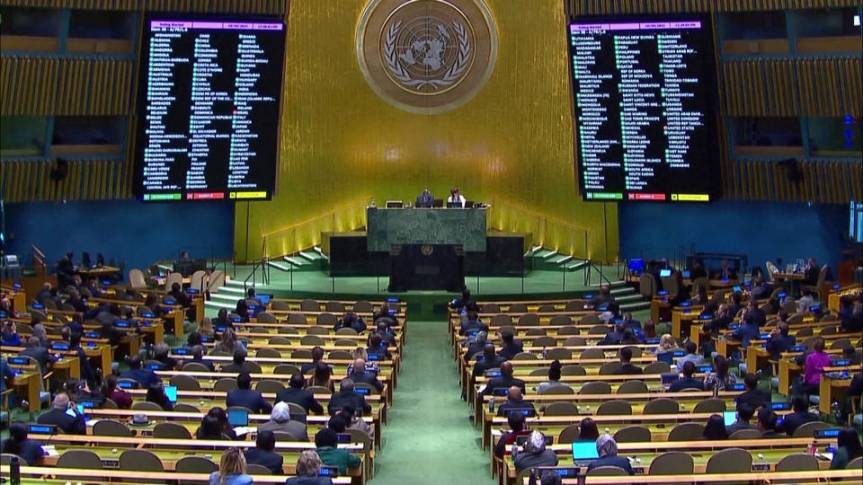
The United Nations General Assembly has voted to condemn the United States’ embargo on Cuba for the 32nd consecutive year. On Wednesday, 187 countries voted in favor of lifting the decades-old sanctions; only the U.S. and Israel voted against the nonbinding resolution | via Democracy Now!

South Paris, Maine


By a 187-nation majority, The United Nations General Assembly on October 30 voted to approve a Cuba Resolution calling for the “Necessity of ending the economic, commercial and financial embargo imposed by the United States of America against Cuba.” The United States and Israel voted no; Moldova abstained.

The same motion has been approved overwhelmingly every year since 1991. No vote took place in 2020 because of the Covid-19 pandemic. For over 20 years, only Israel and the United States have voted down the Resolution; annually one or more states have abstained.

In remarks to the Assembly’s delegates, Cuban Foreign minister Bruno Rodríguez explained that the U.S. economic blockade restricts Cuba’s importation of goods and access to international financial resources, also that shortages hurt every aspect of Cubans’ lives. Cuba’s foreign ministry on September 12 issued a comprehensive summary of adverse effects of the blockade.” Appearing here, it supplements this report.

The UN vote this year has special significance. It took place immediately following both Hurricane Oscar, which devastated eastern Cuba, and an island-wide electrical outage lasting several days. Its cause was lack of oil for generating electricity, restrictions on the shipping of petroleum products, and limited access to international financing, all owing to the blockade.

Now is an extraordinarily difficult time for Cubans and their government. Basic supplies and materials needed for day-to-day functioning are not readily available. Money is short and inflation mounts. The twin culprits are a fall-off in tourism, Cuba’s main source of foreign currency, and U.S. designation of Cuba as a state sponsor of terrorism. The latter entails regulations that persuade international financial institutions and corporations to steer clear of Cuba.

Every year in preparation for its vote on the Resolution, the General Assembly arranges for two days of discussion of the Resolution’s pros and cons. Perhaps reflecting extra stresses weighing on Cuba, commentary during this year’s discussion period came from an unprecedently large group of delegates.

In brief interventions, 59 of them offered reasons why the Resolution should pass; almost 30 international organizations or alliances did likewise. These included the Group of 77 and China, the Association of Southeast Asian Nations (ASEAN), the Community of Latin American and Caribbean States (CELAC), the Organization of Islamic Cooperation (OIC), the Non-Aligned Movement (NAM), and the Caribbean Community (CARICOM).

The speakers made frequent reference to the SSOT designation and to Title III of the U.S. Helms-Burton law (which discourages foreign investment in Cuba). Many of them variously denounced the blockade as violating international law and Cubans’ human rights, for inhibiting Cuba’s development, and for sticking around as a Cold War left-over. Several delegates extolled South-to-South cooperation and multipolarity. Others offered thanks for Cuba’s assistance during the Covid-19 pandemic

Meanwhile, U.S. activists and organizations, rallying against the blockade and in defense of Cuba, joined in vigorous demonstrations taking place in Washington DC, New York, Los Angeles, Chicago and elsewhere.

The International US-Cuba Normalization Coalition Committee on October 27-28 again staged its annual “24 Hour Global Picket” to accompany the UN vote. The effort made for a continuous presentation of commentary, advocacy, video presentations, and music from 61 countries. Hats off to Vancouver-based activists Tamara Hansen and Alison Brodine, and others, for devising a remarkable phenomenon.

One oddity of the discussion on the Cuban Resolution was the contrast between multiples viewpoints offered by nations of the Global South and silence from their northern counterparts, specifically Japan, Canada and all European nations, save Hungary. (The U.S. representative did speak). The divide may represent dismissal of the proceedings by nations identifying with U.S. interests, or a fundamental cleavage within the community of nations, or both.

A standout anomaly was that of Argentinian foreign minister Diana Mondino having been fired from her job shortly after she voted in favor of the Cuban Resolution. Her boss, extremist rightwing President Javier Milei, was displeased.

After the vote in New York, China’s ambassador in Cuba issued a statement qualifying the result as a “just call from the international community that must be applied immediately and effectively.” He added that, “It’s disappointing and outrageous that the United States voted against the Resolution while refusing to end its sanctions against Cuba and insisting on including Cuba on its list state sponsors of terrorism … [And besides] China and Cuba are good friends, comrades and brothers.”


W.T. Whitney Jr. is a political journalist whose focus is on Latin America, health care, and anti-racism. A Cuba solidarity activist, he formerly worked as a pediatrician, lives in rural Maine. W.T. Whitney Jr. es un periodista político cuyo enfoque está en América Latina, la atención médica y el antirracismo. Activista solidario con Cuba, anteriormente trabajó como pediatra, vive en la zona rural de Maine.

In Cuba’s report, US blockade comes off as weapon of war / by W.T. Whitney

Image credit: Prensa Latina

South Paris, Maine


Cuba’s foreign ministry annually reports on the U.S. economic blockade of Cuba and its recent impact mostly in order to enlighten delegates of the United Nations General Assembly prior to voting on a Cuban resolution.  For 31 consecutive years the General Assembly has overwhelmingly approved a resolution claiming “the necessity to put an end to the economic, commercial and financial blockade imposed by the United States of America against Cuba.”.

On September 12 in Havana, Cuba’s foreign minister Bruno Rodríguez held a press conference to introduce “Knock Down the Blockade – CUBA’S REPORT March 2023 – February 2024.” Providing information on blockade workings and the damage it causes, the 65-page Report is comprehensive and detailed.

Rodríguez cast the blockade as “the most comprehensive, far-reaching, and prolonged coercive economic measures [ever] applied against any country.” The yearly reports tally economic losses from blockade effects the year before and cumulatively since the blockade’s onset. The figures this year, cited by Rodríguez, are $5.057 billion and $164.14 billion, respectively. With inflation, the latter amount is $1.499 trillion.

Why the blockade has lasted for over 60 years is not clear. The linkage of planned healthcare difficulties and food shortages with the likelihood of some Cubans dying is reminiscent of war. The United States has trouble ending its wars.

The Report covers U.S. legislation, regulations, and policies reflected in the blockade. Three categories get top billing: requirements imposed by U.S legislation, regulations stemming from executive orders, and the designation of Cuba as a state sponsor of terrorism (SSOT).

The Cuba Democracy Act of 1992 requires that ships docking in Cuba don’t visit U.S. ports for six months afterwards, that companies abroad tied to U.S. corporations don’t trade with Cuba.  The 1996 Cuban Liberty and Democratic Solidarity Act enables the heirs of the former owners of properties nationalized by Cuba’s government to utilize U.S. courts to secure compensation from the third-country investors and companies presently involved with the properties. Consequently, many prospective investors are now hesitant about doing business in Cuba.

Regulations put in place by the U.S. government’s executive branch have long restricted U.S. travel and commercial arrangements with the island. One galling regulation disallows products from abroad containing more than 10% U.S. components from being exported to Cuba. The Trump administration issued dozens of new regulations restricting U.S. travel to Cuba, and they continue.  Regulations requiring “specific licenses or permits” and payments “in cash and in advance” diminish food imports from the United States, approved under legislation in 2000.

The SSOT designation entraps international banks and financial institutions in a system that already restricts the dealings of international corporations and traders with Cuba.  According to the Report, the SSOT label “has brought about serious difficulties to our country’s financial and banking transactions, foreign trade, sources of income and energy, [and] access to credit.”  

The U.S. offers its Visa Waiver Program to the travelers of 42 countries. Persons visiting Cuba are ineligible, because of its SSOT designation. Travelers protecting their waivers stay away from Cuba. Tourism takes a hit.

Indeed, “[t]he US government has used tourism, the main source of income for the country, as a political weapon against Cuba.” In 2023, Cuba … received 2,436,980 international visitors, which represents … 57 per cent of the figure achieved in 2019.”

The Report contains dozens of illustrative examples of harm, shortages, and/or diminished imports bedeviling agencies, activities, and individuals within the various sectors of Cuba’s economy. These are the education, sports, culture, biotechnology, and transport sectors, and the mining, energy, healthcare, agricultural, and food sectors.

According to the Report, “The US blockade against Cuba violates International Law. It is contrary to the purposes and principles of the Charter of the United Nations. It constitutes a violation of the right to peace, development and self-determination of a sovereign State.”  

The blockade continues despite appeals to fundamental principles. A journalist in Havana portrays a “humanitarian crisis throughout Cuba.” Describing “hungry people scavenging through dumpsters and panhandling,” he indicates that, “With pharmacy shelves barren, the price of medicines on the black market has slipped beyond the reach of much of the population. Without money to repair old infrastructure, hundreds of thousands now live without running water.”

Humanitarian disaster in Cuba, the product of prohibitions and restrictions applying to Cuba’s healthcare, food, and agricultural sectors looks to be purposeful rather than accidental. 

Highlighted in the Report are shortages of spare parts for intensive care units and operating rooms, spare parts for a device that encapsulates medicines and fills vials, blood gas analyzers, reagents to diagnose immunodeficiency diseases, drugs used to treat cancers, new equipment for neonatal care.

Now 51% of drugs on a “national list of essential medicines … are not available … surgeries have dramatically decreased.”

Food production is down due to shortages of the “fuels, oils and lubricants needed to operate the existing agricultural machinery” and “a shortage of antibiotics, antiparasitic medications, vitamin supplements.” Significant too are: a “deteriorated fleet of agricultural equipment,” loss of “capacity to refrigerate 26,360 tons of products,” and “limited access to fertilizers and pesticides.”

According to Cuba’s Report, “The historical yields of several crops have deteriorated by almost 40 per cent … [leading to] a remarkable decrease, as compared to 2022 figures, in products such as rice, beans, bread, coffee, cooking oil, soybean yogurt, meat products, powdered milk, sugar, as well as in medical diets. As compared to 2019, the production of rice, egg and milk has decreased by 81 per cent, 61 per cent and 49 per cent respectively.”

The president of the Cuban Association of Animal Production indicates that, “The blockade makes it impossible for cooperatives and farmers to have access to inputs, such as spare parts for machinery, tractors, harvesters and other means of transportation that remain paralyzed and are obsolete, as well as raw materials and other products that would otherwise make it possible to use idle land for production.”

One assumes that, what with an intended humanitarian crisis, at least some Cubans are going to die due to the blockade. What one side intends – restrictions, prohibitions, and shortages – becomes coercion for the other side. Coercion bearing the risk of death, whether of one Cuban or more, is war, or something like it. 

The object of U.S. policy toward Cuba was clear in 1960, and remains so. In his famous memo a year after the victory of Cuba’s Revolution, State Department official Lestor Mallory writes of a “a line of action … [that would] bring about hunger, desperation and overthrow of government.”

To remove a governing system not to its liking, the U.S. government could have turned to diplomacy or to a coup mediated through proxies or agents. It opted for force, with lethal possibilities.

War against Cuba manifests in the U.S. feat, through its blockade, of helping to force a million Cubans out of the country – 10% of the population. It’s a re-worked version of aggressors’ “drain the swamp” theory.  

Prospects for ending the blockade correlate with why it exists and its warlike characteristics. Many U.S. wars seemingly possess a momentum of their own, for instance, the still-unsettled Korean war, U.S. troops still in Iraq, and the prolonged U.S. debacle in Afghanistan. Regime-change in Cuba is a long-term objective. For those in charge and the dominant U.S. media, getting rid of socialism is worth any amount of waiting.   


W.T. Whitney Jr. is a political journalist whose focus is on Latin America, health care, and anti-racism. A Cuba solidarity activist, he formerly worked as a pediatrician, lives in rural Maine. W.T. Whitney Jr. es un periodista político cuyo enfoque está en América Latina, la atención médica y el antirracismo. Activista solidario con Cuba, anteriormente trabajó como pediatra, vive en la zona rural de Maine.

Call to action: Biden must end the designation of Cuba as a state sponsor of terrorism / By W. T. Whitney Jr.

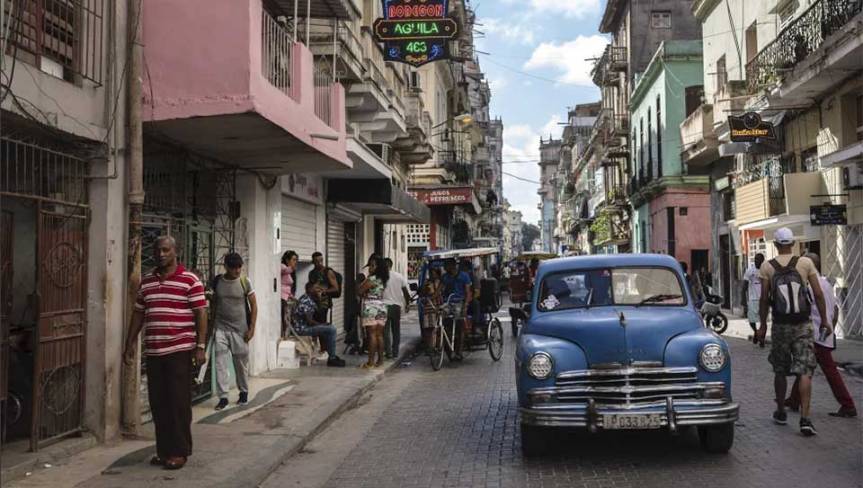
An American classic car makes its way down a street in Havana, Cuba, Nov. 11, 2023. (AP Photo/Ramon Espinosa, File)

Reposted from Peoples World


Ignacio Ramonet, academician and former editor of Le Monde diplomatique, has written an open letter to President Joe Biden. It offers nations, organizations, and individuals a golden moment for getting rid of a critical piece of the U.S. system of economic blockade of Cuba. Ramonet argues in the strongest possible terms that the U.S. President must end the U.S. designation of Cuba as a state sponsor of terrorism (SSOT) and do it now.

Ramonet, originally from Spain, has long lived and worked in Paris, where he prepared. He teaches at Paris Diderot University and formally at the Sorbonne. In 2006, Ramonet praised Fidel Castro’s legacy in a series of articles in Foreign Policy journal. His book My Life: A Spoken Autobiography, written with Fidel Castro, appeared in the same year. It’s based on more than 100 hours of interviews with Castro.

The Casa de las Americas in Havana has sent out to the world an invitation for any and all to endorse Ramonet’s letter. Casa says:

“Our dear friend Ignacio Ramonet sent us this open letter to the President of the United States. Casa de las Americas supports this noble initiative and invites writers, artists, cultural promoters, academics, activists and social fighters, members of non-governmental organizations, and people sensitive to the daily suffering of the Cuban people to support it with their signatures.”

“Cuba’s income per person is probably 1/3 or 1/4 of what it would be without the bloqueo,” writes economist Jeffrey Sachs. The SSOT designation does its bit toward assuring that grim outcome. It provides for penalties against international financial institutions that handle Cuba’s borrowing and commercial transactions overseas, ones that involve dollars, which is usually the case.

Now is a crucial time. The SSOT designation is the one part of the far-reaching U.S. system of sanctions and commercial blockade that does not require action by the U.S. Congress to end or modify it. The U.S. president has sole responsibility for either authorizing or withdrawing the SSOT designation.

President Donald Trump reinstated the designation on January 12, 2021, within days of leaving office. President Obama had removed it in 2015. Right now, Biden could remove Cuba from that list of supposedly terrorist-sponsoring nations before a new president is installed, and without pain. The inevitable howls of outrage from defenders of U.S. domination of Cuba will bother neither him–who will be gone–nor the new administration–that was not there.

The point is that now is the time for a major campaign to persuade many individuals and organizations to sign on to Ignacio Ramonet’s open letter. The project would be part of a major push to get the job done.

After all, the U.S. State Department did remove Cuba from its list of countries “not cooperating fully” in U.S. anti-terrorism efforts in May 2024.

Here is what you do to sign on:

  • First, read Ramonet’s letter. It’s accessible at this link.
  • Second, access the Casa de las Americas invitation to endorse it. Do that by going to the same link.
  • Third, go to page three of the same communication to indicate who you are and the name of your group.

A job well done.


W.T. Whitney Jr. is a political journalist whose focus is on Latin America, health care, and anti-racism. A Cuba solidarity activist, he formerly worked as a pediatrician, lives in rural Maine. W.T. Whitney Jr. es un periodista político cuyo enfoque está en América Latina, la atención médica y el antirracismo. Activista solidario con Cuba, anteriormente trabajó como pediatra, vive en la zona rural de Maine.

US research stations in Peru and elsewhere prepare for biowarfare / by W. T. Whitney

DARPA: Some experts fear GM viruses could transform into a new class of biological weapons (Image: Getty)

South Paris, Maine


The U.S. government began preparing for biological warfare during World War II. Biological weapons were employed during the Korean War against North Korea and China. President Nixon in 1969 ended the U.S. use of biological weapons for offensive purposes. The United States joined other nations in approving the Biological Weapons Convention (BWC), which took effect in 1975.

Even so, U.S. agents introduced microorganisms that devastated Cuba’s agriculture intermittently from the 1970s into the1980s. They introduced dengue virus in 1981, thereby provoking an epidemic that killed 169 Cubans. In 2001 the George W. Bush administration disavowed the Protocol that was essential for strengthening the BWC.

sugarcane plantation in rural Cuba | Wikipedia

A 2017 report from the Latin American think-tank CEPRID tells of suspicious U.S. virologic research centers in Ecuador, of Brazilian soldiers dying of an unknown infectious disease, and “research centers located in countries like Brazil, Guatemala, Panama. Honduras, Costa Rica, República Dominicana, Haiti, [and] Guyana.” The report notes the existence in Peru of U.S. biological research laboratories operating under the façade of sponsorship by local universities. 

“What’s certain,” the report says, “is that research is continuing and new viruses are being created or they are muting to become resistant to all the vaccines that are known.” Mention appeared in 2015 of a “laboratory [in Peru] for the development of bacteriologic war.”  The reference was to one operated by a “Naval Medical Research Unit,” by NAMRU-6. Beginning with WWII or shortly thereafter, the U.S. has operated NAMRUs, numbers one through six, within the United States and in Ethiopia, Italy, Southeast Asia, and Peru. Their purposes varied according to location. Three of them have been discontinued.

Officially, NAMRU-6, also known as NAMRU South, “researches and monitors various infectious diseases with military and public health implications in Central and South America.”  With a presence in Peru since 1983, NAMRU-6 occupies a large office building and laboratory in Lima and a smaller laboratory in Iquitos, on the Amazon River.

NAMRU-6 is in the news. In an article appearing on June 13, Brazilian journalist Tereza Cruvinel notes a big increase in dengue cases in Peru, Paraguay, Bolivia, Brazil, and Argentina. She cites “an entomologist in a neighboring country” who describes unexpected resistance of the Aedes Aegypti mosquito, vector of the dengue virus, to usually effective insecticides. She points to the entomologist’s reference to “a fellow researcher” who abandoned the U.S. NAMRU-South laboratory in Peru, because of “experiments there with the participation of the Pentagon and the Peruvian military.”  

She notes that investigators there are creating new strains of the dengue virus, “which spread more quickly among mosquitoes, with a very high viral load.” Cruvinel reports that, “Latin American doctors and scientists suspect scientific manipulation of the mosquito by powerful forces involving the US and the pharmaceutical industry.”

In his article “US biological weapons,” written in response to Cruvinel,  Costa Rican journalist Jose Amesty claims that “the [current] outbreak of dengue fever, which is a record for sickness and death in Nicaragua, Honduras and Peru, is related to Pentagon experiments in 2023 aimed at creating a modified strain of the aforementioned pathogen.” He cites as his source a “scientist from Namru-South in Peru who, involved with experiments with dengue strains, is disillusioned by implications for the health of millions of people.”

Amesty notes that personnel working at NAMRU-6 in Peru, most of them Peruvians, have had to take on U.S. nationality so they could be prosecuted, if need be, under U.S. jurisdiction and “not be responsible to the Peruvian justice system.”  

Amesty learned from Gabriela Paz-Bailey, dengue specialist at the Puerto Rican branch of the U.S. Centers for Disease Control and Prevention, that a new strain of the dengue virus appeared in 2023 in Peru, one that “diffuses more rapidly among mosquitoes,” leaving them with an “an elevated viral load.” And, “the level of virus dosage sufficient to cause infection has diminished ten times.”

Presumably it’s Amesty himself who notes that, “a similar development of a virus over such a brief period would be impossible without human intervention.” He adds that, the “North Americans achieved a high degree of resistance to insecticides on the part of mosquitos, and that reduced the effectiveness of steps taken by national governments to eradicate the insects with fumigation.”

Paz-Bailey informed Amesty that the NAMRU-6 laboratory has long been relying on the “help of insects” in devising “mechanisms for the proliferation of the virus” both in Peru and elsewhere in the region.

DARPA: The controversial project involves infecting insects with viruses (Image: Getty)

In 2016 the Pentagon’s Defense Advanced Research Projects Agency (DARPA) presented its plan for mobilizing “Insect Allies” to protect farmers’ crops from disasters. As described, the program “is poised … [to use] targeted gene therapy to protect mature plants within a single growing season.” Insects would transfer genetically modified viruses to plants where they affect the behavior of a growing plant’s genes, for example, increasing its growth rate in conditions of drought, plant diseases, or pesticide use.

The advent of the CRISPR system in 2012 allowed for this program involving insects to be developed. CRISPR, a relatively simple and readily accessible tool, allows for selective modification of the DNA of living organisms.

DARPA’s project provoked criticism, beginning with a report published in the journal Science on October 5, 2018. The title was “Agricultural research, or a new bioweapon system?” The authors drew attention to the Biological Weapons Convention. Their associations were with the Max Planck Institute and the Institute of International Law, both in Germany, and Montpellier University in France,

A simultaneous statement on this report, from the Max Planck Institute, focused on dual use possibilities: “[T]the findings of the Insect Allies Program could be more easily used for biological warfare than for routine agricultural use.” The statement suggested that “[N]o compelling reasons have been presented by DARPA for the use of insects as an uncontrolled means of dispersing synthetic viruses into the environment.”

Research programm with potential for dual use: scientists fear that the Insect Ally program by the US could encourage other states to increase their own research activities in the field of biological warfare. © MPG/ D. Duneka

Journalist and peace activist Bharat Dogra maintains that, “[T]he DARPA program risks being perceived as a biological warfare research program that is justified on the basis of stated peaceful purposes … [That misperception] can start a trend of similar research with biological warfare implications by other countries as well.”

Dogra observes too that the mosquitoes themselves, the insect vectors, are being genetically modified along with the viruses they are carrying. He writes that, “According to a 2022 review by the Centers of Disease Control and Prevention, USA, since 2019 over a billion modified mosquitos have been released at world level, in several countries.”

The U.S. government maintains facilities across the world that are related to biological warfare.  Fort Detrick in Maryland, the historic bio-weapons center in the United States, extends across hundreds of acres and is the workplace for almost 8000 military and civilian employees. A network of related U.S.-operated facilities shows up in nations bordering Western Russia. Their role in monitoring and facilitating insect transmission of infectious diseases has been documented. Similar centers exist in Africa, the Middle East, and Southeast Asia.

I suggest that the U.S. government and the U.S. military are very likely building offensive capabilities for biological war. The nature of the DARPA program, activities of NAMRU-6 in Peru, and the U.S. record of disregarding the BWC over recent decades are all consistent with this accusation. Also suggestive is the proliferation within the United States and abroad of U.S. installations dedicated to the study of noxious microorganisms and new ways for their transmission. Lastly, the simultaneous emergence of CRISPR technology and wide dispersion of these activities is more than a coincidence.  


W.T. Whitney Jr. is a political journalist whose focus is on Latin America, health care, and anti-racism. A Cuba solidarity activist, he formerly worked as a pediatrician, lives in rural Maine. W.T. Whitney Jr. es un periodista político cuyo enfoque está en América Latina, la atención médica y el antirracismo. Activista solidario con Cuba, anteriormente trabajó como pediatra, vive en la zona rural de Maine.

How the Knowledge Economy and Science Bolster Cuba’s Socialist Revolution / By W. T. Whitney

via Radio Havana Cuba

South Paris, Maine


Cuba and Cuban science gained acclaim worldwide for producing their own very effective Covid-19 vaccines. The achievement stood out among nations of the Global South. The feat reflects Cuba’s development over decades of a formidable scientific establishment engaged in the development and marketing of biologic products oriented to healthcare mostly, and food production too.

The planning processes and strategizing involved were unique, and so too the resulting organizational forms. These special characteristics relate directly to Cuba’s version of socialism.

In a speech on January 15, 1960, a year after the Revolution came to power, Fidel Castro remarked that, “The future of Cuba will necessarily be a future of men (sic) of science.” The landscape would change dramatically.

The Cuban Academy of Sciences was reactivated in 1962. In succession came:  the National Center for Scientific Research (1965), the Center for Biological Research (1982); the Center of Genetic Engineering and Biotechnology (1986) with its 38 scientific institutions, the Immunoassay Center (1987), the vaccine-manufacturing Finlay Institute (1991), the National Center for Biopreparations (1992), and the Center for Molecular Immunology (1994).

The “Scientific Pole,” formed in the 1980s in Western Havana, now includes over 40 research centers that employ 30,000 workers employed. Established in 2012 to facilitate commercialization, BioCubaFarma  exports some 164 products from 65 centers. It operates 19 units abroad, as joint ventures or Cuba-owned entities.

Dr. Agustín Lage-Dávila, longtime head of the Center for Molecular Immunology, writes of “whole cycle institutions” that carry out research, product development, commercialization, and export, all under single management. Export income goes toward funding each institution’s activities and contributes to the national budget.

Exported products have included vaccines against meningitis B, hepatitis B, Hemophilus Influenza type B, Covid-19, lung cancer (CIMAvax-EGF), and many other infectious agents. Other products are:  interferons, erythropoietin, streptokinase, Heberprot-P (used to treat diabetic foot ulcers), diagnostic test kits, and six non-vaccine treatment modalities for Covid-19.

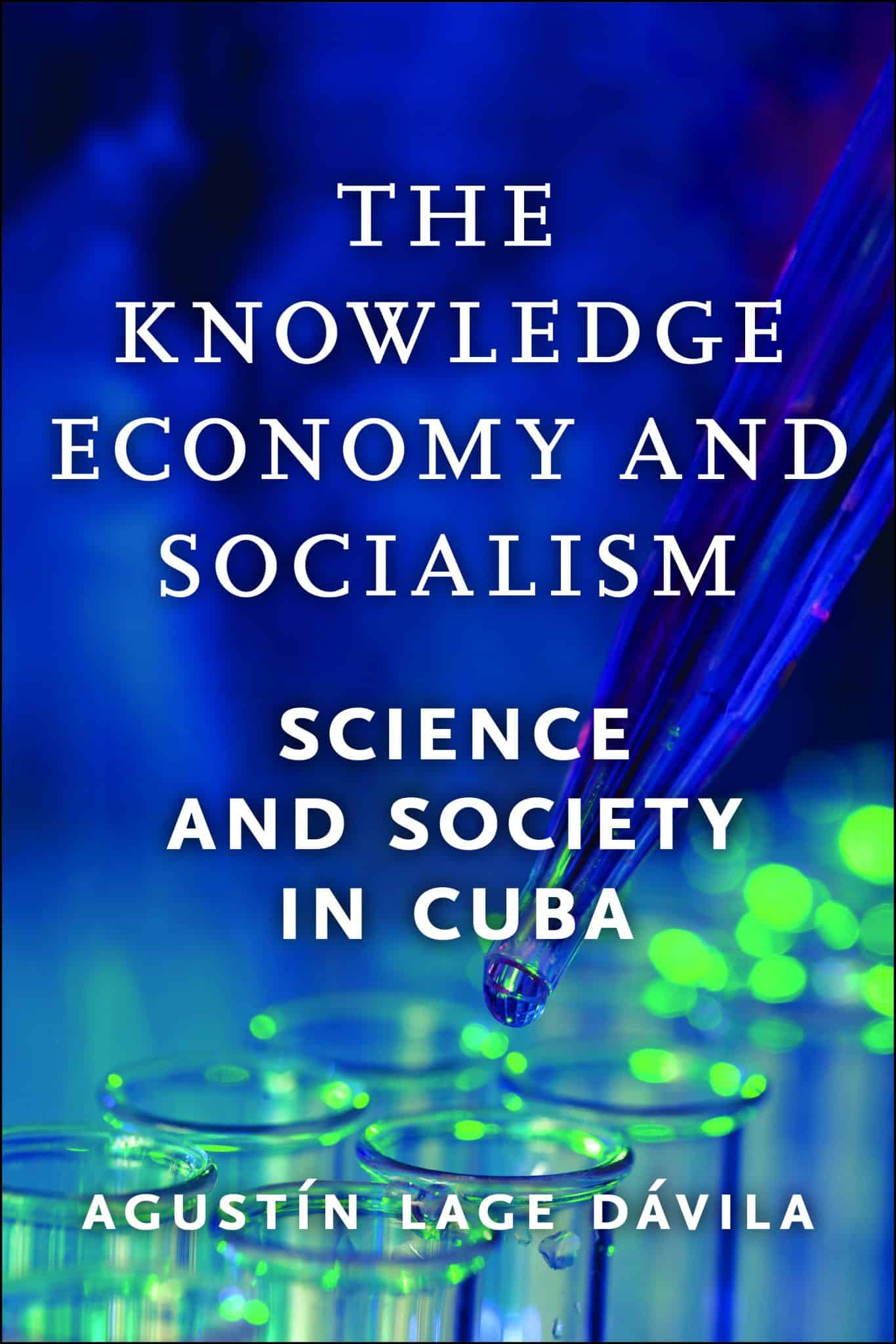
Lage’s book on the origins, development, and upkeep of Cuba’s immense bio-scientific network was published in Cuba in 2013 and again in 2016. Monthly Review Press recently issued a translated version of the book’s second edition titled The Knowledge Economy and Socialism – Science and Society in Cuba. The various chapters represent articles that Lage, an immunologist, biochemist, cancer expert, had written for Cuban journals. An additional chapter consists of Lage’s responses to questions provoked by first edition of the book. The clarity and readability of the book’s English translation is a plus.

The book overflows with information, opinions, analyses, historical references, and optimism balanced by ample recognition of big problems. Lage explains that, after the Revolution, Cuba at once embarked upon developing human capabilities and initiating social advances. There was no waiting for available funding, as is the practice of most nations.

As a result, circumstances were in place for the building of what Lage calls a knowledge economy. It would feature the export of scientific products, these in place of the natural resources and the industrial base that Cuba lacks. Lage notes that biologic products have to be new and novel in order to sell.

Cuba’s bio-technical industries function “without sterile fragmentation …[and] within inter-institution borders … [K]nowledge is captured and incorporated into negotiable assets.” Cooperation, according to Lage, works better than competition. Elimination of institutional boundaries promotes integration of knowledge. The system favors autonomy over centralized decision-making; it features “layered” decision-making, “crosspollination,” and a shared sense of responsibility.

The contrast with capitalist modes of bio-technical production is striking, he suggests. There, funding rests on venture capitalism. Products and their value end up in private hands through patents, intellectual-property protection, and regulatory barriers. Planning is for the short-term. Scientific creation is divorced from ownership of the results.

Lage repeatedly returns to the necessity of overcoming a contradiction pointed out by Karl Marx, that of the social character of production and the private character of appropriation of both the product’s value and the means of production. He refers to the “private appropriation of accumulated science and knowledge,” and to the appropriation of people in the form of brain drain.

As a socialist country, Cuba defends social ownership of the means of production and the accumulated value of products. Socialism is a prerequisite, he suggests, for science to be propelling a nation’s economy.

Lage emphasizes the contribution of Cuban culture and notions of sovereignty in bolstering the project. Culture shows in ethical values, motivation, solidarity, and inclination toward unity. There is an “indissoluble link between sovereignty and socialism” through which “our daily tasks are part of a larger historical task.”

He adds that, “We are getting closer … to the knowledge economy …[and] approaching Marti’s ideal of ‘whole justice’ daily through every social program we successfully implement … Thus we construct not only the spiritual and material well-being of our people but also the defense of national sovereignty.”

Lage discusses the knowledge economy as it manifests at the local level, specifically in Yaguajay, near Sancti Spiritus, the municipality he represents in Cuba’s National Assembly. He cites a “municipal socioeconomic developmental strategy” that, enlisting nearby universities and research centers in “knowledge management,” has led to “qualitative changes” in healthcare, tourism development, computing, housing promotion and agriculture.

The “levers of socialism” are helpful, in particular:  massive state investment in creating human capital, integration among institutions, linkages with social programs, exports connected to Cuba’s international agreements and solidarity programs, the capacity to innovate in managing institutions, and workers’ “political and social motivation.”

He recognizes risks. Time is one; “building a knowledge economy … is today’s task, not tomorrow’s.”  Rich countries use “their accumulated economic advantages … to enlarge those advantages and erect new development barriers in poor countries.” He cites residual damage from the Special Period, old habits of “centralized business management,” brain drain, and pressures exerted “by the most powerful empire that has ever existed.”

As regards U.S. aggression: “They know … the potential of socialism. A country that makes its material wealth grow based on the education and spiritual wealth of its people and on the equity that derives from the social ownership of the means of production and distributive justice would be too clear evidence that the solutions to the problems facing humanity today are not on the path of capitalism nor in the subordination to the interests of the developed capitalist countries. Thus, they need to show that our system ‘does not work,’ hence the blockade.”

A cautionary note: a report from Columbia Law School in 2021, eight years after Lage’s book was first published, cites Cuban statistics showing “a drop of almost 40% in exports of chemical products and related products between 2015 and 2019 … [And] medicinal and pharmaceutical products make up around 90% of the total exports of chemical products.” It seems that income derived from bio-technology exports is down.


Agustín Lage DávilaThe Knowledge Economy and Socialism: Science and Society in Cuba, (Monthly Review Press, NY, 03/31/2024), www.monthlyreview.org, pp320, $29.00 (PB) Paperback ISBN: 978-1-68590-042-7


W.T. Whitney Jr. is a political journalist whose focus is on Latin America, health care, and anti-racism. A Cuba solidarity activist, he formerly worked as a pediatrician, lives in rural Maine. W.T. Whitney Jr. es un periodista político cuyo enfoque está en América Latina, la atención médica y el antirracismo. Activista solidario con Cuba, anteriormente trabajó como pediatra, vive en la zona rural de Maine.

Bernard Lown’s political activism and medical achievements are celebrated in Maine / by W. T. Whitney

Photo: Anadolu Agency (AA)

South Paris, Maine


Bernard Lown was honored June 7 in Lewiston, Maine. The place was the massive Bates Mill, the former workplace for migrants mostly from Quebec who made textiles. The minting of the “American Innovation $1 Coin” in Lown’s honor had been announced in May. It was Lown’s birthday; he was born in Lithuania in 1921 and died in 2021.

The occasion featured the unveiling of a portrait of Lown painted by Robert Shetterly. Lown joins others honored by Shetterly in the series of portraits he calls “Americans Who Speak the Truth” (AWTT).

The event, attended by the writer, offered ample recognition of Bernard Lown’s medical accomplishments and his dedication to collective struggle for justice. A prime concern here is that celebration of Lown’s successes may have obscured how and why Lown did engage with the mass social and political movements of his era. Insight on that score may contribute to an understanding of how individuals now might involve themselves in big political and social catastrophes of our own time.

Maine-resident Shetterly explained to the gathering that individuals being honored through his portraits were, or are, heroes who exemplify creativity, courage, and/or passion for justice. Exhibitions of Shetterly’s portraits and educational programs based on his subjects have circulated throughout the country.

University of Maine President Joan Ferrini-Murphy, reported that Lown participated in and provided support for programs of the University’s Honors College. Doug Rawlings, a founder of the Veterans for Peace organization and head of its Maine chapter, praised Lown as an inspiration for peace advocacy.

Lown had strong connections with Maine. He arrived in Lewiston in 1935, attended high school there – at first not speaking English – and studied at the University of Maine. City officials of Lewiston and Auburn in 1988 renamed a bridge connecting the cities as the Bernard Lown Peace Bridge. Maine VFP staged a rededication of the Peace Bridge to Bernard Lown on the 2022 anniversary of the U.S. nuclear attack on Hiroshima.

Lown’s accomplishments were many: invention and introduction of the DC cardiac defibrillator (he chose not to apply for a patent), introduction of hospital cardiac care units, establishing that sick cardiac patients remain active, and urging physicians to be caring and empathetic with patients.

He founded the group Physicians for Social Responsibility in 1961.With Soviet cardiologist Evgeni Chazov, he founded International Physicians for the Prevention of Nuclear War in 1980. In 1985 they won the Nobel Peace Prize.

Lown became politically engaged with mass movements early, on the side of working people, and against headwinds.

He and his family had confronted the Hitlerite danger in Lithuania. High-school student Lown, according to AWTT, “was outraged at the sight of policemen arresting the unconscious, bleeding striker, while allowing his strike-breaking assailant walk free. Lown jeopardized his relationship with his family and joined the striking workers …The striking French-Canadian workers were accused of being part of an international communist conspiracy.”

This was the Lewiston–Auburn shoe strike of 1937. The Maine Army National Guard was called out. There was confrontation between strikers and police on what is now the Bernard Lown Peace Bridge.

Lown was briefly expelled from Johns Hopkins Medical School for violating the rule that no sick white person would receive a Black donor’s blood. He earned a suspension for inviting a Black physician to speak at the medical school.

He belonged to the Association of Internes and Medical Students (AIMS), a U.S. organization associated with the International Union of Students (IUS). Soviet Bloc students were members of the IUS, which weighed in on post-war peace, anticolonialism and more.  In 1947 Lown wrote “an effusive write-up of IUS’s founding” in the AIMS magazine The Interne.

Lown, an officer with the U.S. Army Reserve, was called up for the Korean War.  He defied the requirement that he indicate political affiliations. The Army allowed him an honorable discharge and drafted him as a private. He recalled that after receiving an undesirable discharge in 1954, “I was without a job and couldn’t get a job …wherever I’d go the FBI was one jump ahead.” 

Then, reports the Harvard Crimson, “[Frederick] Stare, [nutrition professor at the Harvard School of Public Health,] won notoriety for hiring … [Lown] who had been accused of holding communist sympathies.”

Lown’s attitude toward Cuba is revealing. He told an interviewer that, ““I have been to Cuba six times and learned much about doctoring in Cuba … If impoverished Cuba can provide first-class health care for its people so can other developing countries. Perhaps it is even possible for rich USA, if only it ceases viewing medicine as a marketable commodity.”

To return to the question posed at the start here: how do citizens focusing on their own lives and their own reactions to political happenings become part of mass movements the way Bernard Lown did? Do they identify as members of a social class?

New York Times columnist David Brooks, remarkably, seems qualified to explain. The U.S. mainstream media barely acknowledges the existence of social class. For a representative writer actually to examine the origins of class consciousness suggests he may know something.

Brooks stated recently that, “students at elite universities have different interests and concerns than students at less privileged places,” also that “the elite universities are places that attract and produce progressives.” Therefore, “American adults who identify as very progressive skew white, well-educated and urban and hail from relatively advantaged backgrounds.”

(We hold back on critiquing Brooks’ notion of “very progressive” and his idea that working-class and oppressed people are unlikely to identify as such.)    

Brooks, continuing, cites an authority who argues that, “[J]ust as economic capitalists use their resource — wealth — to amass prestige and power, people who form the educated class and the cultural elite … use … resources — beliefs, fancy degrees, linguistic abilities — to amass prestige, power and … money.” Brooks, presuming that the excluded may be resentful, envisions “a multiracial, multiprong, right/left alliance against the educated class.”

He describes a progression: individuals experience their own political awakenings, realize their perceptions are shared, and think of themselves as a larger whole. He pictures two sets of people, two social classes, who find they are at odds with each other. He provides a roadmap of sorts showing that politically-engaged individuals, in large numbers, may well become part of mass political and social movements.

In any case, Bernard Lown, involved with struggles that continue now, lauded for achievements that were extraordinary, does matter, and not least for the model he is now of dedicated political engagement. 


W.T. Whitney Jr. is a political journalist whose focus is on Latin America, health care, and anti-racism. A Cuba solidarity activist, he formerly worked as a pediatrician, lives in rural Maine. W.T. Whitney Jr. es un periodista político cuyo enfoque está en América Latina, la atención médica y el antirracismo. Activista solidario con Cuba, anteriormente trabajó como pediatra, vive en la zona rural de Maine.

US Labor Must Weigh in on Cuba / By W.T. Whitney

Photo credit: Juan Carlos Dorado

South Paris, Maine


Taking note of International Workers’ Day, several Latin American news sources this year cited José Martí’s 1886 essay “A Terrible Drama;” two of them republished it, here and here.  There Martí reports on events in Chicago in 1886 and the fate of the so-called Haymarket Martyrs – seven labor journalists and agitators railroaded to prison and given death sentences.  Another received a 15-year prison term.

Martí, who would become Cuba’s national hero, was living in exile in the United States. He relates how strikes for the eight-hour day were underway on May 1, 1886 in Chicago and nationwide, how the Chicago police killed one striker and wounded others on May 3, and how a mass protest against police violence took place the next day in the Haymarket area. There, a bomb exploded, seven policemen and four workers were killed, and dozens were wounded. 

The court lacked evidence that the defendants, anarchist by inclination, were involved in the violence of May 4. Martí describes the execution of four of them and the suicide of another. An appeals court judge commuted the sentences of two defendants to life in prison. In 1893, Illinois Governor John Altgeld pardoned those two and the remaining prisoner.

The Socialist International in 1889 declared May Day to be an annual celebration of labor militancy.

José Martí’account, “A Terrible Drama,” is a foundational contribution to the history of the U.S. labor movement. Martí defended working people – U.S. workers in his writings, and Cuban workers in words and deeds, from 1886 on. The combination of author and story points to a connection between U.S. labor activism and workers’ struggles in Cuba. Its time has come.

The U.S. economic blockade of Cuba, lasting decades, has led to shortages, misery, and despair. Nations of the world voting annually in the United Nations General Assembly overwhelmingly condemn the blockade. It violates international law.

Domestic opposition to U.S. policies on Cuba, while persistent, vigorous at times, principled, on-target, and diverse, has fallen short. U.S. government measures aimed at destabilization remain in force.  Upping power of the people with labor combativeness would make a difference.

Unions and labor activists know how to organize and how to confront recalcitrant political and economic leaders. They will be active on Cuba’s side, once they realize that working people’s struggles in the two countries are linked, or so our theory goes. In addition:

·        Labor unionists involved in struggle count on unity, the power of numbers, and sometimes solidarity from counterparts, often from abroad.

·        The current Cuban Revolution is the product of a revolutionary tradition. U.S. workers confronting their own government on Cuba would be expressing solidarity with a revolution whose progenitor, Jose Martí, defended U.S. workers fighting for the eight-hour day.  They would be paying back. 

·        Social revolution and ordinary labor struggles are battles of ideas. The writings of Martí, maximum leader of Cuba’s early revolution, speak to Cuban and U.S. workers alike. In that way they are connected.

Martí wrote about working people and their lives.  He contributed greatly to the ideas and substance of revolutionary struggle in Cuba and also defended African-descended and poverty-stricken Cubans with a seemingly unqualified egalitarianism. For example:

·        “And let us place around the star of our new flag this formula of love triumphant: ‘With all, and for the good of all.’”

·        “A nation having a few wealthy men is not rich, only the one where each of its inhabitants shares a little of the common wealth. In political economy and in good government, distribution is the key to prosperity.”

·        “In Cuba there is no fear whatever of racial conflict. A man is more than white, black, or mulatto. A Cuban is more than mulatto, black, or white … True men, black or white, will treat each other with loyalty and tenderness for the sake of merit alone.”

Workers are oppressed

Responding to the Haymarket affair in his “A Terrible Drama,” Martí reflects upon the situation of U.S. working people:

“The nation is terrified by the increased organization among the lower classes … Therefore the Republic decided … to use a crime born of its own transgressions as much as the fanaticism of the criminal in order to strike terror by holding them up as an example …. Because of its unconscionable cult of wealth, and lacking any of the shackles of tradition, this Republic has fallen into monarchical inequality, injustice, and violence …

“In the recently emerging West … where the same astounding rapidity of growth, accumulating mansions and factories on the one hand, and wretched masses of people on the other, clearly reveals the evil of a system that punishes the most industrious with hunger, the most generous with persecution, the useful father with the misery of his children – there the unhappy working man has been making his voice heard.”

Martí’s “A Terrible Drama” appeared in La Nación newspaper in Buenos Aires in January 1888, some 19 months after the Haymarket events. The delay may have stemmed from Martí’s ambivalence about the anarchist leanings of the accused. Previously published segments of his report do appear under the title “The First of May, 1886” in historian Philip Foner’s anthology of Martí’s writings published in 1977. Excerpts follow:

“Enormous events took place in Chicago, but rebellion exists throughout the nation. In the United States … a firm and active struggle has been in preparation for years … …[T]hings are not right when an honest and intelligent man who has worked tenaciously and humbly all his life does not have at the end of it a loaf of bread … or a dollar put away, or the right to take a tranquil stroll in the sunlight… Things are not right when the one who in the cities … lives a contemplative life of leisure so exasperating to the miner, the stevedore, the switchman, the mechanic, and to every wretched person who must be content with seventy-five cents day, in raw winter weather …Things are not right if shabby women and their pallid children must live in tenement cubicles in foul-smelling neighborhoods. …The reasons are the same. The rapid and evident concentration of public wealth, lands, communication lines, enterprises in the hands of the well-to-do caste that rules and governs has given rise to a rapid concentration of workers. Merely by being gathered together in a formidable community which can, at one stroke, extinguish the fires in the boiler and let the grass grow under the wheels of the machinery, the workers are able successfully to defend their own rights against the arrogance and indifference with which they are regarded by those who derive all their wealth from the products of the labor they abuse.”

Deeds and words

Martí acted on behalf of working people. He organized Cuba’s independence struggle that culminated in war with Spain in early 1895. Under his leadership, the process became a social revolution.

From exile in New York, Martí outlined goals, strategies, and methods. Traveling widely, he arranged for Cuban exiles in the United States, Central America, and the Caribbean – many of them workers, many African-descended – to select the revolution’s leadership, provide funding and supplies, and approve goals and proposals. Martí persuaded the military heads to accept civilian leadership. He created and edited the independence movement’s newspaper Patria.

Aware of U.S. aspirations to dominate Cuba and the entire region, Martí led in confronting U.S. imperialism – never good for workers. In 1891 he wrote “Our America,” an essay demonstrating commonalities among diverse peoples inhabiting all the land extending from the Rio Bravo (the Rio Grande) south to Patagonia. Martí highlighted their shared cultural and political orientations that set them apart from U.S. and European societies.

In a letter to a friend shortly before he was killed in battle on May 19, 1895, Martí insisted that: “It is my duty … to prevent, by the independence of Cuba, the United States from spreading over the West Indies and falling, with that added weight, upon the other lands of Our America.”

Attacking military installations of the Batista regime on July 26, 1953, revolutionaries led by Fidel Castro were honoring José Martí, born 100 years earlier. For Castro, Martí was “the Apostle of Independence … whose ideas inspired the Centennial Generation and today inspire and will continue to inspire all of our people more and more.”

For the sake of justice and in view of connections with Cuban workers, U.S. working people would do well to press upon their government the necessity to end the blockade of Cuba. Labor unions, the principal means for expression of workers’ sentiment and power, have prime responsibility in this regard.

They would be acting as did West Coast dockworkers who blocked arms shipments to Chile under the Pinochet dictatorship, cargo arriving from apartheid-ridden South Africa, and, recently, arms shipments bound for Israel. U.S. unionists actively opposed their government’s support for authoritarian El Salvador in the 1980s and supported Iraqi workers after the U.S. invasion there. They collaborated with Mexican miners and other workers over many years. Recently U.S. unions issued statements and approved resolutions calling for a ceasefire in Gaza.  


W.T. Whitney is a political journalist whose focus is on Latin America, health care, and anti-racism. A Cuba solidarity activist, he formerly worked as a pediatrician, lives in rural Maine. W.T. Whitney Jr. es un periodista político cuyo enfoque está en América Latina, la atención médica y el antirracismo. Activista solidario con Cuba, anteriormente trabajó como pediatra, vive en la zona rural de Maine.