
President Biden Must Remove the Designation of Cuba as Terrorist-Sponsoring Nation / By W. T. Whitney

Via Cuba Solidarity Campaign UK

South Paris, Maine


President Obama in 2015 removed Cuba from the U.S. list of state sponsors of terrorism (SSOT). President Trump reversed that action in January 2020, thereby aggravating economic difficulties for Cuba. President Joe Biden needs to end the designation. The time is now for representatives, senators, and other elected officials to pressure him.

Cuba is no terrorist-sponsoring nation. In accusing Cuba of hosting terrorists, the Trump administration disregarded Cuba’s invitation to Colombian guerrillas to join representatives of Colombia’s government on the island to negotiate peace.

The SSOT designation requires that targeted nations not use dollars in international transactions. The U.S. Treasury Department punishes institutional offenders. Dollars are the world’s dominant currency, and in normal circumstances, banks would use them in transactions involving Cuba. Now, however, foreign lenders steer clear of Cuba. Payments for exported goods and services may not arrive. Cuba is financially paralyzed.

Cubans are suffering. Food is short, as are spare parts, raw materials for domestic production, school and healthcare supplies, spare parts, consumer goods, and cash.  The aim of U.S. policy, as specified by a State Department memo of April 1960, is to cause shortages, despair and suffering serious enough to induce Cubans to overthrow their government.

The labeling of Cuba as a terrorist-sponsoring nation is part of the decades-long U.S. policy of embargo, which is more accurately characterized as an economic blockade, this in recognition of its worldwide reach. Reasons for removing the SSOT designation are the same ones for ending the blockade.

After all, ending the blockade is the Cuba solidarity movement’s prime goal. The campaign to persuade congresspersons to pressure the president to remove Cuba from the SSOT list must refer to the blockade, even as it pursues the more limited goal.

Congresspersons know that, as per the Helms-Burton Law of 1996 congressional action is required for the blockade’s end. They know that current political realities are unfavorable for such action.  Were they to agitate for presidential action on the SSOT matter, they would, in effect, be preparing for a fight against the whole blockade. That’s why it makes sense to use the one rationale to back up each fight.

Ending the blockade (and SSOT designation) has its uses

·        Producers and manufacturers would sell goods in Cuba.

·        With despair and discouragement having diminished, fewer Cubans would be heading to the United States; 425,000 Cuban migrants arrived in 2022 and 2023.

·        U.S. citizens could visit Cuba for recreation, cultural enrichment, and education. Their exposure to Cuban artists, scientists, and educators visiting in the United States would be gratifying.

·        For the blockade to end would disappoint proponents.  They should have been disappointed by the results of the decades-long experiment showing that the blockade did not work. Regime change did not happen. Blockade apologists could reasonably enough move on to something else.

·        An end to the U.S. blockade (and SSOT designation) would gratify nations in the UN General Assembly that annually, and all but unanimously, vote to approve a resolution calling for the blockade’s end. Critics of U.S. interventionist tendencies, wherever they are, would be pleased. The U.S. government would earn some love.

Ideals and values

·        The blockade is cruel. It causes human suffering.

·        It violates international law: “Whatever view is adopted, either that of coercion or aggression, it is quite evident that the imposition of the U.S. economic blockade of Cuba constituted an illegal act … the blockade is a fragrant violation of the contemporary standard which is founded on … sovereign equality between states.” (Paul A. Shneyer and Virginia Barta, The Legality of the U.S. Economic Blockade of Cuba under International Law, 13 Case W. Res. J. Int’l L. 451 (1981)

·        The blockade is immoral. It contributes to sickness and deaths: “By reducing access to medicines and medical supplies from other countries and preventing their purchase from US firms, the embargo contributes to this rise in morbidity and mortality.” (Richard Garfield, DrPH, RN, commenting on Cuba’s “Special Period” of shortages following the fall of the Soviet Bloc – Am. J. Public Health 1997, 877, 15-20.)

·        The blockade exposes certain failings of U.S. democracy. U.S. political leaders remain oblivious to polling data showing strong support for normal U.S.-Cuba relations and for ending the blockade. Leaders of the Cuban exile community have long exerted undue influence in determining U.S. policies toward Cuba. The appearance is that of an important aspect of foreign policy having been farmed out to a strident minority. 

Contradictions

The U.S. government claims the blockade serves as punishment of Cuba for allegedly violating human rights. But the United States has easily co-existed with governments famous for disregarding human rights, like Nicaragua’s Somoza regime, Chile under Pinochet, Haiti ruled by the Duvaliers, and the Kingdom of Saudi Arabia.

U.S. policymakers see Cuba as a Communist dictatorship and, on that account, as deserving of economic blockade. Even so, the United States trades with Vietnam and China, where Communist parties are in power.

Vice President Joe Biden presumably backed President Obama’s action in removing Cuba from the SSOT list. Contradicting himself, he refuses to reverse former President Trump’s placement of Cuba back on the list.

Contradictions point to Cuba as special case in the history of U.S. relations with other countries. Only Cubans find an open door on arrival in the United States as irregular migrants. Such red-carpet treatment stands alone in the record of how the U.S. government handles immigration. 

The Cuban Adjustment Act of 1966 ensured that Cubans arriving in the United States without documents would at once receive social services and a work permit and a year later be granted permanent residence and the opportunity for citizenship.

The fact of U.S. hegemonic intent and actions regarding Cuba for 200 years must be extraordinary in the history of international relations. From Thomas Jefferson’s time until the 20th century, leaders in Washington sought to own or annex Cuba. They would later on find other modalities.

U.S.- Cuba relations have long been on automatic pilot. Pursuing justice and fairness, elected officials in Washington would be moving beyond that history. They would go against the grain as they pressure a U.S. president to no longer designate Cuba as a state sponsor of terrorism. Persevering, they would fight to relieve Cuba of all U.S. harassment.


W.T. Whitney is a political journalist whose focus is on Latin America, health care, and anti-racism. A Cuba solidarity activist, he formerly worked as a pediatrician, lives in rural Maine. W.T. Whitney Jr. es un periodista político cuyo enfoque está en América Latina, la atención médica y el antirracismo. Activista solidario con Cuba, anteriormente trabajó como pediatra, vive en la zona rural de Maine.

U.S. policy implicated in the economic crisis driving Cuban protests / by W.T. Whitney Jr.

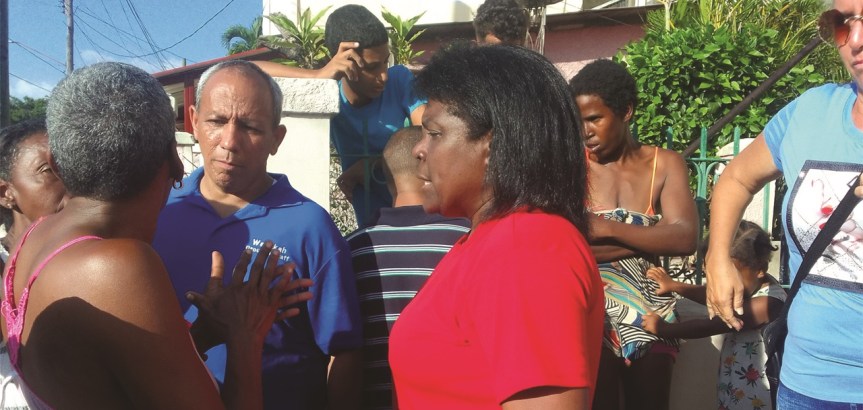
Beatriz Johnson Urrutia (center), the First Secretary of the Provincial Committee of the Communist Party in Santiago de Cuba, speaks directly with people demonstrating against food and electricity shortages on Sunday. | Photo via Juventud Rebelde

Reposted from the People’s World


This report takes advantage of the cogent observations (see below) of Professor Isaac Saney, former co-chairperson of the Canadian Network on Cuba and Coordinator at Dalhousie University for Black and African Diaspora Studies.

Hundreds of Cubans demonstrated peacefully in Santiago de Cuba and other cities across the island on March 17. Portrayed in some U.S. corporate media outlets as “anti-government” protests, the demonstrations were focused on electrical power outages and food shortages.

The protests were reacting to an accumulation of great economic difficulties that have assaulted Cubans and their government alike for decades.

Cuba is in the midst of a sharp economic crisis. Surging inflation is battering the economy, which shrank by almost 2% last year. Fuel prices rose by more than 500% just this month, while electricity rates climbed 25%.

Exports for 2023 were far below predictions, food production was less than 2022, and tourism income has only recovered to 69% of pre-COVID levels. Shortages of fuel and other supplies—largely because of the U.S. blockade—continues to hamper production in most sectors.

The dire circumstances are driving a mass exodus of Cubans; 425,000 migrants arrived in the United States in 2022 and 2023. Among those leaving are 9% of Cuba’s healthcare workers and thousands of educators. These departures have further aggravated the economic situation.

Responding to the Sunday demonstrations, Cuban President Miguel Díaz-Canel pointed out on social media that “enemies of the Revolution are trying to take advantage of a context [of shortages] for destabilizing purposes.” He noted, “In the last hours we have seen how terrorists based in the United States…are encouraging actions against the country’s internal order.”

On March 18, Cuba’s Foreign Ministry summoned U.S. chargé d’affaires Benjamin Ziff—there’s been no U.S. ambassador to Cuba since 1960—where he received a formal note of protest that referred to “interventionist behavior and slanderous messaging by the U.S. government and its embassy.”

While communicating the urgency of the situation, Díaz-Canel explained that his government’s approach would be “to attend to the complaints of our people, listen, dialogue, explain the numerous efforts that are being carried out to improve the situation, always in an atmosphere of tranquility and peace.”

In this screenshot from video circulating on social media, Cubans in the city of Santiago de Cuba protest food and electricity shortages on Sunday. | via X

The predicament for Cuba is evolving. It’s apparent that upcoming reactions from Cuba’s government, the international solidarity community, and by Cubans themselves will unfold according to economic and historical imperatives that are by no means new.

For insight, we turn to Isaac Saney’s analysis that was released on March 18. Excerpts follow:

Recent events in Cuba illustrate how intense the imperial pressures on the island nation are. It always bears underscoring that every effort to defy imperialism’s dictate and build a new society has faced unrelenting Western destabilization and sabotage: from the Haitian Revolution to numerous African, Asian, and Latin American national liberation projects. …

There is no doubt that Washington will spare no efforts to manipulate the current situation in Cuba through the use of various social media and digital platforms in order to further destabilize the situation. Moreover, it was recently revealed that U.S. intelligence agencies have been directly intervening in the Cuban economy to artificially inflate prices, stimulate inflation, and cause greater shortages of already scarce goods.

Cuba has faced—and is facing—the longest economic siege in history from the most powerful military and economic imperial power that has ever existed. Like the Haitian Revolution, the Cuban Revolution is the unforgivable example that must be destroyed. Washington’s overarching strategy aims at denying and eradicating Cuba’s right to self-determination, sovereignty, and independence.

The empire has never accepted the verdict of the Cuban people. It has waged an unceasing economic war and campaign of destabilization aimed at restoring U.S. imperialism’s domination and tutelage.

Cuba has repeatedly repelled the unceasing all-sided, military, economic, financial, and propagandistic assault by U.S imperialism.

Since the triumph of the Cuban Revolution in 1959, the United States has relentlessly pursued an ongoing assault on the Cuban people, employing both military and economic, including orchestrating invasions, assassinations, and terrorist attacks against civilians, as well as engaging in systematic economic sabotage. …

The sinister goal is to coerce the Cuban people into submission by strangling the economy, creating shortages, hardships, and exacerbating social inequalities—the very issues the Cuban Revolution has tirelessly worked to eliminate. This strategy seeks to instigate massive social unrest that would then serve as a pretext for U.S. intervention.

…The U.S. economic war against Cuba extends beyond U.S. borders, affecting businesses from other countries engaged in or seeking trade with Cuba. It stands as the primary impediment to Cuba’s social and economic progress, representing a blatant violation of the human rights of the Cuban people, costing the island nation more than $1 trillion U.S., underscoring its profound and detrimental effects.

A poignant testament on the criminality and immorality of the U.S. economic blockade was the Nov. 2, 2023, United Nations vote, when for the 31st time—with a vote of 187 to 2—the international community resoundingly rejected and condemned Washington’s economic war against Cuba.

Cuba faces significant—and what, for many, may seem overwhelming—challenges. However, the Cuban people have repeatedly shown themselves capable of meeting the challenges they take up.


We hope you appreciated this article. At People’s World, we believe news and information should be free and accessible to all, but we need your help. Our journalism is free of corporate influence and paywalls because we are totally reader-supported. Only you, our readers and supporters, make this possible. If you enjoy reading People’s World and the stories we bring you, please support our work by donating or becoming a monthly sustainer today. Thank you!


W.T. Whitney Jr. is a political journalist whose focus is on Latin America, health care, and anti-racism. A Cuba solidarity activist, he formerly worked as a pediatrician, lives in rural Maine. W.T. Whitney Jr. es un periodista político cuyo enfoque está en América Latina, la atención médica y el antirracismo. Activista solidario con Cuba, anteriormente trabajó como pediatra, vive en la zona rural de Maine.

U.S. migration policy change eases border rules but hurts Cuba / by W. T. Whitney Jr.

Migrants line up for processing in Eagle Pass, Texas. President Biden’s immigration policy allows a limited number of Cubans to enter the U.S. on so-called “humanitarian” grounds. The real aim is to hurt Cuba by decreasing its population of skilled workers. | Eric Gay/AP

Reposted from the People’s World


Undocumented Migrants crossing into the United States disturb U.S. politics. Cuban migrants, part of the mix, hard-pressed like the others, but privileged, are provocative in their own way.

For many years and even now displaced Cubans are portrayed as victims of a brutal dictatorship and as recipients of “rescue” by freedom-loving Americans. Cubans who have special skills are often lured out of the country with promises of “the good life” in the U.S. and with the intent of hurting Cuba as it loses people with skills needed their at home.

Changing U.S. regulations and new migration patterns highlight the anomaly of special U.S. dispensation for migrating Cubans.

U.S. district judge Drew Tipton on March 8 ruled that migrants from Cuba, Venezuela, Nicaragua, and Haiti may enter the United States via humanitarian parole. The plaintiffs had been 21 Republican-governed states that had unsuccessfully claimed that immigrants enabled by humanitarian parole required services they could not pay for.

Under humanitarian parole, a program the Biden administration announced on January 6, 2023, migrants entering from those four countries are assured of legal residence for two years – renewable at that point – and a work permit.

Humanitarian parole is limited to 30,000 immigrants arriving every month from the four countries. Migrants need sponsors in the United States.

Instituted under the Immigration and Nationality Act of 1952, the program allowed entry into the United States of refugees from the former Soviet Union, Afghanistan, Ukraine, and other countries. This time, 138,000 Haitians, 86,000 Venezuelans, 58,000 Nicaraguans, and 74,000 Cubans – a total 357,000 migrants –entered via humanitarian parole as of February, 2024.

The would-be migrants from the four countries travel by air to ports of entry inside the United States, pass quickly through immigration screening, and proceed to new homes. Before leaving their home country or a third country, they had found sponsors, presented documentation to U.S. immigration officials, and been approved– all via the Internet.

An analyst claims that, “Combined with the other parole process at the U.S.-Mexican border …, parole has transformed most migration from [the four] countries from mostly illegal to mostly legal in less than a year.” And, “This policy has transformed migration to the United States. By July 2023, parole had already redirected about 316,000 people away from long, perilous treks through Mexico.”

The Biden administration adopted the parole system in part because of difficulties associated with repatriating migrants from the four countries. They stemmed from a U.S. lack of full diplomatic relations and repatriation agreements with those countries. Normal relations with Mexico and the northern Central American countries allow for more convenient U.S. handling of refugees from those countries.

Humanitarian parole came into effect after the administration’s repeal of Title 42, its role having been to exclude migrants because of health risk. Many migrants saw an opening and attempted a border crossing. But many of those from the four countries opted for humanitarian parole.

Scoring political points

By diverting migrants to other locations and relieving pressures along the southern border, the administration might have scored political points, had not administrative delays with humanitarian parole led to big backlogs of migrants waiting to enter.

Cuban migrants to the United States are a special case. Immigration officials on the southern border have long used an “Order of Release on Recognizance,” the so-called “Form I-220A,” to release border-crossers from custody.  Officials dealing with Cubans being released ended up accommodating Form I-22A with the objectives of the Cuban Adjustment Act (CAA).

The aim of that legislation passed in 1966 was to legalize the already large population of Cubans who had arrived in the United States after Cuba’s Revolution in 1959 and the many who would follow, all presumed to be enemies of the Revolution. The CAA enables newly arrived Cubans immediately to receive social services and a work permit and, after a year, to be granted permanent-resident status, a pathway to citizenship.

No other migrant from any other country is so favored. The displaced Cubans are portrayed as victims of a brutal dictatorship, and the U.S. government and people as their rescuer.

To apply the CAA to the fate of those Cuban migrants released from custody according to Form I-220A is now off limits, as per a ruling by a U.S. immigration court in September 2023. But now they can make use of humanitarian parole.

Curiously, the governments of three of the countries whose migrants benefit from humanitarian parole – Cuba, Venezuela, and Nicaragua – are socialist in nature, and the U.S. government regularly harasses them.

Humanitarian parole entices migrants to the extent that great numbers of citizens depart for the United States. As a result, the human resources of Cuba and the other countries are depleted so much so as to impinge upon the countries’ future development.

The U.S. government with its humanitarian-parole policy, at the very least, has stumbled upon a tool that contributes to destabilizing three governments that variably represent the threat of a good example – Cuba’s government more than the others.

The 425.000 Cuban migrants who arrived in the United States in 2022 and 2023 constituted the greatest exodus since the one following the victory of the Revolution in 1959. Factors pushing Cubans to emigrate are low pay, inflation, and shortages of food, electrical power, medical supplies and drugs. These factors reflect the impact of the U.S. economic blockade, as aggravated by effects of the COVID pandemic and declining tourist income.

Emblematic of the great challenges to Cuba’s future development are the nine percent of  Cuba’s healthcare workers who departed in 2021 and 2022, and the loss of teachers at all levels of education – 17,278 posts being unfilled in October 2023.

Speaking at a multi-national meeting on migration taking place in Chiapas, Mexico in October, 2023, Cuban president Miguel Díaz-Canel declared that, “The hostile policy of the United States is what stimulates the potential of Cuban migration in a very significant way.” U.S. hostility is expressed, he indicated, primarily through “the economic blockade that, reinforced in recent years in a criminal manner, … is by definition aimed at depressing the standard of living of the Cuban population.”

He might have mentioned U.S. economic and political interventions in most of the region’s countries that leave their governments unable to serve and protect their people; their option is to leave home and head north.


We hope you appreciated this article. At People’s World, we believe news and information should be free and accessible to all, but we need your help. Our journalism is free of corporate influence and paywalls because we are totally reader-supported. Only you, our readers and supporters, make this possible. If you enjoy reading People’s World and the stories we bring you, please support our work by donating or becoming a monthly sustainer today. Thank you!


W.T. Whitney Jr. is a political journalist whose focus is on Latin America, health care, and anti-racism. A Cuba solidarity activist, he formerly worked as a pediatrician, lives in rural Maine. W.T. Whitney Jr. es un periodista político cuyo enfoque está en América Latina, la atención médica y el antirracismo. Activista solidario con Cuba, anteriormente trabajó como pediatra, vive en la zona rural de Maine.

Maine Activists Meet with Cuban Ambassador in South Portland / W.T. Whitney Jr.

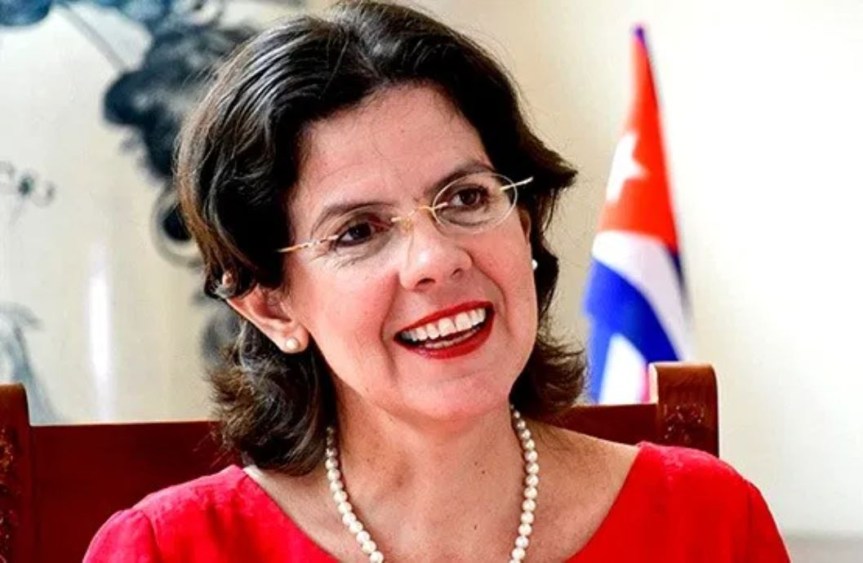
Chargé d’Affaires Lianys Torres Rivera, Ambassador of Cuba | Credit: July 26.org

South Paris, Maine


Word came to the Let Cuba Live Committee of Maine that Cuba’s ambassador to the United States, Lianys Torres Rivera, would be in Portland on other business and wanted to meet with Mainers working for decent U.S. relations with Cuba.

Accordingly, on February 13, in the evening, 40 or so activists from throughout Maine gathered at the hall of Teamsters Local 340 in South Portland to dialogue with the ambassador. Ms. Torres Rivera previously served as Cuba’s ambassador in Vietnam.

She began with a brief survey of Cuba’s current situation, emphasizing that while the country’s economic situation is very difficult, her government’s priorities are unchanged. All citizens’ basic needs are being met, education and healthcare receive maximum support, and Cuba’s solidarity extends throughout the world, to the Global South in particular.

Citing Cuba’s great need for economic development, the ambassador critiqued the U.S. economic blockade as causing shortages that affect every aspect of life in Cuba. She mentioned the false U.S. designation of Cuba as a terrorist-sponsoring nation. That’s the mechanism the U.S. government uses to block the flow of money to Cuba from international financial institutions.

She and her audience agreed that President Biden could remove that misplaced label “with the stoke of a pen.” 

Questions and answers occupied most of the session with Ms. Torres Rivera.  Questions touched on: education in Cuba, increased Cuban migration to the United States, Cuban medical solidarity with the rest of the world, visits of U.S. delegations to Cuba, and U.S. promotion of social media as a device for broadcasting U.S. anti-Cuba propaganda.  

In a comment that particularly resonated with her listeners, Torres Rivera recalled that it was through Cuba’s revolution that she, a daughter of a poor farming family, gained an education preparing her to be an ambassador.

Two members of the Portland City Council were on hand. Great enthusiasm was evident as discussion turned to the prospect of the Portland Council joining other city councils in the United States in passing a resolution condemning the U.S. economic blockade of Cuba.

Facilitating the meeting was Barbara West of Let Cuba Live. Other organizations represented at the encounter were Maine Veterans for Peace, Peace Action Maine, a couple of labor unions, Women’s International League for Peace and Freedom, Democratic Socialists of America, and the Communist Party of Maine – that had made arrangements for the meeting.

To conclude: Anyone wanting to work toward ending the U.S. blockade of Cuba and/or learn more about Cuba might contact Let Cuba Live. Call Barbara at (207) 841-2917 or Tom at (207) 743-2183.


W.T. Whitney Jr. is a political journalist whose focus is on Latin America, health care, and anti-racism. A Cuba solidarity activist, he formerly worked as a pediatrician, lives in rural Maine. W.T. Whitney Jr. es un periodista político cuyo enfoque está en América Latina, la atención médica y el antirracismo. Activista solidario con Cuba, anteriormente trabajó como pediatra, vive en la zona rural de Maine.
The terror returns: Cuba discloses latest attacks by the U.S. / by W. T. Whitney Jr.

Some of the weapons seized from a Florida-based terrorist captured on Cuban soil after he snuck onto the island via jet ski. | Photo courtesy of Granma

Reposted from the People’s World


When the U.S. government launched its so-called “Global War on Terror” after the al Qaeda attacks of Sept. 11, 2001, U.S.-led terror attacks against Cuba had already been ongoing for over 40 years.

They included: military invasion (1961), CIA-sponsored counter-revolutionary paramilitaries in the countryside (1960s), a fully loaded Cuban airliner brought down by U.S. agents (1976), attacks on coastal towns and fishing boats, biowarfare, hundreds of killings in Cuba and abroad, sabotage, and bombings of hotels and tourist facilities (1997).

With the new century, however, violence and terror seemed to be on vacation. The Cuban media and sympathetic international media were reporting little or nothing about U.S.-based terror attacks that had been their stock in trade.

On Dec. 17, 2023, Cuban Chancellor Bruno Rodríguez released a statement harking back to the violent past. He insisted that the “U.S. government is very aware of the official, public, and repeated denunciations by the Cuban government of the assistance, protection, and tolerance that promotors and perpetrators of terrorist acts against Cuba enjoy in the United States.”

He added that, “Recently Cuba’s Interior Ministry has reported on the dismantling of destabilization plans developed in the United States by terrorists of Cuban origin in a security operation that led to the detention of several persons tied to this conspiracy.”

Rodríguez’s statement followed a report appearing on the Communist Party’s Granma newspaper on Dec. 9, 2023. A Florida resident, traveling on a jet ski, came ashore near Matanzas on Cuba’s northern coast in late 2023; no date was specified. Carrying pistols, ammunition, and loading clips, the individual headed for Cienfuegos, his province of origin, and was arrested.

The unnamed man “contacted several people in order to recruit them.” He allegedly had ties in South Florida with “terrorists who publicly promote violent actions against Cuba … [and who] have received military training with weapons, have the physical equipment … and other resources to carry out their plans.”

Granma stated that, “the terrorists, with their plans for actions aimed at undermining internal order, go beyond a virtual setting; they concentrated on promoting violence so as to cause pain, suffering, and death at the year’s end.”

These “instigators of hate and death … appear on [Cuba’s] National List … [Cuban security officials] have investigated actions they’ve taken in the national territory or in other countries.”

report on Jan. 4 from Mexican journalist Beto Rodríguez discusses the Interior Ministry’s “National List of persons and entities … associated with terrorism against Cuba.” Since 1999, they “have planned, carried out, and plotted acts of extreme violence in Cuban territory.’’

The List first appeared on Dec. 7 in Cuba’s Official Gazette as  Resolution 19/2023. It names 61 individuals and 19 terrorist organizations, all based in the United States, presumably most of them in South Florida. One of the names on the List belongs to the jet skier, but which one is unspecified.

According to Beto Rodríguez, criminal investigations in Cuba revealed that some of the listed persons targeted “governmental and tourist installations and carrying out sabotage, illegal incursions, human trafficking, and preparations for war.” They “made plans for assassinating leaders of the revolution.”

He also reported that the arrested jet skier “intended to recruit Cubans for burning sugarcane plantations, provoke disturbances, disturb tourist centers, and hand out propaganda.” “[C]itizen denunciation” led to his arrest.

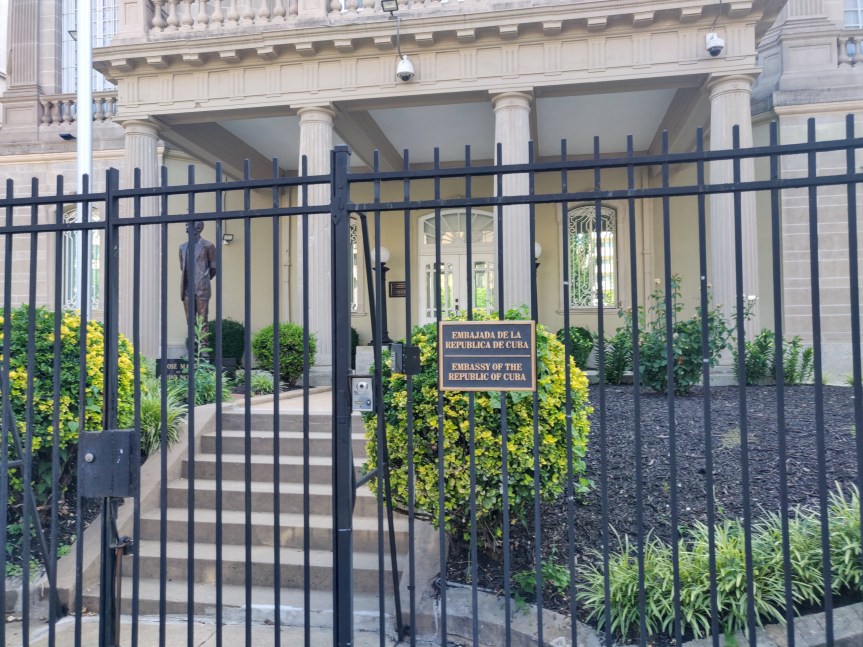
Appearing on the List is Alexander Alazo Baró, who shot at Cuba’s embassy in Washington with a semiautomatic weapon on April 30, 2020. He is still “under investigation.” Two Molotov cocktails exploded at the embassy on Sept. 24, 2023. The perpetrator is unknown.

Beto Rodríguez notes that on Nov. 24, 2023, the U.S. State Department, warning prospective travelers to Cuba of “potential terrorist actions … against the United States,” advised them to avoid “sites commonly used for demonstrations.”

A day earlier, a large pro-Palestinian march headed by Cuban President Miguel Díaz-Canel passed by the U.S. embassy in Havana. Journalist Rodríguez surmises that, “Washington already knew beforehand that anti-Cuban groups were planning to enter onto the island to commit acts of terrorism.”

Hernando Calvo Ospina, veteran analyst of U.S. terror against Cuba, reported on Jan. 10 that Cuba’s government referred the National List to the International Criminal Police Organization (Interpol), which deals with crime extending across borders.

Describing activities of the listed persons, Calvo Ospina highlights their new use of social media to communicate propaganda and to “incite internal violence, the assassination of State personalities, the destruction of common goods and all kinds of sabotage.”

Ospina states that, “the objectives now being pursued are similar to those of the so-called ‘historical exile group.’ Only the method has changed. Both have one thing in common: they use terrorist methods.” Some of those whose names appear were carrying out terrorist activities in the 1990s.

He indicates that, “Many received direct funding from the U.S. State Department, and also from the CIA, which uses various entities and NGOs to deliver it.”

According to the Congressional Research Service, the government’s so-called “democracy and human rights funding” for Cuba, a reference to support provided for interventionist programming, amounted to $20 million annually from 2014 to 2022. In July 2023, Rep. Mario Diaz-Balart, R-Fla., chairman of the House Appropriations Subcommittee, sought “to boost funding by 50% for democracy promotion efforts in Cuba.”

What looks like a revival of the U.S. government’s former anti-Cuba terror campaign may point to one or more of several possibilities:

  • Terror attacks had actually continued during the past two decades, but Cuba’s government, for unknown reasons, opted not to publicize them.
  • Terror attacks did continue, but at a low ebb, and now the Cuban government, at a difficult time, seeks to inform world opinion of illegal and dangerous U.S. actions, the object being to promote multi-national mobilization against prolonged U.S. all-but-war against Cuba.
  • The U.S. government, taking advantage of Cubans’ discouragement aggravated by a terrible economic crisis, has successfully recruited dissidents and once more is capable of mounting terror attacks.
  • The U.S. government, true to its ideologic core, to its imperialist self, stops at nothing while dominating or beating up on lesser peoples of the world.

We hope you appreciated this article. At People’s World, we believe news and information should be free and accessible to all, but we need your help. Our journalism is free of corporate influence and paywalls because we are totally reader-supported. Only you, our readers and supporters, make this possible. If you enjoy reading People’s World and the stories we bring you, please support our work by donating or becoming a monthly sustainer today. Thank you!


W.T. Whitney Jr. is a political journalist whose focus is on Latin America, health care, and anti-racism. A Cuba solidarity activist, he formerly worked as a pediatrician, lives in rural Maine. W.T. Whitney Jr. es un periodista político cuyo enfoque está en América Latina, la atención médica y el antirracismo. Activista solidario con Cuba, anteriormente trabajó como pediatra, vive en la zona rural de Maine.

Letter from Congress to Biden: Cuba is No Sponsor of Terrorism / by William T. Whitney Jr.

South Paris, Maine


The Massachusetts congressional delegation was irritated. The Biden administration, taking office, had promised to remove Cuba from the U.S. list of State Sponsors of Terrorism (SSOT). Massachusetts Representative Jim McGovern, favoring the change, took comfort from Congress having been informed at some point that the process was underway. However, in a closed-door congress briefing in early December, 2023, State Department official Eric Jacobstein indicated no action had been taken.

McGovern and Representatives Ayanna Pressley, Lori Trahan, Seth Moulton and Stephen Lynch and Senators Elizabeth Warren and Edward Markey, all Democrats, were indignant. That any removal of Cuba from the list would require a six-month long review process beforehand aggravated their displeasure.

They wrote a letter to President Joe Biden on December 14, 2023. Unaccountably, it did not become public knowledge until January 2.

The letter credited “President Obama and yourself after thorough review” for having removed Cuba from the list of SSOT nations in 2015, for declaring “the designation is without merit.” The authors decry “vindictive action taken by the Trump Administration in January 2021” in restoring the designation. They inform Biden that, “We believe the time to act and remove Cuba from the SSOT list is now – not months from now.”

The congresspersons note that, “In fact, Cuba and the United States have a functioning bilateral cooperation agreement on counterterrorism.” They mention that Colombian President Gustavo Petro had called for lifting of the designation, thus shattering one argument favoring the designation, the allegation that Cuba had hosted Colombian terrorists.

These, of course, were the representatives of the FARC and ELN insurgencies who were negotiating peace agreements, in Havana.

They pointed to mounting humanitarian disaster in Cuba now: “From the poorest and most vulnerable to the struggling private sector to religious, humanitarian and cultural actors, the Cuban people are enduring the most dire deprivations in recent memory – everyone is suffering.”

The letter identified placement of Cuba on the SSOT list as a “significant contributing factor” to the suffering. To explain: under U.S. law, the U.S. Treasury Department penalizes international banks and lending institutions that handle dollars on behalf of presumed terrorism-sponsoring nations.

To avoid fines, often immense, international financial institutions steer clear of transactions with Cuba, more specifically, the large universe of transactions involving dollars, the dollar being the dominant currency in international banking and commercial activities. Cubans suffer because of a great wall that prevents borrowing, buying supplies, and sometimes receiving payments for exported goods, and so money is short.

In their letter, the congresspersons cite hardship in Cuba as contributing to irregular Cuban migration into the United States, that now is massive. Their implied message is that removing Cuba from the SSOT list will alleviate humanitarian crisis in Cuba and so will reduce migration.

Mexican President Andrés Manuel López, conferring recently with Secretary of State Antony Blinken on migration, asked that Cuba be removed from the list. But Secretary of State Anthony Blinken, in a congressional hearing in March, 2023, indicated that Cuba had not met “the requirements to be removed from the list.”

The idea that Cubans are suffering so much that they are going to rebel has long circulated in official Washington circles. That approach to Cuban affairs dates from a memorandum on suffering in Cuba presented by State Department official Lestor Mallory in 1960.

Interviewed by Prensa Latina, Merri Ansara, board member of Massachusetts Peace Action, associated the letter with “a campaign initiated eight months ago to unify the state of Massachusetts in calling for Cuba to be removed from the SSOT” list. She indicated “We will now ask our elected representatives and senators in the state legislature to send a similar letter to Biden, and then we will ask our governor.”

By no means is this people’s campaign for removing Cuba from the SSOT list new. By mid-September in 2022, “[m]ore than 10,000 people and 100 progressive advocacy groups” had signed the Code Pink advocacy group’s open letter demanding that Biden do exactly that.

Calling for definitive action to remove Cuba from the U.S. list, Chris McKinnon, Chair of the Communist Party of Maine, urged Maine people, and progressive organizations, to register their backing for the Massachusetts congresspersons’ letter to Biden.

The time is now, he explained, “for everyone to update their information on U.S. – Cuban relations, think through their positions, reach out to unions, faith-based social justice committees, and others willing to listen, and meet with the Maine congressional delegation, and other elected officials, to insist upon this policy change.”


W.T. Whitney Jr. is a political journalist whose focus is on Latin America, health care, and anti-racism. A Cuba solidarity activist, he formerly worked as a pediatrician, lives in rural Maine. W.T. Whitney Jr. es un periodista político cuyo enfoque está en América Latina, la atención médica y el antirracismo. Activista solidario con Cuba, anteriormente trabajó como pediatra, vive en la zona rural de Maine.

Cuba’s Government Analyzes and Responds to Economic Woes / By W. T. Whitney Jr.

People look at food prices at a private business in Havana on December 20, 2023. Cuba’s economy will shrink by up to 2 percent this year, Finance Minister Alejandro Gil estimated on Wednesday, after acknowledging that the country will not be able to achieve the projected economic growth of 3 percent by 2023 | Yamil Lage / AFP / Getty

Reposted from Counterpunch


“Our joy is immense … We don’t deceive ourselves thinking that everything ahead will be easy, when perhaps everything is going to be more difficult.” That was Fidel Castro, hours after the victory of Cuba’s Revolution.

Difficulties were center stage 65 years later, at a plenary session of the Central Committee of Cuba’s Communist Party on December 15 and 16 and at the National Assembly of People’s Power, meeting on December 20-22.

The views of Cuban leaders on problems now enveloping Cuba shed light on realities of a nation under siege and a revolution in trouble. The information is pertinent to the solidarity efforts of Cuba’s friends abroad. Addressing the Central Committee’s plenary session, Cuban President Miguel Díaz-Canel noted that, “We have discussed efforts that have not
yielded solutions, measures that did not prosper, and goals that were not fulfilled …The scenario is that of a war economy … [We] are all here to reverse the present situation … with consensus as to decisions and with collective work, with passion and energy.”

Díaz-Canel called for “creative resistance” and “confidence in victory,” while insisting that dissatisfaction “is a motor that moves revolutionary energies. It provokes embarrassment that ends up activating people’s full participation, without which socialism is impossible.”

“We would be surrendering beforehand, if we see this war as an insuperable calamity. We must see it … as the opportunity to grow and to overcome our own selves, while the adversary is nakedly evil before the world … On the eve of the 65th anniversary of the Cuban Revolution … we are called to act together for a common objective: Save the
homeland, the Revolution, socialism, and overcome.”

The Assembly meets

Speaking to the National Assembly were: Alejandro Gil Fernández, minister of the economy and planning; Prime Minister Manuel Marrero Cruz; and President Miguel Díaz-Canel. Gil Fernández regards the U.S. economic, commercial and financial blockade of Cuba as the principal obstacle Cuba faces in restoring its economy.

He indicated that in 2023 Cuba’s GDP will have fallen almost two percent. Exports were $770,000 million below predictions. Food production was less than that of 2022. Tourism income increased by $400 million in 2023 but represented only 69% of the yield in 2019.
Overall production was down due mainly to state enterprises held back by shortages of supplies and fuels. Currency shortages and loss of workers to migration hampered the healthcare and education sectors. Electricity generation was up 32% in 2023, according to Gil Fernández. Cuba’s 30% inflation rate for 2023 was lower than the 77.3% rate in 2021.

State business entities showed “gradual recuperation.” They employ 1.3 million workers while accounting for 92% of goods and services produced in Cuba and 75% of exported products. He attributed price inflation to international price hikes, the government’s release of money to finance its budget deficit, fewer goods being produced, and an agriculture sector burdened by labor shortage, high costs, and low yields.

“What isn’t being produced cannot be imported,” Gil Fernández lamented. His message is that importing goods is almost impossible what with “the effect of high prices on the international market.” But, paradoxically, “a lack of production resources” forces Cuba to import over 70% of the food that is being consumed.

He proposed measures for increasing food production, including:

+ Creation of a financial mechanism for bolstering production based on farmers using Cuban currency derived from agricultural sales to buy supplies they need.
+ Build a farm labor force through moonlighting, employing students, and having young people do agricultural work as part of their military service.
+ Use food produced in Cuba, not imported food, to fill the “normal family food basket.”

Prime Minister Manuel Marrero Cruz critiqued the government’s lack of control over production and distribution which “adversely affects production by state entities and lets currency exchanges on the illegal market determine the pricing of products from the non-state sector.” e reported that social inequalities are growing, and that the tendency exists while state subsidies continue to nourish less distressed sectors of the economy. Equally worrisome: “The former state monopoly in production is now consolidating in the private sector.”

He was referring to the recent appearance of 9000 or so mostly private small-and-medium-sized businesses and to independent farmers and cooperatives that took over land from the state under long-term usage arrangements. They now control 80% of Cuba’s agricultural land. Marrero Cruz called for “stimulation of government-operated small-and-
medium-size business entities.”

Both private businesses and the farming sector sell products at highly inflated prices with prices being set by black market operatives. The prime minister condemned the state subsidies such entities receive in the form of low prices assigned to the fuel, water, transportation and electricity they buy from the state. Similarly, the government pays high
prices to farmers for food that, under the rationing system, is sold inexpensively to the population.

Henceforth, according to Marrero Cruz, the government will be subsidizing people, not products. According to one report, “The Ministry of Work and Social Security will be charged with undertaking a survey of ‘vulnerable’ social sectors.” “Nobody will be abandoned,” Marrero Cruz insisted.

The government, he indicated, will increase sales taxes on final products such as water, gas, electricity, transport and reduce import tariffs by 50% on the “intermediate products” used in food production and manufacturing. More tourist dollars will be harvested. Municipal assemblies will present budgets and in the case of deficits will generate more income and reduce administrative expenses.

For the prime minister, “food production needs to be prioritized and by all sectors. Many countries are saying to us: ‘We’ll put up the money, you provide the land and then pay back the money with production.’” He pointed out that, despite the non-availability of imported fertilizer and pesticides, “there are many instances of countries producing food; an
agricultural country must produce its food.”

Marrero Cruz sees “speculative prices … and intermediaries earning a lot more than producers” and non-state entities now controlling imports rather than the government, the result being “abusive and speculative pricing.” He called for paying for imports with income from exports: “[W]e prefer importing supplies and products essential to the economy and
paying for them by offering other countries certain products and/or services.”

Responding to inflation, the government, collaborating with the Central Bank of Cuba, will change the official exchange rate for the peso. According to Marrero Cruz, the government will be restricting prices for goods and services with a system of “maximum prices.”

President Miguel Díaz-Canel, addressing the National Assembly on December 22, focused on Cuba’s “war economy … [It’s] a political scenario of maximum asphyxia, designed and applied against a small country by the most powerful empire in history.” He also attributed
economic problems to “the crisis in international economic relations and our own errors.”

Economic war takes the form of economic blockade aimed at “reduced supplies of goods used by the population, inflated prices, and low purchasing power for most Cubans.” “Together with constant acts of subversion and disinformation against Cuba, the goal is to break the country, provoke social decomposition, and make for ungovernability.”

Díaz-Canel spoke of errors as “part of the complexity of making decisions in a context of extreme tension … [and of] commitment to preserving social conquests.” He mentioned mistakes, particularly in the “design and implementation of currency unification” and in “approving new economic actors without performance norms having been established.”

The effectiveness of new measures will “depend on generating more wealth, more work incentives, and more distribution of resources.” The president promised there will be no “neoliberal package … no crusade against small businesses, no elimination of the basic food allocation.” The president highlighted: “food production, localities taking care of
more of their needs, the revival of tourism, rescue of the sugar industry, state control of currency and the exchange market, redesign of the financial system, and guarantees for self-financing, and managing currency so as to serve those whose production generates income.”

Díaz-Canel took note of Cubans’ high regard for healthcare workers and teachers, promising that “they will be the first to benefit from additional pay, which the prime minister announced in his intervention.” Testifying earlier before the Economics Commission of the National Assembly, Díaz-Canel emphasized “taking advantage of the facilities of the municipalities and articulating strategies of local development.” Recalling that the “[f]oundation of government is the municipal assembly of people’s power,” he insisted on “mapping out actors in the municipalities and integrating them with state and private businesses.”

In the end

The information and opinions provided by Cuban leaders and reviewed here clarify difficult realities, among them: adverse effects of diminished tourism, inflation, and emigration; social inequalities based on varying access to resources; production stymied by shortages of resources; inadequate food production; lack of buying-power for most Cubans, and
for importing necessary goods; and the near impossibility of securing foreign investment.

Cuba is fashioning responses. They are: decentralization of political and economic administration; cut backs on expenditure of central government funds, reduced subsidies for the purchase of water, fuel, transport, and electricity by business entities; adjustment of import tariffs to favor the availability of resources for production, capturing more tourist dollars, protecting state-operated production entities, fixing prices, and producing more food.

These will be palliative remedies unless basic causes are dealt with. A prime goal of U.S. policy has been to deprive Cuba of money, and that has come to pass. Revolutionary Cuba’s very survival depends on U.S. citizen activists forcing their government to shed its blockade of Cuba. There, the great need now is for Cuba to be removed from the U.S. list of terrorist-sponsoring nations. That designation causes most international financial institutions to refuse handle dollars on Cuba’s behalf.

There is a larger context. The U.S. use of economic sanctions everywhere rests on planet-wide dollar dependency. That emerged out of the Bretton Woods Conference of 1944 and has coincided since with unrelenting U.S. assertion of worldwide power. That’s the basis for a global constituency on Cuba’s behalf. How it will be set in motion is the
big question.


W.T. Whitney Jr. is a political journalist whose focus is on Latin America, health care, and anti-racism. A Cuba solidarity activist, he formerly worked as a pediatrician, lives in rural Maine. W.T. Whitney Jr. es un periodista político cuyo enfoque está en América Latina, la atención médica y el antirracismo. Activista solidario con Cuba, anteriormente trabajó como pediatra, vive en la zona rural de Maine.

‘Economic asphyxiation’: U.S. restricts food supplies in bid to strangle Cuban revolution / by W.T. Whitney Jr.

A portrait of Argentine born Cuban revolutionary hero Ernesto ‘Che’ Guevara hangs on a shelf at a food store in Havana with some of the few products for sale. | Ramon Espinosa / AP

Reposted from the People’s World


The civilian victims of U.S. war-making in Gaza—the U.S. government supplies the big weapons—are on full display right now, broadcast on television screens and Twitter feeds around the world.

There’s another group on the receiving end of U.S. imperialism whose plight is not being publicized very much at the moment, though, and that’s the resistance of the long-suffering people of Cuba against an unrelenting economic war.

Differences in scale and immediacy of course distinguish the assault they face due from the U.S. blockade and the bombardment and constant death being visited upon the Palestinians by Washington’s Israeli ally, but for the island nation to our south, the supply of food and other necessities is becoming ever more precarious by the day.

And despite the differences in the war against Palestinians and the economic war against Cubans, there is a common principle that governs in both instances: Subjecting non-combatant populations to potentially lethal danger, under conditions of war, is criminal. That’s reason enough to force an end to the U.S. economic blockade of Cuba.

The blockade promotes food shortages and is putting more and more lives at risk. The U.S. public needs to know about, understand, and reject this blockade, its operation, and its impact. Letting people in the U.S. know the full details of what’s being done in their name is, of course, no small task. The blockade proceeds automatically and quietly; the human suffering it causes is largely hidden.

Economic embargos are a form of war and the people whose government is dishing out such a strategy is often unaware of what’s happening, writes commentator Nicholas Mulder: “Voters in the sanction-imposing country are unlikely to observe or understand the full costs of sanctions on ordinary people abroad.”

Not by accident

The blockade promotes food shortages, and that’s its intention. New Jersey Congressman Robert Torricelli introduced the Cuban Democracy Act in 1992 in the wake of the Soviet Bloc’s collapse. Cuba had just lost 80% of its trade and was vulnerable, which provided what the U.S. government saw as a chance to finish off Cuba’s Revolution.

The law prohibits those exporters abroad who are affiliated with U.S. companies from shipping food and other goods to Cuba under threat of penalties and fines. Torricelli explained the rationale, saying you mus “keep your foot on the snake, don’t let up.”

Companies around the globe had previously been exporting almost $500 million worth of food to Cuba annually, but Torricelli’s law put a stop to that. The legislation, which is still in effect, prohibits ships from entering U.S. harbors for six months after they visit a Cuban port.

The effect has been to raise shipping prices for Cuba and severely limit the number of international companies willing to risk their access to the giant U.S. market in order to sell to a much smaller customer like Cuba.

U.S legislation in 2000, provided some small relief, authorizing exports of U.S. farm products to Cuba. Payments are in cash only—no loans. Shipping costs remain high, though, because the food products must be carried in U.S. ships, and they return empty. Cuba has to pay for a two-way trip to get only one boatload of goods. U.S. food exports to Cuba peaked in 2008 and have fallen since.

The U.S. blockade also restricts financial services provided by international banks and lenders. Under U.S. pressure, they don’t lend money to Cuba and can’t handle U.S. dollars in transactions involving Cuba. The legislation that authorized U.S. presidents to designate other nations as sponsors of terrorism incorporated these prohibitions, along with penalties.

Cuba, as an alleged—falsely so—terrorist-sponsoring nation, lacks the credit and often the cash to pay for food imports and to develop the island’s own domestic agricultural potential. Cuba must spend $4 billion annually to import 80% of the food it consumes.

The U.S. blockade causes other shortages that also hobble food production. Fuel shortages impede the transport of goods and the operation of machinery. Fertilizer, herbicides, pesticides, seeds, spare parts, new equipment, veterinary supplies, irrigation equipment, new breeding stock, and grains used to make animal feed are all constantly in short supply. U.S. limitations on the remittances Cuban-Americans send to their families in Cuba further interfere with food purchases and spending on agricultural projects.

A comparison of agricultural production in Cuba and in the Dominican Republic suggests food shortages are due mostly to the U.S. blockade. The two are neighbors with essentially identical climates. The total of food produced in the unblockaded DR in 2021 exceeded Cuba’s “best historical average” yield by 35.7%, even though agricultural acreage in the Dominican Republic is only 25% of Cuba’s total.

Some difficulties affecting agricultural production result from non-blockade causes, to be sure: mounting inflation, domestic corruption, theft, currency speculation, and shortages of foreign currency due to reduced tourism during the COVID-19 pandemic and subsequently. Higher food prices generally around the globe recently and climate-change effects are also phenomena bearing on food availability in Cuba.

Policy failures also factor into the equation, as Cuba’s government has fallen short in converting the island’s many idle fields into productive farm land. And relatively few Cuban young people are attracted to farming; only 15% of Cubans live in the countryside.

Empty shelves

Agricultural minister Ydael Jesús Pérez Brito, interviewed recently, noted that the agriculture sector has secured only 40% of the diesel fuel it needs, 4% of required fertilizers, and 20% of feed needed for livestock.

He reported that pork production fell from almost 200,000 tons in 2017 to 16,500 tons in 2022, due in part to only 14% of necessary fuel being available. Rice farmers are producing 10% of recently achieved levels of production. Current production of beans and corn amounts to 9% and 30%, respectively, of yields in 2016.

Manuel Sobrino Martínez, the food industry minister, indicated last month that food processing generally and milk processing in particular is down over three years to 50% of capacity. He described a 46% drop over one year of milk received for processing to powdered milk, and reported that a ton of milk costs $4,508 now, up from $3,150 in 2019.

The availability of cooking oil is down 44% in a year; its cost is up from $880 per ton in 2019 to $1,606 now. Wheat processing is at half capacity. Fishing activity has fallen by 23% since 2022; 60 boats are not operating because motors are expensive and suppliers refuse to sell, or demand hard currency up-front. The minister said he must choose between “powdered milk, or wheat, or motors.”

The essence, according to an observer, is that, “owing to low agricultural yields, total food production in 2022 fell to 26% [of food produced] in 2019.”

Cuban President Miguel Díaz-Canel told a reporter recently that, “They have put us in a situation of maximum pressure, of economic asphyxiation to provoke the collapse of the Revolution, to fracture the unity between the leadership and the people, to obliterate the work of the Revolution.”

Production is low, he pointed out, and “the country’s fundamental problem is low availability of foreign currency.” Díaz-Canel said the government would “take advantage of the possibilities we have as a socialist state to plan and distribute available resources to prioritize the production that … could give us more possibilities, and also to protect people who may be in a situation of social disadvantage.”

Grim reality, of which food insufficiency is one aspect, demonstrates that now is the time for action and messaging strong enough to finally end the U.S. blockade. Suffering and distress at U.S. hands should provoke revulsion, just as does U.S. complicity with attacks on hospitals in Gaza, and killings of non-combatants.

A key element of Cubans’ distress is lack of currency and credit. President Joe Biden has only to remove Cuba from the U.S. list of terrorist-sponsoring nations to provide immediate humanitarian relief and restore Cuba’s government some room to maneuver the food crisis. An easing of current living conditions would surely result in fewer Cuban migrants heading to the United States, too.

For the U.S. government to be at peace with Cuba would hardly violate baseline presumptions for war-making, which would indeed be the case if the United States opposed Israel’s war in Gaza. Doing so would disturb respect for ally Israel’s historical memory, profiteering by U.S. weapons manufacturers, and backing for Israel as U.S. beachhead for regional control.

In dropping the blockade, U.S. power-brokers would lose little more than gratification and political reward for fighting communism and opposing Cuba’s efforts to rearrange their U.S. Latin American and Caribbean backyard.


We hope you appreciated this article. At People’s World, we believe news and information should be free and accessible to all, but we need your help. Our journalism is free of corporate influence and paywalls because we are totally reader-supported. Only you, our readers and supporters, make this possible. If you enjoy reading People’s World and the stories we bring you, please support our work by donating or becoming a monthly sustainer today. Thank you!


W.T. Whitney Jr. is a political journalist whose focus is on Latin America, health care, and anti-racism. A Cuba solidarity activist, he formerly worked as a pediatrician, lives in rural Maine. W.T. Whitney Jr. es un periodista político cuyo enfoque está en América Latina, la atención médica y el antirracismo. Activista solidario con Cuba, anteriormente trabajó como pediatra, vive en la zona rural de Maine.

Cuba Scores Big Victory in the UN General Assembly / By W. T. Whitney

South Paris, Maine


The United Nations General Assembly on November 2 voted to approve
a Cuban resolution that, unchanged over 31 consecutive years, calls for
an end to the U.S. economic blockade of Cuba. Approval once more
was overwhelming: 187 nations voted in favor and two against, the
United States and Israel. Ukraine abstained.

Reacting to the vote, Cuban President Miguel Díaz-Canel proclaimed a
“new victory for the Cuban people and their Revolution!” He pointed to
“the triumph of dignity and the fearlessness of our people,” and
expressed gratitude for “the international community’s recognition of and
support for Cuba’s heroism and resistance.”

For over 20 years, the only nations opposing the Cuban resolution, apart
from the United States, have been Israel and, formerly, a few U.S.-
dependent Pacific island-nations. The blockade began in 1962, and now
80% of Cubans have lived under its sway.

Prior to the vote this year, dozens of delegates representing member
states spoke out against the blockade. Cuba’s Minister of Foreign
Relations Bruno Rodríguez addressed the General Assembly, insisting
that the U.S. blockade interferes with “the right to life, health, progress
and welfare of every Cuban family.”

He explained that Cuba’s financial losses from the blockade reflect
factors like the high cost of substituting for goods excluded under the
blockade with more expensive goods and/or those with higher
transportation costs. Losses take the form also of an overall lack of
necessary materials, goods, and services. And “barriers Cuba faces in
gaining access to advanced technology” lead to monetary loss.

The chancellor emphasized that “sectors like agriculture and energy face
serious obstacles to acquiring spare parts or machinery.” He cited
examples of blockade-related shortages such as extreme shortages of
gasoline and oil, cancer patients being denied “first line treatments and
drugs,” and healthcare providers and their patients lacking respiratory
ventilators and medicinal oxygen normally available from abroad.

The blockade’s assault against the Cuban people shows up clearly and
dramatically in money lost to Cuba’s economy. Rodríguez claimed that
Cuba’s GDP would have grown by 9% in 2022 without the blockade, and
that the $4.87 billion in losses occurring between March, 2023 and
February 2023 correlated with “pain and suffering.”

Cuba’s monetary loss in over 60 years of blockade now totals $159.8
billion, according to one account. What with inflationary change, that’s
$1.3 trillion.

Another report indicates that between August 2021 and February 2022,
losses in the energy and mining sectors added up to $185.5 million, in
the agricultural sector, $270.9 million; and in banking and finance,
$280.8 million. Between January and July in 2021, losses were $113.5
million in the healthcare sector; $30.6 million in education; and $31.3
million in the transport sector.

Cubans’ lives are affected:

* During the last school year, Cuba’s government lacked paper
sufficient to “print and assemble books and notebooks for students,”
in part because a Canadian paper manufacturer did not extend credit.

* Presently, according to Granma news service, no school books are
being produced due to a lack of supplies and spare parts.

* Lack of access to high-performance brands and equipment, as well
as spare parts, serves to handicap Cuba’s telecommunications
sector, thus easing the way for U.S. and European competitors to
reach Cuban users.

Laws authorizing the U.S. blockade include the 1917 Trading with the
Enemy Act, the 1992 Cuban Democracy Act (Torricelli Law), and the
1996 Cuban Liberty and Democratic Solidarity Act (Helms-Burton Law).
Executive actions taken to implement the blockade have been central to
how that policy affects Cuba. The Obama administration eased many
blockade regulations. President Trump added 243 new measures, with
disastrous effect. The Biden administration continues them.

The U.S. Treasury Department imposes large fines on third-country
exporters failing to comply with its rules and so they often do not sell to
Cuba. Because the Treasury Department forbids foreign banks from
using U.S. dollars, international financial institutions rarely make loans to
entities in Cuba and are reluctant to handle U.S. dollars in transactions
involving Cuba.

The U.S. government has recently been weaponizing its false
declarations that Cuba is a terrorist-sponsoring state. The enabling
legislation on the matter granted the U.S. government authority to
penalize any international financial and banking sectors bold enough to
have dealings with states so designated.

Conveniently enough, Cuban analyst Claudia Fonseca Sosa recently
provide President Biden with advice as to “substantive modifications” of
methods for carrying out his policy. He could authorize “the export of
U.S. products to key branches of Cuba’s economy” and of medical
supplies and equipment to the island to help with the manufacture of
biotechnical products. Biden could allow U.S. companies to invest in
Cuba and enable U.S. citizens to receive medical treatment there.

The prospects for changed policies toward Cuba perhaps have
improved; a recent report documented the major role of the blockade in
propelling Cuban emigration to the United States – and sending
Venezuelans and Nicaragua there too. Those three blockaded countries
presently supply most of the migrants crossing into the United States.

U.S. sanctions cause desperate living conditions, and so people leave.
End all three blockades. Relieve the pressure on people, and maybe
they’d stay home. Who could object?


W.T. Whitney Jr. is a political journalist whose focus is on Latin America, health care, and anti-racism. A Cuba solidarity activist, he formerly worked as a pediatrician, lives in rural Maine. W.T. Whitney Jr. es un periodista político cuyo enfoque está en América Latina, la atención médica y el antirracismo. Activista solidario con Cuba, anteriormente trabajó como pediatra, vive en la zona rural de Maine.

New Anti-Cuba Terror Attack Hits at Cuban Embassy in Washington / by William T. Whitney Jr.

Embassy of Cuba, Washington, D.C | Photo: Wikimedia Commons

South Paris, Maine


Cuban Foreign Minister Bruno Rodriguez on Monday, September 25, indicated on social media that late the previous day, someone threw two Molotov cocktails at Cuba’s embassy building in Washington. Referring to “At least one Molotov cocktail,” an AP report indicated no one was injured and no damage occurred, also that “U.S. law enforcement officials were investigating.”

Condemnation of the attacks quickly emerged, in the United States from the Puentes de Amor (Bridges of Love) group, the People’s Forum in New York, Madea Benjamin, co-founder of CODEPINK, and the Washington DC chapter of the CPUSA. The governments of Mexico and Venezuela joined in denouncing the attack.

The National Network on Cuba issued a call for a protest demonstration in front of the Cuban Embassy at 5PM on September 25.

Within hours, President Díaz-Canel “expressed his firm condemnation of the act, attributing it to hate and underlining the possible consequences if forceful measures are not taken to deal with these acts of terrorism,” according to cubadebate.cu.

Outrage at the recent attack recalls national and global abhorrence to the assault-rifle attack on Cuba’s Embassy on April 30, 2020, which caused much damage.  The 42-year-old suspect Alexander Alazo, a 42-year-old undocumented immigrant from Cuba, was arrested, imprisoned, and, three months later, indicted by a federal grand jury on multiple charges relating to the attack. An Internet search reveals no subsequent disposition of Alazo’s case. 

Such incidents in Washington understandably are of the utmost concern to Cubans. Their experience is joining their country’s diplomatic missions abroad has too often put them in the way of U.S.-inspired terror attacks against their government.

Hostile parties used “petrol bombs” in causing damage to Cuba’s Embassy in Paris on July 27, 2021. As of 2020, “various Cuba representatives located abroad” between 1959 and 2018 experienced 581 incidents leading to 365 of them being killed and 721 wounded, according to Cuba’s Foreign Ministry.  This toll includes non-Cubans associated with the diplomatic facilities.

The timing of September 25 attack may relate to recent developments in U.S. Cuban Relations. One in particular was the high-profile visit to New York of Cuban President Miguel Díaz-Canel who addressed the United Nations General Assembly. He was speaking for the G77+China bloc of nations, which he currently serves as chairperson, and for his own country.

Díaz-Canel in New York reached out. He attended a solidarity event on behalf of Cuba and Venezuela, met with Cubans living in the United States, talked with New Yorkers on the street, visited Harlem to honor Malcom X, appeared at a gathering at the People’s Forum, and joined Catholic leaders to remember Cuban independence leader Father Félix Varela.

Perhaps the hatred on display with the attack on the Cuban Embassy represents a twisted attempt to counter any assumption that Cuba is on the side of decency, solidarity, and peace in a troubled world. What with the Cuban President’s visit in New York, U.S. Americans, reasonably enough, may have latched onto that idea.

Possibly the attack was also a signaling that no let-up in counter-revolutionary maneuvering was likely in the United States, despite the federal prosecution and political opprobrium now aimed at Bob Menendez. The New Jersey Senator, an anti-Cuba heavy hitter, faces charges of bribery and corruption on a massive scale. 


W.T. Whitney Jr. is a political journalist whose focus is on Latin America, health care, and anti-racism. A Cuba solidarity activist, he formerly worked as a pediatrician, lives in rural Maine. W.T. Whitney Jr. es un periodista político cuyo enfoque está en América Latina, la atención médica y el antirracismo. Activista solidario con Cuba, anteriormente trabajó como pediatra, vive en la zona rural de Maine.
‘Worse than the Special Period’: Cuba’s food situation more desperate by the day / By W.T. Whitney Jr.

Mariel resident Rosa Lopez lights a charcoal stove to boil sweet potatoes and prepare scrambled eggs with tomatoes for her grandchildren on May 18, 2023. She had just returned from picking up her food rations from a government-run market. At the time, it had been more than a month since any cooking gas had been delivered to the city, so Lopez cooks using charcoal and a wood burning oven. Low agricultural yields, exploding inflation, a lack of gasoline for transportation, and the U.S. blockade have all contributed to soaring food prices. | Ramon Espinosa / AP

Originally posted in People’s World on August 16, 2023


Addressing a meeting of government ministers and the press in Havana on Aug. 11, Cuba’s Vice Prime Minister Jorge Luis Tapia Fonseca exploded when discussing the food crisis gripping the nation.

“It takes work to produce food. Everyone wants food deliveries, but we do nothing to produce it. We lack a culture of production … We don’t need all these papers, or words. When do we begin to plant? Who will do it?”

He was reporting on implementation of Cuba’s 2022 law on Food Sovereignty and Food and Nutritional Security. He noted that food self-sufficiency in local areas is disastrously lagging. Crop yields are low; plant diseases and the lack of inputs has hampered grain production.

The food situation in Cuba is growing more desperate by the day. Residents of the island individually consumed only 438 grams of animal protein per month in 2022, and in May 2023, only 347 grams; recommendations call for ingestion of 5 kg monthly. Not enough chickens were raised last year; poultry meat and eggs remain scarce.

Yields of corn, soy, sorghum and other crops have dropped, and animal feed is mostly unavailable. Therefore, pork production is also down, milk is unavailable to adults, and fewer cattle are being raised. Pasturage is poor, due to drought and no fertilizer.

Farm workers carry a tank of fresh milk to deliver it to a government-run food store in San Nicolas, Cuba, May 19, 2023. Milk is in short supply and reserved for children these days. | Ramon Espinosa / AP

Failures mount

Tapia pointed to the many failures exacerbating the situation. The output of state-controlled food producers is low. Producers, distributers, and institutional consumers don’t regularly contract with one another to facilitate food distribution. Producers aren’t being paid, because credit isn’t available. Cattle-stealing has reached new heights, 44,318 head so far this year.

The Ministry of Finances and Prices issued a report prior to the National Assembly session that recognized high inflation, widespread popular dissatisfaction, and the need for “concrete solutions.” Minister Vladimir Regueiro Ale indicated prices skyrocketed by 39% during 2022 and 18% more so far in 2023.

Inflation, he explained, varies from province to province and may manifest as abusive price-fixing, especially when agricultural supplies and products are in short supply.

Commenting on the report, National Assembly President Esteban Lazo, reminded delegates that diminished production and inflation were connected: “If there is no production and supply, we will not achieve effective control of prices.” He complained that “practically 100% of the food basket is being imported.”

The Assembly’s Food and Agricultural Commission analyzed organizational and management problems and reported that only 68% of expected diesel fuel has arrived so far in 2023, 14,700 tons less than in the similar period a year before; 28,900 tons of imported fertilizer were ordered, but only 168 tons arrived. Cuba’s fertilizer production has been nil this year in contrast to 9,600 tons produced in the same months in 2022.

Lazo communicated a message to Cuba’s Minister of Agriculture from the Assembly, whose recent session ended on July 22. The ministry, he said, would be “transforming and strengthening the country’s agricultural production,” to initiate “a political and participatory movement that would unleash a productive revolution in the agricultural sector.”

Nothing less than a revolution will do

A revolution appears to be exactly what’s needed. The recent National Assembly session dealt almost entirely with Cuba’s present food disaster. The lives of many Cubans are becoming more precarious due to unending food shortages, high prices, and low incomes.

Information emerging from the Assembly’s deliberations attests to the reality of crisis in Cuba, and it means that urgency is building for Cuba’s friends in the United States to resist U.S. policies in new ways, strongly and assertively. Their own government accounts for new suffering and destitution in Cuba.

President Miguel Díaz-Canel emphasized resistance when addressing the National Assembly. He dedicated his remarks to two revolutionary heroes who were present. Admiring how they kept “their foot in the stirrup of difficulties” and their “rifle pointed at mistakes,” he may have been thinking of hard work ahead.

He mentioned “problems of our difficult daily life, such as food production, electricity generation, water availability, crime, rising inflation, abusive prices.”

The president criticized behaviors “that reinforce the omnipresent blockade through inaction, apathy, insensitivity, incapacity, or simple tiredness and lack of faith.”

Díaz-Canel noted approvingly that delegates discussed “closer ties between deputies and the population,” “better management and allocation of the currency,” “greater direct participation of the non-state sector in national production,” “municipal autonomy,” and “downward pressure on prices.”

But it’s not enough. “Above all,” he said, “we must devote ourselves to creating wealth, first of all, by producing food.”

Trouble in the countryside

Cuba’s rural communities are troubled—and shrinking. Soon, “we won’t have any people left in the countryside,” one delegate said. Another called for improved “roadways, housing, and connectivity.”

No fuel means most people in rural areas are resorting to bicycles or horse carts to travel short distances. | Ramon Espinosa / AP

Regarding the low level of agricultural skills among the rural population, someone called for teaching in “agroecological techniques” and “good practices for the producing, processing, and commercialization of food.”

The idea has been circulating for a while now that greater local autonomy might help spur food production, but efforts at prompting that devolution of initiative have seen a slow uptake. As of April 2023, aspiring farmers had not yet taken possession of 258,388 hectares of idle land made available to them without cost under land-tenure reforms in 2008.

Frei Betto, Brazilian friend of revolutionary Cuba and adviser to Cuba’s Food Sovereignty and Nutritional Education Plan, visited Cuba in June. In his assessment, the “current shortages are more severe than in the Special Period (1990-95),” when Cuba’s economy nearly collapsed following the withdrawal of Soviet aid and the contraction of trade with the socialist bloc of nations.

He indicated that Cuba now imports 80% of the food it consumes, up from 70% five or so years ago, and that it costs $4 billion annually, up from $2 billion. For corn, soy, and rice alone, the outlay now is $1.5 billion annually.

He indicated, too, that a ton of imported chicken meat now costs $1.3 million, up from $900,000 a year ago, that “the wheat supply has worsened,” that milk production is down 38 million liters in one year, and that less oil from Venezuela, thanks to U.S. sanctions there, means further reduced food production in Cuba.

Blame the blockade, but not only

The origins of food shortages in Cuba and the mode of U.S. intervention are highly relevant in understanding the current situation, as every Cuban knows.

To be sure, the shortages plaguing the people are not solely due to U.S. policies. Drought, hurricane damage, marabou shrub infestation, soil erosion, high soil acidity, poor drainage, and lack of organic material soil have all contributed.

The still-prevailing bureaucratic and centralizing tendencies of the Cuban government’s economic management also play a role.

The U.S. economic blockade, however, remains central to understanding what’s happening. The creation of a food crisis was among the original proposals put forward by State Department official Lestor Mallory in 1960 for how to overthrow Cuba’s revolutionary government. The program: Use “hunger and desperation” to spark the “overthrow of government.”

Aid from and trade with the socialist world frustrated U.S. efforts and kept disaster at bay for decades, but eventually the Soviet Union and socialist Eastern Europe fell. The U.S. government seized the moment and passed legislation tightening the economic blockade in 1992 and 1996 and, later, designated Cuba a terrorist-sponsoring nation.

Beyond bans on products manufactured or sold by U.S. companies, proscribed categories soon included products manufactured by foreign companies associated with U.S. ones and products containing 10% or more components of U.S. origin. Now, foreign enterprises active in Cuba faced possible U.S. court action.

International loans and international transactions in dollars are usually off-limits. Payments abroad don’t reach destinations. Income from exports doesn’t arrive.

Think imports of seeds, fertilizers, herbicides, pesticides, breeding stock, veterinary supplies and drugs, new equipment, spare parts, exports of coffee, rum, and nickel. Think loans for purchasing food and more, loans for agricultural development. Think impediments to restoring rural infrastructure.

Farm workers wait in line to refuel their tractors on the highway to Pinar del Rio, Guanajay, Cuba, May 18, 2023. Cuba is in the midst of a major fuel shortage that has drivers and farmers waiting in line for days or even weeks to gas up their vehicles and tractors. | Ramon Espinosa / AP

The blockade, the U.S. tool of choice, has hit food production in Cuba hard. It is far along in achieving its ultimate purpose. Cuba needs a new order of support from friends in the United States─Marti’s “belly of the beast.”

Cuba needs friends more than ever

Many have so admired Cuba’s brand of socialism as to assume that Cuba’s social gains and exuberant international solidarity would fire up such enthusiasm that, along with considerations of fairness, legality, neighborliness, and revulsion against U.S. cruelty, would make U.S. policymakers think anew about Cuba. It never happened.

Now at a watershed moment in Cuba, a new direction is necessary, one all about persuading, organizing, and unifying left-leaning political groups and anti-war, anti-empire activists of all stripes. Leadership is needed.

Frei Betto says that, “It is time for all of us, in solidarity with the Cuban Revolution, to intensify the struggle against the U.S. blockade and mobilize international cooperation with the island that dared to conquer its independence and sovereignty against the most powerful and genocidal empire in the history of mankind.”


We hope you appreciated this article. At People’s World, we believe news and information should be free and accessible to all, but we need your help. Our journalism is free of corporate influence and paywalls because we are totally reader-supported. Only you, our readers and supporters, make this possible. If you enjoy reading People’s World and the stories we bring you, please support our work by donating or becoming a monthly sustainer today. Thank you!


W.T. Whitney Jr. is a political journalist whose focus is on Latin America, health care, and anti-racism. A Cuba solidarity activist, he formerly worked as a pediatrician, lives in rural Maine. W.T. Whitney Jr. es un periodista político cuyo enfoque está en América Latina, la atención médica y el antirracismo. Activista solidario con Cuba, anteriormente trabajó como pediatra, vive en la zona rural de Maine.
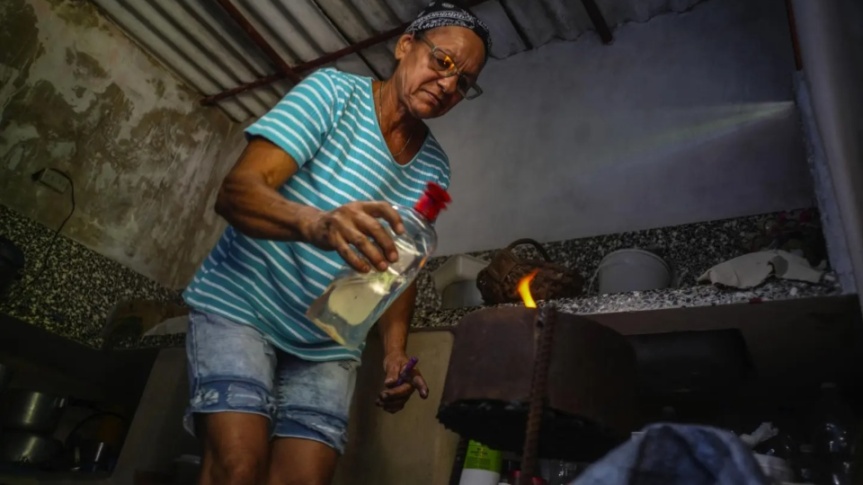
Right-wing forces in European Parliament torpedo EU-Cuba relations / W.T. Whitney Jr.

The fascist and anti-communist VOX Party of Spain is leading the effort to sink EU-Cuba relations in the European Parliament. Here, VOX leader Santiago Abascal makes a speech in Madrid, March 19, 2022. Repeating typical right-wing falsehoods, party banners at the rally allege the media and the government are controlled by communists. | Paul White / AP

Originally published in the People’s World on July 20, 2023


The Cuban musical duo Buena Fe (Good Faith) toured Spain in May. Thugs disrupted their concerts, forcing the cancelation of a few.  A month later in Paris, protests orchestrated by a Cuban émigré university professor forced a prestigious poetry festival to take away the honorary presidency it had bestowed upon Cuban poet Nancy Morejón.

On July 12, Cuba’s relations with European governments went from unstable to possibly disastrous. The European Parliament (EP) approved a “Resolution on the State of the EU-Cuba PDCA.” The vote was 359 in favor, 226 against, and 50 abstentions—signaling trouble ahead for Cuba.

The PDCA is the Political Dialogue and Cooperation Agreement that, signed in 2016, committed individual European countries to rely upon consensus and “constructive engagement” in their dealings with Cuba. It replaced the EU’s “Common Position” that, from 1998 on, promoted “interventionist, selective, and discriminatory” relations with Cuba.

Josep Borrell, the top EU diplomatic representative, visited Cuba in May. He was advocating for the PDCA as a means of “support for the increasingly important Cuban private sector” and for “the expanding economic reform taking place” in Cuba.

With its 60 items, the resolution’s scope was vast. False allegations of human rights violations appeared throughout. The resolution “condemn[ed] the Cuban regime’s support for the Russian war of aggression against Ukraine and its defense of Russia and Belarus.” It called for sanctions by the European Council “against those responsible for the persistent human rights violations in Cuba, starting by sanctioning [President] Miguel Díaz-Canel.”

If the resolution is any indication, EU-Cuba relations are going to be stormy. That was the whole point, surely, for those parliamentarians linked up, says one observer, “with CIA officers and diplomats stationed at the U.S. embassy in Brussels and Luxembourg.”

Spanish EP delegate and Communist Party member Manuel Pineda claimed that the EP “has become a loudspeaker for the most reactionary and extreme right-wing positions, contaminating and clouding what should be the house of Europe’s sovereignty.”

The resolution had been the project of the “Euroskeptic and anti-federalist” European Conservatives and Reformists Group (ECR) within the EP. ECR member Herman Tertsch, belonging to Spain’s fascist-leaning Vox Party, explained that, “The resolution is a further step towards ending the EU’s intolerable complicity with the Cuban dictatorship and that of its High Representative, Josep Borrell.”

He denounced Cuba’s Communists, “communists all over the world,” and “their accomplices in the democracies of America and Europe.”

Meanwhile, the European Union is Cuba’s biggest trading partner and EU countries account for most foreign investment in Cuba and one-third of all tourists visiting there. The EU has donated most of the developmental assistance received by Cuba over many years ─ €100 million as of 2021.

The timing was significant. The vote missed by one day the two-year anniversary of large anti-government protests occurring in Cuba on July 11, 2021. U.S. Secretary of State Blinken used that anniversary to insist that “the United States stands in solidarity with those in Cuba who continue to desire a free democracy.”

Additionally, a heads-of-state summit meeting between the EU and the Community of Latin American and Caribbean States (CELAC) took place soon after the vote, on July 17-18 in Brussels. CELAC includes all Western Hemisphere nations except the United States and Canada,

Preceding this summit were EU meetings with pre-CELAC regional alliances and CELAC-EU summit meetings in 2013 and 2015. The recent hiatus resulted from EU displeasure with “popularly elected governments and leaders” in Latin America. Now the object is to foster “respectful interchange” and to “acknowledge mutual interests.”

Chinese competition with Europe in Latin America and the Caribbean over trade, access to natural resources, and investment opportunities may have provided encouragement.

Reflecting official Cuban sentiment ahead of the summit, journalist Claudia Fonseca Sosa stated, “For Cuba, it’s important that … dialogue in Brussels be serious, participative, and diverse.” However, the EP’s resolution was aimed directly at aspirations of “consensus and bridge-building.”

The Foreign Relations Commission of Cuba’s National Assembly charged that “The EP Resolution represents harassment of European businesses investing in Cuba or seeking to do so. It also expresses the will of extreme right-wing political forces to deprive the EU of its own independent policy toward Cuba.”

As new grief falls on Cuba, the role of a newly evolving version of counterrevolution, fully evident elsewhere in the world, is hitting at the island. For Cuban political analyst Iramís Rosique Cárdenas, that kind of conservative politics with “known liberal discourse of private property, market fundamentals, a minimum state…and with social democratic cooperation” is disappearing.

He describes “a series of movements and organizations of the right and extreme right” with ideas of national chauvinism, reliance on strong states, economic protectionism, provincialism instead of multi-culturalism, xenophobia, “centrality of the traditional family,” exclusion of minorities, nationalism, and religious fundamentalism.

He adds, “The right-wing extremism active in the West displays virulent hostility against Latin American progressivism, especially the Bolivarian process, and against movements and states…like China and Cuba, [that resist] European and North American centers of power.


We hope you appreciated this article. At People’s World, we believe news and information should be free and accessible to all, but we need your help. Our journalism is free of corporate influence and paywalls because we are totally reader-supported. Only you, our readers and supporters, make this possible. If you enjoy reading People’s World and the stories we bring you, please support our work by donating or becoming a monthly sustainer today. Thank you!


W.T. Whitney Jr. is a political journalist whose focus is on Latin America, health care, and anti-racism. A Cuba solidarity activist, he formerly worked as a pediatrician, lives in rural Maine. W.T. Whitney Jr. es un periodista político cuyo enfoque está en América Latina, la atención médica y el antirracismo. Activista solidario con Cuba, anteriormente trabajó como pediatra, vive en la zona rural de Maine.