Fixing Healthcare Failures in the US and in Lewiston, Maine / By W. T. Whitney Jr.

Photo credit: Tim Wheeler/People’s World

South Paris, Maine


Efforts to reform U.S. healthcare fall short. Preventable deaths are excessive, access to care is often impossible, costs are high, and profiteering thrives. Individual solutions replace common purpose. Hope lies with an activated working class fighting for equitable, accessible, humane, and effective healthcare.

Maine people are now collecting signatures for a petition on the 2026 ballot demanding that the state promote universal healthcare. The campaign coincides with costs of Medicare insurance premiums increasing after January 1, 2026. That’s when subsidies provided under the Affordable Care Act are reduced. The campaign will react also to recent federal legislation that removed a million or so low-income Americans from Medicaid coverage.

The precariousness of current healthcare arrangements is evident to Maine voters who are aware of a painful transition taking place in Lewiston, Maine’s second largest city, population 39,187. Lewiston’s Central Maine Healthcare corporation (CMH) has been losing $32.5 million annually over five years. California-based Prime Healthcare, the fifth largest U.S. profit-making health system and owner of 51 hospitals in 14 states, is buying CMH.

Takeover

Serving almost half a million people in its region, CMH operates Central Maine Medical Center (CMMC), two smaller hospitals in the area, and also physicians’ practices, urgent care offices, nursing homes, and counselling centers in 40 locations. CMMC, established in 1891, has 250 beds and employs 300 physicians representing most specialties. The agreement to change ownership, announced in January 2025, is about to be finalized.

Prime Healthcare will invest $150 million in CMH over 10 years, while assigning CMH to its Prime Healthcare Foundation, a supposedly non-profit entity with $2.1 billion in assets. Prime Healthcare has a record

The corporation has periodically faced charges of overcharging, services dropped and safety standards ignored. After 2008, accusations surfaced in California of underfeeding hospital patients, allowing for post-surgery infections, and hospitalizing emergency room patients to increase revenues. Prime Healthcare in 2018 paid $65million in fines to settle accusations of Medicare fraud, over $35 million in 2021 for kickbacks and overcharging, and $1.25 million for false Medicare claims submitted by two Pennsylvania hospitals.

The Center for American Progress, a left-leaning think tank, recently warned against private equity companies owning health centers and controlling practitioners. It cited “unmanageable debt”, “increased costs for patients and payers,” poor patient care, and distressed healthcare workers.

Maine’s legislature on June 22 enacted  legislation establishing a one-year moratorium on private equity companies (and real estate investment trusts) owning or operating hospitals in the state.

Troubles in city and state

Other Maine health systems are also experiencing big financial troubles. Northern Light Health, with debt of $620 million, recently closed an acute-care hospital in Waterville and announced a new partnership with the Harvard Pilgram system in Massachusetts. Lewiston’s St. Mary’s Health System closed its obstetrical services, sold off properties, and is laying off employees. The New England-wide Covenant Health system, owner of St. Mary’s since 1990, indicates covering the hospital’s unpaid bills amounting to $88 million is not “sustainable.”

One media report suggests Maine people aware of layoffs, health institutions’ financial troubles and diminishing services are “wondering about the future of their health care.”  Medicaid funding reductions, shortages of primary care providers, and trimmed-down health centers have led to lengthy wait-times for appointments, long travel distances to new providers, and no care for many.

Lewiston, once a textile and shoe manufacturing center with a large population of French-speaking workers, migrants from Quebec, is “the poorest city in Maine.” Fallout from CMMC’s financial problems and reduced federal funding threaten the healthcare of people whose lives are already precarious.

Eleven percent of Lewiston residents are migrants from Africa, mostly from Somalia. The 2023 poverty rate for the city’s Somali people was 32%. For Lewiston it was 17.7% and for Maine  10.4%. Poverty for Androscoggin County, which includes Lewiston, was 13% in 2023; child poverty was 16.6%.  Life expectancy in Lewiston was 75.5 years in 2020, in Maine, 77.8 years.

Neither Maine or Lewiston is bereft of resources. Apart from remote rural and forested areas, Maine has well-functioning hospitals and competent practitioners.  Experienced and concerned agencies and organizations provide social services and support for health-impaired Mainers.

Maine ranks 17th  among the states in “cost, access, and quality of Medicaid and CHIP (Children’s Health Insurance Program) coverage for low-income individuals.” Another survey has Maine in 23rd place in “per person state public health funding” for 2023. A ranking of “states most supportive of people in poverty” puts Maine in 12th place.

Maine with its healthcare difficulties is not an outlier within the United States. Nevertheless, uncertainties prevail statewide, and Lewiston is in low-grade crisis mode. Planning is incremental, limited to localities, and accepting of the status quo. Collective action is not a consideration for those dealing with the crisis –providers, hospitals, recipients of care, and the general public. Individual initiative is the rule, as per U.S. habits.  

Wider perspective

Those healthcare flaws and difficulties evident in Maine exist throughout the United States. Awareness of the consequences is crucial to building support for necessary change.  

Too many people die. US infant mortality in 2021 ranked 33rd among 38 countries belonging to the Organization of Economic Cooperation and Development, the world’s wealthiest countries. U.S. life expectancy in 2025 ranked 48th in the world. U.S. maternal mortality rate in 2023 was in 59th..

Inequalities are pervasive, as reflected in the poverty and life-expectancy variations in Maine. The huge flow of money through the system highlights inequality; it takes place at levels far removed from the depths of U.S. society. U.S. health expenditures per person in 2023 were $14,885; the average in other countries comparable by wealth was $7,371. Health expenditure as percent of GDP in US was 17.6% in 2023; the figure for all other wealthy countries was lower than Switzerland’s 12.0%.

Incentives for profiteering are many. While administrative costs represented only 3.9% of total Medicaid spending in 2023 and only 1.3% of all traditional Medicarespending in 2021, they accounted for “about 30%” of the cost of private health insurance in 2023. Presumably, profit-taking is embedded within those high administrative costs.

Critics of US healthcare, writing recently in Britain’s Lancet medical journal, assert that “profit-seeking has become preeminent.” They add that:

“Health resources of enormous worth … have come under the control of firms obligated to prioritize shareholders’ interests … The potential for profits has attracted new, even more aggressive corporate players—private equity firms … [These have] a single-minded focus on short-term profit” … The US health-care financing system makes profitability a mandatory condition for survival, even for non-profit hospitals.” 

Realization dawns that adverse social and economic factors are tearing apart the benevolent purposes of healthcare. They make people sick. A report of the American Academy of Actuaries issued in 2020 says that, “30% to 50% of health outcomes are attributable to SDOH (social determinants of health), while only 10% to 20% are attributable to medical care.” A public health study shows that, “Nearly 45,000 annual deaths are associated with lack of health insurance.”

There is a way

That which has led to a floundering care system belongs to no one and weighs upon everyone, more so on the dispossessed and marginalized. It’s an epidemic, in the original Greek meaning of that word, “upon the people.”  Corrective action would therefore derive from and apply to all people all together. Healthcare itself supplies the model.

For many, physician John Snow is the “father of public health.” In London in 1854, Snow investigated an outbreak of cholera, a water-borne infectious disease. Suspecting that water from the Broad Street pump was the culprit, he removed the handle. The epidemic stopped. He had acted preventatively on behalf of the many, not for individuals.

Comes the Cuban Revolution and preventative and curative medical care are joined in one public health system. Political change allowed for that.

Rudolf Virchow (1821-1902), pathology giant and one of the founders of scientific medicine, was on the case almost two centuries earlier.  This leader of the Berlin Revolutionary Committee was behind the barricades in the revolutionary year of 1848. In 1847-1847, Virchow studies a typhus epidemic killing inhabitants of Upper Silesia. He notes in his report that:  

“A devastating epidemic and a terrible famine simultaneously ravaged a poor, ignorant and apathetic population. … No one would have thought such a state of affairs possible in a state such as Prussia, … we must not hesitate to draw all those conclusions that can be drawn. . . I myself …  was determined, … to help in the demolition of the old edifice of our state. [The conclusions] can be summarized briefly in three words: Full unlimited democracy.”

Virchow writes that, “Medicine is a social science, and politics is nothing else but medicine on a large scale… The physicians are the natural attorneys of the poor.”

If democracy was the fix then for an epidemic, it’s the fix now for the current epidemic of disordered healthcare. The people themselves would rise to the occasion. And how are they going to do that?

The role of profiteering in U.S. healthcare is a reminder of the capitalist surroundings of the struggle at hand. Aroused working and marginalized people are on one side and the rich and powerful on the other.

Does capitalism need to go in order that healthcare changes? Not yet, suggests international health analyst Vicente Navarro. In explaining U.S. failure to achieve universal healthcare, he observes that, “The U.S. is the only major capitalist developed country without a national health program, and without a mass-based socialist party. It is also one of the countries with weaker unions, which is to a large degree responsible for the lack of a mass-based working-class party.”

That clarifies. The working class is crucial to repairing a dismal situation. Its partisans will work on strengthening the labor movement in size and militancy. Working class political formations will have their day.

Martin Luther King has the last word. Speaking to health workers in 1966 King remarked that, “Of all the forms of inequality, injustice in health care is the most shocking and inhumane because it often results in physical death.”  His reference to “forms of inequality” implies the existence of the capitalist system giving rise to such forms. Capitalism fosters early deaths as well as racism.


W.T. Whitney, Jr., is a political journalist whose focus is on Latin America, health care, and anti-racism. A Cuba solidarity activist, he formerly worked as a pediatrician and lives in rural Maine.

Promise and contradictions emerge from celebration of Cuba’s Latin American School of Medicine / By W. T. Whitney Jr

Photo credit: Prensa Latina

South Paris, Maine


The Latin American School of Medicine (ELAM for its Spanish language initials) is a masterpiece of Cuba’s remarkable healthcare system. A conference of ELAM graduates took place in Havana from November 11 to November 15; two sets of them attended. The gathering marked the 25th anniversary of ELAM’s founding in 1999.

What happened and what was said reflect Cuba’s healthcare achievements and ELAM’s special contribution. A focus on ELAM demonstrates for us the paradox, cruelty, and injustice of U.S. aggression against a people capable of producing such an unprecedented achievement as ELAM.

To be aware that ELAM exists and that its creation falls within the range of human capacity is to be reassured that, in fact, possibilities do exist other than U.S. warmaking, militarization, and complicity in anti-Palestine genocide.

ELAM evolved out of Cuba’s response in 1999 to the ravages of Hurricanes George and Mitch in the Caribbean area and in parts of Central America. Cuban physicians carrying out rescue missions discovered that local healthcare workers were overwhelmed by the catastrophe. Within weeks, Cuba’s political leaders opted to prepare young people to be physicians in their own countries and be ready for future disasters and much more 

Soon prospective medical students were heading to ELAM from hurricane-affected regions. Later they came from throughout Latin America, and eventually from Africa and farther afield, including from the United States.  They were motivated by idealism – enrollees dedicate themselves to serving the underserved – and the fact that no personal outlay is required.

ELAM has now prepared  31,180 physicians for service in 120 countries. Some 1800 medical students from many countries are presently studying there. ELAM provides the first two years of pre-clinical courses at a converted naval base immediately to the west of Havana. Clinical training over the next four years takes place at teaching hospitals throughout Cuba.

On hand in Havana 25 years after ELAM’s initiation were more than 300 ELAM graduates and students plus 250 guests, physicians and students, from 30 countries. The occasion combined the 1st International Congress of ELAM graduates and the 2nd International Assembly of the International Medical Society of Graduates of ELAM (SMI-ELAM).

Organizers assigned the theme “Guardians of life, creators of a better world.” They projected the assembly as “a space for scientific interchange … and a concrete step toward creation of an international medical and scientific organization whose members [are] ELAM graduates.” 

The gathering featured plenary sessions, round tables, panels, and presentations by clinical and research specialists. These took place in Havana’s teaching hospitals and Conventions Center. Topics were: primary health care, medical care during emergencies and natural disasters, postgraduate medical training, and higher education in the medical sciences. Presenters linked medical education, social impact, and international solidarity. Experts from abroad and from international organizations were participating.

Welcoming the delegates, ELAM’s rector Yoandra Muro insisted that, “Commander Fidel is here, standing up, fighting with the example he instilled in his children, the graduates of this project of love.” Here, “we have a space for [ELAM] graduates to continue strengthening our kind of work and projecting training programs for the guardians of the present and future.” She identified graduates as “invincible standard-bearers in the field of health, who from their quality preparation are steeped in the work of solidarity.”

Luther Castillo Harry, currently minister of science, technology, and innovation in the Honduran government, graduated from ELAM in 2007. He declared at the conference that, “We are looking at the possibility of building the greatest scientific organization in the world … Each one of us has to be an ambassador of the Cuban Revolution.” And, “We will only gain the possible, through struggle against the impossible.”

Cuban President Miguel Díaz-Canel sent a message welcoming graduates back to their “second homeland.” He indicated he would not attend the sessions because of duties with post-hurricane recovery efforts. Díaz-Canel cited Fidel Castro’s “deep conviction that a better world is possible if we fight tirelessly for that ideal.”  He speculated on “Fidel’s happiness had he been able to see you become guardians of the life and health of your people.”

Presiding over a plenary session, public health minister José Ángel Portal Miranda discussed healthcare in Cuba. The report has him outlining a system based on primary care that involves 69 medical specialties and three levels of care. Cuba’s medical network, he explained, consists of 451 polyclinics, 11,315 community health centers, 149 hospitals, and a work force of 400,000 people. There are eight physicians serving each cohort of 1000 Cubans, 80,000 in all. Maternity homes and homes for elders are part of the system.

The minister indicated that 40 different faculties or their affiliates are responsible for training physicians; medical sciences are taught in 13 universities. He identified “the development of science and technology as the fundamental pillar of the health system.” Presently 2,767 research projects and 82 clinical trials are underway.  

Portal highlighted Cuba’s international medical solidarity, mentioning the Comprehensive Health Program mediated through international missions, the Barrio Adentro program for Venezuela, Operation Miracle (for eye care), and the Henry Reeve Brigades. He cited some 600,000 Cuban health workers having cared for people in more than 160 countries over many years.

Concluding his remarks, he stated that, “Out of ELAM have emerged and will emerge galenos who will save humanity from the barbarism. Or, as leader of the Revolution Fidel Castro said – ‘Doctors, not bombs!’” (Claudius Galen was a Greek physician and researcher in the classical era. Spanish speakers often refer to physicians as “galenos.”)

Here is Castro speaking in Buenos Aires in 2003:

“Our country does not drop bombs on other peoples, nor does it send thousands of planes to bomb cities; Our country has no nuclear, chemical or biological weapons. The tens of thousands of scientists and doctors in our country have been educated in the idea of saving lives. It would be absolutely contradictory to their conception to put a scientist or a doctor to produce substances, bacteria or viruses capable of killing other human beings.”


W.T. Whitney Jr. is a political journalist whose focus is on Latin America, health care, and anti-racism. A Cuba solidarity activist, he formerly worked as a pediatrician, lives in rural Maine. W.T. Whitney Jr. es un periodista político cuyo enfoque está en América Latina, la atención médica y el antirracismo. Activista solidario con Cuba, anteriormente trabajó como pediatra, vive en la zona rural de Maine.

Economic Crisis in Cuba – Leaders’ Solutions Face Big Obstacle / by W. T. Whitney Jr.

Selling agricultural products in a wheelbarrow in Havana. Photo: Otmaro Rodríguez.

South Paris, Maine


The Cuban economy is the worse it’s been since the “Special Period” following the end of the Soviet Union. The country is in the midst of a years-long economic contraction that’s affecting food production and the availability of medicines.

For the first time ever, the government has officially requested aid from the United Nations World Food Program. Inflation, meanwhile, is soaring, and there is massive emigration and power outages roll across the island. And unlike in the days of the socialist bloc, the country has major international allies to provide financial relief.

Cuba’s economy contracted 1.9% in 2023, and it’s infant mortality rate (IMR) – the number of infants dying in their first year of life per 1,000 live births – is inching upward. It was 4.7 in 2013, 5.0 in 2017, 6.2 in 2022, and 7.9 in 2023. The IMR is generally seen as  reflecting a society’s social conditions.

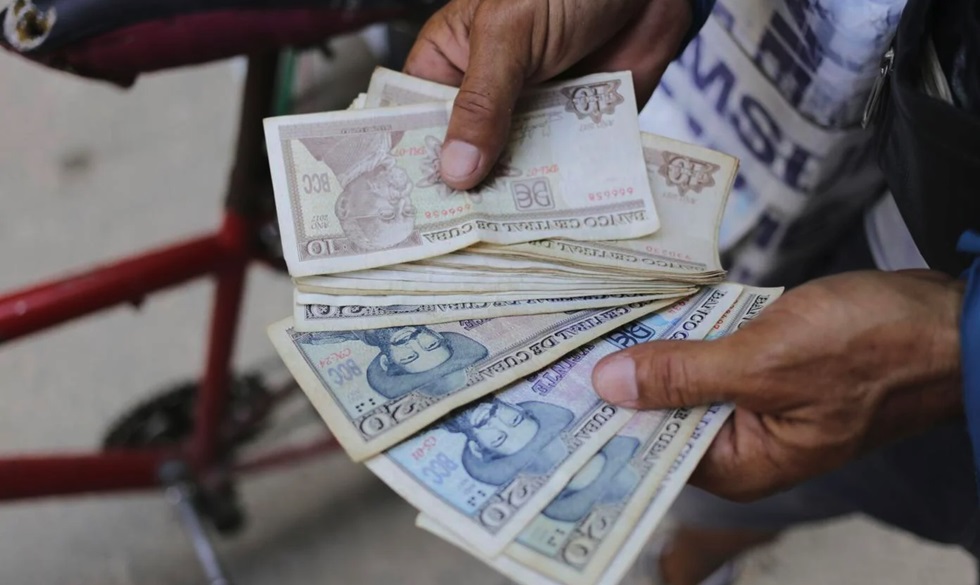
An ice cream street vendor counts his Cuban pesos in Havana, April 20, 2024. | Ariel Ley / AP

The country’s leaders are working overtime to respond to the worsening crisis. Deliberations at a recent meeting of Cuba’s Council of Ministers and a plenary session of the Communist Party’s Central Committee shed light on how government and party officials are reacting and on the resources they have available.

In the Council of Ministers’ meeting, as reported on June 30, President Miguel Díaz-Canel called for a restraining state expenses, limiting pay-outs from the state to the non-state sector, increasing participation of state entities in providing services, and cracking down on tax evasion.

He lauded the “very good experiences of labor collectives…in doing things differently and moving ahead.” He condemned speculation and black marketeering as contributors to inflation.

Prime Minister Manuel Marrero Cruz criticized “bureaucracy and ineffective control of our institutional system that are limiting creative work and promoting undesirable distortions in our society.”  He called for increasing national production and export income, promoting direct foreign investment, capturing remittances for the economy, and identifying sources of financing.

Vice-Minister of Economy and Planning Mildrey Granadillo de la Torre referred to new but unspecified ways of attracting foreign currency; incentivizing national production, especially food products; improving management of non-state entities, and reducing tariffs on importation of raw materials.

She spoke of adjusting the budget to a “war economy” and warned of an expanding deficit. She anticipated “a single, inclusive and equal pricing policy…[on the way] for state and non-state sectors of the economy.”  Vice-Minister of Finances and pPrices Lourdes Rodríguez Ruiz, joined in the assessment, reporting on plans for caps on prices for essential goods sold by non-state enterprises.

The Communist Party Central Committee’s Eighth Plenary Session took place on July 5-6. The agenda, as always, included a rendering of accounts from the Political Bureau and assessment of the implementation of earlier recommendations. The problems of reduced agricultural production, corruption, and crime received special attention.

Social misbehavior

Julio César García Pérez, head of the Justice Ministry’s “Office of Attention,” led a discussion of “crime, corruption, and social illegalities.” He recalled that the party had been called upon at its last congress to take on “strategic leadership” in this area.   As regards “implementation and fulfillment, the results are insufficient,” he reported. Crime rates remain high, with “major incidents of attacks against our patrimony,” often committed by young people and “persons uninvolved in work or study.”

Among the most prevalent crimes: abusive pricing, “illicit commercialization of diverse products,” drug-trafficking, livestock theft, “speculation on goods and services,” hoarding, administrative corruption, tax fraud, marketing of stolen goods, “lack of discipline in public spaces,” damage to public property, and fighting.

Authorities are trying to get a handle on the situation, with García Pérez reporting that “responses on the part of the courts and the attorney general’s office are more rigorous than earlier.”

Having met with party officials at the municipal level, he found that preventative measures were inadequate, however, and follow-up of individual cases lax. Cuba’s attorney general, Yamila Peña Ojeda, assured the Plenary that criminal penalties remain severe while “citizens’ rights and guarantees are respected.”

Comptroller-General Gladys Bejerano Portela, recognizing that “the Party is…working to maintain the soul of the Cuban Revolution,” confessed that she “could not understand why” many party members “are indifferent to deeds of corruption,” adding that “to not fight [corruption] is counterrevolution.”

Food is short 

The Plenary’s discussion of food shortages and low agricultural production focused on implementation of the 2021 Law of Food Sovereignty and Security.

Food and Agriculture Minister José Ramón Monteagudo Ruiz, returning to old themes, called for increasing national food production, reducing food imports, and generating competitive exports. Emphasizing the decisive role to be played by party members, he reported on consultations on agricultural production with mass organizations, provincial governing councils, and municipal assemblies.

Monteagudo Ruiz discussed follow-up of legislation of 2022 that prioritized local food production systems and local self-sufficiency. Party officials have interacted with companies, production units, cooperatives, and markets in 50 municipalities, he said.

The minister observed that the reforms of 2008 which gave individuals and cooperatives long-term use of what now amounts to 31% of all agricultural land have fallen short and not adequately bolstered production.

He attributed production deficits to the worsening economic crisis and adverse effects of the U.S. blockade. Cuban agriculture is being undone, he stated, by shortages of miscellaneous supplies, fuel, spare parts, pesticides, veterinary medications, fertilizers, and raw materials for animal feed.

Agriculture Minister Ydael Pérez Brito lamented that, “Harvests do not even approach 50% of what is needed,” despite various plans having been fulfilled. Consensus prevailed that levels of planting and harvesting are reduced, such that the population’s food requirements are not being met. Proposals re-emerged for enabling companies, organizations, and cooperatives to grow their own food for their own workers and members.

The president speaks

President Díaz-Canel, addressing the plenary, still found reason for optimism:

“If we work in all these areas simultaneously, in a decisive, organized, coherent manner, in a short time we will be managing fundamental issues such as the budget deficit, the excess of circulating cash, tax evasion, abusive prices; We will be managing the proper relations between the state sector and the non-state sector; We will be confronting crime and corruption more decisively…. Doing all this will indirectly and gradually influence changes in the exchange rate and in inflation.”

Aside from just recounting the list of challenges, though, he also elaborated on the job ahead:

I call upon you to correct things on an ongoing basis with determination, effort, and imagination, and to confront those negative tendencies that emerge like weeds in difficult moments. The call now is to go out as combatants, which we know how to do and as we have done so many times before.”

He offered perspective: “Every day that we manage to subdue these great difficulties with tenacity, effort, creativity, talent, and with unity of purpose against the genocidal plan of our historical enemy is a victory.”

He praised the party’s “authentic commitment to the people” and said that party cadres have to lead by example. The Communist Party, the president declared, has “the enormous responsibility of preserving the Revolution… to preserve its conquests and keep on advancing on the path of perfecting society, working tirelessly.”

As regards goals: “The Party and its cadres have the mission to stimulate, inspire, mobilize, and engage with members and the people, aware that an ideal will triumph only as long as it exists for all of us.”

The president said that party members and government leaders had a responsibility to “guarantee a better and greater access to food.” Food production and self-sufficiency, he said, “are tasks of the first order, in which the entire population must participate.”

Díaz-Canel indicated the need to “implement concrete actions” and to ensure that decisions are fulfilled in adherence with a strict timeline.

‘We are here to save the homeland, the Revolution, and socialism,” he insisted. “In six decades, the blockade has not been able to defeat the dignity of the Cuban people nor the immense collective…work of the Revolution. Even as it intensifies now, the blockade will not succeed.”

No money

Words spoken in the meetings were mostly about plans and remedies already in place, about revolutionary values, and virtues of the Cuban people.

In contrast to deliberations of earlier years, the presentations offered no new remedies for fixing Cuba’s economic downturn and shortages. Perhaps something novel will emerge from the commissions and plenary sessions of Cuba’s National Assembly, which started its meeting on July 15.

International solidarity on Cuba’s behalf wasn’t mentioned, and there were indications that divisions disrupting the unity of Cuban society have cropped up. Their extent of and how they may differ from earlier fracturing are unclear.

Shortages, long the central element of ongoing economic crisis in Cuba, featured prominently. The role of the U.S. blockade in causing shortages of specific products from abroad was mentioned, but its importance was downplayed in comparison to past assessments.

Allusions to the fact that the country has essentially no money, and thus no purchasing power on the international market, surfaced in the form of sporadic mention of budget deficits and of non-payment on earlier loans. The basic message was that Cuba’s international credit is nil.

Photograph Source: Susan Ruggles – CC BY 2.0

U.S. power brokers do their bit toward this end. They designate Cuba as a State Sponsor of Terrorism (SSOT). Countries so designated may not benefit from transactions involving U.S. dollars, according to the enabling law. Fearing U.S. penalties, international financial institutions refuse to respond to Cuba’s credit needs.

Any reference to external causation of economic disaster in Cuba, U.S. aggression in particular, broadens the story. Cuba’s leaders, mindful of their revolutionary origins and persistently in search of solutions, and Cuba’s people, their basic unity intact, are not alone in struggle. The reality remains of Cuba’s multifaceted appeal to the wider world. Her people’s aspirations for national independence, socialist revolution, and justice for all working people still call forth strong international support.

The next chapter in the United States turns to continuing and enhanced solidarity activities. These would be humanitarian aid, the never-ending campaign to end the U.S. economic blockade of Cuba, and, crucially, the fight against the SSOT designation. Recently, the U.S. Catholic Bishops called for removing that label. The story will continue.


W.T. Whitney Jr. is a political journalist whose focus is on Latin America, health care, and anti-racism. A Cuba solidarity activist, he formerly worked as a pediatrician, lives in rural Maine. W.T. Whitney Jr. es un periodista político cuyo enfoque está en América Latina, la atención médica y el antirracismo. Activista solidario con Cuba, anteriormente trabajó como pediatra, vive en la zona rural de Maine.

US Labor Must Weigh in on Cuba / By W.T. Whitney

Photo credit: Juan Carlos Dorado

South Paris, Maine


Taking note of International Workers’ Day, several Latin American news sources this year cited José Martí’s 1886 essay “A Terrible Drama;” two of them republished it, here and here.  There Martí reports on events in Chicago in 1886 and the fate of the so-called Haymarket Martyrs – seven labor journalists and agitators railroaded to prison and given death sentences.  Another received a 15-year prison term.

Martí, who would become Cuba’s national hero, was living in exile in the United States. He relates how strikes for the eight-hour day were underway on May 1, 1886 in Chicago and nationwide, how the Chicago police killed one striker and wounded others on May 3, and how a mass protest against police violence took place the next day in the Haymarket area. There, a bomb exploded, seven policemen and four workers were killed, and dozens were wounded. 

The court lacked evidence that the defendants, anarchist by inclination, were involved in the violence of May 4. Martí describes the execution of four of them and the suicide of another. An appeals court judge commuted the sentences of two defendants to life in prison. In 1893, Illinois Governor John Altgeld pardoned those two and the remaining prisoner.

The Socialist International in 1889 declared May Day to be an annual celebration of labor militancy.

José Martí’account, “A Terrible Drama,” is a foundational contribution to the history of the U.S. labor movement. Martí defended working people – U.S. workers in his writings, and Cuban workers in words and deeds, from 1886 on. The combination of author and story points to a connection between U.S. labor activism and workers’ struggles in Cuba. Its time has come.

The U.S. economic blockade of Cuba, lasting decades, has led to shortages, misery, and despair. Nations of the world voting annually in the United Nations General Assembly overwhelmingly condemn the blockade. It violates international law.

Domestic opposition to U.S. policies on Cuba, while persistent, vigorous at times, principled, on-target, and diverse, has fallen short. U.S. government measures aimed at destabilization remain in force.  Upping power of the people with labor combativeness would make a difference.

Unions and labor activists know how to organize and how to confront recalcitrant political and economic leaders. They will be active on Cuba’s side, once they realize that working people’s struggles in the two countries are linked, or so our theory goes. In addition:

·        Labor unionists involved in struggle count on unity, the power of numbers, and sometimes solidarity from counterparts, often from abroad.

·        The current Cuban Revolution is the product of a revolutionary tradition. U.S. workers confronting their own government on Cuba would be expressing solidarity with a revolution whose progenitor, Jose Martí, defended U.S. workers fighting for the eight-hour day.  They would be paying back. 

·        Social revolution and ordinary labor struggles are battles of ideas. The writings of Martí, maximum leader of Cuba’s early revolution, speak to Cuban and U.S. workers alike. In that way they are connected.

Martí wrote about working people and their lives.  He contributed greatly to the ideas and substance of revolutionary struggle in Cuba and also defended African-descended and poverty-stricken Cubans with a seemingly unqualified egalitarianism. For example:

·        “And let us place around the star of our new flag this formula of love triumphant: ‘With all, and for the good of all.’”

·        “A nation having a few wealthy men is not rich, only the one where each of its inhabitants shares a little of the common wealth. In political economy and in good government, distribution is the key to prosperity.”

·        “In Cuba there is no fear whatever of racial conflict. A man is more than white, black, or mulatto. A Cuban is more than mulatto, black, or white … True men, black or white, will treat each other with loyalty and tenderness for the sake of merit alone.”

Workers are oppressed

Responding to the Haymarket affair in his “A Terrible Drama,” Martí reflects upon the situation of U.S. working people:

“The nation is terrified by the increased organization among the lower classes … Therefore the Republic decided … to use a crime born of its own transgressions as much as the fanaticism of the criminal in order to strike terror by holding them up as an example …. Because of its unconscionable cult of wealth, and lacking any of the shackles of tradition, this Republic has fallen into monarchical inequality, injustice, and violence …

“In the recently emerging West … where the same astounding rapidity of growth, accumulating mansions and factories on the one hand, and wretched masses of people on the other, clearly reveals the evil of a system that punishes the most industrious with hunger, the most generous with persecution, the useful father with the misery of his children – there the unhappy working man has been making his voice heard.”

Martí’s “A Terrible Drama” appeared in La Nación newspaper in Buenos Aires in January 1888, some 19 months after the Haymarket events. The delay may have stemmed from Martí’s ambivalence about the anarchist leanings of the accused. Previously published segments of his report do appear under the title “The First of May, 1886” in historian Philip Foner’s anthology of Martí’s writings published in 1977. Excerpts follow:

“Enormous events took place in Chicago, but rebellion exists throughout the nation. In the United States … a firm and active struggle has been in preparation for years … …[T]hings are not right when an honest and intelligent man who has worked tenaciously and humbly all his life does not have at the end of it a loaf of bread … or a dollar put away, or the right to take a tranquil stroll in the sunlight… Things are not right when the one who in the cities … lives a contemplative life of leisure so exasperating to the miner, the stevedore, the switchman, the mechanic, and to every wretched person who must be content with seventy-five cents day, in raw winter weather …Things are not right if shabby women and their pallid children must live in tenement cubicles in foul-smelling neighborhoods. …The reasons are the same. The rapid and evident concentration of public wealth, lands, communication lines, enterprises in the hands of the well-to-do caste that rules and governs has given rise to a rapid concentration of workers. Merely by being gathered together in a formidable community which can, at one stroke, extinguish the fires in the boiler and let the grass grow under the wheels of the machinery, the workers are able successfully to defend their own rights against the arrogance and indifference with which they are regarded by those who derive all their wealth from the products of the labor they abuse.”

Deeds and words

Martí acted on behalf of working people. He organized Cuba’s independence struggle that culminated in war with Spain in early 1895. Under his leadership, the process became a social revolution.

From exile in New York, Martí outlined goals, strategies, and methods. Traveling widely, he arranged for Cuban exiles in the United States, Central America, and the Caribbean – many of them workers, many African-descended – to select the revolution’s leadership, provide funding and supplies, and approve goals and proposals. Martí persuaded the military heads to accept civilian leadership. He created and edited the independence movement’s newspaper Patria.

Aware of U.S. aspirations to dominate Cuba and the entire region, Martí led in confronting U.S. imperialism – never good for workers. In 1891 he wrote “Our America,” an essay demonstrating commonalities among diverse peoples inhabiting all the land extending from the Rio Bravo (the Rio Grande) south to Patagonia. Martí highlighted their shared cultural and political orientations that set them apart from U.S. and European societies.

In a letter to a friend shortly before he was killed in battle on May 19, 1895, Martí insisted that: “It is my duty … to prevent, by the independence of Cuba, the United States from spreading over the West Indies and falling, with that added weight, upon the other lands of Our America.”

Attacking military installations of the Batista regime on July 26, 1953, revolutionaries led by Fidel Castro were honoring José Martí, born 100 years earlier. For Castro, Martí was “the Apostle of Independence … whose ideas inspired the Centennial Generation and today inspire and will continue to inspire all of our people more and more.”

For the sake of justice and in view of connections with Cuban workers, U.S. working people would do well to press upon their government the necessity to end the blockade of Cuba. Labor unions, the principal means for expression of workers’ sentiment and power, have prime responsibility in this regard.

They would be acting as did West Coast dockworkers who blocked arms shipments to Chile under the Pinochet dictatorship, cargo arriving from apartheid-ridden South Africa, and, recently, arms shipments bound for Israel. U.S. unionists actively opposed their government’s support for authoritarian El Salvador in the 1980s and supported Iraqi workers after the U.S. invasion there. They collaborated with Mexican miners and other workers over many years. Recently U.S. unions issued statements and approved resolutions calling for a ceasefire in Gaza.  


W.T. Whitney is a political journalist whose focus is on Latin America, health care, and anti-racism. A Cuba solidarity activist, he formerly worked as a pediatrician, lives in rural Maine. W.T. Whitney Jr. es un periodista político cuyo enfoque está en América Latina, la atención médica y el antirracismo. Activista solidario con Cuba, anteriormente trabajó como pediatra, vive en la zona rural de Maine.

Cuba’s Government Analyzes and Responds to Economic Woes / By W. T. Whitney Jr.

People look at food prices at a private business in Havana on December 20, 2023. Cuba’s economy will shrink by up to 2 percent this year, Finance Minister Alejandro Gil estimated on Wednesday, after acknowledging that the country will not be able to achieve the projected economic growth of 3 percent by 2023 | Yamil Lage / AFP / Getty

Reposted from Counterpunch


“Our joy is immense … We don’t deceive ourselves thinking that everything ahead will be easy, when perhaps everything is going to be more difficult.” That was Fidel Castro, hours after the victory of Cuba’s Revolution.

Difficulties were center stage 65 years later, at a plenary session of the Central Committee of Cuba’s Communist Party on December 15 and 16 and at the National Assembly of People’s Power, meeting on December 20-22.

The views of Cuban leaders on problems now enveloping Cuba shed light on realities of a nation under siege and a revolution in trouble. The information is pertinent to the solidarity efforts of Cuba’s friends abroad. Addressing the Central Committee’s plenary session, Cuban President Miguel Díaz-Canel noted that, “We have discussed efforts that have not
yielded solutions, measures that did not prosper, and goals that were not fulfilled …The scenario is that of a war economy … [We] are all here to reverse the present situation … with consensus as to decisions and with collective work, with passion and energy.”

Díaz-Canel called for “creative resistance” and “confidence in victory,” while insisting that dissatisfaction “is a motor that moves revolutionary energies. It provokes embarrassment that ends up activating people’s full participation, without which socialism is impossible.”

“We would be surrendering beforehand, if we see this war as an insuperable calamity. We must see it … as the opportunity to grow and to overcome our own selves, while the adversary is nakedly evil before the world … On the eve of the 65th anniversary of the Cuban Revolution … we are called to act together for a common objective: Save the
homeland, the Revolution, socialism, and overcome.”

The Assembly meets

Speaking to the National Assembly were: Alejandro Gil Fernández, minister of the economy and planning; Prime Minister Manuel Marrero Cruz; and President Miguel Díaz-Canel. Gil Fernández regards the U.S. economic, commercial and financial blockade of Cuba as the principal obstacle Cuba faces in restoring its economy.

He indicated that in 2023 Cuba’s GDP will have fallen almost two percent. Exports were $770,000 million below predictions. Food production was less than that of 2022. Tourism income increased by $400 million in 2023 but represented only 69% of the yield in 2019.
Overall production was down due mainly to state enterprises held back by shortages of supplies and fuels. Currency shortages and loss of workers to migration hampered the healthcare and education sectors. Electricity generation was up 32% in 2023, according to Gil Fernández. Cuba’s 30% inflation rate for 2023 was lower than the 77.3% rate in 2021.

State business entities showed “gradual recuperation.” They employ 1.3 million workers while accounting for 92% of goods and services produced in Cuba and 75% of exported products. He attributed price inflation to international price hikes, the government’s release of money to finance its budget deficit, fewer goods being produced, and an agriculture sector burdened by labor shortage, high costs, and low yields.

“What isn’t being produced cannot be imported,” Gil Fernández lamented. His message is that importing goods is almost impossible what with “the effect of high prices on the international market.” But, paradoxically, “a lack of production resources” forces Cuba to import over 70% of the food that is being consumed.

He proposed measures for increasing food production, including:

+ Creation of a financial mechanism for bolstering production based on farmers using Cuban currency derived from agricultural sales to buy supplies they need.
+ Build a farm labor force through moonlighting, employing students, and having young people do agricultural work as part of their military service.
+ Use food produced in Cuba, not imported food, to fill the “normal family food basket.”

Prime Minister Manuel Marrero Cruz critiqued the government’s lack of control over production and distribution which “adversely affects production by state entities and lets currency exchanges on the illegal market determine the pricing of products from the non-state sector.” e reported that social inequalities are growing, and that the tendency exists while state subsidies continue to nourish less distressed sectors of the economy. Equally worrisome: “The former state monopoly in production is now consolidating in the private sector.”

He was referring to the recent appearance of 9000 or so mostly private small-and-medium-sized businesses and to independent farmers and cooperatives that took over land from the state under long-term usage arrangements. They now control 80% of Cuba’s agricultural land. Marrero Cruz called for “stimulation of government-operated small-and-
medium-size business entities.”

Both private businesses and the farming sector sell products at highly inflated prices with prices being set by black market operatives. The prime minister condemned the state subsidies such entities receive in the form of low prices assigned to the fuel, water, transportation and electricity they buy from the state. Similarly, the government pays high
prices to farmers for food that, under the rationing system, is sold inexpensively to the population.

Henceforth, according to Marrero Cruz, the government will be subsidizing people, not products. According to one report, “The Ministry of Work and Social Security will be charged with undertaking a survey of ‘vulnerable’ social sectors.” “Nobody will be abandoned,” Marrero Cruz insisted.

The government, he indicated, will increase sales taxes on final products such as water, gas, electricity, transport and reduce import tariffs by 50% on the “intermediate products” used in food production and manufacturing. More tourist dollars will be harvested. Municipal assemblies will present budgets and in the case of deficits will generate more income and reduce administrative expenses.

For the prime minister, “food production needs to be prioritized and by all sectors. Many countries are saying to us: ‘We’ll put up the money, you provide the land and then pay back the money with production.’” He pointed out that, despite the non-availability of imported fertilizer and pesticides, “there are many instances of countries producing food; an
agricultural country must produce its food.”

Marrero Cruz sees “speculative prices … and intermediaries earning a lot more than producers” and non-state entities now controlling imports rather than the government, the result being “abusive and speculative pricing.” He called for paying for imports with income from exports: “[W]e prefer importing supplies and products essential to the economy and
paying for them by offering other countries certain products and/or services.”

Responding to inflation, the government, collaborating with the Central Bank of Cuba, will change the official exchange rate for the peso. According to Marrero Cruz, the government will be restricting prices for goods and services with a system of “maximum prices.”

President Miguel Díaz-Canel, addressing the National Assembly on December 22, focused on Cuba’s “war economy … [It’s] a political scenario of maximum asphyxia, designed and applied against a small country by the most powerful empire in history.” He also attributed
economic problems to “the crisis in international economic relations and our own errors.”

Economic war takes the form of economic blockade aimed at “reduced supplies of goods used by the population, inflated prices, and low purchasing power for most Cubans.” “Together with constant acts of subversion and disinformation against Cuba, the goal is to break the country, provoke social decomposition, and make for ungovernability.”

Díaz-Canel spoke of errors as “part of the complexity of making decisions in a context of extreme tension … [and of] commitment to preserving social conquests.” He mentioned mistakes, particularly in the “design and implementation of currency unification” and in “approving new economic actors without performance norms having been established.”

The effectiveness of new measures will “depend on generating more wealth, more work incentives, and more distribution of resources.” The president promised there will be no “neoliberal package … no crusade against small businesses, no elimination of the basic food allocation.” The president highlighted: “food production, localities taking care of
more of their needs, the revival of tourism, rescue of the sugar industry, state control of currency and the exchange market, redesign of the financial system, and guarantees for self-financing, and managing currency so as to serve those whose production generates income.”

Díaz-Canel took note of Cubans’ high regard for healthcare workers and teachers, promising that “they will be the first to benefit from additional pay, which the prime minister announced in his intervention.” Testifying earlier before the Economics Commission of the National Assembly, Díaz-Canel emphasized “taking advantage of the facilities of the municipalities and articulating strategies of local development.” Recalling that the “[f]oundation of government is the municipal assembly of people’s power,” he insisted on “mapping out actors in the municipalities and integrating them with state and private businesses.”

In the end

The information and opinions provided by Cuban leaders and reviewed here clarify difficult realities, among them: adverse effects of diminished tourism, inflation, and emigration; social inequalities based on varying access to resources; production stymied by shortages of resources; inadequate food production; lack of buying-power for most Cubans, and
for importing necessary goods; and the near impossibility of securing foreign investment.

Cuba is fashioning responses. They are: decentralization of political and economic administration; cut backs on expenditure of central government funds, reduced subsidies for the purchase of water, fuel, transport, and electricity by business entities; adjustment of import tariffs to favor the availability of resources for production, capturing more tourist dollars, protecting state-operated production entities, fixing prices, and producing more food.

These will be palliative remedies unless basic causes are dealt with. A prime goal of U.S. policy has been to deprive Cuba of money, and that has come to pass. Revolutionary Cuba’s very survival depends on U.S. citizen activists forcing their government to shed its blockade of Cuba. There, the great need now is for Cuba to be removed from the U.S. list of terrorist-sponsoring nations. That designation causes most international financial institutions to refuse handle dollars on Cuba’s behalf.

There is a larger context. The U.S. use of economic sanctions everywhere rests on planet-wide dollar dependency. That emerged out of the Bretton Woods Conference of 1944 and has coincided since with unrelenting U.S. assertion of worldwide power. That’s the basis for a global constituency on Cuba’s behalf. How it will be set in motion is the
big question.


W.T. Whitney Jr. is a political journalist whose focus is on Latin America, health care, and anti-racism. A Cuba solidarity activist, he formerly worked as a pediatrician, lives in rural Maine. W.T. Whitney Jr. es un periodista político cuyo enfoque está en América Latina, la atención médica y el antirracismo. Activista solidario con Cuba, anteriormente trabajó como pediatra, vive en la zona rural de Maine.

Birthday Celebration – “Fidel is a country, is this people.” / by W. T. Whitney Jr.

Credit: rebelión.org

Many people here in Maine have traveled to Cuba. Together with our Cuba solidarity group Let Cuba Live, some of them celebrate on August 13. That’s today; it’s the 96th anniversary of Fidel Castro’s birth. But we hear you saying: “isn’t a social revolution supposed be to something collective and not a cult of personality?”

True, we would reply, revolutions do need masses of people who, amid hardship and oppression, have visions of decent lives and can come together. But revolutions are not spontaneous. There is a place for leaders, someone like Fidel Castro. Just as with Jose Martí, Cuba’s great leader in an earlier era, Fidel Castro communicated goals and hope and offered strategic insight and plans. So it’s OK.

Some reflections on this anniversary date make the point. In her article appearing August 13 on cubadebate.orgDaily Sánchez Lemus claims that, “Fidel is a country, is this people, who see in him the architect of their highest dreams.” She asks, “How can we explain what it meant [for him] to be close to the humblest people, to feel them, interpret them and share the same fate?”.

She cites a long letter Fidel wrote on July 21, 1957 to Frank País, his martyred young comrade based in Santiago de Cuba in the early days of the Revolution. She states that Castro’s “concept of people” is displayed there. At that time Castro and his band of guerrilla insurgents, were fighting in the Sierra Maestro mountains. Castro writes:

“Now I do know what a people is: I see it in that invincible force that surrounds us everywhere. I see it in those caravans of thirty and forty men, with torches for light, going down muddy slopes, at two and three in the morning, with seventy pounds of weight on their shoulders, bringing supplies for us.

Where did they come from? Who organized them so marvelously? Where did they get so much skill, so much cunning, so much courage, so much self-sacrifice? Nobody knows! … They organize themselves, spontaneously! When the animals get tired and lie down on the ground, unable to keep on, men appear everywhere and bring the stuff along. [Deadly] force can’t do anything against them. They would have to kill them all, down to the last peasant, and that’s impossible. No tyranny can do that and the people realize it, and are more and more aware of their immense strength.”

From Spain’s Basque region, Paco Azanza Telletxikiwrote in 2008 about Fidel Castro’s decision then not to seek Cuba’s presidency. He cites Haydée Santamaría’s remarks spoken at the University of Havana in 1967. That hero of Cuba’s Revolution declared that, “for me, being a communist is not being a member of a party: for me, being a communist is having an attitude towards life. Fidel is a communist with an attitude; he is more than a Party member. Fidel is the unequivocable communist who is so scarce today and who is needed to bring to fruition the just causes of the whole world.

She adds that, “In the 80’s Fidel commented that if one day the USSR disappeared and Cuba was alone, Cuba would still be socialist. Then came 1991, and the Soviet Union collapsed. When that happened, many “friends” of Cuba disappeared. In this new and complicated situation, the color red was fading. The reds of some countries faded little by little; others, devoid of shame, did so quickly. …Fidel and his Revolution continued walking along the same ideological path as always, flying the same flag.”

Mumia Abu-Jamal, a political prisoner serving a life sentence in a Pennsylvania jail, in 2008 also weighed in on Fidel Castro’s withdrawal from political life.  In his commentsMumia Abu-Jamal points out that:

“Fidel’s nearly 50 years as Cuba’s head of state have had a far-reaching impact not only in Cuba, but in Latin America, and beyond. … Latin America, in large part due to Cuba’s strong and tenacious example, has distanced itself from the draconian governments of U.S.-supported generals and is opting for democratic governments and populist leftists.

“In the field of education, Cuba’s achievements have been exemplary. In Central and South America, the average literacy rate is 86.4 percent. Cuba’s average literacy rate is 98 percent …

“Under its socialist system, education in Cuba is free. Indeed, Cuba is the school of choice for thousands of students from all over the world, especially in higher education and medicine. …  In fact, in 1961 more than one million Cubans (mostly from rural areas of the nation) were illiterate. More than 100,000 children over the age of 10 voluntarily participated in “literacy brigades” and spread throughout the country to teach the poor and peasants to read and write …

“In foreign affairs, Cuba brought its considerable military power to the fore in the struggle against South Africa’s racist apartheid system. Cuba, supporting the Angolan armed forces, …caus[ed] such losses to the South African army that it ushered in a long road of negotiations, compromise, and [eventually] the dissolution of apartheid.”

Lastly, Patricio Montecinos offers reflections that appear today on rebelion.org

These days Cubans are paying special tributer to the historical leader of their Revolution, Fidel Castro. They speak of him with a mixture of admiration, respect, and longing, but for them, he is always present, even now when, physically, he is gone.

For millions of admirers on the island, Fidel – the Commander in Chief, as they always will always call him – lives on, inside all of them.  He is there in every part of the Island where he used to show up to plant ideas and hopes, and listen to his people.

Most Cubans have an anecdote they tell of their maximum leader and guide, and now on his 96th birthday celebration, this August 13, they are proud to have him with them in their various activities. Many say they still talk with Fidel, ask his advice and help with their personal decisions. Sometimes, one hears them saying this in tears, as if he were their closest and most beloved family member

He is the man the CIA tried to assassinate more that 600 times and that successive U.S. administrations tried to being down but couldn’t do so. He is present in every moment of happiness and victory for Cubans and there too in moments of adversity and sadness.

The leader of Cuba’s Revolution of January 1, 1959 is with his people always, and will be for generations, including people who never knew him.  For most young people and children, he is a guardian angel and the idol of the island that deserves the name “island of dignity.” 

Fidel is also remembered on every continent. He always extended hands of solidarity to the dispossessed peoples of this world, and never asked for anything in exchange. He taught his compatriots to continue on that path and always lend a hand to anyone who needs help.


W. T. Whitney Jr. is a political journalist whose focus is on Latin America, health care, and anti-racism. A Cuba solidarity activist, he formerly worked as a pediatrician, lives in rural Maine. W.T. Whitney Jr. es un periodista político cuyo enfoque está en América Latina, la atención médica y el antirracismo. Activista solidario con Cuba, anteriormente trabajó como pediatra, vive en la zona rural de Maine.