

Ocasio-Cortez Would Block US Military Intervention in Peru / By W. T. Whitney Jr.

Rep. Alexandria Ocasio-Cortez, D-N.Y., is proposing a halt to Defense Department funding over intervention in Peru. | AP

Originally published in the People’s World on July 11, 2023


According to a report appearing July 8 on a Peruvian website—and apparently not yet in any English-language internet news source—Rep. Alexandria Ocasio-Cortez, D-N.Y., introduced an amendment to the National Defense Authorization Act requiring that, until conditions are met, a hold be put on Defense Department funding for its activities in Peru during fiscal year 2024.

Ocasio-Cortez introduced her amendment on June 29; the House Rules Committee will take it up on July 11.

As long as any suspension of funding remains, the U.S. military would not be permitted to “provide, authorize, or assist in any way in the transfer of defense articles, defense services, crowd-control supplies, or any other supplies, to [Peru’s] Government, or to coordinate joint exercises with the military or police forces of [Peru’s] Government.”

Ocasio-Cortez introduced her amendment six weeks after additional U.S. troops with weapons began to arrive in Peru. That was two months after Peru’s military and police reached a crescendo of violence marking repressive actions for weeks against mostly Indigenous peoples. They were demanding elections, a new constitution, and the removal of President Dina Boluarte.

The protests were in response to the parliamentary coup that deposed President Pedro Castillo on Dec. 7, replacing him with Boluarte, vice president at the time. Castillo remains in prison.

Elected in July 2021 on the strength of rural and Indigenous votes, the inexperienced and often isolated Castillo tried to bring about progressive change. Opposing him was a well-entrenched oligarchy accustomed to holding political power and benefiting from foreign investments in Peru’s plentiful natural resources.

Ocasio-Cortez’s amendment calls for no funding until “the Secretary of Defense submits to the appropriate congressional committees the certification…that each of the following criteria has been met.” These include free elections in Peru, no repression of “peaceful protesters and indigenous communities,” investigation of “the killings of protesters in Peru on Dec. 14, 2022,” prosecution of those responsible, the return of free speech, respect for civil liberties, and more.

The ‘‘appropriate congressional committees’’ are the Armed Services and Foreign Affairs Committees of the House and the same two committees in the Senate.

Peru’s Congress on May 19 authorized the entry of U.S. troops who will undertake “training activities” throughout the country and stay until Dec. 31, 2023. On May 26, Peru’s Congress approved additional authorization for 1,172 U.S. troops, who will be collaborating with Peruvian counterparts in an exercise called “Resolute Sentinel 2023” that will end on Aug. 29.

Legislation is on the books: the particular Leahy Law that applies to the Defense Department “requires that [funds appropriated to the Defense Department] may not be used for any training, equipment, or other assistance for a foreign security force unit if the Secretary of Defense has credible information that such unit has committed a gross violation of human rights.”

With 19 other congresspersons, Ocasio-Cortez signed a letter to President Joe Biden on Jan. 30 expressing “alarm regarding the human rights violations committed by Peruvian state security forces.” The letter called upon the Biden administration to halt “security assistance funding from the United States” to Peru until this “pattern of repression has ended.”

That Ocasio-Cortez signed this letter and introduced her amendment suggests an attitude on her part that is unusual among her progressively inclined congressional colleagues and even among her progressively-inclined fellow citizens. She is apparently one of the relatively few in both categories who take upon themselves the obligation to stand up against U.S. interventions abroad serving the high and mighty.

The time required for mobilizing support for Ocasio-Cortez’s amendment before it was presented to the Rules Committee was entirely lacking.  The appearance on that account has been one of low expectations and of hopes for the future, maybe.

The consciousness-raising effect of the effort is important. But the evident lack of supporters mobilized on behalf of the amendment has meaning, too. Clearly, there’s much work ahead for the anti-imperialist cause in the United States, and recruits are badly needed.


W.T. Whitney Jr. is a political journalist whose focus is on Latin America, health care, and anti-racism. A Cuba solidarity activist, he formerly worked as a pediatrician, lives in rural Maine. W.T. Whitney Jr. es un periodista político cuyo enfoque está en América Latina, la atención médica y el antirracismo. Activista solidario con Cuba, anteriormente trabajó como pediatra, vive en la zona rural de Maine.
Bolivia’s socialist government confronts separatist, racist uprising / by W. T. Whitney Jr.

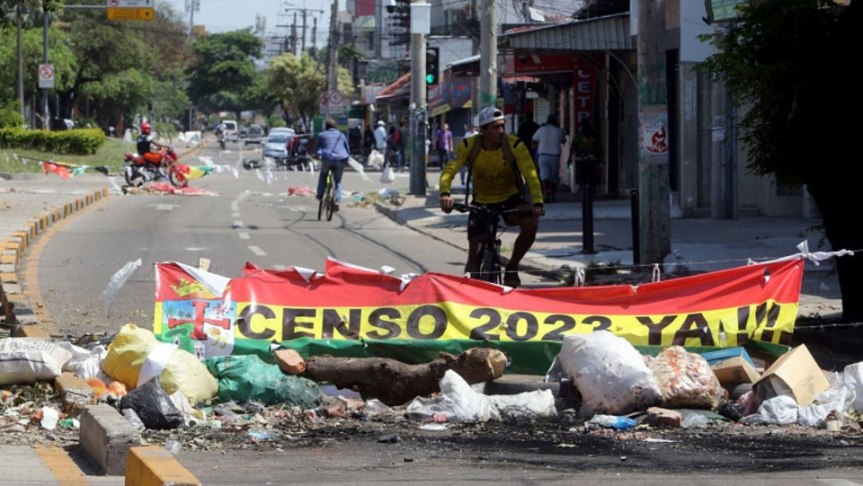
A banner reads ‘2023 census now!’ at a blockade on a Santa Cruz street. | via Twitter

With the exception of a coup-government interregnum in 2019-2021, the Movement Toward Socialism political party (MAS) has headed Bolivia’s government since the beginning of Evo Morales’s presidency in 2006.

The MAS government now led by President Luis Arce and Vice President David Choquehuanca announced on July 12 that its every-ten-year Population and Housing Census would be moved from November 16, 2022, to sometime in 2024.

Spokespersons attributed the change to difficulties left over from the pandemic, a need for translations into indigenous languages, uncertain financial resources, and extra time required for “technical” changes.

Leaders of the Santa Cruz department in Bolivia’s eastern lowlands, the nation’s largest, immediately demanded a census in 2023, not in 2024. Department governor Luis Camacho and Rómulo Calvo, president of the Santa Cruz Civic Committee, warned that without a settlement on the census, they would initiate a strike aimed at undoing the department’s economy, and thereby the national economy.

In response, “over one million Bolivians mobilized” on Aug. 25 in support of the government and against a regional leadership group that is the vanguard of opposition to Bolivia’s socialist and indigenous-led government. Even so, the strike began on Oct. 22. Recent Bolivian history suggests another coup may be in the offing.

Why a seemingly routine piece of government business like staging a census might provoke momentous consequences is not obvious. A look at expectations attached to Bolivia’s census and at the nature of Santa Cruz politics may clarify.

Census results help to determine the national distribution of government-provided services and resources and are the basis for each department’s representation in the national Legislative Assembly. Opposition forces in Santa Cruz see operation of the national census, as presently constituted, as beneficial to their side, particularly for the national elections of 2025.

They see advantage in the increased numbers of indigenous peoples migrating recently from Bolivia’s poverty-stricken highlands to economically-resourced Santa Cruz. That advantage rests on indigenous peoples showing up on the census with an identity other than indigenous.

The national census in 2012 fueled controversy when it showed that many indigenous people identify themselves as mestizo and not as belonging to a particular indigenous nation. That was encouraging to the reactionary and racist Santa Cruz leaders, who have no enthusiasm for increased indigenous representation in the national legislative assembly.

The Arce government, by contrast, objects to an undercount of indigenous people and especially in the eastern lowland departments, where their numbers are increasing.

The category of mestizo did not appear in the census of 2012 and is not part of the census in dispute now. The Santa Cruz leaders are insisting that that mestizo identity be incorporated into the census. Expert advice was sought in 2012 and the Arce government is now proposing the same.

The peculiarities of Santa Cruz are central to this story. For one thing, Bolivia’s four easternmost departments, particularly Santa Cruz, produce most of Bolivia’s wealth. Santa Cruz is home to industrial-scale agricultural operations and to facilities for oil and natural gas production. This lowland region accounts for most of Bolivia’s export income.

The realities are these: Santa Cruz alone accounts for 76% of the country’s food production, for all of its sorghum and sunflower oil production, 99% of its soy products, 92% of its sugar cane, 75% of its wheat, 72% of its rice, and 66% of its corn. In 2021, farmers owned 4.6 million head of cattle, over a million pigs, and 130 million chickens.

Among departments, Santa Cruz consumes 39% of the country’s diesel fuel and contains the bulk of Bolivia’s natural gas reserves, which rate as South America’s second largest. The Financial Times lauds the Santa Cruz economy’s explosive growth and large foreign investments. It mentions Santa Cruz city as one of the world’s fastest growing urban areas.

Also relevant to the strike story is the reactionary and racist nature of opposition leaders in Santa Cruz. They are utilizing the department’s “Civic Committee” to organize the strike and the Union of Santa Cruz Youth to carry out violent, paramilitary-style street actions. Gov. Luis Camacho formerly headed the Santa Cruz Civic Committee.

The civic committees of all departments originated decades ago in response to national-regional tensions. Members of formerly eastern European families, some of them big landowners, belong to the Santa Cruz civic committee. Many brought fascist ideology with them when they immigrated to Bolivia after World War II.

At the last of three big gatherings in Santa Cruz, Camacho on Sept. 30 announced the start on Oct. 22 of an anti-government strike of “indefinite” duration. In operation, the strike has led to barriers being placed across major highways to impede exports and in-country deliveries of commodities, mainly food. Strike leaders have forced key factories and commercial centers to shut down.

The Youth Union and other thugs have carried out anti-government demonstrations and fought in the streets against MAS party supporters and the national police. There have been injuries, human rights violations, and one death. The strike has had little impact in the other eastern departments.

With a presence at border crossings, the strikers have sharply reduced the transit of exported goods. Government authorities on Oct. 27, anticipating domestic food shortages, banned all exports from Santa Cruz of soy products, beef, sugar, and vegetable oil.

The government and MAS activists organized a rally and march by hundreds of thousands of people before the strike began, and another on the day after. In La Paz on Oct. 26, confrontation between government supporters and an opposition march left 20 persons wounded.

The government on Oct. 25 held a “Pluri-national Encuentro for a Census with Consensus.” Officials from throughout the country attended. A proposal emerged that would enable a technical commission to determine a date for the national census.

Camacho rejected it, but opposition leaders Rómulo Calvo and Vicente Cuellar accepted the proposal. In an interview, Camacho asserted that federalism remains the only solution to the “fissure” present since the “founding of the Republic.”

On Nov. 1, President Arce, referring to threats to “national integrity,” called upon military leaders “to guarantee and defend the independence, unity, and integrity of our territory.” A presidential spokesperson indicated that Arce favored new negotiations with no established date for the census and without conditions.

Events in Santa Cruz align with a grim history. President Evo Morales’s accession to power in 2006 was a culmination of old indigenous resistance against European colonialists and of recent pushback against neoliberal assaults inflicted by local enablers of U.S. and European ruling-class objectives.

Social gains achieved by the MAS-led government and its program of modest wealth distribution seemed to cement its place in history and certainly inflamed the animosities of reactionaries in Santa Cruz and nationally.

As a new constitution was being shaped—it was approved in 2009—Santa Cruz and its neighboring eastern departments staged a separatist revolt fueled by racism. A failed assassination plot against Morales in 2008 was part of it. During this period, the Morales government expelled a U.S. ambassador and the U.S. Drug Enforcement Agency.

The U.S. government and the Organization of American States, serving the United States, facilitated the coup that removed the Morales government in 2019 after his election to a fourth term. Luis Camacho of Santa Cruz led the coup and reportedly delivered the U.S. moneys used in various payoffs. Bolivia’s military participated.

The president of the coup government, Jeanine Áñez, is now in prison, in part because of human rights abuses and killings by soldiers during her tenure.

The current MAS-led government came into existence in 2020 following the first-round electoral victory of Arce and Choquehuanca. Its approval rating currently is 51%. The present strike has set back governmental efforts to restore a national economy devastated by the coup government’s neoliberal reforms and by pandemic effects.

Arce, reporting to the Legislative Assembly on Nov. 8, indicated that “We have complete certainty that our people are fully behind us and that they recognize a national patriotic government that looks out for the national welfare, which stands above sectarian and regional interests.” He observed that “in times of crisis, it’s always the poor that end up losing more, or losing everything.”


W.T. Whitney Jr. is a political journalist whose focus is on Latin America, health care, and anti-racism. A Cuba solidarity activist, he formerly worked as a pediatrician, lives in rural Maine. W.T. Whitney Jr. es un periodista político cuyo enfoque está en América Latina, la atención médica y el antirracismo. Activista solidario con Cuba, anteriormente trabajó como pediatra, vive en la zona rural de Maine.

People’s World, November 10, 2022, https://peoplesworld.org/