
The Trump circus has a logic and it’s dangerous / By W.T. Whitney Jr

South Paris, Maine


As startling and far-reaching as they are, actions taken by the Trump administration are most impressive at first glance for their circus-like quality of no central purpose. Realization dawns, however, that measures hitting at the rule of law and democracy itself and promoting war and turmoil in the wider world are so politically disastrous that by no means would they have appeared accidentally.

The idea here is that present situation reflects the U.S. government’s last-ditch response to a crisis of capitalism. If so, any useful defense against unfolding catastrophe has to center, it seems here, on what needs to be done about capitalism.

The term signifies arrangements in effect since feudalism that give full rein to ruling classes everywhere to organize economic and political affairs to their advantage. Capitalism is an evolving process that, stumbling now and then, requires adjustments to its functioning. Presently, the masters of U.S. capitalism seem to be carrying out a major fix of old and new problems that impede profit-taking. The measures being employed are disruptive.

To get the job done, capitalist decision-makers recruited the MAGA crew as agents to take on the unpleasant job, among other, of removing protections against exploitation and abuse of U.S. working people. Lower-order capitalists having reservations will probably join the project, while holding their nose.

Some basic assumptions introduce the discussion here:

· To fix what’s wrong, you look for the cause.

· Focus on impaired personalities running the show does not fully explain the turmoil triggered by the Trump government’s recent actions.

· Preexisting political rules and arrangements for how to govern did nothing to prevent the present catastrophe.

· Wide sectors of the U.S. population are silent, stunned, and without hope. They are generally unconvinced that an alternative way of doing politics exists or is possible.

· The Trump administration regards political opposition as inconvenient, irrelevant, and disposable.

· Actions of his government result from rational decision-making. They are not the products of random impulses.

Beginnings

Capitalists cross established boundaries. Beginning centuries ago in Europe, they have been plundering distant parts of the world. Along the way, they added an exploitative factory system, great industrial monopolies, and, lastly, a world system of markets, cheap labor, and plunder of natural resources.

Overcoming challenges and contradictions, capitalists took charge of faraway peoples, fought wars against rival capitalist powers, confronted socialist governments and suppressed resistance movements at home and abroad. Periodically, they had to recover from economic crashes prompted by the impossibility of impoverished workers buying goods that were produced. The point here is that capitalists are used to dealing with challenges.

Capitalists after World War I were experiencing unprecedented difficulties, and fixing them was fraught with uncertainty. European and the U.S. economies were highly unstable even before the Great Depression arrived. Plus, the Soviet Union was attending to people’s social needs, was industrializing, and was little affected by the Great Depression. A socialist alternative to the capitalists’ faltering system had abruptly asserted itself.

Many capitalists in Germany and Italy reacted by tolerating or actively supporting the fascist political parties fighting for power in each of those countries. They claimed to offer protection for capitalist economies and fightback against the Soviet menace. Their restrained U.S. counterparts accepted palliative reforms mediated through New Deal social democracy.

U.S. capitalism took on new life after World War II when the United States took charge of inserting free trade and other neoliberal policies into the world economy, over which it presided. The system allowed rich nations and their capitalists to exploit low-wage workers abroad, take advantage of poor nations’ debt dependency, and profitably extract their underground resources.

New Troubles

The good times were not so good. Beginning in the 1970s, worldwide economic growth lagged and inflationary tendencies persisted. The U.S. economy was experiencing “long-term stagnation and deindustrialization.” Financial activities and financial assets now loom larger in the U.S. economy than do commodity production and trade.

Manipulation of debt instruments misfired in 2008 leading to serious economic crisis. These adverse, long-developing realities represent one impetus for capitalist leaders to move toward extraordinary corrective measures. The Trump administration is carrying them out.

The other big element marking the current disruption of national politics would be the expected unpredictability of the Trump administration’s conduct of foreign affairs. On the theory that the administration’s major task is to shore up capitalism, it will surely be acting so as to align U.S. overseas activities with capitalist norms.

Lenin and other authorities had a lot to say about these, mainly the notion that aggressive foreign interventions are crucial for capitalism to be able to function.

U.S. imperialism, a bipartisan project, expanded after post-World War II. U.S. imperialists have carried out interventions, wars, proxy wars, and devastating economic sanctions in country after country, mostly in the Global South. These activities will undoubtedly continue under the Trump administration in order to further capitalist purposes. Random remarks on Trump’s part suggestive of easing up on this or that foreign adversary contribute only to the current volatility of political affairs.

Anti-communism had long inspired U.S. overseas adventures, but U.S. warmaking continued even after the Soviet Bloc was no more. The U.S. government and its capitalist junior partners, for example, engineered devastating regime-change operations against Yugoslavia (1999), Iraq (2003), and Libya (2011) The cover of anti-communism was gone, and antiterrorism as justification barely sufficed. Subsequent U.S. foreign interventions have represented imperialism, pure and simple.

China and a few other underdeveloped nations are now major manufacturing centers. China continues to attract significant foreign investment and is investing, building infrastructure, and extracting subsoil resources throughout the Global South, in the process outstripping the United States. The BRICS+ nations, competitive with the Global North in banking, manufacturing and science, are seeking to replace the U.S. dollar as the main international currency.

What to do

U.S. capitalists, seemingly worried about uncertainties surrounding foreign interventions and about weaknesses of the faltering neoliberal free-trade system, are on the way to building something new. The suggestion here is that Trump circus riling U.S. politics is no accident and that a new kind of capitalism is on the horizon.

Under Trump the government is assertive, aggressively nationalistic, and insulated from progressive social and political currents from abroad. The U.S. has disconnected from international agreements and international organizations, notably the 2015 Paris Climate Accord and the World Health Organization. High import tariffs are landing on goods arriving from almost everywhere, with the highest ones reserved for Chinese products.

U.S. working people are, or soon will be, coping with price hikes stemming from high tariffs; assaults on labor organizing, healthcare, schools, and universities; selective food shortages; aggravated racism; and cruel and illegal deportation proceedings. New grief is compounding earlier unmet social and economic needs.

The changes are so far-reaching that progressive reforms introduced by President Franklin Roosevelt in the 1930s are at risk of disappearing. Breakdown of the New Deal consensus would be the crown jewel of the upcoming capitalist reformation.

Almost incidentally, war preparations are a major element of the new kind of capitalism. According to Monthly Review, “[R]earmament of U.S. allies, along with a massive increase in Pentagon spending and bellicose threats directed at designated enemies, could lead to the further proliferation of conflicts, heightening the chance of a Third World War.” A “Trump nationalist imperial policy” envisions a “New Cold War on China” involving a “limited nuclear war.”

Call in the specialists

A government embarking upon such far-reaching initiatives can expect troubles ahead. Vast numbers of U.S. Americans will be experiencing grief and abuse. They may rise up, prompting the need for their suppression and for maintenance of order. A major war would require the home front to be stabilized and controlled with vigor. A special brand of governance would come into play. Specialists are available for this kind of work.

They are MAGA crew, already on the job. Following a script, they hit at the rule of law, politicize the military, prepare for war, scapegoat immigrants and the racially oppressed as internal enemies, assault institutional centers of thought –universities, government research centers, and the independent press – and rip apart the fabric of democracy. Lying and disregard for the truth are nonstop.

You may have already made the association. Another bunch of fascists thugs almost a century ago in Germany and Italy did their reordering in ways similar to those adopted by the Trump administration in our era. Measures taken in both situations are similar, as are overall purposes.

The way out

Working-class resistance becomes important. Turning back the fascists – or protofascists, call them what you will – rests on alliances created between working people and other oppressed and marginalized sectors, especially in rural areas and among the lower ranks of the middle class, the so-called petit bourgeoisie. The MAGA movement’s electoral strength depends on support from both sectors and also, crucially, from elements of the working class.

The record shows that to defeat 20th century fascism, major elements of the Communist movement pursued the popular front strategy, the idea of worldwide alliance involving all democratic forces. That recipe fits today and, besides, no alternative political formation or remedy is waiting in the wings for rescue.

Communists are familiar through study and practice with the linkage between capitalism gone awry and the origins of fascism. Giving voice to that reality may be a first step in bringing unhappy, confused malcontents into political activism, and from there into mass mobilization, which is the essential tool for defeating fascism.

Communists and socialists will be educating and organizing, and asserting their places in public life. They would interact primarily, but not exclusively, with members of the working class. Their educational message would begin with the premise that capitalists unable to solve their big problems turn to fascism for rescue. They would highlight the connection between wars and imperialism.

Loose ends remain. First, U.S. capitalists’ reliance on the fascists is old hat for their kind. Business mogul Henry Ford and Charles Lindbergh of America First fame greatly admired the Nazis. Senator Harry S. Truman in 1941, commenting on war in Europe, stated that, “If we see that Germany is winning, we ought to help Russia, and if Russia is winning, we ought to help Germany, and that way let them kill as many as possible.” His message was that in the right circumstances Nazis are OK.

Secondly, U.S. capitalists, bent upon overcoming failures in how capitalism works, easily dismiss one of the greatest failures of worldwide capitalism, that of weak response to environmental crisis that threatens to destroy humankind and the natural world.


W.T. Whitney Jr. is a political journalist whose focus is on Latin America, health care, and anti-racism. A Cuba solidarity activist, he formerly worked as a pediatrician, and lives in rural Maine.
U.S. policy implicated in the economic crisis driving Cuban protests / by W.T. Whitney Jr.

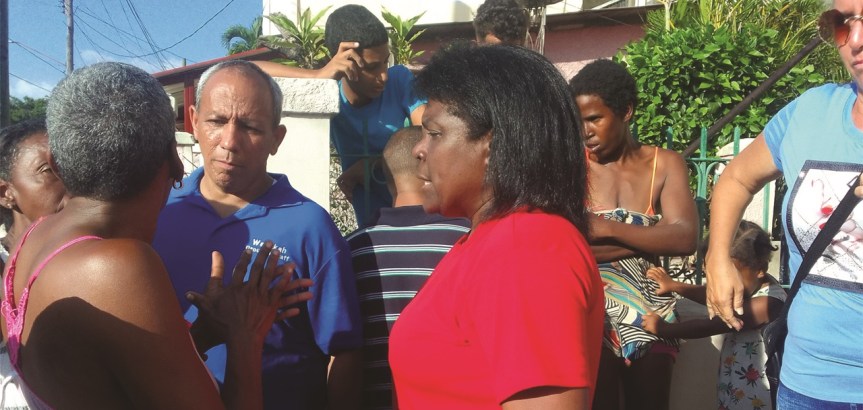
Beatriz Johnson Urrutia (center), the First Secretary of the Provincial Committee of the Communist Party in Santiago de Cuba, speaks directly with people demonstrating against food and electricity shortages on Sunday. | Photo via Juventud Rebelde

Reposted from the People’s World


This report takes advantage of the cogent observations (see below) of Professor Isaac Saney, former co-chairperson of the Canadian Network on Cuba and Coordinator at Dalhousie University for Black and African Diaspora Studies.

Hundreds of Cubans demonstrated peacefully in Santiago de Cuba and other cities across the island on March 17. Portrayed in some U.S. corporate media outlets as “anti-government” protests, the demonstrations were focused on electrical power outages and food shortages.

The protests were reacting to an accumulation of great economic difficulties that have assaulted Cubans and their government alike for decades.

Cuba is in the midst of a sharp economic crisis. Surging inflation is battering the economy, which shrank by almost 2% last year. Fuel prices rose by more than 500% just this month, while electricity rates climbed 25%.

Exports for 2023 were far below predictions, food production was less than 2022, and tourism income has only recovered to 69% of pre-COVID levels. Shortages of fuel and other supplies—largely because of the U.S. blockade—continues to hamper production in most sectors.

The dire circumstances are driving a mass exodus of Cubans; 425,000 migrants arrived in the United States in 2022 and 2023. Among those leaving are 9% of Cuba’s healthcare workers and thousands of educators. These departures have further aggravated the economic situation.

Responding to the Sunday demonstrations, Cuban President Miguel Díaz-Canel pointed out on social media that “enemies of the Revolution are trying to take advantage of a context [of shortages] for destabilizing purposes.” He noted, “In the last hours we have seen how terrorists based in the United States…are encouraging actions against the country’s internal order.”

On March 18, Cuba’s Foreign Ministry summoned U.S. chargé d’affaires Benjamin Ziff—there’s been no U.S. ambassador to Cuba since 1960—where he received a formal note of protest that referred to “interventionist behavior and slanderous messaging by the U.S. government and its embassy.”

While communicating the urgency of the situation, Díaz-Canel explained that his government’s approach would be “to attend to the complaints of our people, listen, dialogue, explain the numerous efforts that are being carried out to improve the situation, always in an atmosphere of tranquility and peace.”

In this screenshot from video circulating on social media, Cubans in the city of Santiago de Cuba protest food and electricity shortages on Sunday. | via X

The predicament for Cuba is evolving. It’s apparent that upcoming reactions from Cuba’s government, the international solidarity community, and by Cubans themselves will unfold according to economic and historical imperatives that are by no means new.

For insight, we turn to Isaac Saney’s analysis that was released on March 18. Excerpts follow:

Recent events in Cuba illustrate how intense the imperial pressures on the island nation are. It always bears underscoring that every effort to defy imperialism’s dictate and build a new society has faced unrelenting Western destabilization and sabotage: from the Haitian Revolution to numerous African, Asian, and Latin American national liberation projects. …

There is no doubt that Washington will spare no efforts to manipulate the current situation in Cuba through the use of various social media and digital platforms in order to further destabilize the situation. Moreover, it was recently revealed that U.S. intelligence agencies have been directly intervening in the Cuban economy to artificially inflate prices, stimulate inflation, and cause greater shortages of already scarce goods.

Cuba has faced—and is facing—the longest economic siege in history from the most powerful military and economic imperial power that has ever existed. Like the Haitian Revolution, the Cuban Revolution is the unforgivable example that must be destroyed. Washington’s overarching strategy aims at denying and eradicating Cuba’s right to self-determination, sovereignty, and independence.

The empire has never accepted the verdict of the Cuban people. It has waged an unceasing economic war and campaign of destabilization aimed at restoring U.S. imperialism’s domination and tutelage.

Cuba has repeatedly repelled the unceasing all-sided, military, economic, financial, and propagandistic assault by U.S imperialism.

Since the triumph of the Cuban Revolution in 1959, the United States has relentlessly pursued an ongoing assault on the Cuban people, employing both military and economic, including orchestrating invasions, assassinations, and terrorist attacks against civilians, as well as engaging in systematic economic sabotage. …

The sinister goal is to coerce the Cuban people into submission by strangling the economy, creating shortages, hardships, and exacerbating social inequalities—the very issues the Cuban Revolution has tirelessly worked to eliminate. This strategy seeks to instigate massive social unrest that would then serve as a pretext for U.S. intervention.

…The U.S. economic war against Cuba extends beyond U.S. borders, affecting businesses from other countries engaged in or seeking trade with Cuba. It stands as the primary impediment to Cuba’s social and economic progress, representing a blatant violation of the human rights of the Cuban people, costing the island nation more than $1 trillion U.S., underscoring its profound and detrimental effects.

A poignant testament on the criminality and immorality of the U.S. economic blockade was the Nov. 2, 2023, United Nations vote, when for the 31st time—with a vote of 187 to 2—the international community resoundingly rejected and condemned Washington’s economic war against Cuba.

Cuba faces significant—and what, for many, may seem overwhelming—challenges. However, the Cuban people have repeatedly shown themselves capable of meeting the challenges they take up.


We hope you appreciated this article. At People’s World, we believe news and information should be free and accessible to all, but we need your help. Our journalism is free of corporate influence and paywalls because we are totally reader-supported. Only you, our readers and supporters, make this possible. If you enjoy reading People’s World and the stories we bring you, please support our work by donating or becoming a monthly sustainer today. Thank you!


W.T. Whitney Jr. is a political journalist whose focus is on Latin America, health care, and anti-racism. A Cuba solidarity activist, he formerly worked as a pediatrician, lives in rural Maine. W.T. Whitney Jr. es un periodista político cuyo enfoque está en América Latina, la atención médica y el antirracismo. Activista solidario con Cuba, anteriormente trabajó como pediatra, vive en la zona rural de Maine.

Enlightened Working People Expect a Lot from Their Political Party: Reply to Brooks / by W.T. Whitney Jr.

Photo via CPUSA

South Paris, Maine


White working-class voters who recently switched to the Republicans have not yet returned to the Democratic Party. They should do that, New York Times columnist David Brooks points out. After all, the Biden administration has “pursued an ambitious agenda to support the working class … [and] economic results have been fantastic.”

He outlines a divide between Republican voters, who mostly lack college degrees and may live in rural areas and small towns, and Democrats, whom he reports as being urban-based, college-educated, and snobby. He mentions a “seismic political realignment,” which “is more about culture and identity than it is about economics.”

Brooks suggests that, if the Biden administration matched the commitment shown by the New Deal, a Democratic Party legacy, many former Democrats voting Republican would return home. Those less attentive to working-class interests and more susceptible to demagoguery and myth-making would presumably remain where they are.

Brooks doesn’t explain why cultural phenomena and the political use of people’s identity led to voters moving to another party. These played out in a way that encouraged a kind of politics that overwhelmed political undertakings crucial to various sectors of the working class.

The object here is to examine some of these political projects and thereby identify certain causes that are off limits to working people who vote Republican. Whether they are compelling enough to persuade errant Democrats to return to the fold is uncertain. So too is the Biden Administration’s dedication to pursuing such struggles.

In any case aspirations inspiring the kinds of activism described below are not far removed from urgings toward a coherent and consistent working-people’s political movement or political party.

Culture and its variations

Brooks’s use of the term “culture” seemingly embraces religious beliefs, persisting racial prejudice, views on abortion and gender nonconformity, rural distrust of city life, and support for gun ownership.

Working-class history is about another kind of culture. The French and American Revolutions of the late 18th century left behind a culture of democracy. It involved popular elections, expanded legislative power, and guarantees of political rights. Royalty and feudal remnants mostly disappeared. Political newspapers and public debate flourished.    

Some of the founders thought George Washington ought to be king. Fearful of democracy, they provided for indirect presidential and Senate elections, gave big and little states equal representation in the Senate and Electoral College, counted enslaved people as three-fifths of a person, and denied women the vote.

Democratic malaise manifests now as: disappearing consensus that elections decide who becomes president, gerrymandered congressional districts, elections given over to money-power, and the Electoral College’s disregard of the idea of one person-one vote.

But democratic forces return. Even as the Constitution took effect, struggling farmers and backwoodsmen rebelled against wealthy politicians in charge of new state governments. Agitation for democracy would resurface in fights for women’s suffrage, voting for the racially excluded and propertyless, economic justice for small farmers (in the progressive era), better wages and working conditions, and civil rights – and fights also to abolish corporate monopolies, slavery, child labor, and police violence.

Working people, socialists included, have long defended democracy. Socialists have realized that the democratic rights achieved by early revolutionists enabled struggles later on for social and economic change.

Presently, working-class voters allied to the Democratic Party most certainly prioritize renewed struggle for democratic guarantees aimed at shoring up a U.S. democracy in trouble.

Hazards of identity politics

Brooks doesn’t explore exactly how misuse of people’s identity disturbs U.S. politics. He implies that working people are somehow hurt.

The identity of being a woman often leads to trouble. Their political struggles have provoked anti-women biases and stereotypes. The origins and evolution of these are so nebulous as to not provide a basis for criticism that would actually end them. They recur, as with current fight over abortion. No end is in sight.

There is another way. Many women struggle now to overcome remnants of the dependency and obligation visited upon them at the beginning of industrialization. It’s an unfinished battle.

Men, and even women and children, were working in the new factories as independent contractors. The state and employers were oblivious to their domestic circumstances. Families were on their own to raise children, find and prepare food, and seek protection. Women were the ones who were responsible.

Factory owners and other capitalists even now regard women’s work at home as a “free gift.” Although less onerous, women’s state of dependency verging on oppression remains.

The manufacturing and service industries today cannot do without women’s work; it has long served them well in quality and quantity. That factor, and women’s struggle too, have induced power-brokers reluctantly to attend to women’s collective demands for fairness and basic equality. Women’s fight continues, but on the basis of realities in their lives, not on their identity.

As women and their families gain access to the social and economic resources needed for preparing new generations, women work toward a new independence freeing them from governmental intrusions in their private affairs, notably their freedom to choose an abortion.

Racial identity

The idea of affirmative action was to open up access to higher education and jobs for previously excluded persons. Racial and gender identity has been the marker of such exclusion. That’s what admissions officers and employers pay attention to. 

The process of expanding admissions to colleges and universities is unfair. Large numbers of U.S. young people eligible for affirmative action through their racial identity can’t aspire towards higher education. Their families are poor and vulnerable to social catastrophe. Their schools likely are inadequate. 

The families of most students benefiting from affirmative action have economic resources. Those students usually have originated from the middle and upper strata of the various minority groupings.  Most have attended good schools. They thrived from encouragement and high expectations at home.

A fix is at hand in the form of economic security for all, better schools, and universal availability of decent jobs. Capable young people of the working class would understand that they are due high-quality education from start to finish. It would be a kind of affirmative action that leads to hope and overcomes division.

David Brooks credits the Biden administration for creating new jobs, including jobs for workers without a college degree. Wondering why working-class people don’t return to the Democrats, he could have produced a more direct answer than one based on speculation about effects of culture and identity. 

Working people’s needs other than jobs go unrecognized. Brooks might have mentioned good schools, healthcare for all, housing for all, and guaranteed income. He would then have been entering territory of the unspeakable, which is redistribution of wealth.


W.T. Whitney Jr. is a political journalist whose focus is on Latin America, health care, and anti-racism. A Cuba solidarity activist, he formerly worked as a pediatrician, lives in rural Maine. W.T. Whitney Jr. es un periodista político cuyo enfoque está en América Latina, la atención médica y el antirracismo. Activista solidario con Cuba, anteriormente trabajó como pediatra, vive en la zona rural de Maine.

‘Economic asphyxiation’: U.S. restricts food supplies in bid to strangle Cuban revolution / by W.T. Whitney Jr.

A portrait of Argentine born Cuban revolutionary hero Ernesto ‘Che’ Guevara hangs on a shelf at a food store in Havana with some of the few products for sale. | Ramon Espinosa / AP

Reposted from the People’s World


The civilian victims of U.S. war-making in Gaza—the U.S. government supplies the big weapons—are on full display right now, broadcast on television screens and Twitter feeds around the world.

There’s another group on the receiving end of U.S. imperialism whose plight is not being publicized very much at the moment, though, and that’s the resistance of the long-suffering people of Cuba against an unrelenting economic war.

Differences in scale and immediacy of course distinguish the assault they face due from the U.S. blockade and the bombardment and constant death being visited upon the Palestinians by Washington’s Israeli ally, but for the island nation to our south, the supply of food and other necessities is becoming ever more precarious by the day.

And despite the differences in the war against Palestinians and the economic war against Cubans, there is a common principle that governs in both instances: Subjecting non-combatant populations to potentially lethal danger, under conditions of war, is criminal. That’s reason enough to force an end to the U.S. economic blockade of Cuba.

The blockade promotes food shortages and is putting more and more lives at risk. The U.S. public needs to know about, understand, and reject this blockade, its operation, and its impact. Letting people in the U.S. know the full details of what’s being done in their name is, of course, no small task. The blockade proceeds automatically and quietly; the human suffering it causes is largely hidden.

Economic embargos are a form of war and the people whose government is dishing out such a strategy is often unaware of what’s happening, writes commentator Nicholas Mulder: “Voters in the sanction-imposing country are unlikely to observe or understand the full costs of sanctions on ordinary people abroad.”

Not by accident

The blockade promotes food shortages, and that’s its intention. New Jersey Congressman Robert Torricelli introduced the Cuban Democracy Act in 1992 in the wake of the Soviet Bloc’s collapse. Cuba had just lost 80% of its trade and was vulnerable, which provided what the U.S. government saw as a chance to finish off Cuba’s Revolution.

The law prohibits those exporters abroad who are affiliated with U.S. companies from shipping food and other goods to Cuba under threat of penalties and fines. Torricelli explained the rationale, saying you mus “keep your foot on the snake, don’t let up.”

Companies around the globe had previously been exporting almost $500 million worth of food to Cuba annually, but Torricelli’s law put a stop to that. The legislation, which is still in effect, prohibits ships from entering U.S. harbors for six months after they visit a Cuban port.

The effect has been to raise shipping prices for Cuba and severely limit the number of international companies willing to risk their access to the giant U.S. market in order to sell to a much smaller customer like Cuba.

U.S legislation in 2000, provided some small relief, authorizing exports of U.S. farm products to Cuba. Payments are in cash only—no loans. Shipping costs remain high, though, because the food products must be carried in U.S. ships, and they return empty. Cuba has to pay for a two-way trip to get only one boatload of goods. U.S. food exports to Cuba peaked in 2008 and have fallen since.

The U.S. blockade also restricts financial services provided by international banks and lenders. Under U.S. pressure, they don’t lend money to Cuba and can’t handle U.S. dollars in transactions involving Cuba. The legislation that authorized U.S. presidents to designate other nations as sponsors of terrorism incorporated these prohibitions, along with penalties.

Cuba, as an alleged—falsely so—terrorist-sponsoring nation, lacks the credit and often the cash to pay for food imports and to develop the island’s own domestic agricultural potential. Cuba must spend $4 billion annually to import 80% of the food it consumes.

The U.S. blockade causes other shortages that also hobble food production. Fuel shortages impede the transport of goods and the operation of machinery. Fertilizer, herbicides, pesticides, seeds, spare parts, new equipment, veterinary supplies, irrigation equipment, new breeding stock, and grains used to make animal feed are all constantly in short supply. U.S. limitations on the remittances Cuban-Americans send to their families in Cuba further interfere with food purchases and spending on agricultural projects.

A comparison of agricultural production in Cuba and in the Dominican Republic suggests food shortages are due mostly to the U.S. blockade. The two are neighbors with essentially identical climates. The total of food produced in the unblockaded DR in 2021 exceeded Cuba’s “best historical average” yield by 35.7%, even though agricultural acreage in the Dominican Republic is only 25% of Cuba’s total.

Some difficulties affecting agricultural production result from non-blockade causes, to be sure: mounting inflation, domestic corruption, theft, currency speculation, and shortages of foreign currency due to reduced tourism during the COVID-19 pandemic and subsequently. Higher food prices generally around the globe recently and climate-change effects are also phenomena bearing on food availability in Cuba.

Policy failures also factor into the equation, as Cuba’s government has fallen short in converting the island’s many idle fields into productive farm land. And relatively few Cuban young people are attracted to farming; only 15% of Cubans live in the countryside.

Empty shelves

Agricultural minister Ydael Jesús Pérez Brito, interviewed recently, noted that the agriculture sector has secured only 40% of the diesel fuel it needs, 4% of required fertilizers, and 20% of feed needed for livestock.

He reported that pork production fell from almost 200,000 tons in 2017 to 16,500 tons in 2022, due in part to only 14% of necessary fuel being available. Rice farmers are producing 10% of recently achieved levels of production. Current production of beans and corn amounts to 9% and 30%, respectively, of yields in 2016.

Manuel Sobrino Martínez, the food industry minister, indicated last month that food processing generally and milk processing in particular is down over three years to 50% of capacity. He described a 46% drop over one year of milk received for processing to powdered milk, and reported that a ton of milk costs $4,508 now, up from $3,150 in 2019.

The availability of cooking oil is down 44% in a year; its cost is up from $880 per ton in 2019 to $1,606 now. Wheat processing is at half capacity. Fishing activity has fallen by 23% since 2022; 60 boats are not operating because motors are expensive and suppliers refuse to sell, or demand hard currency up-front. The minister said he must choose between “powdered milk, or wheat, or motors.”

The essence, according to an observer, is that, “owing to low agricultural yields, total food production in 2022 fell to 26% [of food produced] in 2019.”

Cuban President Miguel Díaz-Canel told a reporter recently that, “They have put us in a situation of maximum pressure, of economic asphyxiation to provoke the collapse of the Revolution, to fracture the unity between the leadership and the people, to obliterate the work of the Revolution.”

Production is low, he pointed out, and “the country’s fundamental problem is low availability of foreign currency.” Díaz-Canel said the government would “take advantage of the possibilities we have as a socialist state to plan and distribute available resources to prioritize the production that … could give us more possibilities, and also to protect people who may be in a situation of social disadvantage.”

Grim reality, of which food insufficiency is one aspect, demonstrates that now is the time for action and messaging strong enough to finally end the U.S. blockade. Suffering and distress at U.S. hands should provoke revulsion, just as does U.S. complicity with attacks on hospitals in Gaza, and killings of non-combatants.

A key element of Cubans’ distress is lack of currency and credit. President Joe Biden has only to remove Cuba from the U.S. list of terrorist-sponsoring nations to provide immediate humanitarian relief and restore Cuba’s government some room to maneuver the food crisis. An easing of current living conditions would surely result in fewer Cuban migrants heading to the United States, too.

For the U.S. government to be at peace with Cuba would hardly violate baseline presumptions for war-making, which would indeed be the case if the United States opposed Israel’s war in Gaza. Doing so would disturb respect for ally Israel’s historical memory, profiteering by U.S. weapons manufacturers, and backing for Israel as U.S. beachhead for regional control.

In dropping the blockade, U.S. power-brokers would lose little more than gratification and political reward for fighting communism and opposing Cuba’s efforts to rearrange their U.S. Latin American and Caribbean backyard.


We hope you appreciated this article. At People’s World, we believe news and information should be free and accessible to all, but we need your help. Our journalism is free of corporate influence and paywalls because we are totally reader-supported. Only you, our readers and supporters, make this possible. If you enjoy reading People’s World and the stories we bring you, please support our work by donating or becoming a monthly sustainer today. Thank you!


W.T. Whitney Jr. is a political journalist whose focus is on Latin America, health care, and anti-racism. A Cuba solidarity activist, he formerly worked as a pediatrician, lives in rural Maine. W.T. Whitney Jr. es un periodista político cuyo enfoque está en América Latina, la atención médica y el antirracismo. Activista solidario con Cuba, anteriormente trabajó como pediatra, vive en la zona rural de Maine.