US Interventionists Busy in Bolivia as Political Crisis Looms / by W.T. Whitney Jr.

Photograph Source: José Fuertes – https://creativecommons.org/licenses/by-sa/4.0/

Reposted from Counterpunch


Delegates loyal to President Luis Arce dominated the 10th Congress of Bolivia’s Movement toward Socialism (MAS) Party held in El Alto in early May. They selected Grover García, chief of a governmental agency and formerly of a farmworkers’ union, to be MAS’s new leader, replacing former president Evo Morales in that capacity.

Another MAS gathering on June 10 takes place in Cochabamba to elect other Party leaders. One more, a “unity congress,” happens there on July 10, in territory friendly to Morales. He conditions his participation on the MAS Party and his own presidential candidacy for 2025 not being eliminated.

Division within the MAS Party is good news for the U.S. government. It had opposed MAS political power from the beginning of Morales’ progressive rule in 2006 until a U.S.-backed coup ousted him in 2019.

Morales, Bolivia’s first indigenous president, retained popular support throughout his tenure. His government overcame repeated attacks from oligarchic, racist, separatist, and U.S.-allied political forces based largely in Bolivia’s eastern departments, notable for rich oil and gas deposits and industrial-scale agriculture. MAS governments, with Luis Arce as minister of economy and public finance, achieved social advances, reduced poverty, nationalized oil and gas extraction and production, carried out land reform, and elevated the status of Bolivia’s majority indigenous population.

The U.S. government has eyed immense lithium deposits in Bolivia and expressed concern about Chinese economic inroads; a commentator notes that, as of 2017, “China has become the principal contractor and financing source for Bolivia’s state-led national development project.”

That President Luis Arce’s secured a 55% majority vote on October 19, 2020 to restore the MAS Party to power is also worrisome to Washington officials. His government in October 2022 mobilized popular support to defeat an opposition uprising led by reactionary politicians in Santa Cruz and other eastern departments. The victory elevated Arce’s appeal to government officials and MAS activists alike.

Division between the Party’s two wings, widening over two years, is highly visible. Highway blockades, strikes and demonstrations carried out by “radical factions of the MAS movement led by former President Evo Morales” played out between January and March. Rising inflation, reduced gas and oil production, falling currency reserves, and shortages of fuel and food add to MAS’s vulnerability.

One goal of the 10th MAS Party Congress was that of meeting constitutional requirements of orderly party function. Observers were on hand whose reports to the Supreme Electoral Tribunal (TSE in Spanish) would allow the Tribunal to certify the “resolutions of the Arcista conclave.” But an adverse ruling now and two more in the future would deprive the MAS Party of its “judicial personhood,” and rule out future election participation.

Democracy is at risk. Journalist Tatiana Castro claims social movements, “pillars that sustain the MAS in power,” are “fundamental for guaranteeing governability … [and] part of the democratic dynamics.”  Within the MAS Party itself, social movements are divided.

Those made up of urban residents and indigenous Aymara people of Bolivia’s high plateau region lean towards President Arce. Others supportive of Morales consist of federations of indigenous peoples in Bolivia’s tropical regions. Castro sees the two factions competing within the state apparatus not about ideology but over “perks, advantages, benefits, and nominations.”

President Luis Arce on May 18 warned that “the right is sharpening up for next year’s elections.” He denounced as “economic blockade” the Bolivian Senate’s recent refusal to authorize foreign loans. Meeting recently in the United States, extreme right-wing opposition politicians were “unifying against MAS,” he claims.

Morales warned that TSE recognition of the Arce-inclined El Alto Congress would signify “genocide against the indigenous movement.” He urged followers to “have patience,” to no longer resort to blocking highways, and to expect legal struggles.

Interviewed, Morales referred to an audio-recording of statements of U.S. chargé d’affaires in Bolivia, Debra Hevia. Her remarks, supposedly leaked on April 27, may be head here. They include mention that, “We have been working for a long time to achieve change in Bolivia, time is vital for us, but for it to be a real change, Evo and Arce have to leave power and close that chapter.”  A subsequent report attributes Hevia’s voice to artificial intelligence.

Weeks earlier, an inflammatory article from the same leaking platform, El Radar, had already reverberated across Latin America. It explains that, “Information leaked from the U.S. Embassy in Bolivia, systematized… by the Center for Multidisciplinary Geopolitical Studies (CEGM) reveals a new U.S. plan.” The article includes a document titled: “Latin America in the Eye of the Storm. Possible Victory of the United States and Recolonization of Latin America (Plan Simón Bolívar).”

The origin of the Plan is unclear. Our Internet search for the CEGM provided no information. Article and document cite serious threats to U.S. worldwide hegemony posed by China, India, the BRICS alliance itself, and by “economic power [for Latin America] through trade with the two Asiatic giants, China and India.”

As regards the article’s recommendations for Bolivia: “the strategy would be focused on its natural resources and on consolidation of a servile, rightwing government,” and on break-up of the MAS political movement. It mentions “Debra Hevia, the new U.S. chargé d’affaires, who has been meeting with different parties and organizations throughout the country.”

A report elsewhere on the supposed Simón Bolívar Plan accuses Hevia of “having initiated a new phase of hybrid war whose politics are those of ‘regime change’ within the framework of the presidential elections of 2025.” Diplomat Hevia serves in place of a U.S. ambassador, absent in Bolivia since 2008. Evo Morales expelled the last ambassador Philip Goldberg, alleging interventionist activities.

Among revealing aspects of Hevia’s work and history are these:

  • She worked at the State Department Operations Center that handles intelligence and counter-insurgency work.
  • Stationed in Nicaragua, she helped arrange for opposition groups to join the failed coup attempt against the Daniel Ortega government in 2018.
  • During an earlier stay in Bolivia she “sought to reconstruct the armed wing of the [fascist-inclined] Santa Cruz Youth organization” and arranged for funding the activities of Svonko Matkovik, “formerly jailed for anti-Morales terrorist activities.”
  • Hevia’s husband, a Bolivian, is a former DEA agent.  He must have “reunited with his contacts and old acquaintances” on return to Bolivia,speculates reporter Martin Agüero. Morales expelled the DEA from Bolivia for interventionist activities in 2008.

Uncertainties prevail. The origin of revealing leaks attributed to the U.S. Embassy is obscure. With elections approaching, the two wings of the MAS Party are far apart.

Declaring the recently-completed MAS Congress to be invalid, the TSE on May 23 rejected the election of Grover García as party leader, leaving Morales in charge. The TSE had previously invalidated the Congress held by the Morales faction in October 2023.

García told a reporter that Evo Morales afterwards had been urged to join the more recent Congress. Morales reiterates that the gathering set for July 10 in Cochabamba will be a “unity congress,” although the TSE is unlikely to rule in its favor. Understating the matter, La Razón news service sees the MAS as “caught up in a vicious cycle.”


W.T. Whitney Jr. is a retired pediatrician and political journalist living in Maine.

Ecuador vote shows contrasting roles of political parties and social movements / By W.T. Whitney, Jr.

An electoral official shows the ballot for a presidential election in Ayora, Ecuador, Sunday, Aug. 20, 2023. The election was called after President Guillermo Lasso dissolved the National Assembly by decree in May to avoid being impeached. | Dolores Ochoa / AP

Originally posted in People’s World on August 31, 2023


On Aug. 20 in Ecuador, 45-year-old lawyer Luisa González of the Citizen’s Revolution movement political party (RC) gained 33.6% of the votes in first-round balloting for eight presidential candidates. Second-place candidate Daniel Noboa of the National Democratic Action, a 35-year-old business man and political neophyte, took 23.4% of the vote. González and Noboa will be competing in second round voting on Oct. 15.

As for the elections to the National Assembly, the RC accounted for 39.4% of the votes, three other parties for 45% of those votes, and five smaller parties for the remaining ballots.

The voters also considered referendums, one on halting oil extraction from Ecuador’s huge Yasuní National Park and the other on prohibiting mining activities in a biosphere region northeast of Quito. The referendums were approved by 59% and 68% of the voters, respectively.

The circumstances were unusual. Two processes played out on parallel tracks and culminated together. These were political parties taking part in elections and social movements pursuing referendums. Contradictions emerged along with the promise of troubles ahead and signs of commitment and hope.

The new president will serve only the 18 months that remain in the term of Guillermo Lasso, elected in 2021 for a five-year term. When confronted with impeachment proceedings in May 2023 on corruption charges, Lasso dissolved the National Assembly and thereby, as provided by the Constitution, set in motion preparations for a new election and his own departure.

Nationwide Indigenous protests in 2022 accelerated the transition now taking place amidst violence attributed to narco-trafficking that took 4,671 lives during the past year. The election campaign itself provoked killings, those of presidential candidate Fernando Villavicencio, a legislator, journalist, and labor leader; the mayor of Manta, Agustín Intriago, and others.

The Citizen’s Revolution movement political party, represented by presidential candidate Luisa González, defends policies of social assistance and national development introduced under the leadership of former President Rafael Correa during his tenure from 2007 to 2017. The CR took shape in reaction to the neoliberal turn taken by the government of Lenin Moreno, Correa’s former vice president and successor.

Its predecessor party, under Correa’s democratic-socialist leadership, managed the national economy so as to preserve funds for social programs through reliance on petroleum exports and foreign credit. The RC led left-leaning forces in opposing the neoliberal government of Guillermo Lasso, in power since 2021.

With his second-place finish in the recent voting, candidate Daniel Noboa surpassed expectations, due in part to a stellar TV debate performance. He represents wealth and power. His father, a five-time presidential candidate, and his uncle preside over an agro-export and real estate conglomerate made up of 200 business entities. They owe the government $1 billion in back taxes.

Now campaigning for the second round of presidential elections, RC candidate González would seem to differ greatly from the prince of such an empire. “We are going to deal with the basic causes of violence and criminality which are hunger, poverty, lack of education, and the absence of opportunity,” she noted as she was accepting her party’s nomination.

But all is not as it appears. The positions taken by the various presidential candidates on the referendums were revealing. Only four of the eight candidates unambiguously supported the Yasuní referendum; three of them represented right-wing parties. Noboa justified leaving oil underground based on his conclusion that the financial yield is low and that over-reliance on oil exports impedes diversification of the economy.

The Correa-inspired RC movement and its candidate Gonzalez rejected the Yasuní referendum. Previous governments, governments headed by Correa in particular, took the position that income from oil exports is crucial to continued funding of social advances.

The contrast between approval at the polls shown for the candidates of political parties and for approval of the referendums was striking─33.6% and 23.4%, respectively, versus 68% and 59%, respectively. One set of the voting results testified to activists’ enthusiasm and commitment.

Approval of the two referendums reflects the advocacy and hard work of environmentalists, Indigenous activists, and supporters of women’s rights. According to NACLA.org: “The vote marks a triumph for the country’s grassroots anti-extractivist, ecological, and Indigenous movements, whose road to victory comes from a decade of social and political conflicts over extractive industry policies.”

Journalist Gabriela Barzallo surveys collective efforts toward restraining oil extraction. Highlighting the persistent participation of social movements, she quotes Ecuadorian sociologist Gregorio Páez:

“This upcoming referendum … serves as an inspiration for all Ecuadorians to have the agency to decide over our natural resources, and to empower people to see that grassroots activism really can have changes in policies.”

Páez sees activism in Ecuador as “inspiring social movements on a global scale.”

Analyst Santiago Kingman explores the impact of social movements on the elections:

“The triumph of the social movements is understood as a positive response from cities and areas far removed from the oil-producing world. At least 59% of Ecuador’s citizens…are alienated from the electoral system and political parties and say they have another way of doing politics. Those who voted for Noboa [who favored the referendum’s approval] are against politics, but they are not anti-capitalists. The social organizations behind the referendums are anti-capitalists and are anti-political parties.” 

Social movements have shaped political resistance throughout Latin America, in some countries more than others. They flourish, it seems, in situations of grief at the hands of international capitalism. Resonating there is contention over control of land and sub-soil resources, provision of energy, debt owed to foreign creditors, and prescriptions for domestic economies from abroad.

Capitalist-oriented political parties, often enablers of foreign predators, offer little resistance. Social movements active in Peru, Chile, Bolivia, Colombia, and now Ecuador have partially filled the void. Social movements operating in conjunction with anti-capitalist governments have different job descriptions.

Imaginings lead to speculation about an expanded role for social movements in the capitalist powerhouse nations. One recalls U.S. labor uprisings in the 1930s and the civil rights movement that peaked a few decades later.


We hope you appreciated this article. At People’s World, we believe news and information should be free and accessible to all, but we need your help. Our journalism is free of corporate influence and paywalls because we are totally reader-supported. Only you, our readers and supporters, make this possible. If you enjoy reading People’s World and the stories we bring you, please support our work by donating or becoming a monthly sustainer today. Thank you!


W. T. Whitney Jr.

W.T. Whitney Jr. is a political journalist whose focus is on Latin America, health care, and anti-racism. A Cuba solidarity activist, he formerly worked as a pediatrician, lives in rural Maine. W.T. Whitney Jr. es un periodista político cuyo enfoque está en América Latina, la atención médica y el antirracismo. Activista solidario con Cuba, anteriormente trabajó como pediatra, vive en la zona rural de Maine.

Book Review – Truth-Telling about Nicaragua’s Long Revolution for Liberation and Democracy / By W. T. Whitney Jr.

Photo : nicaraguasandino.com/vida-y-revolucion-my-name-is-daniel-kovalik/


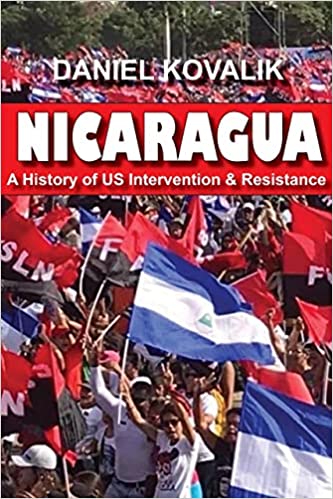
Daniel Kovalik, Nicaragua, a History of US Intervention & Resistance, (Clarity Press, Atlanta, 2023), ISBN; 978-1-949762-64-8, www.claritypress.com, 303 pages.


Prime minister of Saint Vincent and the Grenadines Ralph Gonsalves, speaking in Nicaragua in 2022, points out that the United States “is 350 million people [and is] the strongest military force in the world. Nicaragua is 6.2 million people, a country in Central America seeking to develop itself and its people.”

And so, “Why in God’s name, with a country so large, with so many resources, with such military strength, why would [the U.S.] want to pick on a small country like Nicaragua? I ask myself that question every day.”

Clarity Press, 2023
9781949762600

Peace activist and Vietnam War veteran S. Brian Willson, speaking in South Paris, Maine, on September 13, 1998, had answered the question: “This neoliberal economics, the latest stage of capitalism, does not allow for alternative political or economic ideas or values. We already knew that any country that seriously threatened our model either had to assimilate or be eliminated.”

Willson had acted. On September 1, 1987 in Oakland, California, he put himself in front of a train to prevent a weapons delivery to U.S.- backed “Contra” mercenaries fighting revolutionaries in Nicaragua. The train did not stop and Willson lost two legs.

Daniel Kovalik’s valuable new book “Nicaragua, A History of US Intervention & Resistance” demonstrates the truth of Willson’s insight. Kovalik is a labor lawyer, human rights activist and teacher, and prolific author (his other books are here).

In that summer of 1987, college student Kovalik was part of a reforestation project in Nicaragua. The Contra war was in progress, and he heard machine gun fire “nearly every night.” The suffering was “simply shocking.”  He writes that photos he took of children there “makes me want to cry.” The “Veterans Peace Convey” of humanitarian aid to Nicaragua, which he joined in 1988, was “possibly the most profound experience of my life.” Kovalik’s book is immensely appealing, not least because of personal experience that he relates.

He makes effective use of extended quotations from various reports, other histories, analyses from international agencies, and commentary from participants. Kovalik states that the object with his book was to present “the realities of U.S. intervention [in Nicaragua,] past and present,” highlight Nicaraguans’ abilities to overcome U.S. “assaults,” and promote solidarity with Nicaraguans in their struggle for self-determination.

The book’s first sections review Nicaragua’s history prior to the Sandinista National Liberation Front’s (FSLN) accession to power. It covers Tennessean William Walker’s attempt to set up his own slavocracy in 1855, U.S. Marines’ occupation of Nicaragua from 1912 to 1933, U.S. formation of Nicaragua’s oppressive National Guard, and U.S. support after 1936 for the brutal Somoza-family dictatorship. 

Kovalik reports on Augusto Cesar Sandino’s guerrilla army that fought the Marines from 1927 until their departure. He writes about the struggle of the FSLN rural insurgency after 1960 to bring down the Somoza regime. Over 50,000 Nicaraguans died in the year preceding its collapse on July 17, 1979.

Most of the book is about the FSLN in power, their electoral defeat in 1990, the U.S.-led Contra counter-revolution in the 1980s, the “Dark Days” of neoliberal rule after 1990, and the Sandinistas in power again after 2007. There are these points:

·        Until recently, the Sandinistas, originally an alliance of three factions, governed with allies including Catholic Church representatives, business leaders, capitalists, Marxists, and rural collectives.

·        Women’s lives have improved in equality, political participation, and leadership opportunities.

·        Sandinista approval ratings have remained high, even in stressful times, for example, 80% in 2018 prior to the protests of that year and up to 90% before the 2021 elections.

·        Dissent within FSLN ranks and FSLN differences with its opposition have reflected divisions between city and countryside and between intellectual callings and manual work.

·        The Catholic Church, now far removed from liberation theology, has consistently harassed the Sandinistas.

·        Kovalik inveighs against U.S. leftists who have abandoned the Sandinistas. They “claim to know better about the nature of Daniel Ortega and the FSLN than the Nicaraguan people,” he points out.

·        Sandinistas in power have accomplished much: nutritional gains, agrarian reform, food sovereignty, housing access, widespread electrification, increased literacy, more jobs, youth programs, universal access to schools and healthcare, infrastructure improvements, and lowered mortality rates.

Until 2020 or so, far fewer Nicaraguans were migrating north than were the peoples of other Central American countries. Their reduced numbers testify to the benefits of change in Nicaragua.

Kovalik finishes his book with a look at the interplay of recent anti-government protests, harsh penalties exacted by the government, and mounting criticism of the FSLN government by sectors of the U.S. and European left.

Anti-government protests with street actions and barricades prevailed in mid-2018. In his afterword that concludes Kovalik’s book, Orlando Zelaya Olivas indicates that 198 civilians and 22 police officers were murdered. Mainstream news reports uniformly blamed the police for killing peaceful demonstrators. The truth was otherwise.

Kovalik, citing sources, shows that the protesters had been paid and prepared, that many had criminal records, that snipers rather than the police did most of the killing, and that lethal violence continued even after the police were withdrawn. These were fake protests programmed toward destabilization and eventually a coup.

Kovalik shows the U.S. hand in creating turmoil. The U.S. government had funded opposition NGOs, youth groups, religious organizations, and dissidents who included former Sandinistas. U.S. agents and funding were behind the anti-government messaging on social media that played a prominent role. 

Nicaragua’s government arrested and jailed many of those who in 2018 had violated laws against terrorist activities and against unauthorized service to a foreign government. In June 2019, the government amnestied hundreds of those caught up in the coup attempt. Dozens of jailed coup plotters were released on promising that they would no longer conspire against the government.

Criticism exploded again in 2021 after those who had promised to give up on plotting were imprisoned again on grounds that they were aiming to destabilize upcoming elections. Kovalik states that, “the first duty of a Revolution is to defend itself, for if it cannot meet this most essential goal, it obviously cannot serve and defend the people as they deserve.”

There was the added element of the imprisonments supposedly constituting interference in the elections of November 7, 2021 that gave Daniel Ortega a fourth consecutive presidential term.

Writing from Nicaragua, Stephen Sefton explains that the jailed opposition leaders were not opposition candidates. The political opposition in 2011 had split into regular political parties and “an extra-parliamentary opposition based in local NGOs.” The latter sector had “mounted the violent, US designed coup attempt” of 2018 and were arrested according to Nicaraguan Law. The opposition’s contending political parties had no part in planning a coup in 2021, according to Sefton

After Daniel Kovalik’s book was published, solidarity with the Sandinistas took a big hit. On February 9, 2023, the government released 222 prisoners, mostly those who had been arrested in 2021. It expelled all but a few to the United States. The government took away their citizenship and that of a 100 or so others, and confiscated their properties. Criticism has resounded, for example, from the Economist magazine, the United Nations, to the left-leaning Colombian government.

Taking away someone’s citizenship surely is an extraordinary step, certainly in the United States, and only slightly less so in the U.K. The grounds would be treason. A rationale for such a judgment emerges out of Kovalik’s book.

One imagines a favored few in Nicaragua who are oblivious to decades of U.S. military attacks, violence, pay-offs, trickery and manipulations. They spurned the government’s long efforts at collaboration and coalition building. One equally imagines the grief attending decades of popular resistance against the U.S.-backed dictatorship and, afterwards, the U.S.-backed opposition.

What’s left is desperation, especially what with population elements who reject the idea of justice and dignity for all Nicaraguans and who once more are shown to be dependent on the U.S. government. Meanwhile, U.S. economic sanctions are non-stop.

The book’s basic point is that rescue and recovery of oppressed, marginalized, and poor Nicaraguans have required a very long process. It’s no wonder that some counterparts today of Tom Paine’s “summer soldier and the sunshine patriot” have dropped out.


W.T. Whitney Jr. is a political journalist whose focus is on Latin America, health care, and anti-racism. A Cuba solidarity activist, he formerly worked as a pediatrician, lives in rural Maine. W.T. Whitney Jr. es un periodista político cuyo enfoque está en América Latina, la atención médica y el antirracismo. Activista solidario con Cuba, anteriormente trabajó como pediatra, vive en la zona rural de Maine.

Indigenous rebellion continues as post-coup Peruvian government flounders / By William T. Whitney Jr.

Anti-government protesters chant slogans against Peru’s President Dina Boluarte, on the shore of lake Titicaca in Puno, Peru, Tuesday, March 7. | Juan Karita / AP


Revived democratic struggle in Peru is well along into a second act. There was the parliamentary coup on Dec. 7 that removed democratically-elected President Pedro Castillo and the “First Taking of Lima” in mid-January, when embittered and excluded Peruvians occupied Lima and faced violent repression. Then, on March 1, protests renewed as the Indigenous inhabitants of Peru’s extreme southern regions prepared once more to demonstrate in Lima and would shortly be protesting in their own regions.

The resistance’s make-up was fully on display.

Protesters throughout Peru were rejecting a replacement president and an elite-dominated congress and calling for early elections and a new constitution. They belonged for the most part belonged to Aymara communities in districts south of Lima extending from Lake Titicaca both west and northeast, into the Andes region.

Their complaints centered on wealth inequities, rule by a Lima-based elite, inadequate means for decent lives, and non-recognition of their cultural autonomy. Their support and that of other rural Peruvians had brought about the surprise election to Peru’s presidency in 2021 of the inexperienced Pedro Castillo. He had defeated Keiko Fujimori, daughter of a now imprisoned dictator and favorite of Peru’s neo-liberal enablers.

By March 1, residents of provinces close to the city of Puno were arriving in Lima to carry out the so-called “Second Wave of the Taking of Lima.” Demanding the de facto President Dina Boluarte resign, as of March 4 protesters had not been able to break through police lines surrounding key government buildings. The main action, however, was going on in the epicenter of police and military repression ever since Boluarte had taken office on Dec. 7.

That would be the Puno area, where most of the 60 deaths caused by violent repression have occurred, with 19 protesters having been killed on Jan. 9 in Juliaca, a town 27 miles north of Puno city.

On March 5, violence was again playing out in Juli, a town 58 miles south of Puno, also on the shore of Lake Titicaca. Demonstrations along with roadblocks were in progress throughout the extended region, all in sympathy with the concurrent protests in Lima. Involved were Indigenous groups, small farmer organizations, and social movements.

In July, the demonstrators, confronted by military units and police in civilian dress, set fire to judicial office buildings and the police headquarters. The troops fired, shots came from open windows, and tear gas was released from a helicopter; 18 demonstrators were wounded.

Demonstrators blocking a bridge over a river prevented the entry of troops into the nearby town of Llave. Rains had caused flooding and in the process of swimming across the river, one of them drowned and five others disappeared.

Protesters captured 12 soldiers; community leader Nilo Colque indicated they were released after they admitted to trying to break the “strikes” but that they too opposed the military’s actions. Colque predicted that soon 30,000 Aymaras would be descending on Juli and nearby population centers.

Aymara activists in Llave announced a strike of indefinite duration. A “committee of struggle” in Cusco announced the beginning as of March 7 of an indefinite strike in 10 provinces. The president of the national “Rondas Campesinas” (peasant patrols), said to represent two million Peruvians in all, announced a big march on Lima from all regions set for March 13.

Meanwhile, Peru’s chief prosecutor has embarked upon an investigation of President Boluarte and other officials for crimes of “genocide, homicide resulting from circumstances, and causing serious injury,” that allegedly took place mostly in southern regions in the weeks immediately after her taking office.

There are these other developments:

  • Peru’s Supreme Court on March 3 heard proposal that the “preventive imprisonment of ex-President Castillo be extended from 18 to 36 months. Another court had previously denied his appeal for habeas corpus.
  • The Congress as of March 6looked to be on the verge of, for the fourth time, refusing to advance new presidential elections from April 2024 to sometime in 2013.
  • The UN High Commissioner for Human Rights has released a preliminary report accusing the new Peruvian government of excessive use of force against protesters.
  • Polling results currently go one way: 77% of Peruvians reject the Dina Boluarte government, 70% say she should resign, 90% denounce Peru’s Congress. 69% favor moving general elections ahead to 2023, and 58% support the demonstrations. Most of those making up these majorities live in rural areas, according to the report.

The opposing sides in the Peruvian conflict are stalemated. Powerbrokers presently lack a government capable—willing though it may be—of providing structure and organization adequate for protecting their political and economic interests.

Marginalized Peruvians are without any effective historical experience from which revolutionary leadership and strategies might have developed, such that now they might have direction and focus. The people’s movement there is not as lucky as its counterparts were in Cuba, Venezuela, and Nicaragua.

Now, the U.S. government meddles with this state of precarious balance in Peru. And not surprisingly: it has long intruded militarily and is competing with China economically.

Speaking on March 1, State Department Ned Price did insist that in Peru, “our diplomats do not take sides in political disputes … They recognize that these are sovereign decisions.” He added that the United States backs “Peru’s constitution and Peru’s constitutional processes.”

But political intervention was on the agenda already. Assistant Secretary of State Brian Nichols on February 28 urged Peru’s Congress to expedite early elections and Peru’s president to promptly end the crisis caused by ex-President Castillo’s “self-coup”—whatever that was.


People’s World has an enormous challenge ahead of it—to raise $200,000 from readers and supporters in 2023, including $125,000 during the Fund Drive, which runs Feb. 1 to May 1.

Please donate to help People’s World reach our $200,000 goal. We appreciate whatever you can donate: $5, $10, $25, $50, $100, or more.


W.T. Whitney Jr. is a political journalist whose focus is on Latin America, health care, and anti-racism. A Cuba solidarity activist, he formerly worked as a pediatrician, lives in rural Maine. W.T. Whitney Jr. es un periodista político cuyo enfoque está en América Latina, la atención médica y el antirracismo. Activista solidario con Cuba, anteriormente trabajó como pediatra, vive en la zona rural de Maine.

People’s World, March 9, 2023

Petro wins first-round victory against right wing in Colombian presidential vote / by William T. Whitney, Jr.

Presidential candidate Gustavo Petro, left, and his running mate Francia Marquez, with the Historical Pact coalition, stand before supporters on election night in Bogota, Colombia, Sunday, May 29, 2022. Their ticket will advance to a runoff contest in June after none of the six candidates in Sunday’s first round got half the vote. | Fernando Vergara / AP

During 212 years of Colombia’s national independence, the propertied and wealthy classes, with military backing, have held the reins of power. Gustavo Petro and Francia Marquez, presidential and vice-presidential candidates of the Historical Pact coalition, scored a first-round victory in elections held on May 29. They are forerunners of a new kind of government for Colombia.

If they prevail in second-round voting on June 19, they will head Colombia’s first ever people-centered government. Petro’s opponent will be the May 29 runner-up Rodolfo Hernández.

The tallies were: Petro, 40.3 percent (8.333.338 votes); Hernández, 28.1 percent (5.815.377 votes); Federico Gutiérrez, 23.9 percent (4.939.579 votes). Other candidates shared the remaining votes. The voter participation rate was 54 percent, standard for Colombia.

Petro’s rightwing electoral opponents represented varying degrees of attachment to the extremist ex-President Alvaro Uribe (2002-2010) and his protegee, current President Ivan Duque, who was not a candidate.

Oscar Zuluaga, the early standard-bearer for the Uribe cause ended his non-prospering campaign in March in favor of Federico Gutiérrez and his “Team for Colombia” party. Opinion polls showed Gutiérrez losing ground while, coincidentally, the candidacy of the conservative Hernández was gaining support. 

Petro, 62 years old, was a leader of the radical April 19 Movement, mayor of Bogota, twice a presidential candidate, and has been a senator. As such, he led in calling to account ex- President Uribe for political corruption and ties with paramilitaries.  He defines his politics as “not based on building socialism, but on building democracy and peace, period.”

Vice-presidential candidate Francia Márquez projects what looks, from this vantage point, to be star-power. She is a 40-year-old African-descended lawyer and award-winning environmentalist who, from her rural base, organized against plunder of natural resources. As a presidential candidate in the primary elections in March, she gained 780,000 votes from Historical Pact electors – third place within that coalition. Her candidacy reflects a merger of sorts between social-movement and political-party kinds of activism.

Candidate Rodolfo Hernández is a special case. Analyst Horacio Duque claims that, “The Gringos’ Embassy and the [Colombian] ultraright are moving to catapult” this former mayor of Bucaramanga “onto a platform for existential salvation … by forcing a way toward a second round.”  The wealthy real estate profiteer and mega landlord for low-income renters faces bribery charges relating to a “brokerage contract” and trash disposal. With a slogan of “no lying, no stealing, and no treason,” Hernández is a self-described enemy of the “traditional clans.” He is a devotee of social media.

The Historical Pact campaign benefited from circumstances. The failings of 2016 Peace Agreement with the FARC insurgency are clear, namely: persisting violence, no agrarian reform, and continuing drug war in the countryside. Blame falls upon Uribe’s machinations and the Duque government.

The campaign follows two years of demonstrations that, led by young people, were violently repressed by the police. Protesters called for full access to healthcare and education, pension reforms and new labor legislation. They set an agenda for change.

Death threats greeting Petro and Francia Márquez on the campaign trail forced them to cancel some events and deliver speeches from behind protective shields. Earlier popular mobilizations had also triggered ugly reactions.   

Rodolfo Hernandez, presidential candidate of the right. | Mauricio Pinzon / AP

Commentators recalled the assassinations of four leftist or liberal presidential candidates between 1987 and 1990 and the murder of prospective presidential candidate Jorge Eliécer Gaitán on April 9, 1948. Petro and Gaitan are the only progressively-oriented political figures in Colombia’s history to have had realistic hopes for becoming president.

For a few days in early May the “Clan del Golfo” paramilitary group reacted to its leader’s extradition to the United States on drug-trafficking charges; paramilitaries “stole, threatened, killed, and burned trucks and taxis” throughout northern Colombia. They coordinated their mayhem with the police and soldiers, and “the Duque government didn’t move a finger to contain them.” Reasserting their role as enforcers and destabilizers, the paramilitaries disrupted the Historical Pact’s campaign.

Petro and Márquez promised much. They would to improve food security, education, healthcare, pensions and reverse the privatization of human services. Petro would rein in extractive industries, cut back on fossil-fuel use, and renegotiate free trade agreements. He called for land for small farmers, peace with insurgent National Liberation Army, and for restraining the paramilitaries. He promised to respect Venezuela’s sovereignty.

Colombia’s military is displeased about a prospective Petro government. In April, Petro criticized military commanders’ close ties with paramilitary bosses. In a revealing response that violated constitutional norms, General Eduardo Zapateiro accused Petro of harassing the military for political reasons and of having taken illegal campaign funds.

An interventionist U.S. government is uneasy about a change-oriented government in Colombia. U.S. General Laura Richardson, head of the U.S. Southern Command, met with Colombian General Luis Navarro in March. She sought assurance that a Petro victory would not lead to the dismantling of seven U.S. Air Force bases in Colombia. Navarro indicated military leaders and most congresspersons would oppose such a step. The Southern Command issued a press release confirming that “Colombia is a staunch security partner.”  

U.S. Ambassador Phillip Goldberg’s comment on electoral fraud, delivered to an interviewer in mid-May, had destabilizing potential. He mentioned the “real risk posed by the eventual interference in the elections by the Russians, Venezuelans, or Cubans.” Goldberg’s excessive zeal for U.S. interests had been on display in Bolivia. As ambassador there in 2008, he immersed himself in an unsuccessful coup attempt against President Evo Morales – and was expelled.  

 The U.S. impulse to determine who governs in Colombia was on display on May 13 with a debate involving Colombian vice-presidential candidates. It was staged in Washington, not in Colombia. The congressionally-funded U.S. Institute of Peace session hosted the session. The appearance was that of a junior partner auditioning, as in seeking approval from a boss.

Commenting on his victory, Petro remarked that “forces allied to Duque have been defeated … The message to the world is that an era is finished.” Reaching out to “fearful businesspersons,” he proposed that “social justice and economic stability are good for productivity.”

The Historical Pact faces an uphill battle as it approaches the voting on June 19. According to an observer, opposition candidate Rodolfo Hernández will inherit the institutional and personnel resources the Duque government dedicated to the Federico Gutiérrez campaign. First – round voters for the several rightwing candidates will now turn to Hernández. The Historical Pact will have to engage with Colombians who did not vote on May 29.


W.T. Whitney Jr. is a political journalist whose focus is on Latin America, health care, and anti-racism. A Cuba solidarity activist, he formerly worked as a pediatrician, lives in rural Maine. W.T. Whitney Jr. es un periodista político cuyo enfoque está en América Latina, la atención médica y el antirracismo. Activista solidario con Cuba, anteriormente trabajó como pediatra, vive en la zona rural de Maine.

People’s World, May 31, 2022, https://www.peoplesworld.org/