
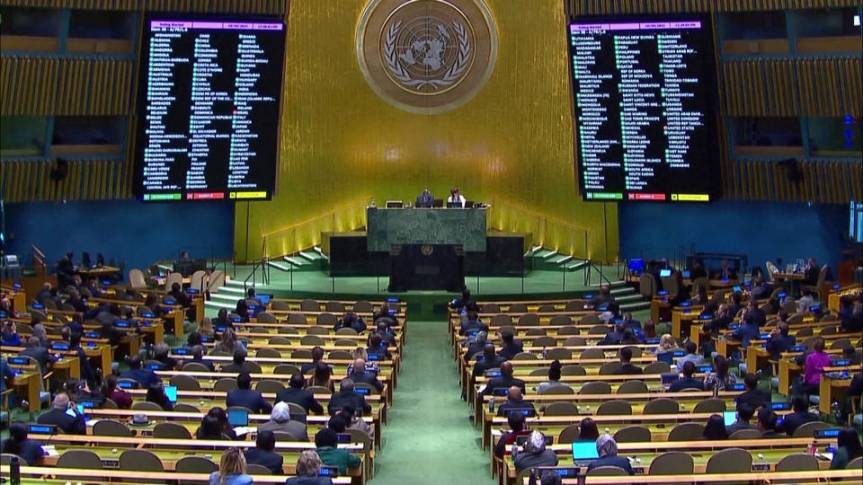
The United Nations General Assembly has voted to condemn the United States’ embargo on Cuba for the 32nd consecutive year. On Wednesday, 187 countries voted in favor of lifting the decades-old sanctions; only the U.S. and Israel voted against the nonbinding resolution | via Democracy Now!
South Paris, Maine
By a 187-nation majority, The United Nations General Assembly on October 30 voted to approve a Cuba Resolution calling for the “Necessity of ending the economic, commercial and financial embargo imposed by the United States of America against Cuba.” The United States and Israel voted no; Moldova abstained.
The same motion has been approved overwhelmingly every year since 1991. No vote took place in 2020 because of the Covid-19 pandemic. For over 20 years, only Israel and the United States have voted down the Resolution; annually one or more states have abstained.
In remarks to the Assembly’s delegates, Cuban Foreign minister Bruno Rodríguez explained that the U.S. economic blockade restricts Cuba’s importation of goods and access to international financial resources, also that shortages hurt every aspect of Cubans’ lives. Cuba’s foreign ministry on September 12 issued a comprehensive summary of adverse effects of the blockade.” Appearing here, it supplements this report.
The UN vote this year has special significance. It took place immediately following both Hurricane Oscar, which devastated eastern Cuba, and an island-wide electrical outage lasting several days. Its cause was lack of oil for generating electricity, restrictions on the shipping of petroleum products, and limited access to international financing, all owing to the blockade.
Now is an extraordinarily difficult time for Cubans and their government. Basic supplies and materials needed for day-to-day functioning are not readily available. Money is short and inflation mounts. The twin culprits are a fall-off in tourism, Cuba’s main source of foreign currency, and U.S. designation of Cuba as a state sponsor of terrorism. The latter entails regulations that persuade international financial institutions and corporations to steer clear of Cuba.
Every year in preparation for its vote on the Resolution, the General Assembly arranges for two days of discussion of the Resolution’s pros and cons. Perhaps reflecting extra stresses weighing on Cuba, commentary during this year’s discussion period came from an unprecedently large group of delegates.
In brief interventions, 59 of them offered reasons why the Resolution should pass; almost 30 international organizations or alliances did likewise. These included the Group of 77 and China, the Association of Southeast Asian Nations (ASEAN), the Community of Latin American and Caribbean States (CELAC), the Organization of Islamic Cooperation (OIC), the Non-Aligned Movement (NAM), and the Caribbean Community (CARICOM).
The speakers made frequent reference to the SSOT designation and to Title III of the U.S. Helms-Burton law (which discourages foreign investment in Cuba). Many of them variously denounced the blockade as violating international law and Cubans’ human rights, for inhibiting Cuba’s development, and for sticking around as a Cold War left-over. Several delegates extolled South-to-South cooperation and multipolarity. Others offered thanks for Cuba’s assistance during the Covid-19 pandemic
Meanwhile, U.S. activists and organizations, rallying against the blockade and in defense of Cuba, joined in vigorous demonstrations taking place in Washington DC, New York, Los Angeles, Chicago and elsewhere.
The International US-Cuba Normalization Coalition Committee on October 27-28 again staged its annual “24 Hour Global Picket” to accompany the UN vote. The effort made for a continuous presentation of commentary, advocacy, video presentations, and music from 61 countries. Hats off to Vancouver-based activists Tamara Hansen and Alison Brodine, and others, for devising a remarkable phenomenon.
One oddity of the discussion on the Cuban Resolution was the contrast between multiples viewpoints offered by nations of the Global South and silence from their northern counterparts, specifically Japan, Canada and all European nations, save Hungary. (The U.S. representative did speak). The divide may represent dismissal of the proceedings by nations identifying with U.S. interests, or a fundamental cleavage within the community of nations, or both.
A standout anomaly was that of Argentinian foreign minister Diana Mondino having been fired from her job shortly after she voted in favor of the Cuban Resolution. Her boss, extremist rightwing President Javier Milei, was displeased.
After the vote in New York, China’s ambassador in Cuba issued a statement qualifying the result as a “just call from the international community that must be applied immediately and effectively.” He added that, “It’s disappointing and outrageous that the United States voted against the Resolution while refusing to end its sanctions against Cuba and insisting on including Cuba on its list state sponsors of terrorism … [And besides] China and Cuba are good friends, comrades and brothers.”
W.T. Whitney Jr. is a political journalist whose focus is on Latin America, health care, and anti-racism. A Cuba solidarity activist, he formerly worked as a pediatrician, lives in rural Maine. W.T. Whitney Jr. es un periodista político cuyo enfoque está en América Latina, la atención médica y el antirracismo. Activista solidario con Cuba, anteriormente trabajó como pediatra, vive en la zona rural de Maine.
 COMMUNIST PARTY OF MAINE