

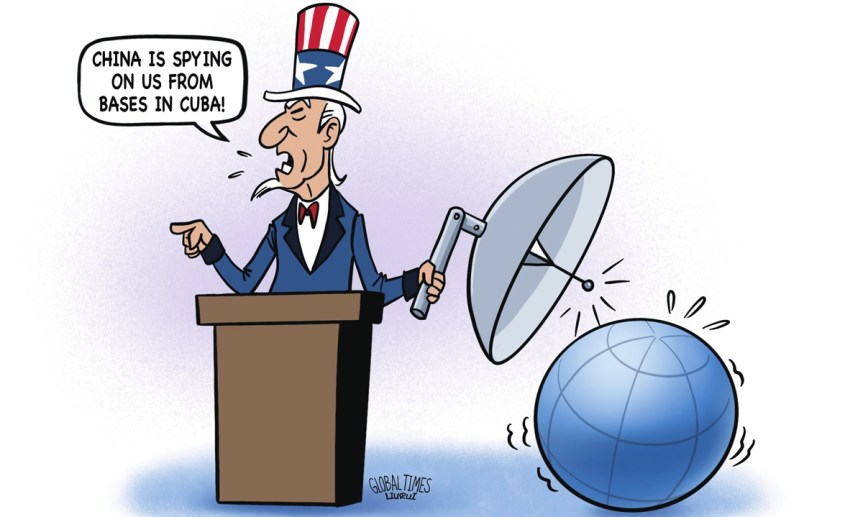
Illustration: Liu Rui/GT
The Wall Street Journal reported on June 8 that Cuba would receive “several billion” dollars in return for China building a “spy base” in Cuba. The story mentions an “electronic eavesdropping” facility that would represent “a brash new geopolitical challenge by Beijing to the US.” Other news platforms offered their own versions of the story.
Chinese, Cuban and U.S. spokespersons took exception to the report, but none of them specifically denied the existence of such an installation on the island. The spokesperson for the U.S. National Security Council indicated merely that the reports were “not accurate.”
Asked about a “Chinese espionage facility” in Cuba, Chinese Foreign Ministry spokesperson Wang Wenbin stated that he “was not aware of what you mentioned.” He quickly moved on to U.S. interventionist activities throughout the world. Cuban Foreign Ministry official Carlos Fernández de Cossío recalled his familiarity with “this kind of slander” having been employed to justify anti-Cuban aggression and to manipulate public opinion.
However, a U.S. Defense Department spokesperson on June 8 declared that, “we are not aware of China and Cuba developing a new type of spy station.” He was introducing the possibility that a spy station already existed.
The New York Times two days later indicated that, indeed, such a facility had been “up and running since or before 2019.” The Associated Press reported the same.
U.S. anti-Cuban counter-revolutionaries pounced, specifically Senate Intelligence Committee Chairman Mark Warner, Vice Chairman Marco Rubio and Senator Bob Menendez, chairperson of the Senate foreign relations committee. Menendez condemned the alleged spying facility as “a direct assault upon the United States.” A constant theme in their complaints was Chinese influence expanding in Latin America.
Florida Congresspersons Debbie Wasserman Schultz and Mario Diaz-Balart sent a letter to Secretary of State Blinken and Defense Secretary Austin. They requested a briefing for Members of Congress. “This escalation,” they insisted, was “the latest step in a long series of Chinese interventions in the Western Hemisphere.” They mentioned an “increasingly symbiotic relationship between Cuba and China.”
Fallout from the report may adversely affect U.S. solidarity efforts on behalf of Cuba. The possibility of Chinese spying on the United States from a base in Cuba, reminiscent of the Cuban Missile crisis of 1962, may end up discouraging any intentions of the Biden administration to deal with anti-Cuban measures in force now. Solidarity activists are demanding an end to the U.S. designation of Cuba as a state sponsor of terrorism and the easing of regulations imposed under the U.S. economic blockade.
The possibility of a spy station in Cuba somewhat darkens the atmosphere ahead of solidarity demonstrations set for Washington and nationwide on June 24.
The timing of the news report on a Chinese spy base in Cuba may have been calculated. Bad news about China can be useful to the U.S. government. The spy-base story represents an opportunity for corroborating supposed Chinese perversity evident recently in fruitless contacts between officials of the two countries.
Exploration of the possibility of arms-control talks apparently yielded very little. Recently the two countries’ defense ministers were unable to agree on meeting on the sidelines of a security conference in Singapore. A proposal for talks on regulating artificial intelligence is going nowhere. And a report surfaced recently on Chinese attempts to gather public information on U.S. military affairs.
Additionally, speculation is flourishing that news about a Chinese spy base in Cuba may irretrievably complicate Secretary of State Andrew Blinken’s plans to visit Beijing on June 18. He had canceled a trip there in February in the wake of the Chinese balloon sailing across North America. Elements of the U.S. government may, in fact, have little enthusiasm for improved U.S. relations with China. They may prefer that Blinken’s visit not take place.
The New York Times reports that “the Biden administration … has been trying to normalize relations with China after a protracted period of heightened tensions.” Even so, “several diplomatic, military and climate engagements between the two countries were frozen” in the wake of Speaker Nancy Pelosi’s visit to Taiwan in 2022.
As reported, the fuss over possible Chinese spying in Cuba looks to be a kind of replay of familiar themes. One is the myth about Cuba as failed state and oppressive society. The other has the United States and China jostling over Taiwan and for regional control. One looks in vain for reporting that deals with those aspects of U.S. relations with Cuba and China that are of immense concern worldwide.
Masses of people everywhere know something, or a lot, about U. S. determination to control the world’s political and economic affairs. Many admire Cuba for resisting for so long. The agenda of media bosses and U.S. powerbrokers is otherwise.
More immediately, peoples of the world don’t want world war. That prospect, associated as it is with nuclear war, hovers over potential U.S. conflict with China. It’s acceptable, surely, to subscribe to the truism that working people everywhere, and multitudes who are abandoned and marginalized, do want peace.
The main message to be taken from the China-spy-base story is that readers of news reports deserve more than they are often getting. Reports they encounter ought, at least, to touch upon those aspects of a story that matter most. Questions of war and peace amply qualify.
W.T. Whitney Jr. is a political journalist whose focus is on Latin America, health care, and anti-racism. A Cuba solidarity activist, he formerly worked as a pediatrician, lives in rural Maine. W.T. Whitney Jr. es un periodista político cuyo enfoque está en América Latina, la atención médica y el antirracismo. Activista solidario con Cuba, anteriormente trabajó como pediatra, vive en la zona rural de Maine.
 COMMUNIST PARTY OF MAINE