Cuba’s President Extolls the Cuban People, Discusses Problems / By W.T. Whitney Jr.

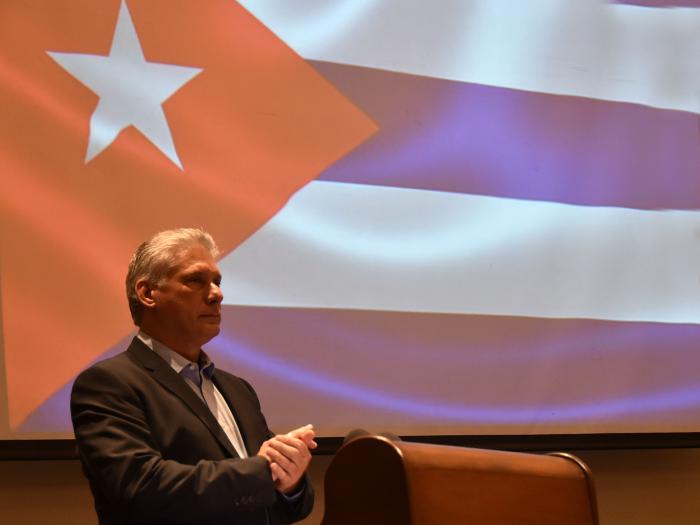
President of the Republic of Cuba, Miguel Díaz-Canel Bermúdez | Photo: Estudios Revolución


Addressing Cuba’s recently-convened National Assembly on April 19, President Miguel Díaz-Canel expressed confidence that the Cuban People would overcome warlike measures imposed by the United States.

“Congratulations to everyone on the Day of Victory!” he proclaimed. “On April 19 in 1961 on the sands of Playa Girón (Girón Beach) Cuba won the right to celebrate this day in providing for the first great defeat of imperialism in America. It was the triumph of the just against the unjust, of little David against the giant Goliath, of a socialist Revolution under the nose of the empire.”

“Thanks to this victory we today, on the tenth such occasion, install the People’s Assembly.” He declared that each of the 470 deputies “defends the interests of the majority,” that none of them won their seat through money or from the backing of an electoral party.

Referring to the Cuban Revolutionary Party founded by José Martíhe extolled “the single party that is the guarantee of unity” and through which, “the forces of a little nation do not disintegrate or fight each other.”

Díaz-Canel catalogued manifestations of U.S. all-but-war: invaders “working out of their caves on social networks,” and the “perennial cruelty of a blockade reinforced during the pandemic,” and “millions of dollars offered to those preparing to subvert Cuba’s internal order,” and “inclusion of Cuba on a list of supposed sponsors of terrorism that blocks access to financing.”

He stated that, “someday, earlier than later, the politics of hegemony will have to cease; multilateralism will take its place, and Cuba will be able to show how far a noble creative and talented people can go if they are united around clear objectives and if they are freed from pressures and blockades.”

Offering praise, Díaz-Canel maintained that “elections to the National Assembly are aimed at choosing the best people. That’s difficult … [because] there are many more good Cubans than there are seats in parliament.”

He expressed “certainty that no simulation of artificial intelligence could match the Cuban people’s achievements in recent years and their creative resistance. Their resilience exceeds the limits of any simulation or prediction. There is no algorithm capable of reflecting what we have lived through.”

Díaz-Canel highlighted the transparency of recent election campaigns, noting that voter participation was ample enough to waylay “hate-inspired” foreign-media expectations of low voter turnout indicative of a failed Cuban state. The recent elections included the Family Code referendum on September 25, 2022, elections for delegates to municipal assemblies on November 27, 2022, and voting for National Assembly deputies on March 27.

The Cuban president noted that the 75.8% of Cubans who voted on the last occasion was “above average for the other models of democracy in the world and [represented] “a show of citizenship, … patriotism, and above all, of political consciousness.”

The recently elected National Assembly overwhelmingly approved new terms for the Council of Ministers, the Council of State, and for Díaz-Canel, who will be serving his second and last five-year presidential term, as prescribed by recent constitutional changes.

Díaz-Canel outlined difficulties and unfinished tasks, observing that:

The world economy, uncertain and unstable in all latitudes, poses the first and greatest challenge for the new Council of Ministers … Leadership should focus on food production, the use of idle productive capacities, increased reliance on foreign-currency income, transformations required by the socialist state enterprise, enhanced efficiency of the investment process, and synergy of our economic actions and foreign investment. We do all this to increase the supply of goods and services and control inflation, which is the main priority in the economic battle. 

Even as he acknowledged “obstacles external to our economy that present profound difficulties,” the President “condemned bureaucratism, indifference, and corruption” in Cuba. He expressed confidence in the deputies’ “commitment and dedication,” while insisting that, “we will overcome the blockade without waiting for them to lift it.”

Díaz-Canel extolled Cuban youth “as the best revolutionaries because, dealing with every-day difficulties, they confront, try to fix, and achieve much. Despite adversity, they keep on smiling, loving, and believing in the possibility of a better country.” In fact, “socialism is closest to youth because it too is unfinished work.”

A persisting undertone of Díaz-Canel’s presentation was that of values, particularly those of solidarity and revolutionary service. Coinciding with the April 20 presentation of Díaz-Canel’s speech on resumenlatinoamericano.org were two news reports that exhibited diverse Cuban and U.S. purposes as regards Ukraine and expressed values.

report from Argentina announced a public television showing on April 23 of the Cuban film “Sacha, a child of Chernobyl,” first viewed in 2021. Living in Ukraine, Sacha was one year old and living in Ukraine on April 28, 1986 when the Chernobyl nuclear power installation exploded and radioactivity and radiation-caused diseases spread far and wide.

Sacha, un niño de Chernobyl, película completa

He was one of 26,000 children in Ukraine, Belarus, and Russia who received sophisticated medical care and rehabilitation in Cuba for their illnesses between 1990 and 2011, at no cost to families or governments. In the 1990s, Cuba was suffering the economic disaster of its “Special Period.” The film may be viewed here; Spanish language subtitles are provided.

Also on that day, a report appeared indicating that “The United States announced … the sending of another package of military aid worth $325 million for the fight against Russian forces. The U.S. Defense Department highlighted through a communique that this aid ‘will allow Ukraine to continue bravely defending itself in a brutal war against Russia, unprovoked and unjustified.’”

During another April, 200 years ago, an early warning sign cropped of a reality that would from then on plague Cuba, provoke revolution and bolster counter-revolution.  In his speech, Díaz-Canel recalled that John Quincy Adams, as secretary of state, statedon April 28,1823 that, “if an apple severed by the tempest from its native tree cannot choose but to fall to the ground, Cuba, forcibly disjoined from its own unnatural connection with Spain, and incapable of self-support, can gravitate only to the North American Union.”


W.T. Whitney Jr. is a political journalist whose focus is on Latin America, health care, and anti-racism. A Cuba solidarity activist, he formerly worked as a pediatrician, lives in rural Maine. W.T. Whitney Jr. es un periodista político cuyo enfoque está en América Latina, la atención médica y el antirracismo. Activista solidario con Cuba, anteriormente trabajó como pediatra, vive en la zona rural de Maine.

Cuba Approves New Family Code with Updates on Equality within Family Life / by W. T. Whitney Jr.

Ramon Espinosa / AP

The Cuban people, voting in a national plebiscite on September 25, gave their approval to a new Family Code. According to the National Electoral Council, preliminary results showed that of almost six million Cubans who cast a valid ballot, 66.9% voted Yes; 33.1% voted No. The New Family Code was left-over business from a new Cuban Constitution approved on April 10, 2019.

The new Code promises all Cubans protection of democratic and legal rights within the context of family life, both existing rights and new ones. It represents revision of the Family Code contained in Cuba’s Constitution of 1976. The principal impulse for a new one stemmed from recognition since then, worldwide and in Cuba, that notions of sexual diversity and gender equality were expanding.

The opportunity came in 2018. A Constituent Assembly that year was undertaking extensive alterations of the 1976 Constitution. In the process of devising what became a new Constitution, opposition to certain provisions of a proposed new Family Code cropped up both in the Assembly and in public consultations. On the table had been authorization of same-sex marriages and allowance for gay people to adopt children.

The Assembly determined that the process “should be pursued in more depth.” The new Constitution ended up with a provision for a new Family Code to be created later and then be approved by “attending to the results of a plebiscite” taking place in two years. The Covid-19 pandemic led to that plebiscite’s delay until September 25, 2022.

The Family Code that resulted would protect the right of same- sex marriage and the right of same-sex parents to adopt children. The first article under the title “Marriage” in the final document – there are 301 articles under that heading – states that, “Marriage is the voluntary union agreed to by two legally competent persons with the purpose of living life in common …” Similarly, provisions relating to adoptive parenting refer exclusively to “persons.” The message conveyed is that marriage does not necessarily require a man and woman.

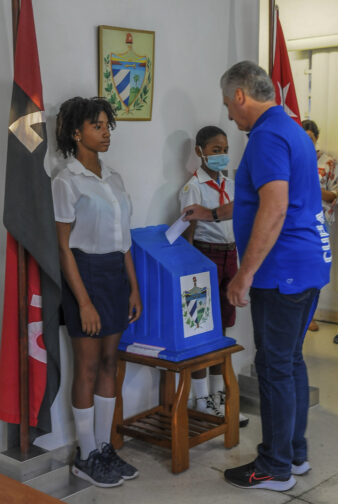
Cuba’s President Miguel Diaz Canel casts his vote at a polling station during the new Family Code referendum in Havana, Cuba, Sunday, Sept. 25, 2022. He encouraged Cubans to vote yes in the lead-up to the poll. | Jose Manuel Correa / Pool photo via AP

The government had carried out vigorous publicity efforts on behalf of the new Code. In nationally televised remarks to the country on September 22, President Miguel Díaz-Canel called upon Cubans “to participate in an action of enormous responsibility.” Catholic clergy and evangelical churches mounted opposition campaigns. The anti-government Havana Times noted that in view of distress in Cuba and sharply increased migration, the Code was just “Bla, Bla, Bla.”

An important point to be emphasized here is that the new Code epitomizes Cuba’s revolutionary zeal as it offers assurance that family life in Cuba will be characterized by equality, democratic rights, and protection. The Code is vast in its reach; it extends to all aspects of family life and establishes principles and values entirely fit for guiding citizens in maintaining family relationships and the state in prescribing for family life.

The Code presented on September 25 was a 63-page document that, on line, displays 11 “titles” representing major categories, dozens of chapters, hundreds of articles, and 2283 paragraphs. Subjects that are covered, all pertaining to family life, include: protection of the rights of children, women, elderly people, persons with disabilities, and members of the LBGTQ communities; arrangement for the handling of property and money; duties and responsibilities, adoption of children and custody arrangements; the special needs and rights of elders and persons with disabilities, and, lastly, aspects of marriage and of parenting and becoming a parent.

The Family Code begins by outlining purposes. Among them are these:

· “To strengthen family members’ mutual responsibilities to assure the emotional and economic well-being of vulnerable family members, and their education and training.

· To establish love, affection, solidarity and responsibility as among the highest of family values.

· To enhance gender equality within the family and strengthen shared responsibly for domestic work and childcare.

· To broaden the range of economic activities within marriage to allow for autonomy of spouses in making decisions favorable to their interests.

· To recognize the right of grandparents, other relatives, and others involved with the children to experience harmonious communications among all family members.”

· To recognize the self-determination, preferences, and equal opportunity for older adults and handicapped persons within the family.

· To respect the right of families to lives that are free of violence and the necessity for preventative measures.”

A statement of principles appears at the beginning of the document: “Relationships that develop in the family setting are based on dignity as the most important value and are governed by the following principals, among them – equality and non-discrimination, plurality, individual and shared responsibility, solidarity, the seeking of happiness …respect, the greater interest of children and adolescents, respect for the desires and preferences of older adults and people with disabilities …”

The far-ranging collection of standards and precepts that are laid out for relationships within all aspects of family life are consistent with the nature of a Cuban society that aims both to follow long-established principles of democracy and equality and to evolve according to new expectations for a just society. As regards the latter, the main impetus for a new Family Code had been mounting agitation for equality between men and women, for women’s empowerment and for arrangements supportive of gender diversity.

This report would emphasize one more important aspect of the new Family Code, specifically the extraordinary process undertaken to fashion the Code. Those who were responsible for creating it and securing its approval did so in a way that makes for the Code’s comprehensiveness and for full participation by the Cuban people in building and evaluating it. The process testifies to the Cuban government’s serious purpose, dedication, competence, and inclination to democracy.

Here is the story of what happened after approval via a plebiscite of that new Cuban Constitution in early 2019. As outlined above, the Constitution provided for the development of a new Family Code over the course of two years. The Ministry of Justice on July 16, 2019 announced the existence of an ad hoc working group that would begin the task. Joining the working group were judiciary, health, and foreign-relations officials, United Nations experts, representatives of the Federation of Cuban Women, the National Center of Sex Education, statisticians, and academicians from the University of Havana.

The working group elaborated one version of a proposed Family Code after another, and finally determined upon version 20. The Council of State on March 22, 2021 announced the creation of an editing commission to be made up of deputies to the National Assembly and representatives of institutions and people’s organizations. On completion of its work, version 22 of the proposed Code appeared on the Ministry of Justice’s web page on September 15, 2021. Expert consultations followed, taking place between September 25 and October 15 and involving representatives of 47 institutions, agencies, and organizations. Changes were made.

Residents attend a popular consultation to discuss the draft of a new Family Code, in Havana, Cuba, Feb. 11, 2022. This past Sunday, Cubans voted to approve the measure, which legalizes same-sex marriage, authorize LGBTQ adoption, expands grandparents’ rights, and allow prenuptial agreements, among other things. | Ramon Espinosa / AP

The National Assembly initiated discussion of version 23 of the Code on December 21, 2021. Once again provisions were altered and new ones added. The Assembly approved version 24 of the Code and submitted it to a popular consultation that took place between February 1 and April 20 of 2022. More than six million Cubans participated in the exercise, the resulted of which being that 49 % of the contents of the proposed Code were changed. In the end, 62 % of Cubans who participated expressed approval of the Code. Finally, version 25 of the Family Code moved on to the National Assembly and its approval came on July 22.

Now the proposal qualified for the September 25 plebiscite. From the beginning to the end of the process, various reviewing bodies and the popular consultation had changed hundreds of the document’s articles and added new ones.

On display had been consistency of purpose, attention to detail, search for perfection, and commitment to objectives of the Code that, together, signify dedication to Cuba’s revolutionary underpinnings. The causes of equal rights, fairness, and safety for all Cubans, no one excluded, evidently have not lost their appeal.

A final observation would be admiration of Cuba’s socialist government and Cuban society for successfully pursuing a project made difficult because of special requirements and meanwhile they are having to cope with a crisis of survival. The latter, of course stems mostly from the U.S. economic blockade that has lasted for over 60 years. Evidently Cubans approach the job of governing with a seriousness entirely lacking in the capitalist United States. There, things are left to chance as wheelers and dealers advance their interests, divisions are cemented, and dark forces have a field day.


W.T. Whitney Jr. is a political journalist whose focus is on Latin America, health care, and anti-racism. A CubaW.T. Whitney Jr. is a political journalist whose focus is on Latin America, health care, and anti-racism. A Cuba solidarity activist, he formerly worked as a pediatrician, lives in rural Maine. W.T. Whitney Jr. es un periodista político cuyo enfoque está en América Latina, la atención médica y el antirracismo. Activista solidario con Cuba, anteriormente trabajó como pediatra, vive en la zona rural de Maine. solidarity activist, he formerly worked as a pediatrician, lives in rural Maine.