
Economic Crisis in Cuba – Leaders’ Solutions Face Big Obstacle / by W. T. Whitney Jr.

Selling agricultural products in a wheelbarrow in Havana. Photo: Otmaro Rodríguez.

South Paris, Maine


The Cuban economy is the worse it’s been since the “Special Period” following the end of the Soviet Union. The country is in the midst of a years-long economic contraction that’s affecting food production and the availability of medicines.

For the first time ever, the government has officially requested aid from the United Nations World Food Program. Inflation, meanwhile, is soaring, and there is massive emigration and power outages roll across the island. And unlike in the days of the socialist bloc, the country has major international allies to provide financial relief.

Cuba’s economy contracted 1.9% in 2023, and it’s infant mortality rate (IMR) – the number of infants dying in their first year of life per 1,000 live births – is inching upward. It was 4.7 in 2013, 5.0 in 2017, 6.2 in 2022, and 7.9 in 2023. The IMR is generally seen as  reflecting a society’s social conditions.
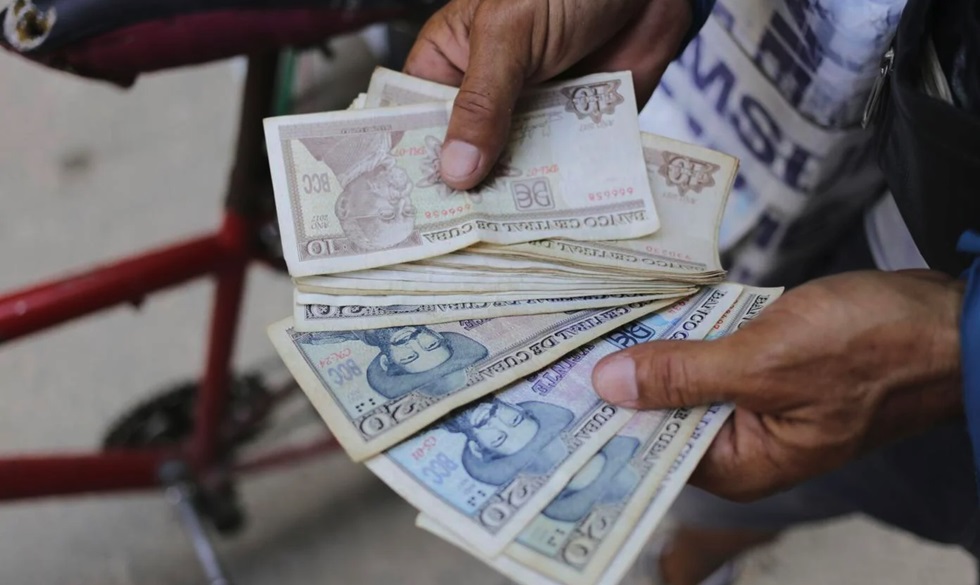
An ice cream street vendor counts his Cuban pesos in Havana, April 20, 2024. | Ariel Ley / AP

The country’s leaders are working overtime to respond to the worsening crisis. Deliberations at a recent meeting of Cuba’s Council of Ministers and a plenary session of the Communist Party’s Central Committee shed light on how government and party officials are reacting and on the resources they have available.

In the Council of Ministers’ meeting, as reported on June 30, President Miguel Díaz-Canel called for a restraining state expenses, limiting pay-outs from the state to the non-state sector, increasing participation of state entities in providing services, and cracking down on tax evasion.

He lauded the “very good experiences of labor collectives…in doing things differently and moving ahead.” He condemned speculation and black marketeering as contributors to inflation.

Prime Minister Manuel Marrero Cruz criticized “bureaucracy and ineffective control of our institutional system that are limiting creative work and promoting undesirable distortions in our society.”  He called for increasing national production and export income, promoting direct foreign investment, capturing remittances for the economy, and identifying sources of financing.

Vice-Minister of Economy and Planning Mildrey Granadillo de la Torre referred to new but unspecified ways of attracting foreign currency; incentivizing national production, especially food products; improving management of non-state entities, and reducing tariffs on importation of raw materials.

She spoke of adjusting the budget to a “war economy” and warned of an expanding deficit. She anticipated “a single, inclusive and equal pricing policy…[on the way] for state and non-state sectors of the economy.”  Vice-Minister of Finances and pPrices Lourdes Rodríguez Ruiz, joined in the assessment, reporting on plans for caps on prices for essential goods sold by non-state enterprises.

The Communist Party Central Committee’s Eighth Plenary Session took place on July 5-6. The agenda, as always, included a rendering of accounts from the Political Bureau and assessment of the implementation of earlier recommendations. The problems of reduced agricultural production, corruption, and crime received special attention.

Social misbehavior

Julio César García Pérez, head of the Justice Ministry’s “Office of Attention,” led a discussion of “crime, corruption, and social illegalities.” He recalled that the party had been called upon at its last congress to take on “strategic leadership” in this area.   As regards “implementation and fulfillment, the results are insufficient,” he reported. Crime rates remain high, with “major incidents of attacks against our patrimony,” often committed by young people and “persons uninvolved in work or study.”

Among the most prevalent crimes: abusive pricing, “illicit commercialization of diverse products,” drug-trafficking, livestock theft, “speculation on goods and services,” hoarding, administrative corruption, tax fraud, marketing of stolen goods, “lack of discipline in public spaces,” damage to public property, and fighting.

Authorities are trying to get a handle on the situation, with García Pérez reporting that “responses on the part of the courts and the attorney general’s office are more rigorous than earlier.”

Having met with party officials at the municipal level, he found that preventative measures were inadequate, however, and follow-up of individual cases lax. Cuba’s attorney general, Yamila Peña Ojeda, assured the Plenary that criminal penalties remain severe while “citizens’ rights and guarantees are respected.”

Comptroller-General Gladys Bejerano Portela, recognizing that “the Party is…working to maintain the soul of the Cuban Revolution,” confessed that she “could not understand why” many party members “are indifferent to deeds of corruption,” adding that “to not fight [corruption] is counterrevolution.”

Food is short 

The Plenary’s discussion of food shortages and low agricultural production focused on implementation of the 2021 Law of Food Sovereignty and Security.

Food and Agriculture Minister José Ramón Monteagudo Ruiz, returning to old themes, called for increasing national food production, reducing food imports, and generating competitive exports. Emphasizing the decisive role to be played by party members, he reported on consultations on agricultural production with mass organizations, provincial governing councils, and municipal assemblies.

Monteagudo Ruiz discussed follow-up of legislation of 2022 that prioritized local food production systems and local self-sufficiency. Party officials have interacted with companies, production units, cooperatives, and markets in 50 municipalities, he said.

The minister observed that the reforms of 2008 which gave individuals and cooperatives long-term use of what now amounts to 31% of all agricultural land have fallen short and not adequately bolstered production.

He attributed production deficits to the worsening economic crisis and adverse effects of the U.S. blockade. Cuban agriculture is being undone, he stated, by shortages of miscellaneous supplies, fuel, spare parts, pesticides, veterinary medications, fertilizers, and raw materials for animal feed.

Agriculture Minister Ydael Pérez Brito lamented that, “Harvests do not even approach 50% of what is needed,” despite various plans having been fulfilled. Consensus prevailed that levels of planting and harvesting are reduced, such that the population’s food requirements are not being met. Proposals re-emerged for enabling companies, organizations, and cooperatives to grow their own food for their own workers and members.

The president speaks

President Díaz-Canel, addressing the plenary, still found reason for optimism:

“If we work in all these areas simultaneously, in a decisive, organized, coherent manner, in a short time we will be managing fundamental issues such as the budget deficit, the excess of circulating cash, tax evasion, abusive prices; We will be managing the proper relations between the state sector and the non-state sector; We will be confronting crime and corruption more decisively…. Doing all this will indirectly and gradually influence changes in the exchange rate and in inflation.”

Aside from just recounting the list of challenges, though, he also elaborated on the job ahead:

I call upon you to correct things on an ongoing basis with determination, effort, and imagination, and to confront those negative tendencies that emerge like weeds in difficult moments. The call now is to go out as combatants, which we know how to do and as we have done so many times before.”

He offered perspective: “Every day that we manage to subdue these great difficulties with tenacity, effort, creativity, talent, and with unity of purpose against the genocidal plan of our historical enemy is a victory.”

He praised the party’s “authentic commitment to the people” and said that party cadres have to lead by example. The Communist Party, the president declared, has “the enormous responsibility of preserving the Revolution… to preserve its conquests and keep on advancing on the path of perfecting society, working tirelessly.”

As regards goals: “The Party and its cadres have the mission to stimulate, inspire, mobilize, and engage with members and the people, aware that an ideal will triumph only as long as it exists for all of us.”

The president said that party members and government leaders had a responsibility to “guarantee a better and greater access to food.” Food production and self-sufficiency, he said, “are tasks of the first order, in which the entire population must participate.”

Díaz-Canel indicated the need to “implement concrete actions” and to ensure that decisions are fulfilled in adherence with a strict timeline.

‘We are here to save the homeland, the Revolution, and socialism,” he insisted. “In six decades, the blockade has not been able to defeat the dignity of the Cuban people nor the immense collective…work of the Revolution. Even as it intensifies now, the blockade will not succeed.”

No money

Words spoken in the meetings were mostly about plans and remedies already in place, about revolutionary values, and virtues of the Cuban people.

In contrast to deliberations of earlier years, the presentations offered no new remedies for fixing Cuba’s economic downturn and shortages. Perhaps something novel will emerge from the commissions and plenary sessions of Cuba’s National Assembly, which started its meeting on July 15.

International solidarity on Cuba’s behalf wasn’t mentioned, and there were indications that divisions disrupting the unity of Cuban society have cropped up. Their extent of and how they may differ from earlier fracturing are unclear.

Shortages, long the central element of ongoing economic crisis in Cuba, featured prominently. The role of the U.S. blockade in causing shortages of specific products from abroad was mentioned, but its importance was downplayed in comparison to past assessments.

Allusions to the fact that the country has essentially no money, and thus no purchasing power on the international market, surfaced in the form of sporadic mention of budget deficits and of non-payment on earlier loans. The basic message was that Cuba’s international credit is nil.

Photograph Source: Susan Ruggles – CC BY 2.0

U.S. power brokers do their bit toward this end. They designate Cuba as a State Sponsor of Terrorism (SSOT). Countries so designated may not benefit from transactions involving U.S. dollars, according to the enabling law. Fearing U.S. penalties, international financial institutions refuse to respond to Cuba’s credit needs.

Any reference to external causation of economic disaster in Cuba, U.S. aggression in particular, broadens the story. Cuba’s leaders, mindful of their revolutionary origins and persistently in search of solutions, and Cuba’s people, their basic unity intact, are not alone in struggle. The reality remains of Cuba’s multifaceted appeal to the wider world. Her people’s aspirations for national independence, socialist revolution, and justice for all working people still call forth strong international support.

The next chapter in the United States turns to continuing and enhanced solidarity activities. These would be humanitarian aid, the never-ending campaign to end the U.S. economic blockade of Cuba, and, crucially, the fight against the SSOT designation. Recently, the U.S. Catholic Bishops called for removing that label. The story will continue.


W.T. Whitney Jr. is a political journalist whose focus is on Latin America, health care, and anti-racism. A Cuba solidarity activist, he formerly worked as a pediatrician, lives in rural Maine. W.T. Whitney Jr. es un periodista político cuyo enfoque está en América Latina, la atención médica y el antirracismo. Activista solidario con Cuba, anteriormente trabajó como pediatra, vive en la zona rural de Maine.

‘Economic asphyxiation’: U.S. restricts food supplies in bid to strangle Cuban revolution / by W.T. Whitney Jr.

A portrait of Argentine born Cuban revolutionary hero Ernesto ‘Che’ Guevara hangs on a shelf at a food store in Havana with some of the few products for sale. | Ramon Espinosa / AP

Reposted from the People’s World


The civilian victims of U.S. war-making in Gaza—the U.S. government supplies the big weapons—are on full display right now, broadcast on television screens and Twitter feeds around the world.

There’s another group on the receiving end of U.S. imperialism whose plight is not being publicized very much at the moment, though, and that’s the resistance of the long-suffering people of Cuba against an unrelenting economic war.

Differences in scale and immediacy of course distinguish the assault they face due from the U.S. blockade and the bombardment and constant death being visited upon the Palestinians by Washington’s Israeli ally, but for the island nation to our south, the supply of food and other necessities is becoming ever more precarious by the day.

And despite the differences in the war against Palestinians and the economic war against Cubans, there is a common principle that governs in both instances: Subjecting non-combatant populations to potentially lethal danger, under conditions of war, is criminal. That’s reason enough to force an end to the U.S. economic blockade of Cuba.

The blockade promotes food shortages and is putting more and more lives at risk. The U.S. public needs to know about, understand, and reject this blockade, its operation, and its impact. Letting people in the U.S. know the full details of what’s being done in their name is, of course, no small task. The blockade proceeds automatically and quietly; the human suffering it causes is largely hidden.

Economic embargos are a form of war and the people whose government is dishing out such a strategy is often unaware of what’s happening, writes commentator Nicholas Mulder: “Voters in the sanction-imposing country are unlikely to observe or understand the full costs of sanctions on ordinary people abroad.”

Not by accident

The blockade promotes food shortages, and that’s its intention. New Jersey Congressman Robert Torricelli introduced the Cuban Democracy Act in 1992 in the wake of the Soviet Bloc’s collapse. Cuba had just lost 80% of its trade and was vulnerable, which provided what the U.S. government saw as a chance to finish off Cuba’s Revolution.

The law prohibits those exporters abroad who are affiliated with U.S. companies from shipping food and other goods to Cuba under threat of penalties and fines. Torricelli explained the rationale, saying you mus “keep your foot on the snake, don’t let up.”

Companies around the globe had previously been exporting almost $500 million worth of food to Cuba annually, but Torricelli’s law put a stop to that. The legislation, which is still in effect, prohibits ships from entering U.S. harbors for six months after they visit a Cuban port.

The effect has been to raise shipping prices for Cuba and severely limit the number of international companies willing to risk their access to the giant U.S. market in order to sell to a much smaller customer like Cuba.

U.S legislation in 2000, provided some small relief, authorizing exports of U.S. farm products to Cuba. Payments are in cash only—no loans. Shipping costs remain high, though, because the food products must be carried in U.S. ships, and they return empty. Cuba has to pay for a two-way trip to get only one boatload of goods. U.S. food exports to Cuba peaked in 2008 and have fallen since.

The U.S. blockade also restricts financial services provided by international banks and lenders. Under U.S. pressure, they don’t lend money to Cuba and can’t handle U.S. dollars in transactions involving Cuba. The legislation that authorized U.S. presidents to designate other nations as sponsors of terrorism incorporated these prohibitions, along with penalties.

Cuba, as an alleged—falsely so—terrorist-sponsoring nation, lacks the credit and often the cash to pay for food imports and to develop the island’s own domestic agricultural potential. Cuba must spend $4 billion annually to import 80% of the food it consumes.

The U.S. blockade causes other shortages that also hobble food production. Fuel shortages impede the transport of goods and the operation of machinery. Fertilizer, herbicides, pesticides, seeds, spare parts, new equipment, veterinary supplies, irrigation equipment, new breeding stock, and grains used to make animal feed are all constantly in short supply. U.S. limitations on the remittances Cuban-Americans send to their families in Cuba further interfere with food purchases and spending on agricultural projects.

A comparison of agricultural production in Cuba and in the Dominican Republic suggests food shortages are due mostly to the U.S. blockade. The two are neighbors with essentially identical climates. The total of food produced in the unblockaded DR in 2021 exceeded Cuba’s “best historical average” yield by 35.7%, even though agricultural acreage in the Dominican Republic is only 25% of Cuba’s total.

Some difficulties affecting agricultural production result from non-blockade causes, to be sure: mounting inflation, domestic corruption, theft, currency speculation, and shortages of foreign currency due to reduced tourism during the COVID-19 pandemic and subsequently. Higher food prices generally around the globe recently and climate-change effects are also phenomena bearing on food availability in Cuba.

Policy failures also factor into the equation, as Cuba’s government has fallen short in converting the island’s many idle fields into productive farm land. And relatively few Cuban young people are attracted to farming; only 15% of Cubans live in the countryside.

Empty shelves

Agricultural minister Ydael Jesús Pérez Brito, interviewed recently, noted that the agriculture sector has secured only 40% of the diesel fuel it needs, 4% of required fertilizers, and 20% of feed needed for livestock.

He reported that pork production fell from almost 200,000 tons in 2017 to 16,500 tons in 2022, due in part to only 14% of necessary fuel being available. Rice farmers are producing 10% of recently achieved levels of production. Current production of beans and corn amounts to 9% and 30%, respectively, of yields in 2016.

Manuel Sobrino Martínez, the food industry minister, indicated last month that food processing generally and milk processing in particular is down over three years to 50% of capacity. He described a 46% drop over one year of milk received for processing to powdered milk, and reported that a ton of milk costs $4,508 now, up from $3,150 in 2019.

The availability of cooking oil is down 44% in a year; its cost is up from $880 per ton in 2019 to $1,606 now. Wheat processing is at half capacity. Fishing activity has fallen by 23% since 2022; 60 boats are not operating because motors are expensive and suppliers refuse to sell, or demand hard currency up-front. The minister said he must choose between “powdered milk, or wheat, or motors.”

The essence, according to an observer, is that, “owing to low agricultural yields, total food production in 2022 fell to 26% [of food produced] in 2019.”

Cuban President Miguel Díaz-Canel told a reporter recently that, “They have put us in a situation of maximum pressure, of economic asphyxiation to provoke the collapse of the Revolution, to fracture the unity between the leadership and the people, to obliterate the work of the Revolution.”

Production is low, he pointed out, and “the country’s fundamental problem is low availability of foreign currency.” Díaz-Canel said the government would “take advantage of the possibilities we have as a socialist state to plan and distribute available resources to prioritize the production that … could give us more possibilities, and also to protect people who may be in a situation of social disadvantage.”

Grim reality, of which food insufficiency is one aspect, demonstrates that now is the time for action and messaging strong enough to finally end the U.S. blockade. Suffering and distress at U.S. hands should provoke revulsion, just as does U.S. complicity with attacks on hospitals in Gaza, and killings of non-combatants.

A key element of Cubans’ distress is lack of currency and credit. President Joe Biden has only to remove Cuba from the U.S. list of terrorist-sponsoring nations to provide immediate humanitarian relief and restore Cuba’s government some room to maneuver the food crisis. An easing of current living conditions would surely result in fewer Cuban migrants heading to the United States, too.

For the U.S. government to be at peace with Cuba would hardly violate baseline presumptions for war-making, which would indeed be the case if the United States opposed Israel’s war in Gaza. Doing so would disturb respect for ally Israel’s historical memory, profiteering by U.S. weapons manufacturers, and backing for Israel as U.S. beachhead for regional control.

In dropping the blockade, U.S. power-brokers would lose little more than gratification and political reward for fighting communism and opposing Cuba’s efforts to rearrange their U.S. Latin American and Caribbean backyard.


We hope you appreciated this article. At People’s World, we believe news and information should be free and accessible to all, but we need your help. Our journalism is free of corporate influence and paywalls because we are totally reader-supported. Only you, our readers and supporters, make this possible. If you enjoy reading People’s World and the stories we bring you, please support our work by donating or becoming a monthly sustainer today. Thank you!


W.T. Whitney Jr. is a political journalist whose focus is on Latin America, health care, and anti-racism. A Cuba solidarity activist, he formerly worked as a pediatrician, lives in rural Maine. W.T. Whitney Jr. es un periodista político cuyo enfoque está en América Latina, la atención médica y el antirracismo. Activista solidario con Cuba, anteriormente trabajó como pediatra, vive en la zona rural de Maine.

‘Worse than the Special Period’: Cuba’s food situation more desperate by the day / By W.T. Whitney Jr.

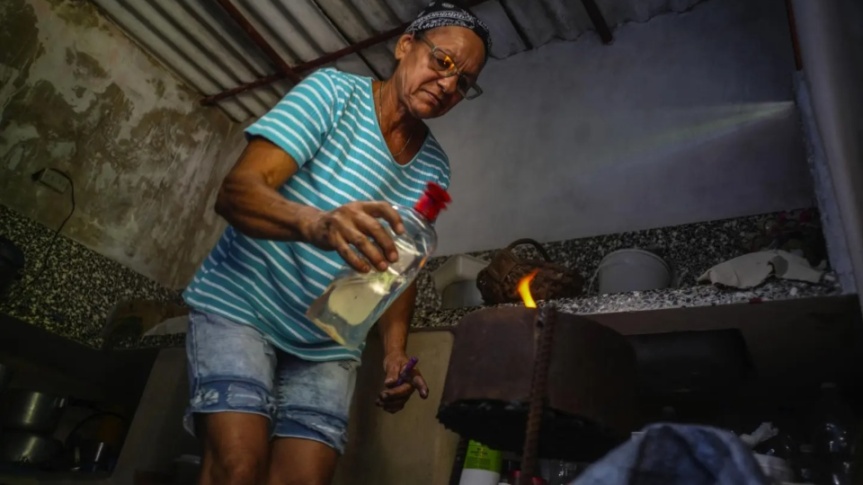
Mariel resident Rosa Lopez lights a charcoal stove to boil sweet potatoes and prepare scrambled eggs with tomatoes for her grandchildren on May 18, 2023. She had just returned from picking up her food rations from a government-run market. At the time, it had been more than a month since any cooking gas had been delivered to the city, so Lopez cooks using charcoal and a wood burning oven. Low agricultural yields, exploding inflation, a lack of gasoline for transportation, and the U.S. blockade have all contributed to soaring food prices. | Ramon Espinosa / AP

Originally posted in People’s World on August 16, 2023


Addressing a meeting of government ministers and the press in Havana on Aug. 11, Cuba’s Vice Prime Minister Jorge Luis Tapia Fonseca exploded when discussing the food crisis gripping the nation.

“It takes work to produce food. Everyone wants food deliveries, but we do nothing to produce it. We lack a culture of production … We don’t need all these papers, or words. When do we begin to plant? Who will do it?”

He was reporting on implementation of Cuba’s 2022 law on Food Sovereignty and Food and Nutritional Security. He noted that food self-sufficiency in local areas is disastrously lagging. Crop yields are low; plant diseases and the lack of inputs has hampered grain production.

The food situation in Cuba is growing more desperate by the day. Residents of the island individually consumed only 438 grams of animal protein per month in 2022, and in May 2023, only 347 grams; recommendations call for ingestion of 5 kg monthly. Not enough chickens were raised last year; poultry meat and eggs remain scarce.

Yields of corn, soy, sorghum and other crops have dropped, and animal feed is mostly unavailable. Therefore, pork production is also down, milk is unavailable to adults, and fewer cattle are being raised. Pasturage is poor, due to drought and no fertilizer.

Farm workers carry a tank of fresh milk to deliver it to a government-run food store in San Nicolas, Cuba, May 19, 2023. Milk is in short supply and reserved for children these days. | Ramon Espinosa / AP

Failures mount

Tapia pointed to the many failures exacerbating the situation. The output of state-controlled food producers is low. Producers, distributers, and institutional consumers don’t regularly contract with one another to facilitate food distribution. Producers aren’t being paid, because credit isn’t available. Cattle-stealing has reached new heights, 44,318 head so far this year.

The Ministry of Finances and Prices issued a report prior to the National Assembly session that recognized high inflation, widespread popular dissatisfaction, and the need for “concrete solutions.” Minister Vladimir Regueiro Ale indicated prices skyrocketed by 39% during 2022 and 18% more so far in 2023.

Inflation, he explained, varies from province to province and may manifest as abusive price-fixing, especially when agricultural supplies and products are in short supply.

Commenting on the report, National Assembly President Esteban Lazo, reminded delegates that diminished production and inflation were connected: “If there is no production and supply, we will not achieve effective control of prices.” He complained that “practically 100% of the food basket is being imported.”

The Assembly’s Food and Agricultural Commission analyzed organizational and management problems and reported that only 68% of expected diesel fuel has arrived so far in 2023, 14,700 tons less than in the similar period a year before; 28,900 tons of imported fertilizer were ordered, but only 168 tons arrived. Cuba’s fertilizer production has been nil this year in contrast to 9,600 tons produced in the same months in 2022.

Lazo communicated a message to Cuba’s Minister of Agriculture from the Assembly, whose recent session ended on July 22. The ministry, he said, would be “transforming and strengthening the country’s agricultural production,” to initiate “a political and participatory movement that would unleash a productive revolution in the agricultural sector.”

Nothing less than a revolution will do

A revolution appears to be exactly what’s needed. The recent National Assembly session dealt almost entirely with Cuba’s present food disaster. The lives of many Cubans are becoming more precarious due to unending food shortages, high prices, and low incomes.

Information emerging from the Assembly’s deliberations attests to the reality of crisis in Cuba, and it means that urgency is building for Cuba’s friends in the United States to resist U.S. policies in new ways, strongly and assertively. Their own government accounts for new suffering and destitution in Cuba.

President Miguel Díaz-Canel emphasized resistance when addressing the National Assembly. He dedicated his remarks to two revolutionary heroes who were present. Admiring how they kept “their foot in the stirrup of difficulties” and their “rifle pointed at mistakes,” he may have been thinking of hard work ahead.

He mentioned “problems of our difficult daily life, such as food production, electricity generation, water availability, crime, rising inflation, abusive prices.”

The president criticized behaviors “that reinforce the omnipresent blockade through inaction, apathy, insensitivity, incapacity, or simple tiredness and lack of faith.”

Díaz-Canel noted approvingly that delegates discussed “closer ties between deputies and the population,” “better management and allocation of the currency,” “greater direct participation of the non-state sector in national production,” “municipal autonomy,” and “downward pressure on prices.”

But it’s not enough. “Above all,” he said, “we must devote ourselves to creating wealth, first of all, by producing food.”

Trouble in the countryside

Cuba’s rural communities are troubled—and shrinking. Soon, “we won’t have any people left in the countryside,” one delegate said. Another called for improved “roadways, housing, and connectivity.”

No fuel means most people in rural areas are resorting to bicycles or horse carts to travel short distances. | Ramon Espinosa / AP

Regarding the low level of agricultural skills among the rural population, someone called for teaching in “agroecological techniques” and “good practices for the producing, processing, and commercialization of food.”

The idea has been circulating for a while now that greater local autonomy might help spur food production, but efforts at prompting that devolution of initiative have seen a slow uptake. As of April 2023, aspiring farmers had not yet taken possession of 258,388 hectares of idle land made available to them without cost under land-tenure reforms in 2008.

Frei Betto, Brazilian friend of revolutionary Cuba and adviser to Cuba’s Food Sovereignty and Nutritional Education Plan, visited Cuba in June. In his assessment, the “current shortages are more severe than in the Special Period (1990-95),” when Cuba’s economy nearly collapsed following the withdrawal of Soviet aid and the contraction of trade with the socialist bloc of nations.

He indicated that Cuba now imports 80% of the food it consumes, up from 70% five or so years ago, and that it costs $4 billion annually, up from $2 billion. For corn, soy, and rice alone, the outlay now is $1.5 billion annually.

He indicated, too, that a ton of imported chicken meat now costs $1.3 million, up from $900,000 a year ago, that “the wheat supply has worsened,” that milk production is down 38 million liters in one year, and that less oil from Venezuela, thanks to U.S. sanctions there, means further reduced food production in Cuba.

Blame the blockade, but not only

The origins of food shortages in Cuba and the mode of U.S. intervention are highly relevant in understanding the current situation, as every Cuban knows.

To be sure, the shortages plaguing the people are not solely due to U.S. policies. Drought, hurricane damage, marabou shrub infestation, soil erosion, high soil acidity, poor drainage, and lack of organic material soil have all contributed.

The still-prevailing bureaucratic and centralizing tendencies of the Cuban government’s economic management also play a role.

The U.S. economic blockade, however, remains central to understanding what’s happening. The creation of a food crisis was among the original proposals put forward by State Department official Lestor Mallory in 1960 for how to overthrow Cuba’s revolutionary government. The program: Use “hunger and desperation” to spark the “overthrow of government.”

Aid from and trade with the socialist world frustrated U.S. efforts and kept disaster at bay for decades, but eventually the Soviet Union and socialist Eastern Europe fell. The U.S. government seized the moment and passed legislation tightening the economic blockade in 1992 and 1996 and, later, designated Cuba a terrorist-sponsoring nation.

Beyond bans on products manufactured or sold by U.S. companies, proscribed categories soon included products manufactured by foreign companies associated with U.S. ones and products containing 10% or more components of U.S. origin. Now, foreign enterprises active in Cuba faced possible U.S. court action.

International loans and international transactions in dollars are usually off-limits. Payments abroad don’t reach destinations. Income from exports doesn’t arrive.

Think imports of seeds, fertilizers, herbicides, pesticides, breeding stock, veterinary supplies and drugs, new equipment, spare parts, exports of coffee, rum, and nickel. Think loans for purchasing food and more, loans for agricultural development. Think impediments to restoring rural infrastructure.

Farm workers wait in line to refuel their tractors on the highway to Pinar del Rio, Guanajay, Cuba, May 18, 2023. Cuba is in the midst of a major fuel shortage that has drivers and farmers waiting in line for days or even weeks to gas up their vehicles and tractors. | Ramon Espinosa / AP

The blockade, the U.S. tool of choice, has hit food production in Cuba hard. It is far along in achieving its ultimate purpose. Cuba needs a new order of support from friends in the United States─Marti’s “belly of the beast.”

Cuba needs friends more than ever

Many have so admired Cuba’s brand of socialism as to assume that Cuba’s social gains and exuberant international solidarity would fire up such enthusiasm that, along with considerations of fairness, legality, neighborliness, and revulsion against U.S. cruelty, would make U.S. policymakers think anew about Cuba. It never happened.

Now at a watershed moment in Cuba, a new direction is necessary, one all about persuading, organizing, and unifying left-leaning political groups and anti-war, anti-empire activists of all stripes. Leadership is needed.

Frei Betto says that, “It is time for all of us, in solidarity with the Cuban Revolution, to intensify the struggle against the U.S. blockade and mobilize international cooperation with the island that dared to conquer its independence and sovereignty against the most powerful and genocidal empire in the history of mankind.”


We hope you appreciated this article. At People’s World, we believe news and information should be free and accessible to all, but we need your help. Our journalism is free of corporate influence and paywalls because we are totally reader-supported. Only you, our readers and supporters, make this possible. If you enjoy reading People’s World and the stories we bring you, please support our work by donating or becoming a monthly sustainer today. Thank you!


W.T. Whitney Jr. is a political journalist whose focus is on Latin America, health care, and anti-racism. A Cuba solidarity activist, he formerly worked as a pediatrician, lives in rural Maine. W.T. Whitney Jr. es un periodista político cuyo enfoque está en América Latina, la atención médica y el antirracismo. Activista solidario con Cuba, anteriormente trabajó como pediatra, vive en la zona rural de Maine.

US Government Must Let Cubans Eat – W.T. Whitney Jr.

Food availability was the top concern of 21 percent of Cubans responding to a recent opinion survey. The U.S. economic blockade has promoted food shortages. In 1960 the idea of a blockade was appealing to the U.S. State Department because it would cause deprivation and suffering.  Those intentions resurfaced in 1992 with the so-called Cuban Democracy Act, which, still in force, restricts foreign partners of U.S. companies from exporting goods to Cuba. It covers exports of food and agricultural supplies. 

Cuba’s food-supply system is presently unstable, due in part to a fragile Cuban economy. How it functions in the future will depend on the government’s management of agriculture and on the impact of the U.S. economic blockade. Economic fallout from the COVID-19 pandemic will play a role.

Some problems won’t be fixed soon. Sugarcane monoculture took a toll on soil fertility. The woody marabou plant, useful only for making charcoal and removable only with heavy machinery, has invaded 4.2 million acres of Cuban land – 18 % of the total.  Cuba has recently experienced severe drought conditions interspersed with intense rains and flooding; 60 percent of the land is at risk of desertification. The agricultural sector accounts for 40 percent of hurricane-related financial losses.

According to one report, disempowerment of women in rural areas “impedes progress in the agricultural sector.” Many young people lack incentive to work in agriculture. The burden of feeding urban dwellers has increased. They accounted for 58 percent of the population in 1960, 77 percent in 2018. 

Cuba’s food –supply problem manifests in the perennial need to import 60-80 % of food consumed on the island – at an annual cost of $2 billion.  

Beginning in 2008, Cuba’s government instituted economic changes affecting the entire society, agriculture included. The government and Communist Party alike fashioned ambitious documents that outlined comprehensive reforms. The first was the Party’s 2011 “Guidelines for Economic and Social Policies.” 

In 2008, private individuals and collectives gained long-term usage rights to small tracts of land. Now some 500,000 new, independent farmers work 4.9 million acres of agricultural land. Private farmers in general, new and old, occupy 5.93 million acres, which yield almost 80 percent of Cuba’s food.  

The largest class of farmers, the UBPC cooperatives, heirs of the dismembered state farms, control 8.42 million acres of Cuba’s total of 15.56 million acres of arable land; 1.16 million acres remain idle and unfarmed.

The new private farmers ought to be producing “even more food,” says one observer.  Supplies, equipment, spare parts, fertilizers, and seeds provided by state agencies are often unavailable, delayed, or of low quality. Access to credit and insurance may be limited. 

Cuban farmers face gasoline and diesel fuel shortages, mainly because of drastically reduced shipments from Venezuelan oil producers, paralyzed by U.S. sanctions. The impact on food production in May 2019 led to increased food rationing. 

Food distribution is inefficient. The National Union of [food] Collection, otherwise known as the “Acopio” (“collection” in English) is the Agriculture Ministry entity responsible for distributing food. Problems include delayed payments to producers, inadequate storage facilities, transportation delays, regional variations in service, and “cumbersome” criteria for defining food quality. 

The Acopio operates 400 state agricultural markets and 1200 other food-selling facilities. Consumers experience long wait times, unavailability of desired food products, and variable quality. Vendors setting their own prices often reserve higher-quality food for consumers paying with the convertible currency used by foreign visitors. Cubans relying on rationed food may be left with lower quality food and smaller amounts – and forced to pay high prices for food they still lack.

Some government efforts at bolstering food supplies look like the ecologically-oriented initiatives for feeding urban populations that appeared during the Special Period, after the fall of the Soviet Bloc. They bear names like “Program for Municipal Self-supply;” “the Program of Urban, Suburban, and Family Agriculture” (focused on growing food in small spaces), and the “Program of Local Support for Agricultural Modernization,” for 37 municipalities. 

Speaking in February, President Miguel Díaz-Canel called for local self-sufficiency and for the Acopio to collect farm products promptly and thoroughly. With more food arriving at markets, he suggested, the state could regain control over food sales and prices, and thereby push out speculators and black marketeers.  Later Díaz-Canel spoke approvingly of producers bypassing the Acopio and selling at local markets. There’s discussion of “participation of other state and non-state actors” in the Acopio system.

Citing the examples of Vietnam and China – socialist countries that export food – reformers propose using remittances from Cubans living abroad for investing in food production, thus promoting farmer autonomy. Díaz-Canel recently advocated greater involvement of scientists and academicians in food production, just as with the coronavirus pandemic. 

Overall, the official response to food-supply problems seems to lack focus and coherence. If so, maybe it’s because planners are stymied as they deal with a regimen of shortages cemented in place and intractable. 

The imagination sees a specter-like U.S. presence as government officials deliberate and as farmers and consumers complain. It’s in the room as officials look abroad to transfer money, secure credit, import food, and seek investment in agriculture, or when they want to import farm machinery, tools, spare parts, premium seeds, fertilizers, pesticides, purebred livestock. and hydrocarbon fuels. 

U.S. pressures on foreign financial institutions are unrelenting. Foreign suppliers face merciless penalties if they ship agricultural supplies to Cuba, especially if they have associations with U.S. companies or if their goods contain some tiny U.S. component. 

When agricultural projects end up badly in Cuba or when food is short, surely recriminations crop up and perhaps animosities and anti-government ideas also. These would be exactly what the U.S. doctor ordered.