
In Distress, Niger Expels US Military, Resurrects Hope / By W. T. Whitney

Supporters of Niger’s governing military council, gather for a protest called to fight for the country’s freedom and push back against foreign interference, in Niamey, Niger, Aug. 3, 2023. A top Pentagon official says that the U.S. has not yet received a formal request from Niger’s rulers to depart the country. | Sam Mednick / AP

Reposted from the People’s World


On March 16, Amadou Abdramane, spokesperson for Niger’s governing military council, announced that Niger was dropping its 12-year-old military-cooperation agreement with the United States. Niger’s military council had assumed power following the coup in July, 2023 that removed Mohamed Bazoum, the elected president.

U.S. military intervention in Niger is now a poor fit with grim realities in the western Sahel region of Africa and with the Nigerien people’s needs and aspirations.

The U.S. military presence there co-exists with danger posed by Islamic extremist military groups. These expanded after 2011 when NATO destroyed the Libyan government, a stabilizing force in the region. Niger faces a humanitarian crisis worsened by environmental disaster. The military council is seeking alternative arrangements for security cooperation and looking to China for help with societal development.

Abdramane denounced “the attitude of the [recently visiting] U.S. delegation in denying the sovereign right of Niger’s people to choose partners and allies capable of really helping them fight terrorism.” General Michael Langley, delegation member and head of the U.S. Africa Command (AFRICOM), “expressed concerns” that Niger was pursuing close ties with Russia and Iran.

AFRICOM, headquartered in Stuttgart, Germany, operates 20 bases in Africa. The two largest are air bases in Djibouti, in East Africa, and Agadez, in central Niger. Niger hosts two other U.S. bases, an airbase nearNiamey, the capital city, and a CIA base in the northeast.

According to a report, the Agadez base cost $110 million to build and costs $30 million annually to maintain. It is “the largest Air Force-led construction project in history.” By means of these two large bases, the United States conducts air war, with drones, over a significant portion of the earth’s surface.

In moving to end U.S. military involvement, the coup government had backing “from the trade unions and the protest movement against French presence.”  The new government had already pressured France, Niger’s colonizer, to remove its military units from the country; the last of them departed in January, 2024. Coup governments in Mali and Burkina Faso expelled French troops in February 2022 and February 2023, respectively.

Also in January 2024, the three countries abandoned the Economic Community of West African States (ECOWAS). France had led in forming this trade bloc in 1975; it would include 15 African nations. Critics cited by the BBC claim that France, through ECOWAS, was able to “meddle … in the politics and economics of its former territories after independence.”

The French government failed in an attempt to mobilize an ECOWAS military force to punish Niger for leaving the trade bloc. Mali, Burkina Faso, and Niger reacted by forming their Alliance of Sahel States. They “are exploring alternative security relations, including with Russia.” Niger also looks to Iran for security assistance.  

Investigator Nick Turse points to U.S. failures to explain why Niger is looking elsewhere for military assistance. He documents the vast number of deaths in the western Sahel region at the hands of extremist Islamist groups over the course of 20 years. The killings skyrocketed despite the U.S. military presence in Niger.

Niger may have given up on the United States also on considering that U.S. and NATO military action in Libya in 2011 contributed to worsening living conditions in the region now. A commentator notes that, “The toppling of Gaddafi created a power vacuum that fostered civil war and terrorist infiltration, with disastrous regional ramifications.”

Additionally, in a Niger unable on its own to adequately fulfill human needs, U.S. focus on military advantage without attention to human suffering would have been disheartening. The scale of suffering is the Sahel region is immense, as evidenced by diminished food production and migration, with climate-change contributing to both.

The International Rescue Committee reports that, “The Central Sahel region of Africa, which includes Burkina FasoMali and Niger, is facing an unprecedented humanitarian crisis. Over 16 million people need assistance and protection, marking a 172 percent increase from 2016.”

China responded and Washington officials are perturbed. A report from Mali indicates that, “In Niger, the main areas of [Chinese] investment are energy ($5.12 million); mining ($620 million) and real estate ($140 million), other aspects of cooperation include: the construction of stadiums and schools, medical missions, military cooperation, infrastructure (roads, bridges, rolling stock, thermal power plants).”

A “Nigerien security analyst” told investigator Nick Turse that “the trappings of paternalism and neocolonialism” have marred Niger’s military-cooperation agreement with the United States. 

Expanding upon these polite words while commenting on Niger’s current situation, Casablanca academician Alex Anfruns observes that, “international capitalism has destroyed the hopes of entire generations of Africans while inflicting its policies like a thug with white gloves. Actors like the International Monetary Fund and World Bank are complicit as key functionaries of the neocolonial system.”

U.S. policy-makers, enablers of world capitalism, look longingly at Africa. Africa claims “98% of the world’s chromium, 90% of its cobalt, 90% of its platinum, 70% of its coltan, 70% of its tantalite, 64% of its manganese, 50% of its gold, and 33% of its uranium.” Even more: “The continent holds 30% of all mineral reserves, 12% of known oil reserves, 8% of known natural gas, and 65% of the world’s arable land.”

Alex Anfruns sees hope: the leaders of Niger, Mali, and Burkina Faso,  with their Alliance of Sahel States, “have sent a powerful message of solidarity to millions of Africans who share a vision and an emancipatory project, that of pan-African unity.” Indeed, “From now on neither the United States or France under the flag of NATO can destroy an isolated African country, as happened in Libya in 2011.” 

Burkina Faso president Thomas Sankara expressed a far-ranging kind of hope in 1984, at the United Nations: “We refuse simple survival. We want to ease the pressures, to free our countryside from medieval stagnation or regression. We want to democratize our society, to open up our minds to a universe of collective responsibility.”


We hope you appreciated this article. At People’s World, we believe news and information should be free and accessible to all, but we need your help. Our journalism is free of corporate influence and paywalls because we are totally reader-supported. Only you, our readers and supporters, make this possible. If you enjoy reading People’s World and the stories we bring you, please support our work by donating or becoming a monthly sustainer today. Thank you!


W.T. Whitney Jr. is a political journalist whose focus is on Latin America, health care, and anti-racism. A Cuba solidarity activist, he formerly worked as a pediatrician, lives in rural Maine. W.T. Whitney Jr. es un periodista político cuyo enfoque está en América Latina, la atención médica y el antirracismo. Activista solidario con Cuba, anteriormente trabajó como pediatra, vive en la zona rural de Maine.
Haiti’s Choice Is Social Revolution or Foreign Intervention / By W. T. Whitney Jr.

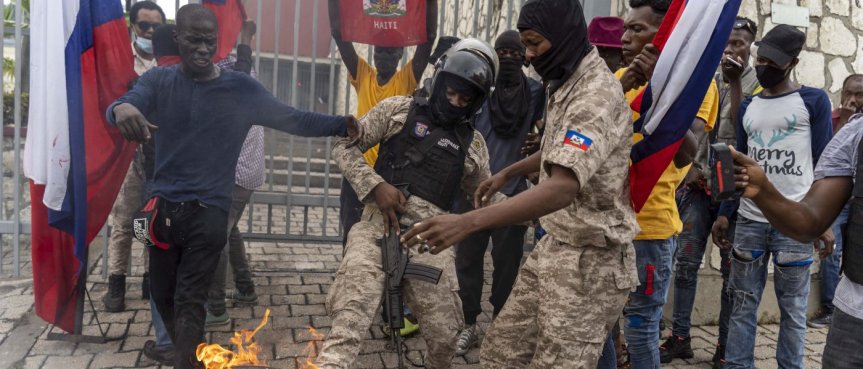
Photo: RICHARD PIERRIN/AFP via Getty Images

With long experience of chaos, violence, and dysfunctional governance, Haiti looks now to be on the verge of new crisis in the form of foreign military intervention. U.S. and United Nations decision-makers have held back, but now they look to be moving, again. 

The need all the while has been for change so that all Haitians might live decent lives. Whatever is in the works now offers little prospect for rearrangement of political and social hierarchies in Haiti. 

Haitians for several years have faced high prices, recurring shortages of essential supplies, and deadly gang violence in cities that has converted Haiti into a war zone and is the focus of media and political attention from abroad.   

Left-leaning political activist Camille Chalmers insists “there is a clear connection between these gangs and sectors of power, [which include] the far right” and the U.S. government. In an interview published on May 7, Henry Boisrolin agrees. This Haitian analyst living in Argentina states that: 

We have entered … a new phase in a spiral of violence characteristic of a crumbling neo- colonial system … The armed gangs are frankly death squads that are instruments in the hands of the Haitian oligarchy and the international community, mainly the United States. They want to subdue the popular movement in Haiti, sew terror, and put off an uprising.

The government headed by Prime Minister Ariel Henry, appointed by President Jovenel Moïse just days before his murder on July 7, 2021, is a façade. The U.S. government and the supervising “Core Group” of foreign nations put him in office and are backing him now. 

The last national elections were in 2016; the National Assembly has no legislators. Those elections, remarkable for minimal voter turn-out, gave the presidency to Moise, a wealthy businessman.  

Moïse overstayed his term of office, was accused of massive corruption, and was killed by paramilitaries who prepared in the United States. His predecessor, millionaire Michel Moise, became president in 2011 only after U.S. Secretary of State Hillary Clinton intruded in the elections.

Affecting Haiti’s situation now are: death and destruction from earthquakes and hurricanes; UN military occupation for 13 years that that introduced cholera, killing tens of thousands; and billions of dollars stolen that were set aside to pay for oil from Venezuela’s Petrocaribe program.

The distant background shows U.S diplomatic and commercial barriers during Haiti’s first 50 years, unjust and massive debt obligations to France for over a century, U.S. military occupation and U.S. support for the Duvalier dictatorships during the twentieth century, and subsequently a U.S. hand in two coups that removed the progressively-inclined President Jean-Bertrand Aristide. 

The United Nations Security Council  on October 21, 2022, “demanded an immediate cessation of gang violence and criminal activity” and declared itself ready “to take appropriate measures … against those engaged in or supporting gang violence.”  In January, 2023,U.N. Secretary General António Guterres called for “deployment of an international specialized armed force to Haiti.” 

On April 26 the Security Council deliberated on Haiti;19 speakers were heard. Maria Isabel Salvador, Head of the UN’s “Integrated Office in Haiti,” indicated that almost 50% of Haitians require humanitarian assistance. “The Haitian people cannot wait,” she declared; a “specialized international armed force” is needed. Jean Victor Geneus, Haiti’s Minister for Foreign Affairs, agreed.

The U.S. government is ready to act, it seems, with plans aimed at implementing the 2019 Global Fragility Act. That law would prevent and reduce violent conflict” abroad by means of “negotiating bilateral, 10-year-long “security assistance” arrangements with  “fragile states.”

The State Department on April 1, 2022, released a document explaining rationale and methods for implementing the GFA. A year later, on March 27, the State Department explained that the GFA would be implemented through 10-year plans … in partnership with Haiti, Libya, Mozambique, Papua New Guinea, and Coastal West Africa, including Benin, Côte d’Ivoire, Ghana, Guinea, and Togo.” 

An accessory document reveals that Haiti was being prioritized. It mentions a “sequenced approach for U.S. efforts” that will depend upon “political and security openings in the country.”

Kim Ives, veteran defender of Haiti’s sovereignty, commented that the plan “is essentially a new alliance of USAID ‘know-how’ with Pentagon muscle.” He foresees that the United States will be “returning the country from a neo-colony back into a virtual colony as it was from 1915 to 1934, when U.S. Marines occupied and ran it. Nonetheless, the U.S. would try to keep some Haitian window-dressing.” 

Vassily A. Nebenzia, the Russian Federation’s Permanent Representative on the UN Security Council, received a letter on April 24 from 58 individual Haitians and representatives of Haitian political organizations.  Russia is currently serving as the Security Council’s president.

The letter claims that U.S. plans for Haiti’s future would violate the United Nations Charter. It calls for an independent commission to evaluate U.S. interventions in Haiti since 1993. The authors fear “a grave attack on the sovereignty, independence, territorial integrity, and unity of Haiti.” 

They also object to U.S. occupation since 1856 of the Haitian island Navase, the U.S. government’s manipulations in the 2010 presidential elections, and U.S. failure to prevent the weapons being shipped to Haiti for use in killings and crimes. 

A month after President Moise’s murder in 2021, the “Montana group” of civic leaders proposed a two-year provisional government that would prepare for elections.  The results have been nil.  

De facto Prime Minister Ariel Henry in December 2022 announced a “High Transition Council” set up to arrange for elections. But eight political parties soon vetoed the project and very little has been achieved. Already in October, Henry had requested the U.S. government and/or United Nations to intervene militarily. 

Whatever happens in Haiti promises little help for a severely distressed underclass; 59 percent of Haitians live on less than $2 a day, the poverty rate is 60%, a quarter of the population has no access to electricity, 50% of Haitians are food insecure, 50% of Haitians must drink polluted water, 50% Haitian children do not attend school, and two thirds of adult Haitians are unemployed or informally employed. 

No social revolution is on the horizon and most Haitians, individually and collectively, are powerless. Power lies with Haiti’s business class whose impulse is for “invasion and occupation.” 

These would be the richest ten percent of Haitians who control 61.7% of the country’s wealth. The billionaires in that class are conglomerate owners Gregory Mevs and Gilbert Bigio, worth $1.0 billion and $1.2 Bіllіоn, respectively, and Irishman Denis O’Brien, who is worth $6.8 billion and controls Haiti’s telephone services.  

Henry Boisrolin, cited above, sees U.S. hypocrisy when he looks at U.S. sanctions against ten powerful families in Haiti that buy “tons of arms and munitions” for use in Haiti. This is a U.S. government that “does not allow a single syringe to make its way to Cuba” while claiming ignorance as to who sells those arms or that they come from the United States.


W.T. Whitney Jr. is a political journalist whose focus is on Latin America, health care, and anti-racism. A Cuba solidarity activist, he formerly worked as a pediatrician, lives in rural Maine. W.T. Whitney Jr. es un periodista político cuyo enfoque está en América Latina, la atención médica y el antirracismo. Activista solidario con Cuba, anteriormente trabajó como pediatra, vive en la zona rural de Maine.