
CELAC Summit Offers Proposals, amid Divisions and Dissent / By W. T. Whitney Jr.

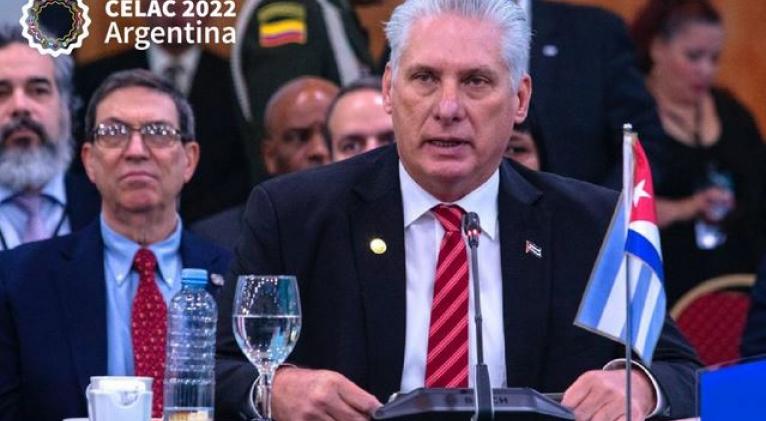
Cuban president denounces US interference at Celac Summit | Prensa Latina, 01.24.23

The 7th Summit Meeting of the Community of Latin and America States (CELAC) took place in Buenos Aires, Argentina on January 23. In their Declaration, representatives of 33 member nations, including 14 presidents, paid  homage to integration, unity, and  “political economic, social, and cultural diversity among member states.” They agreed “by consensus” to an all-embracing set of proposals and statements, 100 in all, and to 11 “special statements” on the situations of particular countries.

As is usual, host-country president Alberto Fernández made arrangements and set the agenda. The one-day meeting included closed- door discussions and brief presentations by representatives of the various country.

Participants at CELAC’s founding meeting in Caracas in 2013 declared  the region to be a “zone of peace.”  CELAC, it was hoped, would be promoting regional cooperation on social and economic development, agreement on common political goals, and progress toward integration and unity.

Preparations had begun in 2010 after U.S. interventions in Venezuela, Bolivia, Ecuador, Cuba, and other countries had intensified. CELAC would differ from Organization of American States (OAS), the regional organization serving U.S. interests since 1948. The United States and Canada are not members of CELAC. 

A gap separated the fifth CELAC Summit in 2017, in the Dominican Republic, from the sixth one, on September 16-18, 2021 in Mexico City. Instability in Venezuela, Bolivia, and Brazil was a likely factor.  Mexican President Andres Manuel Lopez Obrador (AMLO), presiding over CELAC VI, spoke of CELAC as the regional equivalent of the European Union. There was speculation about CELAC replacing the OAS. 

Brazilian President Luiz Inácio “Lula” Da Silva’s arrival at CELAC VII generated excitement. Brazil had rejoined CELEC after being removed by Former President Jair Bolsonaro in 2020. Lula supports closer ties of both CELAC and the Mercosur economic organization with the European Union.

In Buenos Aires, rightwing demonstrators from Argentina and elsewhere were noisily protesting against CELAC. They objected to the presence of leftist countries like Venezuela, Cuba, and Nicaragua. To avoid confrontation, Venezuelan President Nicolas Maduro and President Daniel Ortega of Nicaragua stayed away. AMLO also did not attend, claiming he was busy.

Crisis in Peru provoked divisions.  The Declaration was silent on the coup there and on repression of popular resistance. Colombian president Gustavo Petro, President Xiomara Castro of Honduras, and AMLO, in a video presentation, called for deposed President Pedro Castillo’s release from prison. Presidents Fernández of Argentina and Boric of Chile said nothing on that score. 

CELAC did not respond to Prime Minister Ariel Henry’s requests for  member states to “participate in a specialized multinational force requested by Haiti” to deal with gang warfare.

President Fernández, surprisingly, had invited U.S. President Biden, who sent former Senator Chris Dodd in his stead. Dodd spoke at the plenary session, as did European Council President Charles Michel.  President Droupadi Murmu of India participated virtually. Chinese President Xi Jinping sent a message of solidarity.

The Summit Declaration says little about implementing proposals and realization of earlier plans.  It refers to expected actions by United Nations agencies and by regional organizations with special experience and expertise.

The only CELAC actions mentioned are recent meetings of ministers of CELAC countries with international agencies dealing with healthcare and food-supply issues. The only CELAC initiatives underway soon are meetings of CELAC representatives with officials of the European Union, China, the African Union, and the ASEAN nations.

The website celacinternational.org mentions far-reaching plans as of 2013 for transportation, healthcare, and hunger-alleviation projects. A subsequent lack of follow-up information and references to other projects suggests flawed implementation.

Speaking at the Summit, Colombian President Gustavo Petro called for “building integration through concrete projects” and for action on the climate crisis, revitalizing the Amazonian forests particularly. He denounced “U.S. deficiencies in moving toward a carbon-free economy.” 

President Miguel Díaz-Canel of Cuba reminded his listeners of U.S. “efforts to divide us, stigmatize us and subordinate us to its interests.” The United States is isolated, he suggested, in its “strategy of hegemony and domination.”  And Cuba’s inclusion on the U.S. list of states that sponsor terrorism greatly impedes “our aspirations for development.

On video, President Maduro of Venezuela called upon CELAC to demand that the United States no longer intervene in the affairs of “free and sovereign nations” and “No more coup-plotting, no more sanctions against sovereign nations.” 

Uruguayan President Luis Lacalle, dissenting, charged that, “there are clearly countries here … that do not respect institutions, democracy or human rights.” He has drawn criticism for his push for a regional free trade zone and a Uruguayan -Chinese trade agreement. 

Speaking for El Salvador, Vice President Félix Ulloa urged CELAC to take on an executive secretary to preserve the alliance’s “institutional memory.” 

A CELAC “social summit” took place in Buenos Aires on the day prior to CELAC VII. Present were Argentinian trade unionists and leftist political parties and political leaders and activists from many countries. Former Bolivian President Evo Morales headed a panel of speakers.

Participants demonstrated outside the actual Summit against the rightwing protesters and “in support of our anti-imperialist presidents.”  Returning later, they demanded support for Peruvians’ resistance and called for non-recognition of the coup government. 

U.S. imperialism remained the perennial CELAC theme. Asked about U.S. designs on the region’s natural resources, Bolivian President Luis Arce was forthright: “[T]hese are our natural resources … We are not going to accept any imposition by anybody nor let anyone regard our natural resources as if it were theirs.”   

General Laura Richardson’s remarks before the Atlantic Council on January 19 had prompted the question. She is head of the U.S. Southern Command.

The next CELAC summit meeting will occur in Saint Vincent and the Grenadines, population 104,000 and the first Anglophone site for a CELAC meeting. Prime Minister Ralph Gon­salves will be presiding.


W.T. Whitney Jr. is a political journalist whose focus is on Latin America, health care, and anti-racism. A Cuba solidarity activist, he formerly worked as a pediatrician, lives in rural Maine. W.T. Whitney Jr. es un periodista político cuyo enfoque está en América Latina, la atención médica y el antirracismo. Activista solidario con Cuba, anteriormente trabajó como pediatra, vive en la zona rural de Maine.

Prisoner Simón Trinidad Is Victim of Toxic US – Colombia Alliance / by W. T. Whitney Jr

In this Jan. 13, 2002 photo, the Commander of the Revolutionary Armed Forces of Colombia (FARC), Simón Trinidad, reads a declaration during a press conference in Los Pozos, Colombia. | AP

Simón Trinidad’s 72nd birthday is July 30. Don’t think about sending him a card. U.S. prison authorities have blocked his mail since 2004. Extradited from Colombia, he would remain in solitary confinement until 2018. He is lodged in a maximum-security federal prison in Colorado.

As a leader of the Revolutionary Armed Forces of Colombia (FARC), Trinidad was in charge of political education and propaganda. He was captured in Ecuador in 2003, with CIA assistance. He had been conferring there with a United Nations official about the release of FARC-held prisoners.

Transferred to Colombia, Trinidad was a high-profile prisoner.  He had family connections with upper elements of Colombian society and had been a lead FARC negotiator in peace talks with Colombia’s government from 1998 to 2002. The Colombian government and its U.S. ally might have detected a propaganda advantage in a public trial and severe punishment. Putting him away, out of sight, as a prisoner of war in Colombia would have offered little gain.

Ideas may also have cropped up that Trinidad extradited would be an object lesson for Colombia’s political dissidents, display damage done to the FARC, and advertise the newly strengthened U.S. – Colombian alliance. Colombian officials asked the U.S. government to request his extradition.

U.S. Plan Colombia took effect in the early 2000s. At the cost eventually of more than $10 billion, the U.S government provided military equipment, intelligence services, and funding for Colombia’s military, police, and prisons. The purpose, claims the U.S. Global Leadership Coalition was “to provide security and economic development assistance to help combat the spread of narcotics … and promote economic growth.”

Narco-trafficking was a secondary matter. Plan Colombia was mainly about fighting leftist insurgents, primarily the FARC. A stiffened alliance was background to the targeting of Trinidad and to enhanced political oppression in Colombia.

Interviewed recently, Colombian historian Renán Vega Cantor mentions “80 years, during which Colombia became the main US ally in the region.” He cites seven U.S. military bases, “a U.S. presence in 50 [other] places …[and] 25 secret U.S. agencies” operating in Colombia.  Crucially, the paramilitaries, long notorious as agents of deadly violence, are “Colombian Army proxies sponsored, financed, trained, and supported by the United States, which have carried out all kinds of atrocities that the Armed Forces, openly, cannot legally carry out.”  

Says Vega Cantor, “Plan Colombia militarized [Colombian] society in an impressive way, propelling the growth of the Colombian Armed Forces to unthinkable levels.” Colombia presently fields 500,000 troops; its army is one of the world’s largest. Some 50,000 Colombian military and police officers received training at the U.S. Army’s School of the Americas in Georgia, referred to by some as the “school of assassins.”

The U.S. government has readily accepted the cruelty marking its partner’s civil war. Cruelty was on display recently. The Truth Commission, set up via the 2016 Peace agreement between the FARC and Colombian government released its ten-volume Final Report on June 28, 2022. Cruelty portrayed there is vast enough to have infected the criminal justice system of its ally, or so it seems.    

Analyst Camilo Rengifo Marín, referring to the Report, takes note of “an armed conflict of more than 60 years that goes on still and led to more than 10 million victims of whom 80 percent were civilians.” He writes that, “50.770 were kidnapped, 121.768 disappeared, 450.664 murdered and 7.7 million forcibly disappeared.” Another observer indicates that, “The report is critical of the role played by various U.S. administrations in developing security policies, in militarizing society, and in hiding relations between paramilitary groups and the Colombian Army.”

The Final Report itself states that, “During many years, the victims got little attention and often were defended only by human rights organizations or by churches. From torture victims and kidnappings by guerrillas … to victims belonging to political movements like the Patriot Union and other opposition groups, those victims were invisible to most Colombians over the course of decades.” 

Simón Trinidad has been all but invisible in the United States. U.S. authorities sought his extradition solely because of alleged narco-trafficking. After all, international law does forbid extradition on political grounds, like rebellion. The indictment greeting Trinidad on arrival in Washington charged him with providing material support to terrorists, taking hostages, and dealing in illicit drugs.

It took four trials between 2006 and 2008 to exonerate him on the charges of narco-trafficking and providing material support for terrorists, and to convict him of conspiring to capture three U.S. drug-war contractors.  FARC gunfire had brought down their plane. The idea of conspiracy derived exclusively from Trinidad’s status as a FARC member. 

In 2008, 57-year-old Trinidad received a 60 -year sentence. Since 2018, he’s been allowed to eat a midday meal in a dining hall. Phone calls are rare. Emails and periodicals are prohibited, along with letters. Trinidad’s only visitors are his lawyers and rarely his brother and Colombians conferring about Peace-Agreement arrangements.

Trinidad faces charges in Colombia relating to possible crimes committed during the Civil War. The Peace Agreement provided for a “Special Jurisdiction for Peace” (JEP in Spanish) whose role is to decide on punishment or pardon for former combatants on both sides charged with crimes. To be pardoned they must tell the truth.

Simón Trinidad is eligible to appear before the JEP. Trinidad’s U.S. lawyer Mark Burton indicated via email that a first step towards his virtual appearance there is for Colombia’s Foreign Ministry to ask the U.S. Justice Department to approve of Trinidad’s appearance before the JEP.

Burton is hopeful. The new foreign minister of the incoming Gustavo Petro government may be receptive; Álvaro Leyva Duran “worked on the negotiating team of the FARC in Havana” during the peace talks, Burton recalls. The JEP could pardon Trinidad or require court appearances in Colombia. Either way, pressure would mount for the U.S. government to commute his sentence to allow for deportation.

President-elect Gustavo Petro, campaigning, protested the ongoing killings of community leaders and former FARC combatants. A central demand of his Historical Pact coalition has been full implementation of the 2016 peace agreement. Ultimately, relief for Trinidad rests on realizing peace in Colombia.

Any affinity of the U.S. government with the goals of the new Historical Pact government would be good news for Trinidad. For the United States to back away, even a little, from intervening in Colombia would also be good news.  Secretary of State Blinken, speaking with Petro, “underscored our countries’ shared democratic values and pledged to further strengthen the 200-year U.S.-Colombia friendship,” according to an announcement on June 20. The mouthing of hypocrisy is bad news.

Peace in Colombia, and Trinidad’s fate, depends on the U.S. relaxing its cop-on-the-beat posture for an entire region, that of monitoring any and all stirrings of fundamental political and social change. A new kind of U.S. openness, however, doesn’t jibe with U.S. determination to protect the interests of corporations and the moneyed classes at home and abroad.

Until a new anti-imperialist consciousness has inspired a meaningful and potentially effective, all-points opposition, collective effort is in order now towards organizing and fighting for Simón Trinidad’s return to Colombia. Even so, that struggle would have to fit within a larger context of anti-imperialism, peace now in Colombia, and support for the new government there.


W. T. Whitney Jr. is a political journalist whose focus is on Latin America, health care, and anti-racism. A Cuba solidarity activist, he formerly worked as a pediatrician, lives in rural Maine. W.T. Whitney Jr. es un periodista político cuyo enfoque está en América Latina, la atención médica y el antirracismo. Activista solidario con Cuba, anteriormente trabajó como pediatra, vive en la zona rural de Maine.

People’s World, July 18, 2022, https://peoplesworld.org/

Progressive Coalition Campaigning in Colombia Promises Real Change / by W. T. Whitney Jr.

Historic Pact confirms Gustavo Petro and Francia Márquez presidential ticket in Colombia | Peoples Dispatch

In Colombia Gustavo Petro and Francia Márquez on March 24 registered as presidential and vice-presidential candidates, respectively, for elections taking place on May 29. On behalf of the Historic Pact coalition, Petro stated that, “today is the first day of a campaign that promises to actually change the history of Colombia.”

He was, in effect, proposing that someday killings, disappearances and dispossessions would be gone. And no longer would elections be the exclusive province of oligarchs.  Real democracy would replace the hollow version of Colombian democracy regularly proclaimed by U.S. officials.

The Historic Pact campaign scored well in primary elections held on March 13. Of 5.6 million Colombians voting in the coalition’s primary, 4.5 million of them chose Petro as presidential candidate. Significantly, 783,160 of them opted for Francia Márquez for the same office. Later, of course, Petro selected her as his vice-presidential running mate.

Other primary results were: of the 4.0 million people voting for the rightwing Team Colombia coalition, 2.2 million (54.2%) selected Federico Gutierrez as that coalition’s presidential candidate. Colombians loyal to the centrist Center of Hope coalition, 2.2 million in all, picked Sergio Fajardo as presidential candidate with 723,084 votes (33.5%).  Results were reported also on many other presidential candidates running either as individuals or as candidates of other coalitions.

Voters also cast ballots on March 13 to fill 108 seats in the Senate and 187 in the House of Representatives. In Senate voting, the Historic Pact led with 2.7 million votes and 21 seats.  The Conservative Party followed with 2.2 million votes and 15 seats. The Liberal Party with 2.1 million votes and 15 seats was in third place. Voting for delegates to the House of Representatives gave 33 seats to Liberal Party candidates, 29 to the Historic Pact, and 27 to Conservative Party candidates.

Because most legislators joining the new Congress represent many political groupings.  For the Historic Pact legislators to do their work, they will have to form alliances.  

Petro, a former M-19 urban guerrilla and mayor of Bogota, served in Colombia’s Senate. There he established himself as an implacable foe of two-term former president Alvaro Uribe, who personifies and has led the extreme right-wing sector of Colombian politics.  In 2018, Iván Duque, an Uribe protegee and now the outgoing president, defeated Petro in second-round voting, gaining 10.3 million votes to the latter’s 8.0 million votes. Petro’s first presidential campaign was the first outing for the brand-new Historic Pact, whose formation Petro had engineered.

For progressives, the Historic Pact this year has star-power. Francia Márquez herself gathered more votes for a presidential run than did Sergio Fajardo, the candidate of the third largest electoral coalition. Márquez is a 39-year-old African-descended lawyer and environmentalist, whose activism has centered on the environment harm caused by mining activities in Cauca Department – from where she was forced to leave because of threats.

Márquez won the National Prize for the Defense of Human Rights in 2015 and the prestigious Goldman Environmental Prize in 2018. The BBC named her as one the 100 most influential women in the world.

On announcing Márquez’s vice-presidential candidacy, Petro asserted that Márquez would represent “three pillars [of] the first people’s government of Colombia,” specifically “the women of Colombia, the excluded territories, and peoples excluded by the color of their skin.”

Márquez responded, dedicating her words to Colombia’s youth: “Our job will be to close gaps arising from inequity and inequality in those regions where people are excluded and silenced.” Reports suggest that in a Petro government she would serve as environmental minister and fill a newly created Ministry of Equality.

Troubles emerged after the March 13 elections. At issue were voting irregularities marking the elections for the Senate and House of Representatives. The Election Observation Mission on March 18 reported that not one of more than 28,000 polling booths produced a ballot showing a vote for a candidate supported by the Historic Pact or by other left-leaning groups.

Former President Uribe reacted: “These elections leave mistrust everywhere. To these inconsistences must be added the overwhelming vote for Petro in the narco-trafficking regions. This result cannot be accepted.” His Democratic Center Party called for a total recount, insisting that otherwise “the new Congress would be illegitimate.”

Petro on March 20 called upon “all political parties to reject [Uribe’s] invitation to a coup d’état. It’s time for everyone to defend democracy.”  In a recount, almost 400,00 additional votes were discovered. The Historic Pact gained three more Senate seats at the expense of three other parties.

Obstacles remain. According to  an observer, “Voting for the Historic Pact took shape in spite of and against massive buying of votes by the Mafias of the traditional parties and the new parties of the oligarchy …[and] against the multimillion dollar machinery of the establishment’s electoral businesses.”   

Two recent opinion polls have Gustavo Petro winning the first round of elections on May 29. One points to 37% of likely voters favoring Petro. Next in line, Federico Gutiérrez, candidate of the Team Colombia coalition, polled at 19%. Another poll gives Petro a 32% favorability rating, with Gutiérrez at 23%.

Analysts say that the Historic Pact must win a first-round victory, that a “second-round election would be very dangerous.” Coalition strategists envision a broad-front approach aimed at opening up “political space beyond the Historic Pact.”

Youth activism and popular resistance beyond the orbit of left-leaning political parties did fuel the growth of the Historic Pact – as exemplified by the vice-presidential candidacy of Francia Márquez.  As part of the political uprisings of 2021 in Colombia, these sectors recalled the upsurge of social movements in Chile that helped to install the new progressive government there headed by President Gabriel Boric

Alexander Escobar is a senator whose political party, the Democratic Pole, is part of the Historic Pact; he was a presidential candidate within that coalition. His advice for Petro now is for the Historic Pact to be cautious in assimilating social movements into the campaign.

Escobar insists that electoral success must precede efforts at fostering mobilizations outside regular politics. While admiring activists who “have big dreams, that are so strong and have so many roots,” he relies on “real organizing and decision-making spaces.”

W.T. Whitney Jr. is a political journalist whose focus is on Latin America, health care, and anti-racism. A Cuba solidarity activist, he formerly worked as a pediatrician, lives in rural Maine. W.T. Whitney Jr. es un periodista político cuyo enfoque está en América Latina, la atención médica y el antirracismo. Activista solidario con Cuba, anteriormente trabajó como pediatra, vive en la zona rural de Maine.