
Fixing Healthcare Failures in the US and in Lewiston, Maine / By W. T. Whitney Jr.

Photo credit: Tim Wheeler/People’s World

South Paris, Maine


Efforts to reform U.S. healthcare fall short. Preventable deaths are excessive, access to care is often impossible, costs are high, and profiteering thrives. Individual solutions replace common purpose. Hope lies with an activated working class fighting for equitable, accessible, humane, and effective healthcare.

Maine people are now collecting signatures for a petition on the 2026 ballot demanding that the state promote universal healthcare. The campaign coincides with costs of Medicare insurance premiums increasing after January 1, 2026. That’s when subsidies provided under the Affordable Care Act are reduced. The campaign will react also to recent federal legislation that removed a million or so low-income Americans from Medicaid coverage.

The precariousness of current healthcare arrangements is evident to Maine voters who are aware of a painful transition taking place in Lewiston, Maine’s second largest city, population 39,187. Lewiston’s Central Maine Healthcare corporation (CMH) has been losing $32.5 million annually over five years. California-based Prime Healthcare, the fifth largest U.S. profit-making health system and owner of 51 hospitals in 14 states, is buying CMH.

Takeover

Serving almost half a million people in its region, CMH operates Central Maine Medical Center (CMMC), two smaller hospitals in the area, and also physicians’ practices, urgent care offices, nursing homes, and counselling centers in 40 locations. CMMC, established in 1891, has 250 beds and employs 300 physicians representing most specialties. The agreement to change ownership, announced in January 2025, is about to be finalized.

Prime Healthcare will invest $150 million in CMH over 10 years, while assigning CMH to its Prime Healthcare Foundation, a supposedly non-profit entity with $2.1 billion in assets. Prime Healthcare has a record

The corporation has periodically faced charges of overcharging, services dropped and safety standards ignored. After 2008, accusations surfaced in California of underfeeding hospital patients, allowing for post-surgery infections, and hospitalizing emergency room patients to increase revenues. Prime Healthcare in 2018 paid $65million in fines to settle accusations of Medicare fraud, over $35 million in 2021 for kickbacks and overcharging, and $1.25 million for false Medicare claims submitted by two Pennsylvania hospitals.

The Center for American Progress, a left-leaning think tank, recently warned against private equity companies owning health centers and controlling practitioners. It cited “unmanageable debt”, “increased costs for patients and payers,” poor patient care, and distressed healthcare workers.

Maine’s legislature on June 22 enacted  legislation establishing a one-year moratorium on private equity companies (and real estate investment trusts) owning or operating hospitals in the state.

Troubles in city and state

Other Maine health systems are also experiencing big financial troubles. Northern Light Health, with debt of $620 million, recently closed an acute-care hospital in Waterville and announced a new partnership with the Harvard Pilgram system in Massachusetts. Lewiston’s St. Mary’s Health System closed its obstetrical services, sold off properties, and is laying off employees. The New England-wide Covenant Health system, owner of St. Mary’s since 1990, indicates covering the hospital’s unpaid bills amounting to $88 million is not “sustainable.”

One media report suggests Maine people aware of layoffs, health institutions’ financial troubles and diminishing services are “wondering about the future of their health care.”  Medicaid funding reductions, shortages of primary care providers, and trimmed-down health centers have led to lengthy wait-times for appointments, long travel distances to new providers, and no care for many.

Lewiston, once a textile and shoe manufacturing center with a large population of French-speaking workers, migrants from Quebec, is “the poorest city in Maine.” Fallout from CMMC’s financial problems and reduced federal funding threaten the healthcare of people whose lives are already precarious.

Eleven percent of Lewiston residents are migrants from Africa, mostly from Somalia. The 2023 poverty rate for the city’s Somali people was 32%. For Lewiston it was 17.7% and for Maine  10.4%. Poverty for Androscoggin County, which includes Lewiston, was 13% in 2023; child poverty was 16.6%.  Life expectancy in Lewiston was 75.5 years in 2020, in Maine, 77.8 years.

Neither Maine or Lewiston is bereft of resources. Apart from remote rural and forested areas, Maine has well-functioning hospitals and competent practitioners.  Experienced and concerned agencies and organizations provide social services and support for health-impaired Mainers.

Maine ranks 17th  among the states in “cost, access, and quality of Medicaid and CHIP (Children’s Health Insurance Program) coverage for low-income individuals.” Another survey has Maine in 23rd place in “per person state public health funding” for 2023. A ranking of “states most supportive of people in poverty” puts Maine in 12th place.

Maine with its healthcare difficulties is not an outlier within the United States. Nevertheless, uncertainties prevail statewide, and Lewiston is in low-grade crisis mode. Planning is incremental, limited to localities, and accepting of the status quo. Collective action is not a consideration for those dealing with the crisis –providers, hospitals, recipients of care, and the general public. Individual initiative is the rule, as per U.S. habits.  

Wider perspective

Those healthcare flaws and difficulties evident in Maine exist throughout the United States. Awareness of the consequences is crucial to building support for necessary change.  

Too many people die. US infant mortality in 2021 ranked 33rd among 38 countries belonging to the Organization of Economic Cooperation and Development, the world’s wealthiest countries. U.S. life expectancy in 2025 ranked 48th in the world. U.S. maternal mortality rate in 2023 was in 59th..

Inequalities are pervasive, as reflected in the poverty and life-expectancy variations in Maine. The huge flow of money through the system highlights inequality; it takes place at levels far removed from the depths of U.S. society. U.S. health expenditures per person in 2023 were $14,885; the average in other countries comparable by wealth was $7,371. Health expenditure as percent of GDP in US was 17.6% in 2023; the figure for all other wealthy countries was lower than Switzerland’s 12.0%.

Incentives for profiteering are many. While administrative costs represented only 3.9% of total Medicaid spending in 2023 and only 1.3% of all traditional Medicarespending in 2021, they accounted for “about 30%” of the cost of private health insurance in 2023. Presumably, profit-taking is embedded within those high administrative costs.

Critics of US healthcare, writing recently in Britain’s Lancet medical journal, assert that “profit-seeking has become preeminent.” They add that:

“Health resources of enormous worth … have come under the control of firms obligated to prioritize shareholders’ interests … The potential for profits has attracted new, even more aggressive corporate players—private equity firms … [These have] a single-minded focus on short-term profit” … The US health-care financing system makes profitability a mandatory condition for survival, even for non-profit hospitals.” 

Realization dawns that adverse social and economic factors are tearing apart the benevolent purposes of healthcare. They make people sick. A report of the American Academy of Actuaries issued in 2020 says that, “30% to 50% of health outcomes are attributable to SDOH (social determinants of health), while only 10% to 20% are attributable to medical care.” A public health study shows that, “Nearly 45,000 annual deaths are associated with lack of health insurance.”

There is a way

That which has led to a floundering care system belongs to no one and weighs upon everyone, more so on the dispossessed and marginalized. It’s an epidemic, in the original Greek meaning of that word, “upon the people.”  Corrective action would therefore derive from and apply to all people all together. Healthcare itself supplies the model.

For many, physician John Snow is the “father of public health.” In London in 1854, Snow investigated an outbreak of cholera, a water-borne infectious disease. Suspecting that water from the Broad Street pump was the culprit, he removed the handle. The epidemic stopped. He had acted preventatively on behalf of the many, not for individuals.

Comes the Cuban Revolution and preventative and curative medical care are joined in one public health system. Political change allowed for that.

Rudolf Virchow (1821-1902), pathology giant and one of the founders of scientific medicine, was on the case almost two centuries earlier.  This leader of the Berlin Revolutionary Committee was behind the barricades in the revolutionary year of 1848. In 1847-1847, Virchow studies a typhus epidemic killing inhabitants of Upper Silesia. He notes in his report that:  

“A devastating epidemic and a terrible famine simultaneously ravaged a poor, ignorant and apathetic population. … No one would have thought such a state of affairs possible in a state such as Prussia, … we must not hesitate to draw all those conclusions that can be drawn. . . I myself …  was determined, … to help in the demolition of the old edifice of our state. [The conclusions] can be summarized briefly in three words: Full unlimited democracy.”

Virchow writes that, “Medicine is a social science, and politics is nothing else but medicine on a large scale… The physicians are the natural attorneys of the poor.”

If democracy was the fix then for an epidemic, it’s the fix now for the current epidemic of disordered healthcare. The people themselves would rise to the occasion. And how are they going to do that?

The role of profiteering in U.S. healthcare is a reminder of the capitalist surroundings of the struggle at hand. Aroused working and marginalized people are on one side and the rich and powerful on the other.

Does capitalism need to go in order that healthcare changes? Not yet, suggests international health analyst Vicente Navarro. In explaining U.S. failure to achieve universal healthcare, he observes that, “The U.S. is the only major capitalist developed country without a national health program, and without a mass-based socialist party. It is also one of the countries with weaker unions, which is to a large degree responsible for the lack of a mass-based working-class party.”

That clarifies. The working class is crucial to repairing a dismal situation. Its partisans will work on strengthening the labor movement in size and militancy. Working class political formations will have their day.

Martin Luther King has the last word. Speaking to health workers in 1966 King remarked that, “Of all the forms of inequality, injustice in health care is the most shocking and inhumane because it often results in physical death.”  His reference to “forms of inequality” implies the existence of the capitalist system giving rise to such forms. Capitalism fosters early deaths as well as racism.


W.T. Whitney, Jr., is a political journalist whose focus is on Latin America, health care, and anti-racism. A Cuba solidarity activist, he formerly worked as a pediatrician and lives in rural Maine.

Unionized Maine Nurses reject reactionaries’ push for Medicaid cuts / By W. T. Whitney Jr.

Nicole Ogrysko / Maine Public

South Paris, Maine


U.S. healthcare, chronically afflicted with inequalities, has taken an acute turn for the worse. A proposal has emerged out of the U.S. government’s budget reconciliation process to reduce funding for healthcare and other national programs by $880 billion over the course of 10 years. Alleging fraud, proponents want to clear the way for “4.5 trillion in tax cuts through 2034.” Mostly the very wealthy would be benefitting.

Medicaid, the federal-state health insurance program established in 1965 to guarantee healthcare for low-come and/or disabled Americans, would take a big hit.

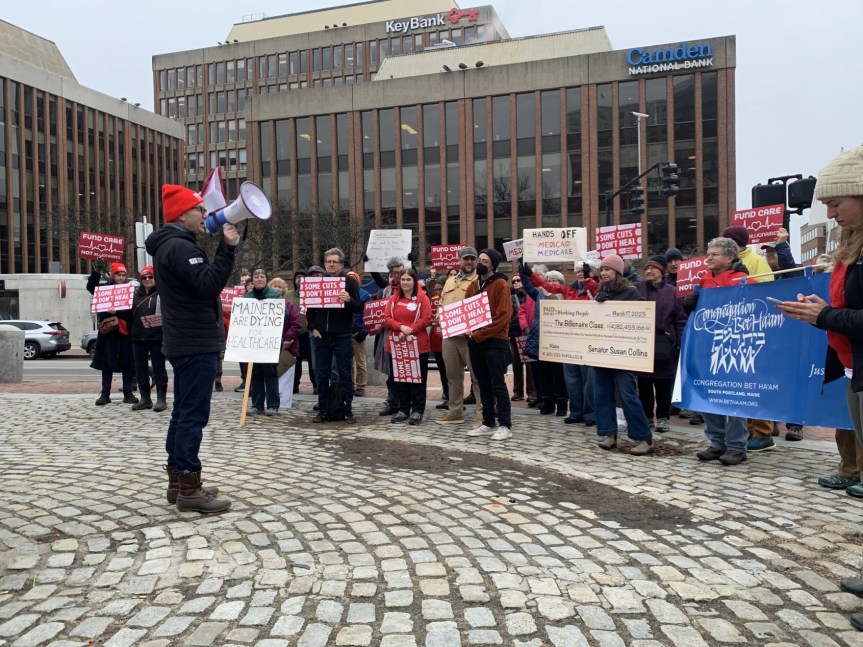
In Portland Maine on March 20, unionized nurses at Maine Medical Center, a big regional hub for sophisticated specialty care, staged a rally in defense of Medicaid outside Senator Susan Collins’s office. Their union, the Maine State Nurses Association/National Nurses Organizing Committee (MSNA/NNOC), made arrangements.

Emergency room nurse Kirsten Lane told the several dozen supporters on hand that, “People with chronic illnesses would not be getting the preventative care they need … We would see a lot of people showing up to the hospital sicker. We would see a lot of hospital crowding. We would see long wait times in the emergency room.”

Intensive care nurse Julianna Hansen remarked that, “The patients we see every day are some of the most vulnerable people in our state … “Our seniors, those with disabilities, and our young people are the ones who would most be hurt by cuts to MaineCare and CubCare … Union nurses stand against any cuts to our patients’ access to Medicaid.”  

(Medicaid in Maine is known as MaineCare; CubCare refers to children’s services provided under MaineCare.)

Some supporters of the nurses also spoke, including Dr. Julie Pease, longtime president of Maine AllCare, the Maine affiliate of Physicians for a National Health Program. The nurses then led the crowd in a march to Senator Collins’ office. They requested the senator’s surprised and grumpy staff to deliver their four-foot-long fake check to her.

According to pre-rally publicity, the check was “made out to the ‘Billionaire Class’ paid for by ‘Working People’ totaling $4,182,453,166 – the amount of Medicaid funding in Maine at risk if Sen. Collins votes to gut Medicaid to fund tax cuts for billionaires.”

The Maine Care program provides coverage for almost 400,000 Maine people─ 25% of the population ─ including two-thirds of Maine’s nursing home residents and half of Maine’s children. Nationally, 20% of all Americans and 40% of children receive healthcare through Medicaid. Medicaid covers 42 % of all births in the nation ─ almost 50% in Maine.

Maine has a Medicaid crisis of its own. The state government in early March was facing a $118 million shortfall in payments to providers for care covered under MaineCare. Many payments would be late in arriving. Spending on MaineCare consumed 32% of the state’s budget in 2023.

A supplemental budget aimed at meeting the shortfall did not survive Republican opposition in the legislature; a two thirds majority was required. The legislature then approved a two-year budget that provides for a one-year extension of MaineCare funding.

Apprehension exists that, if Medicaid funding is reduced, states will have to reduce expanded Medicaid services that were authorized under the Affordable Care Act, approved in 2014. Maine would have to remove 25,000 people enrolled in MaineCare, or else find $117 million more to replace lost federal funding.

According to the National Rural Health Association in February ─ Maine is a rural state ─“Medicaid funding is critical for sustaining rural healthcare systems, including hospitals, clinics, and community health centers.” The financial balances of almost half of rural hospitals are in the red.  Diminished flow of Medicaid funding threatens those hospitals’ existence. Their demise would lead to both preventable deaths in rural areas and significant job loss. All sorts of social and healthcare services of a preventative nature would disappear.

According to the KFF health policy news serviceMedicaid in 2023 covered 80% of children in poverty (and almost half of poverty-stricken adults). Medicaid also covers “nearly half of children with special health care needs.” Analyst Bruce Lesley reports that, “For millions of children with disabilities and chronic illnesses, Medicaid is the difference between survival and suffering.”

Studies of infant mortality in those states that chose expanded access to Medicaid under the Affordable Care Act show significantly reduced deaths of Black and Hispanic infants.  Mortality rates for them have been notoriously high in the United States for years.

Pressure on Senator Collins from the nurses’ union, MSNA/NNOC, reflects a wide vision. Indeed, the mission statement of National Nurses United starts out this way: “Through energetic advocacy we are organizing to: Win health care justice; accessible, quality health care for all, as a human right.”

Under the heading of sober reporting (we insist): the rally in Portland, Maine carried out by the unionized nurses represented something far beyond good news. Our collective prospects for the short and long terms took a sharp, upward turn.  


W.T. Whitney Jr. is a political journalist whose focus is on Latin America, health care, and anti-racism. A Cuba solidarity activist, he formerly worked as a pediatrician, and lives in rural Maine.

Cuba and China Exceed US in Life Expectancy, Send Message to the World – Socialism is the Difference / by W.T. Whitney Jr.


Children born in socialist Cuba and China can expect to live longer than children born in the capitalist United States. | AP photos

To extend a population’s life expectancy at birth (LEB) requires capabilities that are scarce in the United States. The U.S. LEB has fallen in the recent period, quite abruptly. Meanwhile, life expectancy in China and Cuba continues its long-term rise. To understand why we should explore nations’ varying capabilities to achieve social change and promote social gains.

Medical and sociological causes of death that relate to life expectancy and are specific to the United States will not be explored here. A subsequent report will cover that ground.

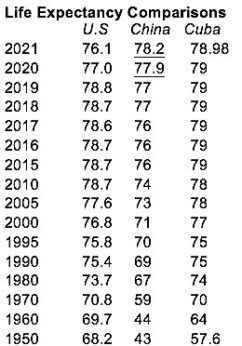
The U.S. National Center for Health Statistics on Aug. 31 set U.S. LEB for 2021 at 76.1 years, the same figure as in 1996. The decline from 77.0 years in 2020 and from 78.8 in 2019 was the greatest continuous U.S. fall in LEB in 100 years. Life expectancy for men in 2021, 73.2 years, represented an unprecedented male-female gap of almost six years (increased male mortality is routine).

Life expectancy for people in Cuba and for China now exceeds that for people born in the United States. Cuba’s LEB rose from 57.6 years in 1950 to 79 years in 2021—an advance of over 21 years. In those years, China’s LEB moved from 43 years to 78.2 years—a 35.2-year increase—and LEB for Americans rose by 7.9 years. The Cuban and Chinese achievements of drastically improving life expectancy in a few years and from very low levels are remarkable.

Policies put in place following the two countries’ socialist revolutions led to wide-ranging social initiatives that are protective of all people’s lives and, incidentally, crucial for long life expectancy. Capitalist governments, less oriented to social change, are prone to tolerating gaps in social development.

The two socialist countries pursued particular objectives to achieve social gains. Specifically, they have endeavored to establish working-class political power, promote decent and healthy lives for all working people, eradicate major economic inequalities, and build unity.

Some capitalist countries have also attempted to fulfill a few of these objectives when under left-wing governance, with mixed success. A look at how well they may have succeeded, and at some of the consequences when they have not, may shed light on the failings of capitalist states to support the lives of their people, particularly the U.S.’ failure to sustain a LEB that in 2020 was already lower than that of 53 other countries.

The subject of providing social support is, of course, vast. On that account, the discussion here pays more attention to health care and less to other areas. It draws on the insights of Vicente Navarro, professor of public health and public policy at universities in Baltimore and Barcelona.

As regards working-class political power, Navarro maintains that “countries with strong labor movements, with social democratic and socialist parties…have developed stronger redistribution policies and inequality-reducing measures…. These worker-friendly countries consequently have better health indicators [including LEB] than those countries where labor movements are very weak, as is the case in the United States.”

Navarro blames the lack of universal health care in the United States, unique among industrialized nations, on the lack there of a strong labor movement and/or a labor or socialist party. Political power exerted by the organized working class in industrialized nations may vary, but it almost always exceeds workers’ power in the United States, where statistical markers of health outcome are decidedly less favorable.

The political weakness of the organized workers’ movement in the United States is clear. “The working class,” Navarro writes in 2021, does not appear anywhere in the Cabinet nor the Senate, and only appears in the House with an extremely limited representation of 1.3 percent.” Most “members of these institutions belong to the corporate class, closely followed by upper-middle class.” He condemns the “privatization of the electoral process,” in which “there is no limit to how much money can go to the Democratic or Republican party or their candidates.”

Decent and healthy lives are far from routine in capitalist countries, where poor health is associated with low social-economic status. Navarro reports that, in the United States, the “blue-collar worker has a mortality rate from heart conditions double that of the professional class. Mortality differentials by social class are much larger in the United States than in Western Europe.”

He notes that “top level British civil servants live considerably longer than do lower level ones,” and that “members of the [Spanish] bourgeoisie…live an average of two years longer than the petit bourgeoisie…who live two years longer than the middle class, who live two years longer than the skilled working class, who live two years longer than members of the unskilled working class, who live two years longer than the unskilled [and unemployed] working class.”

Alienation under capitalism exacerbates health problems. According to Navarro, “the distance among social groups and individuals and the lack of social cohesion that this distance creates is bad for people’s health and quality of life.” The social isolation he describes adds to challenges faced by social support systems and detracts from the usefulness of interventions.

Attempts by capitalist countries to remove wealth inequalities, especially in the health care arena, show mixed success. As commercialization of healthcare advances, difficulties mount. As the result of profit-taking in that sector, society-wide inequalities are aggravated, and working people lose equal access to quality care.

And yet some form of public overview of, or support for, health care sectors is more or less routine in the various capitalist countries. In many, public authorities operate and pay for hospitals, nursing homes, staffing, drugs, equipment, and training. But the infiltration of market prerogatives and privatization in the health care systems of richer countries now threatens long established goals of accessible health care for all.

In Europe, austerity campaigns under neoliberal auspices have led to cutbacks in publicly provided care. Privatization inroads blunted the institutional response in Europe to the COVID-19 pandemic. Investor groups have been eyeing the hospital and nursing home sectors as profit-making opportunities. According to the Lancet medical journal, privatization within the British National Health Service contributed to an increase in preventable deaths from all causes between 2013 and 2020.

The United States is the poster child of war in defense of privilege. There are stories, from health care:

In 2020 salary and benefits for William J. Caron, Jr., CEO of MaineHealth, a major care provider in the author’s locality, were $1,992,044; for Richard W. Petersen, Maine Medical Center CEO, they were $1,822,185. A commentator notes that “Hospital CEOs are compensated primarily for the volume of patients that pass through their doors—so-called “heads in beds.” Average annual income for U.S. primary care physicians was $260,000 in 2021; for specialists, $368,000.

According to bain.com, “Medtech companies are among the most profitable in the healthcare industry, with margins averaging 22%…profit pools [will] grow to $72 billion in 2024.” And “HME (home medical equipment) retail companies average 45 percent gross profit margin (GPM).”

Researchers found that between 2000 and 2018, the “median annual gross profit margin” (gross profit is revenue minus costs) of 35 pharmaceutical companies was 39.1% higher than that of 357 non-pharmaceutical companies. The CEOs of three major pharmaceutical companies” increased their wealth by “a total of $90 million” in 2018. As for COVID-19 vaccine manufacturers: “Moderna’s and BioNTech’s 2021 net profit margins reached 66% and 54%, respectively.”

The matter of creating unity to establish socialism and arrange for the common good needs little comment. Unity within society is a near impossibility under capitalism, inasmuch as divisions there are inherent to a world of greed and individualism. Meanwhile, China, opting in favor of life, put on a magnificent display of socialist unity as its people grappled with the pandemic.

The government imposed strong preventative measures and accepted the inevitability of economic disruption and loss. China’s COVID-19 mortality rate is 1.07 deaths per 100,000 persons. Its U.S. counterpart never seemed to choose and, that way protected economic growth. The U.S. COVID-19 mortality rate is 319.59 deaths per 100,000 persons.

It is important, finally, to lay to rest any suggestion that the riches of the United States and other capitalist nations automatically enable them to offer long life expectancies. Individualized entitlement to wealth is basic to how they operate, and that’s a contradiction and an obstacle.

A society aiming to pursue social initiatives that are comprehensive and directed to all population groups equally is a society that has to redistribute wealth. Wealth redistribution is the necessary adjunct to the objectives already discussed. The message here is that capitalist-inspired measures don’t make the grade and that socialist programs, as in Cuba and China, do work and do offer the promise of decent and secure lives to entire populations.

As with all op-eds published by People’s World, this article reflects the opinions of its author.

W.T. Whitney Jr. is a political journalist whose focus is on Latin America, health care, and anti-racism. A Cuba solidarity activist, he formerly worked as a pediatrician, lives in rural Maine. W.T. Whitney Jr. es un periodista político cuyo enfoque está en América Latina, la atención médica y el antirracismo. Activista solidario con Cuba, anteriormente trabajó como pediatra, vive en la zona rural de Maine.

People’s World, September 21, 2022, https://www.peoplesworld.org/

In a world of great disorder and extravagant lies, we look for compassion / by Vijay Prashad

Francisca Lita Sáez (Spain), An Unequal Fight, 2020.

Greetings from the desk of Tricontinental: Institute for Social Research.

These are deeply upsetting times. The COVID-19 global pandemic had the potential to bring people together, to strengthen global institutions such as the World Health Organisation (WHO), and to galvanise new faith in public action. Our vast social wealth could have been pledged to improve public health systems, including both the surveillance of outbreaks of illness and the development of medical systems to treat people during these outbreaks. Not so.

Studies by the WHO have shown us that health care spending by governments in poorer nations has been relatively flat during the pandemic, while out-of-pocket private expenditure on health care continues to rise. Since the pandemic was declared in March 2020, many governments have responded with exceptional budget allocations; however, across the board from richer to the poorer nations, the health sector received only ‘a fairly small portion’ while the bulk of the spending was used to bail out multinational corporations and banks and provide social relief for the population.

In 2020, the pandemic cost the global gross domestic product an estimated $4 trillion. Meanwhile, according to the WHO, the ‘needed funding … to ensure epidemic preparedness is estimated to be approximately U.S.$150 billion per year’. In other words, an annual expenditure of $150 billion could likely prevent the next pandemic along with its multi-trillion-dollar economic bill and incalculable suffering. But this kind of social investment is simply not in the cards these days. That’s part of what makes our times so upsetting.

S. H. Raza (India), Monsoon in Bombay, 1947–49.

On 5 May, the WHO released its findings on the excess deaths caused by the COVID-19 pandemic. Over the 24-month period of 2020 and 2021, the WHO estimated the pandemic’s death toll to be 14.9 million. A third of these deaths (4.7 million) are said to have been in India; this is ten times the official figure released by the Government of Prime Minister Narendra Modi, which has disputed the WHO’s figures. One would have thought that these staggering numbers–nearly 15 million dead globally in the two-year period–would be sufficient to strengthen the will to rebuild depleted public health systems. Not so.

According to a study on global health financing, development assistance for health (DAH) increased by 35.7 percent between 2019 and 2020. This amounts to $13.7 billion in DAH, far short of the projected $33 billion to $62 billion required to address the pandemic. In line with the global pattern, while DAH funding during the pandemic went towards COVID-19 projects, various key health sectors saw their funds decrease (malaria by 2.2 percent, HIV/AIDS by 3.4 percent, tuberculosis by 5.5 percent, reproductive and maternal health by 6.8 percent). The expenditure on COVID-19 also had some striking geographical disparities, with the Caribbean and Latin America receiving only 5.2 percent of DAH funding despite experiencing 28.7 percent of reported global COVID-19 deaths.

Sajitha R. Shankar (India), Alterbody, 2008.

While the Indian government is preoccupied with disputing the COVID-19 death toll with the WHO, the government of Kerala–led by the Left Democratic Front–has focused on using any and every means to enhance the public health sector. Kerala, with a population of almost 35 million, regularly leads in the country’s health indicators among India’s twenty-eight states. Kerala’s Left Democratic Front government has been able to handle the pandemic because of its robust public investment in health care facilities, the public action led by vibrant social movements that are connected to the government, and its policies of social inclusion that have minimised the hierarchies of caste and patriarchy that otherwise isolate social minorities from public institutions.

In 2016, when the Left Democratic Front took over state leadership, it began to enhance the depleted public health system. Mission Aardram (‘Compassion’), started in 2017, was intended to improve public health care, including emergency departments and trauma units, and draw more people away from the expensive private health sector to public systems. The government rooted Mission Aardram in the structures of local self-government so that the entire health care system could be decentralised and more closely attuned to the needs of communities. For example, the mission developed a close relationship with the various cooperatives, such as Kudumbashree, a 4.5-million-member women’s anti-poverty programme. Due to the revitalised public health care system, Kerala’s population has begun to turn away from the private sector in favour of these government facilities, whose use increased from 28 percent in the 1980s to 70 percent in 2021 as a result.

As part of Mission Aardram, the Left Democratic Front government in Kerala created Family Health Centres across the state. The government has now established Post-COVID Clinics at these centres to diagnose and treat people who are suffering from long-term COVID-19-related health problems. These clinics have been created despite little support from the central government in New Delhi. A number of Kerala’s public health and research institutes have provided breakthroughs in our understanding of communicable diseases and helped develop new medicines to treat them, including the Institute for Advanced Virology, the International Ayurveda Research Institute, and the research centres in biotechnology and pharmaceutical medicines at the Bio360 Life Sciences Park. All of this is precisely the agenda of compassion that gives us hope in the possibilities of a world that is not rooted in private profit but in social good.

Nguyễn tư Nghiêm (Vietnam), The Dance, 1968.

In November 2021, Tricontinental: Institute for Social Research worked alongside twenty-six research institutes to develop A Plan to Save the Planet. The plan has many sections, each of which emerged out of deep study and analysis. One of the key sections is on health, with thirteen clear policy proposals:

If even half of these policy proposals were to be enacted, the world would be less dangerous and more compassionate. Take point no. 6 as a reference. During the early months of the pandemic, it became normal to talk about the need to support ‘essential workers’, including health care workers (our dossier from June 2020, Health Is a Political Choice, made the case for these workers). All those banged pots went silent soon thereafter and health care workers found themselves with low pay and poor working conditions. When these health care workers went on strike–from the United States to Kenya–that support simply did not materialise. If health care workers had a say in their own workplaces and in the formation of health policy, our societies would be less prone to repeated healthcare calamities.

1. Advance the cause of a people’s vaccine for COVID-19 and for future diseases.
2. Remove patent controls on essential medicines and facilitate the transfer of both medical science and technology to developing countries.
3. De-commodify, develop, and increase investment in robust public health systems.
4. Develop the public sector’s pharmaceutical production, particularly in developing countries.
5. Form a United Nations Intergovernmental Panel on Health Threats.
6. Support and strengthen the role health workers’ unions play at the workplace and in the economy.
7. Ensure that people from underprivileged backgrounds and rural areas are trained as doctors.
8. Broaden medical solidarity, including through the World Health Organisation and health platforms associated with regional bodies.
9. Mobilise campaigns and actions that protect and expand reproductive and sexual rights.
10. Levy a health tax on large corporations that produce beverages and foods that are widely recognised by international health organisations to be harmful to children and to public health in general (such as those that lead to obesity or other chronic diseases).
11. Curb the promotional activities and advertising expenditures of pharmaceutical corporations.
12. Build a network of accessible, publicly funded diagnostic centres and strictly regulate the prescription and prices of diagnostic tests.
13. Provide psychological therapy as part of public health systems.

Roque Dalton

There’s an old Roque Dalton poem from 1968 about headaches and socialism that gives us a taste of what it will take to save the planet:

It is beautiful to be a communist,
even if it gives you many headaches.

The communists’ headache
is presumed to be historical; that is to say,
that it does not yield to painkillers,
but only to the realisation of paradise on earth.
That’s the way it is.

Under capitalism, we get a headache
and our heads are torn off.
In the revolution’s struggle, the head is a time-bomb.

In socialist construction,
we plan for the headache
which does not make it scarce, but quite the contrary.
Communism will be, among other things,
an aspirin the size of the sun.

Originally published: Tricontinental: Institute for Social Research on May 12, 2022

Vijay Prashad is an Indian historian, editor and journalist. He is a writing fellow and chief correspondent at Globetrotter, a project of the Independent Media Institute. He is the chief editor of LeftWord Books and the director of Tricontinental: Institute for Social Research. He has written more than twenty books, including The Darker Nations: A People’s History of the Third World (The New Press, 2007), The Poorer Nations: A Possible History of the Global South (Verso, 2013), The Death of the Nation and the Future of the Arab Revolution (University of California Press, 2016) and Red Star Over the Third World (LeftWord, 2017). He writes regularly for Frontline, the Hindu, Newsclick, AlterNet and BirGün.

MR Online, May 13, 2022, https://mronline.org/