
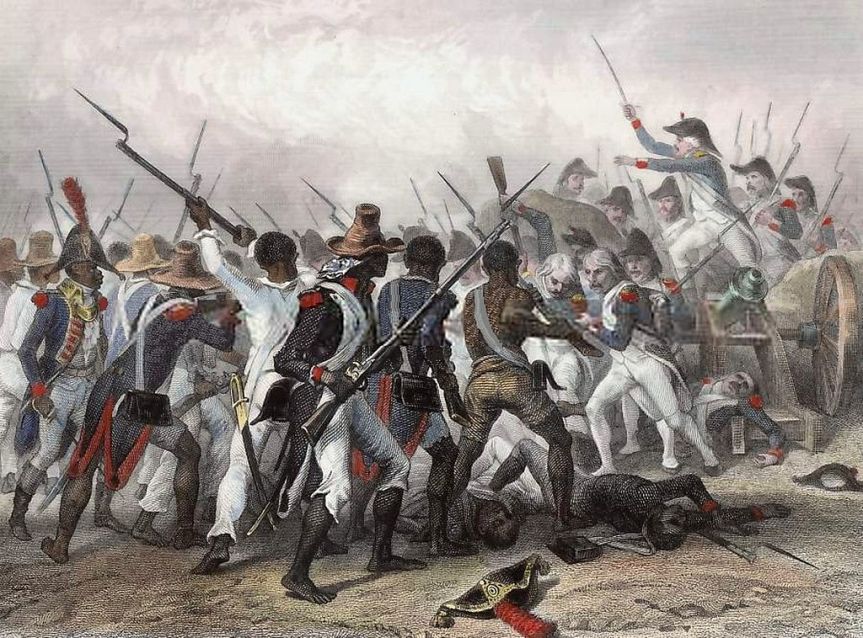
Haitian Revolution: Attack and take of the Crête-à-Pierrot (March 24, 1802). Original illustration by Auguste Raffet, engraving by Ernst Hébert. | Public Domain
Reposted from Peoples World
Republican presidential and vice-presidential candidates expressed horror a couple of weeks ago on apparently learning from social media that Haitian migrants in Springfield, Ohio, were eating dogs and cats, “eating people’s pets,” as Trump put it. The reports, as we all know now, were false, but their fallout was quite real. Bomb threats followed, schools and public buildings closed down, and longtime African-American residents felt threatened.
A bit of backstory: Springfield’s economy lost jobs and industries over the years. Some 15,000 Haitians arrived, eager to work. Industry expanded, but social service providers were stressed. Most of the Haitians in Springfield are there under Temporary Protected Status. That governmental designation enables migrants forced out of their counties by serious crises to enter the United States legally.
The bizarre twist of political behavior stems in part from the migrants being Haitian. Haitians and their nation have been problematic for the United States’ ruling class for more than two centuries.
The fact of migration itself does not account for the exaggerated hostility, though. Almost nothing of that order happens to the one-third of New York state residents and 40.9% of Miamians who are immigrants, or to the foreign-born residents of nine other urban areas in the United States who comprise from 21.1% to 39.1% of the several populations.
Stresses and frustrations associated with Springfield’s economic decline logically enough could have stimulated hostility toward migrants, if we look at what has happened historically in other communities. But economist Franklin J. James rejects the idea “that immigration hurts U.S. natives by reducing job opportunities …[and] that immigrants displace natives from jobs or reduce earnings of the average worker.”
Being Black may indeed invite hostility in a racist society, however. But the disconnect is sharp between the rarity of unbounded disparagement at high political levels and the large numbers of African-descended people who never experience the like from anybody. Opportunities abound. In 2019 Black people made up from 21.6% to 48.5% of the populations of 20 U.S. cities. That year nine Ohio cities, not including Springfield, claimed between 32.0% and 11.2% Black people. In 2024, 17.4% of Springfield residents are Black.
The scenario in Springfield may itself have been toxic: A large number of Black people from abroad arrived together on an economically depressed small city. But Somali migrants arrived in Lewiston, Maine under similar circumstances, and their reception was different.
They showed up in 2001, and a year later numbered 2,000 or so. In January 2003, an Illinois-based Nazi group staged a tiny anti-Black rally; 4,500 Mainers joined in a counter-demonstration.
As of 2019, according to writer Cynthia Anderson, “Lewiston … has one of the highest per capita Muslim populations in the United States, most of it Somali along with rising numbers of refugees and asylum-seekers from other African nations.” Of Lewiston’s 38,404 inhabitants, 10.9% presently are “Black or African American.” Blacks are 1.4% of Maine’s population.
Anderson reports that with the influx of migrants, Lewiston “has struggled financially, especially early on as the needs for social services and education intensified. Joblessness remains high among the older generation of refugees.”
Lewiston is Maine’s poorest city. For generations, massive factories along the Androscoggin River produced textiles and shoes, but they are gone. The city’s poverty rate is 18.1%; for Blacks it’s 51.5%. In 2016, 50% of Lewiston’s children under the age of five lived in poverty.
Citing school superintendent Bill Webster, an AP report indicates “immigrant children are doing better than native-born kids” in school, and are “going off to college to get degrees, as teachers, doctors, engineers.”
Analyst Anna Chase Hogeland concludes: “The Lewiston community’s reaction to the Somalis demonstrated both their hostility and reservations, as well as the great efforts of many to accommodate and welcome the refugees.” Voters in Lewiston are conservative; the majority of them backed Donald Trump in the 2016 and 2020 presidential elections.
The circumstances under which the two cities received Black immigrants differed in two ways. A nationwide upsurge in racist rhetoric and anti-immigrant hostility worsened conditions for migrants in Springfield. Lewiston’s experience had played out earlier.
Additionally, immigrants arriving in Springfield qualified for special attention. The aforementioned political candidates could have exercised their anti-migrant belligerence in many cities. They chose Springfield, presumably because the migrants there, objects of their wrath, are Haitian. Why are Haitians vulnerable?

Black people in what is now Haiti boldly rebelled against enslavement on French-owned plantations. Remarkably, they expelled the French and in 1804 established the independent nation they called Haiti.
Ever since, the United States has spelled trouble for Haiti. Pre-eminent abolitionist Frederick Douglas pointed out in 1893 that, “Haiti is black and we [the United States] have not yet forgiven Haiti for being black.” Long after “Haiti had shaken off the fetters of bondage…we continued to refuse to acknowledge the fact and treated her as outside the sisterhood of nations.”
Scholar and activist W.E.B DuBois, biographer of abolitionist John Brown, explains that “there was hell in Hayti (sic) in the red waning of the eighteenth century, in the days when John Brown was born … [At that time] the shudder of Hayti was running through all the Americas, and from his earliest boyhood he saw and felt the price of repression—the fearful cost that the western world was paying for slavery.”
DuBois’s reference was to the U.S. slavocracy and its encouragement of collective fear among many white people that Black workers—bought, owned, and sold—might rise up in rebellion. They did look to the example of Haiti and did rebel—see Herbert Aptheker, American Negro Slave Revolts.
In the United States, from the Civil War on, the prospect of resistance and rebellion on the part of Black people has had government circles and segments of U.S. society on high alert.
That attitude, applied to Haiti, shows in:
- S. instigation of multi-national military occupations intermittently since 2004.
- Coups in 1991 and 2004 involving the CIA and/or U.S.-friendly paramilitaries.
- Backing of the Duvalier family dictatorship between 1957 and 1986.
- The brutal U.S. military occupation of Haiti between 1915 and 1934.
- S. control of Haiti’s finances and government departments until 1947.
- No diplomatic recognition of Haiti from its beginning nationhood in 1804 until 1862.
- S. economic sanctions against Haiti for decades, until 1863.
Says activist lawyer Bill Quigley: “U.S.-based corporations have for years been teaming up with Haitian elite to run sweatshops teeming with tens of thousands of Haitians who earn less than $2 a day.”
Ultimately, it seems, threads of governmental callousness, societal disregard for basic human needs, and outright demagoguery coalesced to thrust Springfield and Haitian migrants into the national spotlight. Molelike, the anomalous and little-acknowledged presence of Haiti asserts itself in the unfolding of U.S. history.
As with all op-eds and news-analysis articles published by People’s World, this article reflects the views of its author.
We hope you appreciated this article. At People’s World, we believe news and information should be free and accessible to all, but we need your help. Our journalism is free of corporate influence and paywalls because we are totally reader-supported. Only you, our readers and supporters, make this possible. If you enjoy reading People’s World and the stories we bring you, please support our work by donating or becoming a monthly sustainer today. Thank you!
W.T. Whitney Jr. is a political journalist whose focus is on Latin America, health care, and anti-racism. A Cuba solidarity activist, he formerly worked as a pediatrician, lives in rural Maine. W.T. Whitney Jr. es un periodista político cuyo enfoque está en América Latina, la atención médica y el antirracismo. Activista solidario con Cuba, anteriormente trabajó como pediatra, vive en la zona rural de Maine.

 COMMUNIST PARTY OF MAINE