
Ecuador vote shows contrasting roles of political parties and social movements / By W.T. Whitney, Jr.

An electoral official shows the ballot for a presidential election in Ayora, Ecuador, Sunday, Aug. 20, 2023. The election was called after President Guillermo Lasso dissolved the National Assembly by decree in May to avoid being impeached. | Dolores Ochoa / AP

Originally posted in People’s World on August 31, 2023


On Aug. 20 in Ecuador, 45-year-old lawyer Luisa González of the Citizen’s Revolution movement political party (RC) gained 33.6% of the votes in first-round balloting for eight presidential candidates. Second-place candidate Daniel Noboa of the National Democratic Action, a 35-year-old business man and political neophyte, took 23.4% of the vote. González and Noboa will be competing in second round voting on Oct. 15.

As for the elections to the National Assembly, the RC accounted for 39.4% of the votes, three other parties for 45% of those votes, and five smaller parties for the remaining ballots.

The voters also considered referendums, one on halting oil extraction from Ecuador’s huge Yasuní National Park and the other on prohibiting mining activities in a biosphere region northeast of Quito. The referendums were approved by 59% and 68% of the voters, respectively.

The circumstances were unusual. Two processes played out on parallel tracks and culminated together. These were political parties taking part in elections and social movements pursuing referendums. Contradictions emerged along with the promise of troubles ahead and signs of commitment and hope.

The new president will serve only the 18 months that remain in the term of Guillermo Lasso, elected in 2021 for a five-year term. When confronted with impeachment proceedings in May 2023 on corruption charges, Lasso dissolved the National Assembly and thereby, as provided by the Constitution, set in motion preparations for a new election and his own departure.

Nationwide Indigenous protests in 2022 accelerated the transition now taking place amidst violence attributed to narco-trafficking that took 4,671 lives during the past year. The election campaign itself provoked killings, those of presidential candidate Fernando Villavicencio, a legislator, journalist, and labor leader; the mayor of Manta, Agustín Intriago, and others.

The Citizen’s Revolution movement political party, represented by presidential candidate Luisa González, defends policies of social assistance and national development introduced under the leadership of former President Rafael Correa during his tenure from 2007 to 2017. The CR took shape in reaction to the neoliberal turn taken by the government of Lenin Moreno, Correa’s former vice president and successor.

Its predecessor party, under Correa’s democratic-socialist leadership, managed the national economy so as to preserve funds for social programs through reliance on petroleum exports and foreign credit. The RC led left-leaning forces in opposing the neoliberal government of Guillermo Lasso, in power since 2021.

With his second-place finish in the recent voting, candidate Daniel Noboa surpassed expectations, due in part to a stellar TV debate performance. He represents wealth and power. His father, a five-time presidential candidate, and his uncle preside over an agro-export and real estate conglomerate made up of 200 business entities. They owe the government $1 billion in back taxes.

Now campaigning for the second round of presidential elections, RC candidate González would seem to differ greatly from the prince of such an empire. “We are going to deal with the basic causes of violence and criminality which are hunger, poverty, lack of education, and the absence of opportunity,” she noted as she was accepting her party’s nomination.

But all is not as it appears. The positions taken by the various presidential candidates on the referendums were revealing. Only four of the eight candidates unambiguously supported the Yasuní referendum; three of them represented right-wing parties. Noboa justified leaving oil underground based on his conclusion that the financial yield is low and that over-reliance on oil exports impedes diversification of the economy.

The Correa-inspired RC movement and its candidate Gonzalez rejected the Yasuní referendum. Previous governments, governments headed by Correa in particular, took the position that income from oil exports is crucial to continued funding of social advances.

The contrast between approval at the polls shown for the candidates of political parties and for approval of the referendums was striking─33.6% and 23.4%, respectively, versus 68% and 59%, respectively. One set of the voting results testified to activists’ enthusiasm and commitment.

Approval of the two referendums reflects the advocacy and hard work of environmentalists, Indigenous activists, and supporters of women’s rights. According to NACLA.org: “The vote marks a triumph for the country’s grassroots anti-extractivist, ecological, and Indigenous movements, whose road to victory comes from a decade of social and political conflicts over extractive industry policies.”

Journalist Gabriela Barzallo surveys collective efforts toward restraining oil extraction. Highlighting the persistent participation of social movements, she quotes Ecuadorian sociologist Gregorio Páez:

“This upcoming referendum … serves as an inspiration for all Ecuadorians to have the agency to decide over our natural resources, and to empower people to see that grassroots activism really can have changes in policies.”

Páez sees activism in Ecuador as “inspiring social movements on a global scale.”

Analyst Santiago Kingman explores the impact of social movements on the elections:

“The triumph of the social movements is understood as a positive response from cities and areas far removed from the oil-producing world. At least 59% of Ecuador’s citizens…are alienated from the electoral system and political parties and say they have another way of doing politics. Those who voted for Noboa [who favored the referendum’s approval] are against politics, but they are not anti-capitalists. The social organizations behind the referendums are anti-capitalists and are anti-political parties.” 

Social movements have shaped political resistance throughout Latin America, in some countries more than others. They flourish, it seems, in situations of grief at the hands of international capitalism. Resonating there is contention over control of land and sub-soil resources, provision of energy, debt owed to foreign creditors, and prescriptions for domestic economies from abroad.

Capitalist-oriented political parties, often enablers of foreign predators, offer little resistance. Social movements active in Peru, Chile, Bolivia, Colombia, and now Ecuador have partially filled the void. Social movements operating in conjunction with anti-capitalist governments have different job descriptions.

Imaginings lead to speculation about an expanded role for social movements in the capitalist powerhouse nations. One recalls U.S. labor uprisings in the 1930s and the civil rights movement that peaked a few decades later.


We hope you appreciated this article. At People’s World, we believe news and information should be free and accessible to all, but we need your help. Our journalism is free of corporate influence and paywalls because we are totally reader-supported. Only you, our readers and supporters, make this possible. If you enjoy reading People’s World and the stories we bring you, please support our work by donating or becoming a monthly sustainer today. Thank you!

W. T. Whitney Jr.

W.T. Whitney Jr. is a political journalist whose focus is on Latin America, health care, and anti-racism. A Cuba solidarity activist, he formerly worked as a pediatrician, lives in rural Maine. W.T. Whitney Jr. es un periodista político cuyo enfoque está en América Latina, la atención médica y el antirracismo. Activista solidario con Cuba, anteriormente trabajó como pediatra, vive en la zona rural de Maine.
Bolivia’s socialist government confronts separatist, racist uprising / by W. T. Whitney Jr.

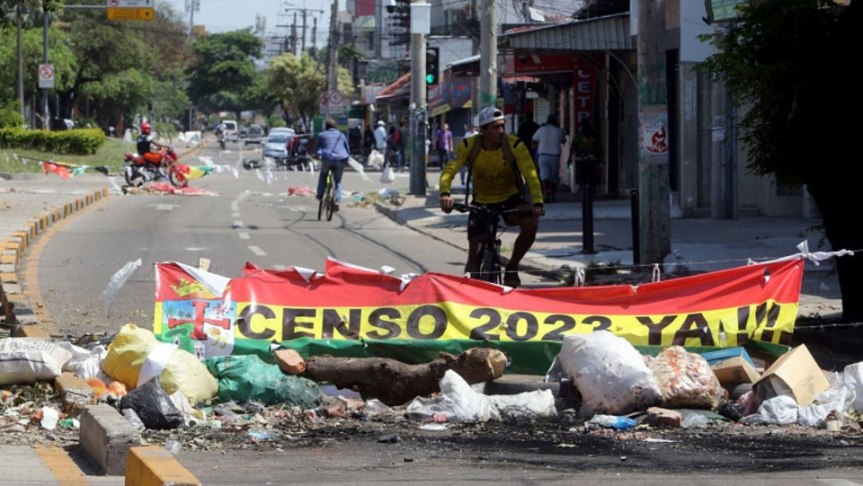
A banner reads ‘2023 census now!’ at a blockade on a Santa Cruz street. | via Twitter

With the exception of a coup-government interregnum in 2019-2021, the Movement Toward Socialism political party (MAS) has headed Bolivia’s government since the beginning of Evo Morales’s presidency in 2006.

The MAS government now led by President Luis Arce and Vice President David Choquehuanca announced on July 12 that its every-ten-year Population and Housing Census would be moved from November 16, 2022, to sometime in 2024.

Spokespersons attributed the change to difficulties left over from the pandemic, a need for translations into indigenous languages, uncertain financial resources, and extra time required for “technical” changes.

Leaders of the Santa Cruz department in Bolivia’s eastern lowlands, the nation’s largest, immediately demanded a census in 2023, not in 2024. Department governor Luis Camacho and Rómulo Calvo, president of the Santa Cruz Civic Committee, warned that without a settlement on the census, they would initiate a strike aimed at undoing the department’s economy, and thereby the national economy.

In response, “over one million Bolivians mobilized” on Aug. 25 in support of the government and against a regional leadership group that is the vanguard of opposition to Bolivia’s socialist and indigenous-led government. Even so, the strike began on Oct. 22. Recent Bolivian history suggests another coup may be in the offing.

Why a seemingly routine piece of government business like staging a census might provoke momentous consequences is not obvious. A look at expectations attached to Bolivia’s census and at the nature of Santa Cruz politics may clarify.

Census results help to determine the national distribution of government-provided services and resources and are the basis for each department’s representation in the national Legislative Assembly. Opposition forces in Santa Cruz see operation of the national census, as presently constituted, as beneficial to their side, particularly for the national elections of 2025.

They see advantage in the increased numbers of indigenous peoples migrating recently from Bolivia’s poverty-stricken highlands to economically-resourced Santa Cruz. That advantage rests on indigenous peoples showing up on the census with an identity other than indigenous.

The national census in 2012 fueled controversy when it showed that many indigenous people identify themselves as mestizo and not as belonging to a particular indigenous nation. That was encouraging to the reactionary and racist Santa Cruz leaders, who have no enthusiasm for increased indigenous representation in the national legislative assembly.

The Arce government, by contrast, objects to an undercount of indigenous people and especially in the eastern lowland departments, where their numbers are increasing.

The category of mestizo did not appear in the census of 2012 and is not part of the census in dispute now. The Santa Cruz leaders are insisting that that mestizo identity be incorporated into the census. Expert advice was sought in 2012 and the Arce government is now proposing the same.

The peculiarities of Santa Cruz are central to this story. For one thing, Bolivia’s four easternmost departments, particularly Santa Cruz, produce most of Bolivia’s wealth. Santa Cruz is home to industrial-scale agricultural operations and to facilities for oil and natural gas production. This lowland region accounts for most of Bolivia’s export income.

The realities are these: Santa Cruz alone accounts for 76% of the country’s food production, for all of its sorghum and sunflower oil production, 99% of its soy products, 92% of its sugar cane, 75% of its wheat, 72% of its rice, and 66% of its corn. In 2021, farmers owned 4.6 million head of cattle, over a million pigs, and 130 million chickens.

Among departments, Santa Cruz consumes 39% of the country’s diesel fuel and contains the bulk of Bolivia’s natural gas reserves, which rate as South America’s second largest. The Financial Times lauds the Santa Cruz economy’s explosive growth and large foreign investments. It mentions Santa Cruz city as one of the world’s fastest growing urban areas.

Also relevant to the strike story is the reactionary and racist nature of opposition leaders in Santa Cruz. They are utilizing the department’s “Civic Committee” to organize the strike and the Union of Santa Cruz Youth to carry out violent, paramilitary-style street actions. Gov. Luis Camacho formerly headed the Santa Cruz Civic Committee.

The civic committees of all departments originated decades ago in response to national-regional tensions. Members of formerly eastern European families, some of them big landowners, belong to the Santa Cruz civic committee. Many brought fascist ideology with them when they immigrated to Bolivia after World War II.

At the last of three big gatherings in Santa Cruz, Camacho on Sept. 30 announced the start on Oct. 22 of an anti-government strike of “indefinite” duration. In operation, the strike has led to barriers being placed across major highways to impede exports and in-country deliveries of commodities, mainly food. Strike leaders have forced key factories and commercial centers to shut down.

The Youth Union and other thugs have carried out anti-government demonstrations and fought in the streets against MAS party supporters and the national police. There have been injuries, human rights violations, and one death. The strike has had little impact in the other eastern departments.

With a presence at border crossings, the strikers have sharply reduced the transit of exported goods. Government authorities on Oct. 27, anticipating domestic food shortages, banned all exports from Santa Cruz of soy products, beef, sugar, and vegetable oil.

The government and MAS activists organized a rally and march by hundreds of thousands of people before the strike began, and another on the day after. In La Paz on Oct. 26, confrontation between government supporters and an opposition march left 20 persons wounded.

The government on Oct. 25 held a “Pluri-national Encuentro for a Census with Consensus.” Officials from throughout the country attended. A proposal emerged that would enable a technical commission to determine a date for the national census.

Camacho rejected it, but opposition leaders Rómulo Calvo and Vicente Cuellar accepted the proposal. In an interview, Camacho asserted that federalism remains the only solution to the “fissure” present since the “founding of the Republic.”

On Nov. 1, President Arce, referring to threats to “national integrity,” called upon military leaders “to guarantee and defend the independence, unity, and integrity of our territory.” A presidential spokesperson indicated that Arce favored new negotiations with no established date for the census and without conditions.

Events in Santa Cruz align with a grim history. President Evo Morales’s accession to power in 2006 was a culmination of old indigenous resistance against European colonialists and of recent pushback against neoliberal assaults inflicted by local enablers of U.S. and European ruling-class objectives.

Social gains achieved by the MAS-led government and its program of modest wealth distribution seemed to cement its place in history and certainly inflamed the animosities of reactionaries in Santa Cruz and nationally.

As a new constitution was being shaped—it was approved in 2009—Santa Cruz and its neighboring eastern departments staged a separatist revolt fueled by racism. A failed assassination plot against Morales in 2008 was part of it. During this period, the Morales government expelled a U.S. ambassador and the U.S. Drug Enforcement Agency.

The U.S. government and the Organization of American States, serving the United States, facilitated the coup that removed the Morales government in 2019 after his election to a fourth term. Luis Camacho of Santa Cruz led the coup and reportedly delivered the U.S. moneys used in various payoffs. Bolivia’s military participated.

The president of the coup government, Jeanine Áñez, is now in prison, in part because of human rights abuses and killings by soldiers during her tenure.

The current MAS-led government came into existence in 2020 following the first-round electoral victory of Arce and Choquehuanca. Its approval rating currently is 51%. The present strike has set back governmental efforts to restore a national economy devastated by the coup government’s neoliberal reforms and by pandemic effects.

Arce, reporting to the Legislative Assembly on Nov. 8, indicated that “We have complete certainty that our people are fully behind us and that they recognize a national patriotic government that looks out for the national welfare, which stands above sectarian and regional interests.” He observed that “in times of crisis, it’s always the poor that end up losing more, or losing everything.”


W.T. Whitney Jr. is a political journalist whose focus is on Latin America, health care, and anti-racism. A Cuba solidarity activist, he formerly worked as a pediatrician, lives in rural Maine. W.T. Whitney Jr. es un periodista político cuyo enfoque está en América Latina, la atención médica y el antirracismo. Activista solidario con Cuba, anteriormente trabajó como pediatra, vive en la zona rural de Maine.

People’s World, November 10, 2022, https://peoplesworld.org/