
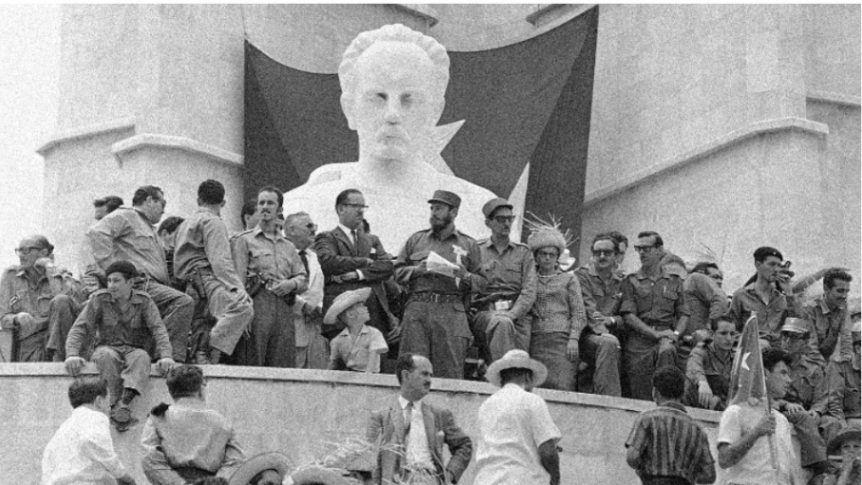
Photo: Fidel Castro, center, at the May Day 1960 parade in Havana at the Jose Marti Monument. | AP
South Paris, Maine
Introduction
While living in exile in the United States, José Martí dedicated the time between 1880 and 1895 to preparations for Cuba’s Second War for Independence from Spain, which ran from 1895 to 1898. Martí died as a martyr in Cuba on May 18, 1895. Our interest here is in Marti’s ideas on Cuba’s independence from the United States.
His writings are full of criticisms of the United States and U.S. pretentions for control of Cuba. Our object in presenting Martí’s ideas on the United States is to show that U.S. assault on Cuba, ongoing now for six decades as economic blockade, is hardly new. The U.S. has in fact sought domination over Cuba since the beginning of the 19 th century.
What follows is a sampling of Martí’s observation on the United States, written while he was living in New York between 1880 and early 1895. Martí, born in 1893, traveled frequently to Florida and even to Central America and the West Indies to educate, recruit, and raise funds for the coming independence struggle. In 1892, he founded the Cuban
Revolutionary Party and its newspaper Patria.
The Spanish colonial government arrested Martí for his writings in 1869 early in the course of Cuba’s First War for Independence (1868-1878). After one year in prison, Martí in 1871 left for exile in Spain where he remained for three years. Subsequently he was teaching and writing in Mexico and Guatemala until he returned to Cuba in 1878, only to be
exiled again to Spain. He moved on to New York, where, except for a six-month stay in Venezuela in 1881, he would remain until he left for Cuba in 1895.
Two themes dominate in his writings about the United States. He projected the idea of the idea of “our America,” which for him was all the territory lying between the Rio Bravo (Rio Grande) and Tierra del Fuego. That region had its own cultures, traditions, and history rather than those of North America and Europe. His essay “Our America” was published in
New York in 1991.
Warning about the U.S. threat to Cuban independence, Martí also mentioned the terms annexationism and annexationists to signify longings by U.S. Americans and by Cubans for U.S. possession of the island.
Excerpts of Martí’s writings follow:
José Martí’s letter to NY Evening Post, March 25, 1889 –
“It is probable that no self-respecting Cuban would like to see his country annexed to a nation where the leaders of opinion share towards him the prejudices excusable only to vulgar jingoism or rampant ignorance. There are some Cubans who … would like to see the island annexed to the United States. But those who have fought in war and learned in exile
… do not desire the annexation of Cuba to the United States. They do not need it; …they cannot honestly believe that excessive individualism, reverence for wealth, and the protracted exultation of a terrible victory are preparing the United States to be the typical nation of liberty.
José Martí’s letter to Gonzalo de Quesada on December 14, 1889 mentions this:
“On our land, Gonzalo, there is another [U.S.] plan even more sinister than what we have seen so far, and that is the wicked plan to force the island into war, to precipitate it, in order to have a pretext to intervene in it, and with the credit of mediator and guarantor, to take it over. There is nothing more cowardly in the annals of free peoples: nor any more cold- blooded evil.
The Washington Pan-American Congress — José Martí provided La Nación newspaper in Buenos Aires with a report (December 19-20, 1889) on the First International Conference of American States that took place in Washington from October,1889 to April,1890. Marti attended as consul for Uruguay. On the agenda were U.S. plans for bolstering commercial ties to the region and establishing a customs union.
“The parade of delegates is ending and the sessions of the Pan-American Congress are about to begin. Never in America, from its independence to the present, has there been a matter requiring more good judgment or more vigilance … than the invitation which the
powerful United States (glutted with unsaleable merchandise and determined to extend its dominions in America) is sending to the less powerful American nations (bound by free and useful commerce to the European nations) for purposes of arranging an alliance against Europe and cutting off transactions with the rest of the world. Spanish America
learned how to save itself from the tyranny of Spain; and now, after viewing with judicial eyes the antecedents, motives, and ingredients of the invitation, it is essential to say, for it is true, that the time has come for Spanish America to declare its second independence.”
The Inter-American Monetary Commission convened in Washington between January 7 and April 8, 1891. Its object was to fulfill instructions from the recent Pan-American International Conference to form an international monetary union and adopt a common silver currency. The Latin American delegates chose Martí, attending as Uruguay’s
representative, to present a report on their views.
“In every invitation among nations, one must look for hidden motives. No nation does anything against its interest; … Lesser nations, which are still in the throes of gestation, cannot safely join forces with those who seek a union with weaker nations as a solution for the excessive production of a compact and aggressive population, and a vent for their restless masses … They believe in the incontrovertible superiority of “the Anglo-Saxon
race over the Latin race”. They believe in the inferiority of the Black race, which they enslaved yesterday and continue to oppress today, and of the Indian race, which they are exterminating. They also believe that the peoples of Spanish America are composed principally of Indians and Blacks. … Does a political and economic alliance with the United States benefit Spanish America?
“Whoever says economic union, says political union. The nation that buys, rules. The nation that sells, serves.….
The Truth about the United States – Martí published this article in Patria, newspaper of the Cuban Revolutionary Party on March 23, 1894. “But it is certainly true that … in the United States, the reasons for unity are weakening, not solidifying; [that] the various localities are dividing and irritating national politics, not uniting with it; [that] democracy is
being corrupted and diminished, not strengthened and not saved from the hatred and wretchedness of monarchies … From the standpoint of justice and a legitimate social science it should be recognized that … the North American character has gone downhill since the winning of independence, and is today less human and virile; whereas the Spanish- American character today is in all ways superior, in spite of its confusion
and fatigue, to what it was when it began to emerge from the disorganized mass of grasping clergy, unskilled ideologists and ignorant or savage Indians.”
José Martí’s article “The Third Year of the Cuban Revolutionary Party” appeared in Patria on April 17, 1994. It contains this segment:
“Glory does not belong to those who look back, but to those who look forward. It is not merely two flower-covered islands (Cuba and Puerto Rico) … that we are going to bring forth, but we will save and serve them in such a way that the skills and vigor of their peoples, less isolated than those of the resentful and hungry European societies, ensures the independence of the happy archipelago that nature placed at the center of the world – despite the greed of a strong and unequal neighbor. … On the side of America are the Antilles, which, if enslaved, would be a mere pontoon in the war of an imperial republic against a jealous and superior world that is already preparing to deny it power—a mere fort of American Rome. If they were free … they would be the guarantee of balance between the continents, of independence for Spanish America, now under threat, and of honor for the great republic of the North.”
Martí’s article “Honduras and the Outsiders” appeared in Patria onDecember 15, 1894. There he explains that, “In America there are two peoples, and no more than two, with very
different souls due to their origins, backgrounds, and customs, and similar only in their fundamental human identity. On one side is our America, and all its peoples are of a similar or identical nature and background, and of an identical prevailing mix; on the other side is the America that is not ours, whose enmity it is neither sensible nor viable to foster, and with which it is not impossible, and indeed useful, to be friends, with firm decorum and shrewd independence. But we must live from our soul, cleansed of the evil church and the habits of mastery and undeserved luxury.”
José Martí’s letter to Manuel Mercado of May 18,1895
Mercado, living in Mexico, was Martí’s friend of many years. Martí, General Maximo Gomez and four others came ashore in eastern Cuba on April 11 1895. They had traveled from the Dominican Republic. Accompanied by rebel troops, they proceeded westward. Mari died in
battle on May 18, 1895, a day after writing this unfinished letter.
My dearest brother: Now I can write, now I can tell you how tenderly and gratefully and respectfully I love you and that home which I consider my pride and responsibility. I am in daily danger of giving my life for my country and duty. For I understand that duty and have the courage to carry it out – the duty of preventing the United States from spreading
through the Antilles as Cuba gains its independence and from overpowering our lands of America with that additional strength. All I have done so far, and all I will do, is for this purpose. … I have lived in the monster and I know its entrails; my sling is David’s. …
I am doing my duty here. The war in Cuba to prevent … the annexation of Cuba to the United States has come at the right time in America. It’s a reality greater than the vague and scattered desires of the annexationists among the Cubans and Spaniards, whose alliance with the Spanish government would only give them relative power.
Unless otherwise noted, Martí’s writings are taken from “Our America”, José Martí and Philip S. Foner, Monthly Review Press, 1977.
W.T. Whitney, Jr., is a political journalist whose focus is on Latin America, health care, and anti-racism. A Cuba solidarity activist, he formerly worked as a pediatrician and lives in rural Maine.
 COMMUNIST PARTY OF MAINE