
Photo: Anadolu Agency (AA)
South Paris, Maine
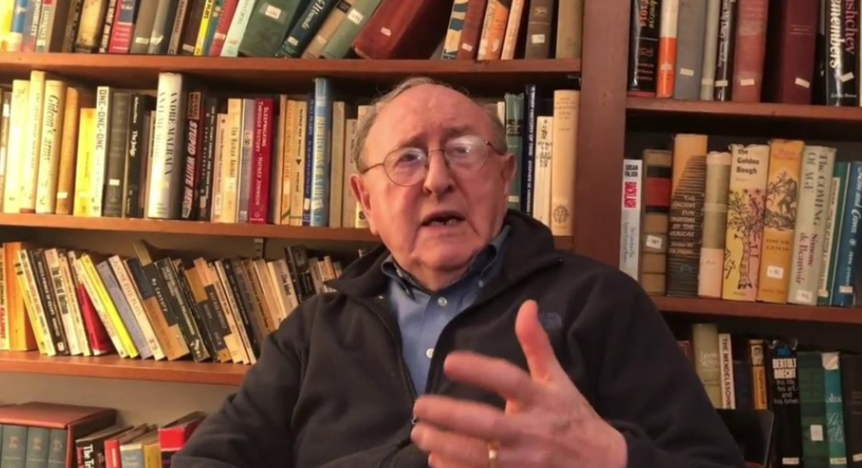
Bernard Lown was honored June 7 in Lewiston, Maine. The place was the massive Bates Mill, the former workplace for migrants mostly from Quebec who made textiles. The minting of the “American Innovation $1 Coin” in Lown’s honor had been announced in May. It was Lown’s birthday; he was born in Lithuania in 1921 and died in 2021.
The occasion featured the unveiling of a portrait of Lown painted by Robert Shetterly. Lown joins others honored by Shetterly in the series of portraits he calls “Americans Who Speak the Truth” (AWTT).
The event, attended by the writer, offered ample recognition of Bernard Lown’s medical accomplishments and his dedication to collective struggle for justice. A prime concern here is that celebration of Lown’s successes may have obscured how and why Lown did engage with the mass social and political movements of his era. Insight on that score may contribute to an understanding of how individuals now might involve themselves in big political and social catastrophes of our own time.
Maine-resident Shetterly explained to the gathering that individuals being honored through his portraits were, or are, heroes who exemplify creativity, courage, and/or passion for justice. Exhibitions of Shetterly’s portraits and educational programs based on his subjects have circulated throughout the country.
University of Maine President Joan Ferrini-Murphy, reported that Lown participated in and provided support for programs of the University’s Honors College. Doug Rawlings, a founder of the Veterans for Peace organization and head of its Maine chapter, praised Lown as an inspiration for peace advocacy.
Lown had strong connections with Maine. He arrived in Lewiston in 1935, attended high school there – at first not speaking English – and studied at the University of Maine. City officials of Lewiston and Auburn in 1988 renamed a bridge connecting the cities as the Bernard Lown Peace Bridge. Maine VFP staged a rededication of the Peace Bridge to Bernard Lown on the 2022 anniversary of the U.S. nuclear attack on Hiroshima.
Lown’s accomplishments were many: invention and introduction of the DC cardiac defibrillator (he chose not to apply for a patent), introduction of hospital cardiac care units, establishing that sick cardiac patients remain active, and urging physicians to be caring and empathetic with patients.
He founded the group Physicians for Social Responsibility in 1961.With Soviet cardiologist Evgeni Chazov, he founded International Physicians for the Prevention of Nuclear War in 1980. In 1985 they won the Nobel Peace Prize.
Lown became politically engaged with mass movements early, on the side of working people, and against headwinds.
He and his family had confronted the Hitlerite danger in Lithuania. High-school student Lown, according to AWTT, “was outraged at the sight of policemen arresting the unconscious, bleeding striker, while allowing his strike-breaking assailant walk free. Lown jeopardized his relationship with his family and joined the striking workers …The striking French-Canadian workers were accused of being part of an international communist conspiracy.”
This was the Lewiston–Auburn shoe strike of 1937. The Maine Army National Guard was called out. There was confrontation between strikers and police on what is now the Bernard Lown Peace Bridge.
Lown was briefly expelled from Johns Hopkins Medical School for violating the rule that no sick white person would receive a Black donor’s blood. He earned a suspension for inviting a Black physician to speak at the medical school.
He belonged to the Association of Internes and Medical Students (AIMS), a U.S. organization associated with the International Union of Students (IUS). Soviet Bloc students were members of the IUS, which weighed in on post-war peace, anticolonialism and more. In 1947 Lown wrote “an effusive write-up of IUS’s founding” in the AIMS magazine The Interne.
Lown, an officer with the U.S. Army Reserve, was called up for the Korean War. He defied the requirement that he indicate political affiliations. The Army allowed him an honorable discharge and drafted him as a private. He recalled that after receiving an undesirable discharge in 1954, “I was without a job and couldn’t get a job …wherever I’d go the FBI was one jump ahead.”
Then, reports the Harvard Crimson, “[Frederick] Stare, [nutrition professor at the Harvard School of Public Health,] won notoriety for hiring … [Lown] who had been accused of holding communist sympathies.”
Lown’s attitude toward Cuba is revealing. He told an interviewer that, ““I have been to Cuba six times and learned much about doctoring in Cuba … If impoverished Cuba can provide first-class health care for its people so can other developing countries. Perhaps it is even possible for rich USA, if only it ceases viewing medicine as a marketable commodity.”
To return to the question posed at the start here: how do citizens focusing on their own lives and their own reactions to political happenings become part of mass movements the way Bernard Lown did? Do they identify as members of a social class?
New York Times columnist David Brooks, remarkably, seems qualified to explain. The U.S. mainstream media barely acknowledges the existence of social class. For a representative writer actually to examine the origins of class consciousness suggests he may know something.
Brooks stated recently that, “students at elite universities have different interests and concerns than students at less privileged places,” also that “the elite universities are places that attract and produce progressives.” Therefore, “American adults who identify as very progressive skew white, well-educated and urban and hail from relatively advantaged backgrounds.”
(We hold back on critiquing Brooks’ notion of “very progressive” and his idea that working-class and oppressed people are unlikely to identify as such.)
Brooks, continuing, cites an authority who argues that, “[J]ust as economic capitalists use their resource — wealth — to amass prestige and power, people who form the educated class and the cultural elite … use … resources — beliefs, fancy degrees, linguistic abilities — to amass prestige, power and … money.” Brooks, presuming that the excluded may be resentful, envisions “a multiracial, multiprong, right/left alliance against the educated class.”
He describes a progression: individuals experience their own political awakenings, realize their perceptions are shared, and think of themselves as a larger whole. He pictures two sets of people, two social classes, who find they are at odds with each other. He provides a roadmap of sorts showing that politically-engaged individuals, in large numbers, may well become part of mass political and social movements.
In any case, Bernard Lown, involved with struggles that continue now, lauded for achievements that were extraordinary, does matter, and not least for the model he is now of dedicated political engagement.
W.T. Whitney Jr. is a political journalist whose focus is on Latin America, health care, and anti-racism. A Cuba solidarity activist, he formerly worked as a pediatrician, lives in rural Maine. W.T. Whitney Jr. es un periodista político cuyo enfoque está en América Latina, la atención médica y el antirracismo. Activista solidario con Cuba, anteriormente trabajó como pediatra, vive en la zona rural de Maine.

 COMMUNIST PARTY OF MAINE