Economic Crisis in Cuba – Leaders’ Solutions Face Big Obstacle / by W. T. Whitney Jr.

Selling agricultural products in a wheelbarrow in Havana. Photo: Otmaro Rodríguez.

South Paris, Maine


The Cuban economy is the worse it’s been since the “Special Period” following the end of the Soviet Union. The country is in the midst of a years-long economic contraction that’s affecting food production and the availability of medicines.

For the first time ever, the government has officially requested aid from the United Nations World Food Program. Inflation, meanwhile, is soaring, and there is massive emigration and power outages roll across the island. And unlike in the days of the socialist bloc, the country has major international allies to provide financial relief.

Cuba’s economy contracted 1.9% in 2023, and it’s infant mortality rate (IMR) – the number of infants dying in their first year of life per 1,000 live births – is inching upward. It was 4.7 in 2013, 5.0 in 2017, 6.2 in 2022, and 7.9 in 2023. The IMR is generally seen as  reflecting a society’s social conditions.

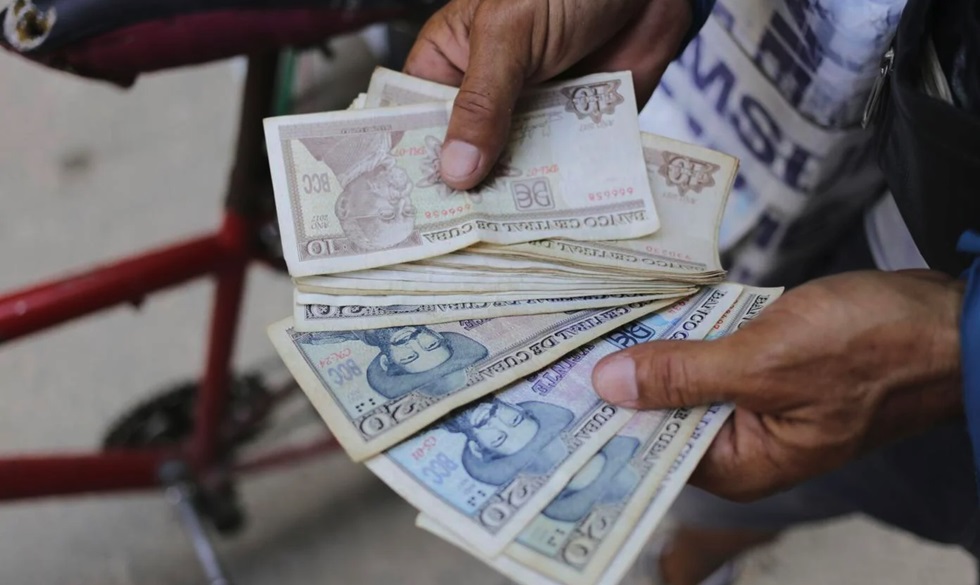
An ice cream street vendor counts his Cuban pesos in Havana, April 20, 2024. | Ariel Ley / AP

The country’s leaders are working overtime to respond to the worsening crisis. Deliberations at a recent meeting of Cuba’s Council of Ministers and a plenary session of the Communist Party’s Central Committee shed light on how government and party officials are reacting and on the resources they have available.

In the Council of Ministers’ meeting, as reported on June 30, President Miguel Díaz-Canel called for a restraining state expenses, limiting pay-outs from the state to the non-state sector, increasing participation of state entities in providing services, and cracking down on tax evasion.

He lauded the “very good experiences of labor collectives…in doing things differently and moving ahead.” He condemned speculation and black marketeering as contributors to inflation.

Prime Minister Manuel Marrero Cruz criticized “bureaucracy and ineffective control of our institutional system that are limiting creative work and promoting undesirable distortions in our society.”  He called for increasing national production and export income, promoting direct foreign investment, capturing remittances for the economy, and identifying sources of financing.

Vice-Minister of Economy and Planning Mildrey Granadillo de la Torre referred to new but unspecified ways of attracting foreign currency; incentivizing national production, especially food products; improving management of non-state entities, and reducing tariffs on importation of raw materials.

She spoke of adjusting the budget to a “war economy” and warned of an expanding deficit. She anticipated “a single, inclusive and equal pricing policy…[on the way] for state and non-state sectors of the economy.”  Vice-Minister of Finances and pPrices Lourdes Rodríguez Ruiz, joined in the assessment, reporting on plans for caps on prices for essential goods sold by non-state enterprises.

The Communist Party Central Committee’s Eighth Plenary Session took place on July 5-6. The agenda, as always, included a rendering of accounts from the Political Bureau and assessment of the implementation of earlier recommendations. The problems of reduced agricultural production, corruption, and crime received special attention.

Social misbehavior

Julio César García Pérez, head of the Justice Ministry’s “Office of Attention,” led a discussion of “crime, corruption, and social illegalities.” He recalled that the party had been called upon at its last congress to take on “strategic leadership” in this area.   As regards “implementation and fulfillment, the results are insufficient,” he reported. Crime rates remain high, with “major incidents of attacks against our patrimony,” often committed by young people and “persons uninvolved in work or study.”

Among the most prevalent crimes: abusive pricing, “illicit commercialization of diverse products,” drug-trafficking, livestock theft, “speculation on goods and services,” hoarding, administrative corruption, tax fraud, marketing of stolen goods, “lack of discipline in public spaces,” damage to public property, and fighting.

Authorities are trying to get a handle on the situation, with García Pérez reporting that “responses on the part of the courts and the attorney general’s office are more rigorous than earlier.”

Having met with party officials at the municipal level, he found that preventative measures were inadequate, however, and follow-up of individual cases lax. Cuba’s attorney general, Yamila Peña Ojeda, assured the Plenary that criminal penalties remain severe while “citizens’ rights and guarantees are respected.”

Comptroller-General Gladys Bejerano Portela, recognizing that “the Party is…working to maintain the soul of the Cuban Revolution,” confessed that she “could not understand why” many party members “are indifferent to deeds of corruption,” adding that “to not fight [corruption] is counterrevolution.”

Food is short 

The Plenary’s discussion of food shortages and low agricultural production focused on implementation of the 2021 Law of Food Sovereignty and Security.

Food and Agriculture Minister José Ramón Monteagudo Ruiz, returning to old themes, called for increasing national food production, reducing food imports, and generating competitive exports. Emphasizing the decisive role to be played by party members, he reported on consultations on agricultural production with mass organizations, provincial governing councils, and municipal assemblies.

Monteagudo Ruiz discussed follow-up of legislation of 2022 that prioritized local food production systems and local self-sufficiency. Party officials have interacted with companies, production units, cooperatives, and markets in 50 municipalities, he said.

The minister observed that the reforms of 2008 which gave individuals and cooperatives long-term use of what now amounts to 31% of all agricultural land have fallen short and not adequately bolstered production.

He attributed production deficits to the worsening economic crisis and adverse effects of the U.S. blockade. Cuban agriculture is being undone, he stated, by shortages of miscellaneous supplies, fuel, spare parts, pesticides, veterinary medications, fertilizers, and raw materials for animal feed.

Agriculture Minister Ydael Pérez Brito lamented that, “Harvests do not even approach 50% of what is needed,” despite various plans having been fulfilled. Consensus prevailed that levels of planting and harvesting are reduced, such that the population’s food requirements are not being met. Proposals re-emerged for enabling companies, organizations, and cooperatives to grow their own food for their own workers and members.

The president speaks

President Díaz-Canel, addressing the plenary, still found reason for optimism:

“If we work in all these areas simultaneously, in a decisive, organized, coherent manner, in a short time we will be managing fundamental issues such as the budget deficit, the excess of circulating cash, tax evasion, abusive prices; We will be managing the proper relations between the state sector and the non-state sector; We will be confronting crime and corruption more decisively…. Doing all this will indirectly and gradually influence changes in the exchange rate and in inflation.”

Aside from just recounting the list of challenges, though, he also elaborated on the job ahead:

I call upon you to correct things on an ongoing basis with determination, effort, and imagination, and to confront those negative tendencies that emerge like weeds in difficult moments. The call now is to go out as combatants, which we know how to do and as we have done so many times before.”

He offered perspective: “Every day that we manage to subdue these great difficulties with tenacity, effort, creativity, talent, and with unity of purpose against the genocidal plan of our historical enemy is a victory.”

He praised the party’s “authentic commitment to the people” and said that party cadres have to lead by example. The Communist Party, the president declared, has “the enormous responsibility of preserving the Revolution… to preserve its conquests and keep on advancing on the path of perfecting society, working tirelessly.”

As regards goals: “The Party and its cadres have the mission to stimulate, inspire, mobilize, and engage with members and the people, aware that an ideal will triumph only as long as it exists for all of us.”

The president said that party members and government leaders had a responsibility to “guarantee a better and greater access to food.” Food production and self-sufficiency, he said, “are tasks of the first order, in which the entire population must participate.”

Díaz-Canel indicated the need to “implement concrete actions” and to ensure that decisions are fulfilled in adherence with a strict timeline.

‘We are here to save the homeland, the Revolution, and socialism,” he insisted. “In six decades, the blockade has not been able to defeat the dignity of the Cuban people nor the immense collective…work of the Revolution. Even as it intensifies now, the blockade will not succeed.”

No money

Words spoken in the meetings were mostly about plans and remedies already in place, about revolutionary values, and virtues of the Cuban people.

In contrast to deliberations of earlier years, the presentations offered no new remedies for fixing Cuba’s economic downturn and shortages. Perhaps something novel will emerge from the commissions and plenary sessions of Cuba’s National Assembly, which started its meeting on July 15.

International solidarity on Cuba’s behalf wasn’t mentioned, and there were indications that divisions disrupting the unity of Cuban society have cropped up. Their extent of and how they may differ from earlier fracturing are unclear.

Shortages, long the central element of ongoing economic crisis in Cuba, featured prominently. The role of the U.S. blockade in causing shortages of specific products from abroad was mentioned, but its importance was downplayed in comparison to past assessments.

Allusions to the fact that the country has essentially no money, and thus no purchasing power on the international market, surfaced in the form of sporadic mention of budget deficits and of non-payment on earlier loans. The basic message was that Cuba’s international credit is nil.

Photograph Source: Susan Ruggles – CC BY 2.0

U.S. power brokers do their bit toward this end. They designate Cuba as a State Sponsor of Terrorism (SSOT). Countries so designated may not benefit from transactions involving U.S. dollars, according to the enabling law. Fearing U.S. penalties, international financial institutions refuse to respond to Cuba’s credit needs.

Any reference to external causation of economic disaster in Cuba, U.S. aggression in particular, broadens the story. Cuba’s leaders, mindful of their revolutionary origins and persistently in search of solutions, and Cuba’s people, their basic unity intact, are not alone in struggle. The reality remains of Cuba’s multifaceted appeal to the wider world. Her people’s aspirations for national independence, socialist revolution, and justice for all working people still call forth strong international support.

The next chapter in the United States turns to continuing and enhanced solidarity activities. These would be humanitarian aid, the never-ending campaign to end the U.S. economic blockade of Cuba, and, crucially, the fight against the SSOT designation. Recently, the U.S. Catholic Bishops called for removing that label. The story will continue.


W.T. Whitney Jr. is a political journalist whose focus is on Latin America, health care, and anti-racism. A Cuba solidarity activist, he formerly worked as a pediatrician, lives in rural Maine. W.T. Whitney Jr. es un periodista político cuyo enfoque está en América Latina, la atención médica y el antirracismo. Activista solidario con Cuba, anteriormente trabajó como pediatra, vive en la zona rural de Maine.

Cuba’s Government Analyzes and Responds to Economic Woes / By W. T. Whitney Jr.

People look at food prices at a private business in Havana on December 20, 2023. Cuba’s economy will shrink by up to 2 percent this year, Finance Minister Alejandro Gil estimated on Wednesday, after acknowledging that the country will not be able to achieve the projected economic growth of 3 percent by 2023 | Yamil Lage / AFP / Getty

Reposted from Counterpunch


“Our joy is immense … We don’t deceive ourselves thinking that everything ahead will be easy, when perhaps everything is going to be more difficult.” That was Fidel Castro, hours after the victory of Cuba’s Revolution.

Difficulties were center stage 65 years later, at a plenary session of the Central Committee of Cuba’s Communist Party on December 15 and 16 and at the National Assembly of People’s Power, meeting on December 20-22.

The views of Cuban leaders on problems now enveloping Cuba shed light on realities of a nation under siege and a revolution in trouble. The information is pertinent to the solidarity efforts of Cuba’s friends abroad. Addressing the Central Committee’s plenary session, Cuban President Miguel Díaz-Canel noted that, “We have discussed efforts that have not
yielded solutions, measures that did not prosper, and goals that were not fulfilled …The scenario is that of a war economy … [We] are all here to reverse the present situation … with consensus as to decisions and with collective work, with passion and energy.”

Díaz-Canel called for “creative resistance” and “confidence in victory,” while insisting that dissatisfaction “is a motor that moves revolutionary energies. It provokes embarrassment that ends up activating people’s full participation, without which socialism is impossible.”

“We would be surrendering beforehand, if we see this war as an insuperable calamity. We must see it … as the opportunity to grow and to overcome our own selves, while the adversary is nakedly evil before the world … On the eve of the 65th anniversary of the Cuban Revolution … we are called to act together for a common objective: Save the
homeland, the Revolution, socialism, and overcome.”

The Assembly meets

Speaking to the National Assembly were: Alejandro Gil Fernández, minister of the economy and planning; Prime Minister Manuel Marrero Cruz; and President Miguel Díaz-Canel. Gil Fernández regards the U.S. economic, commercial and financial blockade of Cuba as the principal obstacle Cuba faces in restoring its economy.

He indicated that in 2023 Cuba’s GDP will have fallen almost two percent. Exports were $770,000 million below predictions. Food production was less than that of 2022. Tourism income increased by $400 million in 2023 but represented only 69% of the yield in 2019.
Overall production was down due mainly to state enterprises held back by shortages of supplies and fuels. Currency shortages and loss of workers to migration hampered the healthcare and education sectors. Electricity generation was up 32% in 2023, according to Gil Fernández. Cuba’s 30% inflation rate for 2023 was lower than the 77.3% rate in 2021.

State business entities showed “gradual recuperation.” They employ 1.3 million workers while accounting for 92% of goods and services produced in Cuba and 75% of exported products. He attributed price inflation to international price hikes, the government’s release of money to finance its budget deficit, fewer goods being produced, and an agriculture sector burdened by labor shortage, high costs, and low yields.

“What isn’t being produced cannot be imported,” Gil Fernández lamented. His message is that importing goods is almost impossible what with “the effect of high prices on the international market.” But, paradoxically, “a lack of production resources” forces Cuba to import over 70% of the food that is being consumed.

He proposed measures for increasing food production, including:

+ Creation of a financial mechanism for bolstering production based on farmers using Cuban currency derived from agricultural sales to buy supplies they need.
+ Build a farm labor force through moonlighting, employing students, and having young people do agricultural work as part of their military service.
+ Use food produced in Cuba, not imported food, to fill the “normal family food basket.”

Prime Minister Manuel Marrero Cruz critiqued the government’s lack of control over production and distribution which “adversely affects production by state entities and lets currency exchanges on the illegal market determine the pricing of products from the non-state sector.” e reported that social inequalities are growing, and that the tendency exists while state subsidies continue to nourish less distressed sectors of the economy. Equally worrisome: “The former state monopoly in production is now consolidating in the private sector.”

He was referring to the recent appearance of 9000 or so mostly private small-and-medium-sized businesses and to independent farmers and cooperatives that took over land from the state under long-term usage arrangements. They now control 80% of Cuba’s agricultural land. Marrero Cruz called for “stimulation of government-operated small-and-
medium-size business entities.”

Both private businesses and the farming sector sell products at highly inflated prices with prices being set by black market operatives. The prime minister condemned the state subsidies such entities receive in the form of low prices assigned to the fuel, water, transportation and electricity they buy from the state. Similarly, the government pays high
prices to farmers for food that, under the rationing system, is sold inexpensively to the population.

Henceforth, according to Marrero Cruz, the government will be subsidizing people, not products. According to one report, “The Ministry of Work and Social Security will be charged with undertaking a survey of ‘vulnerable’ social sectors.” “Nobody will be abandoned,” Marrero Cruz insisted.

The government, he indicated, will increase sales taxes on final products such as water, gas, electricity, transport and reduce import tariffs by 50% on the “intermediate products” used in food production and manufacturing. More tourist dollars will be harvested. Municipal assemblies will present budgets and in the case of deficits will generate more income and reduce administrative expenses.

For the prime minister, “food production needs to be prioritized and by all sectors. Many countries are saying to us: ‘We’ll put up the money, you provide the land and then pay back the money with production.’” He pointed out that, despite the non-availability of imported fertilizer and pesticides, “there are many instances of countries producing food; an
agricultural country must produce its food.”

Marrero Cruz sees “speculative prices … and intermediaries earning a lot more than producers” and non-state entities now controlling imports rather than the government, the result being “abusive and speculative pricing.” He called for paying for imports with income from exports: “[W]e prefer importing supplies and products essential to the economy and
paying for them by offering other countries certain products and/or services.”

Responding to inflation, the government, collaborating with the Central Bank of Cuba, will change the official exchange rate for the peso. According to Marrero Cruz, the government will be restricting prices for goods and services with a system of “maximum prices.”

President Miguel Díaz-Canel, addressing the National Assembly on December 22, focused on Cuba’s “war economy … [It’s] a political scenario of maximum asphyxia, designed and applied against a small country by the most powerful empire in history.” He also attributed
economic problems to “the crisis in international economic relations and our own errors.”

Economic war takes the form of economic blockade aimed at “reduced supplies of goods used by the population, inflated prices, and low purchasing power for most Cubans.” “Together with constant acts of subversion and disinformation against Cuba, the goal is to break the country, provoke social decomposition, and make for ungovernability.”

Díaz-Canel spoke of errors as “part of the complexity of making decisions in a context of extreme tension … [and of] commitment to preserving social conquests.” He mentioned mistakes, particularly in the “design and implementation of currency unification” and in “approving new economic actors without performance norms having been established.”

The effectiveness of new measures will “depend on generating more wealth, more work incentives, and more distribution of resources.” The president promised there will be no “neoliberal package … no crusade against small businesses, no elimination of the basic food allocation.” The president highlighted: “food production, localities taking care of
more of their needs, the revival of tourism, rescue of the sugar industry, state control of currency and the exchange market, redesign of the financial system, and guarantees for self-financing, and managing currency so as to serve those whose production generates income.”

Díaz-Canel took note of Cubans’ high regard for healthcare workers and teachers, promising that “they will be the first to benefit from additional pay, which the prime minister announced in his intervention.” Testifying earlier before the Economics Commission of the National Assembly, Díaz-Canel emphasized “taking advantage of the facilities of the municipalities and articulating strategies of local development.” Recalling that the “[f]oundation of government is the municipal assembly of people’s power,” he insisted on “mapping out actors in the municipalities and integrating them with state and private businesses.”

In the end

The information and opinions provided by Cuban leaders and reviewed here clarify difficult realities, among them: adverse effects of diminished tourism, inflation, and emigration; social inequalities based on varying access to resources; production stymied by shortages of resources; inadequate food production; lack of buying-power for most Cubans, and
for importing necessary goods; and the near impossibility of securing foreign investment.

Cuba is fashioning responses. They are: decentralization of political and economic administration; cut backs on expenditure of central government funds, reduced subsidies for the purchase of water, fuel, transport, and electricity by business entities; adjustment of import tariffs to favor the availability of resources for production, capturing more tourist dollars, protecting state-operated production entities, fixing prices, and producing more food.

These will be palliative remedies unless basic causes are dealt with. A prime goal of U.S. policy has been to deprive Cuba of money, and that has come to pass. Revolutionary Cuba’s very survival depends on U.S. citizen activists forcing their government to shed its blockade of Cuba. There, the great need now is for Cuba to be removed from the U.S. list of terrorist-sponsoring nations. That designation causes most international financial institutions to refuse handle dollars on Cuba’s behalf.

There is a larger context. The U.S. use of economic sanctions everywhere rests on planet-wide dollar dependency. That emerged out of the Bretton Woods Conference of 1944 and has coincided since with unrelenting U.S. assertion of worldwide power. That’s the basis for a global constituency on Cuba’s behalf. How it will be set in motion is the
big question.


W.T. Whitney Jr. is a political journalist whose focus is on Latin America, health care, and anti-racism. A Cuba solidarity activist, he formerly worked as a pediatrician, lives in rural Maine. W.T. Whitney Jr. es un periodista político cuyo enfoque está en América Latina, la atención médica y el antirracismo. Activista solidario con Cuba, anteriormente trabajó como pediatra, vive en la zona rural de Maine.

Cuba Scores Big Victory in the UN General Assembly / By W. T. Whitney

South Paris, Maine


The United Nations General Assembly on November 2 voted to approve
a Cuban resolution that, unchanged over 31 consecutive years, calls for
an end to the U.S. economic blockade of Cuba. Approval once more
was overwhelming: 187 nations voted in favor and two against, the
United States and Israel. Ukraine abstained.

Reacting to the vote, Cuban President Miguel Díaz-Canel proclaimed a
“new victory for the Cuban people and their Revolution!” He pointed to
“the triumph of dignity and the fearlessness of our people,” and
expressed gratitude for “the international community’s recognition of and
support for Cuba’s heroism and resistance.”

For over 20 years, the only nations opposing the Cuban resolution, apart
from the United States, have been Israel and, formerly, a few U.S.-
dependent Pacific island-nations. The blockade began in 1962, and now
80% of Cubans have lived under its sway.

Prior to the vote this year, dozens of delegates representing member
states spoke out against the blockade. Cuba’s Minister of Foreign
Relations Bruno Rodríguez addressed the General Assembly, insisting
that the U.S. blockade interferes with “the right to life, health, progress
and welfare of every Cuban family.”

He explained that Cuba’s financial losses from the blockade reflect
factors like the high cost of substituting for goods excluded under the
blockade with more expensive goods and/or those with higher
transportation costs. Losses take the form also of an overall lack of
necessary materials, goods, and services. And “barriers Cuba faces in
gaining access to advanced technology” lead to monetary loss.

The chancellor emphasized that “sectors like agriculture and energy face
serious obstacles to acquiring spare parts or machinery.” He cited
examples of blockade-related shortages such as extreme shortages of
gasoline and oil, cancer patients being denied “first line treatments and
drugs,” and healthcare providers and their patients lacking respiratory
ventilators and medicinal oxygen normally available from abroad.

The blockade’s assault against the Cuban people shows up clearly and
dramatically in money lost to Cuba’s economy. Rodríguez claimed that
Cuba’s GDP would have grown by 9% in 2022 without the blockade, and
that the $4.87 billion in losses occurring between March, 2023 and
February 2023 correlated with “pain and suffering.”

Cuba’s monetary loss in over 60 years of blockade now totals $159.8
billion, according to one account. What with inflationary change, that’s
$1.3 trillion.

Another report indicates that between August 2021 and February 2022,
losses in the energy and mining sectors added up to $185.5 million, in
the agricultural sector, $270.9 million; and in banking and finance,
$280.8 million. Between January and July in 2021, losses were $113.5
million in the healthcare sector; $30.6 million in education; and $31.3
million in the transport sector.

Cubans’ lives are affected:

* During the last school year, Cuba’s government lacked paper
sufficient to “print and assemble books and notebooks for students,”
in part because a Canadian paper manufacturer did not extend credit.

* Presently, according to Granma news service, no school books are
being produced due to a lack of supplies and spare parts.

* Lack of access to high-performance brands and equipment, as well
as spare parts, serves to handicap Cuba’s telecommunications
sector, thus easing the way for U.S. and European competitors to
reach Cuban users.

Laws authorizing the U.S. blockade include the 1917 Trading with the
Enemy Act, the 1992 Cuban Democracy Act (Torricelli Law), and the
1996 Cuban Liberty and Democratic Solidarity Act (Helms-Burton Law).
Executive actions taken to implement the blockade have been central to
how that policy affects Cuba. The Obama administration eased many
blockade regulations. President Trump added 243 new measures, with
disastrous effect. The Biden administration continues them.

The U.S. Treasury Department imposes large fines on third-country
exporters failing to comply with its rules and so they often do not sell to
Cuba. Because the Treasury Department forbids foreign banks from
using U.S. dollars, international financial institutions rarely make loans to
entities in Cuba and are reluctant to handle U.S. dollars in transactions
involving Cuba.

The U.S. government has recently been weaponizing its false
declarations that Cuba is a terrorist-sponsoring state. The enabling
legislation on the matter granted the U.S. government authority to
penalize any international financial and banking sectors bold enough to
have dealings with states so designated.

Conveniently enough, Cuban analyst Claudia Fonseca Sosa recently
provide President Biden with advice as to “substantive modifications” of
methods for carrying out his policy. He could authorize “the export of
U.S. products to key branches of Cuba’s economy” and of medical
supplies and equipment to the island to help with the manufacture of
biotechnical products. Biden could allow U.S. companies to invest in
Cuba and enable U.S. citizens to receive medical treatment there.

The prospects for changed policies toward Cuba perhaps have
improved; a recent report documented the major role of the blockade in
propelling Cuban emigration to the United States – and sending
Venezuelans and Nicaragua there too. Those three blockaded countries
presently supply most of the migrants crossing into the United States.

U.S. sanctions cause desperate living conditions, and so people leave.
End all three blockades. Relieve the pressure on people, and maybe
they’d stay home. Who could object?


W.T. Whitney Jr. is a political journalist whose focus is on Latin America, health care, and anti-racism. A Cuba solidarity activist, he formerly worked as a pediatrician, lives in rural Maine. W.T. Whitney Jr. es un periodista político cuyo enfoque está en América Latina, la atención médica y el antirracismo. Activista solidario con Cuba, anteriormente trabajó como pediatra, vive en la zona rural de Maine.

New Anti-Cuba Terror Attack Hits at Cuban Embassy in Washington / by William T. Whitney Jr.

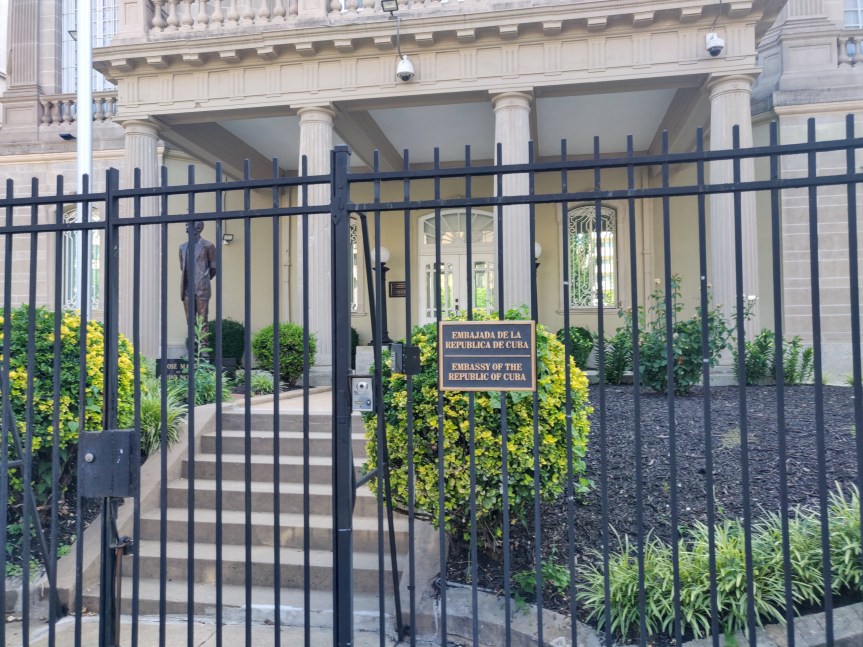
Embassy of Cuba, Washington, D.C | Photo: Wikimedia Commons

South Paris, Maine


Cuban Foreign Minister Bruno Rodriguez on Monday, September 25, indicated on social media that late the previous day, someone threw two Molotov cocktails at Cuba’s embassy building in Washington. Referring to “At least one Molotov cocktail,” an AP report indicated no one was injured and no damage occurred, also that “U.S. law enforcement officials were investigating.”

Condemnation of the attacks quickly emerged, in the United States from the Puentes de Amor (Bridges of Love) group, the People’s Forum in New York, Madea Benjamin, co-founder of CODEPINK, and the Washington DC chapter of the CPUSA. The governments of Mexico and Venezuela joined in denouncing the attack.

The National Network on Cuba issued a call for a protest demonstration in front of the Cuban Embassy at 5PM on September 25.

Within hours, President Díaz-Canel “expressed his firm condemnation of the act, attributing it to hate and underlining the possible consequences if forceful measures are not taken to deal with these acts of terrorism,” according to cubadebate.cu.

Outrage at the recent attack recalls national and global abhorrence to the assault-rifle attack on Cuba’s Embassy on April 30, 2020, which caused much damage.  The 42-year-old suspect Alexander Alazo, a 42-year-old undocumented immigrant from Cuba, was arrested, imprisoned, and, three months later, indicted by a federal grand jury on multiple charges relating to the attack. An Internet search reveals no subsequent disposition of Alazo’s case. 

Such incidents in Washington understandably are of the utmost concern to Cubans. Their experience is joining their country’s diplomatic missions abroad has too often put them in the way of U.S.-inspired terror attacks against their government.

Hostile parties used “petrol bombs” in causing damage to Cuba’s Embassy in Paris on July 27, 2021. As of 2020, “various Cuba representatives located abroad” between 1959 and 2018 experienced 581 incidents leading to 365 of them being killed and 721 wounded, according to Cuba’s Foreign Ministry.  This toll includes non-Cubans associated with the diplomatic facilities.

The timing of September 25 attack may relate to recent developments in U.S. Cuban Relations. One in particular was the high-profile visit to New York of Cuban President Miguel Díaz-Canel who addressed the United Nations General Assembly. He was speaking for the G77+China bloc of nations, which he currently serves as chairperson, and for his own country.

Díaz-Canel in New York reached out. He attended a solidarity event on behalf of Cuba and Venezuela, met with Cubans living in the United States, talked with New Yorkers on the street, visited Harlem to honor Malcom X, appeared at a gathering at the People’s Forum, and joined Catholic leaders to remember Cuban independence leader Father Félix Varela.

Perhaps the hatred on display with the attack on the Cuban Embassy represents a twisted attempt to counter any assumption that Cuba is on the side of decency, solidarity, and peace in a troubled world. What with the Cuban President’s visit in New York, U.S. Americans, reasonably enough, may have latched onto that idea.

Possibly the attack was also a signaling that no let-up in counter-revolutionary maneuvering was likely in the United States, despite the federal prosecution and political opprobrium now aimed at Bob Menendez. The New Jersey Senator, an anti-Cuba heavy hitter, faces charges of bribery and corruption on a massive scale. 


W.T. Whitney Jr. is a political journalist whose focus is on Latin America, health care, and anti-racism. A Cuba solidarity activist, he formerly worked as a pediatrician, lives in rural Maine. W.T. Whitney Jr. es un periodista político cuyo enfoque está en América Latina, la atención médica y el antirracismo. Activista solidario con Cuba, anteriormente trabajó como pediatra, vive en la zona rural de Maine.

Mexico’s President Would Build Alliance to Counter Cuba Blockade / By William T. Whitney Jr.

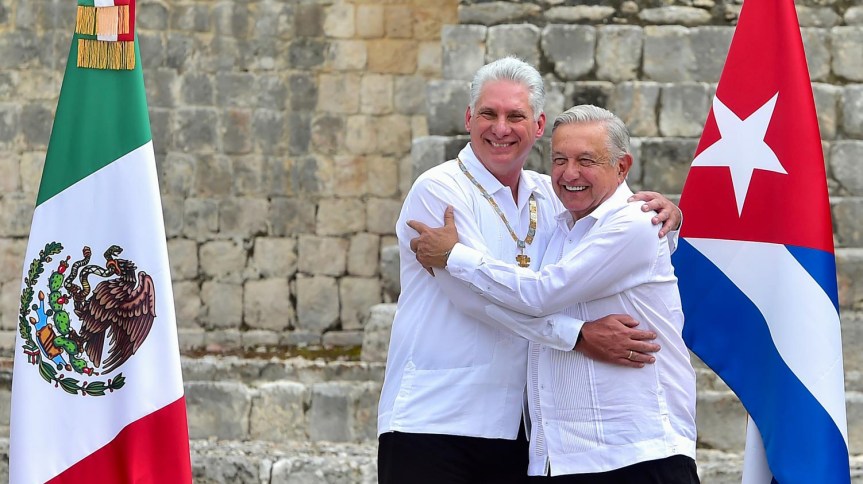
Photo credit: People’s Dispatch

On the occasion of Cuban President Miguel Díaz-Canel’s visit recently to Mexico, Mexican President Andrés Manuel López Obrador (AMLO) raised the possibility of many nations cooperating to oppose the U.S blockade of Cuba. AMLO has become Cuba’s champion in the international arena, and perhaps not accidentally: the governments of the two nations each originated from social and political revolutions.

The two leaders have built a tight relationship.  Diaz-Canal visited to Mexico in September, 2021. AMLO was in Cuba in May, 2022. And AMLO refused to attend a U.S – organized Summit of the Americas in Los Angeles in June 2022 because Cuba had been excluded. 

Accompanied by Cuban government officials, Díaz-Canel on February 11 joined AMLO in the Mexican state of Campeche. That Cuban medical teams are working there now may have helped determine the meeting’s location.

In remarks at a medical center,  AMLO lauded Cuba’s medical solidarity and described his own people’s unmet social needs. He called upon the U.S. government to end its blockade of Cuba:

[Cuba] has our respect, our gratitude, our support, and we are going to continue demanding the removal, the elimination of the blockade against Cuba, which is inhumane. And there’s more than voting in the United Nations where the anti-blockade resolution is always approved overwhelmingly, and then it’s back to the way it was.

I promise President Miguel Díaz-Canel that Mexico will be leading a more active movement so that all countries come together and defend the independence and sovereignty of Cuba. No longer will there be anything about treating Cuba as a terrorist country or putting Cuba on the black list of supposed terrorists.

Cuba has been able to count on support from Mexico. As the Bay of Pigs invasion was unfolding in 1961, former Mexican President Lázaro Cárdenas spoke in defense of Cuba before 80,000 people in Mexico City’s Zocalo. Soon afterwards, Mexico’s government backed Cuba in the United Nations. Later Mexico rejected calls by the U.S. – dominated Organization of American States for member states to impose economic sanctions against Cuba and break off diplomatic ties.

AMLO visited Cuba in May, 2022. Speaking before Cuban leaders, he recalled “times when the United States wanted to own the continent …. They were annexing, deciding on independence wherever; creating new countries, freely associated states, protectorates, military bases; and … invading.”  The U.S. government, he declared, needs to know “that a new relationship among the peoples of America … is possible.”

While in Cuba he signed agreements for Mexican young people to study medicine in Cuba, for Cuba to provide Mexico with anti-Covid vaccines, and for hundreds of Cuban physicians to work in Mexico in underserved areas.

Months before, in September 2021, Díaz-Canel was the honored guest at celebrations in Mexico City of the 200th anniversary of Mexico’s national independence. Welcoming his guest, AMLO praised Cuba’s steadfastness in defending its revolution. Calling upon U.S. political leaders to lift the blockade on Cuba, he appealed to their good sense and rationality, saying nothing about nations uniting in opposition to the blockade. 

Photo credit: People’s Dispatch

[The U.S. government] must lift its blockade against Cuba, because no state has a right to subjugate another people, or another country … [And] It looks very bad that the U.S. government uses the blockade to hurt the people of Cuba in order to force them by necessity to confront their own government … President Biden, who shows political sensitivity, [must] take a wider view and put a permanent end to the politics of grievances against Cuba.

The emphasis was different, however, when the two leaders met recently, on February 11 in Campeche. AMLO unveiled an evolved and more forceful approach to ending the blockade. He bestowed upon Díaz-Canel Mexico’s highest recognition extended to foreign notables, the Aztec Eagle, and then praised Cuba as a special case for its strenuous resistance to U.S. enforcement of the Monroe Doctrine. He continued: 

I also maintain that it is time for a new coexistence among all the countries of America, because that model imposed more than two centuries ago is completely exhausted, it is anachronistic, it has no future. There is no way out, it no longer benefits anyone, we must put aside the trade-off imposed on us either to go along with the United States or be in opposition, courageously and defensively. 

It is time to express and explore another option, that of dialoguing with the leaders of all the countries and especially with U.S. leaders, and convince and persuade them that a new relationship between the countries of our continent, of all America, is possible. I believe that conditions are perfect now for achieving this goal of mutual respect.

In an interview later on, Mexican foreign minister Marcelo Ebrard offered some specifics:

President Lopez Obrador wants to bring the presidents of the progressive states of Latin America together to address food security, well-being and other issues that are important for our community of nations. This is something we have to discuss with other foreign ministers and move forward in the coming months. 

The progressive governments AMLO has in mind, according to Ebrard, are Mexico, Argentina, Brazil. Colombia, Cuba, Venezuela, Bolivia, Chile, and Honduras. They include “the three largest economies in Latin America.” The implication may be that these countries, collaborating on various issues, political ones included, have sufficient economic clout to pressure the United States on Cuba.

President Díaz-Canel himself has been building other bridges. In recent weeks he visited Belize, Saint Vincent and the Grenadines, and Barbados, for the 7th CARICOM (Caribbean Community) – Cuba Summit meeting.

AMLO’s focus on progressive nations is crucial. He has worked toward reviving the Community of Latin American and Caribbean States (CELAC) as a vehicle for collective action, despite participation there by conservatively-governed nations. Yet he did not attend the CELAC summit taking place in January and so may be discouraged as to prospects for CELAC serving his purposes. 

AMLO’s power to orchestrate regional support is limited. Only 18 months remain of his six-year term as president of a country dependent economically on the United States and divided geographically, ethnically, and by social class. Nevertheless, Cuba, whose external resources for ending the U.S. economic blockade are hardly infinite, badly needs international partnering that offers persuasive power. Lifelines thrown by AMLO are a start in that direction. 


W.T. Whitney Jr. is a political journalist whose focus is on Latin America, health care, and anti-racism. A Cuba solidarity activist, he formerly worked as a pediatrician, lives in rural Maine. W.T. Whitney Jr. es un periodista político cuyo enfoque está en América Latina, la atención médica y el antirracismo. Activista solidario con Cuba, anteriormente trabajó como pediatra, vive en la zona rural de Maine.

CELAC Summit Offers Proposals, amid Divisions and Dissent / By W. T. Whitney Jr.

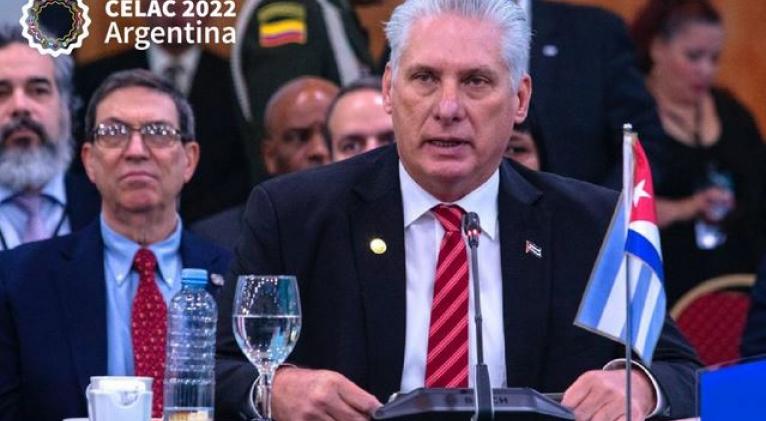
Cuban president denounces US interference at Celac Summit | Prensa Latina, 01.24.23

The 7th Summit Meeting of the Community of Latin and America States (CELAC) took place in Buenos Aires, Argentina on January 23. In their Declaration, representatives of 33 member nations, including 14 presidents, paid  homage to integration, unity, and  “political economic, social, and cultural diversity among member states.” They agreed “by consensus” to an all-embracing set of proposals and statements, 100 in all, and to 11 “special statements” on the situations of particular countries.

As is usual, host-country president Alberto Fernández made arrangements and set the agenda. The one-day meeting included closed- door discussions and brief presentations by representatives of the various country.

Participants at CELAC’s founding meeting in Caracas in 2013 declared  the region to be a “zone of peace.”  CELAC, it was hoped, would be promoting regional cooperation on social and economic development, agreement on common political goals, and progress toward integration and unity.

Preparations had begun in 2010 after U.S. interventions in Venezuela, Bolivia, Ecuador, Cuba, and other countries had intensified. CELAC would differ from Organization of American States (OAS), the regional organization serving U.S. interests since 1948. The United States and Canada are not members of CELAC. 

A gap separated the fifth CELAC Summit in 2017, in the Dominican Republic, from the sixth one, on September 16-18, 2021 in Mexico City. Instability in Venezuela, Bolivia, and Brazil was a likely factor.  Mexican President Andres Manuel Lopez Obrador (AMLO), presiding over CELAC VI, spoke of CELAC as the regional equivalent of the European Union. There was speculation about CELAC replacing the OAS. 

Brazilian President Luiz Inácio “Lula” Da Silva’s arrival at CELAC VII generated excitement. Brazil had rejoined CELEC after being removed by Former President Jair Bolsonaro in 2020. Lula supports closer ties of both CELAC and the Mercosur economic organization with the European Union.

In Buenos Aires, rightwing demonstrators from Argentina and elsewhere were noisily protesting against CELAC. They objected to the presence of leftist countries like Venezuela, Cuba, and Nicaragua. To avoid confrontation, Venezuelan President Nicolas Maduro and President Daniel Ortega of Nicaragua stayed away. AMLO also did not attend, claiming he was busy.

Crisis in Peru provoked divisions.  The Declaration was silent on the coup there and on repression of popular resistance. Colombian president Gustavo Petro, President Xiomara Castro of Honduras, and AMLO, in a video presentation, called for deposed President Pedro Castillo’s release from prison. Presidents Fernández of Argentina and Boric of Chile said nothing on that score. 

CELAC did not respond to Prime Minister Ariel Henry’s requests for  member states to “participate in a specialized multinational force requested by Haiti” to deal with gang warfare.

President Fernández, surprisingly, had invited U.S. President Biden, who sent former Senator Chris Dodd in his stead. Dodd spoke at the plenary session, as did European Council President Charles Michel.  President Droupadi Murmu of India participated virtually. Chinese President Xi Jinping sent a message of solidarity.

The Summit Declaration says little about implementing proposals and realization of earlier plans.  It refers to expected actions by United Nations agencies and by regional organizations with special experience and expertise.

The only CELAC actions mentioned are recent meetings of ministers of CELAC countries with international agencies dealing with healthcare and food-supply issues. The only CELAC initiatives underway soon are meetings of CELAC representatives with officials of the European Union, China, the African Union, and the ASEAN nations.

The website celacinternational.org mentions far-reaching plans as of 2013 for transportation, healthcare, and hunger-alleviation projects. A subsequent lack of follow-up information and references to other projects suggests flawed implementation.

Speaking at the Summit, Colombian President Gustavo Petro called for “building integration through concrete projects” and for action on the climate crisis, revitalizing the Amazonian forests particularly. He denounced “U.S. deficiencies in moving toward a carbon-free economy.” 

President Miguel Díaz-Canel of Cuba reminded his listeners of U.S. “efforts to divide us, stigmatize us and subordinate us to its interests.” The United States is isolated, he suggested, in its “strategy of hegemony and domination.”  And Cuba’s inclusion on the U.S. list of states that sponsor terrorism greatly impedes “our aspirations for development.

On video, President Maduro of Venezuela called upon CELAC to demand that the United States no longer intervene in the affairs of “free and sovereign nations” and “No more coup-plotting, no more sanctions against sovereign nations.” 

Uruguayan President Luis Lacalle, dissenting, charged that, “there are clearly countries here … that do not respect institutions, democracy or human rights.” He has drawn criticism for his push for a regional free trade zone and a Uruguayan -Chinese trade agreement. 

Speaking for El Salvador, Vice President Félix Ulloa urged CELAC to take on an executive secretary to preserve the alliance’s “institutional memory.” 

A CELAC “social summit” took place in Buenos Aires on the day prior to CELAC VII. Present were Argentinian trade unionists and leftist political parties and political leaders and activists from many countries. Former Bolivian President Evo Morales headed a panel of speakers.

Participants demonstrated outside the actual Summit against the rightwing protesters and “in support of our anti-imperialist presidents.”  Returning later, they demanded support for Peruvians’ resistance and called for non-recognition of the coup government. 

U.S. imperialism remained the perennial CELAC theme. Asked about U.S. designs on the region’s natural resources, Bolivian President Luis Arce was forthright: “[T]hese are our natural resources … We are not going to accept any imposition by anybody nor let anyone regard our natural resources as if it were theirs.”   

General Laura Richardson’s remarks before the Atlantic Council on January 19 had prompted the question. She is head of the U.S. Southern Command.

The next CELAC summit meeting will occur in Saint Vincent and the Grenadines, population 104,000 and the first Anglophone site for a CELAC meeting. Prime Minister Ralph Gon­salves will be presiding.


W.T. Whitney Jr. is a political journalist whose focus is on Latin America, health care, and anti-racism. A Cuba solidarity activist, he formerly worked as a pediatrician, lives in rural Maine. W.T. Whitney Jr. es un periodista político cuyo enfoque está en América Latina, la atención médica y el antirracismo. Activista solidario con Cuba, anteriormente trabajó como pediatra, vive en la zona rural de Maine.