
Promise and contradictions emerge from celebration of Cuba’s Latin American School of Medicine / By W. T. Whitney Jr

Photo credit: Prensa Latina

South Paris, Maine


The Latin American School of Medicine (ELAM for its Spanish language initials) is a masterpiece of Cuba’s remarkable healthcare system. A conference of ELAM graduates took place in Havana from November 11 to November 15; two sets of them attended. The gathering marked the 25th anniversary of ELAM’s founding in 1999.

What happened and what was said reflect Cuba’s healthcare achievements and ELAM’s special contribution. A focus on ELAM demonstrates for us the paradox, cruelty, and injustice of U.S. aggression against a people capable of producing such an unprecedented achievement as ELAM.

To be aware that ELAM exists and that its creation falls within the range of human capacity is to be reassured that, in fact, possibilities do exist other than U.S. warmaking, militarization, and complicity in anti-Palestine genocide.

ELAM evolved out of Cuba’s response in 1999 to the ravages of Hurricanes George and Mitch in the Caribbean area and in parts of Central America. Cuban physicians carrying out rescue missions discovered that local healthcare workers were overwhelmed by the catastrophe. Within weeks, Cuba’s political leaders opted to prepare young people to be physicians in their own countries and be ready for future disasters and much more 

Soon prospective medical students were heading to ELAM from hurricane-affected regions. Later they came from throughout Latin America, and eventually from Africa and farther afield, including from the United States.  They were motivated by idealism – enrollees dedicate themselves to serving the underserved – and the fact that no personal outlay is required.

ELAM has now prepared  31,180 physicians for service in 120 countries. Some 1800 medical students from many countries are presently studying there. ELAM provides the first two years of pre-clinical courses at a converted naval base immediately to the west of Havana. Clinical training over the next four years takes place at teaching hospitals throughout Cuba.

On hand in Havana 25 years after ELAM’s initiation were more than 300 ELAM graduates and students plus 250 guests, physicians and students, from 30 countries. The occasion combined the 1st International Congress of ELAM graduates and the 2nd International Assembly of the International Medical Society of Graduates of ELAM (SMI-ELAM).

Organizers assigned the theme “Guardians of life, creators of a better world.” They projected the assembly as “a space for scientific interchange … and a concrete step toward creation of an international medical and scientific organization whose members [are] ELAM graduates.” 

The gathering featured plenary sessions, round tables, panels, and presentations by clinical and research specialists. These took place in Havana’s teaching hospitals and Conventions Center. Topics were: primary health care, medical care during emergencies and natural disasters, postgraduate medical training, and higher education in the medical sciences. Presenters linked medical education, social impact, and international solidarity. Experts from abroad and from international organizations were participating.

Welcoming the delegates, ELAM’s rector Yoandra Muro insisted that, “Commander Fidel is here, standing up, fighting with the example he instilled in his children, the graduates of this project of love.” Here, “we have a space for [ELAM] graduates to continue strengthening our kind of work and projecting training programs for the guardians of the present and future.” She identified graduates as “invincible standard-bearers in the field of health, who from their quality preparation are steeped in the work of solidarity.”

Luther Castillo Harry, currently minister of science, technology, and innovation in the Honduran government, graduated from ELAM in 2007. He declared at the conference that, “We are looking at the possibility of building the greatest scientific organization in the world … Each one of us has to be an ambassador of the Cuban Revolution.” And, “We will only gain the possible, through struggle against the impossible.”

Cuban President Miguel Díaz-Canel sent a message welcoming graduates back to their “second homeland.” He indicated he would not attend the sessions because of duties with post-hurricane recovery efforts. Díaz-Canel cited Fidel Castro’s “deep conviction that a better world is possible if we fight tirelessly for that ideal.”  He speculated on “Fidel’s happiness had he been able to see you become guardians of the life and health of your people.”

Presiding over a plenary session, public health minister José Ángel Portal Miranda discussed healthcare in Cuba. The report has him outlining a system based on primary care that involves 69 medical specialties and three levels of care. Cuba’s medical network, he explained, consists of 451 polyclinics, 11,315 community health centers, 149 hospitals, and a work force of 400,000 people. There are eight physicians serving each cohort of 1000 Cubans, 80,000 in all. Maternity homes and homes for elders are part of the system.

The minister indicated that 40 different faculties or their affiliates are responsible for training physicians; medical sciences are taught in 13 universities. He identified “the development of science and technology as the fundamental pillar of the health system.” Presently 2,767 research projects and 82 clinical trials are underway.  

Portal highlighted Cuba’s international medical solidarity, mentioning the Comprehensive Health Program mediated through international missions, the Barrio Adentro program for Venezuela, Operation Miracle (for eye care), and the Henry Reeve Brigades. He cited some 600,000 Cuban health workers having cared for people in more than 160 countries over many years.

Concluding his remarks, he stated that, “Out of ELAM have emerged and will emerge galenos who will save humanity from the barbarism. Or, as leader of the Revolution Fidel Castro said – ‘Doctors, not bombs!’” (Claudius Galen was a Greek physician and researcher in the classical era. Spanish speakers often refer to physicians as “galenos.”)

Here is Castro speaking in Buenos Aires in 2003:

“Our country does not drop bombs on other peoples, nor does it send thousands of planes to bomb cities; Our country has no nuclear, chemical or biological weapons. The tens of thousands of scientists and doctors in our country have been educated in the idea of saving lives. It would be absolutely contradictory to their conception to put a scientist or a doctor to produce substances, bacteria or viruses capable of killing other human beings.”


W.T. Whitney Jr. is a political journalist whose focus is on Latin America, health care, and anti-racism. A Cuba solidarity activist, he formerly worked as a pediatrician, lives in rural Maine. W.T. Whitney Jr. es un periodista político cuyo enfoque está en América Latina, la atención médica y el antirracismo. Activista solidario con Cuba, anteriormente trabajó como pediatra, vive en la zona rural de Maine.
Cuba’s President Extolls the Cuban People, Discusses Problems / By W.T. Whitney Jr.

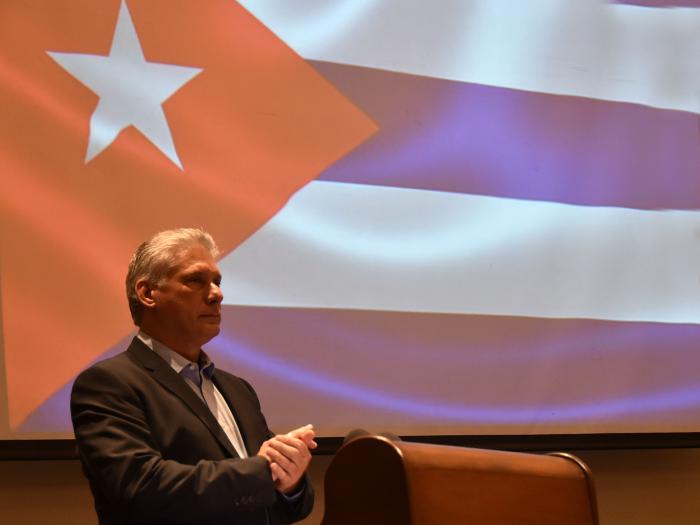
President of the Republic of Cuba, Miguel Díaz-Canel Bermúdez | Photo: Estudios Revolución


Addressing Cuba’s recently-convened National Assembly on April 19, President Miguel Díaz-Canel expressed confidence that the Cuban People would overcome warlike measures imposed by the United States.

“Congratulations to everyone on the Day of Victory!” he proclaimed. “On April 19 in 1961 on the sands of Playa Girón (Girón Beach) Cuba won the right to celebrate this day in providing for the first great defeat of imperialism in America. It was the triumph of the just against the unjust, of little David against the giant Goliath, of a socialist Revolution under the nose of the empire.”

“Thanks to this victory we today, on the tenth such occasion, install the People’s Assembly.” He declared that each of the 470 deputies “defends the interests of the majority,” that none of them won their seat through money or from the backing of an electoral party.

Referring to the Cuban Revolutionary Party founded by José Martíhe extolled “the single party that is the guarantee of unity” and through which, “the forces of a little nation do not disintegrate or fight each other.”

Díaz-Canel catalogued manifestations of U.S. all-but-war: invaders “working out of their caves on social networks,” and the “perennial cruelty of a blockade reinforced during the pandemic,” and “millions of dollars offered to those preparing to subvert Cuba’s internal order,” and “inclusion of Cuba on a list of supposed sponsors of terrorism that blocks access to financing.”

He stated that, “someday, earlier than later, the politics of hegemony will have to cease; multilateralism will take its place, and Cuba will be able to show how far a noble creative and talented people can go if they are united around clear objectives and if they are freed from pressures and blockades.”

Offering praise, Díaz-Canel maintained that “elections to the National Assembly are aimed at choosing the best people. That’s difficult … [because] there are many more good Cubans than there are seats in parliament.”

He expressed “certainty that no simulation of artificial intelligence could match the Cuban people’s achievements in recent years and their creative resistance. Their resilience exceeds the limits of any simulation or prediction. There is no algorithm capable of reflecting what we have lived through.”

Díaz-Canel highlighted the transparency of recent election campaigns, noting that voter participation was ample enough to waylay “hate-inspired” foreign-media expectations of low voter turnout indicative of a failed Cuban state. The recent elections included the Family Code referendum on September 25, 2022, elections for delegates to municipal assemblies on November 27, 2022, and voting for National Assembly deputies on March 27.

The Cuban president noted that the 75.8% of Cubans who voted on the last occasion was “above average for the other models of democracy in the world and [represented] “a show of citizenship, … patriotism, and above all, of political consciousness.”

The recently elected National Assembly overwhelmingly approved new terms for the Council of Ministers, the Council of State, and for Díaz-Canel, who will be serving his second and last five-year presidential term, as prescribed by recent constitutional changes.

Díaz-Canel outlined difficulties and unfinished tasks, observing that:

The world economy, uncertain and unstable in all latitudes, poses the first and greatest challenge for the new Council of Ministers … Leadership should focus on food production, the use of idle productive capacities, increased reliance on foreign-currency income, transformations required by the socialist state enterprise, enhanced efficiency of the investment process, and synergy of our economic actions and foreign investment. We do all this to increase the supply of goods and services and control inflation, which is the main priority in the economic battle. 

Even as he acknowledged “obstacles external to our economy that present profound difficulties,” the President “condemned bureaucratism, indifference, and corruption” in Cuba. He expressed confidence in the deputies’ “commitment and dedication,” while insisting that, “we will overcome the blockade without waiting for them to lift it.”

Díaz-Canel extolled Cuban youth “as the best revolutionaries because, dealing with every-day difficulties, they confront, try to fix, and achieve much. Despite adversity, they keep on smiling, loving, and believing in the possibility of a better country.” In fact, “socialism is closest to youth because it too is unfinished work.”

A persisting undertone of Díaz-Canel’s presentation was that of values, particularly those of solidarity and revolutionary service. Coinciding with the April 20 presentation of Díaz-Canel’s speech on resumenlatinoamericano.org were two news reports that exhibited diverse Cuban and U.S. purposes as regards Ukraine and expressed values.

report from Argentina announced a public television showing on April 23 of the Cuban film “Sacha, a child of Chernobyl,” first viewed in 2021. Living in Ukraine, Sacha was one year old and living in Ukraine on April 28, 1986 when the Chernobyl nuclear power installation exploded and radioactivity and radiation-caused diseases spread far and wide.

Sacha, un niño de Chernobyl, película completa

He was one of 26,000 children in Ukraine, Belarus, and Russia who received sophisticated medical care and rehabilitation in Cuba for their illnesses between 1990 and 2011, at no cost to families or governments. In the 1990s, Cuba was suffering the economic disaster of its “Special Period.” The film may be viewed here; Spanish language subtitles are provided.

Also on that day, a report appeared indicating that “The United States announced … the sending of another package of military aid worth $325 million for the fight against Russian forces. The U.S. Defense Department highlighted through a communique that this aid ‘will allow Ukraine to continue bravely defending itself in a brutal war against Russia, unprovoked and unjustified.’”

During another April, 200 years ago, an early warning sign cropped of a reality that would from then on plague Cuba, provoke revolution and bolster counter-revolution.  In his speech, Díaz-Canel recalled that John Quincy Adams, as secretary of state, statedon April 28,1823 that, “if an apple severed by the tempest from its native tree cannot choose but to fall to the ground, Cuba, forcibly disjoined from its own unnatural connection with Spain, and incapable of self-support, can gravitate only to the North American Union.”


W.T. Whitney Jr. is a political journalist whose focus is on Latin America, health care, and anti-racism. A Cuba solidarity activist, he formerly worked as a pediatrician, lives in rural Maine. W.T. Whitney Jr. es un periodista político cuyo enfoque está en América Latina, la atención médica y el antirracismo. Activista solidario con Cuba, anteriormente trabajó como pediatra, vive en la zona rural de Maine.