

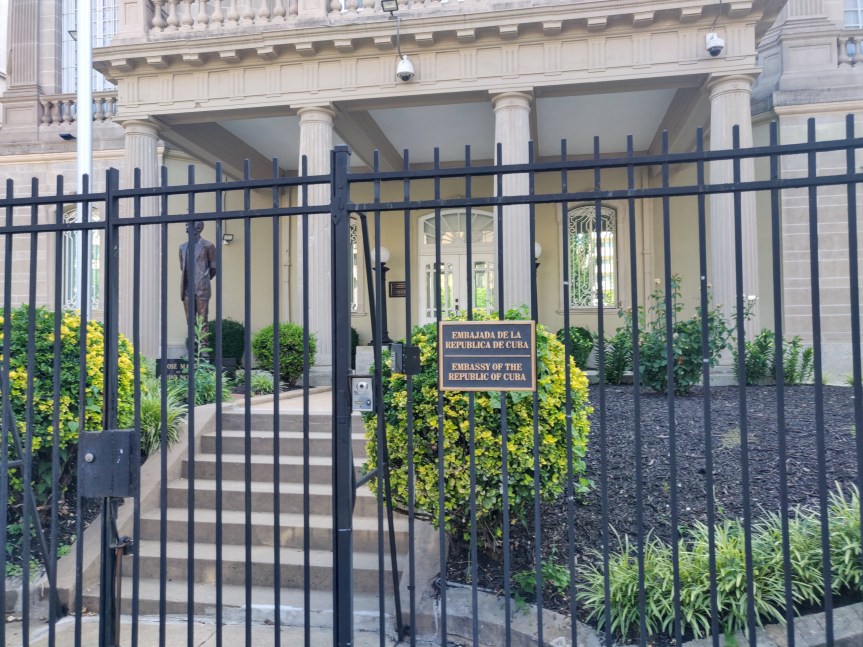
Embassy of Cuba, Washington, D.C | Photo: Wikimedia Commons
South Paris, Maine
Cuban Foreign Minister Bruno Rodriguez on Monday, September 25, indicated on social media that late the previous day, someone threw two Molotov cocktails at Cuba’s embassy building in Washington. Referring to “At least one Molotov cocktail,” an AP report indicated no one was injured and no damage occurred, also that “U.S. law enforcement officials were investigating.”
Condemnation of the attacks quickly emerged, in the United States from the Puentes de Amor (Bridges of Love) group, the People’s Forum in New York, Madea Benjamin, co-founder of CODEPINK, and the Washington DC chapter of the CPUSA. The governments of Mexico and Venezuela joined in denouncing the attack.
The National Network on Cuba issued a call for a protest demonstration in front of the Cuban Embassy at 5PM on September 25.
Within hours, President Díaz-Canel “expressed his firm condemnation of the act, attributing it to hate and underlining the possible consequences if forceful measures are not taken to deal with these acts of terrorism,” according to cubadebate.cu.
Outrage at the recent attack recalls national and global abhorrence to the assault-rifle attack on Cuba’s Embassy on April 30, 2020, which caused much damage. The 42-year-old suspect Alexander Alazo, a 42-year-old undocumented immigrant from Cuba, was arrested, imprisoned, and, three months later, indicted by a federal grand jury on multiple charges relating to the attack. An Internet search reveals no subsequent disposition of Alazo’s case.
Such incidents in Washington understandably are of the utmost concern to Cubans. Their experience is joining their country’s diplomatic missions abroad has too often put them in the way of U.S.-inspired terror attacks against their government.
Hostile parties used “petrol bombs” in causing damage to Cuba’s Embassy in Paris on July 27, 2021. As of 2020, “various Cuba representatives located abroad” between 1959 and 2018 experienced 581 incidents leading to 365 of them being killed and 721 wounded, according to Cuba’s Foreign Ministry. This toll includes non-Cubans associated with the diplomatic facilities.
The timing of September 25 attack may relate to recent developments in U.S. Cuban Relations. One in particular was the high-profile visit to New York of Cuban President Miguel Díaz-Canel who addressed the United Nations General Assembly. He was speaking for the G77+China bloc of nations, which he currently serves as chairperson, and for his own country.
Díaz-Canel in New York reached out. He attended a solidarity event on behalf of Cuba and Venezuela, met with Cubans living in the United States, talked with New Yorkers on the street, visited Harlem to honor Malcom X, appeared at a gathering at the People’s Forum, and joined Catholic leaders to remember Cuban independence leader Father Félix Varela.
Perhaps the hatred on display with the attack on the Cuban Embassy represents a twisted attempt to counter any assumption that Cuba is on the side of decency, solidarity, and peace in a troubled world. What with the Cuban President’s visit in New York, U.S. Americans, reasonably enough, may have latched onto that idea.
Possibly the attack was also a signaling that no let-up in counter-revolutionary maneuvering was likely in the United States, despite the federal prosecution and political opprobrium now aimed at Bob Menendez. The New Jersey Senator, an anti-Cuba heavy hitter, faces charges of bribery and corruption on a massive scale.
W.T. Whitney Jr. is a political journalist whose focus is on Latin America, health care, and anti-racism. A Cuba solidarity activist, he formerly worked as a pediatrician, lives in rural Maine. W.T. Whitney Jr. es un periodista político cuyo enfoque está en América Latina, la atención médica y el antirracismo. Activista solidario con Cuba, anteriormente trabajó como pediatra, vive en la zona rural de Maine.
 COMMUNIST PARTY OF MAINE