
Libya Catastrophe is Double Whammy, Capitalism to Blame / By W. T. Whitney Jr.

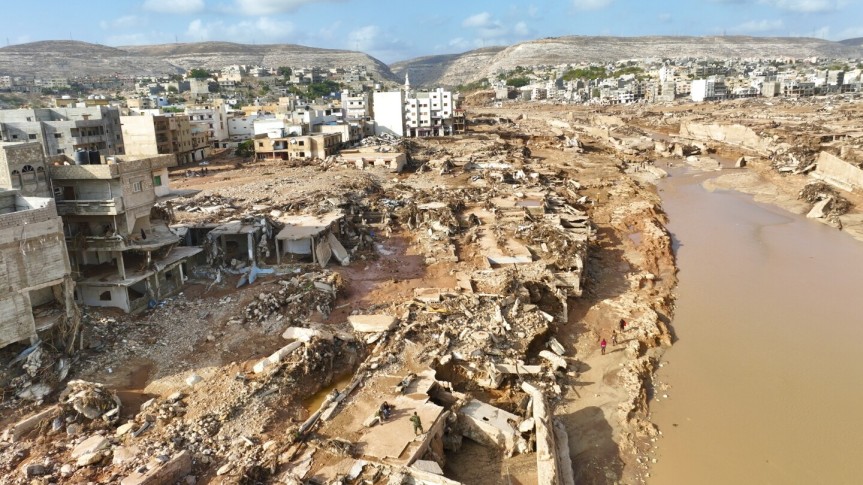
Darna, Libya after dams collapsed in the wake of storm Daniel. (Photo: AP/Jamal Alkomaty)

South Paris, Maine


Prodigious rainfall and the failure of long-deteriorated earthen dams caused a rush of waters through Derna, in Libya, on September 11.  Thousands of residents died, infrastructure was destroyed, and buildings ended up in the Mediterranean. Failure to protect residents, maintain the dams, and sustain the lives of all Libyans point to societal collapse.  

There is also the environmental crisis. Climate change provoked the enormity of storm Daniel that had drenched the eastern Mediterranean area ahead of the disaster. The association of climate change and terrible storms is known and so too is the role of human activities in causing great amounts of greenhouse gases to be released into the atmosphere.

The focus here is on the social disruption that transformed Libya. That’s because predisposing factors may not be clear. There are lessons to be learned.  The two crises are actually joined by virtue of both having developed out of a single impulse for domination.

Nationalist rebels led by Muammar Gaddafi deposed the embattled Libyan regime of King Idris on Sept. 1, 1969. Between 1973 and 1977, a Yugoslavian company contracted by the new government built two dams on the Wadi Derna River for the sake of flood control and irrigation. Maintenance of the dam would be lax.

A 1998 study revealed cracks and deterioration. After delays, a Turkish company began repairs on the dams in 2010. When the Gaddafi government was ousted in the following year, the work stopped.  Some $2.3 million was on hand for finishing the project. It disappeared.

Anti-government protests ─ the   Arab Spring ─ had broken out throughout the region in 2010. An anti-Gaddafi insurgency making headway in early 2011 prompted the military forces of the United States France, Great Britain, and a host of other countries to carry out a self-styled humanitarian intervention in March. Gaddafi’s murder seven months later ended the intrusion.  

U.S complaints had centered on an “opaque political and economic system,” widespread corruption, and Gaddafi’s autocratic proclivities. There had been mutual, and occasionally lethal, provocations.  Gaddafi’s increasing financial and banking influence in Africa raised eyebrows.

Gaddafi had offended by nationalizing 51% of oil companies’ assets in 1973.  According to one expert, “in 2006 the oil sector in Libya … made up ninety-five percent of export earnings, ninety-two percent of government revenue, and seventy-three percent of GDP.”  

The foreign assailants could not have overlooked the reality that a government with tight control over oil was in trouble with an insurgency.  It was no mean prize. Libya’s oil reserves now rank first in Africa and nineth in the world.  

Their forces carried out air operations, inflicted civilian casualties, assisted with the rebels’ ground actions, blockaded ports and embargoed weapons deliveries. They had a convenient tool.

Writer Eve Ottenberg a decade later accuses NATO, instrument for intervention, of fattening the wallets of war profiteers and weapons moguls and wreaking havoc in places like Yugoslavia, Afghanistan, Libya, now Ukraine.” Today France , Holland, and the United States are looking at French Guyana as a “forward-operating base for NATO” in Latin America, reports Guyanese activist Maurice Pindard. 

In its own review of “past and present” missions, NATO, with planetwide ambitions and unlimited potential for destruction, is, as expected, bereft of even a hint at repairing places left in chaos after its wars.

NATO departed from Libya, and ever since a government in the West of the country has been vying with a militarized counterpart in the East, where Derna is located. Cities have been bombed and occupied; Derna was subject to Islamic State rule from 2014 to 2016. Mercenaries, militias, and tribes jostle with one other. Milita groups control oil fields and extort vast sums. There’s “pillage on a vast scale,” plus drug-trafficking and exploitation of migrants heading to Europe.

Now one third of Libyans live in poverty; 13% of them require humanitarian aid, according to one estimate. By 2016, oil production, the source of social spending, had fallen to 75% below Gaddafi-era levels. It’s risen recently. 

The troubles experienced by Libya’s people were new. The Ghaddafi government had achieved much. The  2010 UN Human Development Index, a composite measure of health, education and income, ranked Libya 53rd in the world and first in Africa. By then, Libya was registering the highest per capita income in Africa, the lowest infant mortality, and the highest life expectancy. Schooling and healthcare were provided without Libyans having to pay.

Under Gaddafi, more than 95% of Libyans were adequately nourished; the government had abolished taxes on food. Literacy increased from 25% to 87% during the Gaddafi era. Almost 10% of Libya’s youth received scholarships for study abroad. Beginning in 1983 the government developed a massive water-delivery system with 1,100 new wells and 4,000 kilometers of pipelines.

Had the Gaddafi government not disappeared, the social advances and protection might have remained. Some of the progress might have continued under another government, if there had been no intervention. 

What’s certain is that previous arrangements for sustaining the population disappeared following NATO’s military action. Adverse conditions now allowed for the dams to disintegrate and for Libya’s people to not be rescued.

Pointing to a planetary “double crisis,” an ecological crisis and a social one, analyst Jason Hickle insisted recently that the two crises be dealt with simultaneously: “Attempting to address one without the other leaves fundamental contradictions entrenched.” He adds that, “the two dimensions are symptoms of the same underlying pathology … [which is] the capitalist system of production.”

Derner is witness to Hickle’s double crisis. The unprecedently heavy rainfall reflects climate crisis. A decade of turmoil and neglect of the dams attests to social crisis. The two share the same root cause. 

Capitalism requires perpetually increasing production of goods, which led to overuse of fossil fuels, which has translated into climate change. Under capitalism, natural resources in the world’s peripheral regions are plundered. Popular forces may be suppressed. Devices like NATO come into their own. If it had occurred a little earlier, Jason Hickle could have used the catastrophe to illustrate the main point of his article.


W.T. Whitney Jr. is a political journalist whose focus is on Latin America, health care, and anti-racism. A Cuba solidarity activist, he formerly worked as a pediatrician, lives in rural Maine. W.T. Whitney Jr. es un periodista político cuyo enfoque está en América Latina, la atención médica y el antirracismo. Activista solidario con Cuba, anteriormente trabajó como pediatra, vive en la zona rural de Maine.

US General Hypes China as Threat in Latin America / By W.T. Whitney Jr.


The U.S. government has long intervened in Latin America and the Caribbean (LAC). Now the U.S. military is paying attention to China’s economic activities there. 

General Laura Richardson on March 8 reported to the Armed Services Committee of the U.S. House of Representatives on actions and needs of the Southern Command, which she heads. She has charge of all U.S. military operations in the region. 

Citing the 2022 National Security Strategy, Richardson declared that “no region impacts the United States more directly than the Western Hemisphere …. [There] autocrats are working overtime to undermine democracy.” And security there “is critical to homeland defense.”

Richardson stated that “the PRC (People’s Republic of China) has both the capability and intent to eschew international norms, advance its brand of authoritarianism, and amass power and influence at the expense of the existing and emerging democracies in our hemisphere.” The Southern Command’s “main priority … is to expose and mitigate PRC malign activity.”

She sees a “myriad of ways in which the PRC is spreading its malign influence, wielding its economic might, and conducting gray zone activities to expand its military and political access and influence.” A “grey zone,” according to the NATO-friendly Atlantic Council, is a “set of activities … [like] nefarious economic activities, influence operations, … cyberattacks, mercenary operations, assassinations, and disinformation campaigns.”

Richardson highlighted China’s trade with LAC that is heading toward “$700 billion [annually] by 2035.” The United States, in her view, will be facing intense competition and presently “its comparative trade advantage is eroding.”

She added that, “The PRC’s efforts to extract South America’s natural resources to support its own population … are conducted at the expense of our partner nations and their citizens.” And opportunities for “quality private sector investment” are disappearing.

Competition extends to space: “11 PRC-linked space facilities across five countries in this region [enable] space tracking and surveillance capabilities.” Richardson complained of “24 countries [that] have existing Chinese telecommunication infrastructure (3G/4G), increasing their potential to transition to Chinese 5G.” 

She expressed concern both about surveillance networks supplied by China that represent a “potential counterintelligence threat” and about Latin Americans going to China “to receive training on cybersecurity and military doctrine.” Richardson denounced China’s role in facilitating environmental crimes and pointed to “potential dual use for malign commercial and military activities.”

“Relationships absolutely matter,” she insisted, “and our partner democracies are desperate for assistance from the United States.” Plus, “if we’re not there in time, they … take what’s available, creating opportunities for the PRC.”

Moving beyond China, Richardson indicated that “many partner nations …  see TCOs (transnational criminal organizations) as their primary security challenge.” That’s because drug-cartel violence leads to deaths and poverty and “illicit funds exacerbate regionalcorruption, insecurity, and instability.”

Her report avoids mention of particular countries other than offering brief references to Haiti, Cuba, Nicaragua, and Venezuela. She criticized Russia for “military engagements with Venezuela and Nicaragua” and for spreading “false narratives.” Richardson praised Colombia for providing military training in other countries. 

The Southern Command gains “exponential return” on supplying various countries with U.S. weapons and supplies. It conducts joint military exercises, and “provides professional military education to personnel from 28 countries.”

Richardson reported at length on processes she sees as fostering useful relationships between her command and the various governments and military services. The tone of urgency characterizing her discussion on China was entirely lacking. 

Economic intervention

General Richardson’s view that China has greatly expanded its economic involvement with the LAC nations is on target.

Since 2005, China’s state-owned banks have arranged for 117 loans in the region worth, in all, more than $140 billion. They averaged over $10 billion annually. Since 2020, China has made fewer loans.

Chinese trade with Latin America grew from $12 billion in 2000 to $448 billion in 2021. China’s imports of “ores (42%), soybeans (16%), mineral fuels and oils (10%), meat (6%), and copper (5%)” totaled $221 billion in 2021. The value of exported manufactured goods that year was $227 billion. By 2022, China had become the biggest trading partner in four Latin American countries and the second-largest in many others.  

China’s foreign direct investment (FDI) has long represented China’s strongest economic tie to the region. FDI signifies funding of projects abroad directed at long-term impact. China’s FDI from 2005 to mid-2022 was $143 billion. Energy projects and “metals/mining” accounted for 59% and 24% of the total, respectively. Of that total, Brazil and Peru received 45% and 17%, respectively. 

The FDI flow since 2016 has averaged $4.5 billion annually; worldwide, China’s FDI has contracted.

Chinese banks and corporations have invested heavily in lithium production in Argentina, Bolivia, and Chile, which, together, account for 56% of the world’s lithium deposits. China is the largest investor in Peru’s mining sector, controlling seven large mines and owning two of Peru’s biggest copper mines. Brazil is the world’s largest recipient of Chinese investments.  

China’s government has linked FDI to its Belt and Road Initiative (BRI) that began in 2013. As of May 2022, 21 Latin American and Caribbean countries were cooperating with the BRI and 11 of them had formally joined.

On the ground

U.S. military intervention in LAC is far from new. Analyst Sergio Rodríguez Gelfenstein complements Richardson’s report with a three-part survey, accessible herehere, and here, of recent U.S. military activities in the region.

He indicates the United States now has “12 military bases in Panamá, 12 in Puerto Rico, 9 in Colombia, 8 in Perú, 3 in Honduras, 2 in Paraguay, as well as similar installations in Aruba, Costa Rica, El Salvador, Cuba (Guantánamo), and in other countries.”

Rodríguez maintains that, “levels of aggressive interference by Washington in the region have increased dramatically” and that U.S. embassies there are supplied with more military, Cuba, Nicaragua, and CIA personnel than ever before.

Rodríguez notes features of the LAC region that attract U.S. attention, among them: closeness to strategically-important Antarctica; reserves of fresh water and biodiversity in Amazonian regions; the Guarani Aquifer near the triple frontier of Brazil, Paraguay, and Argentina, the largest in the world; and huge reserves of valuable natural resources.

Among ongoing or recent U.S. military interventions are these:

·        The U.S. Army Corps of Engineers is implementing a “master plan” for navigability of the Paraguay River and Plata River Basin. The nearby Triple Frontier area supposedly harbors international terrorism and drug-trafficking.

·        The U.S. military facility in Neuquén, Argentina is turning from its alleged humanitarian mission to activities in line with local preparations for oil extraction.            

·        U.S. officials on October 13, 2022 announced that 95 military vehicles were being donated to Guatemala for drug-war activities.   

·        In Brazil in September 2022, General Richardson indicated that U.S. forces would join Brazilian counterparts to fight fires in the Amazon..

·        The Southern Command’s fostering of good relations with Peru’s military has borne fruit. Under consideration in Peru’s Congress is a proposal to authorize the entry of foreign military forces. To what nation would they belong? Hint: former CIA operative and U.S. Ambassador Lisa Kenna met with Peru’s Defense Minister the day before President Pedro Castillo was removed in a parliamentary coup on December 7, 2022.

·        In March 2023, two U.S. congresspersons proposed that U.S. troops enter Mexico to carry out drug-war operations.

·        Presently the United States is making great efforts to establish a naval base on Gorgona island off Colombia’s Pacific coast. It would be the ninth U.S. base in Colombia, a NATO “global partner.”

·        In Colombia, U.S. troops acting on behalf of NATO, are active in that country’s Amazon region supposedly to protect the environment and combat drug-trafficking.

·        The U.S. National Defense Authorization Act of December 2022 awarded the Southern Command $858 million for military operations in Ecuador.

·        In a second visit, the US Coast Guard Cutter Stone was plying Uruguayan waters in February ostensibly to train with local counterparts for search and rescue operations. The ship was also monitoring the nearby Chinese fishing fleet.

Rodríguez does not comment on U.S. interventions in Cuba, Nicaragua, and Venezuela. That’s because they’ve persisted for “more than 60, 40, and 20 years, respectively” and each requires a “special report.”

John Quincy Adams returns

Proclaiming the Monroe Doctrine 200 years ago, Secretary of State Adams informed European powers that the United States regarded “any attempt on their part to extend their system to any portion of this hemisphere as dangerous to our peace and safety.”

General Richardson would apply the warning of that era to the PRC. Yet signs of hegemonic aspirations from that quarter are absent.

Commenting recently, Argentinian economist and academician Claudio Katz notes that, “China concentrates its forces in the economic arena while avoiding confrontations at the political or military level … Investments are not accompanied by troops and bases, useful for guaranteeing return on investments.”

Besides, China “does business with all governments, without regard to their internal politics.” That tendency, Katz writes, stems from the PRC having “arisen from a socialist experience, having hybrid characteristics, and not completing a passage to capitalism.” He maintains that China, with its economic involvement, contributes nothing to advancing socialism in the region.   


W.T. Whitney Jr. is a political journalist whose focus is on Latin America, health care, and anti-racism. A Cuba solidarity activist, he formerly worked as a pediatrician, lives in rural Maine. W.T. Whitney Jr. es un periodista político cuyo enfoque está en América Latina, la atención médica y el antirracismo. Activista solidario con Cuba, anteriormente trabajó como pediatra, vive en la zona rural de Maine.