
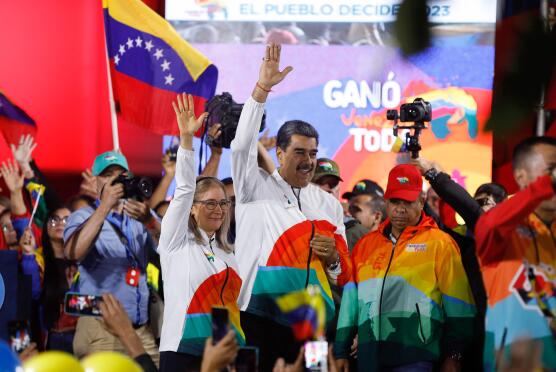
Venezuelan president Nicolas Maduro just before his speech celebrating the “Yes” vote in the Essequibo referendum, in Caracas, December 3, 2023 | Pedro Rances Mattey / AFP
South Paris, Maine
Venezuela’s National Assembly on December 6 began deliberation on President Nicolás Maduro’s plan for incorporating Essequibo into the Venezuelan nation. The region lying between Guyana to the East and Venezuela to the West has long been claimed by both nations.
Maduro’s plan involves creation of a “Zone of Comprehensive Defense of Guyanese Essequibo,” the naming of General Alexis Rodríguez Cabello to direct the project, designation of state agencies for licensing the “exploration and exploitation of oil, gas, and minerals,” distribution of a revised map of Venezuela, and, importantly, creation of “an organic law for formation of Guyanese Essequibo and all the decisions [voted upon] last Sunday.”
Venezuelans on December 3 did approve a referendum calling upon their government to establish sovereignty over the contested territory. Over 95% of those voting backed each of the referendum’s five points; 50% of Venezuelans did not vote. The upshot was a big majority in favor of Essequibo being a new Venezuelan state and of its 125,000 inhabitants becoming Venezuelan citizens and receiving social support.
An old border dispute is now a conflict impinging on the very fabric of the Venezuelan nation. Prime responsibility lies with U.S.-based ExxonMobil Corporation, its activities and acquisitive purposes.
Guyana became a British colony after the Napoleonic wars. Britain was uncertain about the boundary between their new colony and newly independent Venezuela. A survey carried out under British auspices in 1835 put the colony’s western boundary close to or at Venezuela’s Orinoco River.
However, Venezuela’s eastern border during its colonial period extended beyond the Orinoco, to the East, to the Essequibo River, flowing from south to north. During the 19th century, Venezuela’s leaders adhered to that version of the border.
President Antonio Guzmán Blanco initiated negotiations with Great Britain. Assuming that the Monroe Doctrine represented a barrier against European designs, as advertised, Venezuela’s government allowed two U.S. diplomats to negotiate on Venezuela’s behalf.
They colluded with their British counterparts. The negotiations ended with an agreement signed in Paris in 1899 that assigned the disputed Essequibo region to Guyana, the British colony.
Essequibo’s gold-mining potential was evident at the time. Now, according to a recent report, “Gold mining generates Guyana’s main export product, and such mining is carried out mainly in the Essequibo.”
Britain granted independence to Guyana in 1966. Earlier that year representatives of the Venezuelan and British governments, meeting in Geneva, agreed to submit the continuing dispute over Essequibo to arbitration. Venezuela’s government subsequently presumed that the 1899 Paris agreement no longer applied.
With no resolution in sight, the two sides in 1987 submitted the issue to United Nations mediation. Nothing happened. In 2018, in response to a request from Guyana, UN Secretary General Antonio Guterres referred the issue to the International Court of Justice located in The Hague.
Although Venezuela denies the Court’s jurisdiction, representatives of both nations appeared before the Court in November 2023. At issue was a Guyanese demand that Venezuela cancel the referendum that did take place on December 3.
The recent urgency of resolving the Essequibo quandary has everything to do with actions taken by ExxonMobil Corporation.
In 2015 ExxonMobil discovered copious off-shore oil reserves under Essequibo’s territorial waters. Guyana’s government expanded the bidding process for oil explorations. A previously humdrum territorial dispute had turned into a momentous contest with potentially far-reaching consequences.
ExxonMobil epitomizes power and wealth. Profits in 2022 were $56 billion. ExxonMobil revenues of $413.7 billion for 2022 were greater than the GDPs that year of all but 34 countries in the world; it ranked seventh for income-generating capacity among the world’s corporations. ExxonMobil sees Guyana as its potentially most productive oil-producing region, a place accounting for more than 25% of ExxonMobil’s total hydrocarbon production.
According to analyst Vishay Prashad, “ExxonMobil … signed an agreement with the government of Guyana in 1999 to develop the Stabroek block, which is off the coast of the disputed Essequibo region.” He adds that, “ExxonMobil was given 75% of the oil revenue toward cost recovery, with the rest shared 50-50 with Guyana; the oil company, in turn, is exempt from any taxes.”
W.T. Whitney Jr. is a political journalist whose focus is on Latin America, health care, and anti-racism. A Cuba solidarity activist, he formerly worked as a pediatrician, lives in rural Maine. W.T. Whitney Jr. es un periodista político cuyo enfoque está en América Latina, la atención médica y el antirracismo. Activista solidario con Cuba, anteriormente trabajó como pediatra, vive en la zona rural de Maine.
 COMMUNIST PARTY OF MAINE