
U.S. Drug War Arrives in Ecuador, with Baggage / By W. T. Whitney Jr.

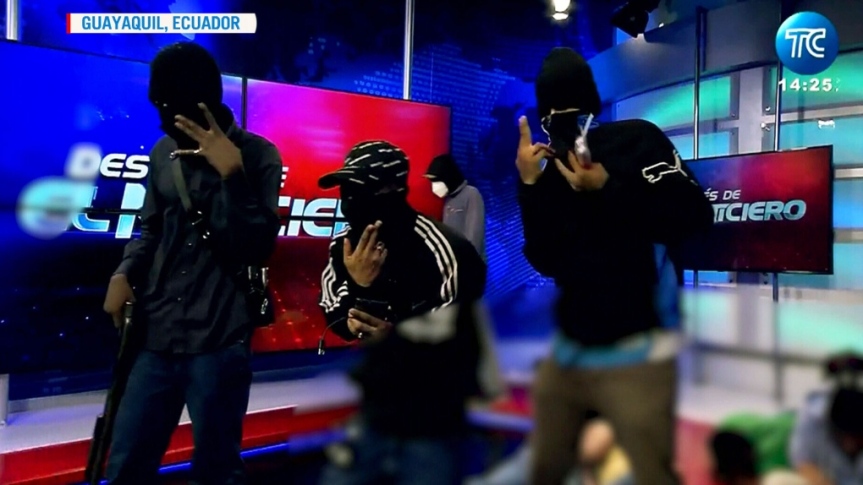
Photo via People’s Dispatch

South Paris, Maine


Joined by other U.S. officials, Laura Richardson, commander of the U.S. Army’s Southern Command, was in Ecuador January 22-25 to confer with government leaders there about U.S. military assistance. They included recently elected, and very wealthy, President Daniel Noboa. She mentioned to reporters an “investment portfolio…worth $93.4 million including not only military equipment … [but also] humanitarian assistance and disaster response, [and] professional military education.”

Prompting the visit was recently intensifying crime and turmoil manifesting as prison riots, escapes from prisons, and assassinations of political figures. A homicide rate of 5.8 per 100,000 persons in 2017 increased to 43 murders per 1000 Ecuadorians in 2023.

In the “grip of drug gangs,” Ecuador has been receiving cocaine and other illicit drugs produced and processed in countries such as Colombia, Peru, Bolivia, and Brazil. From Guayaquil and Esmeraldas, ports in Ecuador, the goods move on to U.S. and European consumers. The cartels’ former routes, through Central America and the Caribbean, are less active.

Ecuador’s government recently decreed a state of “internal armed conflict.” Its Army now has charge of domestic security.  From 2017 to 2023, governments under presidents Lenin Moreno and Guillermo Lasso arranged for privatizations, fiscal austerity, and a reduced package of state services. Resources are lacking to deal with powerful region-wide drug cartels now operating in the country.  U.S. military intervention would fill the gap.

The U.S. so-called drug war, as waged in Latin America and the Caribbean, began during the Nixon administration. Notable examples are Plan Colombia from 1999 until 2015 and the Merida Initiative, applied to Mexico from 2007 until 2021. The U.S. media provocatively associates drug cartels with international terrorism.  U.S. drug war spending has reached $1 trillion over four decades, says a report.

Ecuador’s situation has special features. Analyst Pablo Dávalos sees “convergence among political power, organized crime, and narcotrafficking to allow [Ecuador’s] use of the dollar as its national currency to enable money laundering.” Organized crime “controls vast areas” and Ecuadorians “refusing to pay extorsions are being systematically eliminated.”

Eloy Osvaldo Proaño of the Latin American Center of Strategic Analysis points out that the “neoliberal recipe reduces institutional presence, which weakens control of borders and facilitates penetration of criminal gangs.” What President Noboa has proposed “is part of a regional plan of paramilitaries occupying wide areas to instill terror, tear apart the social fabric and subdue populations.”   

The “22 organizations declared [by Noboa] to be ‘terrorist groups’ … have a capacity of maneuver and omnipresence enabling them to control territories and prisons, even to penetrate the institutions [of the state].”

Ecuador recently became the leading recipient of U.S. military assistance in Latin America and the Caribbean area. More is on the way. Ecuador’s defense minister indicated the U.S. government will be “investing” $3.1 billion in military assistance over seven years.  

Planning has been elaborate:

·        The FBI in 2017 assisted the “lawfare” campaign of President Guillermo Lasso against President Rafael Correa, his progressive predecessor.

·        The U.S. Congress on December 15, 2022, approved the United States-Ecuador Partnership Act of 2022.

·        A memorandum of understanding was signed in Washington in July 2023. It covers U.S. efforts to strengthen Ecuador’s military capacities and combat the drug trade.

·        A binational agreement was signed on August 16, 2023 for cooperation in building the capacity of Ecuador’s military, police, and judiciary.

·        President Lasso in Washington on September 28, 2023 signed agreements allowing U.S. troops and naval personnel to deploy in Ecuador.

·        Ecuador’s foreign minister signed a status of forces agreement with the U.S. ambassador on October 6, 2023 relating to privileges, immunities, and guarantees for U.S. armed forces personnel.

·        Ecuador’s Constitutional Court on January 11, 2024 ratified the U.S.- Ecuador security agreement.

Colombian President Gustavo Petro in September, 2022 recalled an earlier conversation with General Richardson about “the failure of [U.S.] anti-drug policies.” He mentioned to her that, “It’s our obligation … to say that and also to propose alternatives that don’t allow a million more Latin Americans to die.”  

Petro has company. Many progressives in the United States and elsewhere also regard the U.S. drug war as a failure. Facts are on their side:

·        Narcotrafficking has increased despite drug war.

·        Moneys spent on drug war is money not spent on preventative programs and poverty reduction.

·        U.S.-assisted militarization of targeted countries undermines democratic renewal.

·        Drug war means profits to weapons suppliers, narco-traffickers, and money-laundering banks and businesses.

·        The United States, the great consumer of illicit drugs, bears responsibility for not reducing consumption.

This consensus resonated at the Latin American and Caribbean Conference on Drugs – for Life, Peace, and Development that took place September 7-9, 2023 in Cali, Colombia. President Petro and Mexican President Andrés Manuel López Obrador had called for the gathering. Attending were officials of 19 regional nations and representatives both of observer countries and international social organizations.  

The object was “to rethink drug policies in response to the failure of the punitive strategy imposed by the United States.” The most impactful recommendations emerging were these:

·        Change basic assumptions by recognizing the failure of the U.S. war on drugs.

·        Contain the drug problem internally by dealing with structural causes of poverty, inequalities, lack of opportunities, and violence.

·        Block drug trafficking through “principles of justice and through development.” Fight poverty by giving people opportunities, youth especially.

·        Explore legal modes of drug consumption.

·        Reduce demand through “universal prevention” and attending to mental health problems.

Why does the U.S. government fight narcotrafficking in Ecuador? Its agenda is full already. Its prohibitions on narcotics use at home are less than effective.

Here’s a hint. Indigenous peoples organized by Ecuador’s Confederation of Indigenous Nationalities (CONAIE) carried out week-long national strike in June 2022.  At issue were labor rights, rescuing the environment, poor families’ unmet needs, and support for small farmers. A people’s political resistance movement evidently exists there.

Leonidas Iza, the CONAIE leader, now speaks out in regard to General Richardson’s visit. He told an interviewer that, “We struggle for the Ecuadorian people” and that, “We are ceding not only military sovereignty, sovereignty over our country but even more: we are submitting to their desire to control our resources.”

All is revealed. What’s happening is nationwide political resistance striking at U.S. economic and political interests abroad. The U.S. government characteristically takes protective action in such circumstances.

Drug war serves as a cover for putting U.S. troops and U.S. proxies on the ground for preventative purposes. In Colombia, under Plan Colombia, the U.S. military joined up with Colombia’s Army to confront leftist insurgencies. A U.S. military presence would have been handy in Peru and Bolivia to ward off indigenous mobilizations led, respectively, by former presidents Pedro Castillo and Evo Morales.


W.T. Whitney Jr. is a political journalist whose focus is on Latin America, health care, and anti-racism. A Cuba solidarity activist, he formerly worked as a pediatrician, lives in rural Maine. W.T. Whitney Jr. es un periodista político cuyo enfoque está en América Latina, la atención médica y el antirracismo. Activista solidario con Cuba, anteriormente trabajó como pediatra, vive en la zona rural de Maine.
Haiti’s Choice Is Social Revolution or Foreign Intervention / By W. T. Whitney Jr.

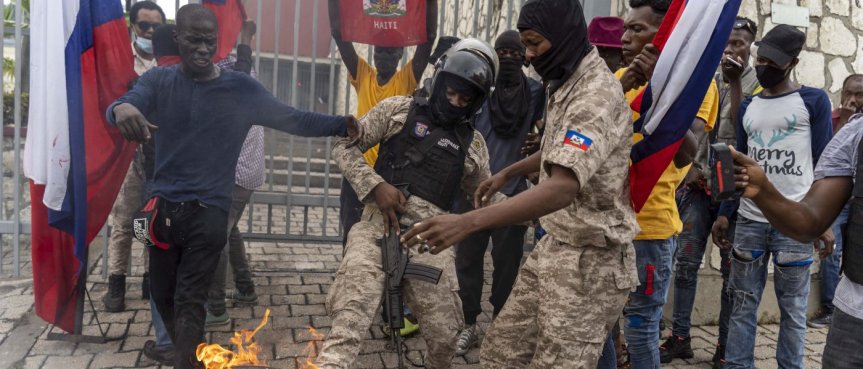
Photo: RICHARD PIERRIN/AFP via Getty Images

With long experience of chaos, violence, and dysfunctional governance, Haiti looks now to be on the verge of new crisis in the form of foreign military intervention. U.S. and United Nations decision-makers have held back, but now they look to be moving, again. 

The need all the while has been for change so that all Haitians might live decent lives. Whatever is in the works now offers little prospect for rearrangement of political and social hierarchies in Haiti. 

Haitians for several years have faced high prices, recurring shortages of essential supplies, and deadly gang violence in cities that has converted Haiti into a war zone and is the focus of media and political attention from abroad.   

Left-leaning political activist Camille Chalmers insists “there is a clear connection between these gangs and sectors of power, [which include] the far right” and the U.S. government. In an interview published on May 7, Henry Boisrolin agrees. This Haitian analyst living in Argentina states that: 

We have entered … a new phase in a spiral of violence characteristic of a crumbling neo- colonial system … The armed gangs are frankly death squads that are instruments in the hands of the Haitian oligarchy and the international community, mainly the United States. They want to subdue the popular movement in Haiti, sew terror, and put off an uprising.

The government headed by Prime Minister Ariel Henry, appointed by President Jovenel Moïse just days before his murder on July 7, 2021, is a façade. The U.S. government and the supervising “Core Group” of foreign nations put him in office and are backing him now. 

The last national elections were in 2016; the National Assembly has no legislators. Those elections, remarkable for minimal voter turn-out, gave the presidency to Moise, a wealthy businessman.  

Moïse overstayed his term of office, was accused of massive corruption, and was killed by paramilitaries who prepared in the United States. His predecessor, millionaire Michel Moise, became president in 2011 only after U.S. Secretary of State Hillary Clinton intruded in the elections.

Affecting Haiti’s situation now are: death and destruction from earthquakes and hurricanes; UN military occupation for 13 years that that introduced cholera, killing tens of thousands; and billions of dollars stolen that were set aside to pay for oil from Venezuela’s Petrocaribe program.

The distant background shows U.S diplomatic and commercial barriers during Haiti’s first 50 years, unjust and massive debt obligations to France for over a century, U.S. military occupation and U.S. support for the Duvalier dictatorships during the twentieth century, and subsequently a U.S. hand in two coups that removed the progressively-inclined President Jean-Bertrand Aristide. 

The United Nations Security Council  on October 21, 2022, “demanded an immediate cessation of gang violence and criminal activity” and declared itself ready “to take appropriate measures … against those engaged in or supporting gang violence.”  In January, 2023,U.N. Secretary General António Guterres called for “deployment of an international specialized armed force to Haiti.” 

On April 26 the Security Council deliberated on Haiti;19 speakers were heard. Maria Isabel Salvador, Head of the UN’s “Integrated Office in Haiti,” indicated that almost 50% of Haitians require humanitarian assistance. “The Haitian people cannot wait,” she declared; a “specialized international armed force” is needed. Jean Victor Geneus, Haiti’s Minister for Foreign Affairs, agreed.

The U.S. government is ready to act, it seems, with plans aimed at implementing the 2019 Global Fragility Act. That law would prevent and reduce violent conflict” abroad by means of “negotiating bilateral, 10-year-long “security assistance” arrangements with  “fragile states.”

The State Department on April 1, 2022, released a document explaining rationale and methods for implementing the GFA. A year later, on March 27, the State Department explained that the GFA would be implemented through 10-year plans … in partnership with Haiti, Libya, Mozambique, Papua New Guinea, and Coastal West Africa, including Benin, Côte d’Ivoire, Ghana, Guinea, and Togo.” 

An accessory document reveals that Haiti was being prioritized. It mentions a “sequenced approach for U.S. efforts” that will depend upon “political and security openings in the country.”

Kim Ives, veteran defender of Haiti’s sovereignty, commented that the plan “is essentially a new alliance of USAID ‘know-how’ with Pentagon muscle.” He foresees that the United States will be “returning the country from a neo-colony back into a virtual colony as it was from 1915 to 1934, when U.S. Marines occupied and ran it. Nonetheless, the U.S. would try to keep some Haitian window-dressing.” 

Vassily A. Nebenzia, the Russian Federation’s Permanent Representative on the UN Security Council, received a letter on April 24 from 58 individual Haitians and representatives of Haitian political organizations.  Russia is currently serving as the Security Council’s president.

The letter claims that U.S. plans for Haiti’s future would violate the United Nations Charter. It calls for an independent commission to evaluate U.S. interventions in Haiti since 1993. The authors fear “a grave attack on the sovereignty, independence, territorial integrity, and unity of Haiti.” 

They also object to U.S. occupation since 1856 of the Haitian island Navase, the U.S. government’s manipulations in the 2010 presidential elections, and U.S. failure to prevent the weapons being shipped to Haiti for use in killings and crimes. 

A month after President Moise’s murder in 2021, the “Montana group” of civic leaders proposed a two-year provisional government that would prepare for elections.  The results have been nil.  

De facto Prime Minister Ariel Henry in December 2022 announced a “High Transition Council” set up to arrange for elections. But eight political parties soon vetoed the project and very little has been achieved. Already in October, Henry had requested the U.S. government and/or United Nations to intervene militarily. 

Whatever happens in Haiti promises little help for a severely distressed underclass; 59 percent of Haitians live on less than $2 a day, the poverty rate is 60%, a quarter of the population has no access to electricity, 50% of Haitians are food insecure, 50% of Haitians must drink polluted water, 50% Haitian children do not attend school, and two thirds of adult Haitians are unemployed or informally employed. 

No social revolution is on the horizon and most Haitians, individually and collectively, are powerless. Power lies with Haiti’s business class whose impulse is for “invasion and occupation.” 

These would be the richest ten percent of Haitians who control 61.7% of the country’s wealth. The billionaires in that class are conglomerate owners Gregory Mevs and Gilbert Bigio, worth $1.0 billion and $1.2 Bіllіоn, respectively, and Irishman Denis O’Brien, who is worth $6.8 billion and controls Haiti’s telephone services.  

Henry Boisrolin, cited above, sees U.S. hypocrisy when he looks at U.S. sanctions against ten powerful families in Haiti that buy “tons of arms and munitions” for use in Haiti. This is a U.S. government that “does not allow a single syringe to make its way to Cuba” while claiming ignorance as to who sells those arms or that they come from the United States.


W.T. Whitney Jr. is a political journalist whose focus is on Latin America, health care, and anti-racism. A Cuba solidarity activist, he formerly worked as a pediatrician, lives in rural Maine. W.T. Whitney Jr. es un periodista político cuyo enfoque está en América Latina, la atención médica y el antirracismo. Activista solidario con Cuba, anteriormente trabajó como pediatra, vive en la zona rural de Maine.