Fixing Healthcare Failures in the US and in Lewiston, Maine / By W. T. Whitney Jr.

Photo credit: Tim Wheeler/People’s World

South Paris, Maine


Efforts to reform U.S. healthcare fall short. Preventable deaths are excessive, access to care is often impossible, costs are high, and profiteering thrives. Individual solutions replace common purpose. Hope lies with an activated working class fighting for equitable, accessible, humane, and effective healthcare.

Maine people are now collecting signatures for a petition on the 2026 ballot demanding that the state promote universal healthcare. The campaign coincides with costs of Medicare insurance premiums increasing after January 1, 2026. That’s when subsidies provided under the Affordable Care Act are reduced. The campaign will react also to recent federal legislation that removed a million or so low-income Americans from Medicaid coverage.

The precariousness of current healthcare arrangements is evident to Maine voters who are aware of a painful transition taking place in Lewiston, Maine’s second largest city, population 39,187. Lewiston’s Central Maine Healthcare corporation (CMH) has been losing $32.5 million annually over five years. California-based Prime Healthcare, the fifth largest U.S. profit-making health system and owner of 51 hospitals in 14 states, is buying CMH.

Takeover

Serving almost half a million people in its region, CMH operates Central Maine Medical Center (CMMC), two smaller hospitals in the area, and also physicians’ practices, urgent care offices, nursing homes, and counselling centers in 40 locations. CMMC, established in 1891, has 250 beds and employs 300 physicians representing most specialties. The agreement to change ownership, announced in January 2025, is about to be finalized.

Prime Healthcare will invest $150 million in CMH over 10 years, while assigning CMH to its Prime Healthcare Foundation, a supposedly non-profit entity with $2.1 billion in assets. Prime Healthcare has a record

The corporation has periodically faced charges of overcharging, services dropped and safety standards ignored. After 2008, accusations surfaced in California of underfeeding hospital patients, allowing for post-surgery infections, and hospitalizing emergency room patients to increase revenues. Prime Healthcare in 2018 paid $65million in fines to settle accusations of Medicare fraud, over $35 million in 2021 for kickbacks and overcharging, and $1.25 million for false Medicare claims submitted by two Pennsylvania hospitals.

The Center for American Progress, a left-leaning think tank, recently warned against private equity companies owning health centers and controlling practitioners. It cited “unmanageable debt”, “increased costs for patients and payers,” poor patient care, and distressed healthcare workers.

Maine’s legislature on June 22 enacted  legislation establishing a one-year moratorium on private equity companies (and real estate investment trusts) owning or operating hospitals in the state.

Troubles in city and state

Other Maine health systems are also experiencing big financial troubles. Northern Light Health, with debt of $620 million, recently closed an acute-care hospital in Waterville and announced a new partnership with the Harvard Pilgram system in Massachusetts. Lewiston’s St. Mary’s Health System closed its obstetrical services, sold off properties, and is laying off employees. The New England-wide Covenant Health system, owner of St. Mary’s since 1990, indicates covering the hospital’s unpaid bills amounting to $88 million is not “sustainable.”

One media report suggests Maine people aware of layoffs, health institutions’ financial troubles and diminishing services are “wondering about the future of their health care.”  Medicaid funding reductions, shortages of primary care providers, and trimmed-down health centers have led to lengthy wait-times for appointments, long travel distances to new providers, and no care for many.

Lewiston, once a textile and shoe manufacturing center with a large population of French-speaking workers, migrants from Quebec, is “the poorest city in Maine.” Fallout from CMMC’s financial problems and reduced federal funding threaten the healthcare of people whose lives are already precarious.

Eleven percent of Lewiston residents are migrants from Africa, mostly from Somalia. The 2023 poverty rate for the city’s Somali people was 32%. For Lewiston it was 17.7% and for Maine  10.4%. Poverty for Androscoggin County, which includes Lewiston, was 13% in 2023; child poverty was 16.6%.  Life expectancy in Lewiston was 75.5 years in 2020, in Maine, 77.8 years.

Neither Maine or Lewiston is bereft of resources. Apart from remote rural and forested areas, Maine has well-functioning hospitals and competent practitioners.  Experienced and concerned agencies and organizations provide social services and support for health-impaired Mainers.

Maine ranks 17th  among the states in “cost, access, and quality of Medicaid and CHIP (Children’s Health Insurance Program) coverage for low-income individuals.” Another survey has Maine in 23rd place in “per person state public health funding” for 2023. A ranking of “states most supportive of people in poverty” puts Maine in 12th place.

Maine with its healthcare difficulties is not an outlier within the United States. Nevertheless, uncertainties prevail statewide, and Lewiston is in low-grade crisis mode. Planning is incremental, limited to localities, and accepting of the status quo. Collective action is not a consideration for those dealing with the crisis –providers, hospitals, recipients of care, and the general public. Individual initiative is the rule, as per U.S. habits.  

Wider perspective

Those healthcare flaws and difficulties evident in Maine exist throughout the United States. Awareness of the consequences is crucial to building support for necessary change.  

Too many people die. US infant mortality in 2021 ranked 33rd among 38 countries belonging to the Organization of Economic Cooperation and Development, the world’s wealthiest countries. U.S. life expectancy in 2025 ranked 48th in the world. U.S. maternal mortality rate in 2023 was in 59th..

Inequalities are pervasive, as reflected in the poverty and life-expectancy variations in Maine. The huge flow of money through the system highlights inequality; it takes place at levels far removed from the depths of U.S. society. U.S. health expenditures per person in 2023 were $14,885; the average in other countries comparable by wealth was $7,371. Health expenditure as percent of GDP in US was 17.6% in 2023; the figure for all other wealthy countries was lower than Switzerland’s 12.0%.

Incentives for profiteering are many. While administrative costs represented only 3.9% of total Medicaid spending in 2023 and only 1.3% of all traditional Medicarespending in 2021, they accounted for “about 30%” of the cost of private health insurance in 2023. Presumably, profit-taking is embedded within those high administrative costs.

Critics of US healthcare, writing recently in Britain’s Lancet medical journal, assert that “profit-seeking has become preeminent.” They add that:

“Health resources of enormous worth … have come under the control of firms obligated to prioritize shareholders’ interests … The potential for profits has attracted new, even more aggressive corporate players—private equity firms … [These have] a single-minded focus on short-term profit” … The US health-care financing system makes profitability a mandatory condition for survival, even for non-profit hospitals.” 

Realization dawns that adverse social and economic factors are tearing apart the benevolent purposes of healthcare. They make people sick. A report of the American Academy of Actuaries issued in 2020 says that, “30% to 50% of health outcomes are attributable to SDOH (social determinants of health), while only 10% to 20% are attributable to medical care.” A public health study shows that, “Nearly 45,000 annual deaths are associated with lack of health insurance.”

There is a way

That which has led to a floundering care system belongs to no one and weighs upon everyone, more so on the dispossessed and marginalized. It’s an epidemic, in the original Greek meaning of that word, “upon the people.”  Corrective action would therefore derive from and apply to all people all together. Healthcare itself supplies the model.

For many, physician John Snow is the “father of public health.” In London in 1854, Snow investigated an outbreak of cholera, a water-borne infectious disease. Suspecting that water from the Broad Street pump was the culprit, he removed the handle. The epidemic stopped. He had acted preventatively on behalf of the many, not for individuals.

Comes the Cuban Revolution and preventative and curative medical care are joined in one public health system. Political change allowed for that.

Rudolf Virchow (1821-1902), pathology giant and one of the founders of scientific medicine, was on the case almost two centuries earlier.  This leader of the Berlin Revolutionary Committee was behind the barricades in the revolutionary year of 1848. In 1847-1847, Virchow studies a typhus epidemic killing inhabitants of Upper Silesia. He notes in his report that:  

“A devastating epidemic and a terrible famine simultaneously ravaged a poor, ignorant and apathetic population. … No one would have thought such a state of affairs possible in a state such as Prussia, … we must not hesitate to draw all those conclusions that can be drawn. . . I myself …  was determined, … to help in the demolition of the old edifice of our state. [The conclusions] can be summarized briefly in three words: Full unlimited democracy.”

Virchow writes that, “Medicine is a social science, and politics is nothing else but medicine on a large scale… The physicians are the natural attorneys of the poor.”

If democracy was the fix then for an epidemic, it’s the fix now for the current epidemic of disordered healthcare. The people themselves would rise to the occasion. And how are they going to do that?

The role of profiteering in U.S. healthcare is a reminder of the capitalist surroundings of the struggle at hand. Aroused working and marginalized people are on one side and the rich and powerful on the other.

Does capitalism need to go in order that healthcare changes? Not yet, suggests international health analyst Vicente Navarro. In explaining U.S. failure to achieve universal healthcare, he observes that, “The U.S. is the only major capitalist developed country without a national health program, and without a mass-based socialist party. It is also one of the countries with weaker unions, which is to a large degree responsible for the lack of a mass-based working-class party.”

That clarifies. The working class is crucial to repairing a dismal situation. Its partisans will work on strengthening the labor movement in size and militancy. Working class political formations will have their day.

Martin Luther King has the last word. Speaking to health workers in 1966 King remarked that, “Of all the forms of inequality, injustice in health care is the most shocking and inhumane because it often results in physical death.”  His reference to “forms of inequality” implies the existence of the capitalist system giving rise to such forms. Capitalism fosters early deaths as well as racism.


W.T. Whitney, Jr., is a political journalist whose focus is on Latin America, health care, and anti-racism. A Cuba solidarity activist, he formerly worked as a pediatrician and lives in rural Maine.

Haiti has disturbed U.S. ruling class for two centuries; Springfield is latest flare-up / By W. T. Whitney Jr.

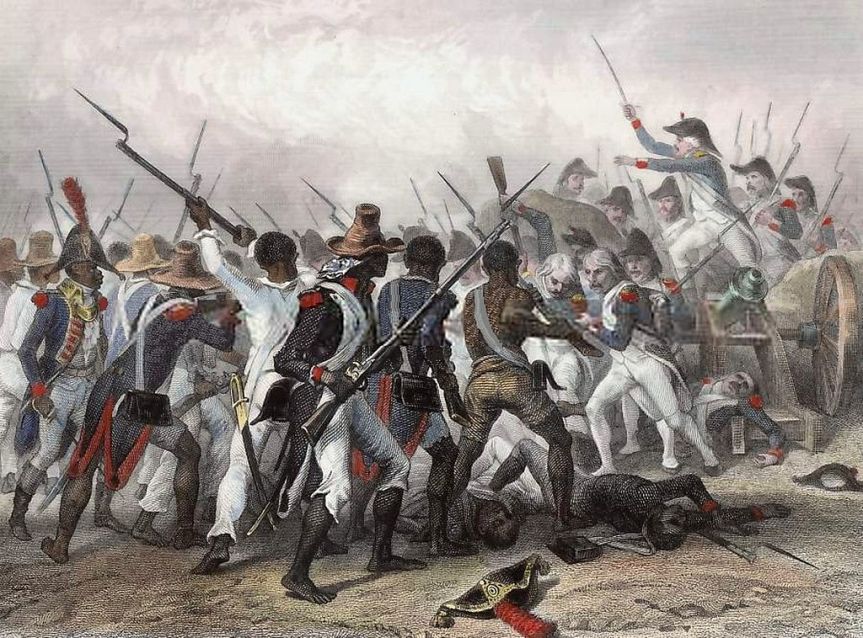
Haitian Revolution: Attack and take of the Crête-à-Pierrot (March 24, 1802). Original illustration by Auguste Raffet, engraving by Ernst Hébert. | Public Domain

Reposted from Peoples World


Republican presidential and vice-presidential candidates expressed horror a couple of weeks ago on apparently learning from social media that Haitian migrants in Springfield, Ohio, were eating dogs and cats, “eating people’s pets,” as Trump put it. The reports, as we all know now, were false, but their fallout was quite real. Bomb threats followed, schools and public buildings closed down, and longtime African-American residents felt threatened.

A bit of backstory: Springfield’s economy lost jobs and industries over the years. Some 15,000 Haitians arrived, eager to work. Industry expanded, but social service providers were stressed. Most of the Haitians in Springfield are there under Temporary Protected Status. That governmental designation enables migrants forced out of their counties by serious crises to enter the United States legally.

The bizarre twist of political behavior stems in part from the migrants being Haitian. Haitians and their nation have been problematic for the United States’ ruling class for more than two centuries.

The fact of migration itself does not account for the exaggerated hostility, though. Almost nothing of that order happens to the one-third of New York state residents and 40.9% of Miamians who are immigrants, or to the foreign-born residents of nine other urban areas in the United States who comprise from 21.1% to 39.1% of the several populations.

Stresses and frustrations associated with Springfield’s economic decline logically enough could have stimulated hostility toward migrants, if we look at what has happened historically in other communities. But economist Franklin J. James rejects the idea “that immigration hurts U.S. natives by reducing job opportunities …[and] that immigrants displace natives from jobs or reduce earnings of the average worker.”

Being Black may indeed invite hostility in a racist society, however. But the disconnect is sharp between the rarity of unbounded disparagement at high political levels and the large numbers of African-descended people who never experience the like from anybody. Opportunities abound. In 2019 Black people made up from 21.6% to 48.5% of the populations of 20 U.S. cities. That year nine Ohio cities, not including Springfield, claimed between 32.0% and 11.2% Black people. In 2024, 17.4% of Springfield residents are Black.

The scenario in Springfield may itself have been toxic: A large number of Black people from abroad arrived together on an economically depressed small city. But Somali migrants arrived in Lewiston, Maine under similar circumstances, and their reception was different.

They showed up in 2001, and a year later numbered 2,000 or so. In January 2003, an Illinois-based Nazi group staged a tiny anti-Black rally; 4,500 Mainers joined in a counter-demonstration.

As of 2019, according to writer Cynthia Anderson, “Lewiston … has one of the highest per capita Muslim populations in the United States, most of it Somali along with rising numbers of refugees and asylum-seekers from other African nations.” Of Lewiston’s 38,404 inhabitants, 10.9% presently are “Black or African American.” Blacks are 1.4% of Maine’s population.

Anderson reports that with the influx of migrants, Lewiston “has struggled financially, especially early on as the needs for social services and education intensified. Joblessness remains high among the older generation of refugees.”

Lewiston is Maine’s poorest city. For generations, massive factories along the Androscoggin River produced textiles and shoes, but they are gone. The city’s poverty rate is 18.1%; for Blacks it’s 51.5%. In 2016, 50% of Lewiston’s children under the age of five lived in poverty.

Citing school superintendent Bill Webster, an AP report indicates “immigrant children are doing better than native-born kids” in school, and are “going off to college to get degrees, as teachers, doctors, engineers.”

Analyst Anna Chase Hogeland concludes: “The Lewiston community’s reaction to the Somalis demonstrated both their hostility and reservations, as well as the great efforts of many to accommodate and welcome the refugees.” Voters in Lewiston are conservative; the majority of them backed Donald Trump in the 2016 and 2020 presidential elections.

The circumstances under which the two cities received Black immigrants differed in two ways. A nationwide upsurge in racist rhetoric and anti-immigrant hostility worsened conditions for migrants in Springfield. Lewiston’s experience had played out earlier.

Additionally, immigrants arriving in Springfield qualified for special attention. The aforementioned political candidates could have exercised their anti-migrant belligerence in many cities. They chose Springfield, presumably because the migrants there, objects of their wrath, are Haitian. Why are Haitians vulnerable?

A mural painted on an alley wall this month in Springfield, Ohio. | Carolyn Kaster / AP

Black people in what is now Haiti boldly rebelled against enslavement on French-owned plantations. Remarkably, they expelled the French and in 1804 established the independent nation they called Haiti.

Ever since, the United States has spelled trouble for Haiti. Pre-eminent abolitionist Frederick Douglas pointed out in 1893 that, “Haiti is black and we [the United States] have not yet forgiven Haiti for being black.” Long after “Haiti had shaken off the fetters of bondage…we continued to refuse to acknowledge the fact and treated her as outside the sisterhood of nations.”

Scholar and activist W.E.B DuBois, biographer of abolitionist John Brown, explains that “there was hell in Hayti (sic) in the red waning of the eighteenth century, in the days when John Brown was born … [At that time] the shudder of Hayti was running through all the Americas, and from his earliest boyhood he saw and felt the price of repression—the fearful cost that the western world was paying for slavery.”

DuBois’s reference was to the U.S. slavocracy and its encouragement of collective fear among many white people that Black workers—bought, owned, and sold—might rise up in rebellion. They did look to the example of Haiti and did rebel—see Herbert Aptheker, American Negro Slave Revolts.

In the United States, from the Civil War on, the prospect of resistance and rebellion on the part of Black people has had government circles and segments of U.S. society on high alert.

That attitude, applied to Haiti, shows in:

  • S. instigation of multi-national military occupations intermittently since 2004.
  • Coups in 1991 and 2004 involving the CIA and/or U.S.-friendly paramilitaries.
  • Backing of the Duvalier family dictatorship between 1957 and 1986.
  • The brutal U.S. military occupation of Haiti between 1915 and 1934.
  • S. control of Haiti’s finances and government departments until 1947.
  • No diplomatic recognition of Haiti from its beginning nationhood in 1804 until 1862.
  • S. economic sanctions against Haiti for decades, until 1863.

Says activist lawyer Bill Quigley: “U.S.-based corporations have for years been teaming up with Haitian elite to run sweatshops teeming with tens of thousands of Haitians who earn less than $2 a day.”

Ultimately, it seems, threads of governmental callousness, societal disregard for basic human needs, and outright demagoguery coalesced to thrust Springfield and Haitian migrants into the national spotlight. Molelike, the anomalous and little-acknowledged presence of Haiti asserts itself in the unfolding of U.S. history.

As with all op-eds and news-analysis articles published by People’s World, this article reflects the views of its author.


We hope you appreciated this article. At People’s World, we believe news and information should be free and accessible to all, but we need your help. Our journalism is free of corporate influence and paywalls because we are totally reader-supported. Only you, our readers and supporters, make this possible. If you enjoy reading People’s World and the stories we bring you, please support our work by donating or becoming a monthly sustainer today. Thank you!


W.T. Whitney Jr. is a political journalist whose focus is on Latin America, health care, and anti-racism. A Cuba solidarity activist, he formerly worked as a pediatrician, lives in rural Maine. W.T. Whitney Jr. es un periodista político cuyo enfoque está en América Latina, la atención médica y el antirracismo. Activista solidario con Cuba, anteriormente trabajó como pediatra, vive en la zona rural de Maine.

Abuse against Haitians in Ohio: examined with reference to Lewiston, Maine / By W.T. Whitney

Members of the Haitian community in Springfield, Ohio, from left, Lindsay Aime, James Fleurijean, Viles Dorsainvil, and Rose-Thamar Joseph, stand for worship at Central Christian Church, on Sunday, Sept. 15, 2024.Jessie Wardarski/AP/AP

South Paris, Maine


Republican presidential and vice-presidential candidates expressed horror on learning from social media that Haitian migrants in Springfield, Ohio were eating dogs and cats, their pets. The reports were false. Bomb threats followed, schools and public buildings closed down. Longtime African-American residents felt threatened.

Springfield’s economy had lost jobs and industries. Some 15,000 Haitians arrived, eager to work. Industry expanded but social service providers were stressed. The Haitians are in Springfield mostly under Temporary Protected Status. That governmental designation enables those migrants forced out of their counties by serious crises to enter the United States legally.  

The bizarre twist of political behavior stems in part from the migrants being Haitian. Haitians and their nation have been problematic for the United States.

The fact of migration itself does not account for the exaggerated hostility. Almost nothing of that order happens to the one third of New York state residents and 40.9% of Miamians who are immigrants, or to the foreign-born residents of nine other urban areas in the United States who comprise from 21.1% to 39.1% of the several populations.

Stresses and frustrations associated with Springfield’s economic decline logically enough could have stimulated hostility toward migrants. But economist Franklin J. James rejects the idea “that immigration hurts U.S. natives by reducing job opportunities …[and] that immigrants displace natives from jobs or reduce earnings of the average worker.”

Being Black may indeed invite hostility in a racist society. But the disconnect is sharp between the rarity of unbounded disparagement at high political levels and the large numbers of African-descended people who never experience the like from anybody. Opportunities abound. In 2019 Black people made up from 21.6% to 48.5% of the populations of 20 U.S. cities. That year nine Ohio cities, not including Springfield, claimed between 32.0% and 11.2% Black people. In 2024, 17.4% of Springfield residents are Black.They showed up in 2001 and a year later numbered 2000 or so. In January 2003, an Illinois-based Nazi group staged a tiny anti-Black rally; 4500 Mainers joined in a counter-demonstration.

The Many and One rally in Merrill Gym on Jan. 11, 2003, sent a strong, unified message far and wide. Photograph by Phyllis Graber Jensen/Bates College, Lewiston, Maine.

The scenario in Springfield may itself have been toxic: a large number of Black people from abroad descended together on an economically depressed small city. But Somali migrants arrived in Lewiston, Maine under similar circumstances, and their reception was different.

As of 2019, according to writer Cynthia Anderson, “Lewiston … has one of the highest per capita Muslim populations in the United States, most of it Somali along with rising numbers of refugees and asylum-seekers from other African nations.” Of Lewiston’s38,404 inhabitants, 10.9% presently are “Black or African American.” Blacks are 1.4% of Maine’s population.

Anderson reports that with the influx of migrants, Lewiston “has struggled financially, especially early on as the needs for social services and education intensified. Joblessness remains high among the older generation of refugees.” 

Lewiston is Maine’s poorest city. For generations massive factories along the Androscoggin River produced textiles and shoes, but no more. The city’s poverty rate is 18.1%; for Blacks it’s 51.5%. In 2016, 50.0% of Lewiston’s children under five lived in poverty.

Citing school superintendent Bill Webster, an AP report indicates “immigrant children are doing better than native-born kids” in school, and are “going off to college to get degrees, as teachers, doctors, engineers.”

Analyst Anna Chase Hogeland concludes that, “The Lewiston community’s reaction to the Somalis demonstrated both their hostility and reservations, as well as the great efforts of many to accommodate and welcome the refugees.” Voters in Lewiston are conservative; they backed Donald Trump in the 2016 and 2020 presidential elections.

The circumstances under which the two cities received Black immigrants differed in two ways.  A nationwide upsurge in racist rhetoric and anti-immigrant hostility worsened conditions for migrants in Springfield.  Lewiston’s experience had played out earlier.

Additionally, immigrants arriving in Springfield qualified for special attention. The aforementioned political candidates could have exercised their anti-migrant belligerence in many cities. They chose Springfield, presumably because Haitians are there. Why are Haitians vulnerable?

Black people in what is now Haiti boldly rebelled against enslavement on French-owned plantations. Remarkably, they expelled the French and in 1804 established the independent nation they called Haiti.  

Ever since, the United States has spelled trouble for Haiti. Preeminent abolitionist Frederick Douglas pointed out in 1893 that, “Haiti is black and we [the United States] have not yet forgiven Haiti for being black.” Long after “Haiti had shaken off the fetters of bondage … we continued to refuse to acknowledge the fact and treated her as outside the sisterhood of nations.”

Scholar and activist W.E.B DuBois, biographer of abolitionist John Brown, explains that “There was hell in Hayti (sic) in the red waning of the eighteenth century, in the days when John Brown was born … [At that time] the shudder of Hayti was running through all the Americas, and from his earliest boyhood he saw and felt the price of repression —the fearful cost that the western world was paying for slavery.”

DuBois’s reference was to the U.S. slavocracy and its encouragement of collective fear among many white people that Black workers – bought, owned and sold – might rise up in rebellion. They did look to the example of Haiti and did rebel – see Herbert Aptheker, American Negro Slave Revolts. In the United States, from the Civil War on, the prospect of resistance and rebellion on the part of Black people has had government circles and segments of U.S. society on high alert.

That attitude, applied to Haiti, shows in:

·        U.S. instigation of multi-national military occupations intermittently since 2004.

·        Coups in 1991and 2004 involving the CIA and/or U.S.-friendly paramilitaries.

·        Backing of the Duvalier family dictatorship between 1957 and 1986.

·        The brutal U.S. military occupation of Haiti between 1915 and 1934.

·        U.S. control of Haiti’s finances and government departments until 1947.

·        No diplomatic recognition of Haiti from its beginning nationhood in 1804 until 1862.

·        U.S. economic sanctions against Haiti for decades, until 1863.

Says activist lawyer Bill Quigley: “US based corporations have for years been teaming up with Haitian elite to run sweatshops teeming with tens of thousands of Haitians who earn less than $2 a day.”

Ultimately, it seems, threads of governmental callousness, societal disregard for basic human needs, and outright demagoguery coalesced to thrust Springfield and Haitian migrants into the national spotlight. Molelike, the anomalous and little-acknowledged presence of Haiti asserts itself in the unfolding of U.S. history.       


W.T. Whitney Jr. is a political journalist whose focus is on Latin America, health care, and anti-racism. A Cuba solidarity activist, he formerly worked as a pediatrician, lives in rural Maine. W.T. Whitney Jr. es un periodista político cuyo enfoque está en América Latina, la atención médica y el antirracismo. Activista solidario con Cuba, anteriormente trabajó como pediatra, vive en la zona rural de Maine.

U.S. Deaths Highlight Need for Far-Reaching Change / By W. T. Whitney Jr.

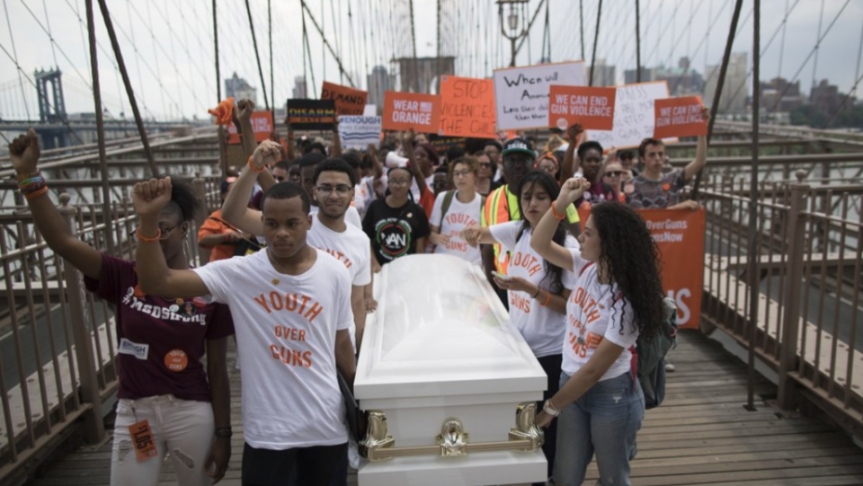
Demonstrators carry a coffin over Brooklyn Bridge during a march against gun violence, 06.02.18, in NY. | Mary Altaffer – AP

Under U.S. capitalism, industrial production and consumerism expand. Greenhouse gases increase, the climate changes, and people die. U.S. imperialism leads to wars and potentially nuclear war.

U.S. life expectancy has fallen. According to government statistics released in December, 2022, life expectancy at birth (LEB) for 2021 was 76.4 years. LEB was 77.0 years in 2020 and 78.8 years in 2019. Public health officials claimed this “was the biggest two-year decline in life expectancy since 1921-1923.”

Mothers fare badly. In 2020,19.1 mothers in general and 55.3 Black mothers died per 100,000 live births. They died from illnesses related to childbearing, most of them preventable. In the Netherlands that year, the maternal mortality rate was 1.2 mothers per 100,000 live births. In 2018, 55 nations showed a rate more favorable than that of the United States. 

Americans, mostly working-age adults, die from “diseases of despair” – substance abuse, accidental drug overdose, alcoholism, and suicide. They also died of Covid 19 infection, the U.S. rate of 332.81 Covid deaths per 100,000 population being the 16th highest in the world.

During most of the pandemic, Black people died at two or more times the rate of infected white people. Now the cumulative death rates of each group are similar, with 355 deaths of whites and 369 deaths of Blacks per 100,000 population. Cumulative Covid deaths for American indigenous peoples register at 478 deaths per 100,000 population. Vaccine skepticism may account for increased vulnerability of whites. 

The pandemic aside, Blacks and American Indians live far shorter lives than white people do. As of October 2022, LEB for Hispanics was 77.7 years; white people, 76.6 years; Blacks, 70.8 years; and American Indians, 65.2 years. In 2020, 65 nations showed longer LEB than did the United States.

Healthcare failings may have contributed to the high U.S death rates. Proposals for reform, especially for universal healthcare, center on its financing. The United States is the top healthcare spender among all nations.

Paying  $12,914 per capita for healthcare in 2021, the United States outspent second-place spender Germany whose outlay was $7383 per capita. Total spending on health that year amounted to $4.3 trillion –18.3% of the U.S. GDP. The United States accounted for 42% of healthcare spending in the world in 2018.

Healthcare in the United States is a profit center. The pricing of drugs, medical equipment, medical insurance, and services provided by hospitals and outpatient facilities in general is exorbitant.  Executives of medical supply and pharmaceutical companies, specialty physicians, and administrators of hospitals and healthcare networks receive enormous salaries.

Profitmaking hospital chains, health insurance companies, and pharmaceutical companies generate enough revenue to allow for stock buybacks and dividend payments. Over nine recent years 14 pharmaceutical companies spent $747 billion on stock buybacks. Payments to private insurance companies and private hospital networks are large enough to cover astronomically high administrative costs and profit-taking.

Some healthcare and health-promotion activities produce no revenue, or very little. They tend to receive relatively little support and skimpy funding.

  • The U.S. public health sector, charged with health education and illness prevention, is a low-priority item. Inadequate preparation and preventative measures largely accounted for the U.S. Covid-19 debacle. 
  • Insurance companies dedicate effort to denying coverage for particular diagnostic and therapeutic interventions.
  • Multi-hospital, multi-service conglomerates are cutting back on health services in rural and economical depressed areas because of decreased “productivity.” 
  • Many hospitals have recently dropped children’s hospital services as being less remunerative than care for hospitalized adults.
  • Small rural hospitals unable to pay bills have been closing down in droves throughout the nation, depriving area residents of care.
  • Specialty practitioners and hospitals often prioritize expensive medical procedures and high-technology diagnostic modes over care centering on provider – patient interaction and communication.
  • Many physicians during training opt for a specialty rather than a primary-care career, often because of income considerations. Primary care physicians now comprise only 20% of all U.S. physicians.
  • Diminished emphasis on a “medical home,” that hallmark of primary care, opens the door to inefficient, low-quality care.

Other capitalist countries have achieved long life expectancies.  The average life expectancy for 2021 in eight European countries plus Australia and Japan was 82.4 years. Their average per- capita health spending was $6,003. Japan spent $4,666 per capita on healthcare; LEB was 84.5 years.

Those countries protect healthcare as a public good, mainly because labor unions and social democratic or labor political parties apply pressure. Universal access to care is the norm. 

Universal care in the United States is but a dream. U.S. unions are weak and there is no working people’s political party. Some 25 million working age adults had no health insurance in 2021; insurance for 23% of them was inadequate. Too many have no care or fragmented care.

Reform efforts will continue in the United States, propelled perhaps by worsening life expectancy. But healthcare has its limitations. Steven Woolf, retired director of Virginia Commonwealth University’s Center on Society and Health, told an interviewer recently that better healthcare is “only a partial answer” to extending life expectancy, accounting “for about 10 to 20 percent of health outcomes.”

He explained: “Our health is really shaped by our living conditions, jobs, the wages we earn, our wealth accumulation, the education that enables us to get those jobs … The country that we live in is the richest in the world, but we have the highest level of income inequality. So, much of the resources that we need for a healthy population are not available to most of the population.”

Woolf is saying, in effect, that people die early because of inequalities, oppression, and organized greed. The United States appears as different from other rich capitalist counties. Social guarantees are fragile. The wealthy have few restraints on satisfying their wants. A besieged working class lacks voice and agency.

The prospect that reforms, alone, will restore justice and decent lives for working people is nil. They confront a voracious, extreme kind of capitalism.  Its rulers tolerate, promote, and seek out collaborators for actions and policies leading to die-offs. Think climate catastrophe, wars, and nuclear war.

In response to impending disaster, Americans desiring better and more secure lives for everyone would adjust their forward vision. Working for reforms, they would aim at something new, which is top-to-bottom social and political change. New motivation, determination and hope would be a shot in the arm.

Revolutionary change is a worldwide project, and not to be left to one people – except in special circumstances. One such was pre-1917 Czarist Russia and another would be that anomaly among capitalist nations which is the death-dealing U.S. nation.


W.T. Whitney Jr. is a political journalist whose focus is on Latin America, health care, and anti-racism. A Cuba solidarity activist, he formerly worked as a pediatrician, lives in rural Maine. W.T. Whitney Jr. es un periodista político cuyo enfoque está en América Latina, la atención médica y el antirracismo. Activista solidario con Cuba, anteriormente trabajó como pediatra, vive en la zona rural de Maine.

Bolivia’s socialist government confronts separatist, racist uprising / by W. T. Whitney Jr.

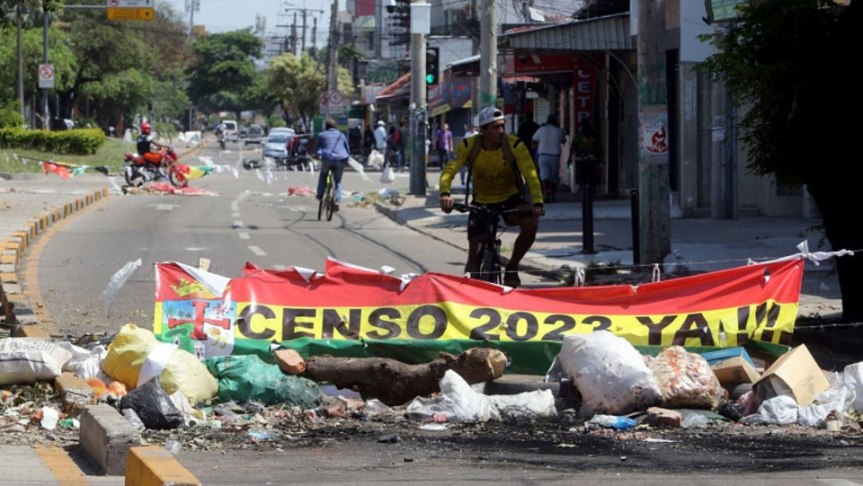
A banner reads ‘2023 census now!’ at a blockade on a Santa Cruz street. | via Twitter

With the exception of a coup-government interregnum in 2019-2021, the Movement Toward Socialism political party (MAS) has headed Bolivia’s government since the beginning of Evo Morales’s presidency in 2006.

The MAS government now led by President Luis Arce and Vice President David Choquehuanca announced on July 12 that its every-ten-year Population and Housing Census would be moved from November 16, 2022, to sometime in 2024.

Spokespersons attributed the change to difficulties left over from the pandemic, a need for translations into indigenous languages, uncertain financial resources, and extra time required for “technical” changes.

Leaders of the Santa Cruz department in Bolivia’s eastern lowlands, the nation’s largest, immediately demanded a census in 2023, not in 2024. Department governor Luis Camacho and Rómulo Calvo, president of the Santa Cruz Civic Committee, warned that without a settlement on the census, they would initiate a strike aimed at undoing the department’s economy, and thereby the national economy.

In response, “over one million Bolivians mobilized” on Aug. 25 in support of the government and against a regional leadership group that is the vanguard of opposition to Bolivia’s socialist and indigenous-led government. Even so, the strike began on Oct. 22. Recent Bolivian history suggests another coup may be in the offing.

Why a seemingly routine piece of government business like staging a census might provoke momentous consequences is not obvious. A look at expectations attached to Bolivia’s census and at the nature of Santa Cruz politics may clarify.

Census results help to determine the national distribution of government-provided services and resources and are the basis for each department’s representation in the national Legislative Assembly. Opposition forces in Santa Cruz see operation of the national census, as presently constituted, as beneficial to their side, particularly for the national elections of 2025.

They see advantage in the increased numbers of indigenous peoples migrating recently from Bolivia’s poverty-stricken highlands to economically-resourced Santa Cruz. That advantage rests on indigenous peoples showing up on the census with an identity other than indigenous.

The national census in 2012 fueled controversy when it showed that many indigenous people identify themselves as mestizo and not as belonging to a particular indigenous nation. That was encouraging to the reactionary and racist Santa Cruz leaders, who have no enthusiasm for increased indigenous representation in the national legislative assembly.

The Arce government, by contrast, objects to an undercount of indigenous people and especially in the eastern lowland departments, where their numbers are increasing.

The category of mestizo did not appear in the census of 2012 and is not part of the census in dispute now. The Santa Cruz leaders are insisting that that mestizo identity be incorporated into the census. Expert advice was sought in 2012 and the Arce government is now proposing the same.

The peculiarities of Santa Cruz are central to this story. For one thing, Bolivia’s four easternmost departments, particularly Santa Cruz, produce most of Bolivia’s wealth. Santa Cruz is home to industrial-scale agricultural operations and to facilities for oil and natural gas production. This lowland region accounts for most of Bolivia’s export income.

The realities are these: Santa Cruz alone accounts for 76% of the country’s food production, for all of its sorghum and sunflower oil production, 99% of its soy products, 92% of its sugar cane, 75% of its wheat, 72% of its rice, and 66% of its corn. In 2021, farmers owned 4.6 million head of cattle, over a million pigs, and 130 million chickens.

Among departments, Santa Cruz consumes 39% of the country’s diesel fuel and contains the bulk of Bolivia’s natural gas reserves, which rate as South America’s second largest. The Financial Times lauds the Santa Cruz economy’s explosive growth and large foreign investments. It mentions Santa Cruz city as one of the world’s fastest growing urban areas.

Also relevant to the strike story is the reactionary and racist nature of opposition leaders in Santa Cruz. They are utilizing the department’s “Civic Committee” to organize the strike and the Union of Santa Cruz Youth to carry out violent, paramilitary-style street actions. Gov. Luis Camacho formerly headed the Santa Cruz Civic Committee.

The civic committees of all departments originated decades ago in response to national-regional tensions. Members of formerly eastern European families, some of them big landowners, belong to the Santa Cruz civic committee. Many brought fascist ideology with them when they immigrated to Bolivia after World War II.

At the last of three big gatherings in Santa Cruz, Camacho on Sept. 30 announced the start on Oct. 22 of an anti-government strike of “indefinite” duration. In operation, the strike has led to barriers being placed across major highways to impede exports and in-country deliveries of commodities, mainly food. Strike leaders have forced key factories and commercial centers to shut down.

The Youth Union and other thugs have carried out anti-government demonstrations and fought in the streets against MAS party supporters and the national police. There have been injuries, human rights violations, and one death. The strike has had little impact in the other eastern departments.

With a presence at border crossings, the strikers have sharply reduced the transit of exported goods. Government authorities on Oct. 27, anticipating domestic food shortages, banned all exports from Santa Cruz of soy products, beef, sugar, and vegetable oil.

The government and MAS activists organized a rally and march by hundreds of thousands of people before the strike began, and another on the day after. In La Paz on Oct. 26, confrontation between government supporters and an opposition march left 20 persons wounded.

The government on Oct. 25 held a “Pluri-national Encuentro for a Census with Consensus.” Officials from throughout the country attended. A proposal emerged that would enable a technical commission to determine a date for the national census.

Camacho rejected it, but opposition leaders Rómulo Calvo and Vicente Cuellar accepted the proposal. In an interview, Camacho asserted that federalism remains the only solution to the “fissure” present since the “founding of the Republic.”

On Nov. 1, President Arce, referring to threats to “national integrity,” called upon military leaders “to guarantee and defend the independence, unity, and integrity of our territory.” A presidential spokesperson indicated that Arce favored new negotiations with no established date for the census and without conditions.

Events in Santa Cruz align with a grim history. President Evo Morales’s accession to power in 2006 was a culmination of old indigenous resistance against European colonialists and of recent pushback against neoliberal assaults inflicted by local enablers of U.S. and European ruling-class objectives.

Social gains achieved by the MAS-led government and its program of modest wealth distribution seemed to cement its place in history and certainly inflamed the animosities of reactionaries in Santa Cruz and nationally.

As a new constitution was being shaped—it was approved in 2009—Santa Cruz and its neighboring eastern departments staged a separatist revolt fueled by racism. A failed assassination plot against Morales in 2008 was part of it. During this period, the Morales government expelled a U.S. ambassador and the U.S. Drug Enforcement Agency.

The U.S. government and the Organization of American States, serving the United States, facilitated the coup that removed the Morales government in 2019 after his election to a fourth term. Luis Camacho of Santa Cruz led the coup and reportedly delivered the U.S. moneys used in various payoffs. Bolivia’s military participated.

The president of the coup government, Jeanine Áñez, is now in prison, in part because of human rights abuses and killings by soldiers during her tenure.

The current MAS-led government came into existence in 2020 following the first-round electoral victory of Arce and Choquehuanca. Its approval rating currently is 51%. The present strike has set back governmental efforts to restore a national economy devastated by the coup government’s neoliberal reforms and by pandemic effects.

Arce, reporting to the Legislative Assembly on Nov. 8, indicated that “We have complete certainty that our people are fully behind us and that they recognize a national patriotic government that looks out for the national welfare, which stands above sectarian and regional interests.” He observed that “in times of crisis, it’s always the poor that end up losing more, or losing everything.”


W.T. Whitney Jr. is a political journalist whose focus is on Latin America, health care, and anti-racism. A Cuba solidarity activist, he formerly worked as a pediatrician, lives in rural Maine. W.T. Whitney Jr. es un periodista político cuyo enfoque está en América Latina, la atención médica y el antirracismo. Activista solidario con Cuba, anteriormente trabajó como pediatra, vive en la zona rural de Maine.

People’s World, November 10, 2022, https://peoplesworld.org/

U.S. eyes military intervention in Haiti, again / by W.T. Whitney Jr.

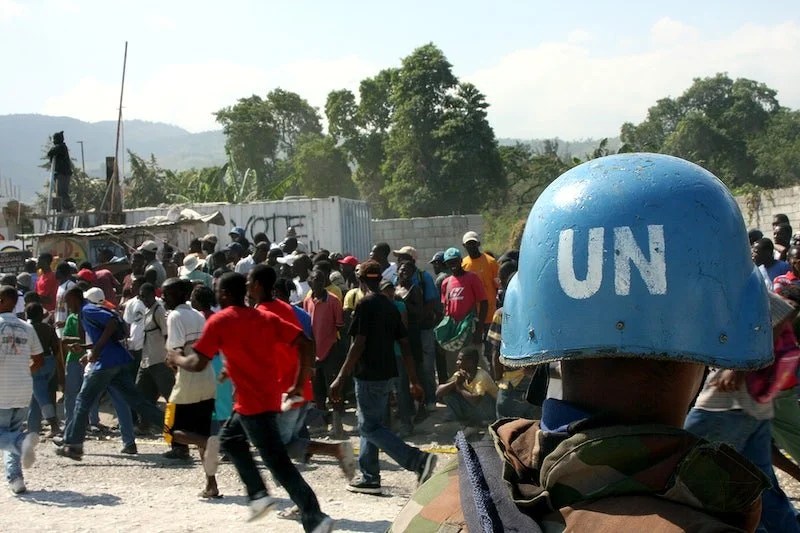
Protesters calling for the resignation of Haitian Prime Minister Ariel Henry run after police fired tear gas to disperse them in the Delmas area of Port-au-Prince, Haiti, Monday, Oct. 10, 2022. | Odelyn Joseph / AP

The news story begins: “The Council of Ministers [on October 8 in Haiti] authorized the prime minister to seek the presence in the country of a specialized military force in order to end the humanitarian crisis provoked by insecurity caused by gangs and their sponsors.”

The circumstances are these:

Masses of Haitians have been in the streets protesting intermittently since August. Their grievances are high costs—thanks to the International Monetary Fund—and shortages of food and fuel. Banks and stores are closed. Students are demonstrating. Labor unions have been on strike.

The pattern has continued intermittently for ten years. Pointing to corruption, demonstrators have called for the removal, in succession, of Presidents Michel Martelly and Jovenel Moïse, and now de facto prime minister Ariel Henry.

Recently, violence has aggravated the situation, and foreign powers, including the United States, have paid attention. That’s significant because U.S military interventions and other kinds of U.S. intrusions have worked to trash Haiti’s national sovereignty, and, with an assist from Haiti’s elite, deprive ordinary people of control of their lives.

Presently, 40% of Haitians are food insecure. Some 4.9 million of them (43%) need humanitarian assistance. Life expectancy at birth is 63.7 years. Haiti’s poverty rate is 58.5%, with 73.5% of adult Haitians living on less than $5.50 per day.

Electoral politics is fractured. It was Secretary of State Hillary Clinton who arranged for Martelly to be a presidential candidate in 2011. Moïse in 2017 was the choice of 600,000 voters—out of six million eligible citizens. He illegally extended his presidential term by a year. As of now, there have been no presidential elections for six years, no elected mayors or legislators in office for over a year, and no scheduled elections ahead.

Washington’s man: De facto Haitian Prime Minister Ariel Henry holds power, even though he wasn’t elected. Some believe he may have been involved in the murder of the previous president and now he’s seeking U.S. troops to stem protests against his government. | Odelyn Joseph / AP

Gangs mushroomed in recent years, and violence has worsened. Moïse’s election in 2017 prompted turf wars, competing appeals to politicians, narcotrafficking, kidnappings, and deadly violence in most cities, predominately in the capital, Port-au-Prince. Violence escalated further after Moise’s murder in July 2021. Hundreds have been killed and thousands displaced, wounded, or kidnapped.

The U.S. Global Fragility Act of 2019 authorizes multi-agency intervention in “fragile” countries like Haiti, the U.S. military being one such agency designated to do the intervening. The influential Council of Foreign Relations (CFR) wants U.S. soldiers instructing Haitian police on handling gangs. Luis Almagro, head of the Organization of American States, calls for military occupation. U.N. Secretary General Antonio Guterres wants international support for training Haitian police.

Former U.S. Special Envoy to Haiti Daniel Foote weighs in with a choice: Either “send a company of special forces trainers to teach the police and set up an anti-gang task force, or send 25,000 troops at some undetermined but imminent period in the future.” The Dominican Republic has stationed troops at its border with Haiti and calls for international military intervention.

Meanwhile, foreign actors intrude as Haitians try to reconstruct a government. Their tool is the Core Group, formed in 2004 following the U.S.-led coup against progressive Haitian President Jean-Bertrand Aristide. The Core Group consists of the ambassadors of Brazil, Canada, France, Germany, Spain, the United States, and representatives of the United Nations and Organization of American States.

Haiti’s government is now in the hands of Ariel Henry, whom the Core Group approved as acting prime minister, overruling Moïse’s choice made before he died. Some believe Henry, a U.S. government favorite, may even be complicit in Moïse’s murder.

Henry insists he will arrange for presidential elections at some point in the future. Prevailing opinion, however, holds that conditions don’t favor elections any time soon.

The Core Group backs an important agreement announced by the so-called Montana Group on Aug. 30, 2021. It provides for a National Transition Council that would prepare for national elections in two years and govern the country in the meantime. The Council in January 2022 chose banker Fritz Jean as transitional president and former senator Steven Benoit as prime minister. They have still not assumed those jobs.

The Montana Group consists of “civil society organizations and powerful political figures,” plus representatives of political parties in Haiti. One leader of the Group is Magali Comeau Denis, who allegedly participated in the U.S-organized coup that removed Aristide in 2004. Henry also has a connection to coup-plotting, having worked with the Democratic Convergence that in 2000 was already planning the overthrow of Aristide.

The CFR wants the U.S. government to persuade Henry to join the Montana Group’s transition process. U.S. Envoy Foote supports the Montana agreement because it shows off Haitians acting on their own. Recently, some member organizations have defected, among them the right-wing PHTK Party of Henry and of Presidents Martelly and Moïse.

The weakness of Haiti’s government in the face of dictates from abroad was on display during Moïse’s era. The perpetrators of his murder, who had been recruited by a Florida-based military contractor, were 26 Colombian paramilitaries and two Haitian-Americans. Their motives remain unclear, and there is no apparent movement toward a trial.

Moïse, the wealthy head of an industrial-scale agricultural operation, became president through fraudulent elections in 2017. He was the target of massive protests a year later. Prompting them were fuel and food shortages and revelations that the president and others had stolen billions of dollars from the fund created through the Venezuela’s PetroCaribe program of cheap oil for Caribbean nations.

Foreign governments, the United States in particular, may now be on the verge of intervening in Haiti. But the ostensible pretext—gang violence—turns out to be muddled. Progressive Haitian academic and economist Camille Chalmers makes the point. He claims that “gangsterism” in Haiti actually serves U.S. purposes.

Interviewed in May 2022, Chalmers explains that the “principal [U.S.] objective is to block the process of social mobilization, to impede all real political participation … through these antidemocratic methods, through force using the police … and above all these paramilitary bands.” Terror is useful for “breaking the social fabric, ties of trust, and any possible resistance process.”

By means of gang violence, the Haitian people “are removed from any political role, and the economic project of plundering resources from the country is facilitated.” Also, Haiti becomes “an appendage of the interests of the North Americans and Europeans.” Chalmers refers to gold deposits on Haiti’s border with the Dominican Republic and big investments by multinational corporations.

He sees a bond between reactionary elements in Haiti and the gangs. The gangs “have financing and weapons that come from the United States. Many of their leaders are Haitians who have been repatriated by the United States.”

A U.S. Army soldier arrests a Haitian man during the U.S. military occupation following the overthrow of President Jean-Bertrand Aristide, Port-au-Prince, Haiti, Oct. 3, 1994. | John Gaps III / AP

Within this framework, Haiti’s police must be ready and able to fight the gangs in order to achieve maximum turmoil. The U.S. government provided Haiti’s police with $312 million in weapons and training between 2010 and 2020, and with $20 million in 2021. The State Department contributed $28 million for SWAT training in July. As of 2019, there were illegal arms in Haiti worth half-a-million dollars, mostly from the United States.

In view of U.S. tolerance or even support of the gangs, the zeal to suppress them now is a mystery. Perhaps some gangs have changed their colors and now really do pose danger to U.S. interests.

The so-called “G-9 Family and Allies,” an alliance of armed neighborhood groups led by former policeman Jimmy Cherizier, may qualify. Not only has it emerged as the Haitian gang most capable of destabilization, but the words “Revolutionary Forces” are a new part of its name.

Cherizier observed in 2021 that, “the country has been controlled by a small group of people who decide everything …They put guns into the poor neighborhoods for us to fight with one another for their benefit.” He noted that, “We have to overturn the whole system, where 12 families have taken the nation hostage.” That system “is not good, stinks, and is corrupt.”

Referring to a mural depicting Che Guevara, Cherizier declared, “we made that mural, and we intend to make murals of other figures like … Thomas Sankara and … Fidel Castro, to depict people who have engaged in struggle.”

These are words of social revolution suggestive of the kind of political turn that repeatedly has prompted serious U.S. reaction. Beyond that, the words of Haitian journalist Jean Waltès Bien-Aimé represent for Washington officials the worst kind of nightmare.

He told People’s Dispatch: “Activation of gangs is part of a strategy to prevent Haitian people from taking to the streets.” He scorns Ariel Henry “as a present from the U.S. embassy,” adding that the “Haitian people do not need a leader at the moment. Haitian people need a socialist state … We have a bourgeois state. What we need now is a people’s state.”

In the background are U.S. racist attitudes. They flourished initially as a consequence of the slavery system’s central role in developing the U.S. economy. They still show up, it seems, as discomfort with the ideas of formerly enslaved Haitians gaining autonomy and securing independence for their own nation.

W.T. Whitney Jr. is a political journalist whose focus is on Latin America, health care, and anti-racism. A Cuba solidarity activist, he formerly worked as a pediatrician, lives in rural Maine. W.T. Whitney Jr. es un periodista político cuyo enfoque está en América Latina, la atención médica y el antirracismo. Activista solidario con Cuba, anteriormente trabajó como pediatra, vive en la zona rural de Maine.

Peoples World, October 12, 2022, https://peoplesworld.org/