
A Plea for Simón Trinidad / By W. T. Whitney Jr.

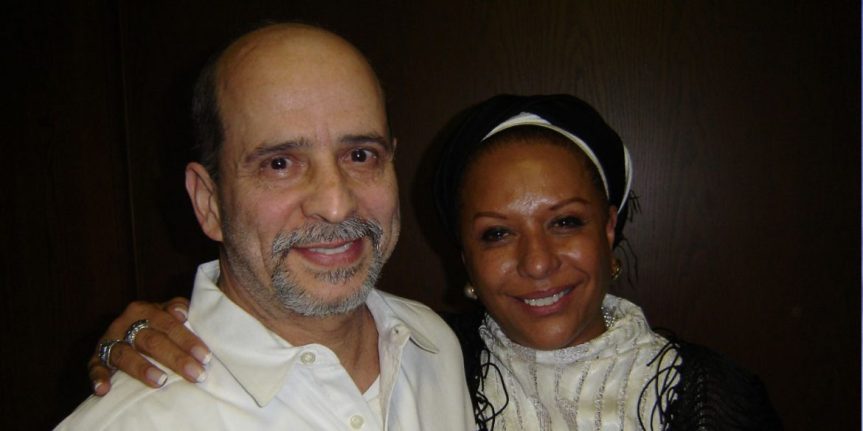
“Simon Trinidad” and Piedad Cordoba (Image: Piedad Cordoba)

South Paris, Maine


The title recalls the title of Henry David Thoreau’s essay “A Plea for Captain John Brown.” Trinidad, like John Brown, is remarkable for his implacable resolve and regard for justice.

Trinidad was 58 years of age when a U.S. court in 2008 sentenced him to 60 years in prison. His alleged crime was that of conspiracy to hold hostage three U.S. drug-war contractors operating in Colombia. In effect, he is serving a life sentence. He had nothing to do with the hostage-taking.

The contractors, captured in 2003, went free in 2008. U.S. drug war in Colombia has obscured the big U.S. role in Colombia’s war against leftist insurgents, primarily the Revolutionary Armed Forces of Colombia (FARC).

Simon Trinidad

Simón Trinidad was a FARC leader. The FARC and Colombia’s government signed a peace agreement in 2016 and Trinidad and other ex-combatants expected to be part of a peace process. Now he is a prisoner in a super-max prison in the United States and is confined to his cell for all but two hours per day, receives no mail, and is allowed very few visitors.

On July 27, Simón Trinidad unexpectedly was a featured item in the news in Colombia. An undated letter he had written to Colombian chancellor Álvaro Leyva requesting repatriation to Colombia had appeared on social media. News reports were reproducing it.

Observers associated Trinidad’s letter with the U.S. government’s announcement the day before that the bloodthirsty former paramilitary chieftain Salvatore Mancuso, also jailed in the United States, soon would be extradited to Colombia. President Gustavo Petro designated Mancuso as a “promotor of peace.”

Trinidad, not so favored as this, in his letter wrote of his determination to testify before the Special Jurisdiction for Peace, as other former FARC combatants have done, and Mancuso too, virtually. This court, established under the Peace Agreement of 2016, offers former combatants an opportunity to tell the truth about crimes they may have committed during the civil war and, having done so, to be pardoned or punished.

Trinidad apparently hopes not only that that Chancellor Leyva will inform the U.S. Secretary of State of his request to be repatriated but also that his message will be passed on to President Biden, who has the power to release him from prison.
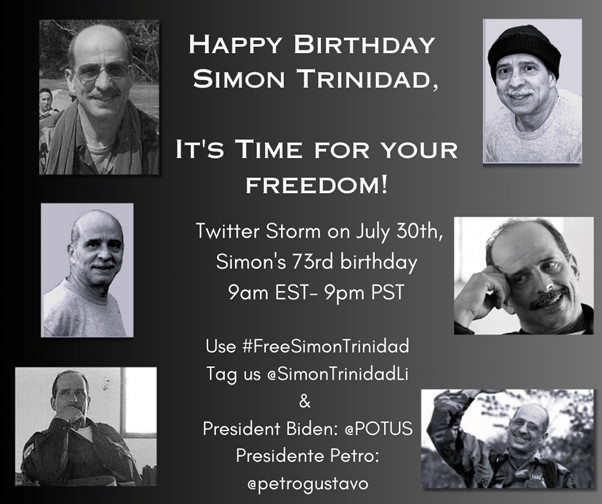
Progressive Colombian Senator Iván Cepeda, “one of the people who speaks of peace on behalf of President Gustavo Petro,” welcomed “Simón Trinidad’s proposal [and] sent it directly to Chancellor Álvaro Leyva.”

Trinidad had joined the left-leaning Patriotic Union (UP) electoral coalition after it formed in 1985. A year later, paramilitaries began their massacre of UP adherents that, with impunity from Colombia’s government, lasted for years. In response, Trinidad in 1987 joined the FARC and, in the process, dropped his name Ricardo Palmera Pineda. For the FARC, Trinidad was responsible for political education and propaganda and was a negotiator.

The U.S. government in 2000 introduced its “Plan Colombia” through which Colombia’s military secured U.S. weapons and training assistance; U.S. troops and military contractors were deployed in Colombia. The appearance of Plan Colombia doomed peace negotiations between the FARC and Colombia’s government that were in progress at the time.

As a lead FARC negotiator in those talks, Simón Trinidad became known to international observers. His course with the FARC ended abruptly on January 2, 2004, when Colombian military personnel and the CIA seized him in Quito. Trinidad was there seeking UN assistance for a proposed prisoner exchange.

Colombia’s government extradited Trinidad to the United States on New Year’s Eve, 2004. According to his U.S. lawyer Mark Burton, Trinidad’s U.S. captors regarded him as a “trophy prisoner.”

Trinidad’s U.S. handlers had to stage four trials for them to finally gain a conviction. His capture and his multiple appearances in U.S. courtrooms from 2005 to 2008 served as real-time advertising that testified to U.S. commitment to anti-insurgency war and drug war in Colombia.

Trinidad’s misfortune was to have fallen into the clutches of a nation whose record on prisoners is horrific. After all, “The United States stands alone as the only nation that sentences people to life without parole for crimes committed before turning 18.” (No wonder: of 196 countries, only the United States has yet to ratify the UN’s Convention on the Rights of the Child.)

As a U.S. political prisoner, Simón Trinidad harks back to the Scottsboro Boys, who in Alabama faced death penalties in the 1930s; to Communist Party members jailed under the Smith Act; to Black Panther Party members caught up in the U.S. government’s COINTELPRO project. Simón Trinidad is also representative of prisoners gathered up in U.S. wars and other interventions abroad. They include: Ricardo Flores Magón, Mexican revolutionary who died in Leavenworth Federal Prison in 1922; the “Cuban Five” prisoners who resisted U.S. hostilities against Cuba; and the unfortunates ending up in the U.S. prison in Guantanamo during and after the Iraq War.

Despite the Peace Agreement, paramilitaries or other thugs have since killed almost 400 former FARC fighters; 300 FARC prisoners of war are still in prison almost seven years later.

Violence in the countryside persists. Colombia’s military is unable or unwilling to suppress a new breed of paramilitaries. One report highlights the paramilitaries’ “symbiotic relationship with Colombian state actors.” Declassified State Department and CIA documents from George Washington University’s National Security Archives say the same. The plot thickens: the tight relationship between the U.S. and Colombian militaries and the U.S. alliance with Colombia’s government together suggest U.S. complicity with a violence that Colombia’s Army and state are unable or unwilling to control.

The bad news for Simón Trinidad is that the U.S. government is betting not on peace in Colombia, but on continuing war. For that reason, Simón Trinidad confronts formidable barriers in satisfying his need to join Colombia’s peace process. Mark Burton’s words end this report: “Simón Trinidad is a man with a clear vision for a new Colombia, a Colombia in peace and with social justice. Colombia needs to listen to his voice, his vision, his proposals for peace. His continued imprisonment in the United States on false charges is an insult to Colombia, its history, and its people.”

Burton’s comments appear in a remarkable new eBook, accessible here. It contains commentary, in Spanish, from activists, writers, and intellectuals seeking Trinidad’s repatriation. The announcement of this book offers a video presentation, here, of reflections and documentary material.

W.T. Whitney Jr. is a political journalist whose focus is on Latin America, health care, and anti-racism. A Cuba solidarity activist, he formerly worked as a pediatrician, lives in rural Maine. W.T. Whitney Jr. es un periodista político cuyo enfoque está en América Latina, la atención médica y el antirracismo. Activista solidario con Cuba, anteriormente trabajó como pediatra, vive en la zona rural de Maine.

Court Says Colombian State Responsible for Patriotic Union “Extermination” – No Mention of US Role / By W.T. Whitney Jr.

The survivors and family members of the victims of the genocide against the Patriotic Union party celebrated the IACHR Court’s ruling, which declared the Colombian State responsible for the extermination of UP militants and members in the mid-1980s. Photo: Corporación Reiniciar/Twitter

Rubí Andrea Forero, 52 years old, talked to Prensa Latina about the recent court ruling in the Patriotic Union’s case against Colombia’s government. She felt relief. She has coped with her father’s murder on February 27, 1989 and her awareness of “impunity and continuing crimes”. She recalls “silent longings and frustrated dreams from the war” and the “fears, absences, and frustrations” of families and friends. 

Teofilo Forero, Rubí’s father, was a union president, a deputy in the Cundinamarca legislature, and Bogota City councilor. Nationally, he was a leader of the CTC Labor Federation and organization secretary of Colombia’s Communist Party. That party, the interviewer explains, was the “vertebral column of the Patriotic Union (UP in Spanish-language initials).” The UP dates from 1985.

On January 30, the Inter-American Court of Human Rights (IACHR Court) announced its long-anticipated ruling in the UP case. The Court named the Colombian state as responsible “for violations of human rights committed against more than 6000 members of the Patriotic Union political party during a period that began in 1984 and lasted for more than 20 years.”

(The Special Jurisdiction for Peace, established under the 2016 Peace Agreement between the FARC and Colombian government, indicated in 2022 that “5,733 persons were assassinated or disappeared in attacks directed against the UP.”)  

The Court ruling cites a “plan of systematic extermination … relying on participation by state agents and acquiescence by authorities.” It cites “forced disappearances, massacres, extrajudicial executions, assassinations … [and] impunity.”

The peace agreement between the Revolutionary Armed Forces of Colombia (FARC) and Colombia’s government in 1984 enabled demobilized FARC insurgents, Communist Party activists, and others to create the UP. The organization undertook to “promote the social, economic, and political transformations necessary for building a peace with social justice,” according to the Reiniciar Corporation, stalwart defender of the UP since 1992.

As 1985 closed, the UP had established “2,229 grassroots organizations” in more than 200 municipalities and rural districts. In early 1986, 15 UP candidates were elected to Colombia’s Congress, 18 to departmental legislatures, and 335 to city councils; there were 23 UP mayors. In elections a few weeks later, UP candidate Jaime Pardo Leal proved to be the third most popular presidential candidate. The UP was a powerful political force.

Then came catastrophe. Assassins killed “nine congresspersons, 70 city council members, and dozens of deputies, mayors, and grassroots leaders,” and also “labor leaders, students, artists, activists, and sympathizers” from all sectors. Two presidential candidates would be murdered. 

The IACHR Court ordered reparations. The state must pursue investigations of “gross violations of human rights and [that way] determine penal responsibilities.”  In addition, disappeared victims must be located, victims cared for, and the Court’s decision publicized. The Court called for protecting UP activists now, a national educational campaign, recompense for “material and immaterial damages” and a national day of commemorating UP victims.

The Reiniciar Corporation in 1993 led in submitting the UP case to the Inter-American Commission on Human Rights (IACHR). That agency collected evidence and collaborated  with the Colombian government to reach a settlement, but to no avail. The case moved to the IACHR Court in 2017.

No longer able to field electoral candidates, the UP in 2002 lost its “judicial personhood” and state recognition of its status as a political party. Reacting to IACHR verification of persecution, election officials in 2013 restored the UP’s former status.

UP participation in elections was evident recently in the party having joined the victorious Historic Pact coalition of President Gustavo Petro. Former UP activist Germán Umaña serves as minister of commerce in the Petro government. He had abandoned political life after the assassination in 1998 of his brother Eduardo Umaña, law professor and defender of human rights.

Revival of the UP and its distancing from a violent past go along with Colombia’s tentative turn to peace. In that regard, the government on January 1 announced a ceasefire among combatant groups; among them the Colombian Army, National Liberation Army guerrillas, two groups of narco-trafficking paramilitaries, and two dissident insurgencies formerly part of the now defunct FARC.  

However, the UP story is about U.S. military intervention as well as peace in Colombia.

Journalist Nelson Lombana Silva sees the IACHR Court decision as “not solely applying to the Colombia state, but also to Colombia’s liberal-conservative, criminal oligarchy that decided to remove this political movement,” and did so “with U.S. participation.”

Historian Ivan David Ortiz, investigating the failure of the 1984 peace agreement, notes the FARC’s explanation at the time, that “hegemonic political and economic sectors continued the warlike policies of the United States.” He cites the FARC’s claim that, “the anti-peace offensive in Colombia came from the Pentagon.” (1)

An Amnesty International report of 2005 covers the same ground:

Efforts by the government of President Belisario Betancur (1982-1986) to initiate peace talks with guerrilla groups in the mid-1980s heightened concern that any peace agreement would have entailed land and other socio-economic reforms. This dynamic strengthened the alliance between the traditional economic elites and the armed forces and spurred on the development of paramilitary structures under the coordination of the armed forces.

Accessory information points to U.S. involvement within this context. Paramilitaries bore most of the direct responsibly for massacring the Patriotic Union. Paramilitaries coordinate their operations with Colombia’s military, which has a supervisory role, as documented here and here. The impetus for the paramilitary phenomenon derived from recommendations of a U.S. “Special Warfare” consulting team in 1962. 

Secondly, Colombia’s military, the paramilitaries’ senior partner, thrives due in part to the U.S. government’s generous support and financing. The flow of billions of dollars to Colombia’s military is notable.  It began in 2000 under U.S. Plan Colombia and continued for more than ten years. Drug war, the usual justification for U.S. partnering with Colombia’s military, has been useful as a cover for war against leftist guerrillas and against left-leaning political groups and social movements.

Ultimately, it seems, there was a big element of U.S. proxy war in the deadly suppression of the UP. U.S. would-be masters of global affairs have long manifested instant readiness to blot out popular risings viewed as threatening to their accustomed ways. Viewed like this, perpetrators of the anti-UP violence were kin to Bay of Pigs assailants in Cuba, Contra warriors in Nicaragua and Ukraine’s military fighting against Russians now.

Note: (1) Iván David Ortiz Palacios, “El Genocidio Político contra la Unión Patriótica,” (Universidad Nacional de Colombia, Bogotá, 2007), p. 17


W.T. Whitney Jr. is a political journalist whose focus is on Latin America, health care, and anti-racism. A Cuba solidarity activist, he formerly worked as a pediatrician, lives in rural Maine. W.T. Whitney Jr. es un periodista político cuyo enfoque está en América Latina, la atención médica y el antirracismo. Activista solidario con Cuba, anteriormente trabajó como pediatra, vive en la zona rural de Maine.