
Abuse against Haitians in Ohio: examined with reference to Lewiston, Maine / By W.T. Whitney

Members of the Haitian community in Springfield, Ohio, from left, Lindsay Aime, James Fleurijean, Viles Dorsainvil, and Rose-Thamar Joseph, stand for worship at Central Christian Church, on Sunday, Sept. 15, 2024.Jessie Wardarski/AP/AP

South Paris, Maine


Republican presidential and vice-presidential candidates expressed horror on learning from social media that Haitian migrants in Springfield, Ohio were eating dogs and cats, their pets. The reports were false. Bomb threats followed, schools and public buildings closed down. Longtime African-American residents felt threatened.

Springfield’s economy had lost jobs and industries. Some 15,000 Haitians arrived, eager to work. Industry expanded but social service providers were stressed. The Haitians are in Springfield mostly under Temporary Protected Status. That governmental designation enables those migrants forced out of their counties by serious crises to enter the United States legally.  

The bizarre twist of political behavior stems in part from the migrants being Haitian. Haitians and their nation have been problematic for the United States.

The fact of migration itself does not account for the exaggerated hostility. Almost nothing of that order happens to the one third of New York state residents and 40.9% of Miamians who are immigrants, or to the foreign-born residents of nine other urban areas in the United States who comprise from 21.1% to 39.1% of the several populations.

Stresses and frustrations associated with Springfield’s economic decline logically enough could have stimulated hostility toward migrants. But economist Franklin J. James rejects the idea “that immigration hurts U.S. natives by reducing job opportunities …[and] that immigrants displace natives from jobs or reduce earnings of the average worker.”

Being Black may indeed invite hostility in a racist society. But the disconnect is sharp between the rarity of unbounded disparagement at high political levels and the large numbers of African-descended people who never experience the like from anybody. Opportunities abound. In 2019 Black people made up from 21.6% to 48.5% of the populations of 20 U.S. cities. That year nine Ohio cities, not including Springfield, claimed between 32.0% and 11.2% Black people. In 2024, 17.4% of Springfield residents are Black.They showed up in 2001 and a year later numbered 2000 or so. In January 2003, an Illinois-based Nazi group staged a tiny anti-Black rally; 4500 Mainers joined in a counter-demonstration.
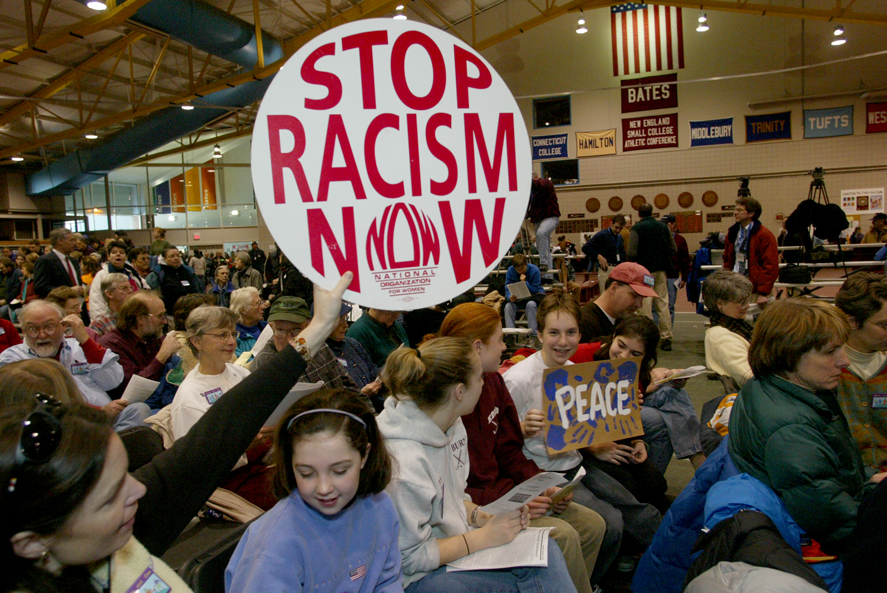
The Many and One rally in Merrill Gym on Jan. 11, 2003, sent a strong, unified message far and wide. Photograph by Phyllis Graber Jensen/Bates College, Lewiston, Maine.

The scenario in Springfield may itself have been toxic: a large number of Black people from abroad descended together on an economically depressed small city. But Somali migrants arrived in Lewiston, Maine under similar circumstances, and their reception was different.

As of 2019, according to writer Cynthia Anderson, “Lewiston … has one of the highest per capita Muslim populations in the United States, most of it Somali along with rising numbers of refugees and asylum-seekers from other African nations.” Of Lewiston’s38,404 inhabitants, 10.9% presently are “Black or African American.” Blacks are 1.4% of Maine’s population.

Anderson reports that with the influx of migrants, Lewiston “has struggled financially, especially early on as the needs for social services and education intensified. Joblessness remains high among the older generation of refugees.” 

Lewiston is Maine’s poorest city. For generations massive factories along the Androscoggin River produced textiles and shoes, but no more. The city’s poverty rate is 18.1%; for Blacks it’s 51.5%. In 2016, 50.0% of Lewiston’s children under five lived in poverty.

Citing school superintendent Bill Webster, an AP report indicates “immigrant children are doing better than native-born kids” in school, and are “going off to college to get degrees, as teachers, doctors, engineers.”

Analyst Anna Chase Hogeland concludes that, “The Lewiston community’s reaction to the Somalis demonstrated both their hostility and reservations, as well as the great efforts of many to accommodate and welcome the refugees.” Voters in Lewiston are conservative; they backed Donald Trump in the 2016 and 2020 presidential elections.

The circumstances under which the two cities received Black immigrants differed in two ways.  A nationwide upsurge in racist rhetoric and anti-immigrant hostility worsened conditions for migrants in Springfield.  Lewiston’s experience had played out earlier.

Additionally, immigrants arriving in Springfield qualified for special attention. The aforementioned political candidates could have exercised their anti-migrant belligerence in many cities. They chose Springfield, presumably because Haitians are there. Why are Haitians vulnerable?

Black people in what is now Haiti boldly rebelled against enslavement on French-owned plantations. Remarkably, they expelled the French and in 1804 established the independent nation they called Haiti.  

Ever since, the United States has spelled trouble for Haiti. Preeminent abolitionist Frederick Douglas pointed out in 1893 that, “Haiti is black and we [the United States] have not yet forgiven Haiti for being black.” Long after “Haiti had shaken off the fetters of bondage … we continued to refuse to acknowledge the fact and treated her as outside the sisterhood of nations.”

Scholar and activist W.E.B DuBois, biographer of abolitionist John Brown, explains that “There was hell in Hayti (sic) in the red waning of the eighteenth century, in the days when John Brown was born … [At that time] the shudder of Hayti was running through all the Americas, and from his earliest boyhood he saw and felt the price of repression —the fearful cost that the western world was paying for slavery.”

DuBois’s reference was to the U.S. slavocracy and its encouragement of collective fear among many white people that Black workers – bought, owned and sold – might rise up in rebellion. They did look to the example of Haiti and did rebel – see Herbert Aptheker, American Negro Slave Revolts. In the United States, from the Civil War on, the prospect of resistance and rebellion on the part of Black people has had government circles and segments of U.S. society on high alert.

That attitude, applied to Haiti, shows in:

·        U.S. instigation of multi-national military occupations intermittently since 2004.

·        Coups in 1991and 2004 involving the CIA and/or U.S.-friendly paramilitaries.

·        Backing of the Duvalier family dictatorship between 1957 and 1986.

·        The brutal U.S. military occupation of Haiti between 1915 and 1934.

·        U.S. control of Haiti’s finances and government departments until 1947.

·        No diplomatic recognition of Haiti from its beginning nationhood in 1804 until 1862.

·        U.S. economic sanctions against Haiti for decades, until 1863.

Says activist lawyer Bill Quigley: “US based corporations have for years been teaming up with Haitian elite to run sweatshops teeming with tens of thousands of Haitians who earn less than $2 a day.”

Ultimately, it seems, threads of governmental callousness, societal disregard for basic human needs, and outright demagoguery coalesced to thrust Springfield and Haitian migrants into the national spotlight. Molelike, the anomalous and little-acknowledged presence of Haiti asserts itself in the unfolding of U.S. history.       


W.T. Whitney Jr. is a political journalist whose focus is on Latin America, health care, and anti-racism. A Cuba solidarity activist, he formerly worked as a pediatrician, lives in rural Maine. W.T. Whitney Jr. es un periodista político cuyo enfoque está en América Latina, la atención médica y el antirracismo. Activista solidario con Cuba, anteriormente trabajó como pediatra, vive en la zona rural de Maine.

US Intervention and Neoliberalism Aggravate Political Upheaval inBangladesh / By W. T. Whitney Jr.

Anti-government protestors march towards Prime Minister Sheikh Hasina’s palace as army personnel (C) stand guard in Shahbag area, near Dhaka university in Dhaka on August 5, 2024. Protests in Bangladesh that began as student-led demonstrations against government hiring rules in July culminated on August 5, in the prime minister fleeing and the military announcing it would form an interim government | Photo by Munir Uz Zuman/AFP via Getty Images

South Paris, Maine


Weeks of student-led and often violent protests forced the resignation and exile on August 5 of Bangladesh’s prime minister Sheikh Hasina. Demonstrators were reacting to inflation, unemployment, governmental and banking corruption and a quota system that preferentially opens up government jobs to descendants of people participating in the national liberation struggle. Brutal police repression and killings recalled Bangladesh’s long history of recurring coups, protests, and lethal violence.

Sheikh Hasina’s Awami alliance won a large parliamentary majority in elections taking place in January 2024, and she remained as prime minister. She had served as such from 1996 to 2001 and again from 2008 on. Sheikh Hasina faced little opposition in the low-turnout election. The large Bangladesh Nationalist Party (BNP) did not participate.

Her political party harks back to the Awami League, the central protagonist to the liberation struggle that in 1971 turned the former East Pakistan into an independent nation. Sheikh Hasina’s father, Sheikh Mujibur Rahman, was an Awami leader and Bangladesh’s first president. He and most of his family were killed in a coup in 1975.

Here we consider economic factors contributing to people’s distress and dissent and the U.S. role in the country’s difficulties.

Indian economist Prabhat Patnaik suggests that Sheikh Hasina’s government was oblivious to both the country’s changing economic situation and deterioration of living conditions. He points out that until recently, “growth in Bangladesh’s garment exports [had been] so rapid that it was even suggested that within a very short time Bangladesh would be meeting as much as 10 per cent of the world’s garment demand.” In 2022-2023 that industry provided Bangladesh with 84.58% of its export earnings.

Now production and export are reduced. Patnaik points to “the rise in imported fuel prices after the start of the Russo-Ukraine war [that] has contributed to a serious foreign exchange shortage, given rise toprolonged power cuts, and also caused a rise in the price of power that has had a cost-push effect on the economy as a whole.”

Factors contributing to inflation include “depreciation in the exchange rate vis-à-vis the dollar” and “the growing fiscal squeeze that the government is compelled to enforce within a neoliberal setting.” The government is unable “to insulate the people from the effects of inflation.” Additionally, “A rise in the minimum wage, as a means of compensating workers in the face of inflation, is…[impossible] within the neoliberal setting;” “export markets” would suffer.

Patniak’s report appears in People’s Democracy, the website of the Communist Party of India (M). He suggests that, “The transcendence of neoliberalism requires the mobilization of people around an alternative economic strategy that gives a greater role to the State, focuses on the home market, and on national control over mineral and other natural resources.”

Nobel Peace Prize laureate Muhammad Yunus now heads a make-shift government backed by Bangladesh’s military. The army chief and representatives of three political parties are meeting to form an interim government made up of “advisors.” Preparations for elections are underway.

The Awami League is not participating. Patnaik observes that, “if the Awami League is not allowed to contest the elections that are to be held, then the right-wing parties would emerge as the main beneficiaries of the political upheaval; Bangladesh would be pushed to the right to the delight of imperialism and the domestic corporate oligarchy.”

The U.S. government is paying attention. Assistant Secretary of State Donald Lu visited Bangladesh on May 17. Interviewed, he indicated that discussions covered Bangladesh’s role in U.S. strategy for the Indo-Pacific region. He denied reports that the United States wants to build anairbase in Bangladesh.

The US Department of State on May 20 announced sanctions against retired Army General Aziz Ahmed on grounds of “significant corruption.” Its statement testified to “U.S. commitment to strengthening democratic institutions and rule of law in Bangladesh.”

Prime Minister Sheikh Hasina spoke at a meeting May 23 of leaders of political parties making up the Awami League. She reported that a foreign country, unnamed, was seeking her approval for an airbase to be built in Bangladesh and would reward her by protecting her tenure in office. The proposal, she said, came from a “white skin country.” She insisted that, “I do not want to gain power by renting or giving certain parts of my country to anyone.”

Hasina’s hold on power was insecure. At a follow-up meeting on June 4 independent Awami League candidates and heads of political parties associated with the League joined in vigorously disputing the results of the January, 2024 elections.

Hasina had earlier predicted that, “if the (opposition) BNP came to power, it would sell the island to the US.” She was referring to St. Martin’s Island, located in the Bay of Bengal at the southernmost tip of Bangladesh. It sits eight km west of the Myanmar coast.

In 2003, American ambassador to Bangladesh Mary Ann Peters rejected speculation about a U.S. airbase in the country. In Parliament on June 14, 2023. Deputy Rashed Khan Menon, president of the Workers Party –Bangladesh’s largest Communist Party– asserted that, “The US wants Saint Martin’s Island and they want Bangladesh in the Quadrilateral Security Dialogue (Quad). They are doing everything to destabilize the current government.”

The Bay of Bengal is crucial to marine commerce in the entire region. An Indian observer notes that, “The island is ideally positioned to facilitate surveillance in the Bay of Bengal which has gained strategic significance due to China’s assertive push in the Indian Ocean region.” A Myanmar analyst refers to China as “the most influential foreign actor in Myanmar [and] the biggest investor” there.

The U.S.-promoted “Quad” alliance, aimed at China, includes India, Japan, Australia and the United States. The U.S. government has long pressured Bangladesh to join, while China has urged Bangladesh to maintain its non-aligned status.

In his remarks, Menon condemned the visa policy announced by the U.S. State Department on May 24, 2023 as “part of their ‘regime change’ strategy.” The U.S. government would withhold visas from Bangladeshis (family members too) viewed as “undermining the democratic election process in Bangladesh.”

Menon had more to say: “”During our Liberation War, [the United States] dispatched the Seventh Fleet, aiming to strip us of our hard-won victory. Amidst a severe famine, they rerouted a grain ship from the Indian Ocean, a calculated move to disrupt Bangabandhu’s administration.

Their clandestine influence was also involved in the assassination of Bangabandhu. Now, they are repeating such tactics, doing all within their power to undermine the existing government.” (“Bangabandhu” is the honorific of Sheikh Mujibur Rahman, Sheikh Hasina’s father.)

Under Sheikh Hasani’s leadership, U.S-Bangladesh relations have cooled, mostly in response to U.S. accusations of human rights abuses and U.S. economic sanctions. Visiting China on July 10 and seeking $20 billion in new loans, Hasani signed 28 bilateral agreements centering on trade and investments. Through its Belt and Road Initiative, China has upgraded the country’s infrastructure.

Bangladesh, it seems, is a small country attached to a worldwide economic system serving big powers but always close to social and economic catastrophe. Its plight is not unique.

Patnaik elaborates upon the theme: “Because of the world capitalist crisis, many third world countries pursuing neoliberal policies are being pushed into economic stagnation, acute unemployment and burgeoning/ external debt, which are going to make their prevailing centrist regimes that maintain a degree of autonomy vis-à-vis imperialism, unpopular; but this creates the condition for right-wing regimes supported by imperialism to topple these centrist regimes and come to power.”

In an authoritarian turn, security forces of the new government on August 22 arrested and detained Workers Party president Rashed Khan Menon, along with other cabinet ministers of the Sheikh Hasina government. They were blamed for deaths resulting from street protests prior to August 5. His defenders see a “political vendetta” on the way.


W.T. Whitney Jr. is a political journalist whose focus is on Latin America, health care, and anti-racism. A Cuba solidarity activist, he formerly worked as a pediatrician, lives in rural Maine. W.T. Whitney Jr. es un periodista político cuyo enfoque está en América Latina, la atención médica y el antirracismo. Activista solidario con Cuba, anteriormente trabajó como pediatra, vive en la zona rural de Maine.

How to Ease the Migration Crisis: End US Economic Sanctions / by W.T. Whitney Jr.

Migrants wait to be processed by US Border Patrol after crossing the US-Mexico border in Yuma, Arizona, July 2022. (Allison Dinner / AFP via Getty Images)

South Paris, Maine


Top officials of 11 Latin American and Caribbean governments met October 22 in Chiapas, Mexico to deal with the flood of migrants heading to the United States. There was agreement that U. S. interventions in their region fuel migration.  A report from Chicago, released two days earlier and discussed here, concluded similarly.  

The goal of the meeting called by Mexican president Andrés Manuel López Obrador was to form a regional block tasked with finding solutions. Presidents on hand, besides AMLO, were Xiomara Castro of Honduras, Miguel Díaz-Canel of Cuba, Gustavo Petro of Colombia, and Nicolás Maduro of Venezuela.

The joint statement emerging from the meeting outlined baseline assumptions: 

  • “The main structural causes of migration have political, economic, and social origins, to which the negative effects of climate change are added.” 
  • “Unilateral, coercive policies from the outside are by nature indiscriminate; they affect entire populations adversely.”

The statement concluded with an agreement covering 14 points, among them: further development of an action plan, mutual cooperation, attention to commercial relationships, demands put on destination countries, respect for human rights, protection of vulnerable populations, the special case of Haiti, and a plea that the Cuban and U.S. governments “comprehensively discuss their bilateral relations.”  

AMLO declared that “unilateral measures and sanctions imposed against countries in the region, particularly Venezuela and Cuba, contribute to instigating migration,” also that the U.S. government has to “dialogue with us.”  

The Great Cities Institute, a research center at the University of Illinois at Chicago, on Oct 20 released a report prepared by journalist Juan González. It analyzes recently-imposed economic sanctions and U.S. assaults over many years against regional governments.

The report concludes that “U.S. foreign policy toward Latin America …[and] sanctions directed at Venezuela, Cuba and Nicaragua, have played a major role in crippling theeconomies of those three nations, thus fueling for the past two years an unprecedented wave of migrants and asylum seekers from those countries that have appeared at our borders.”

Undocumented Mexican immigrants are shown to have represented 70% of all undocumented immigrants in 2008 but only 46 % in 2021. It appears that, later on, most unauthorized migrants entering the United States came from Honduras, Guatemala, and El Salvador.

Then Venezuelans “apprehended at the border” increased from 4,500 in 2020 to “more than 265,000 in the first 11 months FY 2023.” There were 3,164 undocumented Nicaraguans crossing the border in 2020 and 131,831 two years later. 14,000 Cubans crossed in 2020; 184,00 did so in 2023. In fact, “more Cubans have sought to enter the U.S. during the past two years than at any time in U.S. history.”

The report indicates that the three countries supplying these migrants “have been targeted by Washington for regime change through economic sanctions, a form of financial warfare that has only made life worse for their citizens.”

Note is taken of Venezuela’s GDP falling 74% over eight years and of $31 billion in oil revenues lost between 2017 and 2020. Venezuela must import most of the pharmaceuticals, medical supplies, and food it needs, according to the report. Funds for importing goods and for maintaining oil production derives from oil exports, which are blocked by U.S. sanctions. Shortages mounted, people suffered, and even died. Venezuelans reacted by leaving.

The Obama administration instituted sanctions in 2015 and President Trump added more afterwards. The sanctions block access to international credit, punish owners of foreign ships entering Venezuelan ports, and prevent income generated in the United States by Venezuela’s Citgo oil company from being repatriated.

The U.S government, according to the report, “is virtually alone in the world” in having unilaterally pursued such a lengthy economic blockade against Cuba. The U.S government punishes “an entire population for a political purpose.”  

The report notes that, “Cubans have garnered far less nationwide attention [than Venezuelan migrants] because they tend to settle in just one part of the country.” The real reason is that the Cuban Adjustment Act of 1966 provides undocumented Cubans with permanent residence a year after their arrival, and until then with work permits. The legislation, magnet-like, draws Cubans to the United States.

Cuban President Miguel Diaz-Canel, speaking at the Chiapas meeting denounced U.S. “coercive measures aimed, by definition, at depressing the standard of living of the Cuban population, reducing their real income and making them suffer hunger and misery.”

One learns that in Nicaragua after 2006, when the socialist-oriented Sandinistas returned to power, poverty diminished and food supplies increased.  Migration to the United States remained very low. Then, in 2018, protests erupted, with violence and deaths.

The report points out that “investigative journalists” viewed the uprising as “an attempted violent coup organized by U.S.- funded dissident groups.” But the U.S. government saw the Sandinista government as violating human rights and instituted sanctions, strengthening them in 2021.  International loans were now off limits and countries assisting Nicaragua would be punished. Emigration skyrocketed.

Juan González, who prepared the report, recalls having “documented in a previous study, [that] the largest migrations from Latin America over the past sixty years have come precisely from those countries the U.S. has repeatedly occupied and most controlled.”

The report catalogues U.S. interventions, among them: Guatemala, 1954; Cuba, Bay of Pigs, 1961; Dominican Republic, 1965; Chile, coup, 1973; Nicaragua, Contra war, 1980s; Panama, 1989; Venezuela, failed coup, 2002; Honduras, rightwing coup, 2009.

The report offers recommendations for easing the migration crisis. One is to end “economic warfare against Venezuela, Cuba and Nicaragua.” Another is to provide “expedited work permits” to recently arrived migrants and to long-term undocumented immigrants. The report asks that, “our government listen to the rest of the world community and end its destructive embargo against Cuba.”

The United Nations General Assembly will soon vote on a Cuban resolution calling for no more blockade. It has approved the resolution annually for 30 years, overwhelmingly so in recent years. The U.S. government does not listen.

Discussing his report on Democracy Now, Juan González provided a rationale for ending the various economic blockades that, based on cost-benefit analysis, ought to resonant with capitalists in charge of our national affairs.

He pointed to U.S. government spending of $333 billion between 2003 and 2021 “for immigration enforcement and for ICE and Border Patrol and fences.” It makes sense: ending U.S. economic sanctions would result in far fewer migrants at the southern border and, potentially, a big cost saving. 


W.T. Whitney Jr. is a political journalist whose focus is on Latin America, health care, and anti-racism. A Cuba solidarity activist, he formerly worked as a pediatrician, lives in rural Maine. W.T. Whitney Jr. es un periodista político cuyo enfoque está en América Latina, la atención médica y el antirracismo. Activista solidario con Cuba, anteriormente trabajó como pediatra, vive en la zona rural de Maine.