Call to action: Biden must end the designation of Cuba as a state sponsor of terrorism / By W. T. Whitney Jr.

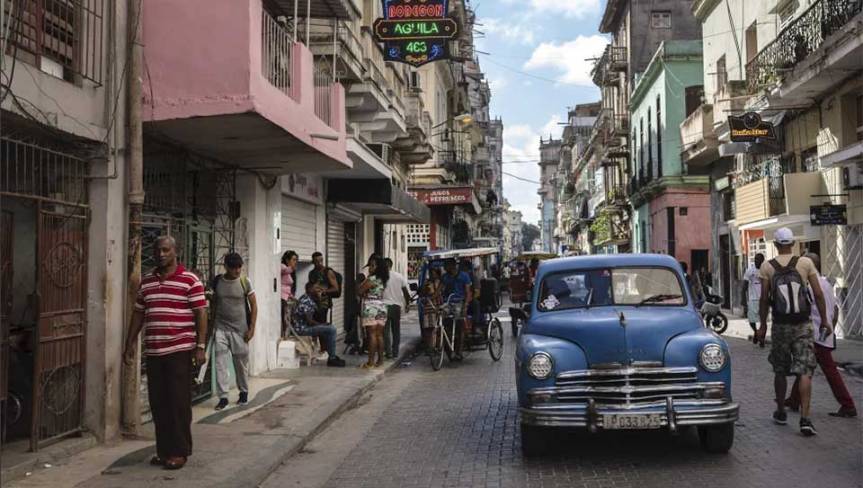
An American classic car makes its way down a street in Havana, Cuba, Nov. 11, 2023. (AP Photo/Ramon Espinosa, File)

Reposted from Peoples World


Ignacio Ramonet, academician and former editor of Le Monde diplomatique, has written an open letter to President Joe Biden. It offers nations, organizations, and individuals a golden moment for getting rid of a critical piece of the U.S. system of economic blockade of Cuba. Ramonet argues in the strongest possible terms that the U.S. President must end the U.S. designation of Cuba as a state sponsor of terrorism (SSOT) and do it now.

Ramonet, originally from Spain, has long lived and worked in Paris, where he prepared. He teaches at Paris Diderot University and formally at the Sorbonne. In 2006, Ramonet praised Fidel Castro’s legacy in a series of articles in Foreign Policy journal. His book My Life: A Spoken Autobiography, written with Fidel Castro, appeared in the same year. It’s based on more than 100 hours of interviews with Castro.

The Casa de las Americas in Havana has sent out to the world an invitation for any and all to endorse Ramonet’s letter. Casa says:

“Our dear friend Ignacio Ramonet sent us this open letter to the President of the United States. Casa de las Americas supports this noble initiative and invites writers, artists, cultural promoters, academics, activists and social fighters, members of non-governmental organizations, and people sensitive to the daily suffering of the Cuban people to support it with their signatures.”

“Cuba’s income per person is probably 1/3 or 1/4 of what it would be without the bloqueo,” writes economist Jeffrey Sachs. The SSOT designation does its bit toward assuring that grim outcome. It provides for penalties against international financial institutions that handle Cuba’s borrowing and commercial transactions overseas, ones that involve dollars, which is usually the case.

Now is a crucial time. The SSOT designation is the one part of the far-reaching U.S. system of sanctions and commercial blockade that does not require action by the U.S. Congress to end or modify it. The U.S. president has sole responsibility for either authorizing or withdrawing the SSOT designation.

President Donald Trump reinstated the designation on January 12, 2021, within days of leaving office. President Obama had removed it in 2015. Right now, Biden could remove Cuba from that list of supposedly terrorist-sponsoring nations before a new president is installed, and without pain. The inevitable howls of outrage from defenders of U.S. domination of Cuba will bother neither him–who will be gone–nor the new administration–that was not there.

The point is that now is the time for a major campaign to persuade many individuals and organizations to sign on to Ignacio Ramonet’s open letter. The project would be part of a major push to get the job done.

After all, the U.S. State Department did remove Cuba from its list of countries “not cooperating fully” in U.S. anti-terrorism efforts in May 2024.

Here is what you do to sign on:

  • First, read Ramonet’s letter. It’s accessible at this link.
  • Second, access the Casa de las Americas invitation to endorse it. Do that by going to the same link.
  • Third, go to page three of the same communication to indicate who you are and the name of your group.

A job well done.


W.T. Whitney Jr. is a political journalist whose focus is on Latin America, health care, and anti-racism. A Cuba solidarity activist, he formerly worked as a pediatrician, lives in rural Maine. W.T. Whitney Jr. es un periodista político cuyo enfoque está en América Latina, la atención médica y el antirracismo. Activista solidario con Cuba, anteriormente trabajó como pediatra, vive en la zona rural de Maine.

How to Ease the Migration Crisis: End US Economic Sanctions / by W.T. Whitney Jr.

Migrants wait to be processed by US Border Patrol after crossing the US-Mexico border in Yuma, Arizona, July 2022. (Allison Dinner / AFP via Getty Images)

South Paris, Maine


Top officials of 11 Latin American and Caribbean governments met October 22 in Chiapas, Mexico to deal with the flood of migrants heading to the United States. There was agreement that U. S. interventions in their region fuel migration.  A report from Chicago, released two days earlier and discussed here, concluded similarly.  

The goal of the meeting called by Mexican president Andrés Manuel López Obrador was to form a regional block tasked with finding solutions. Presidents on hand, besides AMLO, were Xiomara Castro of Honduras, Miguel Díaz-Canel of Cuba, Gustavo Petro of Colombia, and Nicolás Maduro of Venezuela.

The joint statement emerging from the meeting outlined baseline assumptions: 

  • “The main structural causes of migration have political, economic, and social origins, to which the negative effects of climate change are added.” 
  • “Unilateral, coercive policies from the outside are by nature indiscriminate; they affect entire populations adversely.”

The statement concluded with an agreement covering 14 points, among them: further development of an action plan, mutual cooperation, attention to commercial relationships, demands put on destination countries, respect for human rights, protection of vulnerable populations, the special case of Haiti, and a plea that the Cuban and U.S. governments “comprehensively discuss their bilateral relations.”  

AMLO declared that “unilateral measures and sanctions imposed against countries in the region, particularly Venezuela and Cuba, contribute to instigating migration,” also that the U.S. government has to “dialogue with us.”  

The Great Cities Institute, a research center at the University of Illinois at Chicago, on Oct 20 released a report prepared by journalist Juan González. It analyzes recently-imposed economic sanctions and U.S. assaults over many years against regional governments.

The report concludes that “U.S. foreign policy toward Latin America …[and] sanctions directed at Venezuela, Cuba and Nicaragua, have played a major role in crippling theeconomies of those three nations, thus fueling for the past two years an unprecedented wave of migrants and asylum seekers from those countries that have appeared at our borders.”

Undocumented Mexican immigrants are shown to have represented 70% of all undocumented immigrants in 2008 but only 46 % in 2021. It appears that, later on, most unauthorized migrants entering the United States came from Honduras, Guatemala, and El Salvador.

Then Venezuelans “apprehended at the border” increased from 4,500 in 2020 to “more than 265,000 in the first 11 months FY 2023.” There were 3,164 undocumented Nicaraguans crossing the border in 2020 and 131,831 two years later. 14,000 Cubans crossed in 2020; 184,00 did so in 2023. In fact, “more Cubans have sought to enter the U.S. during the past two years than at any time in U.S. history.”

The report indicates that the three countries supplying these migrants “have been targeted by Washington for regime change through economic sanctions, a form of financial warfare that has only made life worse for their citizens.”

Note is taken of Venezuela’s GDP falling 74% over eight years and of $31 billion in oil revenues lost between 2017 and 2020. Venezuela must import most of the pharmaceuticals, medical supplies, and food it needs, according to the report. Funds for importing goods and for maintaining oil production derives from oil exports, which are blocked by U.S. sanctions. Shortages mounted, people suffered, and even died. Venezuelans reacted by leaving.

The Obama administration instituted sanctions in 2015 and President Trump added more afterwards. The sanctions block access to international credit, punish owners of foreign ships entering Venezuelan ports, and prevent income generated in the United States by Venezuela’s Citgo oil company from being repatriated.

The U.S government, according to the report, “is virtually alone in the world” in having unilaterally pursued such a lengthy economic blockade against Cuba. The U.S government punishes “an entire population for a political purpose.”  

The report notes that, “Cubans have garnered far less nationwide attention [than Venezuelan migrants] because they tend to settle in just one part of the country.” The real reason is that the Cuban Adjustment Act of 1966 provides undocumented Cubans with permanent residence a year after their arrival, and until then with work permits. The legislation, magnet-like, draws Cubans to the United States.

Cuban President Miguel Diaz-Canel, speaking at the Chiapas meeting denounced U.S. “coercive measures aimed, by definition, at depressing the standard of living of the Cuban population, reducing their real income and making them suffer hunger and misery.”

One learns that in Nicaragua after 2006, when the socialist-oriented Sandinistas returned to power, poverty diminished and food supplies increased.  Migration to the United States remained very low. Then, in 2018, protests erupted, with violence and deaths.

The report points out that “investigative journalists” viewed the uprising as “an attempted violent coup organized by U.S.- funded dissident groups.” But the U.S. government saw the Sandinista government as violating human rights and instituted sanctions, strengthening them in 2021.  International loans were now off limits and countries assisting Nicaragua would be punished. Emigration skyrocketed.

Juan González, who prepared the report, recalls having “documented in a previous study, [that] the largest migrations from Latin America over the past sixty years have come precisely from those countries the U.S. has repeatedly occupied and most controlled.”

The report catalogues U.S. interventions, among them: Guatemala, 1954; Cuba, Bay of Pigs, 1961; Dominican Republic, 1965; Chile, coup, 1973; Nicaragua, Contra war, 1980s; Panama, 1989; Venezuela, failed coup, 2002; Honduras, rightwing coup, 2009.

The report offers recommendations for easing the migration crisis. One is to end “economic warfare against Venezuela, Cuba and Nicaragua.” Another is to provide “expedited work permits” to recently arrived migrants and to long-term undocumented immigrants. The report asks that, “our government listen to the rest of the world community and end its destructive embargo against Cuba.”

The United Nations General Assembly will soon vote on a Cuban resolution calling for no more blockade. It has approved the resolution annually for 30 years, overwhelmingly so in recent years. The U.S. government does not listen.

Discussing his report on Democracy Now, Juan González provided a rationale for ending the various economic blockades that, based on cost-benefit analysis, ought to resonant with capitalists in charge of our national affairs.

He pointed to U.S. government spending of $333 billion between 2003 and 2021 “for immigration enforcement and for ICE and Border Patrol and fences.” It makes sense: ending U.S. economic sanctions would result in far fewer migrants at the southern border and, potentially, a big cost saving. 


W.T. Whitney Jr. is a political journalist whose focus is on Latin America, health care, and anti-racism. A Cuba solidarity activist, he formerly worked as a pediatrician, lives in rural Maine. W.T. Whitney Jr. es un periodista político cuyo enfoque está en América Latina, la atención médica y el antirracismo. Activista solidario con Cuba, anteriormente trabajó como pediatra, vive en la zona rural de Maine.
U.S. Congress terrorizes Cuba: GOP seeks power to designate island a terrorism sponsor / W. T. Whitney Jr.

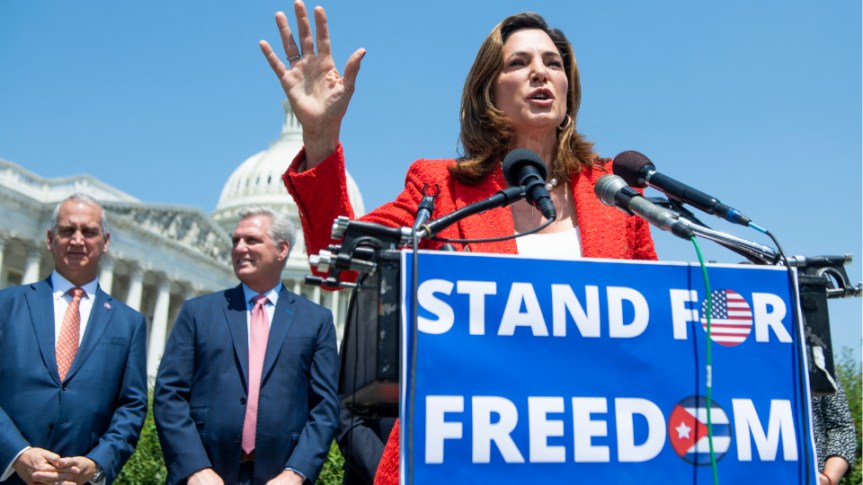
Rep. Maria Elvira Salazar, R-Fla., speaks during a news conference to highlight ‘Cuban Independence Day’ outside the Capitol on Thursday, May 20, 2021. Rep. Mario Diaz-Balart, R-Fla., left, and House Minority Leader Kevin McCarthy, R-Calif., also appear. | Tom Williams / CQ Roll Call via AP

Originally published in the People’s World on April 6, 2023


Although Cuba’s Revolution survived military invasion, guerrilla actions, terrorist attacks, and bacteriologic warfare, enough was not enough. Now, there are pay-offs to dissidents, manipulation of worldwide media coverage, and weaponization of social media capabilities. And of course, the U.S. economic and financial blockade persists, after 60 years, with no sign of stopping any time soon.

That’s mostly because power to end the blockade switched from the executive branch to Congress, courtesy of the Helms-Burton Law of 1996. Now, the House of Representatives will be considering a bill that, similarly, would have Congress and no longer the president decide on removing Cuba from the U.S. list of terrorism-sponsoring nations.

Miami’s Republican Rep. María Elvira Salazar introduced H.R. 314, the so-called FORCE Act, on Jan. 12, 2023. Its aim is to “prohibit the removal of Cuba from the list of state sponsors of terrorism until Cuba satisfies certain conditions, and for other purposes.”

GOP Sen. Marco Rubio introduced a companion bill in the U.S. Senate on March 16. The House bill has 24 co-sponsors; five are Floridians. The House Foreign Affairs Committee sent the bill to the House floor on March 28.

Meanwhile, a revived campaign is pressuring President Joe Biden to end the designation of Cuba as a state sponsor of terrorism. That campaign takes on urgency now, inasmuch as Congress may soon co-opt Biden’s power to do so.

The designation represents a false account of Cuba’s facilitation of peace talks between Colombia’s government and leftist guerrillas. It traces back to old accusations that Cuba was harboring fugitives from the United States.

The designation persisted from the 1980s until 2015, when President Barack Obama removed it, only to be reinstated by White House occupant Donald Trump in 2021. The effect is to broaden economic war and bring new grief to the people of Cuba.

U.S. dollars are weaponized; they are still the de facto currency in all international financial dealings, anywhere, by anyone. A convenient choke point exists, as pointed out recently by Cuban diplomat José Ramón Cabañas: “The issue is the clearing system based in New York. 90% of [Cuba’s] international transactions with U.S. dollars go through that system … [and are] automatically frozen.”

U.S. regulations, introduced through executive action, long ago prohibited state sponsors of terrorism from using U.S. dollars in international transactions. Consequently, payments that Cuban exporters expect from foreign buyers may not arrive, and Cuban importers have difficulties paying foreign suppliers. International loan payments are blocked, and grants from international agencies go astray.

The U.S. Treasury Department may impose heavy fines on those international banks and foreign corporations that do handle dollars in transactions with Cuba. Non-offenders avoid Cuba, out of caution. The connection between the terrorism-sponsoring designation and prohibition on the use of U.S. currency has led to shortages and economic distress in Cuba.

Massachusetts Peace Action has spearheaded the necessary campaign against H.R 314. A recent communication provides information and shows how to contact members of the House of Representatives.

The extended Cuban exile community provides the main political support for the anti-Cuba legislative proposals in the House and Senate. The Cuba part of U.S. foreign policy is regularly farmed out to the population sector with the most to lose or gain. That approach is dysfunctional, irrational, and unfair.

The text of the proposed bill assigns Cuba goals, fulfillment of which would signal that the country is no longer to be designated as a sponsor of terrorism. These are the very goals that, as specified in the Helms-Burton Law, need to be achieved so that the blockade may be ended.

The goals are:

  • Release all political prisoners and allow for investigations of Cuban prisons by appropriate international human rights organizations.
  • Transition away from the “Castro regime” to a system that guarantees the rights of the Cuban people to express themselves freely.
  • Commit to holding free and fair elections.

Perspective reveals contradictions in all of this. The subject of political prisoners demands consideration of the fate of U.S. prisoners held at the U.S. military base in Guantánamo Bay.

It’s worthwhile also to recall that neither Fidel nor Raul Castro now plays a part in Cuba’s government. As for Fidel, he’s dead. And when it comes to the retired Raul, his influence may persist, just as does that of former presidents in the United States, but he occupies no leadership role. His thinking is sought from time to time in Cuba when, for instance, organized discussion among wide sectors of the population precedes the introduction of important initiatives. The last such occasion was the discussion period in 2022 prior to the vote on the Constitutional Amendment for a Family Code.

And, lastly, Cuba’s conduct of elections is exemplary. In voting on March 26 for Cuba’s National Assembly, 75% of the voting population took part. The portion of those who vote in U.S. national elections is far smaller. Plus, the make-up of delegates to the Assembly actually reflects the demographics of Cuba’s population, unlike the U.S. Congress.

The National Assembly then chooses from among its members to be Cuba’s leaders. That’s the standard process followed in the parliamentary systems of many countries.


W.T. Whitney Jr. is a political journalist whose focus is on Latin America, health care, and anti-racism. A Cuba solidarity activist, he formerly worked as a pediatrician, lives in rural Maine. W.T. Whitney Jr. es un periodista político cuyo enfoque está en América Latina, la atención médica y el antirracismo. Activista solidario con Cuba, anteriormente trabajó como pediatra, vive en la zona rural de Maine.

Colombian Intelligence Operations, with US Backing, Are Bad for Peace / by W. T. Whitney Jr.

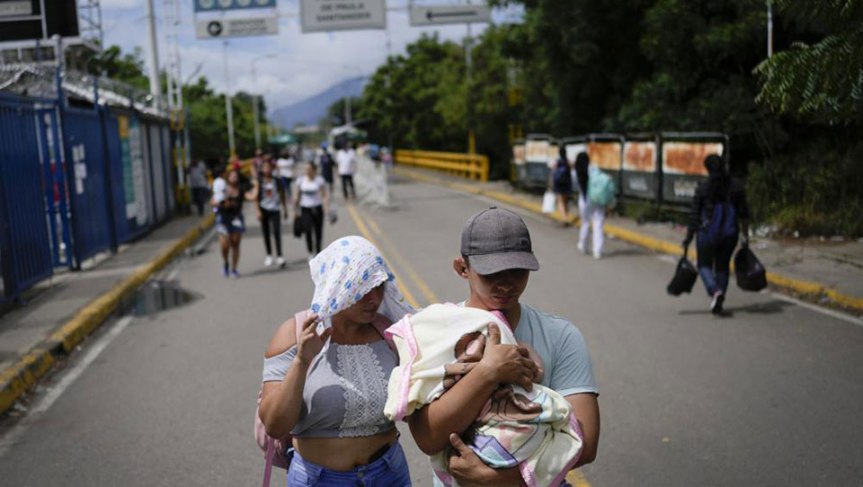
A Venezuelan couple use the Francisco De Paula Santander Bridge to cross between Urena, Venezuela, and Cucuta, Colombia, Aug. 6, 2022. | Matias Delacroix / AP

Colombia’s new president Gustavo Petro wants peace. Colombia’s military, the largest in Latin America, except for that of Brazil, stands in the way. It benefits from U.S. largesse while attending to U.S. needs. Its intelligence branch, discussed here, is not about peace and reconciliation.

The U.S. government, militarily involved in Colombia for decades is likewise an obstacle to peace. As explained recently by analyst Hernando Calvo Ospina, military cooperation has been central to the U.S.-Colombian alliance. He details how since World War II the United States has partnered with Colombia in dominating the entire region to maintain access to strategic resources, exclude Communism, and suppress left-wing movements. Calvo Ospina mentions Colombian-U.S. drug-war operations and the two countries’ addiction to military and ruling-class power. This is the setting for the intelligence operations described below.

Colombian intelligence operations serve U.S. imperialist objectives as they target Cuba and Venezuela. Colombian governing authorities appear to have forgotten the legacy of independence hero Simón Bolívar who, up against Spanish rule and U.S. pretentions, fought for Latin American unity. In 1829 he remarked that, “The United States appear to be destined by Providence to plague America with misery in the name of liberty.” He was denouncing unencumbered U.S. license to control Spanish America, as proclaimed in the Monroe Doctrine of 1823 and still in force. 

Trump-era national security advisor John Bolton recently boasted he had planned coups to unseat the Maduro government in Venezuela. Current White House advisor on Western Hemisphere affairs Juan González took a different tack while speaking in Colombia in August: “40 years ago the United States would have done everything possible to avoid the election of Gustavo Petro and, once elected would have done everything possible to sabotage his policies.”  Now, says González, the United States wants to collaborate and “navigate that change.” 

Meanwhile, Petro wants young people to choose social service and not do military service. His government will be negotiating peace with National Liberation Army (ELN) guerrillas. He rejects the U.S.-promoted drug war and has re-established diplomatic relations with Venezuela, the object of U.S. hybrid war. On August 12, Petro named new military chiefs and replaced 40 generals and admirals because of corruption and human rights violations.

This report turns to Colombian military intelligence. The Revista Raya website, directed by Edinson Bolaños, recently published three articles on Colombian intelligence operations that began in 2016 and continued for almost six years. (See the end note for possible translations in English of “raya.”)

Face-off against Cuba

The first article, titled “International Espionage: Operation Cuba,” appeared on the website on August 19.  One learns that, “Revista Raya had access to thousands of classified Colombian military intelligence documents where evidence appears of spying on Cuban diplomats and officials, left-leaning [Colombian] political leaders, journalists, and social leaders.” The folders contained “profiles of targeted personnel, photographs, videos of subjects being followed, maps, sketches and drawings.”

Agents posing as journalists or photographers mapped routes to facilities used by diplomats. They photographed the interiors of the Cuban embassy, consulates, and diplomats’ quarters, and also diplomats’ automobiles and license plates. They monitored diplomats’ encounters with Colombian activists and politicians. Operatives gained access to phones, computers and on-line communications.

They were able to alter the text of the Cubans’ email communications. Colombian intelligence operatives communicated their findings with U.S. counterparts. U.S. documents with responses and commentary show up in the files.

Operatives attended solidarity gatherings in Colombia and farther afield – at a Sao Paolo Forum of leftist political parties, for example. At these venues, they identified attendees, monitored conversations, gained access to email communications, and informed intelligence agencies in home countries of their citizens’ participation in leftist or pro-Cuba activities. They spied on solidarity gatherings at the Julio Antonio Mella International Camp near Havana.

People attending various events had their phone calls intercepted, among them: Cuban ambassador José Luis Ponce and Vice Consul Kendry Sosa, leftist senators Iván Cepeda and Gloria Flórez; Communist Party leaders Jaime Caycedo and Carlos Lozano Guillén; and FARC lawyer Diego Martínez. Among attendees monitored at the Sao Paolo Forum in 2019 were Communist Party member Gloria Inés Ramírez, now President Petro’s labor minister, and leftist senator Piedad Córdoba.

One purpose for the phone monitoring, according to Revista Raya, was to unearth or install material suggesting that Cuban operatives were promoting the protest demonstrations that rocked Colombia in 2019 and later, and contributed to the election of President Petro. The intelligence units also sought to connect Cuba’s government with leftist insurgents in Colombia, particularly the National Liberation Army (ELN).

According to documents in the report, agents “sewed” information in the computers of ELN guerrilla leaders suggesting the “complicity of Cuba’s government with the ELN in manufacturing the violence associated with the social protests.”  Nothing appeared in the files indicating that Cuba’s government actually did promote anti-government activities, according to Revista Raya.

Agents planted “evidence” of alleged terrorism undertaken by ELN guerrilla leader Andrés Vanegas Londoño, alias “Uriel,” and sent it to Colombian prosecutors and to Interpol. They communicated his location in Choco department. Uriel died in a bombardment of his camp 20 days later, on October 25, 1920.

Targeting Venezuela

Encouraged by its U.S. partner, Colombia’s government has long taken steps to destabilize Venezuelan society and government operations, and more so recently. Secret operations have taken place in Venezuela’s border region with Colombia. Colombian narco-traffickers are active there, and also Colombian paramilitaries. A small U.S.-Colombian force, Operation Gideon, carried out a maritime invasion of Venezuela in 2020.

Colombian military intelligence engaged with agencies and personnel of Venezuela’s government. On August 24, Revista Raya published “International Espionage: Objective Venezuela. The survey covers destabilization plans and monitoring of Colombian and Venezuelan politicians and Venezuelan diplomats.

Colombia’s intelligence service secreted 28 spies within various branches of Venezuela’s military. As part of so-called “Operation Vengeance,” operatives “tried to encourage the Venezuelan Army to carry out military operations against the ELN,” whose detachments were active in Venezuelan territory. They created hostile pamphlets and audio recordings and attributed them to the ELN.The spies “totally infiltrated” the communications of a Venezuelan press attaché in Bogota and monitored his contacts with prominent Colombian politicians of the left. Colombian officials later expelled him. 

Citing “another hundred documents,” Revista Raya shows that, during the presidency of President Iván Duque (2018 -2022), Colombian spies entered, photographed, and took material from the Venezuela’s consulate in Cartagena. The Colombian intelligence operatives attended primarily to consul Ayskel Torres.  

Under “Operation Sunset,” they “monitored her contacts with leftist social leaders in the region and her “sentimental relationship” with the “military attaché of a Caribbean country.” They were blackmailed and the latter provided a list of “cooperating” contacts.

Spying ceased after February 23, 2019, when The Maduro government broke relations with Colombia. The spies had monitored Venezuelan diplomats’ communications about the safety of money and sensitive documents lodged in an Embassy strong box. After the Venezuelans had departed, spies entered the building, took photographs, opened the strong box and stole documents and money. 

Responsibility

The last section of this three-part Revista Raya series is titled “International Espionage: Massive Profiling.” Documents were cited that contained “telephone numbers, homes addresses, political preferences, work places, email addresses, nationalities, and date of identification” for 450 persons. The article presents political profiles of eight individuals as examples of other profiles that were created. Dozens of images appear.

The targeted individuals included “political, social, and union leaders and also diplomats and officials of the Cuban and Venezuelan governments.” Intelligence agents descended on them when they attended “commemorations and political events relating to socialist countries,” or “peaceful mobilizations and … political events in Colombia.”

This last article in the series identifies the chief of Navy Intelligence as the individual primarily responsible for the illegal spying.

Rear Admiral Norman Iván Cabrera Martínez heads that agency now. He served as naval attaché at the Colombian Embassy in Washington and the U.S government awarded him a Meritorious Service Medal. Cabrera Martínez assumed his post on August 27, 2022. 

Colombian Communist Party secretary general Jaime Caycedo, the object of spying, commented to Revista Raya: “We … think this is a violation flagrant of our rights and constitutional liberties …[We] attach great importance to the journalistic work you are doing. You showed how we fell into their hands. You explained how public resources and public entities were used to maltreat citizens with this illegal profiling and to spy on diplomats of friendly countries with diplomatic relations.”

Note: The meaning in English of “raya,” as used in the website’s name, is mysterious here. We opt for “line-by-line review.” “Raya” may signify victim or despised person in that a “tienda de raya” in Mexico was a store operated by a company or hacienda relying on a laborer’s written line for a signature. A possibility from Colombia is “detective.”  Another commentator suggests “memorable happenings.”


W.T. Whitney Jr. is a political journalist whose focus is on Latin America, health care, and anti-racism. A Cuba solidarity activist, he formerly worked as a pediatrician, lives in rural Maine. W.T. Whitney Jr. es un periodista político cuyo enfoque está en América Latina, la atención médica y el antirracismo. Activista solidario con Cuba, anteriormente trabajó como pediatra, vive en la zona rural de Maine.