The Trump circus has a logic and it’s dangerous / By W.T. Whitney Jr

South Paris, Maine


As startling and far-reaching as they are, actions taken by the Trump administration are most impressive at first glance for their circus-like quality of no central purpose. Realization dawns, however, that measures hitting at the rule of law and democracy itself and promoting war and turmoil in the wider world are so politically disastrous that by no means would they have appeared accidentally.

The idea here is that present situation reflects the U.S. government’s last-ditch response to a crisis of capitalism. If so, any useful defense against unfolding catastrophe has to center, it seems here, on what needs to be done about capitalism.

The term signifies arrangements in effect since feudalism that give full rein to ruling classes everywhere to organize economic and political affairs to their advantage. Capitalism is an evolving process that, stumbling now and then, requires adjustments to its functioning. Presently, the masters of U.S. capitalism seem to be carrying out a major fix of old and new problems that impede profit-taking. The measures being employed are disruptive.

To get the job done, capitalist decision-makers recruited the MAGA crew as agents to take on the unpleasant job, among other, of removing protections against exploitation and abuse of U.S. working people. Lower-order capitalists having reservations will probably join the project, while holding their nose.

Some basic assumptions introduce the discussion here:

· To fix what’s wrong, you look for the cause.

· Focus on impaired personalities running the show does not fully explain the turmoil triggered by the Trump government’s recent actions.

· Preexisting political rules and arrangements for how to govern did nothing to prevent the present catastrophe.

· Wide sectors of the U.S. population are silent, stunned, and without hope. They are generally unconvinced that an alternative way of doing politics exists or is possible.

· The Trump administration regards political opposition as inconvenient, irrelevant, and disposable.

· Actions of his government result from rational decision-making. They are not the products of random impulses.

Beginnings

Capitalists cross established boundaries. Beginning centuries ago in Europe, they have been plundering distant parts of the world. Along the way, they added an exploitative factory system, great industrial monopolies, and, lastly, a world system of markets, cheap labor, and plunder of natural resources.

Overcoming challenges and contradictions, capitalists took charge of faraway peoples, fought wars against rival capitalist powers, confronted socialist governments and suppressed resistance movements at home and abroad. Periodically, they had to recover from economic crashes prompted by the impossibility of impoverished workers buying goods that were produced. The point here is that capitalists are used to dealing with challenges.

Capitalists after World War I were experiencing unprecedented difficulties, and fixing them was fraught with uncertainty. European and the U.S. economies were highly unstable even before the Great Depression arrived. Plus, the Soviet Union was attending to people’s social needs, was industrializing, and was little affected by the Great Depression. A socialist alternative to the capitalists’ faltering system had abruptly asserted itself.

Many capitalists in Germany and Italy reacted by tolerating or actively supporting the fascist political parties fighting for power in each of those countries. They claimed to offer protection for capitalist economies and fightback against the Soviet menace. Their restrained U.S. counterparts accepted palliative reforms mediated through New Deal social democracy.

U.S. capitalism took on new life after World War II when the United States took charge of inserting free trade and other neoliberal policies into the world economy, over which it presided. The system allowed rich nations and their capitalists to exploit low-wage workers abroad, take advantage of poor nations’ debt dependency, and profitably extract their underground resources.

New Troubles

The good times were not so good. Beginning in the 1970s, worldwide economic growth lagged and inflationary tendencies persisted. The U.S. economy was experiencing “long-term stagnation and deindustrialization.” Financial activities and financial assets now loom larger in the U.S. economy than do commodity production and trade.

Manipulation of debt instruments misfired in 2008 leading to serious economic crisis. These adverse, long-developing realities represent one impetus for capitalist leaders to move toward extraordinary corrective measures. The Trump administration is carrying them out.

The other big element marking the current disruption of national politics would be the expected unpredictability of the Trump administration’s conduct of foreign affairs. On the theory that the administration’s major task is to shore up capitalism, it will surely be acting so as to align U.S. overseas activities with capitalist norms.

Lenin and other authorities had a lot to say about these, mainly the notion that aggressive foreign interventions are crucial for capitalism to be able to function.

U.S. imperialism, a bipartisan project, expanded after post-World War II. U.S. imperialists have carried out interventions, wars, proxy wars, and devastating economic sanctions in country after country, mostly in the Global South. These activities will undoubtedly continue under the Trump administration in order to further capitalist purposes. Random remarks on Trump’s part suggestive of easing up on this or that foreign adversary contribute only to the current volatility of political affairs.

Anti-communism had long inspired U.S. overseas adventures, but U.S. warmaking continued even after the Soviet Bloc was no more. The U.S. government and its capitalist junior partners, for example, engineered devastating regime-change operations against Yugoslavia (1999), Iraq (2003), and Libya (2011) The cover of anti-communism was gone, and antiterrorism as justification barely sufficed. Subsequent U.S. foreign interventions have represented imperialism, pure and simple.

China and a few other underdeveloped nations are now major manufacturing centers. China continues to attract significant foreign investment and is investing, building infrastructure, and extracting subsoil resources throughout the Global South, in the process outstripping the United States. The BRICS+ nations, competitive with the Global North in banking, manufacturing and science, are seeking to replace the U.S. dollar as the main international currency.

What to do

U.S. capitalists, seemingly worried about uncertainties surrounding foreign interventions and about weaknesses of the faltering neoliberal free-trade system, are on the way to building something new. The suggestion here is that Trump circus riling U.S. politics is no accident and that a new kind of capitalism is on the horizon.

Under Trump the government is assertive, aggressively nationalistic, and insulated from progressive social and political currents from abroad. The U.S. has disconnected from international agreements and international organizations, notably the 2015 Paris Climate Accord and the World Health Organization. High import tariffs are landing on goods arriving from almost everywhere, with the highest ones reserved for Chinese products.

U.S. working people are, or soon will be, coping with price hikes stemming from high tariffs; assaults on labor organizing, healthcare, schools, and universities; selective food shortages; aggravated racism; and cruel and illegal deportation proceedings. New grief is compounding earlier unmet social and economic needs.

The changes are so far-reaching that progressive reforms introduced by President Franklin Roosevelt in the 1930s are at risk of disappearing. Breakdown of the New Deal consensus would be the crown jewel of the upcoming capitalist reformation.

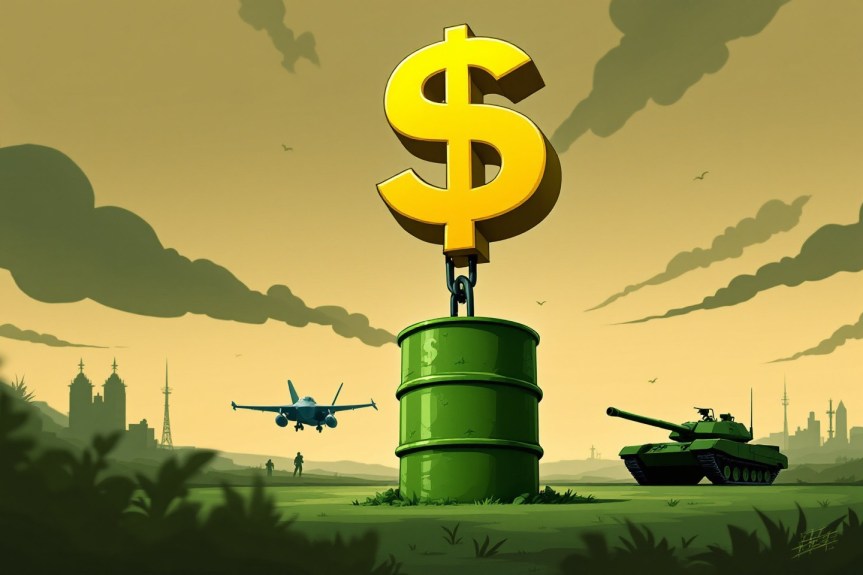
Almost incidentally, war preparations are a major element of the new kind of capitalism. According to Monthly Review, “[R]earmament of U.S. allies, along with a massive increase in Pentagon spending and bellicose threats directed at designated enemies, could lead to the further proliferation of conflicts, heightening the chance of a Third World War.” A “Trump nationalist imperial policy” envisions a “New Cold War on China” involving a “limited nuclear war.”

Call in the specialists

A government embarking upon such far-reaching initiatives can expect troubles ahead. Vast numbers of U.S. Americans will be experiencing grief and abuse. They may rise up, prompting the need for their suppression and for maintenance of order. A major war would require the home front to be stabilized and controlled with vigor. A special brand of governance would come into play. Specialists are available for this kind of work.

They are MAGA crew, already on the job. Following a script, they hit at the rule of law, politicize the military, prepare for war, scapegoat immigrants and the racially oppressed as internal enemies, assault institutional centers of thought –universities, government research centers, and the independent press – and rip apart the fabric of democracy. Lying and disregard for the truth are nonstop.

You may have already made the association. Another bunch of fascists thugs almost a century ago in Germany and Italy did their reordering in ways similar to those adopted by the Trump administration in our era. Measures taken in both situations are similar, as are overall purposes.

The way out

Working-class resistance becomes important. Turning back the fascists – or protofascists, call them what you will – rests on alliances created between working people and other oppressed and marginalized sectors, especially in rural areas and among the lower ranks of the middle class, the so-called petit bourgeoisie. The MAGA movement’s electoral strength depends on support from both sectors and also, crucially, from elements of the working class.

The record shows that to defeat 20th century fascism, major elements of the Communist movement pursued the popular front strategy, the idea of worldwide alliance involving all democratic forces. That recipe fits today and, besides, no alternative political formation or remedy is waiting in the wings for rescue.

Communists are familiar through study and practice with the linkage between capitalism gone awry and the origins of fascism. Giving voice to that reality may be a first step in bringing unhappy, confused malcontents into political activism, and from there into mass mobilization, which is the essential tool for defeating fascism.

Communists and socialists will be educating and organizing, and asserting their places in public life. They would interact primarily, but not exclusively, with members of the working class. Their educational message would begin with the premise that capitalists unable to solve their big problems turn to fascism for rescue. They would highlight the connection between wars and imperialism.

Loose ends remain. First, U.S. capitalists’ reliance on the fascists is old hat for their kind. Business mogul Henry Ford and Charles Lindbergh of America First fame greatly admired the Nazis. Senator Harry S. Truman in 1941, commenting on war in Europe, stated that, “If we see that Germany is winning, we ought to help Russia, and if Russia is winning, we ought to help Germany, and that way let them kill as many as possible.” His message was that in the right circumstances Nazis are OK.

Secondly, U.S. capitalists, bent upon overcoming failures in how capitalism works, easily dismiss one of the greatest failures of worldwide capitalism, that of weak response to environmental crisis that threatens to destroy humankind and the natural world.


W.T. Whitney Jr. is a political journalist whose focus is on Latin America, health care, and anti-racism. A Cuba solidarity activist, he formerly worked as a pediatrician, and lives in rural Maine.

Mexico’s President Would Build Alliance to Counter Cuba Blockade / By William T. Whitney Jr.

Photo credit: People’s Dispatch

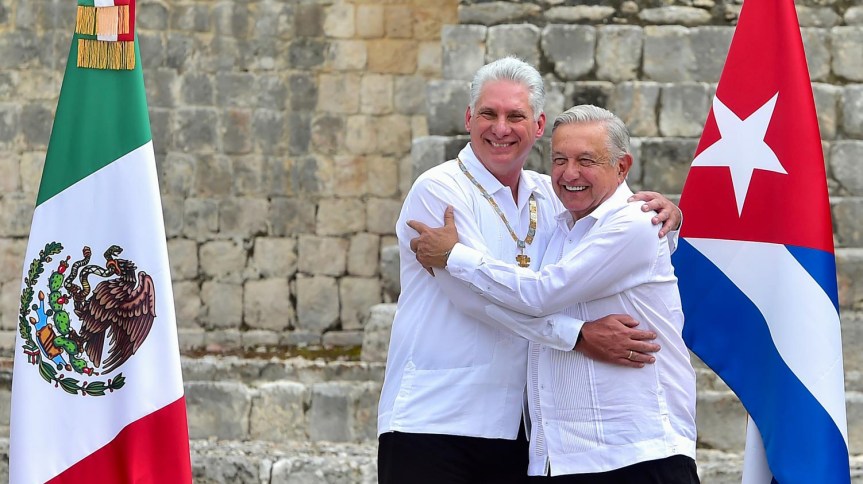
On the occasion of Cuban President Miguel Díaz-Canel’s visit recently to Mexico, Mexican President Andrés Manuel López Obrador (AMLO) raised the possibility of many nations cooperating to oppose the U.S blockade of Cuba. AMLO has become Cuba’s champion in the international arena, and perhaps not accidentally: the governments of the two nations each originated from social and political revolutions.

The two leaders have built a tight relationship.  Diaz-Canal visited to Mexico in September, 2021. AMLO was in Cuba in May, 2022. And AMLO refused to attend a U.S – organized Summit of the Americas in Los Angeles in June 2022 because Cuba had been excluded. 

Accompanied by Cuban government officials, Díaz-Canel on February 11 joined AMLO in the Mexican state of Campeche. That Cuban medical teams are working there now may have helped determine the meeting’s location.

In remarks at a medical center,  AMLO lauded Cuba’s medical solidarity and described his own people’s unmet social needs. He called upon the U.S. government to end its blockade of Cuba:

[Cuba] has our respect, our gratitude, our support, and we are going to continue demanding the removal, the elimination of the blockade against Cuba, which is inhumane. And there’s more than voting in the United Nations where the anti-blockade resolution is always approved overwhelmingly, and then it’s back to the way it was.

I promise President Miguel Díaz-Canel that Mexico will be leading a more active movement so that all countries come together and defend the independence and sovereignty of Cuba. No longer will there be anything about treating Cuba as a terrorist country or putting Cuba on the black list of supposed terrorists.

Cuba has been able to count on support from Mexico. As the Bay of Pigs invasion was unfolding in 1961, former Mexican President Lázaro Cárdenas spoke in defense of Cuba before 80,000 people in Mexico City’s Zocalo. Soon afterwards, Mexico’s government backed Cuba in the United Nations. Later Mexico rejected calls by the U.S. – dominated Organization of American States for member states to impose economic sanctions against Cuba and break off diplomatic ties.

AMLO visited Cuba in May, 2022. Speaking before Cuban leaders, he recalled “times when the United States wanted to own the continent …. They were annexing, deciding on independence wherever; creating new countries, freely associated states, protectorates, military bases; and … invading.”  The U.S. government, he declared, needs to know “that a new relationship among the peoples of America … is possible.”

While in Cuba he signed agreements for Mexican young people to study medicine in Cuba, for Cuba to provide Mexico with anti-Covid vaccines, and for hundreds of Cuban physicians to work in Mexico in underserved areas.

Months before, in September 2021, Díaz-Canel was the honored guest at celebrations in Mexico City of the 200th anniversary of Mexico’s national independence. Welcoming his guest, AMLO praised Cuba’s steadfastness in defending its revolution. Calling upon U.S. political leaders to lift the blockade on Cuba, he appealed to their good sense and rationality, saying nothing about nations uniting in opposition to the blockade. 

Photo credit: People’s Dispatch

[The U.S. government] must lift its blockade against Cuba, because no state has a right to subjugate another people, or another country … [And] It looks very bad that the U.S. government uses the blockade to hurt the people of Cuba in order to force them by necessity to confront their own government … President Biden, who shows political sensitivity, [must] take a wider view and put a permanent end to the politics of grievances against Cuba.

The emphasis was different, however, when the two leaders met recently, on February 11 in Campeche. AMLO unveiled an evolved and more forceful approach to ending the blockade. He bestowed upon Díaz-Canel Mexico’s highest recognition extended to foreign notables, the Aztec Eagle, and then praised Cuba as a special case for its strenuous resistance to U.S. enforcement of the Monroe Doctrine. He continued: 

I also maintain that it is time for a new coexistence among all the countries of America, because that model imposed more than two centuries ago is completely exhausted, it is anachronistic, it has no future. There is no way out, it no longer benefits anyone, we must put aside the trade-off imposed on us either to go along with the United States or be in opposition, courageously and defensively. 

It is time to express and explore another option, that of dialoguing with the leaders of all the countries and especially with U.S. leaders, and convince and persuade them that a new relationship between the countries of our continent, of all America, is possible. I believe that conditions are perfect now for achieving this goal of mutual respect.

In an interview later on, Mexican foreign minister Marcelo Ebrard offered some specifics:

President Lopez Obrador wants to bring the presidents of the progressive states of Latin America together to address food security, well-being and other issues that are important for our community of nations. This is something we have to discuss with other foreign ministers and move forward in the coming months. 

The progressive governments AMLO has in mind, according to Ebrard, are Mexico, Argentina, Brazil. Colombia, Cuba, Venezuela, Bolivia, Chile, and Honduras. They include “the three largest economies in Latin America.” The implication may be that these countries, collaborating on various issues, political ones included, have sufficient economic clout to pressure the United States on Cuba.

President Díaz-Canel himself has been building other bridges. In recent weeks he visited Belize, Saint Vincent and the Grenadines, and Barbados, for the 7th CARICOM (Caribbean Community) – Cuba Summit meeting.

AMLO’s focus on progressive nations is crucial. He has worked toward reviving the Community of Latin American and Caribbean States (CELAC) as a vehicle for collective action, despite participation there by conservatively-governed nations. Yet he did not attend the CELAC summit taking place in January and so may be discouraged as to prospects for CELAC serving his purposes. 

AMLO’s power to orchestrate regional support is limited. Only 18 months remain of his six-year term as president of a country dependent economically on the United States and divided geographically, ethnically, and by social class. Nevertheless, Cuba, whose external resources for ending the U.S. economic blockade are hardly infinite, badly needs international partnering that offers persuasive power. Lifelines thrown by AMLO are a start in that direction. 


W.T. Whitney Jr. is a political journalist whose focus is on Latin America, health care, and anti-racism. A Cuba solidarity activist, he formerly worked as a pediatrician, lives in rural Maine. W.T. Whitney Jr. es un periodista político cuyo enfoque está en América Latina, la atención médica y el antirracismo. Activista solidario con Cuba, anteriormente trabajó como pediatra, vive en la zona rural de Maine.

Peru Sees Possible Transformative Change, and US Intervention / By W.T. Whitney Jr.

Photograph Source: Mayimbú – CC BY-SA 4.0


Critics of U.S. interference in Latin America and the Caribbean may soon realize, is such is not the case now, that Peru has a compelling claim on their attention. The massive popular resistance emerging now amid political crisis looks to be sustainable into the future. Meanwhile, a reactionary political class obstinately defends its privileges, and the U.S. government is aroused.

This new mobilization of Peru’s long-oppressed majority population manifested initially as the force behind left-leaning presidential candidate Pedro Castillo’s surprise second-round election victory on June 6, 2021. It exploded again following the coup that removed Castillo on December 7, 2022.

The politically inexperienced Castillo, a primary school teacher and teachers’ union leader in rural northern Peru, espoused a program of resisting both Peru’s corrupt and oligarchical elite and foreign exploiters.  Castillo had begun his 2020 presidential campaign prior to aligning with a political party.  His affiliation eventually would the Marxist-oriented Peru Libre (Free Peru) Party, which abandoned him during his presidency.  

Castillo was the first leftist to be elected president of Peru. The candidate he defeated was Keiko Fijimoro, standard-bearer of Peru’s oligarchs and militarists and daughter of dictator and former president Alberto Fujimori.

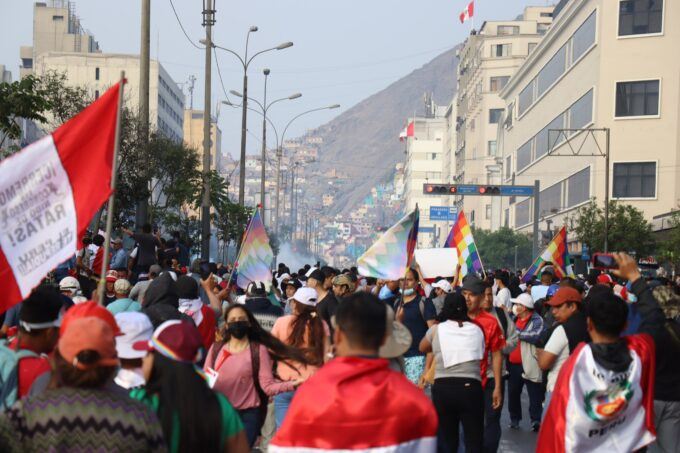
Castillo’s forced removal from office prompted massive popular resistance.  Since then, small farmers, indigenous communities, social organizations, students, and labor unions have sustained a national strike. Concentrated in Peru’s southern provinces at first, and later spreading throughout northern regions, strikers have been blocking highways, city streets, and access to government offices and airports. 

In their “March from the Four Corners” of Peru, protesters on January 19 occupied Lima massively in what they called the “Taking of Lima.” They have filled streets and plazas, marched, and impeded access to government offices. They say they will stay. Lima residents and social movements have stocked food for them and, with the help of schools and universities, provided shelter.

Anthropologist Elmer Torrejón Pizarro, from Amazonian Peru, was marching on January 19. He writes: “I saw no criminals next to me, much less terrorists. I observed young university students and mostly peasants, women and men from the south. I saw their faces, furrowed by the pain of life and death. They were next to me, their faces hard and burned by blows from life, from Peru. They were faces expressing generational hibernation of a country that, as a state, has failed.”

The protesters are demanding: resignation of de-facto president Dina Boluarte, liberation of the imprisoned Pedro Castillo, and dismissal of a Congress dominated by rightwing and centrist political operatives. They want new elections in 2023 and a popular referendum on instituting a Constituent Assembly. They, like Castillo, want a new Constitution.

Left-oriented news sources haven’t reported reactions to the strike from Peru’s leftist political parties. The few websites of those parties that are accessible add little.  The Communist Party of Peru Patria Roja, an exception, on January 16 condemned the coup government as a dictatorship, called for a transitional government, and expressed support for the demands outlined above.   

Popular resistance is one aspect of this crisis situation. The other is political repression. For weeks, the police and the military have been assaulting protesters throughout the country with lethal force. They have killed over 60 of them, wounded hundreds and jailed hundreds more.

In Lima on January 21, almost 12,000 police were in the streets blocking demonstrations and harassing residents and students; 14,000 more were otherwise engaged. The police that day violated a university autonomy law and entered San Marcos University where they arrested strikers sheltering there and students, over 200 in all.

The security forces and their handlers are heirs to repressors who, from Spanish colonization on, have repeatedly victimized masses of impoverished, mostly indigenous Peruvians.  Peru experienced three prolonged military dictatorships during the 20th century.

In dealing with Castillo and the threat he represented, forces of reaction turned to softer methods. These centered on congressional maneuvering aimed at harassing Castillo’s ministers and blocking his government’s program.

Finally, the Congress demanded that Castillo resign, and immediately soldiers seized the president. He was charged with “rebellion and conspiracy” and will remain in prison for at least 18 months.  He is held incommunicado.

Interviewed, Wilfredo Robles Rivera, the deposed president’s lawyer, spoke of a “parliamentary coup, a slow coup, a prolonged one organized on several fronts.” He explains that, “It was a strategy that began even before President Castillo took office. The rightwing … was pressuring election officials to recognize electoral fraud. An electoral coup, therefore. The true parliamentary coup began when Castillo became president.”

An earlier article by the present author elaborates on this terminal phase of Castillo’s downfall. Robles Rivera’s perspective appears in one of the addenda below.

Lastly, there is that aspect of Peru’s mounting crisis that relates to North Americans: U.S. intervention is possible. 

General Laura Richardson, head of the U.S. Southern Command, spoke to the establishment-oriented Atlantic Council on January 19. In regard to Latin America, she mentioned “rare earth elements,” “the lithium triangle – Argentina, Bolivia, Chile,” the “largest oil reserves [and] light, sweet crude discovered off Guyana,” Venezuela’s “oil, copper, gold” and “31% of the world’s fresh water in this region.”  She concludes, crucially: “This region matters. It has a lot to do with national security. And we need to step up our game.”

On January 18, de facto President  Dina Boluarte and her Council of Ministers informed Peru’s Congress that they were submitting for approval a draft legislative resolution saying, in effect, that Congress would be “authorizing the entry of naval units and foreign military personnel with weapons of war” into Peru.

Who but U.S. troops and military machinery would be first in line? The U.S. military is already familiar with deploying in Peru.  And the day prior to Castillo’s removal from office. U.S. ambassador Lisa Kenna, a CIA veteran, was in the office of Peru’s defense minister, conferring.  

She is persistent. On January 18 Kenna conferred with Peru’s minister of energy and mining and his associates. Journalist Ben Norton attests to that minister tweeting about “a high-level institutional dialogue that day between Peru and the United States.” The minister expressed pleasure at “support from the North American government in mining-energy issues” and mentioned his government’s prioritization of the natural gas and energy sectors.

Presently all liquified natural gas produced in Peru goes to Europe. Energy supplies there are precarious due to U.S. anti-Russian sanctions. We imagine U.S. applause.

The author did the translating above and below.


Addenda:

Lawyer Wilfredo Robles Rivera describes some of the congressional maneuvering that led to President Pedro Castillo’s removal.

“Obstructionists in the Congress prevented that body from discussing hundreds of the [Castillo] government’s legislative proposals …They followed with demands for dismissing the president through the vacancy procedure. …Their request for vacancy came in response to the President’s speech of December 7 in which he called for dissolution of Congress. They did not have the necessary votes to present the request … [and so] there was an accelerated process backed by other institutions, especially the military and police. At this point, the military-police coup comes into play.”

We add that Peru’s Constitution, in force since 1993 and a product of the Fujimori dictatorship, does allow a president to dismiss the Congress under specified circumstances and the Congress to “request a vacancy” in order to remove a president. Twice before, the Congress failed in that attempt.

Héctor Béjar offers reflections. His interview with  Prensa Latina reporter Manuel Robles Sosa appeared on January 18.   [WW1]  

Béjar served for three weeks as minister of foreign affairs in ex-President Castillo’s new government. He resigned in response to unfounded charges from the military conveyed through Parliament. Béjar has taught and written extensively on revolutionary change in Peru. He and others founded the National Liberation Army in 1962 for which he was imprisoned.

Prensa Latina: How do you evaluate the protest movement forming in the South of Peru?

Héctor Béjar: It’s a many-faceted movement composed of the quechua and aimaras communities, especially the aimaras, of women vendors in the popular markets, of transport workers in the South, traders in general, small business owners in the booming city of Juliaca, students from universities and high schools, and people in general. Added to them are the “rondas campesinas” (autonomous peasant patrols in rural areas) active in Cajamarca, Amazonian communities, and within many other popular networks.

PL: The social organizations that are protesting are putting forth a platform of political demands … without being ready to back off in exchange for development projects. What are the implications of this characteristic of the current protests for the people’s movement?

HB: It’s a qualitative shift. It’s the first time in Peruvian history that a movement surging up from the people themselves is setting forth a clearly political agenda that takes precedence over immediate, isolated demands limited to local problems. 

PL: What about ex-President Pedro Castillo? 

HB: The protesters identify with him as a person, as a teacher and rural resident, quite apart from his questionable performance in governing. … I have to say also that the movement has already largely transcended the idea of simply rescuing Castillo.

PL:  Most political analysts assert that the failure of Castillo has been harmful for the left and its future. Do the social protests and participation of left forces call this idea into question?

HB: The big movement we are speaking about must not be defined as of the left. If we look at reality, it’s a people’s movement, from the base, much broader than left politics. It’s also certain that most militants of the different left movements existing in Peru are fully invested in supporting this movement.

PL: Opinion polls show that the demand for a constituent assembly is shared by a majority of the population. That has to have an impact on the protests. (NB: Opinion polling in mid-January indicated that 71 % of Peruvians reject the government; 19% approve; 88% of them object to the Congress. )

HB: Evidently so. We are already in the process of getting rid of the old system and the constituent is part of a new one. The most probable outcome is that as the days and weeks pass, and if this movement persists and grows, the demand of a constituent assembly and a new constitution will continue growing until it takes over.

PL: What is the future and what are the options that might open up after this struggle?

HB: If this struggle continues and is not betrayed … we would have the possibility of a true democracy open to all of the country’s cultures and nationalities – a social state and an economy open to investments by the people and closed to every kind of corruption ….

Lautaro Rivara’s interview with Héctor Béjar for the alai.info website appeared on January 3. Excerpts from  Béjar’s comments follow:

On Peru’s 1993 Constitution: It’s the bad result of a disastrous coup d’état and of entangled negotiations of de facto President Fujimori with the OAS and the international community. This resulted in a text full of legal patchwork…It also contains a famous economic chapter that shields foreign investment, making it invulnerable and paying no taxes in Peru. … What is happening is that this Constitution, already makeshift in 1993, has been patched up repeatedly since then. And it was the present Congress … that has made more than thirty modifications that Peruvians do not even know about. Some of these modifications repealed existing rights, such as the right to referendum.

In regard to a coup: The Army and Police know that they cannot carry out a coup d’état directly; there is no environment either in Latin America or the world that favors that. But as everybody knows, the patterns of coups now vary … Some military chief leaked information to the effect that the left will never govern the country while armed forces remain in Peru. The problem is no longer communism, which is what they used to say, but now it’s the entire left that these people are rejecting.

How does Peru’s government work? Today in Peru we have a media party, very active as a concentrated monopoly; a prosecution party, and the judiciary’s party. These three parties, and the Congress, are the four great actors that govern Peru, with support from big capitalists, both local and foreign … Closing the Congress is a national demand. Everyone wants that, apart from the congresspersons themselves. …. The same goes for the judiciary, which is highly corrupt. In my opinion, it should be reorganized, but also totally dismantled.

About Peru’s social movements: They have grown a lot. In Peru there is a political left, which is part of the political apparatus, the political system, and there is a co-called “social left”, which is not left in terms of strict political consciousness, but which includes many social activists who feel they are part of the left. They are very articulate in expressing political ideas … and have highly articulated political ideas. There are thousands of them in Peru now. However, corruption permeates everything in this country, including sectors of the social movement.


W.T. Whitney Jr. is a political journalist whose focus is on Latin America, health care, and anti-racism. A Cuba solidarity activist, he formerly worked as a pediatrician, lives in rural Maine. W.T. Whitney Jr. es un periodista político cuyo enfoque está en América Latina, la atención médica y el antirracismo. Activista solidario con Cuba, anteriormente trabajó como pediatra, vive en la zona rural de Maine.