
South Paris, Maine
A lightning U.S. military attack on January 3 succeeded in capturing Venezuelan President Nicolás Maduro and his wife, National Assembly member Cilia Flores. They are now lodged in a New York prison, awaiting trial on narcotrafficking and weapons changers.
Speculation based on the historical record suggesting that the U.S. military might overturn Venezuela’s government has not materialized. Until recently, the U.S. government has, in fact, worked strenuously to destroy Venezuela’s Bolivarian Revolution, the political project led by President Hugo Chavez from its onset in 1999 until his death in 2013, and afterwards, until January 3, by President Maduro.
Under that banner, Venezuela’s government has taken on U.S. imperialism, collaborated with revolutionary Cuba, promoted regional unity, and moved toward socialism. Responding, the United States supported or financed a failed military coup in 2002; a strike against the state-owned oil company in 2003; violent, recurring street demonstrations; and countless dissident organizations. U.S. economic sanctions have been devastating. The U.S. in 2019 named Juan Guaidó as a puppet Venezuelan president.
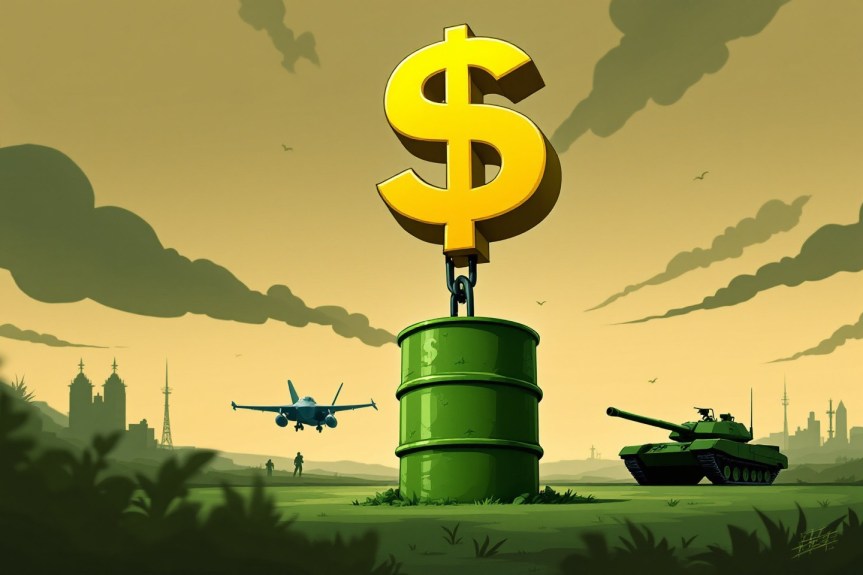
Now, for the U.S. government, reaction to revolutionary stirrings in Venezuela fades into the background. The mission now is that of propping up U.S. economic hegemony in the world. This rests on the U.S. dollar continuing to serve as the world’s dominant currency. That lofty position is maintained through the dollar’s role in the marketing of oil.
Venezuela harbors vast oil reserves and is, therefore, an object of U.S. strategizing. U.S. planners, it seems, are relying upon an intact Venezuelan state – which is the case now, given an annual growth rate recently of close to 9%. The specter looms of regime change in the chaotic style of U.S. endeavors in Afghanistan and Iraq, not to speak of Libya. In the case of Venezuela, the stakes are high and risk is to be avoided.
As 2025 closed, the destruction of small boats, the killings of crewmembers and a great U.S. naval fleet hovering off the coast did suggest the possibility of regime change. But narcotrafficking charges against Venezuelan leaders and the labeling of Maduro as a dictator qualify more as flimsy pretexts for the capture of Maduro than for replacing a
government.
That vast U.S. military presence still lingering in the area surely has use now in frightening Venezuelans into compliance with an evolving U.S. plan. They would be dreading horrendous consequences.
Moving toward collaboration
Evolving public statements of the U.S. president and of Venezuelan acting president Delcy Rodríguez suggest Venezuela’s government is safe. Rodríguez served as vice president in Maduro’s government. She is the daughter of a founder of the Marxist-oriented and long defunct Socialist League and sister of the current president of Venezuela’s National
Assembly.
In remarks on January 3 at an emergency meeting of the National Defense Council, Rodríguez turned to themes appropriate to the occasion. “There is only one president in this country and his name is Nicolás Maduro Moros,” she declared. She called for the liberation of Maduro and of Cilia Flores. Taking note of pro-government, anti-U.S. demonstrations, Rodríguez insisted Venezuela “will never go back to being the colony of anyone.” She decried “regime change” aimed at “capturing our energy, minerals, and natural resources.”
President Donald Trump speaking on January 4 declared that, “We’re going to take our oil back” and “ “[W]e’re going to run everything. We’re going to run it, fix it.”
The next day, Rodriguez declared, “We extend an invitation to the government of the US to work jointly on an agenda of cooperation, aimed at shared development … [one] that strengthens lasting peaceful coexistence.” Even so, on Venezuelan TV she soon insisted that, “No external agent governs Venezuela,” and that, “Venezuela is on a painful course through the aggression we suffered.”
The two heads of state spoke on the telephone on January 14. Trump reported that, “This partnership between the United States of America and Venezuela will be a spectacular one FOR ALL” and “Venezuela will soon be great and prosperous again.” Rodríguez stated that, “I had a long, productive, and courteous telephone conversation with the President of the
United States, Donald Trump, conducted in a framework of mutual respect.”
Two days later, speaking before the National Assembly, Rodríguez indicated she would “continue shaping energy cooperation” with the United States and that she and Trump were developing “a working agenda for the benefit of both peoples.”
CIA Director John Ratcliffe conferred with Rodríguez in Caracas. Washington officials had been talking with interior minister Diosdado Cabello prior to January 3. U.S. State Department officers visited in Caracas on January 9 “to conduct technical and logistical assessments aimed at a potential reopening of the US embassy in Caracas.”
The impression here is of Venezuela being assigned a job description and of the United States applying pressure so that Venezuelans comply and cooperate. For what’s ahead, the United States needs partnership, specifically a cohesive and functioning Venezuelan government.
A plan in the works
President Trump has repeatedly declared that the United States wants Venezuela’s oil. Why would the world’s largest oil producer want more oil?
According to misionverdad.org, “The main target was not [Venezuela’s] oil reserves … but rather the currency in which they are traded. By breaking the commercial and financial blockade and negotiating crude oil outside the dollarized system, Venezuela opened a real breach in the petrodollar monopoly that had existed since 1974.”
A report from Francisco Delgado Rodríguez states that the United States “had no choice but to leave the entire [Venezuelan] government intact” and claims too that “controlling the world’s main oil reserve, in Venezuela, serves to sustain the dominance of petrodollars. Without that, everything else will go downhill sooner rather than later.”
According to middleeastmonitor.com, “Venezuela holds the highest proven oil deposits in the world, with a reserve of about 303 billion barrels, or about 17 per cent of world reserves, far surpassing Saudi Arabia.” Plus, the fact of “Maduro selling oil in and avoiding the use of the dollar was a direct threat to the Petrodollar system, which had been the foundation of the American global economic hegemony over the past five decades.”
Realities intrude. One is that the U.S. government after 1971 was no longer setting the dollar’s value in terms of gold. Inflation emerged, and in 1974 Henry Kissinger struck a deal with Saudi Arabia, the world’s major oil producer and exporter. The U.S. government would protect the Kingdom militarily and require that Saudi Arabia demand dollars in payment for the oil it sells, also that Saudi Arabia invest 80% of its oil revenue in U.S.
Treasury and corporate securities and bonds.
The requirement that nations buy Saudi oil with dollars stimulated demand for dollars. Increased demand has enabled the U.S. government to borrow money at lower interest rates than do other borrowers.
Most importantly for purposes here, the dollar, the world’s dominant currency, fuels the commercialization of petroleum. The linkage of one to the other, the so-called petrodollar system, accounts for U.S. power over the world economy.
According to economist Michael Hudson, “Control over oil is one of its key methods for achieving unipolar control over the world’s broad trade and dollarized financial arrangements” He adds that “Venezuela … has been supplying 5% of China’s oil needs.”
Analyst Kasper Bjørkskov explains that, from 2018 on, “Venezuela has sold 100% of its oil exports to China, with transactions settled in yuan, not dollars. Moreover, Venezuela became an official BRICS+ partner nation in 2024, gaining access to the bloc’s alternative payment systems.”
As of January 2025, Saudi Arabia itself was selling oil to China in exchange for yuan.
Bjørkskov concludes that, “Venezuela represents an existential threat to the petrodollar system, and by extension, to American global power itself. … This is about the slow-motion collapse of the architecture that has supported American power for half a century: the dollar’s role as the world’s dominant reserve currency. And Venezuela, improbably, has become ground zero in the fight to preserve it.”
Ultimately, the U.S. government has every reason to promote a setting that favors the production and export of oil in great quantities – oil that will be sold in dollars. It will stick with Venezuela’s current government. The task of keeping a historically-disobedient Venezuela in line is left for another day.
W.T. Whitney Jr. is a retired pediatrician and political journalist living in Maine.


 COMMUNIST PARTY OF MAINE