
Abuse against Haitians in Ohio: examined with reference to Lewiston, Maine / By W.T. Whitney

Members of the Haitian community in Springfield, Ohio, from left, Lindsay Aime, James Fleurijean, Viles Dorsainvil, and Rose-Thamar Joseph, stand for worship at Central Christian Church, on Sunday, Sept. 15, 2024.Jessie Wardarski/AP/AP

South Paris, Maine


Republican presidential and vice-presidential candidates expressed horror on learning from social media that Haitian migrants in Springfield, Ohio were eating dogs and cats, their pets. The reports were false. Bomb threats followed, schools and public buildings closed down. Longtime African-American residents felt threatened.

Springfield’s economy had lost jobs and industries. Some 15,000 Haitians arrived, eager to work. Industry expanded but social service providers were stressed. The Haitians are in Springfield mostly under Temporary Protected Status. That governmental designation enables those migrants forced out of their counties by serious crises to enter the United States legally.  

The bizarre twist of political behavior stems in part from the migrants being Haitian. Haitians and their nation have been problematic for the United States.

The fact of migration itself does not account for the exaggerated hostility. Almost nothing of that order happens to the one third of New York state residents and 40.9% of Miamians who are immigrants, or to the foreign-born residents of nine other urban areas in the United States who comprise from 21.1% to 39.1% of the several populations.

Stresses and frustrations associated with Springfield’s economic decline logically enough could have stimulated hostility toward migrants. But economist Franklin J. James rejects the idea “that immigration hurts U.S. natives by reducing job opportunities …[and] that immigrants displace natives from jobs or reduce earnings of the average worker.”

Being Black may indeed invite hostility in a racist society. But the disconnect is sharp between the rarity of unbounded disparagement at high political levels and the large numbers of African-descended people who never experience the like from anybody. Opportunities abound. In 2019 Black people made up from 21.6% to 48.5% of the populations of 20 U.S. cities. That year nine Ohio cities, not including Springfield, claimed between 32.0% and 11.2% Black people. In 2024, 17.4% of Springfield residents are Black.They showed up in 2001 and a year later numbered 2000 or so. In January 2003, an Illinois-based Nazi group staged a tiny anti-Black rally; 4500 Mainers joined in a counter-demonstration.
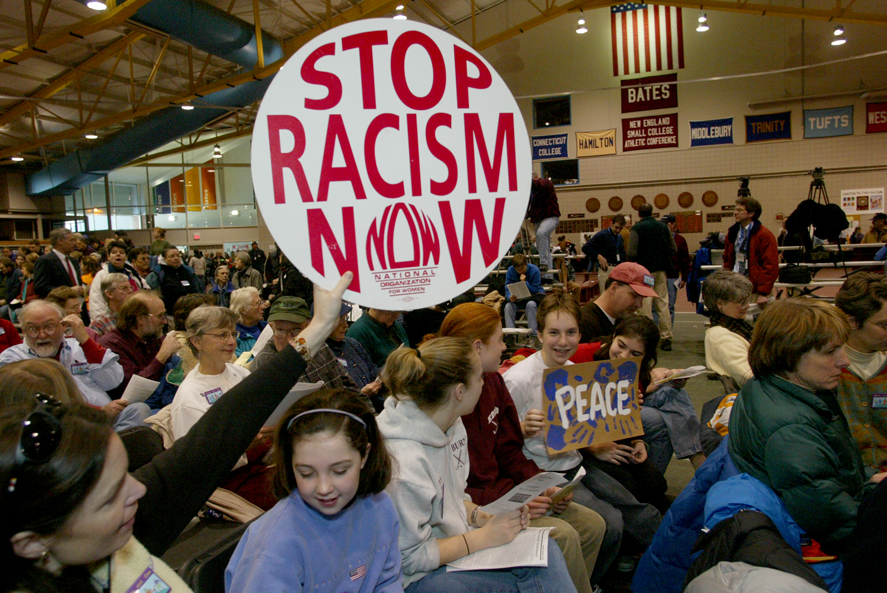
The Many and One rally in Merrill Gym on Jan. 11, 2003, sent a strong, unified message far and wide. Photograph by Phyllis Graber Jensen/Bates College, Lewiston, Maine.

The scenario in Springfield may itself have been toxic: a large number of Black people from abroad descended together on an economically depressed small city. But Somali migrants arrived in Lewiston, Maine under similar circumstances, and their reception was different.

As of 2019, according to writer Cynthia Anderson, “Lewiston … has one of the highest per capita Muslim populations in the United States, most of it Somali along with rising numbers of refugees and asylum-seekers from other African nations.” Of Lewiston’s38,404 inhabitants, 10.9% presently are “Black or African American.” Blacks are 1.4% of Maine’s population.

Anderson reports that with the influx of migrants, Lewiston “has struggled financially, especially early on as the needs for social services and education intensified. Joblessness remains high among the older generation of refugees.” 

Lewiston is Maine’s poorest city. For generations massive factories along the Androscoggin River produced textiles and shoes, but no more. The city’s poverty rate is 18.1%; for Blacks it’s 51.5%. In 2016, 50.0% of Lewiston’s children under five lived in poverty.

Citing school superintendent Bill Webster, an AP report indicates “immigrant children are doing better than native-born kids” in school, and are “going off to college to get degrees, as teachers, doctors, engineers.”

Analyst Anna Chase Hogeland concludes that, “The Lewiston community’s reaction to the Somalis demonstrated both their hostility and reservations, as well as the great efforts of many to accommodate and welcome the refugees.” Voters in Lewiston are conservative; they backed Donald Trump in the 2016 and 2020 presidential elections.

The circumstances under which the two cities received Black immigrants differed in two ways.  A nationwide upsurge in racist rhetoric and anti-immigrant hostility worsened conditions for migrants in Springfield.  Lewiston’s experience had played out earlier.

Additionally, immigrants arriving in Springfield qualified for special attention. The aforementioned political candidates could have exercised their anti-migrant belligerence in many cities. They chose Springfield, presumably because Haitians are there. Why are Haitians vulnerable?

Black people in what is now Haiti boldly rebelled against enslavement on French-owned plantations. Remarkably, they expelled the French and in 1804 established the independent nation they called Haiti.  

Ever since, the United States has spelled trouble for Haiti. Preeminent abolitionist Frederick Douglas pointed out in 1893 that, “Haiti is black and we [the United States] have not yet forgiven Haiti for being black.” Long after “Haiti had shaken off the fetters of bondage … we continued to refuse to acknowledge the fact and treated her as outside the sisterhood of nations.”

Scholar and activist W.E.B DuBois, biographer of abolitionist John Brown, explains that “There was hell in Hayti (sic) in the red waning of the eighteenth century, in the days when John Brown was born … [At that time] the shudder of Hayti was running through all the Americas, and from his earliest boyhood he saw and felt the price of repression —the fearful cost that the western world was paying for slavery.”

DuBois’s reference was to the U.S. slavocracy and its encouragement of collective fear among many white people that Black workers – bought, owned and sold – might rise up in rebellion. They did look to the example of Haiti and did rebel – see Herbert Aptheker, American Negro Slave Revolts. In the United States, from the Civil War on, the prospect of resistance and rebellion on the part of Black people has had government circles and segments of U.S. society on high alert.

That attitude, applied to Haiti, shows in:

·        U.S. instigation of multi-national military occupations intermittently since 2004.

·        Coups in 1991and 2004 involving the CIA and/or U.S.-friendly paramilitaries.

·        Backing of the Duvalier family dictatorship between 1957 and 1986.

·        The brutal U.S. military occupation of Haiti between 1915 and 1934.

·        U.S. control of Haiti’s finances and government departments until 1947.

·        No diplomatic recognition of Haiti from its beginning nationhood in 1804 until 1862.

·        U.S. economic sanctions against Haiti for decades, until 1863.

Says activist lawyer Bill Quigley: “US based corporations have for years been teaming up with Haitian elite to run sweatshops teeming with tens of thousands of Haitians who earn less than $2 a day.”

Ultimately, it seems, threads of governmental callousness, societal disregard for basic human needs, and outright demagoguery coalesced to thrust Springfield and Haitian migrants into the national spotlight. Molelike, the anomalous and little-acknowledged presence of Haiti asserts itself in the unfolding of U.S. history.       


W.T. Whitney Jr. is a political journalist whose focus is on Latin America, health care, and anti-racism. A Cuba solidarity activist, he formerly worked as a pediatrician, lives in rural Maine. W.T. Whitney Jr. es un periodista político cuyo enfoque está en América Latina, la atención médica y el antirracismo. Activista solidario con Cuba, anteriormente trabajó como pediatra, vive en la zona rural de Maine.
Haiti’s Choice Is Social Revolution or Foreign Intervention / By W. T. Whitney Jr.

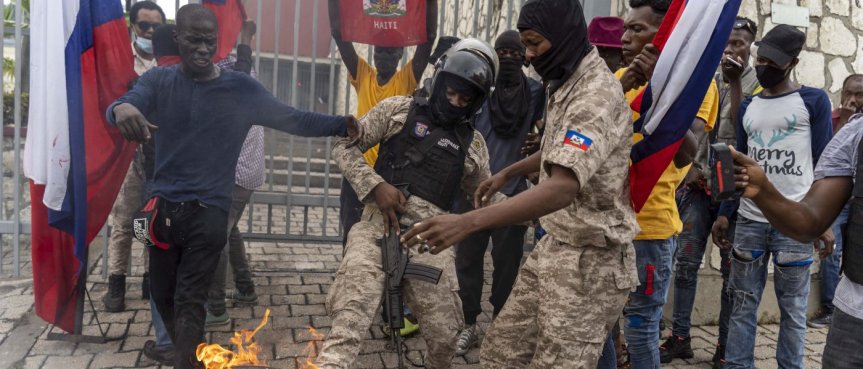
Photo: RICHARD PIERRIN/AFP via Getty Images

With long experience of chaos, violence, and dysfunctional governance, Haiti looks now to be on the verge of new crisis in the form of foreign military intervention. U.S. and United Nations decision-makers have held back, but now they look to be moving, again. 

The need all the while has been for change so that all Haitians might live decent lives. Whatever is in the works now offers little prospect for rearrangement of political and social hierarchies in Haiti. 

Haitians for several years have faced high prices, recurring shortages of essential supplies, and deadly gang violence in cities that has converted Haiti into a war zone and is the focus of media and political attention from abroad.   

Left-leaning political activist Camille Chalmers insists “there is a clear connection between these gangs and sectors of power, [which include] the far right” and the U.S. government. In an interview published on May 7, Henry Boisrolin agrees. This Haitian analyst living in Argentina states that: 

We have entered … a new phase in a spiral of violence characteristic of a crumbling neo- colonial system … The armed gangs are frankly death squads that are instruments in the hands of the Haitian oligarchy and the international community, mainly the United States. They want to subdue the popular movement in Haiti, sew terror, and put off an uprising.

The government headed by Prime Minister Ariel Henry, appointed by President Jovenel Moïse just days before his murder on July 7, 2021, is a façade. The U.S. government and the supervising “Core Group” of foreign nations put him in office and are backing him now. 

The last national elections were in 2016; the National Assembly has no legislators. Those elections, remarkable for minimal voter turn-out, gave the presidency to Moise, a wealthy businessman.  

Moïse overstayed his term of office, was accused of massive corruption, and was killed by paramilitaries who prepared in the United States. His predecessor, millionaire Michel Moise, became president in 2011 only after U.S. Secretary of State Hillary Clinton intruded in the elections.

Affecting Haiti’s situation now are: death and destruction from earthquakes and hurricanes; UN military occupation for 13 years that that introduced cholera, killing tens of thousands; and billions of dollars stolen that were set aside to pay for oil from Venezuela’s Petrocaribe program.

The distant background shows U.S diplomatic and commercial barriers during Haiti’s first 50 years, unjust and massive debt obligations to France for over a century, U.S. military occupation and U.S. support for the Duvalier dictatorships during the twentieth century, and subsequently a U.S. hand in two coups that removed the progressively-inclined President Jean-Bertrand Aristide. 

The United Nations Security Council  on October 21, 2022, “demanded an immediate cessation of gang violence and criminal activity” and declared itself ready “to take appropriate measures … against those engaged in or supporting gang violence.”  In January, 2023,U.N. Secretary General António Guterres called for “deployment of an international specialized armed force to Haiti.” 

On April 26 the Security Council deliberated on Haiti;19 speakers were heard. Maria Isabel Salvador, Head of the UN’s “Integrated Office in Haiti,” indicated that almost 50% of Haitians require humanitarian assistance. “The Haitian people cannot wait,” she declared; a “specialized international armed force” is needed. Jean Victor Geneus, Haiti’s Minister for Foreign Affairs, agreed.

The U.S. government is ready to act, it seems, with plans aimed at implementing the 2019 Global Fragility Act. That law would prevent and reduce violent conflict” abroad by means of “negotiating bilateral, 10-year-long “security assistance” arrangements with  “fragile states.”

The State Department on April 1, 2022, released a document explaining rationale and methods for implementing the GFA. A year later, on March 27, the State Department explained that the GFA would be implemented through 10-year plans … in partnership with Haiti, Libya, Mozambique, Papua New Guinea, and Coastal West Africa, including Benin, Côte d’Ivoire, Ghana, Guinea, and Togo.” 

An accessory document reveals that Haiti was being prioritized. It mentions a “sequenced approach for U.S. efforts” that will depend upon “political and security openings in the country.”

Kim Ives, veteran defender of Haiti’s sovereignty, commented that the plan “is essentially a new alliance of USAID ‘know-how’ with Pentagon muscle.” He foresees that the United States will be “returning the country from a neo-colony back into a virtual colony as it was from 1915 to 1934, when U.S. Marines occupied and ran it. Nonetheless, the U.S. would try to keep some Haitian window-dressing.” 

Vassily A. Nebenzia, the Russian Federation’s Permanent Representative on the UN Security Council, received a letter on April 24 from 58 individual Haitians and representatives of Haitian political organizations.  Russia is currently serving as the Security Council’s president.

The letter claims that U.S. plans for Haiti’s future would violate the United Nations Charter. It calls for an independent commission to evaluate U.S. interventions in Haiti since 1993. The authors fear “a grave attack on the sovereignty, independence, territorial integrity, and unity of Haiti.” 

They also object to U.S. occupation since 1856 of the Haitian island Navase, the U.S. government’s manipulations in the 2010 presidential elections, and U.S. failure to prevent the weapons being shipped to Haiti for use in killings and crimes. 

A month after President Moise’s murder in 2021, the “Montana group” of civic leaders proposed a two-year provisional government that would prepare for elections.  The results have been nil.  

De facto Prime Minister Ariel Henry in December 2022 announced a “High Transition Council” set up to arrange for elections. But eight political parties soon vetoed the project and very little has been achieved. Already in October, Henry had requested the U.S. government and/or United Nations to intervene militarily. 

Whatever happens in Haiti promises little help for a severely distressed underclass; 59 percent of Haitians live on less than $2 a day, the poverty rate is 60%, a quarter of the population has no access to electricity, 50% of Haitians are food insecure, 50% of Haitians must drink polluted water, 50% Haitian children do not attend school, and two thirds of adult Haitians are unemployed or informally employed. 

No social revolution is on the horizon and most Haitians, individually and collectively, are powerless. Power lies with Haiti’s business class whose impulse is for “invasion and occupation.” 

These would be the richest ten percent of Haitians who control 61.7% of the country’s wealth. The billionaires in that class are conglomerate owners Gregory Mevs and Gilbert Bigio, worth $1.0 billion and $1.2 Bіllіоn, respectively, and Irishman Denis O’Brien, who is worth $6.8 billion and controls Haiti’s telephone services.  

Henry Boisrolin, cited above, sees U.S. hypocrisy when he looks at U.S. sanctions against ten powerful families in Haiti that buy “tons of arms and munitions” for use in Haiti. This is a U.S. government that “does not allow a single syringe to make its way to Cuba” while claiming ignorance as to who sells those arms or that they come from the United States.


W.T. Whitney Jr. is a political journalist whose focus is on Latin America, health care, and anti-racism. A Cuba solidarity activist, he formerly worked as a pediatrician, lives in rural Maine. W.T. Whitney Jr. es un periodista político cuyo enfoque está en América Latina, la atención médica y el antirracismo. Activista solidario con Cuba, anteriormente trabajó como pediatra, vive en la zona rural de Maine.