
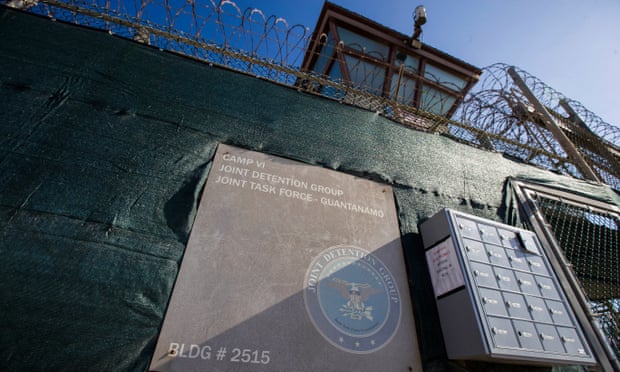
The control tower of Camp VI detention facility is seen in Guantánamo Bay in April 2019. Photograph: Alex Brandon/AP
South Paris, Maine
Nothing on the horizon now threatens the end of the U.S. economic
blockade of Cuba. Critical voices inside the United States and beyond
fall flat; nothing is in the works, it seems. Recently, however, the United
Nations put forth a denunciation that carries unusual force, mainly
because of the UN’s legal authority and its practical experience in Cuba.
Criticism of U.S. policies on Cuba from within the United States is
usually brushed aside due in large measure to the low priority
Washington officials assign to Cuban affairs. Coalitions of nations that
condemn the blockade may lack staying power and surely have no
means for enforcement. The anti-blockade opinions of nations or
individuals, alone or together, are useful mainly for consciousness-
raising.
The United Nations is different on account of its institutional capacity. It’s
on display when the UN General Assembly annually votes on a Cuban
resolution calling for an end to the blockade. Every year word of its
overwhelming and inevitable approval goes worldwide, because of the
UN connection.
The United Nations is unique on account of its Charter, which took effect
on October 24, 1945. This founding instrument outlines purposes as to
peace, no war, and human rights. It is legally binding on participating
nations, like a treaty. Additionally, the history and expectations
associated with the United Nations endow that organization with
institutional power. That’s something that neither NGOs operating in
Cuba or the time-limited projects of various governments on the scene
there can claim.
Another element emerges. The United Nations works within Cuba and
participates in Cuban affairs. On that account, UN complaints about
U.S. all-but-war against Cuba take on special authority.
On the ground
UN workers and technical specialists since 2015 have been
implementing the UN’s “National Plan[s] for Sustainable Economic and
Social Development” in dozens of countries since 2015, including Cuba.
Work is carried out inside countries and territories in order to fulfill a
“Development Agenda [for] 2030.” The main goals are: government
efficiency, transformation of production, protecting natural resources and
the environment, and human development with equity.
The Cuba section of the so-called “United Nations System” consists of
22 “agencies, funds, and programs,” 11 of which are physically present
on the island. That section recently issued a report on its activities in
2022.
Francisco Pichón is a Colombia native serving as the UN program’s
“resident coordinator.” In comments to the Cuban News Agency, Pichón
noted that in Cuba his teams participated with Cubans in dealing with
disaster situations and introducing developmental assistance.
Collaboration was impaired, he observed, by the “the economic,
commercial, and financial blockade imposed by the United States.”
Pichón testified to the constant necessity for making adjustments. What
with the impact of Covid-19; the increase of prices of food, sources of
energy, and more; and the war in Ukraine, his associates had to
“circumvent U.S. economic sanctions” and work around Cuba’s
exclusion from “international financing mechanisms”. UN personnel
found it necessary to divert funds in order to mount special assistance
programs after Hurricane Ian and in response to problems in Pinar del
Rio.
He indicated that “pre-positioning of essential resources for emergency
situations” was essential in order to mount quick and efficient responses.
That was helpful in reacting to the Hotel Santiago explosion in Havana
and the terrible fire at an oil storage facility in Matanzas.
Pichón highlighted the complexity of making any kind of payments,
especially because costs go up when resources are imported from far-
distant countries and because Cuba is excluded from international
lending agencies and banking services.
Guantanamo
The idea that the United Nations is a potentially capable partner in
warding off U.S. aggression against Cuba gains additional strength
following the recently concluded visit to Cuba of the UN Special
Rapporteur on Human Rights and Counterterrorism. Through her visit
and report, the United Nations was asserting legal norms.
Law professor Fionnuala Ni Aolain examined the plight of prisoners at
the U.S. naval base in Guantanamo in Cuba. The U.S. government
occupied land there as a condition of its approval in 1902 of a
constitution for newly-independent Cuba. Cuba’s government denounces
the occupation as violating international law.
Of the almost 800 men imprisoned there at one time or another since
2002, 30 prisoners remain, of whom 16 have been cleared for release
and represent no danger.
In an interview, Aolain testified to U.S. violation of human rights: “Men
are shackled as they move within the facility. They were shackled when
they met me.” She referred to “enormous deficits … in health care, in the
standard operating procedures … [Men] are called by numbers, not by
name.
She added that, “Those who tortured betrayed the rights of victims …
[W]hat they ensured is that you couldn’t have [a] fair trial … [And
therefore] it would be impossible for the victims of terrorism to redeem
their rights.” And, “let me be clear. Torture is the most egregious and
heinous of crimes.”
Quoted in a Cuban news report, Aolain referred to “cumulative
aggravating effects on the dignity, freedom and fundamental rights of
each detainee, which I think amounts to cruel, inhuman and degrading
treatment, according to international law.”
W.T. Whitney Jr. is a political journalist whose focus is on Latin America, health care, and anti-racism. A Cuba solidarity activist, he formerly worked as a pediatrician, lives in rural Maine. W.T. Whitney Jr. es un periodista político cuyo enfoque está en América Latina, la atención médica y el antirracismo. Activista solidario con Cuba, anteriormente trabajó como pediatra, vive en la zona rural de Maine.
 COMMUNIST PARTY OF MAINE