US misperceptions about Russia feed into war-making in Ukraine / By W.T. Whitney

Waving a Russian flag, Moscow, September 2023 Stringer / Reuters

South Paris, Maine


Indian peace advocate Bharat Dogra recently noted the near impossibility of raising the “issue of improving relations with Russia or stopping the disastrous, destructive Ukraine war.”He sees the Ukrainian people as “victims of an entirely avoidable proxy war that started way back in 2014 with a USA-instigated coup in Ukraine.” He condemns “[t]he mobilization of almost the entire military might of the West and the NATO to encircle and defeat Russia.”

Russia “has to be considered … in an unbiased way,” he insists. U.S. publicists have created “the devilish image of Putin” and “policymakers are forced to respond not to realties but to the false notions.”

The U.S. people and many public officials may indeed be uninformed generally about realities in Russia. The situation would be due to U.S. government actions, recent educational trends, and biases of a subservient media.

In penalizing Russian media personnel, the U.S. government interferes with the transmission of news from Russia to the United States. FBI agents recently raided the homes of Scott Ritter and Dimitri Simes. Ritter is a former United Nations weapons inspector who writes for the Russian news service Russia Today (RT). Simes, a U.S. resident born in Russia, hosts a Russian television talk show. They allegedly violated the Foreign Agents Registration Act

The Justice Department on September 4 indicted RT employees Kostiantyn Kalashnikov and Elena Afanasyeva under the same charge and issued sanctions against RT editor Margarita Simonyan and several colleagues. The New York Times in 2022 reported that its own journalists and those of other U.S. news outlets were being withdrawn from Russia.

On September 16 Rachel Maddow interviewed former Democratic Party presidential candidate Hillary Clinton on MSNBC. One topic was Russian interference in U.S. elections. Asserted Clinton: “I think it’s important to indict the Russians [and] I also think there are Americans who are engaged in this kind of propaganda. [Perhaps] they should be civilly or even in some cases criminally charged.”

Schools and universities have skimped on teaching and research about Russia.  An academicians’ group in 2015 reported that Russian studies in universities were in “unmistakable decline in interest and numbers in terms of both faculty and graduate students.” Enrollment levels are presently down by “30 to 50 percent.” College and university students studying Russian dropped 20% between 2007 and 2016.

According to the Carnegie Endowment for Peace, “U.S. policy toward Russia has largely ignored such crucial factors as Russia’s history, culture, geography, and security requirements—as they are seen from Moscow.”

Dogra laments that, the space for hearing and considering differing points of views [is] shrinking fast in the West,” adding that, “[m]ature democracies are supposed to be keen to hear to hear all points of view, including those of opponents.”

The U.S. people, he notes, don’t realize that“Putin tried repeatedly earlier to avoid conflict and to find a place of self-respect for Russia within Europe, … [and] made huge investments in ensuring cheap energy supply to Europe. … [H]e repeatedly pleaded with the West to honor commitments made earlier regarding not moving the NATO and its weapon systems too close to Russia … [and] took the Minsk accords very seriously.”

Dogra asks, “What kind of democracy is this, what kind of free media? What is wrong with people hearing the views of a leader even though he is widely regarded to be hostile by the West?”

Opinion polls have demonstrated high approval ratings for Putin. The U.S. and European public, says Dogra, ought to appreciate the successes of Russian governments under his leadership. They need “to examine his role as a national leader of Russia, whether he has been good for Russia and for the welfare of Russian people.”

In the 1990s, “western advisers had been active in Russia, leading to sale of Russian assets to private businesses, including foreigners as well as Russian oligarchs, at cheap rates, resulting in huge profits for a few but also in terrible disruptions in the economy.” Life expectancy plummeted.

Dogra highlights a “remarkable recovery in terms of human development indicators, to the extent that some of these are now better than or almost equal to those of the USA.”He cites data:

·        In 2021, child mortality under five years of age per 1000 live births “was 5.1 in the Russian federation, while it was 6.2 in the USA,” down from 20 deaths and 8 deaths, respectively. 

·        “Infant mortality under 1 year of age per 1000 births in Russia declined in a big way,” from 19 deaths in 2000 to 4.8 deaths in 2023, the comparable U.S. figures being 7.2 and 5.4, respectively.

·        UN data indicates that, “In the case of maternal mortality rate (reported per 100,000 births), this declined … in Russia” from 52 in 2000 to 14 in 2020, “while that of the USA actually increased from 12 to 21” in those years.

·        “During 2000-2019 according to UN data the life-expectancy in the Russian Federation increased significantly from 65.3 years to 73.2 years.”

·        “The increase of income or GNI per capita in Russia during this period was very significant—from $1710 in year 2000 to $4450 in 2005 to $9980 in 2010 to $11,610 in 2021. The literacy rate for the Russian Federation is around 99% … The Human Development Index of Russia has improved from 720 in 2000 to 822 in 2021”.

There are two conclusions. One, U.S. citizens certainly need to know more about Russia. Two, information blockade accompanies the supplying of weapons as the U.S. prolongs Russia’s war in Ukraine.

Dogra presumes that with more U.S. appreciation of realities in Russia, U.S. prolongation of the war might lose its appeal. He overlooks key factors: the economic boost provided by war-spending, U.S. habituation over a century to anti-Russian hostility, the official view that Russia is ganging up with China against the U.S. and Europe, and the distracting effect of war in the face of seemingly unsolvable U.S. problems. These include an economy mired in debt, apparently intractable inequalities, and a dysfunctional system of democratic governance.


W.T. Whitney Jr. is a political journalist whose focus is on Latin America, health care, and anti-racism. A Cuba solidarity activist, he formerly worked as a pediatrician, lives in rural Maine. W.T. Whitney Jr. es un periodista político cuyo enfoque está en América Latina, la atención médica y el antirracismo. Activista solidario con Cuba, anteriormente trabajó como pediatra, vive en la zona rural de Maine.
Cuba’s President Extolls the Cuban People, Discusses Problems / By W.T. Whitney Jr.

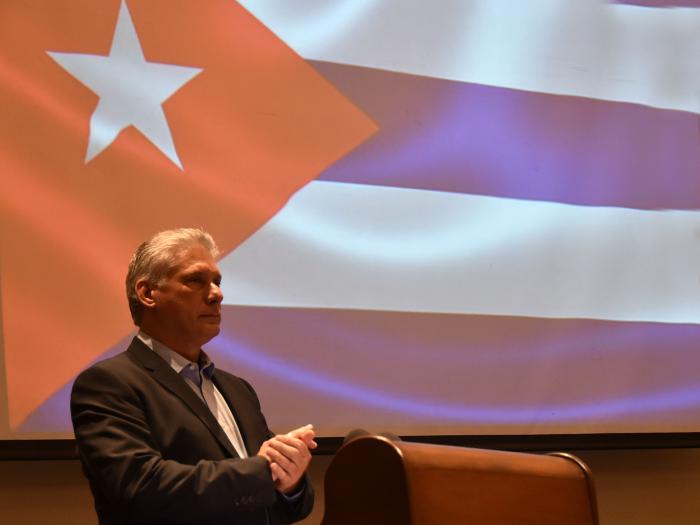
President of the Republic of Cuba, Miguel Díaz-Canel Bermúdez | Photo: Estudios Revolución


Addressing Cuba’s recently-convened National Assembly on April 19, President Miguel Díaz-Canel expressed confidence that the Cuban People would overcome warlike measures imposed by the United States.

“Congratulations to everyone on the Day of Victory!” he proclaimed. “On April 19 in 1961 on the sands of Playa Girón (Girón Beach) Cuba won the right to celebrate this day in providing for the first great defeat of imperialism in America. It was the triumph of the just against the unjust, of little David against the giant Goliath, of a socialist Revolution under the nose of the empire.”

“Thanks to this victory we today, on the tenth such occasion, install the People’s Assembly.” He declared that each of the 470 deputies “defends the interests of the majority,” that none of them won their seat through money or from the backing of an electoral party.

Referring to the Cuban Revolutionary Party founded by José Martíhe extolled “the single party that is the guarantee of unity” and through which, “the forces of a little nation do not disintegrate or fight each other.”

Díaz-Canel catalogued manifestations of U.S. all-but-war: invaders “working out of their caves on social networks,” and the “perennial cruelty of a blockade reinforced during the pandemic,” and “millions of dollars offered to those preparing to subvert Cuba’s internal order,” and “inclusion of Cuba on a list of supposed sponsors of terrorism that blocks access to financing.”

He stated that, “someday, earlier than later, the politics of hegemony will have to cease; multilateralism will take its place, and Cuba will be able to show how far a noble creative and talented people can go if they are united around clear objectives and if they are freed from pressures and blockades.”

Offering praise, Díaz-Canel maintained that “elections to the National Assembly are aimed at choosing the best people. That’s difficult … [because] there are many more good Cubans than there are seats in parliament.”

He expressed “certainty that no simulation of artificial intelligence could match the Cuban people’s achievements in recent years and their creative resistance. Their resilience exceeds the limits of any simulation or prediction. There is no algorithm capable of reflecting what we have lived through.”

Díaz-Canel highlighted the transparency of recent election campaigns, noting that voter participation was ample enough to waylay “hate-inspired” foreign-media expectations of low voter turnout indicative of a failed Cuban state. The recent elections included the Family Code referendum on September 25, 2022, elections for delegates to municipal assemblies on November 27, 2022, and voting for National Assembly deputies on March 27.

The Cuban president noted that the 75.8% of Cubans who voted on the last occasion was “above average for the other models of democracy in the world and [represented] “a show of citizenship, … patriotism, and above all, of political consciousness.”

The recently elected National Assembly overwhelmingly approved new terms for the Council of Ministers, the Council of State, and for Díaz-Canel, who will be serving his second and last five-year presidential term, as prescribed by recent constitutional changes.

Díaz-Canel outlined difficulties and unfinished tasks, observing that:

The world economy, uncertain and unstable in all latitudes, poses the first and greatest challenge for the new Council of Ministers … Leadership should focus on food production, the use of idle productive capacities, increased reliance on foreign-currency income, transformations required by the socialist state enterprise, enhanced efficiency of the investment process, and synergy of our economic actions and foreign investment. We do all this to increase the supply of goods and services and control inflation, which is the main priority in the economic battle. 

Even as he acknowledged “obstacles external to our economy that present profound difficulties,” the President “condemned bureaucratism, indifference, and corruption” in Cuba. He expressed confidence in the deputies’ “commitment and dedication,” while insisting that, “we will overcome the blockade without waiting for them to lift it.”

Díaz-Canel extolled Cuban youth “as the best revolutionaries because, dealing with every-day difficulties, they confront, try to fix, and achieve much. Despite adversity, they keep on smiling, loving, and believing in the possibility of a better country.” In fact, “socialism is closest to youth because it too is unfinished work.”

A persisting undertone of Díaz-Canel’s presentation was that of values, particularly those of solidarity and revolutionary service. Coinciding with the April 20 presentation of Díaz-Canel’s speech on resumenlatinoamericano.org were two news reports that exhibited diverse Cuban and U.S. purposes as regards Ukraine and expressed values.

report from Argentina announced a public television showing on April 23 of the Cuban film “Sacha, a child of Chernobyl,” first viewed in 2021. Living in Ukraine, Sacha was one year old and living in Ukraine on April 28, 1986 when the Chernobyl nuclear power installation exploded and radioactivity and radiation-caused diseases spread far and wide.

Sacha, un niño de Chernobyl, película completa

He was one of 26,000 children in Ukraine, Belarus, and Russia who received sophisticated medical care and rehabilitation in Cuba for their illnesses between 1990 and 2011, at no cost to families or governments. In the 1990s, Cuba was suffering the economic disaster of its “Special Period.” The film may be viewed here; Spanish language subtitles are provided.

Also on that day, a report appeared indicating that “The United States announced … the sending of another package of military aid worth $325 million for the fight against Russian forces. The U.S. Defense Department highlighted through a communique that this aid ‘will allow Ukraine to continue bravely defending itself in a brutal war against Russia, unprovoked and unjustified.’”

During another April, 200 years ago, an early warning sign cropped of a reality that would from then on plague Cuba, provoke revolution and bolster counter-revolution.  In his speech, Díaz-Canel recalled that John Quincy Adams, as secretary of state, statedon April 28,1823 that, “if an apple severed by the tempest from its native tree cannot choose but to fall to the ground, Cuba, forcibly disjoined from its own unnatural connection with Spain, and incapable of self-support, can gravitate only to the North American Union.”


W.T. Whitney Jr. is a political journalist whose focus is on Latin America, health care, and anti-racism. A Cuba solidarity activist, he formerly worked as a pediatrician, lives in rural Maine. W.T. Whitney Jr. es un periodista político cuyo enfoque está en América Latina, la atención médica y el antirracismo. Activista solidario con Cuba, anteriormente trabajó como pediatra, vive en la zona rural de Maine.

Peace Forces Mobilize as NATO Summit in Madrid Plans for War / by W.T Whitney Jr.

‘Yes to peace, No to NATO’: Anti-imperialist activists organized by the World Federation of Democratic Youth march against the NATO Summit that opens in Madrid on June 29. | via WFDY

The NATO Summit taking place in Madridon June 29-30 “will be transformative,”  asserted NATO Secretary General Jens Stoltenberg; it will project “a new Strategic Concept for a new security reality.” At its 50th anniversary summit, in Washington in 1999, NATO had expanded its Cold-War era mission of collective defense of Europe to include protection for democracy “within and beyond our borders.”

According to Stoltenberg on June 27, NATO will provide “support to Ukraine now, and for the future.” The “Allies consider Russia as the most significant and direct threat to our security.” NATO “will address China for the first time …[and also] the challenges that Beijing poses to our security, interests, and values.” Pacific nations – Australia, Japan, the Republic of Korea and New Zealand – will be attending a NATO summit for the first time.

The Summit provoked opposition beforehand. A “Peace Summit,” described as “the People’s Alternative to NATO and War,” gathered in Madrid on June 24-25. A conglomeration of Spanish and European anti-capitalists, environmentalists, feminists, anti-imperialists, peace activists, and spokespersons for struggles in the global South attended workshops, panel discussions, cultural presentations, and plenary sessions.

The Peace Summit made demands. First, NATO will be disbanded: “NATO violates the UN Charter … authoritarian, fascist, and colonial regimes are included in its alliance …NATO’s military interventions have destabilized and destroyed Yugoslavia, Afghanistan, and Libya. Now NATO pursues a new Cold War against China and Russia. … NATO leads the worldwide arms race … NATO’s nuclear agenda greatly endangers our survival.” Regarding environmental contamination: “The U.S. army “is the most contaminating institution on the planet … NATO generates poverty and inequalities.”

The Summit then declared, “Yes, to Peace … we need a non-militarized system of security, without nuclear arms, without foreign bases, and with a drastic reduction of military expenses. We defend a politics of active peace … [We want] investment in social progress, not in war … Europe and North America must commit to disarmament.”

The statement concluded with an invitation: “March with us against NATO and for building a world of peace.” Indeed, on June 26 thousands marched through central Madrid, their banners flying. Organizers claimed 30,000 marchers. The government reported considerably less. 

The Communist Party of Spain (PCE) and the United Left (Izquierda Unida) were the only political parties that joined with dozens of Spanish and international organizations endorsing the declaration and march. The PCE belongs to the United Left electoral coalition that, after the November 2019 general election, combined with the larger United We Can alliance (Unidas Podemos) to form a government under the leadership of Prime Minister Pedro Sánchez, head of the Socialist Party.

Sánchez issued a statement welcoming the NATO summit to Madrid. He mentioned concerns about Spain’s “southern flank,” a reference, presumablyto migrants from Africa.

PCE member Yolanda Díaz serves as labor minister and second deputy prime minister in Sánchez’s government. Even so, Enrique Santiago, secretary general of her party, on June 7 offered ideas at odds with those of the prime minister: “We don’t want the NATO summit in Madrid. The story of the Ukraine conflict is of a war foretold, what with the continuing expansion of NATO to the East … And in wars, the peoples, the workers, always lose out.” Santiago cited the risk of “nuclear confrontation” and commended the upcoming Peace Summit and “international demonstration against war on June 26.” 

In remarks two days prior to the Summit, NATO Secretary-General Jens Stoltenberg greatly heightened the urgency of the peace proponents’ fears. “At the summit,” he said, “we will strengthen our forward defenses. We will enhance our battle groups in the eastern part of the alliance.”

One report predicted that, “NATO allies will decide at a summit this week to increase the strength of their rapid reaction force nearly eightfold to 300,000 troops …  The NATO response force …currently numbers around 40,000 soldiers.” As part of efforts “to shore up the defenses on Europe’s eastern flank,” the NATO Summit will speed up arrangements for the entry of Finland and Sweden’s into the alliance

Stoltenberg spoke of a “strengthened Comprehensive Assistance Package for Ukraine” and “about the military build-up in Kaliningrad … with highly advanced weapon systems.” Partly because of Kaliningrad, “we have modernized our armed forces, our capabilities, and also increased our presence in that part of the region”.

According to the Brookings Institute, Kaliningrad, a tiny Baltic Sea, Russian-controlled enclave, located between Poland and Lithuania, “could become a new flashpoint in Russia’s war on Ukraine.” That’s because Lithuania is blocking the passage of EU-sanctioned Russian goods into the territory for delivery beyond.


W.T. Whitney Jr. is a political journalist whose focus is on Latin America, health care, and anti-racism. A Cuba solidarity activist, he formerly worked as a pediatrician, lives in rural Maine. W.T. Whitney Jr. es un periodista político cuyo enfoque está en América Latina, la atención médica y el antirracismo. Activista solidario con Cuba, anteriormente trabajó como pediatra, vive en la zona rural de Maine.

The original version of the article appeared in People’s World, June 28, 2022, http://www.peoplesworld.org/

Ukraine War Unveils US Preparations for Biological Warfare / by W. T. Whitney Jr.

Biological warfare | Image: Wikipedia

War in Ukraine is turning people’s lives and affairs upside down. Governmental functioning is confounded. Unsurprisingly, dirty laundry, previously hidden, is on display. A Russian communication March 6 mentions “evidence of an emergency clean-up performed by the Kiev regime was found – aimed at eradicating traces of the military-biological program in Ukraine, financed by @DeptofDefense.” 

A Chinese Foreign ministry spokesperson two days later spoke of “26 [U.S.] bio-labs and other related facilities in Ukraine.”  

WASHINGTON, DC – MARCH 08: Undersecretary of State for Political Affairs Victoria Nuland testifies before a Senate Foreign Relation Committee hearing on Ukraine on March 08, 2022 in Washington, DC. (Photo by Kevin Dietsch/Getty Images)

White House press secretary Jen Psaki responded, saying that that the United States “does not develop or possess such weapons anywhere.” Undersecretary of State Victoria Nuland indicated “Ukraine has biological research facilities …[and] so we are working with the Ukrainians [to] prevent any of those research materials from falling into the hands of Russian forces.” 

The Bulletin of Atomic Scientists reported that, as of February 25, “a network of US-linked labs [existed] in Ukraine that work with dangerous pathogens.” Those 26 such facilities are “public and animal health labs.” 

The gist of the Chinese and Russian communications is their claim that the U.S. Government is doing biowarfare. In that regard, the large “Richard Lugar Center for Public Health Research” in Tbilisi, Georgia, comes into view. The U.S. Defense Department’s Defense Threat Reduction Agency (DTRA) paid for the Center’s construction and for its operation, between 2011 and 2018.

Bulgarian investigative journalist Dilyana Gaytandzhieva produced a report in 2018 alleging the Center had bioweapons capabilities. She claimed that most of the Center’s staff were U.S. citizens enjoying diplomatic immunity and that at least three U.S. companies were doing bio-weapons research there. She indicates elsewhere that biologic specimens arrive by diplomatic pouch

Richard G. Lugar Center for Public Health Research

Gaytandzhieva’s extraordinarily detailed report displays dozens of official U.S. documents and graphics. She points out that DTRA-funded private companies carry out bio-weapons research and testing in laboratories and facilities located in Georgia, Ukraine, in the Middle East, South East Asia, Africa, and at Fort Detrick, Maryland, and the Dugway Proving Ground in Utah. U.S. government apologists have dismissed the report as Russian-inspired propaganda.

The distinction between offense and defensive preparations has been clear as regards Fort Detrick. A “biological weapons program” existed there until 1969, when, as ordered by President Richard Nixon, it became a “biological defense program.” U.S. research installations elsewhere in the world lack clear demarcation between offensive and defensive purposes. 

One of the U.S. bio-laboratories abroad is Battelle Corporation, “a $59 million subcontractor at Lugar Center,” that, according to Gaytandzhieva, operates laboratories in eight countries across the globe and, as of 2018 “has been awarded some $2 billion [in] federal contracts” and ranks 23rd among US government contractors. 

As of that year, the Southern Research Institute, Black & Veatch, and Metabiota company were operating one or more of the 11 Defense Department-funded bio-laboratories in Ukraine. In a report published in January, 2022, Gaytandzhieva mentions the “US Federal contracts registry” as documenting that “DTRA allocated $80 million [to Black & Veatch company] for biological research in Ukraine as of 30 July 2020.” 

Dilyana Gaytandzhieva

She charges that the contractor did more than merely fund the labs – as suggested by Victoria Nuland – but instead has been responsible for their day-to-day operation. Cited as evidence are “internal documents” showing that “independent experts were denied even a visit” to the laboratories. 

Ominously, scientists funded by the Defense Department have developed a new way of transmitting viruses to plants. According to a Science magazine article in 2018, the Defense Department initiated a program named “Insect Allies” in 2017 and would continue it for four years. Biting insects are being studied at the Luger Center in Georgia and presumably in other laboratories included in the multi-national U.S. bio-weapons network, such as those in Ukraine.  

The scientists have arranged for genetically-modified viruses to infect insects that then go on to transmit the fixed-up viruses to plants where they alter the plants’ properties.  Critics, mainly in Europe, doubt the peaceful purposes of the new methodology.  They fear that the technique of “lab-modified self-spreading viruses” will soon be applied to humans and animals.  

Commentary from the Max-Planck Institute interprets the Science magazine article as arguing “that the findings of the Insect Allies Program could be more easily used for biological warfare than for routine agricultural use.” It cites a legal opinion saying that, “The Insect Allies Program could be seen to violate the Biological Weapons Convention” (BWC),” which took effect in 1975. 

This photo shows corn leaf aphids used in a study to modify crop plants through engineered viruses. | Meena Haribal – Boyce Thompson Institute via AP

Information presented here suggests it’s at least possible that the United States really has been developing bio-weapons for offensive use at facilities throughout the world and particularly in countries along Russia’s western periphery. 

But questions crop up of mission overlap. Bio-medical and bio-industrial products are developed for both peaceful and war-making uses. In the latter case, a given product may be used for offensive or defensive purposes. A representative statement from officials in The Netherlands in 2013 testifies to a merging of purposes:

“On the one hand, many pathogenic organisms are very important to research and development in the fields of medicine, biology and agriculture. However, some of these organisms can also be used to develop biological weapons that may pose a threat to public health and the environment. The term ‘dual-use research’ can be extended … ‘Dual-use research of concern’ is the type of research that could be misused directly and whereby such misuse would have major consequences.”

Ambiguity cries out.  That ambiguity demands that, in regard to Ukraine, and elsewhere, we view the likelihood of the United States preparing for biowarfare as probable, not as possible. 

One more set of circumstances now boosts that likelihood up to near certainty. In furtherance of its goals, the U.S. government easily accepts the reality that masses of humans are going to suffer and die. We recall:

  • The nuclear bombing of Hiroshima and Nagasaki and the conventional bombing of Dresden that sickened and killed hundreds of thousands.
  • Pursuit of wars, in Korea and Vietnam, in which millions died, plus wars and occupation in Iraq and Afghanistan that took the lives of hundreds of thousands.
  • Complicity in massacres in Indonesia and Latin America. 
  • Institution of economic sanctions that killed or incapacitated hundreds of thousands in Iraq, Cuba and Venezuela.
  • Support for repressive regimes like apartheid South Africa and Saudi Arabia that killed and maimed.    

W.T. Whitney Jr. is a political journalist whose focus is on Latin America, health care, and anti-racism. A Cuba solidarity activist, he formerly worked as a pediatrician, lives in rural Maine.